PROFESSIONAL ISSUE
ON:
• Plagiarism
• Censorship
-from the Latin word
plagiarius
-“kidnapper”
-a form of cheating
-“the false assumption of
authorship: the wrongful act
of taking the product of
another person’s mind and
presenting it as one ’s own” .
What is Plagiarism?
(Alexander Lindey, Plagiarism and
Originality [New York, Harper, 1952] 2)
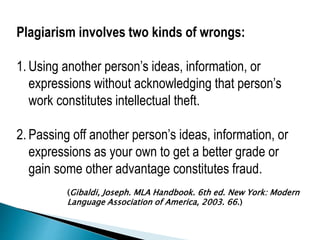
Plagiarism involves two kinds of wrongs:
1. Using another person’s ideas, information, or
expressions without acknowledging that person’s
work constitutes intellectual theft.
2. Passing off another person’s ideas, information, or
expressions as your own to get a better grade or
gain some other advantage constitutes fraud.
(Gibaldi, Joseph. MLA Handbook. 6th ed. New York: Modern
Language Association of America, 2003. 66.)
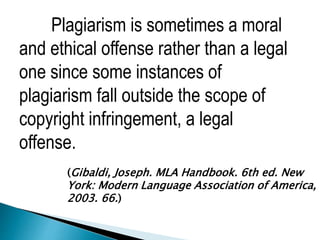
Plagiarism is sometimes a moral
and ethical offense rather than a legal
one since some instances of
plagiarism fall outside the scope of
copyright infringement, a legal
offense.
(Gibaldi, Joseph. MLA Handbook. 6th ed. New
York: Modern Language Association of America,
2003. 66.)
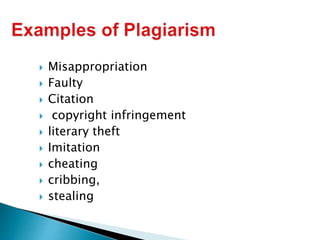
 Misappropriation
 Faulty
 Citation
 copyright infringement
 literary theft
 Imitation
 cheating
 cribbing,
 stealing
Are you stealing
intellectual property?
Intellectual property
•is protected by patents on
inventions;
•trademarks on branded devices;
• copyrights on music,
•videos,
•patterns,
•forms of expression;
• state and federal laws.
The type of intellectual property that has been stolen
will determine what rights you have and how you will
need to go about proving theft. The most common
types of intellectual property are:Copyrighted
material. Original material fixed in a tangible medium
of expression is eligible for copyright
protection.[1] Examples of work eligible for copyright
protection includes poems, photographs, paintings,
software, and music.
Trademarks. A trademark is a word, symbol, phrase,
and/or design that identifies and distinguishes the
source of goods of one party from those of another. A
service mark is a trademark that identifies the source
of services instead of goods.[2]
Trade secrets. A trade secret is any valuable business
information that is not generally known, which is kept
confidential to preserve its economic value.[3] An
example is Kentucky Fried Chicken's secret recipe.
http://www.wikihow.com/Prove-
Intellectual-Property-Theft
•Isolate the reasons why plagiarism occurs
•Identify the different types of plagiarism
•Integrate plagiarism prevention
Strategy to avoid plagiarism
Unintentional Plagiarism
Paraphrasing poorly: changing a few words without changing
the sentence structure of the original, or changing the
sentence structure but not the words.
Quoting poorly: putting quotation marks around part of a
quotation but not around all of it, or putting quotation marks
around a passage that is partly paraphrased and partly quoted.
Citing poorly: omitting an occasional citation or citing
inaccurately.
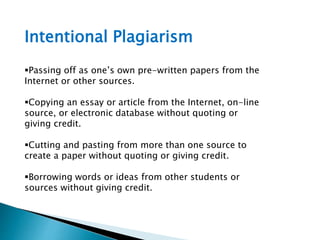
Intentional Plagiarism
Passing off as one’s own pre-written papers from the
Internet or other sources.
Copying an essay or article from the Internet, on-line
source, or electronic database without quoting or
giving credit.
Cutting and pasting from more than one source to
create a paper without quoting or giving credit.
Borrowing words or ideas from other students or
sources without giving credit.
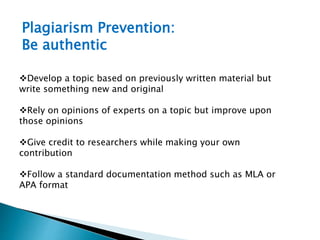
Plagiarism Prevention:
Be authentic
Develop a topic based on previously written material but
write something new and original
Rely on opinions of experts on a topic but improve upon
those opinions
Give credit to researchers while making your own
contribution
Follow a standard documentation method such as MLA or
APA format
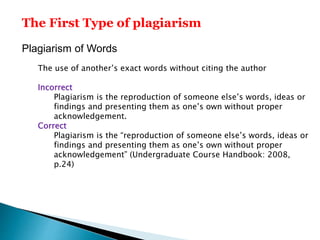
The First Type of plagiarism
Plagiarism of Words
The use of another’s exact words without citing the author
Incorrect
Plagiarism is the reproduction of someone else’s words, ideas or
findings and presenting them as one’s own without proper
acknowledgement.
Correct
Plagiarism is the “reproduction of someone else’s words, ideas or
findings and presenting them as one’s own without proper
acknowledgement” (Undergraduate Course Handbook: 2008,
p.24)
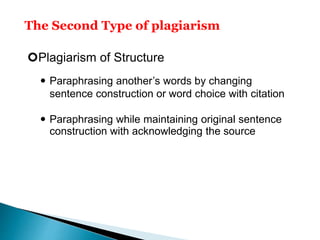
The Second Type of plagiarism
Plagiarism of Structure
 Paraphrasing another’s words by changing
sentence construction or word choice with citation
 Paraphrasing while maintaining original sentence
construction with acknowledging the source
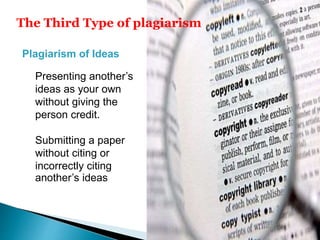
The Third Type of plagiarism
Plagiarism of Ideas
Presenting another’s
ideas as your own
without giving the
person credit.
Submitting a paper
without citing or
incorrectly citing
another’s ideas
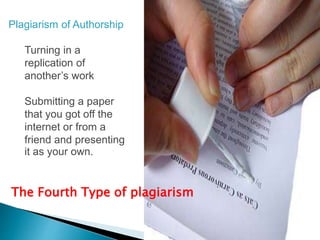
The Fourth Type of plagiarism
Plagiarism of Authorship
Turning in a
replication of
another’s work
Submitting a paper
that you got off the
internet or from a
friend and presenting
it as your own.
Plagiarism of Self
• The use of previous work
for a separate assignment
• Although these were you
original words and
thoughts, receiving credit
for a previous assignment
is considered cheating
The Penalties of Plagiarism
Although plagiarism can be intentional or unintentional,
both have consequences. A meeting with the VP of Students
will be scheduled to determine an outcome
Receiving zero on the assignment
Failing the course
Suspension
 Expulsion
Avoiding Plagiarism
Avoiding plagiarism is quite simple. The
best method for avoiding it is to simply be
honest; when you've used a source in
your paper, give credit where it's due.
Acknowledge the author of the original
work you've used.
Another way to avoid plagiarism is to use your own work as
often as possible. Quoting and citing sources is usually
required and inevitable when doing research -- that's how you
"back up" your own work. But using someone else's work
excessively can be construed as plagiarism.
Another way to it is to quote and/or cite your sources
properly.
Avoiding Plagiarism
Proper Quotations
In order to properly quote your sources, you should consult
the style manual that would be appropriate for the research.
In most cases, your professor will tell you which style manual
would be preferred. If your professor doesn't indicate which
manual to use, be sure to ask.
The following examples are formatted in MLA, APA, and
Chicago (Turabian is similar to Chicago) formats. The text is
taken from the passage we saw earlier from Zimbardo.
Indirect: Some researchers note that
"children are totally insensitive to their
parents' shyness" (Zimbardo 62).
Direct: Zimbardo notes that “children are
totally insensitive to their parents’ shyness”
(62).
Paraphrasing: Some researchers have
observed that children seem unaware that
their parents are considered bashful
(Zimbardo 62).
MLA Quotations
APA or Chicago Quotations
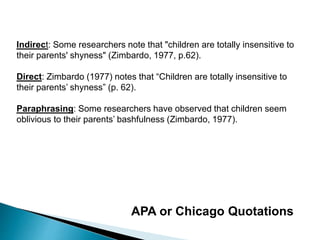
Indirect: Some researchers note that "children are totally insensitive to
their parents' shyness" (Zimbardo, 1977, p.62).
Direct: Zimbardo (1977) notes that “Children are totally insensitive to
their parents’ shyness” (p. 62).
Paraphrasing: Some researchers have observed that children seem
oblivious to their parents’ bashfulness (Zimbardo, 1977).
Visit
www.centralia.edu/academics/writingc
enter/
or
http://owl.waol.org/
To learn more
http://library.columbia.edu/subject-
guides/social-
sciences/plagiarism.html
file:///C:/Users/blis04/Downloads/5%20Most%20Effective%20Meth
ods%20for%20Avoiding%20Plagiarism%20-%20Gram
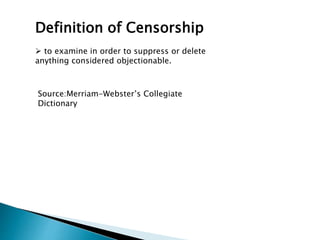
Definition of Censorship
 to examine in order to suppress or delete
anything considered objectionable.
Source:Merriam-Webster’s Collegiate
Dictionary
DEFINITIONS of CENSORSHIP
"Supervision and control of the information and ideas that are
circulated among the people within a society.
In modern times, censorship refers to the examination of books,
periodicals, plays, films, television and radio programs, news reports,
and other communication media for the purpose of altering or
suppressing parts thought to be objectionable or offensive."
-- Funk & Wagnalls New World Encyclopedia
•What's missing from this definition? Censorship by whom?
•Is censorship by private groups and individuals included in this
definition? Do they "supervise and control"?
http://media.okstate.edu/faculty/jsenat/cens
orship/defining.htm
History of Censorship
The word censor comes from the Office of the Censor
created in Rome in 443 BC. The Censor’s job was to
conduct the statistical census of the citizenry and
protect their morals.
What leads to censorship?
• Fear
•Conservation of Power
•Individual Morality
•Religious Interpretation
by keren B. oguis

by keren B. oguis

  • 1.
  • 2.
    -from the Latinword plagiarius -“kidnapper” -a form of cheating -“the false assumption of authorship: the wrongful act of taking the product of another person’s mind and presenting it as one ’s own” . What is Plagiarism? (Alexander Lindey, Plagiarism and Originality [New York, Harper, 1952] 2)
  • 3.
    Plagiarism involves twokinds of wrongs: 1. Using another person’s ideas, information, or expressions without acknowledging that person’s work constitutes intellectual theft. 2. Passing off another person’s ideas, information, or expressions as your own to get a better grade or gain some other advantage constitutes fraud. (Gibaldi, Joseph. MLA Handbook. 6th ed. New York: Modern Language Association of America, 2003. 66.)
  • 4.
    Plagiarism is sometimesa moral and ethical offense rather than a legal one since some instances of plagiarism fall outside the scope of copyright infringement, a legal offense. (Gibaldi, Joseph. MLA Handbook. 6th ed. New York: Modern Language Association of America, 2003. 66.)
  • 5.
     Misappropriation  Faulty Citation  copyright infringement  literary theft  Imitation  cheating  cribbing,  stealing
  • 6.
  • 7.
    Intellectual property •is protectedby patents on inventions; •trademarks on branded devices; • copyrights on music, •videos, •patterns, •forms of expression; • state and federal laws.
  • 8.
    The type ofintellectual property that has been stolen will determine what rights you have and how you will need to go about proving theft. The most common types of intellectual property are:Copyrighted material. Original material fixed in a tangible medium of expression is eligible for copyright protection.[1] Examples of work eligible for copyright protection includes poems, photographs, paintings, software, and music. Trademarks. A trademark is a word, symbol, phrase, and/or design that identifies and distinguishes the source of goods of one party from those of another. A service mark is a trademark that identifies the source of services instead of goods.[2] Trade secrets. A trade secret is any valuable business information that is not generally known, which is kept confidential to preserve its economic value.[3] An example is Kentucky Fried Chicken's secret recipe. http://www.wikihow.com/Prove- Intellectual-Property-Theft
  • 9.
    •Isolate the reasonswhy plagiarism occurs •Identify the different types of plagiarism •Integrate plagiarism prevention Strategy to avoid plagiarism
  • 10.
    Unintentional Plagiarism Paraphrasing poorly:changing a few words without changing the sentence structure of the original, or changing the sentence structure but not the words. Quoting poorly: putting quotation marks around part of a quotation but not around all of it, or putting quotation marks around a passage that is partly paraphrased and partly quoted. Citing poorly: omitting an occasional citation or citing inaccurately.
  • 11.
    Intentional Plagiarism Passing offas one’s own pre-written papers from the Internet or other sources. Copying an essay or article from the Internet, on-line source, or electronic database without quoting or giving credit. Cutting and pasting from more than one source to create a paper without quoting or giving credit. Borrowing words or ideas from other students or sources without giving credit.
  • 12.
    Plagiarism Prevention: Be authentic Developa topic based on previously written material but write something new and original Rely on opinions of experts on a topic but improve upon those opinions Give credit to researchers while making your own contribution Follow a standard documentation method such as MLA or APA format
  • 13.
    The First Typeof plagiarism Plagiarism of Words The use of another’s exact words without citing the author Incorrect Plagiarism is the reproduction of someone else’s words, ideas or findings and presenting them as one’s own without proper acknowledgement. Correct Plagiarism is the “reproduction of someone else’s words, ideas or findings and presenting them as one’s own without proper acknowledgement” (Undergraduate Course Handbook: 2008, p.24)
  • 14.
    The Second Typeof plagiarism Plagiarism of Structure  Paraphrasing another’s words by changing sentence construction or word choice with citation  Paraphrasing while maintaining original sentence construction with acknowledging the source
  • 15.
    The Third Typeof plagiarism Plagiarism of Ideas Presenting another’s ideas as your own without giving the person credit. Submitting a paper without citing or incorrectly citing another’s ideas
  • 16.
    The Fourth Typeof plagiarism Plagiarism of Authorship Turning in a replication of another’s work Submitting a paper that you got off the internet or from a friend and presenting it as your own.
  • 17.
    Plagiarism of Self •The use of previous work for a separate assignment • Although these were you original words and thoughts, receiving credit for a previous assignment is considered cheating
  • 18.
    The Penalties ofPlagiarism Although plagiarism can be intentional or unintentional, both have consequences. A meeting with the VP of Students will be scheduled to determine an outcome Receiving zero on the assignment Failing the course Suspension  Expulsion
  • 19.
    Avoiding Plagiarism Avoiding plagiarismis quite simple. The best method for avoiding it is to simply be honest; when you've used a source in your paper, give credit where it's due. Acknowledge the author of the original work you've used.
  • 20.
    Another way toavoid plagiarism is to use your own work as often as possible. Quoting and citing sources is usually required and inevitable when doing research -- that's how you "back up" your own work. But using someone else's work excessively can be construed as plagiarism. Another way to it is to quote and/or cite your sources properly. Avoiding Plagiarism
  • 21.
    Proper Quotations In orderto properly quote your sources, you should consult the style manual that would be appropriate for the research. In most cases, your professor will tell you which style manual would be preferred. If your professor doesn't indicate which manual to use, be sure to ask. The following examples are formatted in MLA, APA, and Chicago (Turabian is similar to Chicago) formats. The text is taken from the passage we saw earlier from Zimbardo.
  • 22.
    Indirect: Some researchersnote that "children are totally insensitive to their parents' shyness" (Zimbardo 62). Direct: Zimbardo notes that “children are totally insensitive to their parents’ shyness” (62). Paraphrasing: Some researchers have observed that children seem unaware that their parents are considered bashful (Zimbardo 62). MLA Quotations
  • 23.
    APA or ChicagoQuotations Indirect: Some researchers note that "children are totally insensitive to their parents' shyness" (Zimbardo, 1977, p.62). Direct: Zimbardo (1977) notes that “Children are totally insensitive to their parents’ shyness” (p. 62). Paraphrasing: Some researchers have observed that children seem oblivious to their parents’ bashfulness (Zimbardo, 1977).
  • 25.
  • 26.
  • 27.
    Definition of Censorship to examine in order to suppress or delete anything considered objectionable. Source:Merriam-Webster’s Collegiate Dictionary
  • 28.
    DEFINITIONS of CENSORSHIP "Supervisionand control of the information and ideas that are circulated among the people within a society. In modern times, censorship refers to the examination of books, periodicals, plays, films, television and radio programs, news reports, and other communication media for the purpose of altering or suppressing parts thought to be objectionable or offensive." -- Funk & Wagnalls New World Encyclopedia •What's missing from this definition? Censorship by whom? •Is censorship by private groups and individuals included in this definition? Do they "supervise and control"? http://media.okstate.edu/faculty/jsenat/cens orship/defining.htm
  • 29.
    History of Censorship Theword censor comes from the Office of the Censor created in Rome in 443 BC. The Censor’s job was to conduct the statistical census of the citizenry and protect their morals.
  • 30.
    What leads tocensorship? • Fear •Conservation of Power •Individual Morality •Religious Interpretation