Discover the power
of Applied Behavioral Analysis
Executive Coaching & Leadership Solutions
Fernando J. Vinagre, BCBA
www.bxchangesolutions.com
321-720-6411
2
What is Executive Coaching?
• Defined as the development process that builds a leader’s capability
to achieve short- and long-term organizational goals.
• Executive Coaching is most successful as a three-way partnership
among coach, executive, and the executive’s organization.
• Each partner has an obligation and responsibility to contribute to
the success of the coaching process.
• Although the primary work is between executive and coach,
coaching is always an organizational intervention and, as such,
should be conducted within the context of the organization’s goals
and objectives.
– The Executive Coaching Handbook, TECF, 2012
3
Leadership Development Process
• Executive coaching focuses on developing the
executive’s ability to influence, motivate, and
lead others.
• Rather than relying on tactical problem solving
or basic skill acquisition, executive coaching
develops strategic thinking skills.
• This process may involve unlearning past
behaviors or patterns as well as
learning/developing new ones.
– The Executive Coaching Handbook, TECF, 2012
4
Brief History
• Some form of Executive Coaching has always occurred within
organizations. Traditionally, experienced senior leaders were expected to
“bring along” their successors by advising, mentoring, and developing
more junior executives and managers. This was an implicit part of the role
of senior leadership.
• Over time, business changed in (2) important ways that decreased this
internal coaching expectation:
1. Executive life has become faster paced and less personal in response
to global and technological changes;
2. The relationship between organizations and employees changed after
the introduction of downsizing as a business tool during the 1980s.
After all, how much time should a time-stressed executive spend
developing employees if they are unlikely to stay with the
organization long enough to show a return on the investment?
5
Today’s Executive Coach
• The same business changes (increased globalization,
technology, speed, and complexity) that reduced the
ability of leaders inside the organization to provide
coaching, simultaneously increased employees’ need for
external coaching.
• Employees, as a result of having to face this rapidly
changing and more complex work environment, are now
constantly looking for ways to meet the challenges and
develop the pertinent skills more rapidly:
• Enter the Workplace / Executive Coach
6
What Needs do Executive Coaches Address?
(R. Witherspoon and R. White, Four Essential Ways that Coaching Can Help Executives, Center
for Creative Leadership, 1997.)
• Skill Building:
– Skill building goals are areas of new learning that address
address a task, project or accountability that the executive
executive faces in the current job.
– They can include basic ideas, strategies, methods,
behaviors, and attitudes.
– The work is relatively short-term, ending as soon as the
the skill-based learning goals have been achieved to the
the satisfaction of the executive, the organization and the
the coach.
• Examples might include coaching in presentation skills, delegation
delegation skills, performance review management, etc.
7
What Needs do Executive Coaches Address?
• Performance Improvement:
– Performance improvement goals address learning on the
the broader aspects of the present job, not just a particular
particular project or task.
– This category can include coaching for an executive who
who is “at risk” for being terminated or demoted if the
goals are not met.
• Examples might include increasing collaborative behavior with
with peers, reducing abrasive behaviors, or meeting key job
accountabilities or sales quotas.
8
What Needs do Executive Coaches Address?
• Development for Future Assignments (aka:
Succession Planning/Training):
– Development for future assignments includes coaching to
coaching to prepare an executive for a future job move
and is often part of succession planning in the
organization.
– It may involve preparation for overseas work, for a larger
larger scope of responsibility, for work in highly political
political arenas, etc.
– Organizations typically invest in this form of coaching
only for those employees deemed to have “high potential”
potential” for future success in the organization.
9
What Needs do Executive Coaches Address?
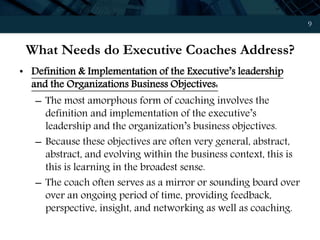
• Definition & Implementation of the Executive’s leadership
and the Organizations Business Objectives:
– The most amorphous form of coaching involves the
definition and implementation of the executive’s
leadership and the organization’s business objectives.
– Because these objectives are often very general, abstract,
abstract, and evolving within the business context, this is
this is learning in the broadest sense.
– The coach often serves as a mirror or sounding board over
over an ongoing period of time, providing feedback,
perspective, insight, and networking as well as coaching.
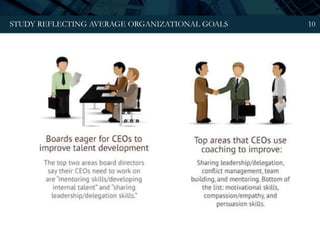
STUDY REFLECTING AVERAGE ORGANIZATIONAL GOALS 10
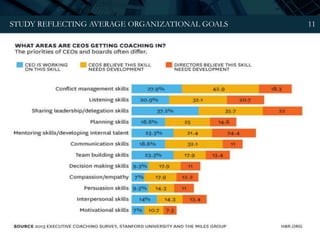
STUDY REFLECTING AVERAGE ORGANIZATIONAL GOALS 11
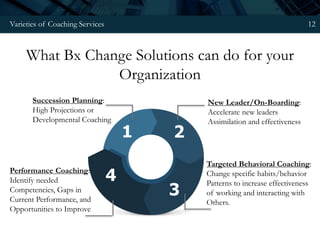
Varieties of Coaching Services 12
Succession Planning:
High Projections or
Developmental Coaching
New Leader/On-Boarding:
Accelerate new leaders
Assimilation and effectiveness
Targeted Behavioral Coaching:
Change specific habits/behavior
Patterns to increase effectiveness
of working and interacting with
Others.
Performance Coaching:
Identify needed
Competencies, Gaps in
Current Performance, and
Opportunities to Improve
What Bx Change Solutions can do for your
Organization
Discover the Power
of Applied Behavioral Analysis
www.bxchangesolutions.com
321-720-6411
Call for an appointment

BxCS- Coaching Overview

  • 1.
    Discover the power ofApplied Behavioral Analysis Executive Coaching & Leadership Solutions Fernando J. Vinagre, BCBA www.bxchangesolutions.com 321-720-6411
  • 2.
    2 What is ExecutiveCoaching? • Defined as the development process that builds a leader’s capability to achieve short- and long-term organizational goals. • Executive Coaching is most successful as a three-way partnership among coach, executive, and the executive’s organization. • Each partner has an obligation and responsibility to contribute to the success of the coaching process. • Although the primary work is between executive and coach, coaching is always an organizational intervention and, as such, should be conducted within the context of the organization’s goals and objectives. – The Executive Coaching Handbook, TECF, 2012
  • 3.
    3 Leadership Development Process •Executive coaching focuses on developing the executive’s ability to influence, motivate, and lead others. • Rather than relying on tactical problem solving or basic skill acquisition, executive coaching develops strategic thinking skills. • This process may involve unlearning past behaviors or patterns as well as learning/developing new ones. – The Executive Coaching Handbook, TECF, 2012
  • 4.
    4 Brief History • Someform of Executive Coaching has always occurred within organizations. Traditionally, experienced senior leaders were expected to “bring along” their successors by advising, mentoring, and developing more junior executives and managers. This was an implicit part of the role of senior leadership. • Over time, business changed in (2) important ways that decreased this internal coaching expectation: 1. Executive life has become faster paced and less personal in response to global and technological changes; 2. The relationship between organizations and employees changed after the introduction of downsizing as a business tool during the 1980s. After all, how much time should a time-stressed executive spend developing employees if they are unlikely to stay with the organization long enough to show a return on the investment?
  • 5.
    5 Today’s Executive Coach •The same business changes (increased globalization, technology, speed, and complexity) that reduced the ability of leaders inside the organization to provide coaching, simultaneously increased employees’ need for external coaching. • Employees, as a result of having to face this rapidly changing and more complex work environment, are now constantly looking for ways to meet the challenges and develop the pertinent skills more rapidly: • Enter the Workplace / Executive Coach
  • 6.
    6 What Needs doExecutive Coaches Address? (R. Witherspoon and R. White, Four Essential Ways that Coaching Can Help Executives, Center for Creative Leadership, 1997.) • Skill Building: – Skill building goals are areas of new learning that address address a task, project or accountability that the executive executive faces in the current job. – They can include basic ideas, strategies, methods, behaviors, and attitudes. – The work is relatively short-term, ending as soon as the the skill-based learning goals have been achieved to the the satisfaction of the executive, the organization and the the coach. • Examples might include coaching in presentation skills, delegation delegation skills, performance review management, etc.
  • 7.
    7 What Needs doExecutive Coaches Address? • Performance Improvement: – Performance improvement goals address learning on the the broader aspects of the present job, not just a particular particular project or task. – This category can include coaching for an executive who who is “at risk” for being terminated or demoted if the goals are not met. • Examples might include increasing collaborative behavior with with peers, reducing abrasive behaviors, or meeting key job accountabilities or sales quotas.
  • 8.
    8 What Needs doExecutive Coaches Address? • Development for Future Assignments (aka: Succession Planning/Training): – Development for future assignments includes coaching to coaching to prepare an executive for a future job move and is often part of succession planning in the organization. – It may involve preparation for overseas work, for a larger larger scope of responsibility, for work in highly political political arenas, etc. – Organizations typically invest in this form of coaching only for those employees deemed to have “high potential” potential” for future success in the organization.
  • 9.
    9 What Needs doExecutive Coaches Address? • Definition & Implementation of the Executive’s leadership and the Organizations Business Objectives: – The most amorphous form of coaching involves the definition and implementation of the executive’s leadership and the organization’s business objectives. – Because these objectives are often very general, abstract, abstract, and evolving within the business context, this is this is learning in the broadest sense. – The coach often serves as a mirror or sounding board over over an ongoing period of time, providing feedback, perspective, insight, and networking as well as coaching.
  • 10.
    STUDY REFLECTING AVERAGEORGANIZATIONAL GOALS 10
  • 11.
    STUDY REFLECTING AVERAGEORGANIZATIONAL GOALS 11
  • 12.
    Varieties of CoachingServices 12 Succession Planning: High Projections or Developmental Coaching New Leader/On-Boarding: Accelerate new leaders Assimilation and effectiveness Targeted Behavioral Coaching: Change specific habits/behavior Patterns to increase effectiveness of working and interacting with Others. Performance Coaching: Identify needed Competencies, Gaps in Current Performance, and Opportunities to Improve What Bx Change Solutions can do for your Organization
  • 13.
    Discover the Power ofApplied Behavioral Analysis www.bxchangesolutions.com 321-720-6411 Call for an appointment