Air Pollutants and Health Risks:
A Case Study of Sick Building Syndrome
(SBS) in an Underground Metro Station
Platform Area in Tropical Region

Lee Voth-Gaeddert
Yiseul Kim
David Melton
Stephanie Stumpos
Mentors: Dr. Mukesh Khare & Dr. Hernando Perez
Indoor Air Pollution and
Sick Building Syndrome
—The Chandi Chowk “Moonlit Market” Metro, built in
2005, is one of 35 underground stations that serve the
National Capital Region of India Due to building
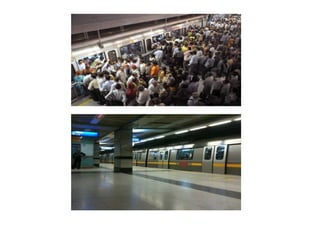
characteristics and a large number of daily commuters,
there is concern for workers who spend their entire shifts
working in the underground station and their healthThis
case study will focus on the quantification of exposures to
a unique set of stressors and the mitigation of these events
which are associated with SBS and microbial infection
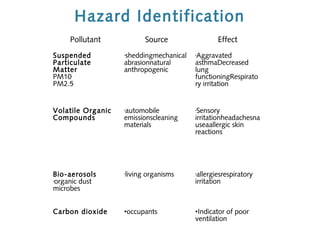
Hazard Identification
Pollutant
Suspended
Particulate
Matter
PM10
PM2.5

Volatile Organic
Compounds

Bio-aerosols
•organic dust
microbes
Carbon dioxide

Source
sheddingmechanical
abrasionnatural
anthropogenic
•

automobile
emissionscleaning
materials
•

living organisms

Effect
Aggravated
asthmaDecreased
lung
functioningRespirato
ry irritation
•

Sensory
irritationheadachesna
useaallergic skin
reactions
•

allergiesrespiratory
irritation

•

•

•occupants

•Indicator of poor
ventilation
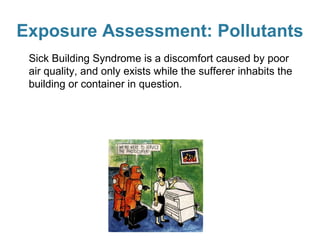
Exposure Assessment: Pollutants
Sick Building Syndrome is a discomfort caused by poor
air quality, and only exists while the sufferer inhabits the
building or container in question.
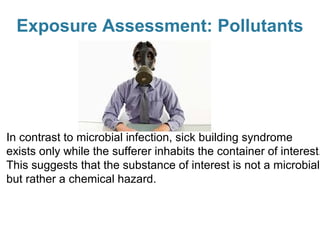
Exposure Assessment: Pollutants

In contrast to microbial infection, sick building syndrome
exists only while the sufferer inhabits the container of interest.
This suggests that the substance of interest is not a microbial
but rather a chemical hazard.
Exposure Assessment Tasks
Pathway
Amount
Duration
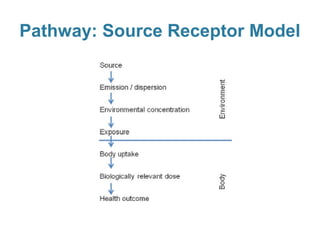
Pathway: Source Receptor Model
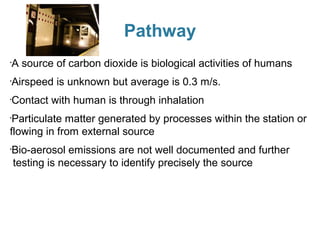
Pathway
•

A source of carbon dioxide is biological activities of humans

•

Airspeed is unknown but average is 0.3 m/s.

•

Contact with human is through inhalation

Particulate matter generated by processes within the station or
flowing in from external source
•

•

Bio-aerosol emissions are not well documented and further
testing is necessary to identify precisely the source
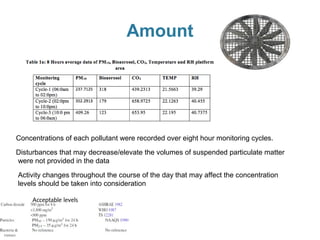
Amount

Concentrations of each pollutant were recorded over eight hour monitoring cycles.
Disturbances that may decrease/elevate the volumes of suspended particulate matter
were not provided in the data
Activity changes throughout the course of the day that may affect the concentration
levels should be taken into consideration
Acceptable levels
Duration
If concentration is assumed to be uniform,
the duration of exposure is the length of
time the person inhabits the building.
•

If concentrations of the pollutants fluctuate
throughout the day due to external disturbances,
the duration of exposure becomes difficult to
quantify, as the contact with the substance could be sporadic.
•
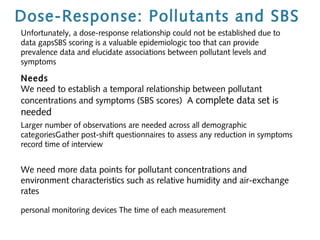
Dose-Response: Pollutants and SBS
Unfortunately, a dose-response relationship could not be established due to
data gapsSBS scoring is a valuable epidemiologic too that can provide
prevalence data and elucidate associations between pollutant levels and
symptoms

Needs
We need to establish a temporal relationship between pollutant
concentrations and symptoms (SBS scores) A complete data set is

needed
Larger number of observations are needed across all demographic
categoriesGather post-shift questionnaires to assess any reduction in symptoms
record time of interview

We need more data points for pollutant concentrations and
environment characteristics such as relative humidity and air-exchange
rates
personal monitoring devices The time of each measurement
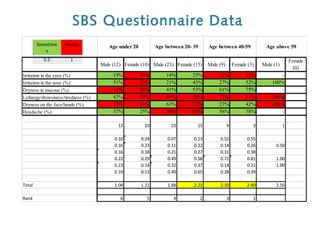
SBS Questionnaire Data
Sometime
s

Always

0.5

1

Age under 20

Age between 20- 39

Age between 40-59

Male (12) Female (10) Male (23) Female (15)

Male (9)

Age above 59

Female (3)

Female
(0)

Male (1)

19%
31%
16%
43%
23%
37%

24%
23%
18%
29%
14%
25%

14%
21%
41%
49%
63%
49%

25%
43%
53%
58%
37%
65%

52%
27%
61%
72%
27%
56%

55%
52%
75%
81%
42%
78%

100%
100%
100%
-

12

10

23

15

9

3

1

0.10
0.16
0.16
0.22
0.23
0.19

0.24
0.23
0.18
0.29
0.14
0.13

0.07
0.11
0.21
0.49
0.32
0.49

0.13
0.22
0.27
0.58
0.37
0.65

0.52
0.14
0.31
0.72
0.14
0.28

0.55
0.26
0.38
0.81
0.21
0.39

Total

1.04

1.21

1.68

2.21

2.10

2.60

2.50

Rank

6

5

4

2

3

1

-

Irritation in the eyes (%)
Irritation in the nose (%)
Dryness in mucous (%)
Lethargy/drowsiness/tiredness (%)
Dryness on the face/hands (%)
Headache (%)

0.50
1.00
1.00
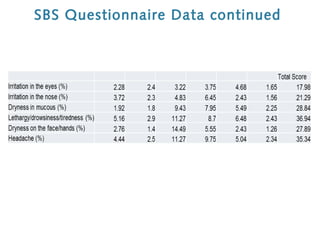
SBS Questionnaire Data continued
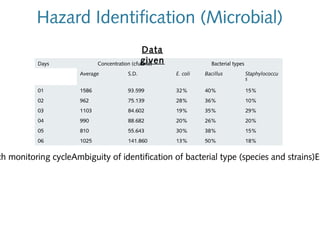
Hazard Identification (Microbial)
Data
given
Concentration (cfu/m3)

Days

Bacterial types

Average

S.D.

E. coli

Bacillus

Staphylococcu
s

01

1586

93.599

32%

40%

15%

02

962

75.139

28%

36%

10%

03

1103

84.602

19%

35%

29%

04

990

88.682

20%

26%

20%

05

810

55.643

30%

38%

15%

06

1025

141.860

13%

50%

18%

ch monitoring cycleAmbiguity of identification of bacterial type (species and strains)Ex
Escherichia coli (E. coli)
A large and diverse group of bacteriaGram-negative,
facultative anaerobic, and rod-shaped Commonly found in
the lower intestine of warm-blooded organismsUsed as
markers for water contaminationMost strains of E. coli are
harmless

Centers for Disease Control and Prevention
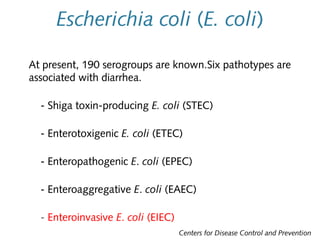
Escherichia coli (E. coli)
At present, 190 serogroups are known.Six pathotypes are
associated with diarrhea.
- Shiga toxin-producing E. coli (STEC)
- Enterotoxigenic E. coli (ETEC)
- Enteropathogenic E. coli (EPEC)
- Enteroaggregative E. coli (EAEC)
- Enteroinvasive E. coli (EIEC)
Centers for Disease Control and Prevention
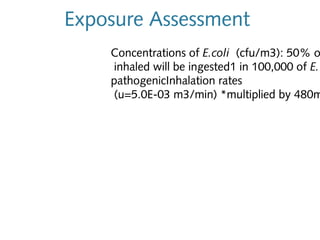
Exposure Assessment

Concentrations of E.coli (cfu/m3): 50% o
inhaled will be ingested1 in 100,000 of E.
pathogenicInhalation rates
(u=5.0E-03 m3/min) *multiplied by 480m
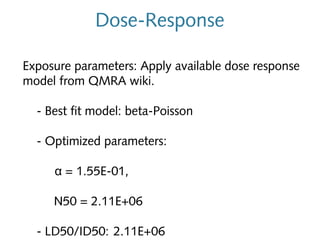
Dose-Response
Exposure parameters: Apply available dose response
model from QMRA wiki.
- Best fit model: beta-Poisson
- Optimized parameters:
α = 1.55E-01,
N50 = 2.11E+06
- LD50/ID50: 2.11E+06
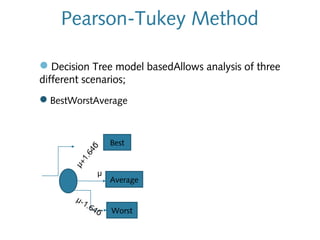
Pearson-Tukey Method
—Decision Tree model basedAllows analysis of three
different scenarios;

μ+
1

.6
4Ϭ

—BestWorstAverage

μ-1
.6

μ

4Ϭ

Best

Average

Worst
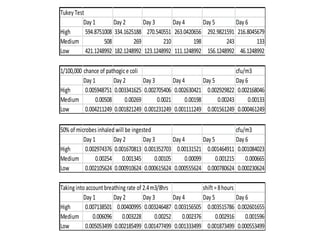
Tukey Test
Day 1
Day 2
Day 3
Day 4
Day 5
Day 6
High
594.8751008 334.1625188 270.540551 263.0420656 292.9821591 216.8045679
Medium
508
269
210
198
243
133
Low
421.1248992 182.1248992 123.1248992 111.1248992 156.1248992 46.1248992
1/100,000 chance of pathogic e coli
cfu/m3
Day 1
Day 2
Day 3
Day 4
Day 5
Day 6
High
0.005948751 0.003341625 0.002705406 0.002630421 0.002929822 0.002168046
Medium
0.00508
0.00269
0.0021
0.00198
0.00243
0.00133
Low
0.004211249 0.001821249 0.001231249 0.001111249 0.001561249 0.000461249
50% of microbes inhaled will be ingested
cfu/m3
Day 1
Day 2
Day 3
Day 4
Day 5
Day 6
High
0.002974376 0.001670813 0.001352703 0.00131521 0.001464911 0.001084023
Medium
0.00254 0.001345
0.00105
0.00099
0.001215
0.000665
Low
0.002105624 0.000910624 0.000615624 0.000555624 0.000780624 0.000230624
Taking into account breathing rate of 2.4 m3/8hrs
shift = 8 hours
Day 1
Day 2
Day 3
Day 4
Day 5
Day 6
High
0.007138501 0.00400995 0.003246487 0.003156505 0.003515786 0.002601655
Medium
0.006096 0.003228
0.00252
0.002376
0.002916
0.001596
Low
0.005053499 0.002185499 0.001477499 0.001333499 0.001873499 0.000553499
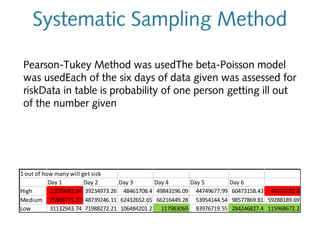
Systematic Sampling Method
Pearson-Tukey Method was usedThe beta-Poisson model
was usedEach of the six days of data given was assessed for
riskData in table is probability of one person getting ill out
of the number given

1 out of how many will get sick
Day 1
Day 2
Day 3
Day 4
Day 5
Day 6
High
22039682.64 39234973.26 48461708.4 49843196.09 44749677.99 60473158.43 44133732.8
Medium 25808775.77 48739246.11 62432652.65 66216449.28 53954144.54 98577869.81 59288189.69
Low
31132943.74 71988272.21 106484201.2 117983069 83976719.55 284246827.4 115968672.2
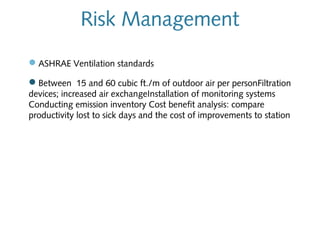
Risk Management
—ASHRAE Ventilation standards
—Between 15 and 60 cubic ft./m of outdoor air per personFiltration
devices; increased air exchangeInstallation of monitoring systems
Conducting emission inventory Cost benefit analysis: compare
productivity lost to sick days and the cost of improvements to station
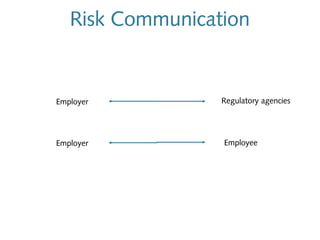
Risk Communication

Employer

Employer

Regulatory agencies

Employee
References

Abdul-Wahab, Sabah A. Sick Building Syndrome: In Public Buildings and Workplaces. Berlin: Springer, 2011. Internet
resource.

Apte, Michael G, William J. Fisk, and Joan M. Daisey. Associations between Indoor Co2 Concentrations and Sick
Building Syndrome Symptoms in Us Office Buildings: An Analysis of the 1994-1996 Base Study Data. Berkeley, CA:
Lawrence Berkeley National Laboratory, 2000. Print.

Dybwad, Marius, Gunnar Skogan, and Janet Martha Blatny. ''Temporal Variability of the Bioaerosol Background at a
Subway Station: Concentration 2 Level, Size Distribution and Diversity of Airborne Bacteria. American Society for
Microbiology, 2013.

Exposure Factors Handbook. Washington, DC: Exposure Assessment Group, Office of Health and Environmental
Assessment, U.S. Environmental Protection Agency, 1989. Print.

Gupta, S, M Khare, and R Goyal. "Sick Building Syndrome-a Case Study in a Multistory Centrally Air-Conditioned
Building in the Delhi City." Building and Environment. 42.8 (2007): 2797-2809. Print.

Indoor Air Facts, No. 4: Sick Building Syndrome. Washington, D.C: U.S. Environmental Protection Agency, Office of Air
and Radiation, 1991. Print.
Chart Reference

Sbs

  • 1.
    Air Pollutants andHealth Risks: A Case Study of Sick Building Syndrome (SBS) in an Underground Metro Station Platform Area in Tropical Region Lee Voth-Gaeddert Yiseul Kim David Melton Stephanie Stumpos Mentors: Dr. Mukesh Khare & Dr. Hernando Perez
  • 2.
    Indoor Air Pollutionand Sick Building Syndrome —The Chandi Chowk “Moonlit Market” Metro, built in 2005, is one of 35 underground stations that serve the National Capital Region of India Due to building characteristics and a large number of daily commuters, there is concern for workers who spend their entire shifts working in the underground station and their healthThis case study will focus on the quantification of exposures to a unique set of stressors and the mitigation of these events which are associated with SBS and microbial infection
  • 5.
    Hazard Identification Pollutant Suspended Particulate Matter PM10 PM2.5 Volatile Organic Compounds Bio-aerosols •organicdust microbes Carbon dioxide Source sheddingmechanical abrasionnatural anthropogenic • automobile emissionscleaning materials • living organisms Effect Aggravated asthmaDecreased lung functioningRespirato ry irritation • Sensory irritationheadachesna useaallergic skin reactions • allergiesrespiratory irritation • • •occupants •Indicator of poor ventilation
  • 6.
    Exposure Assessment: Pollutants SickBuilding Syndrome is a discomfort caused by poor air quality, and only exists while the sufferer inhabits the building or container in question.
  • 7.
    Exposure Assessment: Pollutants Incontrast to microbial infection, sick building syndrome exists only while the sufferer inhabits the container of interest. This suggests that the substance of interest is not a microbial but rather a chemical hazard.
  • 8.
  • 9.
  • 10.
    Pathway • A source ofcarbon dioxide is biological activities of humans • Airspeed is unknown but average is 0.3 m/s. • Contact with human is through inhalation Particulate matter generated by processes within the station or flowing in from external source • • Bio-aerosol emissions are not well documented and further testing is necessary to identify precisely the source
  • 11.
    Amount Concentrations of eachpollutant were recorded over eight hour monitoring cycles. Disturbances that may decrease/elevate the volumes of suspended particulate matter were not provided in the data Activity changes throughout the course of the day that may affect the concentration levels should be taken into consideration Acceptable levels
  • 12.
    Duration If concentration isassumed to be uniform, the duration of exposure is the length of time the person inhabits the building. • If concentrations of the pollutants fluctuate throughout the day due to external disturbances, the duration of exposure becomes difficult to quantify, as the contact with the substance could be sporadic. •
  • 13.
    Dose-Response: Pollutants andSBS Unfortunately, a dose-response relationship could not be established due to data gapsSBS scoring is a valuable epidemiologic too that can provide prevalence data and elucidate associations between pollutant levels and symptoms Needs We need to establish a temporal relationship between pollutant concentrations and symptoms (SBS scores) A complete data set is needed Larger number of observations are needed across all demographic categoriesGather post-shift questionnaires to assess any reduction in symptoms record time of interview We need more data points for pollutant concentrations and environment characteristics such as relative humidity and air-exchange rates personal monitoring devices The time of each measurement
  • 14.
    SBS Questionnaire Data Sometime s Always 0.5 1 Ageunder 20 Age between 20- 39 Age between 40-59 Male (12) Female (10) Male (23) Female (15) Male (9) Age above 59 Female (3) Female (0) Male (1) 19% 31% 16% 43% 23% 37% 24% 23% 18% 29% 14% 25% 14% 21% 41% 49% 63% 49% 25% 43% 53% 58% 37% 65% 52% 27% 61% 72% 27% 56% 55% 52% 75% 81% 42% 78% 100% 100% 100% - 12 10 23 15 9 3 1 0.10 0.16 0.16 0.22 0.23 0.19 0.24 0.23 0.18 0.29 0.14 0.13 0.07 0.11 0.21 0.49 0.32 0.49 0.13 0.22 0.27 0.58 0.37 0.65 0.52 0.14 0.31 0.72 0.14 0.28 0.55 0.26 0.38 0.81 0.21 0.39 Total 1.04 1.21 1.68 2.21 2.10 2.60 2.50 Rank 6 5 4 2 3 1 - Irritation in the eyes (%) Irritation in the nose (%) Dryness in mucous (%) Lethargy/drowsiness/tiredness (%) Dryness on the face/hands (%) Headache (%) 0.50 1.00 1.00
  • 15.
  • 16.
    Hazard Identification (Microbial) Data given Concentration(cfu/m3) Days Bacterial types Average S.D. E. coli Bacillus Staphylococcu s 01 1586 93.599 32% 40% 15% 02 962 75.139 28% 36% 10% 03 1103 84.602 19% 35% 29% 04 990 88.682 20% 26% 20% 05 810 55.643 30% 38% 15% 06 1025 141.860 13% 50% 18% ch monitoring cycleAmbiguity of identification of bacterial type (species and strains)Ex
  • 17.
    Escherichia coli (E.coli) A large and diverse group of bacteriaGram-negative, facultative anaerobic, and rod-shaped Commonly found in the lower intestine of warm-blooded organismsUsed as markers for water contaminationMost strains of E. coli are harmless Centers for Disease Control and Prevention
  • 18.
    Escherichia coli (E.coli) At present, 190 serogroups are known.Six pathotypes are associated with diarrhea. - Shiga toxin-producing E. coli (STEC) - Enterotoxigenic E. coli (ETEC) - Enteropathogenic E. coli (EPEC) - Enteroaggregative E. coli (EAEC) - Enteroinvasive E. coli (EIEC) Centers for Disease Control and Prevention
  • 19.
    Exposure Assessment Concentrations ofE.coli (cfu/m3): 50% o inhaled will be ingested1 in 100,000 of E. pathogenicInhalation rates (u=5.0E-03 m3/min) *multiplied by 480m
  • 20.
    Dose-Response Exposure parameters: Applyavailable dose response model from QMRA wiki. - Best fit model: beta-Poisson - Optimized parameters: α = 1.55E-01, N50 = 2.11E+06 - LD50/ID50: 2.11E+06
  • 21.
    Pearson-Tukey Method —Decision Treemodel basedAllows analysis of three different scenarios; μ+ 1 .6 4Ϭ —BestWorstAverage μ-1 .6 μ 4Ϭ Best Average Worst
  • 22.
    Tukey Test Day 1 Day2 Day 3 Day 4 Day 5 Day 6 High 594.8751008 334.1625188 270.540551 263.0420656 292.9821591 216.8045679 Medium 508 269 210 198 243 133 Low 421.1248992 182.1248992 123.1248992 111.1248992 156.1248992 46.1248992 1/100,000 chance of pathogic e coli cfu/m3 Day 1 Day 2 Day 3 Day 4 Day 5 Day 6 High 0.005948751 0.003341625 0.002705406 0.002630421 0.002929822 0.002168046 Medium 0.00508 0.00269 0.0021 0.00198 0.00243 0.00133 Low 0.004211249 0.001821249 0.001231249 0.001111249 0.001561249 0.000461249 50% of microbes inhaled will be ingested cfu/m3 Day 1 Day 2 Day 3 Day 4 Day 5 Day 6 High 0.002974376 0.001670813 0.001352703 0.00131521 0.001464911 0.001084023 Medium 0.00254 0.001345 0.00105 0.00099 0.001215 0.000665 Low 0.002105624 0.000910624 0.000615624 0.000555624 0.000780624 0.000230624 Taking into account breathing rate of 2.4 m3/8hrs shift = 8 hours Day 1 Day 2 Day 3 Day 4 Day 5 Day 6 High 0.007138501 0.00400995 0.003246487 0.003156505 0.003515786 0.002601655 Medium 0.006096 0.003228 0.00252 0.002376 0.002916 0.001596 Low 0.005053499 0.002185499 0.001477499 0.001333499 0.001873499 0.000553499
  • 23.
    Systematic Sampling Method Pearson-TukeyMethod was usedThe beta-Poisson model was usedEach of the six days of data given was assessed for riskData in table is probability of one person getting ill out of the number given 1 out of how many will get sick Day 1 Day 2 Day 3 Day 4 Day 5 Day 6 High 22039682.64 39234973.26 48461708.4 49843196.09 44749677.99 60473158.43 44133732.8 Medium 25808775.77 48739246.11 62432652.65 66216449.28 53954144.54 98577869.81 59288189.69 Low 31132943.74 71988272.21 106484201.2 117983069 83976719.55 284246827.4 115968672.2
  • 24.
    Risk Management —ASHRAE Ventilationstandards —Between 15 and 60 cubic ft./m of outdoor air per personFiltration devices; increased air exchangeInstallation of monitoring systems Conducting emission inventory Cost benefit analysis: compare productivity lost to sick days and the cost of improvements to station
  • 25.
  • 26.
    References Abdul-Wahab, Sabah A.Sick Building Syndrome: In Public Buildings and Workplaces. Berlin: Springer, 2011. Internet resource. Apte, Michael G, William J. Fisk, and Joan M. Daisey. Associations between Indoor Co2 Concentrations and Sick Building Syndrome Symptoms in Us Office Buildings: An Analysis of the 1994-1996 Base Study Data. Berkeley, CA: Lawrence Berkeley National Laboratory, 2000. Print. Dybwad, Marius, Gunnar Skogan, and Janet Martha Blatny. ''Temporal Variability of the Bioaerosol Background at a Subway Station: Concentration 2 Level, Size Distribution and Diversity of Airborne Bacteria. American Society for Microbiology, 2013. Exposure Factors Handbook. Washington, DC: Exposure Assessment Group, Office of Health and Environmental Assessment, U.S. Environmental Protection Agency, 1989. Print. Gupta, S, M Khare, and R Goyal. "Sick Building Syndrome-a Case Study in a Multistory Centrally Air-Conditioned Building in the Delhi City." Building and Environment. 42.8 (2007): 2797-2809. Print. Indoor Air Facts, No. 4: Sick Building Syndrome. Washington, D.C: U.S. Environmental Protection Agency, Office of Air and Radiation, 1991. Print.
  • 27.

Editor's Notes

  • #3 Why are we investigating? Air quality is a major concern due to the conditions in subways (enclosed space, relies on ventilation systems to provide fresh air, a large number of occupants) From an occupational health POV , there is a vulnerable population (employees working in the station)Literature suggests that poor ventilation and suspended particulate matter is responsible for health problemsStudying SBS are challenging: Sick building syndrome is a very unique health outcome that has no clinical diagnosis; symptoms only present themselves during the exposure; difficult to quantify
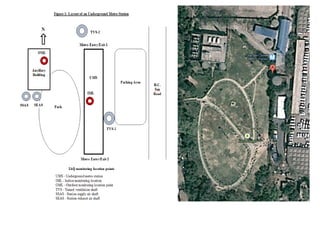
  • #4 Air supply intake and exhaust systems are in close proximity to one another Parking lot could be a source for combustion byproducts
  • #6 Every risk assessment starts with hazard ID All of these are a form of particulate matter (commonly cited) but it is important to enumerate the types unique to our case study situation PM2.5 can travel deeper into lungs and can stay suspended for longer periods of time These pollutants would be of particular concern in our case study
  • #14 Our case study can generate hypotheses that can direct future chemical D-R analysis Can identify susceptible/vulnerable groups Desirable response qualities: a measurable outcome, a clear outcome (detecting actual stressor in the body, biomarkers, death) Needs Individual SBS scores over different time frames were unknown; we weren’t given individual pollutant readings over time Some of the strata had very low numbers of observations- effects power of study Bias and validity issues
  • #15 In lieu of dose-response Each age strata is divided into male and female; values are weighted and a score for each gender in each age group is generated; higher values mean sicker Older groups report more symptom; females report more symptoms
  • #16 Percentage cells were multiplied against the n in each category; totals represent number of people experiencing each symptom based on the data given to us Lethargy and headaches are experienced most In conclusion we could not determine a dose response relationship between stressor and end point but.. SBS scoring and pollutant monitoring can be used together to establish associations and bolster causal link that is currently missing in SBS. It gives direction to future investigations