Buyer and Seller
Perspectives on Open
Source in Tech Contracts
David Tollen, Tech Contracts Academy
Phil Odence, Black Duck Software
Speakers
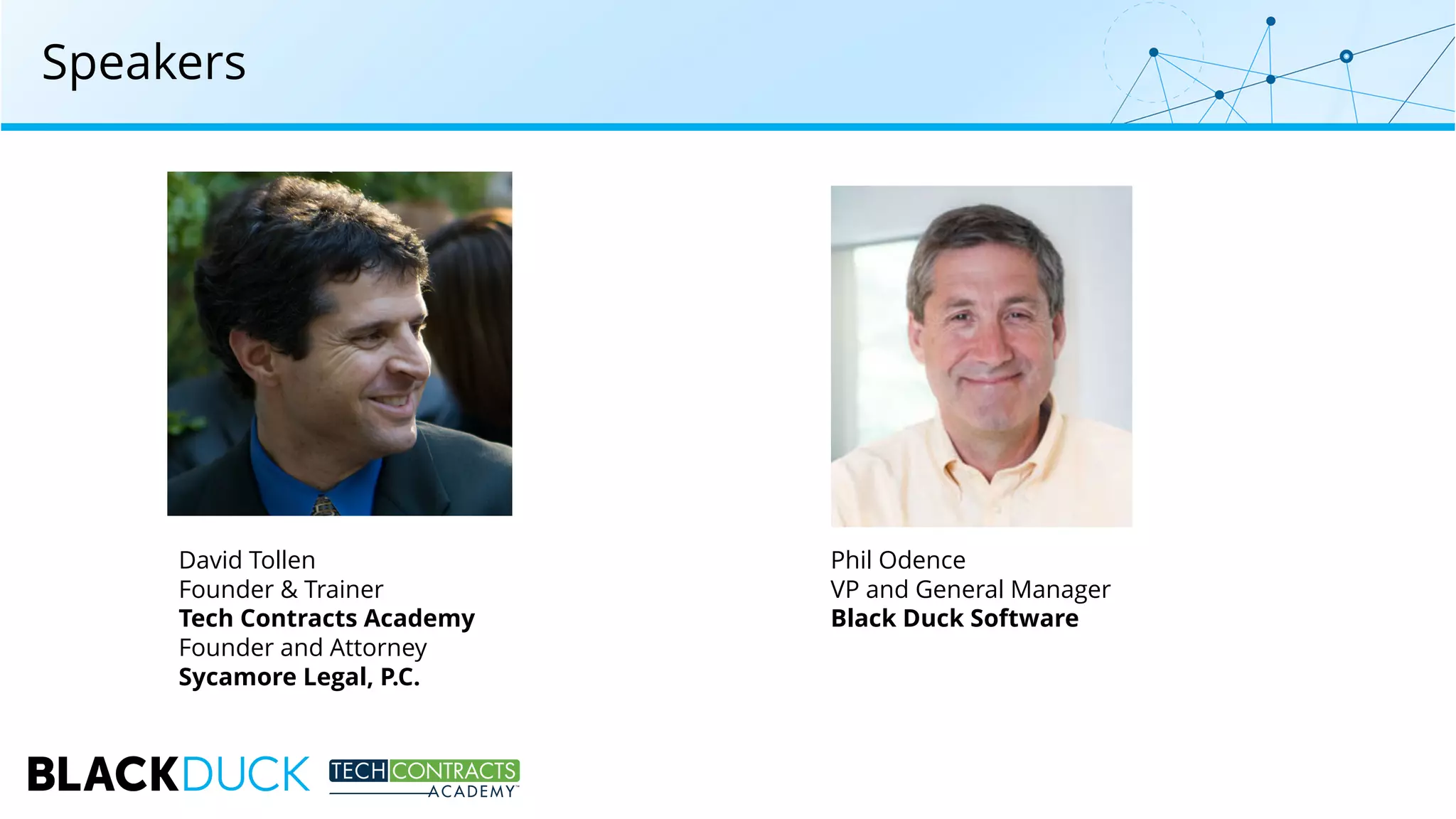
David Tollen
Founder & Trainer
Tech Contracts Academy
Founder and Attorney
Sycamore Legal, P.C.
Phil Odence
VP and General Manager
Black Duck Software
Intro
Trends in Software and Open Source
4
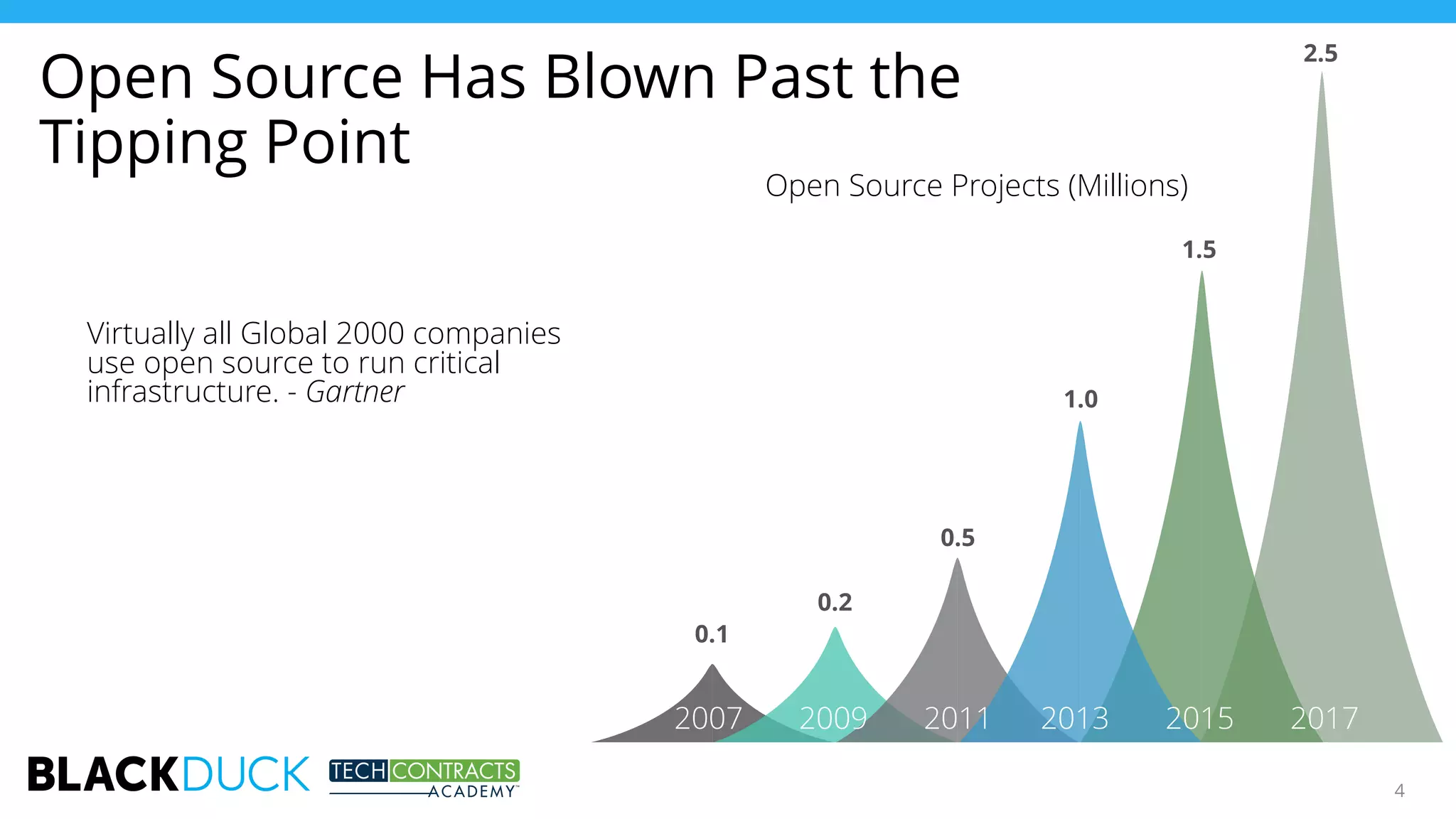
Virtually all Global 2000 companies
use open source to run critical
infrastructure. - Gartner
Open Source Has Blown Past the
Tipping Point
Open Source Projects (Millions)
2.5
0.1
0.2
0.5
1.5
1.0
2007 2009 2011 2013 2015 2017
Your Clients Use Open Source
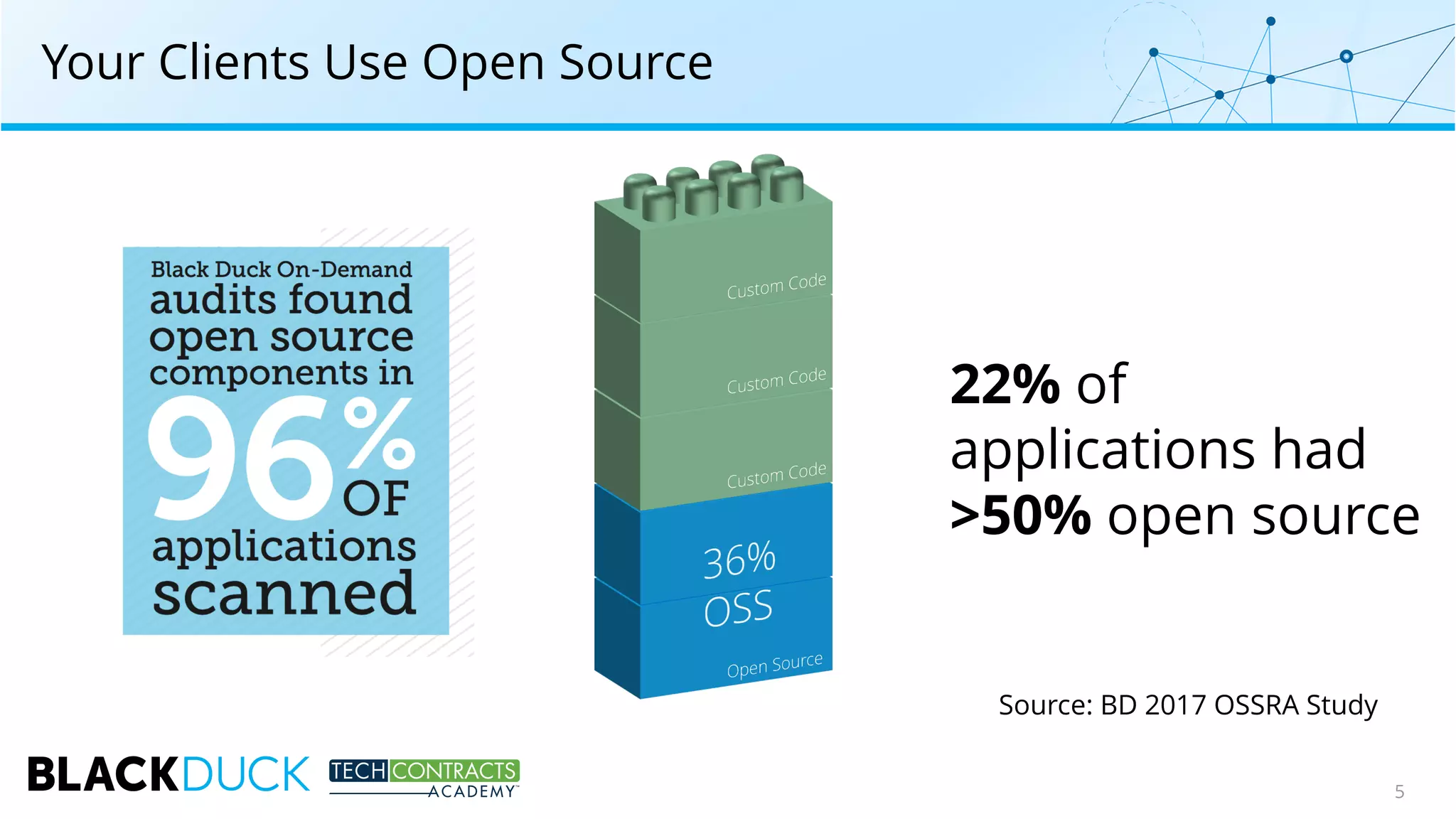
22% of
applications had
>50% open source
Source: BD 2017 OSSRA Study
5
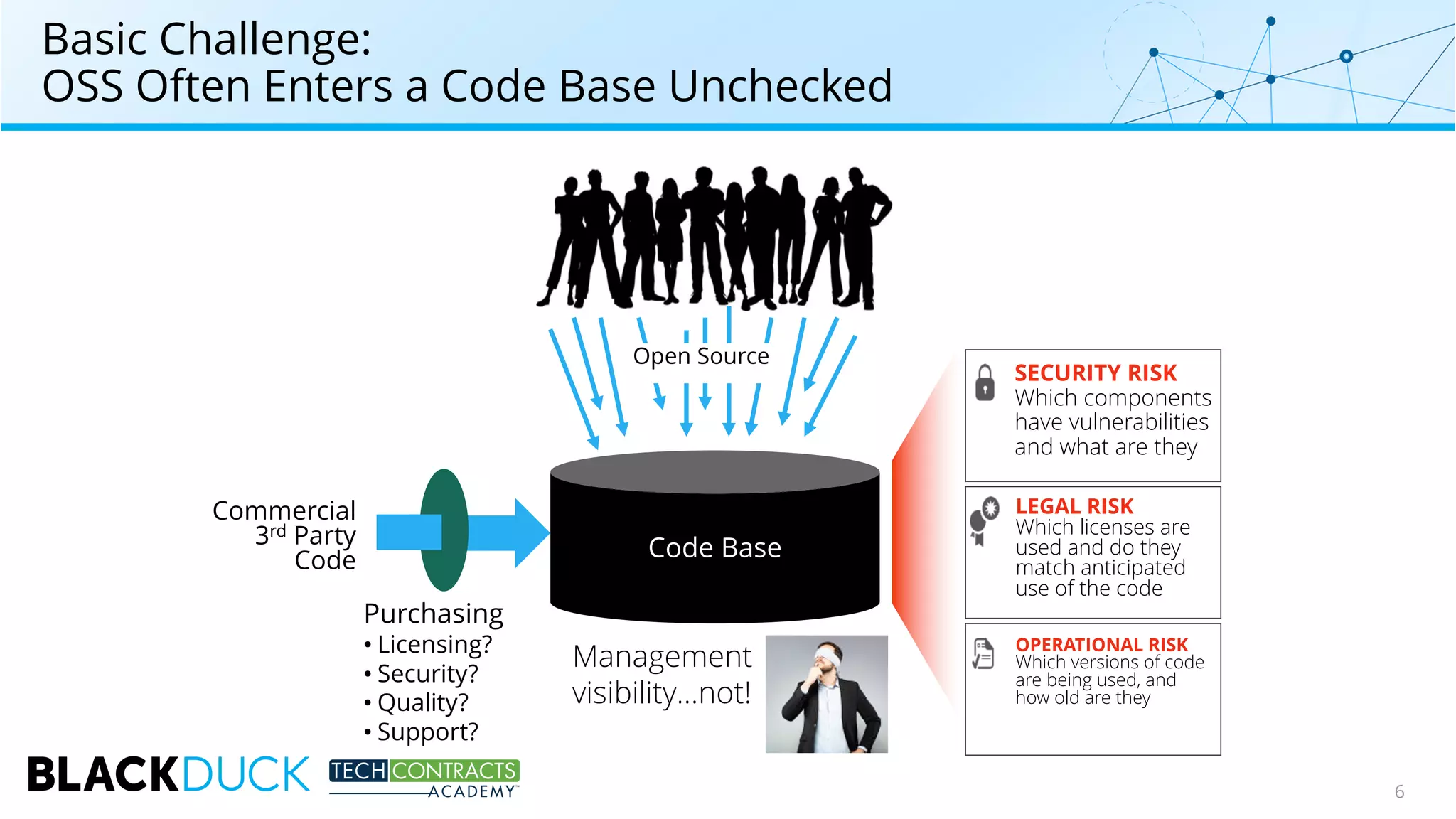
Basic Challenge:
OSS Often Enters a Code Base Unchecked
Code Base
Commercial
3rd Party
Code
Purchasing
• Licensing?
• Security?
• Quality?
• Support?
Open Source
OPERATIONAL RISK
Which versions of code
are being used, and
how old are they
LEGAL RISK
Which licenses are
used and do they
match anticipated
use of the code
SECURITY RISK
Which components
have vulnerabilities
and what are they
Management
visibility…not!
6
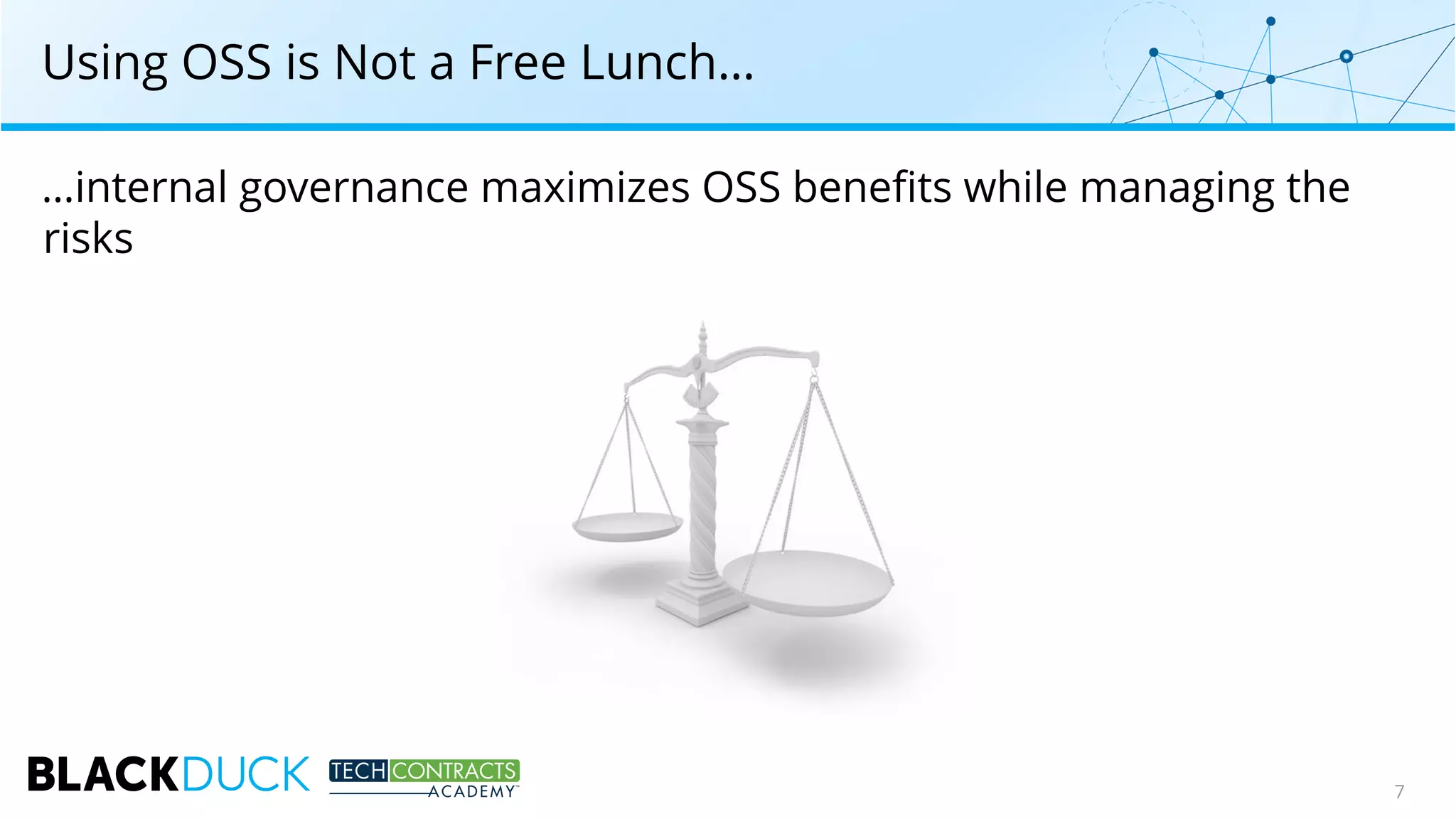
Using OSS is Not a Free Lunch…
…internal governance maximizes OSS benefits while managing the
risks
7
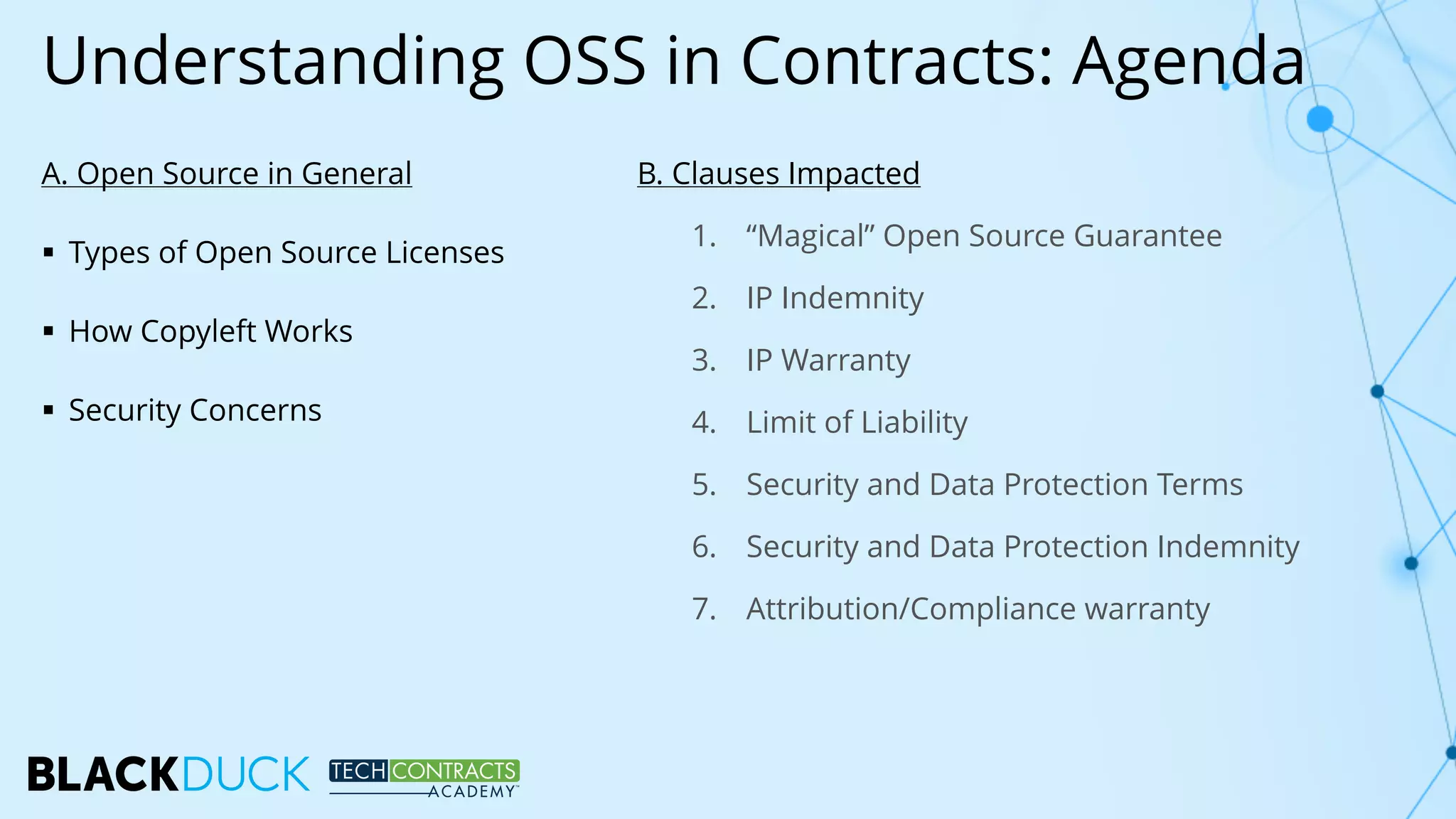
Understanding OSS in Contracts: Agenda
A. Open Source in General
§ Types of Open Source Licenses
§ How Copyleft Works
§ Security Concerns
B. Clauses Impacted
1. “Magical” Open Source Guarantee
2. IP Indemnity
3. IP Warranty
4. Limit of Liability
5. Security and Data Protection Terms
6. Security and Data Protection Indemnity
7. Attribution/Compliance warranty
• THE TECH CONTRACTS HANDBOOK: Software Licenses, Cloud Computing
Agreements, and Other IT Contracts, for Lawyers and Businesspeople, Second
Edition, by David W. Tollen (ABA Publishing 2015)
• TechContracts.com: form contracts, sample language, articles, & other
resources – free – www.TechContracts.com
• Tech Contracts Academy™: training on drafting and negotiating IT contracts,
for lawyers and businesspeople – www.TechContracts.com
• Sycamore Legal, P.C.®: legal services, including coaching/advice for in-house
counsel – www.SycamoreLegal.com
Resources
A. Open Source
In General
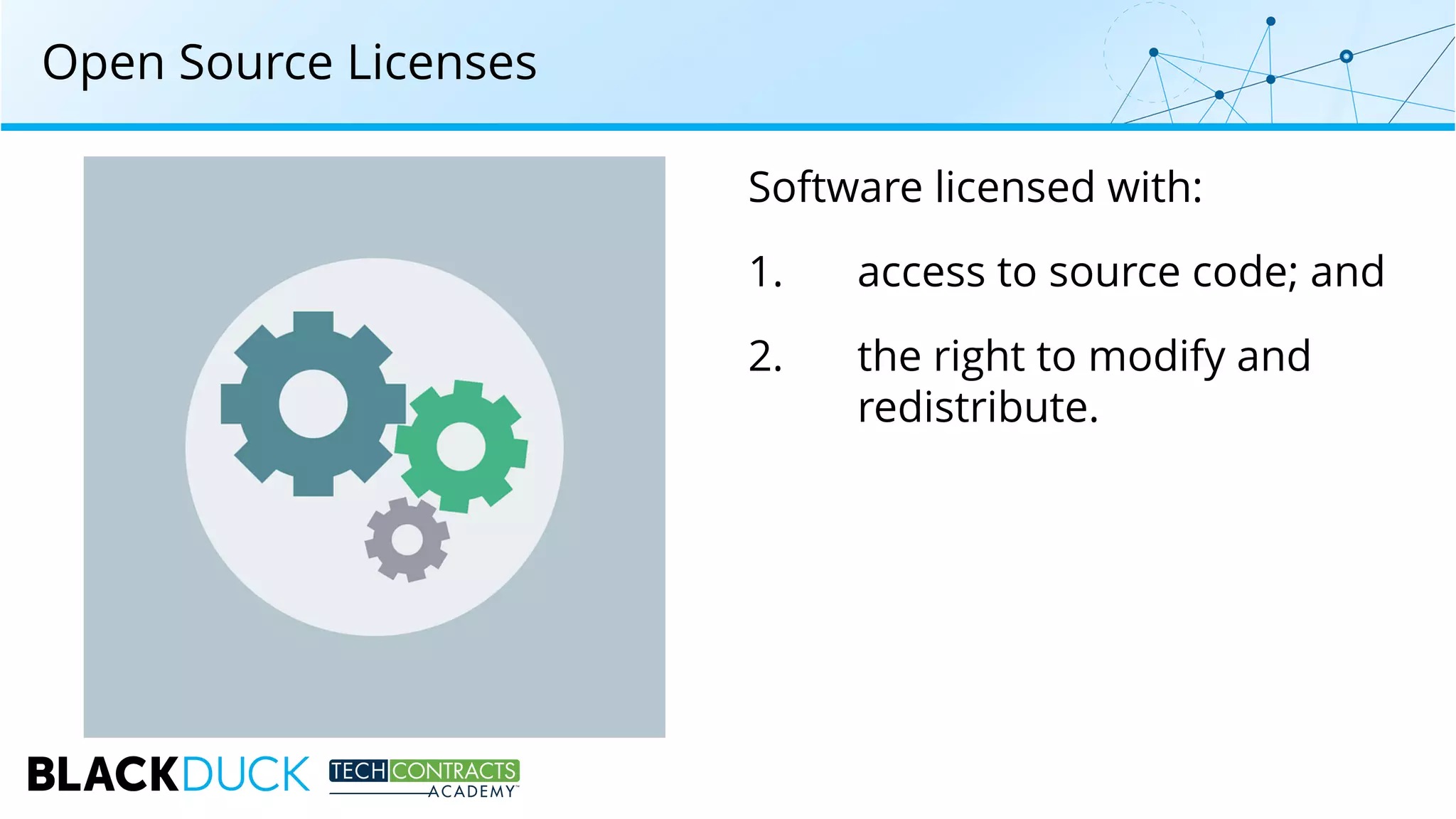
Software licensed with:
1. access to source code; and
2. the right to modify and
redistribute.
Open Source Licenses
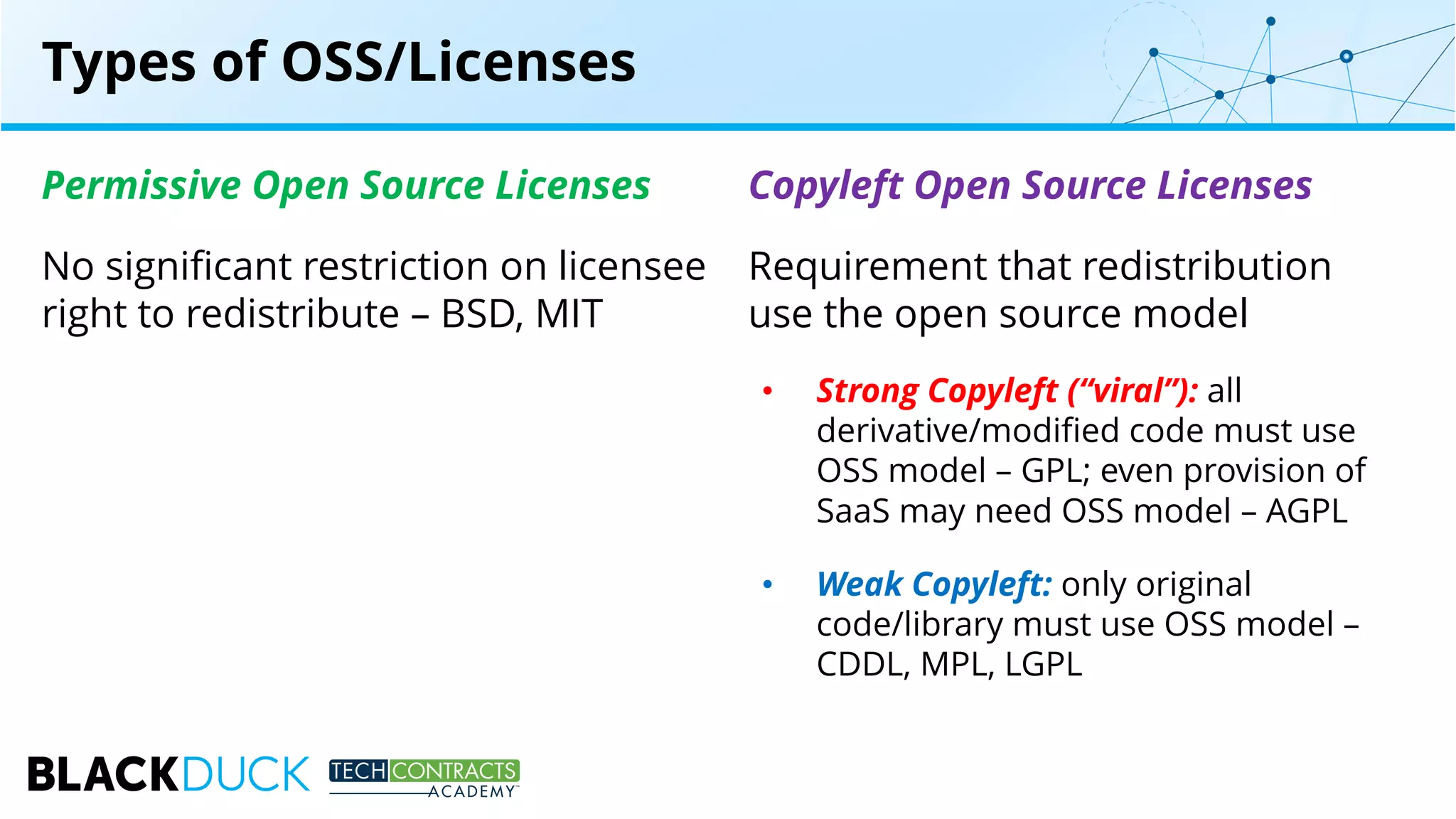
Permissive Open Source Licenses
No significant restriction on licensee
right to redistribute – BSD, MIT
Copyleft Open Source Licenses
Requirement that redistribution
use the open source model
• Strong Copyleft (“viral”): all
derivative/modified code must use
OSS model – GPL; even provision of
SaaS may need OSS model – AGPL
• Weak Copyleft: only original
code/library must use OSS model –
CDDL, MPL, LGPL
Types of OSS/Licenses
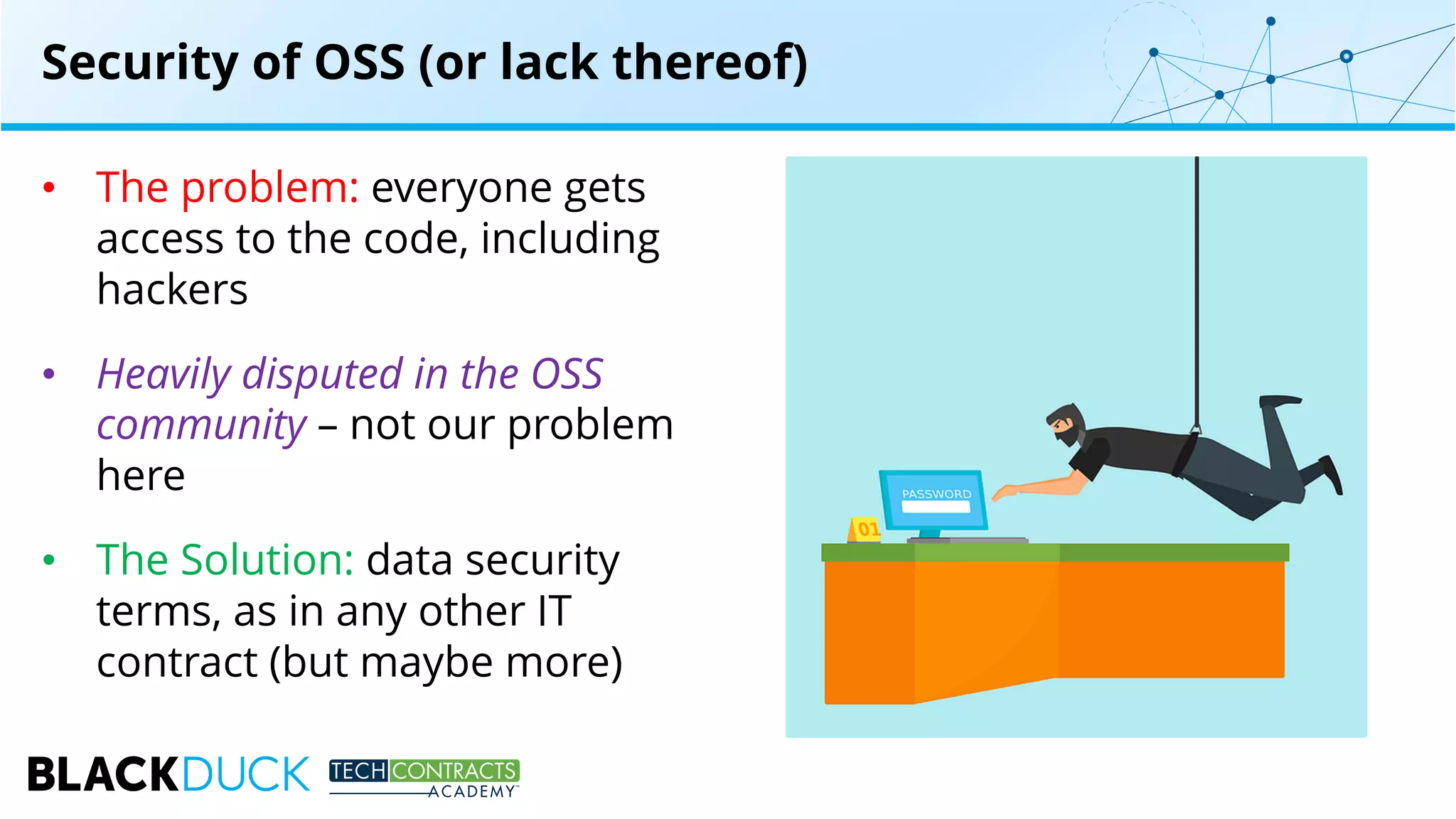
• The problem: everyone gets
access to the code, including
hackers
• Heavily disputed in the OSS
community – not our problem
here
• The Solution: data security
terms, as in any other IT
contract (but maybe more)
Security of OSS (or lack thereof)
B. Contract
Clauses
Impacted
1. “Magical” Open Source Guarantees
• Promise that the code won’t include OSS: “Yeah,
right.”
• Promise that the code won’t include copyleft or
strong copyleft: better
• View this instead as an issue for typical IT contract
clauses, like warranty, indemnity, data security:
best
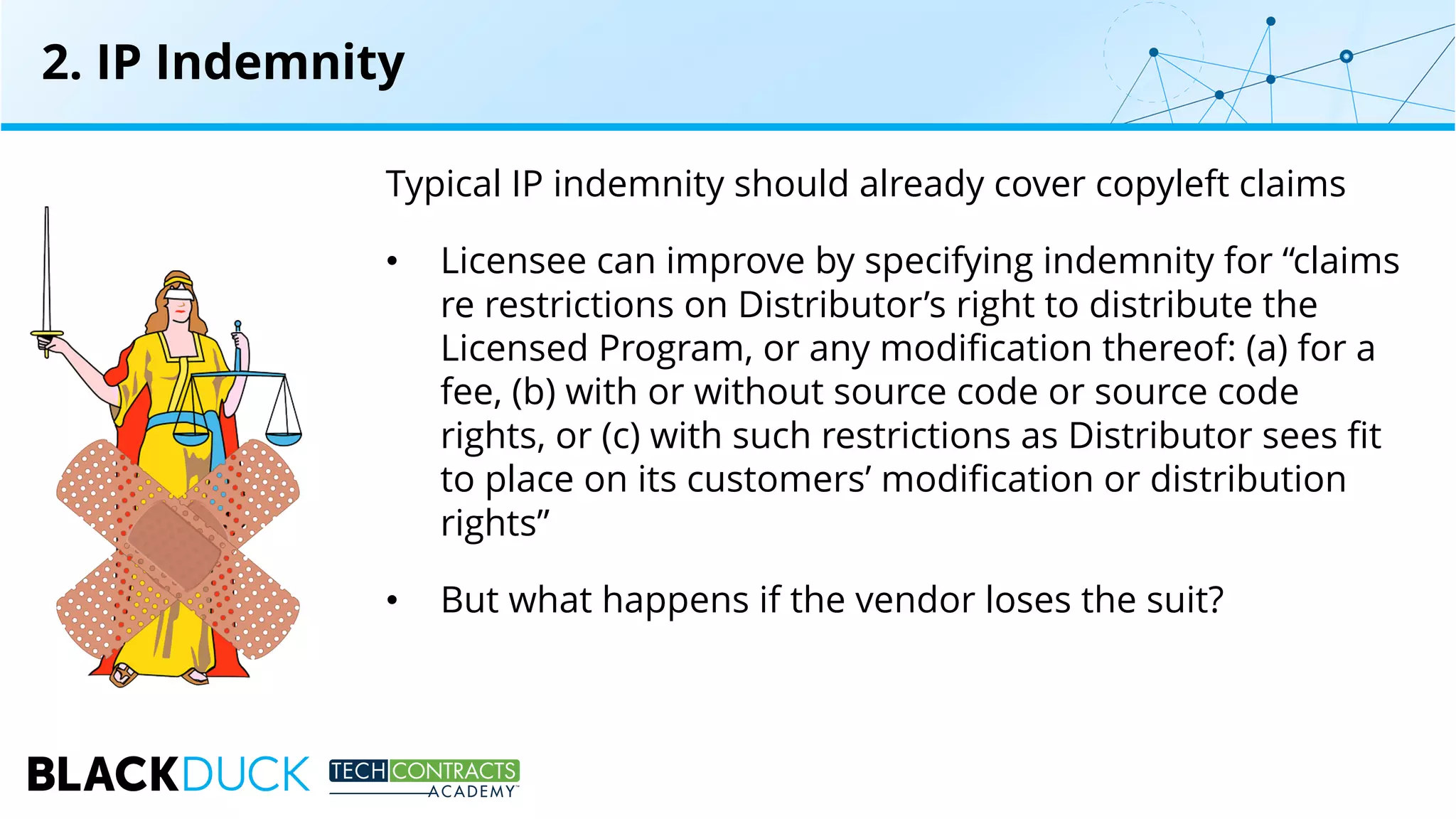
Typical IP indemnity should already cover copyleft claims
• Licensee can improve by specifying indemnity for “claims
re restrictions on Distributor’s right to distribute the
Licensed Program, or any modification thereof: (a) for a
fee, (b) with or without source code or source code
rights, or (c) with such restrictions as Distributor sees fit
to place on its customers’ modification or distribution
rights”
• But what happens if the vendor loses the suit?
2. IP Indemnity
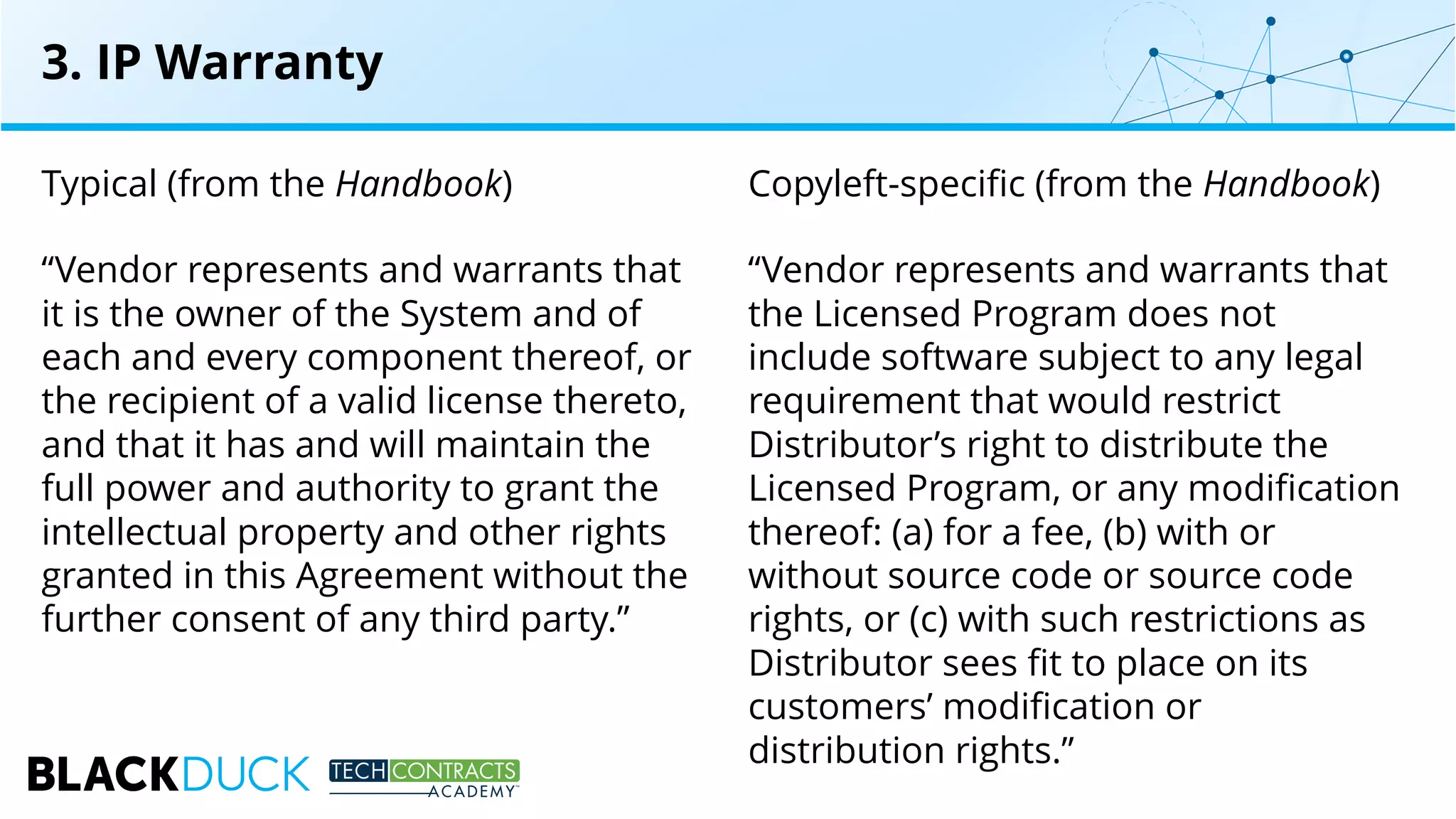
Typical (from the Handbook)
“Vendor represents and warrants that
it is the owner of the System and of
each and every component thereof, or
the recipient of a valid license thereto,
and that it has and will maintain the
full power and authority to grant the
intellectual property and other rights
granted in this Agreement without the
further consent of any third party.”
Copyleft-specific (from the Handbook)
“Vendor represents and warrants that
the Licensed Program does not
include software subject to any legal
requirement that would restrict
Distributor’s right to distribute the
Licensed Program, or any modification
thereof: (a) for a fee, (b) with or
without source code or source code
rights, or (c) with such restrictions as
Distributor sees fit to place on its
customers’ modification or
distribution rights.”
3. IP Warranty
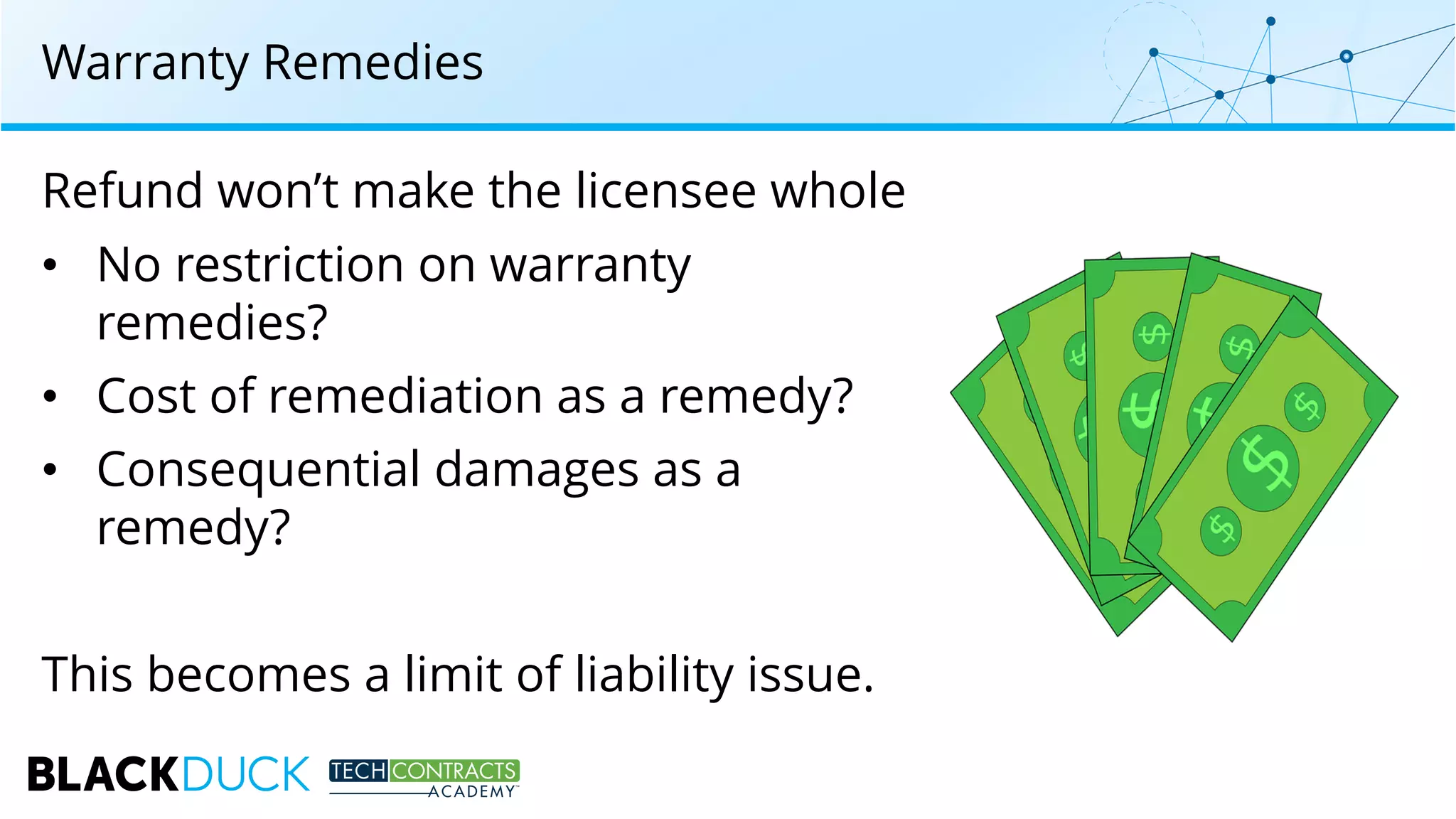
Refund won’t make the licensee whole
• No restriction on warranty
remedies?
• Cost of remediation as a remedy?
• Consequential damages as a
remedy?
This becomes a limit of liability issue.
Warranty Remedies
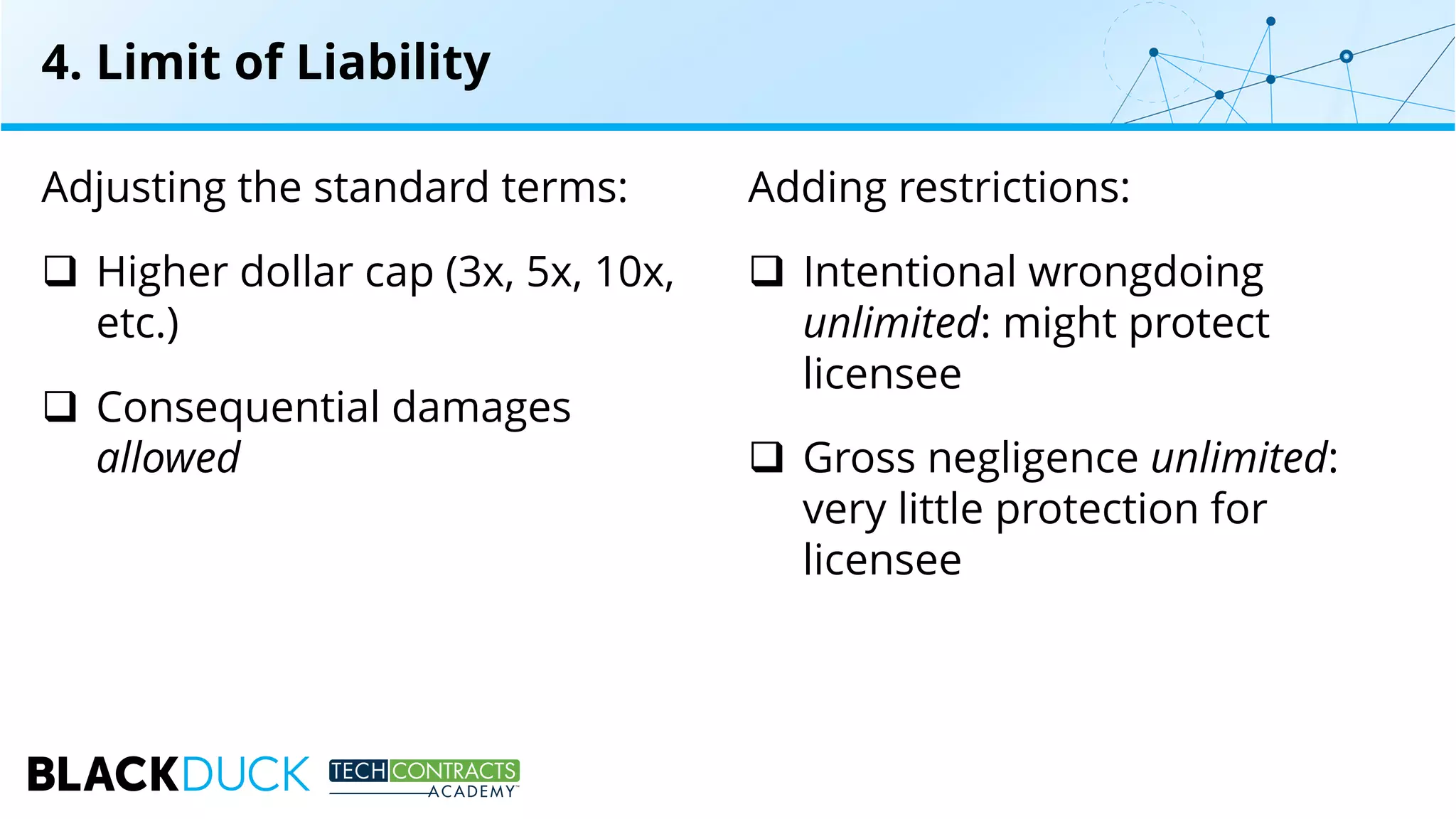
Adjusting the standard terms:
q Higher dollar cap (3x, 5x, 10x,
etc.)
q Consequential damages
allowed
Adding restrictions:
q Intentional wrongdoing
unlimited: might protect
licensee
q Gross negligence unlimited:
very little protection for
licensee
4. Limit of Liability
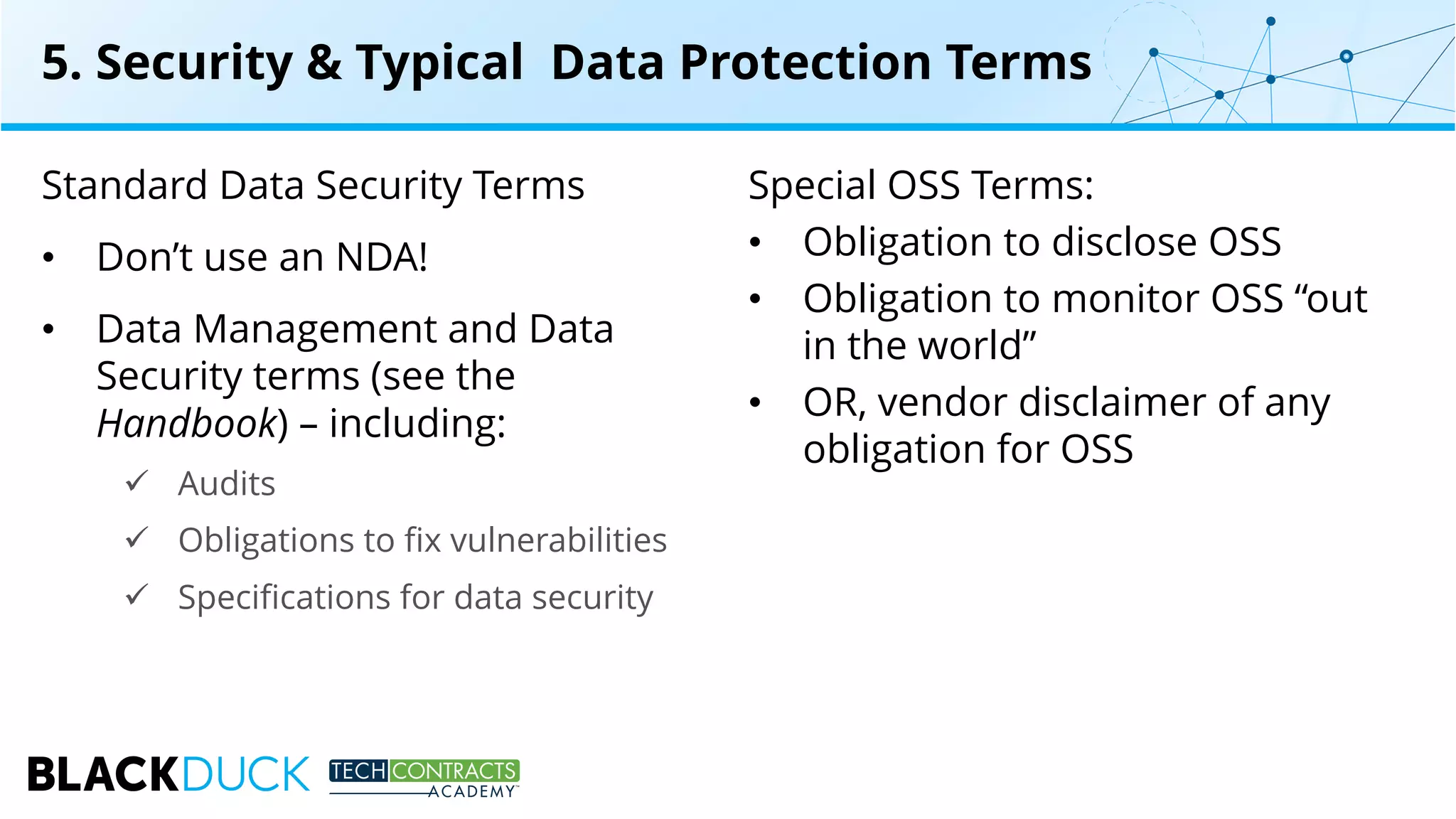
Standard Data Security Terms
• Don’t use an NDA!
• Data Management and Data
Security terms (see the
Handbook) – including:
ü Audits
ü Obligations to fix vulnerabilities
ü Specifications for data security
Special OSS Terms:
• Obligation to disclose OSS
• Obligation to monitor OSS “out
in the world”
• OR, vendor disclaimer of any
obligation for OSS
5. Security & Typical Data Protection Terms
This is tricky, since it’s hard to know which party should be
responsible for a data breach (unlike an IP claim).
• Vendor indemnifies all data breaches
• Vendor indemnifies all data breaches related to OSS
• Vendor indemnifies if it’s at fault
• Licensee indemnifies all data breaches (except maybe re
OSS)
• Whoever’s computers were breached indemnifies
• No data breach indemnity
6. Security & Data Protection Indemnity
q Typical IP Warranty: should cover
it
q Clearer Attribution Warranty:
“Vendor represents and warrants
that all software included in the
System includes attribution to
third party vendors as required
by such licenses.”
7. Attribution/Compliance Warranty
Thank you to Pixabay for several of these graphics: www.Pixabay.com

Buyer and Seller Perspectives on Open Source in Tech Contracts

  • 1.
    Buyer and Seller Perspectiveson Open Source in Tech Contracts David Tollen, Tech Contracts Academy Phil Odence, Black Duck Software
  • 2.
    Speakers David Tollen Founder &Trainer Tech Contracts Academy Founder and Attorney Sycamore Legal, P.C. Phil Odence VP and General Manager Black Duck Software
  • 3.
    Intro Trends in Softwareand Open Source
  • 4.
    4 Virtually all Global2000 companies use open source to run critical infrastructure. - Gartner Open Source Has Blown Past the Tipping Point Open Source Projects (Millions) 2.5 0.1 0.2 0.5 1.5 1.0 2007 2009 2011 2013 2015 2017
  • 5.
    Your Clients UseOpen Source 22% of applications had >50% open source Source: BD 2017 OSSRA Study 5
  • 6.
    Basic Challenge: OSS OftenEnters a Code Base Unchecked Code Base Commercial 3rd Party Code Purchasing • Licensing? • Security? • Quality? • Support? Open Source OPERATIONAL RISK Which versions of code are being used, and how old are they LEGAL RISK Which licenses are used and do they match anticipated use of the code SECURITY RISK Which components have vulnerabilities and what are they Management visibility…not! 6
  • 7.
    Using OSS isNot a Free Lunch… …internal governance maximizes OSS benefits while managing the risks 7
  • 8.
    Understanding OSS inContracts: Agenda A. Open Source in General § Types of Open Source Licenses § How Copyleft Works § Security Concerns B. Clauses Impacted 1. “Magical” Open Source Guarantee 2. IP Indemnity 3. IP Warranty 4. Limit of Liability 5. Security and Data Protection Terms 6. Security and Data Protection Indemnity 7. Attribution/Compliance warranty
  • 9.
    • THE TECHCONTRACTS HANDBOOK: Software Licenses, Cloud Computing Agreements, and Other IT Contracts, for Lawyers and Businesspeople, Second Edition, by David W. Tollen (ABA Publishing 2015) • TechContracts.com: form contracts, sample language, articles, & other resources – free – www.TechContracts.com • Tech Contracts Academy™: training on drafting and negotiating IT contracts, for lawyers and businesspeople – www.TechContracts.com • Sycamore Legal, P.C.®: legal services, including coaching/advice for in-house counsel – www.SycamoreLegal.com Resources
  • 10.
  • 11.
    Software licensed with: 1.access to source code; and 2. the right to modify and redistribute. Open Source Licenses
  • 12.
    Permissive Open SourceLicenses No significant restriction on licensee right to redistribute – BSD, MIT Copyleft Open Source Licenses Requirement that redistribution use the open source model • Strong Copyleft (“viral”): all derivative/modified code must use OSS model – GPL; even provision of SaaS may need OSS model – AGPL • Weak Copyleft: only original code/library must use OSS model – CDDL, MPL, LGPL Types of OSS/Licenses
  • 13.
    • The problem:everyone gets access to the code, including hackers • Heavily disputed in the OSS community – not our problem here • The Solution: data security terms, as in any other IT contract (but maybe more) Security of OSS (or lack thereof)
  • 14.
  • 15.
    1. “Magical” OpenSource Guarantees • Promise that the code won’t include OSS: “Yeah, right.” • Promise that the code won’t include copyleft or strong copyleft: better • View this instead as an issue for typical IT contract clauses, like warranty, indemnity, data security: best
  • 16.
    Typical IP indemnityshould already cover copyleft claims • Licensee can improve by specifying indemnity for “claims re restrictions on Distributor’s right to distribute the Licensed Program, or any modification thereof: (a) for a fee, (b) with or without source code or source code rights, or (c) with such restrictions as Distributor sees fit to place on its customers’ modification or distribution rights” • But what happens if the vendor loses the suit? 2. IP Indemnity
  • 17.
    Typical (from theHandbook) “Vendor represents and warrants that it is the owner of the System and of each and every component thereof, or the recipient of a valid license thereto, and that it has and will maintain the full power and authority to grant the intellectual property and other rights granted in this Agreement without the further consent of any third party.” Copyleft-specific (from the Handbook) “Vendor represents and warrants that the Licensed Program does not include software subject to any legal requirement that would restrict Distributor’s right to distribute the Licensed Program, or any modification thereof: (a) for a fee, (b) with or without source code or source code rights, or (c) with such restrictions as Distributor sees fit to place on its customers’ modification or distribution rights.” 3. IP Warranty
  • 18.
    Refund won’t makethe licensee whole • No restriction on warranty remedies? • Cost of remediation as a remedy? • Consequential damages as a remedy? This becomes a limit of liability issue. Warranty Remedies
  • 19.
    Adjusting the standardterms: q Higher dollar cap (3x, 5x, 10x, etc.) q Consequential damages allowed Adding restrictions: q Intentional wrongdoing unlimited: might protect licensee q Gross negligence unlimited: very little protection for licensee 4. Limit of Liability
  • 20.
    Standard Data SecurityTerms • Don’t use an NDA! • Data Management and Data Security terms (see the Handbook) – including: ü Audits ü Obligations to fix vulnerabilities ü Specifications for data security Special OSS Terms: • Obligation to disclose OSS • Obligation to monitor OSS “out in the world” • OR, vendor disclaimer of any obligation for OSS 5. Security & Typical Data Protection Terms
  • 21.
    This is tricky,since it’s hard to know which party should be responsible for a data breach (unlike an IP claim). • Vendor indemnifies all data breaches • Vendor indemnifies all data breaches related to OSS • Vendor indemnifies if it’s at fault • Licensee indemnifies all data breaches (except maybe re OSS) • Whoever’s computers were breached indemnifies • No data breach indemnity 6. Security & Data Protection Indemnity
  • 22.
    q Typical IPWarranty: should cover it q Clearer Attribution Warranty: “Vendor represents and warrants that all software included in the System includes attribution to third party vendors as required by such licenses.” 7. Attribution/Compliance Warranty
  • 23.
    Thank you toPixabay for several of these graphics: www.Pixabay.com