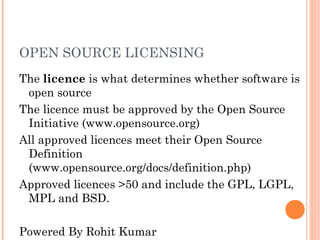
OPEN SOURCE LICENSING
The licence is what determines whether software is
 open source
The licence must be approved by the Open Source
 Initiative (www.opensource.org)
All approved licences meet their Open Source
 Definition
 (www.opensource.org/docs/definition.php)
Approved licences >50 and include the GPL, LGPL,
 MPL and BSD.

Powered By Rohit Kumar
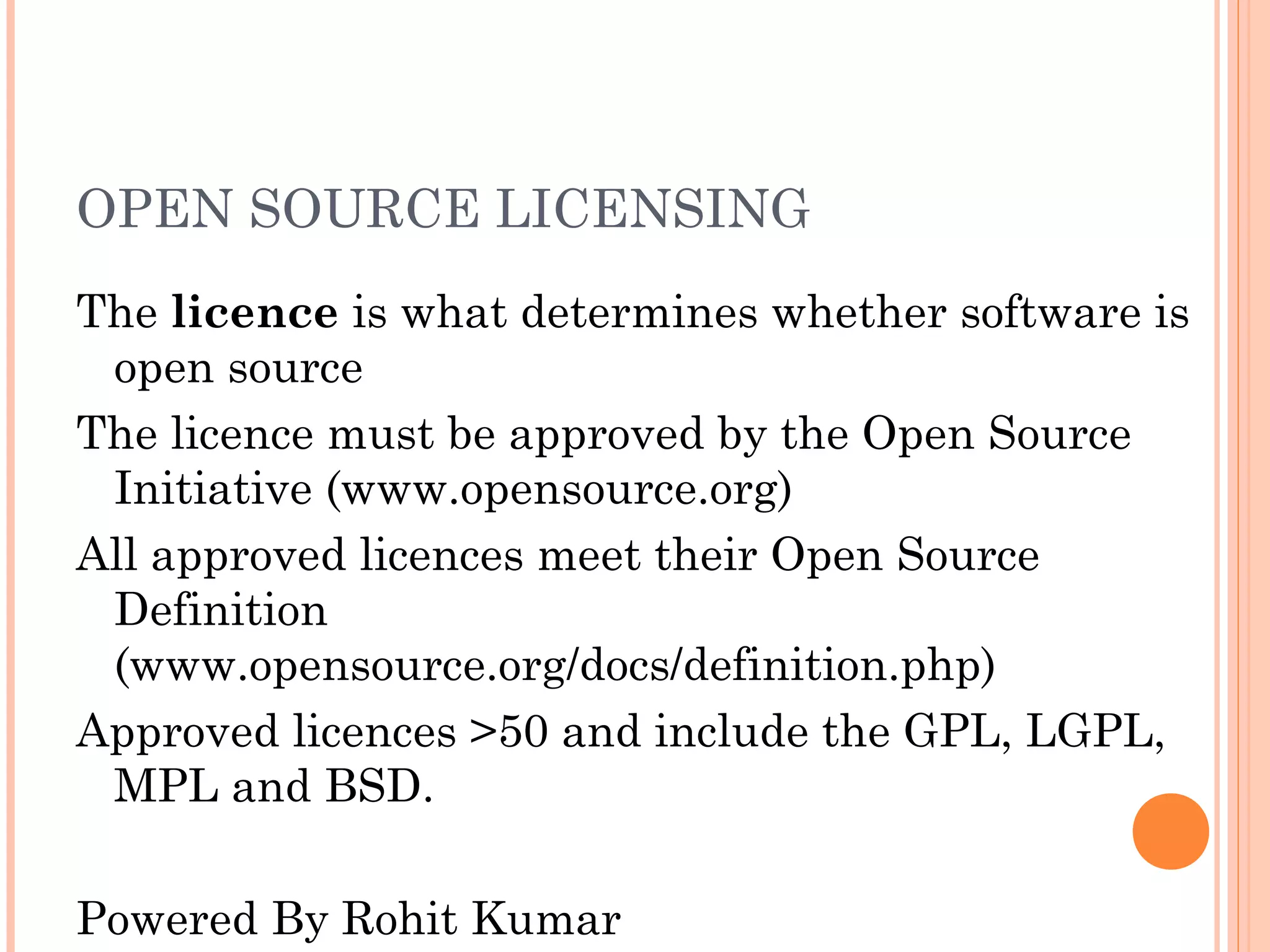
INTELLECTUAL PROPERTY RIGHTS
 Writing  software = creating property
 Property is always owned by somebody
 Agreements and contracts should specify who
  owns property that is created
 This may require a technical legal examination of
  any agreement and contracts
 All projects which produce software need to keep
  complete, detailed records of the licensing and
  ownership of contributions to that software - an
  IPR registry

Powered By Rohit Kumar
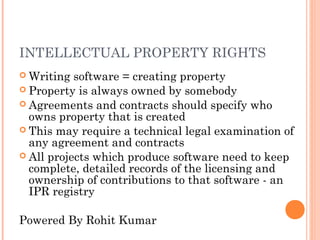
COPYRIGHT
 Software is protected by copyright law
 By default only the owner of software may copy, adapt
  or distribute it.
 The owner of software can agree to let another person
  copy, adapt or distribute the code - this agreement is
  called a licence.


Powered By Rohit Kumar
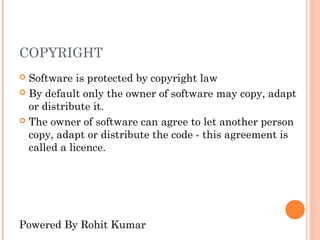
LICENCE EFFECTS
 Open source licences grant the rights to copy, adapt or
  distribute the code to people other than the owner
 Open source licences aim to create a community of
  contributors who will fix and develop the software.
 Combining two pieces of software code under different
  licences can be complex.


Powered By Rohit Kumar
A COMMON MYTH
 There is no compulsion to release changes that you
  make, either under the GPL or any other open source
  licence
 You may keep internal versions of GPL software that
  you have modified without necessarily licensing them
  to anyone else
 This applies equally to individuals and legal entities
  like companies and institutions.


Powered By Rohit Kumar
A COMMON MYTH
 There is no compulsion to release changes that you
  make, either under the GPL or any other open source
  licence
 You may keep internal versions of GPL software that
  you have modified without necessarily licensing them
  to anyone else
 This applies equally to individuals and legal entities
  like companies and institutions.


Powered By Rohit Kumar

Open source license

  • 1.
    OPEN SOURCE LICENSING Thelicence is what determines whether software is open source The licence must be approved by the Open Source Initiative (www.opensource.org) All approved licences meet their Open Source Definition (www.opensource.org/docs/definition.php) Approved licences >50 and include the GPL, LGPL, MPL and BSD. Powered By Rohit Kumar
  • 2.
    INTELLECTUAL PROPERTY RIGHTS Writing software = creating property  Property is always owned by somebody  Agreements and contracts should specify who owns property that is created  This may require a technical legal examination of any agreement and contracts  All projects which produce software need to keep complete, detailed records of the licensing and ownership of contributions to that software - an IPR registry Powered By Rohit Kumar
  • 3.
    COPYRIGHT  Software isprotected by copyright law  By default only the owner of software may copy, adapt or distribute it.  The owner of software can agree to let another person copy, adapt or distribute the code - this agreement is called a licence. Powered By Rohit Kumar
  • 4.
    LICENCE EFFECTS  Opensource licences grant the rights to copy, adapt or distribute the code to people other than the owner  Open source licences aim to create a community of contributors who will fix and develop the software.  Combining two pieces of software code under different licences can be complex. Powered By Rohit Kumar
  • 5.
    A COMMON MYTH There is no compulsion to release changes that you make, either under the GPL or any other open source licence  You may keep internal versions of GPL software that you have modified without necessarily licensing them to anyone else  This applies equally to individuals and legal entities like companies and institutions. Powered By Rohit Kumar
  • 6.
    A COMMON MYTH There is no compulsion to release changes that you make, either under the GPL or any other open source licence  You may keep internal versions of GPL software that you have modified without necessarily licensing them to anyone else  This applies equally to individuals and legal entities like companies and institutions. Powered By Rohit Kumar