STRATEGIC
MANAGEMENT
Session By: Hitesh Sharma & Tanya Singh
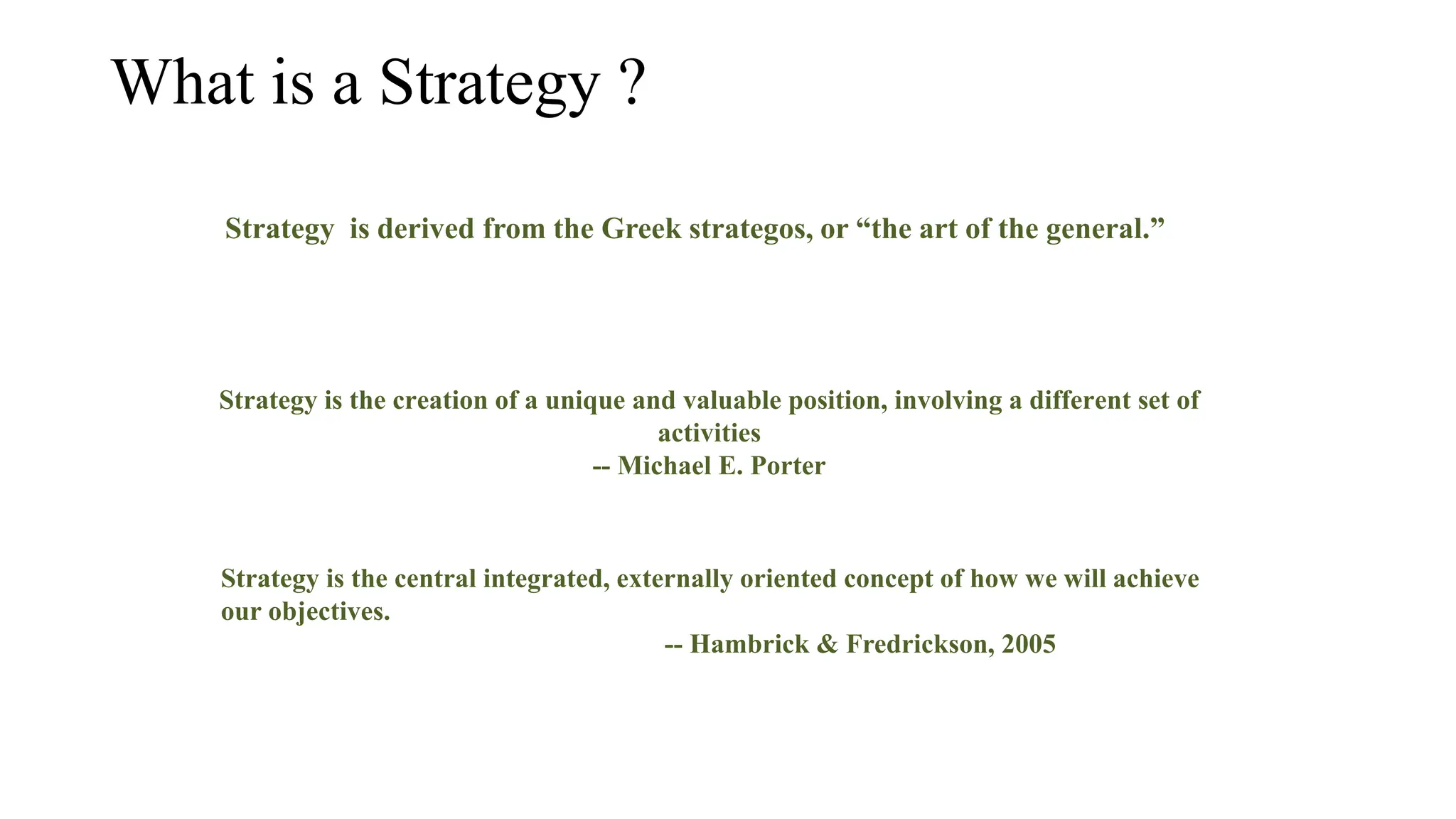
What is a Strategy ?
Strategy is the creation of a unique and valuable position, involving a different set of
activities
-- Michael E. Porter
Strategy is derived from the Greek strategos, or “the art of the general.”
Strategy is the central integrated, externally oriented concept of how we will achieve
our objectives.
-- Hambrick & Fredrickson, 2005
What is a good strategy all about?
1. A diagnosis: an explanation of the nature of the challenge. A good diagnosis
simplifies the often overwhelming complexity of reality by identifying certain
aspects of the situation as being the critical ones.
2. A guiding policy: an overall approach chosen to cope with or overcome the
obstacles identified in the diagnosis.
3. Coherent actions: steps that are coordinated with one another to support the
accomplishment of the guiding policy.
What Is Strategic Management?
• Strategic management is the management of an organization’s
resources to achieve its goals and objectives.
• Strategic management involves setting objectives, analyzing the
competitive environment, analyzing the internal organization,
evaluating strategies, and ensuring that management rolls out the
strategies across the organization.
DECISION MAKING
• Strategic decision-making is a process of understanding the
interaction of decisions and their impact upon the organization to
gain an advantage. Wrong decisions taken at the wrong time, may
result in catastrophic consequences. In other words, the power of
strategic thinking lies in combining the power of the right decision
with the right time.
• It all starts with problem identification, seek information, brainstorm
solutions, choose an alternative, implement the plan and evaluate
the outcome.
Strategic Intent
The ten schools of strategy formulation
Process of Strategic management
There are four stages of strategic management. They are:
• Environmental scanning
• Strategy formulation
• Strategy implementation
• Strategy evaluation
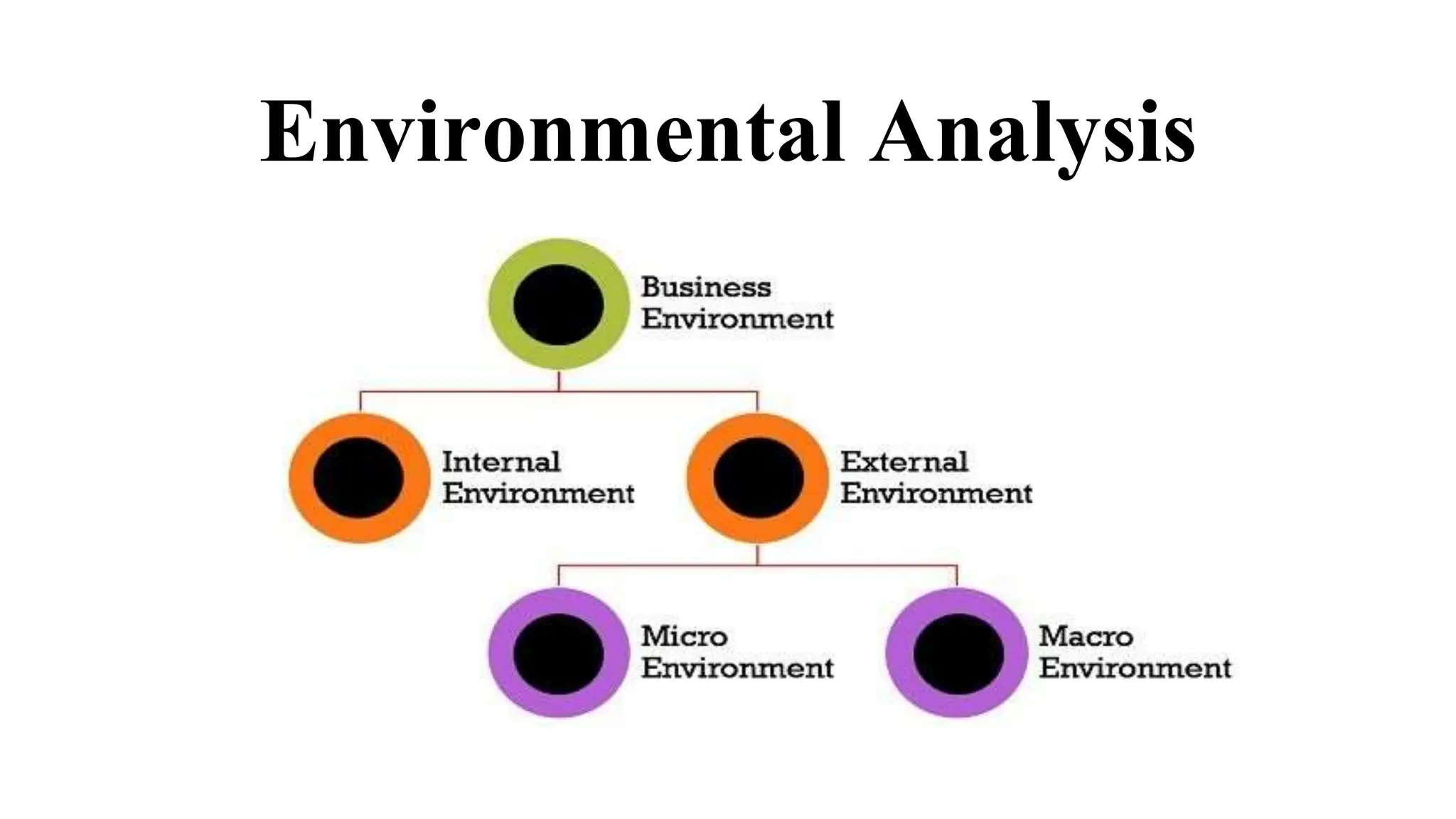
Environmental Analysis
Porter 5 forces analyses
 Competitive Rivals
The number of competitors
Industry growth
Similarities in what's offered
Exit barriers
 Potential for New Entrants in an Industry
Economies of scale - Industries where large-scale production leads to lower costs face less of a threat from
new entrants.
Capital requirements - High startup costs for equipment, facilities, etc., can deter new entrants.
Access to distribution channels - If existing firms control the distribution channels—retail stores, online
platforms, cable infrastructure, etc.—then new entrants would need to find a way to replicate that structure
Regulations - Licenses, safety standards, and other regulatory standards can create barriers
Switching costs - If it's costly or difficult for customers to switch from existing firms to new entrants, the
threat of entry is lower.
 Supplier Power
The number of suppliers: When few firms can give a company something it needs to
stay in business, each has greater negotiating power
Uniqueness: If a supplier provides a unique product or it's not easy to find a
substitute, it is more dominant
Switching costs: If it's costly or time-consuming to switch suppliers, then they have
more power
 Customer Power
The number of buyers: The fewer the buyers, the more they have power
Switching costs: In industries like telecommunications, where it's easy for consumers to
switch providers, they have to offer competitive terms.
Price sensitivity: In the fast-fashion industry, where customers are highly price-
sensitive, brands must keep their prices low to attract cost-conscious consumers.
Informed buyers: In many sectors, the customers are savvy, know the competitive
terrain well, and thus can negotiate better prices.
 Threat of Substitutes
Relative price performance: If the cost of a substitute is lower and its performance is
comparable or better, customers are likely to switch to the substitute
Customer willingness to go elsewhere: The threat is high if buyers find it easy to
switch to a substitute
Factors influencing external environment
Dynamics of Internal Environment
• Internal environment is a component of the business environment, which
is composed of various elements present inside the organization that can
affect or can be affected with, the choices, activities and decisions of the
organization
• It encompasses the climate, culture, machines/ equipment, work
and work processes, members, management and management
practices.
Factors influencing Internal environment:
The VRIO Framework
• VRIO is an acronym standing for Valuable, Rare, Inimitable, and Organized. The framework
provides a way to analyze your resources and capabilities to uncover a sustainable competitive
advantage.
• What the VRIO framework says is that in order to have a sustainable competitive advantage, one of your
resources must be valuable, rare, inimitable, and organized.
• Examining resources and capabilities in this way is often referred to as a resource-based view (RBV).
Resource-based view works on the premise that resources and capabilities are fundamental to superior
performance for a firm.
WHAT IS STRATEGY FORMULATION?
• Strategy formulation is the process of using available
knowledge to document the intended direction of a business and
the actionable steps to reach its goals.
• This process is used for resource allocation, prioritization,
organization-wide alignment, and validation of business goals.
• A successful strategy can allow your organization to share one clear
vision, catch biases by examining the reasoning behind goals, and
track performance with measurable key performance indicators
(KPIs).
Levels of Strategy
Corporate level strategy
A corporate-level strategy can be instrumental in outlining
your company's goal for the following year. You need to break down all
steps that make it clear for your employees the path they're supposed to
take. The type of corporate-level strategy you select can be an indicator
of the company's financial success and the method they take to generate
profits.
Types of Corporate-level strategy
Stability Strategy
As the name implies, a stability business strategy seeks to
maintain operations and market size and position. This strategy is
characteristic of small risk-averse firms or firms operating in a very
precarious market that is comfortable with its current position.
Expansion Strategy
• An expansion strategy is synonymous with a growth strategy. A firm seeks to
achieve faster growth, compete, achieve higher profits, grow a brand, capitalize
on economies of scale, have greater impact, or occupy a larger market share.
This may entail acquiring more market share through traditional competitive
strategies, entering new markets, targeting new market segments, offering new
produce or services, expanding or improving current operations.
Retrenchment Strategy
• Aredemption strategy seeks to restructure, sell or otherwise divest a
business unit. The purpose is to reduce costs, streamline operations,
or stabilize cash flow.
Business level strategy:
• Business level strategies refer to the combined set of moves and
actions taken with an aim of offering value to the customers and
developing a competitive advantage, by using the firm’s core
competencies, in the individual product or service market. It
determines the market position of the enterprise, in relation to its
rivals.
• Business-Level Strategies are mainly concerned with the firms
having multiple businesses and each business is considered as
Strategic Business Unit (SBU).
Cost Uniqueness
Competitive advantage
Amazon, Mc Donald,
Coca-Cola etc.
Apple, Toyota, etc.
South-west airlines,
Costco etc.
Rolls Royce, Louis
Vuitton etc.
Functional level strategy
• Functional strategy is the approach,
a functional area takes to achieve
corporate and business unit
objectives and strategies by
maximizing resource productivity.
• It helps managers in focusing
company’s major functional areas
of activity.
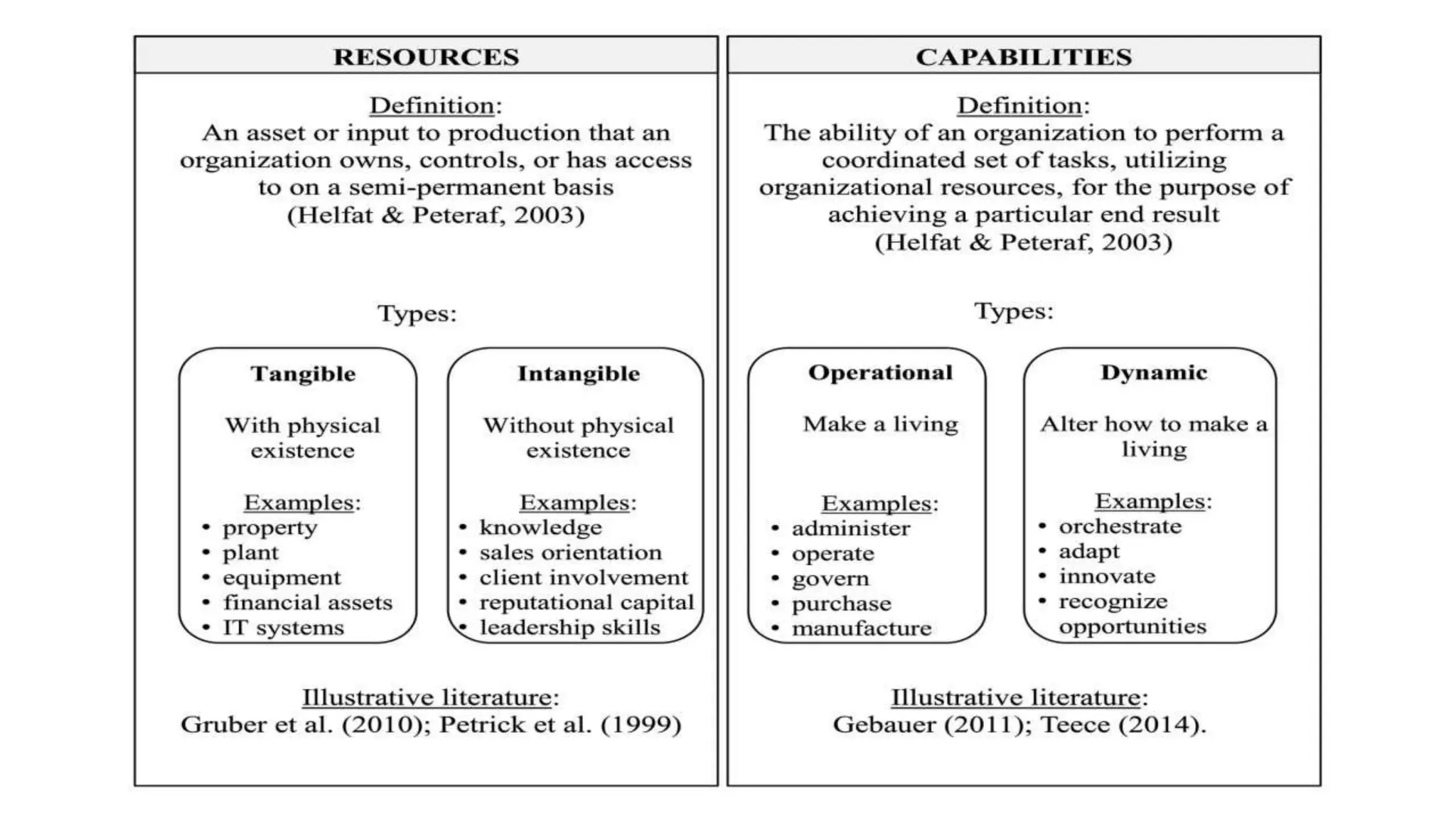
Resources, Capabilities and Core-competence
Core-competence: A core competency is a concept in management theory introduced by C. K. Prahlad and Gary
Hamel. It can be defined as "a harmonized combination of multiple resources and skills that distinguish a firm in
the marketplace" and therefore are the foundation of companies' competitiveness.
Resources: Resource refers to all the materials available in the internal or external environment which are
technologically accessible, economically feasible and culturally sustainable and helps business to satisfy consumer
needs and wants.
Capabilities: The word capability has its root in the systems engineering, which is defined as the ability to execute
a specified course of action. A capability may or may not be accompanied by an intention.
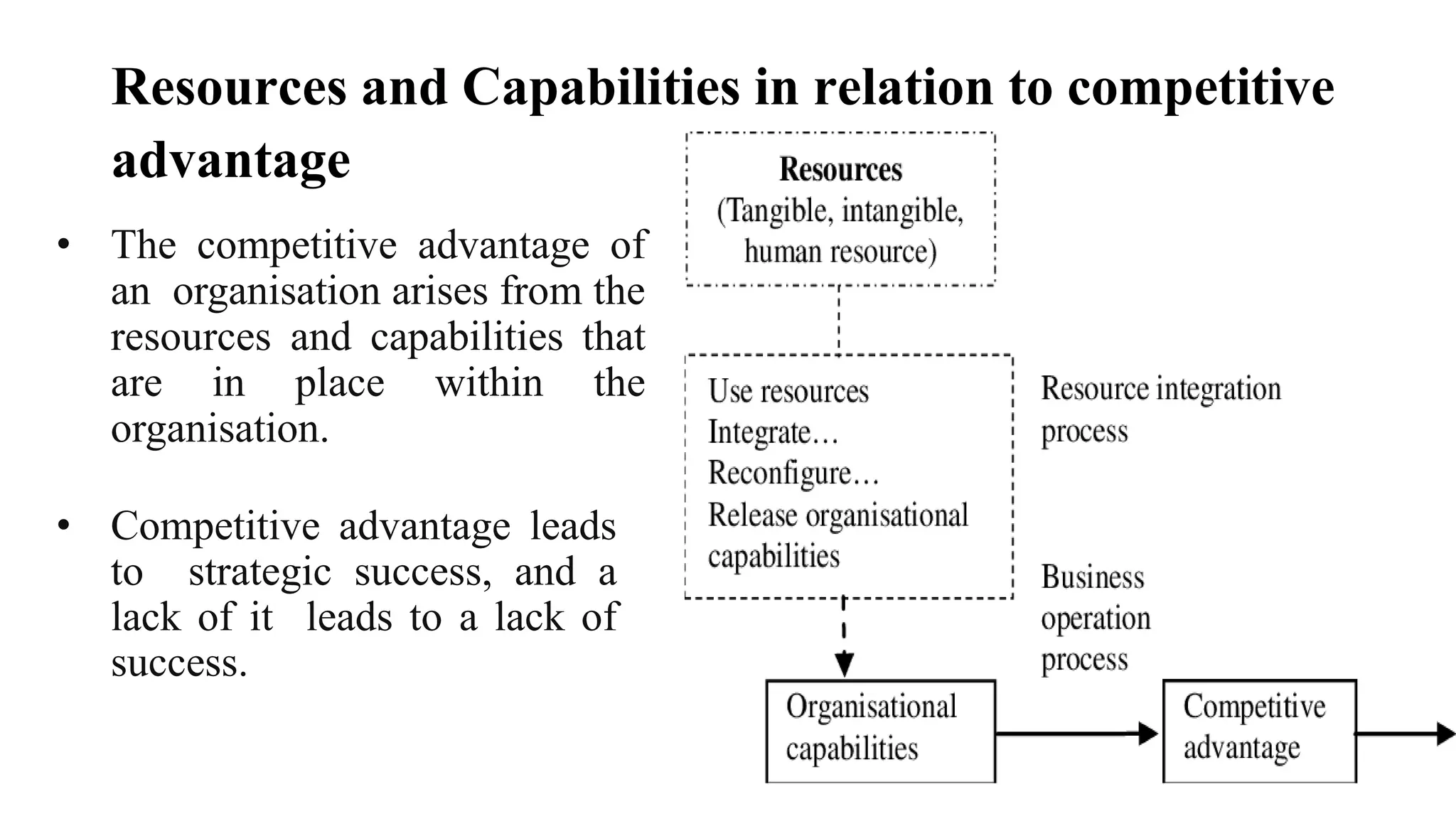
Resources and Capabilities in relation to competitive
advantage
• The competitive advantage of
an organisation arises from the
resources and capabilities that
are in place within the
organisation.
• Competitive advantage leads
to strategic success, and a
lack of it leads to a lack of
success.
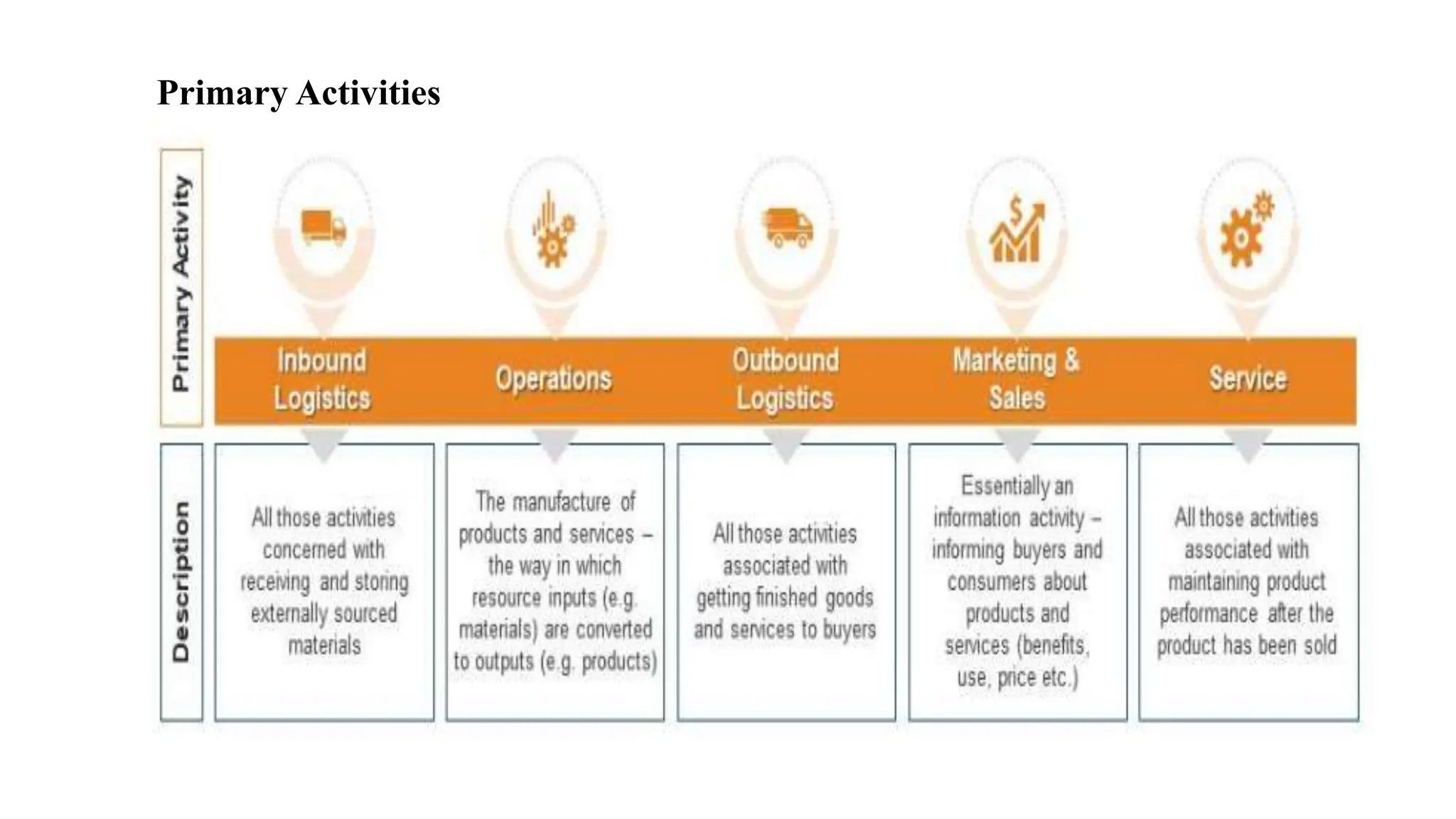
Primary Activities
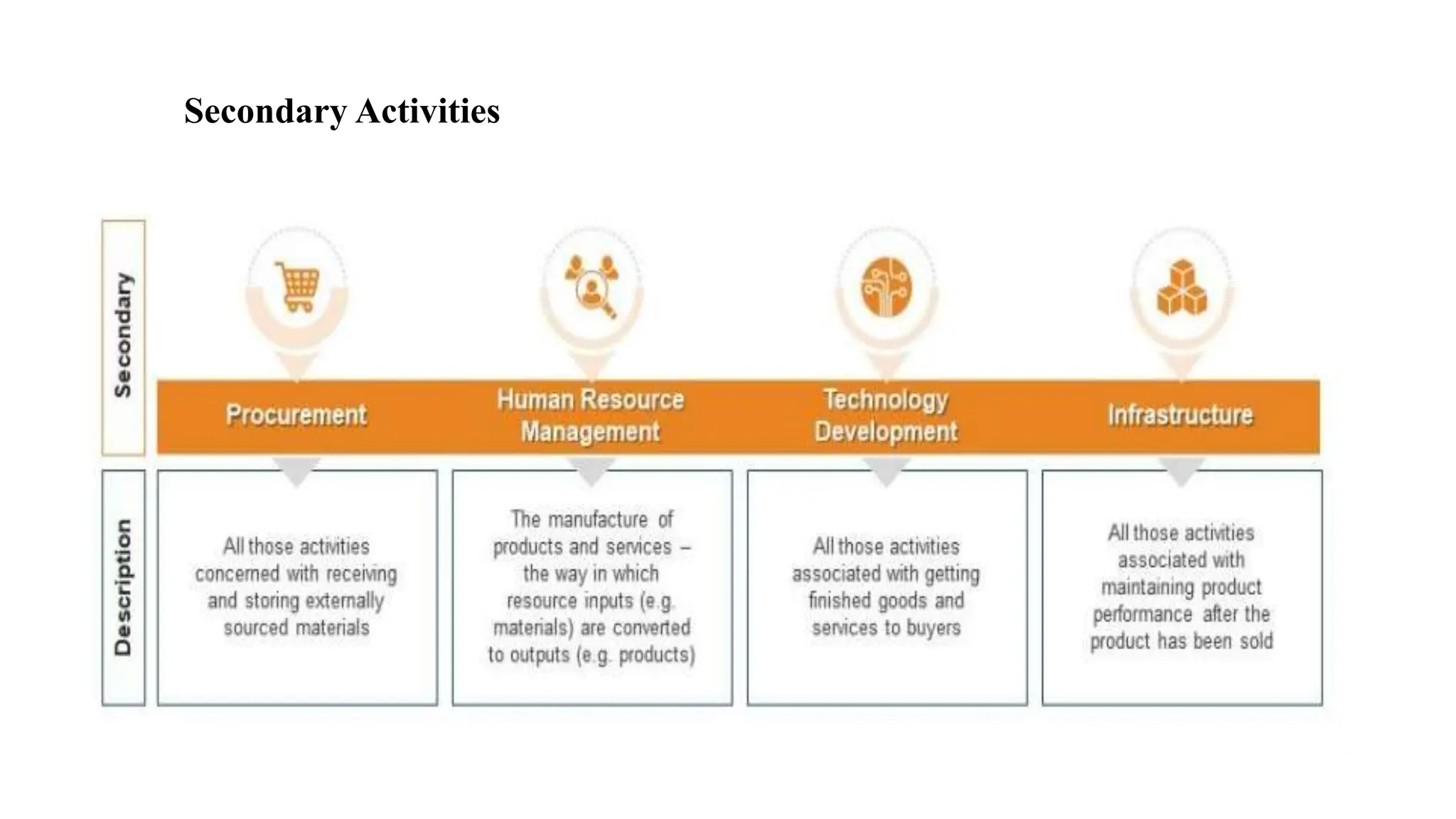
Secondary Activities

Strategies for managing the managers.pptx

  • 1.
  • 2.
    What is aStrategy ? Strategy is the creation of a unique and valuable position, involving a different set of activities -- Michael E. Porter Strategy is derived from the Greek strategos, or “the art of the general.” Strategy is the central integrated, externally oriented concept of how we will achieve our objectives. -- Hambrick & Fredrickson, 2005
  • 5.
    What is agood strategy all about? 1. A diagnosis: an explanation of the nature of the challenge. A good diagnosis simplifies the often overwhelming complexity of reality by identifying certain aspects of the situation as being the critical ones. 2. A guiding policy: an overall approach chosen to cope with or overcome the obstacles identified in the diagnosis. 3. Coherent actions: steps that are coordinated with one another to support the accomplishment of the guiding policy.
  • 6.
    What Is StrategicManagement? • Strategic management is the management of an organization’s resources to achieve its goals and objectives. • Strategic management involves setting objectives, analyzing the competitive environment, analyzing the internal organization, evaluating strategies, and ensuring that management rolls out the strategies across the organization.
  • 7.
    DECISION MAKING • Strategicdecision-making is a process of understanding the interaction of decisions and their impact upon the organization to gain an advantage. Wrong decisions taken at the wrong time, may result in catastrophic consequences. In other words, the power of strategic thinking lies in combining the power of the right decision with the right time. • It all starts with problem identification, seek information, brainstorm solutions, choose an alternative, implement the plan and evaluate the outcome.
  • 8.
  • 9.
    The ten schoolsof strategy formulation
  • 11.
    Process of Strategicmanagement There are four stages of strategic management. They are: • Environmental scanning • Strategy formulation • Strategy implementation • Strategy evaluation
  • 13.
  • 14.
    Porter 5 forcesanalyses  Competitive Rivals The number of competitors Industry growth Similarities in what's offered Exit barriers  Potential for New Entrants in an Industry Economies of scale - Industries where large-scale production leads to lower costs face less of a threat from new entrants. Capital requirements - High startup costs for equipment, facilities, etc., can deter new entrants. Access to distribution channels - If existing firms control the distribution channels—retail stores, online platforms, cable infrastructure, etc.—then new entrants would need to find a way to replicate that structure Regulations - Licenses, safety standards, and other regulatory standards can create barriers Switching costs - If it's costly or difficult for customers to switch from existing firms to new entrants, the threat of entry is lower.
  • 15.
     Supplier Power Thenumber of suppliers: When few firms can give a company something it needs to stay in business, each has greater negotiating power Uniqueness: If a supplier provides a unique product or it's not easy to find a substitute, it is more dominant Switching costs: If it's costly or time-consuming to switch suppliers, then they have more power  Customer Power The number of buyers: The fewer the buyers, the more they have power Switching costs: In industries like telecommunications, where it's easy for consumers to switch providers, they have to offer competitive terms. Price sensitivity: In the fast-fashion industry, where customers are highly price- sensitive, brands must keep their prices low to attract cost-conscious consumers. Informed buyers: In many sectors, the customers are savvy, know the competitive terrain well, and thus can negotiate better prices.
  • 16.
     Threat ofSubstitutes Relative price performance: If the cost of a substitute is lower and its performance is comparable or better, customers are likely to switch to the substitute Customer willingness to go elsewhere: The threat is high if buyers find it easy to switch to a substitute
  • 18.
  • 19.
    Dynamics of InternalEnvironment • Internal environment is a component of the business environment, which is composed of various elements present inside the organization that can affect or can be affected with, the choices, activities and decisions of the organization • It encompasses the climate, culture, machines/ equipment, work and work processes, members, management and management practices.
  • 20.
  • 21.
    The VRIO Framework •VRIO is an acronym standing for Valuable, Rare, Inimitable, and Organized. The framework provides a way to analyze your resources and capabilities to uncover a sustainable competitive advantage. • What the VRIO framework says is that in order to have a sustainable competitive advantage, one of your resources must be valuable, rare, inimitable, and organized. • Examining resources and capabilities in this way is often referred to as a resource-based view (RBV). Resource-based view works on the premise that resources and capabilities are fundamental to superior performance for a firm.
  • 23.
    WHAT IS STRATEGYFORMULATION? • Strategy formulation is the process of using available knowledge to document the intended direction of a business and the actionable steps to reach its goals. • This process is used for resource allocation, prioritization, organization-wide alignment, and validation of business goals. • A successful strategy can allow your organization to share one clear vision, catch biases by examining the reasoning behind goals, and track performance with measurable key performance indicators (KPIs).
  • 24.
  • 25.
    Corporate level strategy Acorporate-level strategy can be instrumental in outlining your company's goal for the following year. You need to break down all steps that make it clear for your employees the path they're supposed to take. The type of corporate-level strategy you select can be an indicator of the company's financial success and the method they take to generate profits.
  • 26.
  • 27.
    Stability Strategy As thename implies, a stability business strategy seeks to maintain operations and market size and position. This strategy is characteristic of small risk-averse firms or firms operating in a very precarious market that is comfortable with its current position.
  • 29.
    Expansion Strategy • Anexpansion strategy is synonymous with a growth strategy. A firm seeks to achieve faster growth, compete, achieve higher profits, grow a brand, capitalize on economies of scale, have greater impact, or occupy a larger market share. This may entail acquiring more market share through traditional competitive strategies, entering new markets, targeting new market segments, offering new produce or services, expanding or improving current operations.
  • 30.
    Retrenchment Strategy • Aredemptionstrategy seeks to restructure, sell or otherwise divest a business unit. The purpose is to reduce costs, streamline operations, or stabilize cash flow.
  • 32.
    Business level strategy: •Business level strategies refer to the combined set of moves and actions taken with an aim of offering value to the customers and developing a competitive advantage, by using the firm’s core competencies, in the individual product or service market. It determines the market position of the enterprise, in relation to its rivals. • Business-Level Strategies are mainly concerned with the firms having multiple businesses and each business is considered as Strategic Business Unit (SBU).
  • 33.
    Cost Uniqueness Competitive advantage Amazon,Mc Donald, Coca-Cola etc. Apple, Toyota, etc. South-west airlines, Costco etc. Rolls Royce, Louis Vuitton etc.
  • 34.
    Functional level strategy •Functional strategy is the approach, a functional area takes to achieve corporate and business unit objectives and strategies by maximizing resource productivity. • It helps managers in focusing company’s major functional areas of activity.
  • 35.
  • 36.
    Core-competence: A corecompetency is a concept in management theory introduced by C. K. Prahlad and Gary Hamel. It can be defined as "a harmonized combination of multiple resources and skills that distinguish a firm in the marketplace" and therefore are the foundation of companies' competitiveness. Resources: Resource refers to all the materials available in the internal or external environment which are technologically accessible, economically feasible and culturally sustainable and helps business to satisfy consumer needs and wants. Capabilities: The word capability has its root in the systems engineering, which is defined as the ability to execute a specified course of action. A capability may or may not be accompanied by an intention.
  • 38.
    Resources and Capabilitiesin relation to competitive advantage • The competitive advantage of an organisation arises from the resources and capabilities that are in place within the organisation. • Competitive advantage leads to strategic success, and a lack of it leads to a lack of success.
  • 40.
  • 41.