Staffing the
Engineering
Organization
Chapter 5
Objectives:
Establish a basic ground of what staffing.
Identify and appreciate the basic process of
staffing and its benefits.
 Develop staffing techniques in order to be
an efficient engineer manager.
Address company issues with an effective
staffing management application.
What is STAFFING?
Staffing is the process of
acquiring, deploying, and retaining a
workforce of sufficient quantity and quality
to create positive impacts on the
organization’s effectiveness.
(Heneman and Judge, 2005)
The Goal of Staffing…
Is to match people with jobs so that the
realization of the organizations objectives will be
facilitated.
As an Engineer Manager…
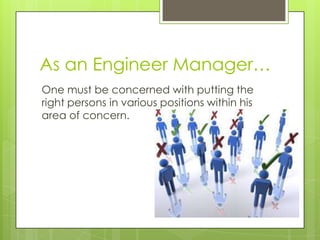
One must be concerned with putting the
right persons in various positions within his
area of concern.
As an Engineer Manager…
There is great responsibility in assuring that
the right persons are assigned to positions
that fit their qualifications.
Staffing Procedure
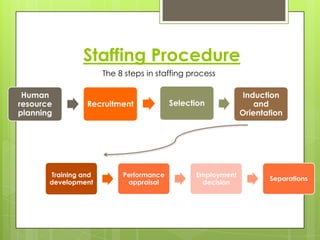
Human
resource
planning
Recruitment Selection
Induction
and
Orientation
Training and
development
Performance
appraisal
Employment
decision
Separations
The 8 steps in staffing process
Staffing Procedure:
Human Resource
Planning
 Human resource planning is first step
in staffing and is defined as the on-
going process of systematic planning
to achieve optimum use of an
organization's most valuable asset - its
human resources.
 The objective of human resource
planning is to ensure the best fit
between employees and jobs, while
avoiding manpower shortages or
surpluses.
The 3 Key Elements of
Human Resource Planning
1. Forecasting – is an assessment of
future human resource needs in relation
to the current capabilities of the
organization.
Methods of Forecasting:
 Time series methods
 Explanatory or casual method
 Monitoring methods
The 3 Key Elements of
Human Resource Planning
2. Programming - which means
translating the forecasted human
resource needs to personnel objectives
and goals.
3. Evaluation and control – which
refers to monitoring human resource
action plans and evaluating their
success.
Staffing Procedure:
Recruitment
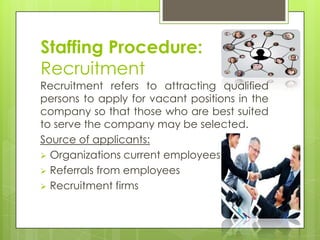
Recruitment refers to attracting qualified
persons to apply for vacant positions in the
company so that those who are best suited
to serve the company may be selected.
Source of applicants:
 Organizations current employees
 Referrals from employees
 Recruitment firms
Source of applicants:
 Newspaper advertisement
 Schools
 Competitors
 Internet
Staffing Procedure:
Selection
Selection refers to the act of choosing from
those that are available the individuals most
likely to succeed on the job.
The purpose of selection is to evaluate
each candidate and to pick the most
suited for the position available.
Selection procedures may be simple or
complex depending on the cost of a wrong
decision.
Staffing Procedure:
Selection
 If the management picks the wrong
person and the subsequent effect to the
organization is negligible, then the
selection process is made simple.
 Subsequently, when the position under
consideration involves special skills, a
more elaborate selection process is
undertaken.
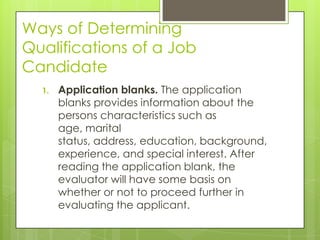
Ways of Determining
Qualifications of a Job
Candidate
1. Application blanks. The application
blanks provides information about the
persons characteristics such as
age, marital
status, address, education, background,
experience, and special interest. After
reading the application blank, the
evaluator will have some basis on
whether or not to proceed further in
evaluating the applicant.
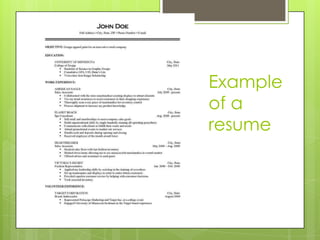
Example
of a
resume
Ways of Determining
Qualifications of a Job
Candidate
2. References. References are those written
by previous employees, co-
workers, teachers, club officers, etc.
there statement may provide some vital
information on the character of the
applicant.
Ways of Determining
Qualifications of a Job
Candidate
3. Interviews. Information may be gathered
in an interview by asking a series of
relevant questions to the job candidate.
Ways of Determining
Qualifications of a Job
Candidate
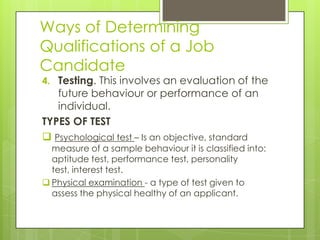
4. Testing. This involves an evaluation of the
future behaviour or performance of an
individual.
TYPES OF TEST
 Psychological test – Is an objective, standard
measure of a sample behaviour it is classified into:
aptitude test, performance test, personality
test, interest test.
 Physical examination - a type of test given to
assess the physical healthy of an applicant.
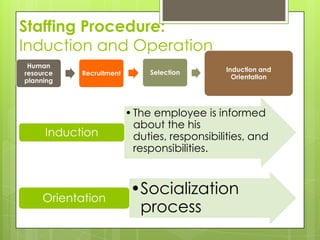
Staffing Procedure:
Induction and Operation
Human
resource
planning
Recruitment Selection Induction and
Orientation
•The employee is informed
about the his
duties, responsibilities, and
responsibilities.
Induction
•Socialization
process
Orientation
Staffing Procedure:
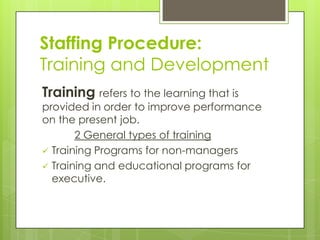
Training and Development
Training refers to the learning that is
provided in order to improve performance
on the present job.
2 General types of training
 Training Programs for non-managers
 Training and educational programs for
executive.
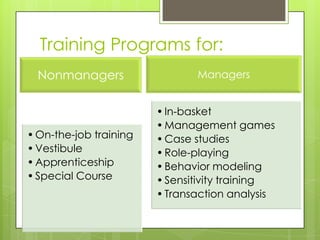
Training Programs for:
Nonmanagers
•On-the-job training
•Vestibule
•Apprenticeship
•Special Course
Managers
•In-basket
•Management games
•Case studies
•Role-playing
•Behavior modeling
•Sensitivity training
•Transaction analysis
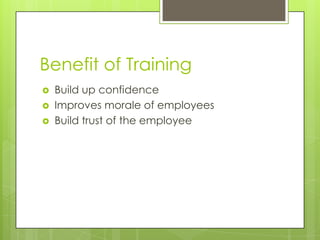
Benefit of Training
 Build up confidence
 Improves morale of employees
 Build trust of the employee
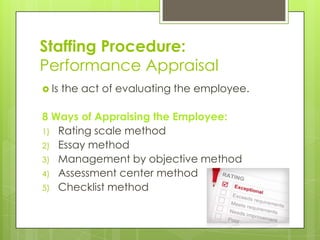
Staffing Procedure:
Performance Appraisal
 Is the act of evaluating the employee.
8 Ways of Appraising the Employee:
1) Rating scale method
2) Essay method
3) Management by objective method
4) Assessment center method
5) Checklist method
8 Ways of Appraising the
Employee:
6) Work standard method
7) Ranking method
8) Critical-incident method
Staffing Procedure:
Employment Decision
 Monetary Reward – this are given
to employees whose
performance is at par or above
standard requirements.
 Promotion – this refers to a
movement by a person into a
position of higher pay and greater
responsibilities and which is given
to a reward for competence and
ambition.
Staffing Procedure:
Employment Decision
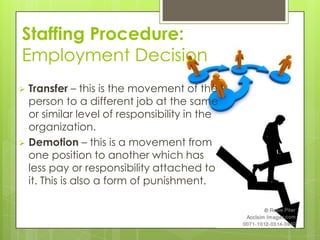
 Transfer – this is the movement of the
person to a different job at the same
or similar level of responsibility in the
organization.
 Demotion – this is a movement from
one position to another which has
less pay or responsibility attached to
it. This is also a form of punishment.
Staffing Procedure:
Separation
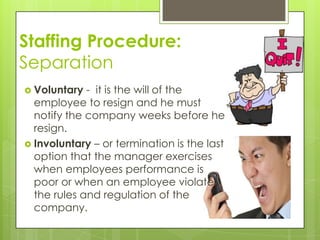
 Voluntary - it is the will of the
employee to resign and he must
notify the company weeks before he
resign.
 Involuntary – or termination is the last
option that the manager exercises
when employees performance is
poor or when an employee violates
the rules and regulation of the
company.
That’s all folks! I hope this
will make you the best
engineer manager in the
near future, kudos!

Staffing the engineering - ES 08

  • 1.
  • 2.
    Objectives: Establish a basicground of what staffing. Identify and appreciate the basic process of staffing and its benefits.  Develop staffing techniques in order to be an efficient engineer manager. Address company issues with an effective staffing management application.
  • 3.
    What is STAFFING? Staffingis the process of acquiring, deploying, and retaining a workforce of sufficient quantity and quality to create positive impacts on the organization’s effectiveness. (Heneman and Judge, 2005)
  • 4.
    The Goal ofStaffing… Is to match people with jobs so that the realization of the organizations objectives will be facilitated.
  • 5.
    As an EngineerManager… One must be concerned with putting the right persons in various positions within his area of concern.
  • 6.
    As an EngineerManager… There is great responsibility in assuring that the right persons are assigned to positions that fit their qualifications.
  • 7.
    Staffing Procedure Human resource planning Recruitment Selection Induction and Orientation Trainingand development Performance appraisal Employment decision Separations The 8 steps in staffing process
  • 8.
    Staffing Procedure: Human Resource Planning Human resource planning is first step in staffing and is defined as the on- going process of systematic planning to achieve optimum use of an organization's most valuable asset - its human resources.  The objective of human resource planning is to ensure the best fit between employees and jobs, while avoiding manpower shortages or surpluses.
  • 9.
    The 3 KeyElements of Human Resource Planning 1. Forecasting – is an assessment of future human resource needs in relation to the current capabilities of the organization. Methods of Forecasting:  Time series methods  Explanatory or casual method  Monitoring methods
  • 10.
    The 3 KeyElements of Human Resource Planning 2. Programming - which means translating the forecasted human resource needs to personnel objectives and goals. 3. Evaluation and control – which refers to monitoring human resource action plans and evaluating their success.
  • 11.
    Staffing Procedure: Recruitment Recruitment refersto attracting qualified persons to apply for vacant positions in the company so that those who are best suited to serve the company may be selected. Source of applicants:  Organizations current employees  Referrals from employees  Recruitment firms
  • 12.
    Source of applicants: Newspaper advertisement  Schools  Competitors  Internet
  • 13.
    Staffing Procedure: Selection Selection refersto the act of choosing from those that are available the individuals most likely to succeed on the job. The purpose of selection is to evaluate each candidate and to pick the most suited for the position available. Selection procedures may be simple or complex depending on the cost of a wrong decision.
  • 14.
    Staffing Procedure: Selection  Ifthe management picks the wrong person and the subsequent effect to the organization is negligible, then the selection process is made simple.  Subsequently, when the position under consideration involves special skills, a more elaborate selection process is undertaken.
  • 15.
    Ways of Determining Qualificationsof a Job Candidate 1. Application blanks. The application blanks provides information about the persons characteristics such as age, marital status, address, education, background, experience, and special interest. After reading the application blank, the evaluator will have some basis on whether or not to proceed further in evaluating the applicant.
  • 16.
  • 17.
    Ways of Determining Qualificationsof a Job Candidate 2. References. References are those written by previous employees, co- workers, teachers, club officers, etc. there statement may provide some vital information on the character of the applicant.
  • 18.
    Ways of Determining Qualificationsof a Job Candidate 3. Interviews. Information may be gathered in an interview by asking a series of relevant questions to the job candidate.
  • 19.
    Ways of Determining Qualificationsof a Job Candidate 4. Testing. This involves an evaluation of the future behaviour or performance of an individual. TYPES OF TEST  Psychological test – Is an objective, standard measure of a sample behaviour it is classified into: aptitude test, performance test, personality test, interest test.  Physical examination - a type of test given to assess the physical healthy of an applicant.
  • 20.
    Staffing Procedure: Induction andOperation Human resource planning Recruitment Selection Induction and Orientation •The employee is informed about the his duties, responsibilities, and responsibilities. Induction •Socialization process Orientation
  • 21.
    Staffing Procedure: Training andDevelopment Training refers to the learning that is provided in order to improve performance on the present job. 2 General types of training  Training Programs for non-managers  Training and educational programs for executive.
  • 22.
    Training Programs for: Nonmanagers •On-the-jobtraining •Vestibule •Apprenticeship •Special Course Managers •In-basket •Management games •Case studies •Role-playing •Behavior modeling •Sensitivity training •Transaction analysis
  • 23.
    Benefit of Training Build up confidence  Improves morale of employees  Build trust of the employee
  • 24.
    Staffing Procedure: Performance Appraisal Is the act of evaluating the employee. 8 Ways of Appraising the Employee: 1) Rating scale method 2) Essay method 3) Management by objective method 4) Assessment center method 5) Checklist method
  • 25.
    8 Ways ofAppraising the Employee: 6) Work standard method 7) Ranking method 8) Critical-incident method
  • 26.
    Staffing Procedure: Employment Decision Monetary Reward – this are given to employees whose performance is at par or above standard requirements.  Promotion – this refers to a movement by a person into a position of higher pay and greater responsibilities and which is given to a reward for competence and ambition.
  • 27.
    Staffing Procedure: Employment Decision Transfer – this is the movement of the person to a different job at the same or similar level of responsibility in the organization.  Demotion – this is a movement from one position to another which has less pay or responsibility attached to it. This is also a form of punishment.
  • 28.
    Staffing Procedure: Separation  Voluntary- it is the will of the employee to resign and he must notify the company weeks before he resign.  Involuntary – or termination is the last option that the manager exercises when employees performance is poor or when an employee violates the rules and regulation of the company.
  • 29.
    That’s all folks!I hope this will make you the best engineer manager in the near future, kudos!