Business Structure
Jose Cintron, MBA-CPC
Business/Accounting Professor
Josecintron.mba@gmail.com
(954) 374-8298
www.mba4help.com
What kind of business?
www.mba4help.com
Business Structures
SOLE PROPRIETORSHIP
PARTNERSHIPS
LLC CORPORATIONS
S-CORPORTATIONS
C-CORPORATIONS
NON FOR PROFITS CORPORATIONS
www.mba4help.com
SOLE PROPRIETORSHIP
SOLE PROPRIETORSHIP
• Easy to form-Business owned by one person
• legal existence of proprietorship is extension of
proprietor
• may have any number of employees
• Unlimited liability
• Single Taxation
www.mba4help.com
Business Structures
PARTNERSHIP
• Business owned by at least two people
• may have any number of employees
• Must be in writing for more than one year
• NO double Taxation
• Unlimited Liability for all partners
www.mba4help.com
Partnership form of
organization
A partnership is an association of two or more persons to carry on as co-
owners of a business for profit.
Partnerships are fairly easy to form. People form partnerships simply by
a verbal agreement, or more formally, by written agreement.
A partnership is a legal entity. A partnership can own property
(land, buildings, equipment), and can sue or be sued. A partnership also
is an accounting entity. Thus, the personal assets, liabilities, and
transactions of the partners are excluded from the accounting records of
the partnership, just as they are in a proprietorship.
www.mba4help.com
Partnership and taxes
The net income of a partnership is not taxed as a separate entity. But, a
partnership must file an information tax return showing partnership net
income and each partner's share of that net income. Each partner's share
is taxable at personal tax rates, regardless of the amount of net income
each withdraws from the business during the year.
www.mba4help.com
Mutual Agency
Mutual agency means that each partner acts on behalf of the partnership
when engaging in partnership business. The act of any partner is binding
on all other partners. This is true even when partners act beyond the
scope of their authority, so long as the act appears to be appropriate for
the partnership.
www.mba4help.com
Limited Life
A partnership may be ended voluntarily at any time through the
acceptance of a new partner or the withdrawal of a partner. It may be
ended involuntarily by the death or incapacity of a partner. Partnership
dissolution occurs whenever a partner withdraws or a new partner is
admitted. Dissolution does not necessarily mean that the business ends.
If the continuing partners agree, operations can continue without
interruption by forming a new partnership.
www.mba4help.com
Unlimited Liability
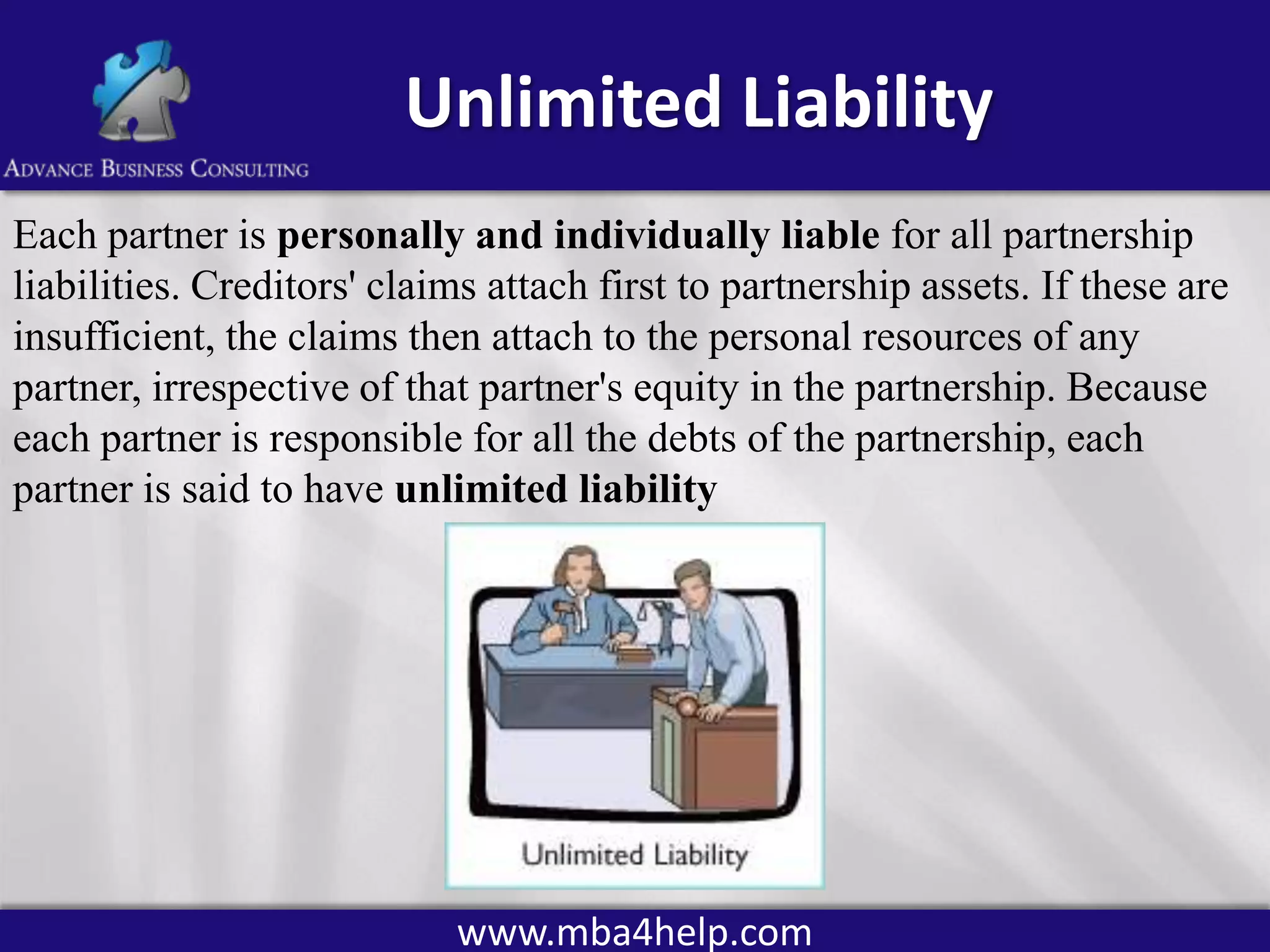
Each partner is personally and individually liable for all partnership
liabilities. Creditors' claims attach first to partnership assets. If these are
insufficient, the claims then attach to the personal resources of any
partner, irrespective of that partner's equity in the partnership. Because
each partner is responsible for all the debts of the partnership, each
partner is said to have unlimited liability
www.mba4help.com
Co-Ownership of Property
Partners jointly own partnership assets. If the partnership is
dissolved, each partner has a claim on total assets equal to the balance in
his or her respective capital account. This claim does not attach to
specific assets that an individual partner contributed to the firm.
Similarly, if a partner invests a building in the partnership valued at
$100,000 and the building is later sold at a gain of $20,000, the partners
all share in the gain.
www.mba4help.com
Share Income or loss
Partnership net income (or net loss) is also co-owned. If the partnership
contract does not specify to the contrary, all net income or net loss is
shared equally by the partners. As you will see later, though, partners
may agree to unequal sharing of net income or net loss.
www.mba4help.com
Limited partnership
“Ltd.,” or “LP”
In a limited partnership, one or more partners have unlimited liability
and one or more partners have limited liability for the debts of the firm.
Those with unlimited liability are general partners. Those with limited
liability are limited partners. Limited partners are responsible for the
debts of the partnership up to the limit of their investment in the firm.
Limited partners does not get involved in management.
www.mba4help.com
Limited Liability Partnership
In an LLP, all partners have limited liability. No general partners.
The LLP is designed to protect innocent partners from malpractice or
negligence claims resulting from the acts of another partner.
These professional partnerships vary in size from a medical/Lawyer
partnership of three to five doctors, to 150 to 200 partners.
www.mba4help.com
One major advantage of a partnership is to combine the skills and
resources of two or more individuals.
Partnerships are easily formed and are relatively free from government
regulations and restrictions.
A partnership does not have to contend with the “red tape” that a
corporation must face.
Partners generally can make decisions quickly.
Advantages & Disadvantages
www.mba4help.com
The Partnership Agreement
Ideally, the agreement of two or more individuals to form a partnership
should be expressed in a written contract, called the partnership
agreement or articles of co-partnership. The partnership agreement
contains such basic information as the name and principal location of
the firm, the purpose of the business.
1. Names and capital contributions of partners.
2. Rights and duties of partners.
3. Basis for sharing net income or net loss.
4. Provision for withdrawals of assets.
5. Procedures for submitting disputes to arbitration.
6. Procedures for the withdrawal or addition of a partner.
7. Rights and duties of surviving partners in the event of a partner's
death.
www.mba4help.com
Partner's initial investment
Each partner's initial investment in a partnership is entered in the
partnership records. The partnership should record these investments at
the fair market value of the assets at the date of their transfer to the
partnership. All partners must agree to the values assigned.
www.mba4help.com
The partnership records
the investments
Investment of A. Rolfe
Cash 8,000
Office Equipment 4,000
A. Rolfe, Capital 12,000
(To record investment of Rolfe)
Investment of T. Shea
Cash 9,000
Accounts Receivable 4,000
Allowance for Doubtful Accounts 1,000
T. Shea, Capital 12,000
(To record investment of Shea)
www.mba4help.com
Dividing Net
Income or Net Loss
Partners equally share partnership net income or net loss unless the
partnership contract indicates otherwise. The same basis of division
usually applies to both net income and net loss. It is customary to refer to
this basis as the income ratio, the income and loss ratio, or the profit
and loss (P&L) ratio.
www.mba4help.com
LLC-Corporations
LLC-CORPORATIONS
• Hybrid for of Corporations
• One or more owners
• Owners are call members
• No double taxation
• Less paper work and regulations
• More freedom
www.mba4help.com
Limited Liability Companies
A hybrid form of business organization with certain features like a
corporation and others like a limited partnership is the limited liability
company, or “LLC.” An LLC usually has a limited life. The
owners, called members, have limited liability like owners of a
corporation. Whereas limited partners do not actively participate in the
management of a limited partnership (LP), the members of a limited
liability company (LLC) can assume an active management role.
For income tax purposes, the IRS usually classifies an LLC as a
partnership.
www.mba4help.com
www.mba4help.com
Corporations
CORPORATION
• an entity created by a state stature
• exists separately from and independently of the
owners
• may have one of more owners
• owners are called shareholders or stockholders
• ownership evidenced by stock certificate
www.mba4help.com
Corporation is created by law
A corporation is created by law, and its continued existence depends
upon the statutes of the state in which it is incorporated. As a legal
entity, a corporation has most of the rights and privileges of a person.
The major exceptions relate to privileges that only a living person can
exercise, such as the right to vote or to hold public office. A corporation
is subject to the same duties and responsibilities as a person. For
example, it must abide by the laws, and it must pay taxes.
www.mba4help.com
Publicly held and Privately
Classification by ownership distinguishes between publicly held and
privately held corporations.
Publicly held corporation may have thousands of stockholders. Its
stock is regularly traded on a national securities exchange such as the
New York Stock Exchange. Most of the largest U.S. corporations are
publicly held. Examples of publicly held corporations are
Intel, IBM, Google, and General Electric.
Privately held corporation usually has only a few stockholders, and
does not offer its stock for sale to the general public.
www.mba4help.com
Separate Legal Existence
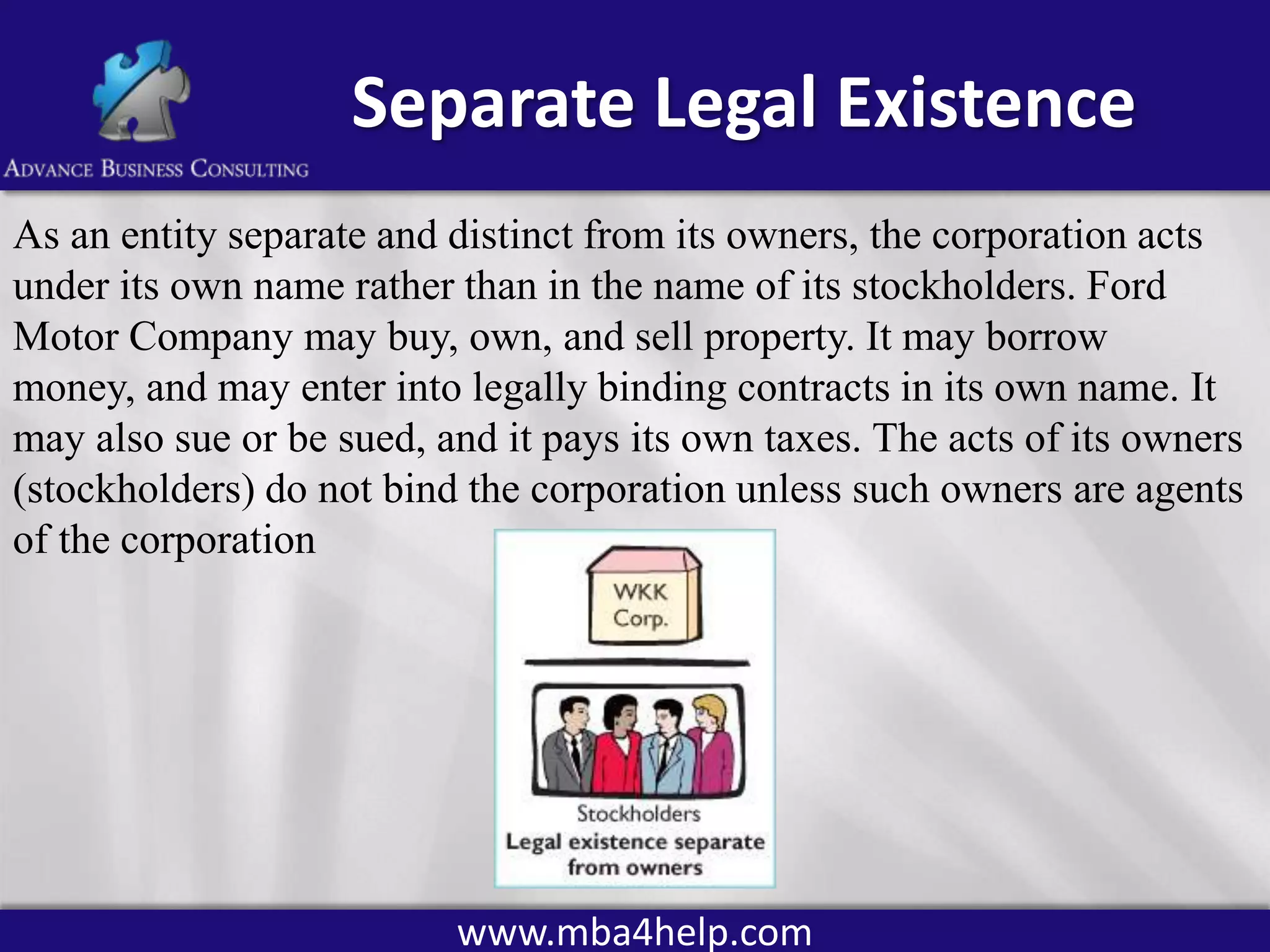
As an entity separate and distinct from its owners, the corporation acts
under its own name rather than in the name of its stockholders. Ford
Motor Company may buy, own, and sell property. It may borrow
money, and may enter into legally binding contracts in its own name. It
may also sue or be sued, and it pays its own taxes. The acts of its owners
(stockholders) do not bind the corporation unless such owners are agents
of the corporation
www.mba4help.com
Limited Liability of
Stockholders
Corporation is a separate legal entity, creditors have recourse only to
corporate assets to satisfy their claims. The liability of stockholders is
normally limited to their investment in the corporation. Creditors have no
legal claim on the personal assets of the owners unless fraud has
occurred. Even in the event of bankruptcy, stockholders' losses are
generally limited to their capital investment in the corporation.
www.mba4help.com
Transferable Ownership Rights
Shares of capital stock give ownership in a corporation. These shares are
transferable units. Stockholders may dispose of part or all of their interest
in a corporation simply by selling their stock.
The transfer of ownership rights between stockholders normally has no
effect on the daily operating activities of the corporation.
www.mba4help.com
Ability to Acquire Capital
It is relatively easy for a corporation to obtain capital through the
issuance of stock. Investors buy stock in a corporation to earn money
over time as the share price grows, and because a stockholder has limited
liability and shares of stock are readily transferable. Also, individuals can
become stockholders by investing relatively small amounts of money. In
sum, the ability of a successful corporation to obtain capital is virtually
unlimited.
www.mba4help.com
Continuous Life
Since a corporation is a separate legal entity, its continuance as a going
concern is not affected by the withdrawal, death, or incapacity of a
stockholder, employee, or officer. As a result, a successful enterprise can
have a continuous and perpetual life.
www.mba4help.com
Corporation Management
As in Ford Motor Company, stockholders legally own the corporation.
But they manage the corporation indirectly through a board of directors
they elect. The board, in turn, formulates the operating policies for the
company. The board also selects officers, such as a president and one or
more vice presidents, to execute policy and to perform daily management
functions.
The chief executive officer (CEO) has overall responsibility for
managing the business.
www.mba4help.com
Structure
www.mba4help.com
Forming a Corporation
The initial step in forming a corporation is to file an application with the
Secretary of State in the state in which incorporation is desired. The
application contains such information as: (1) the name and purpose of the
proposed corporation; (2) amounts, kinds, and number of shares of
capital stock to be authorized; (3) the names of the incorporators; and (4)
the shares of stock to which each has subscribed.
www.mba4help.com
Advantages vs. Disadvantages
www.mba4help.com
Additional Taxes
In addition, stockholders must pay taxes on cash dividends (pro rata
distributions of net income). Thus, many argue that the government taxes
corporate income twice (double taxation)—once at the corporate
level, and again at the individual level.

Business structure 1

  • 1.
    Business Structure Jose Cintron,MBA-CPC Business/Accounting Professor Josecintron.mba@gmail.com (954) 374-8298
  • 2.
  • 3.
    www.mba4help.com Business Structures SOLE PROPRIETORSHIP PARTNERSHIPS LLCCORPORATIONS S-CORPORTATIONS C-CORPORATIONS NON FOR PROFITS CORPORATIONS
  • 4.
    www.mba4help.com SOLE PROPRIETORSHIP SOLE PROPRIETORSHIP •Easy to form-Business owned by one person • legal existence of proprietorship is extension of proprietor • may have any number of employees • Unlimited liability • Single Taxation
  • 5.
    www.mba4help.com Business Structures PARTNERSHIP • Businessowned by at least two people • may have any number of employees • Must be in writing for more than one year • NO double Taxation • Unlimited Liability for all partners
  • 6.
    www.mba4help.com Partnership form of organization Apartnership is an association of two or more persons to carry on as co- owners of a business for profit. Partnerships are fairly easy to form. People form partnerships simply by a verbal agreement, or more formally, by written agreement. A partnership is a legal entity. A partnership can own property (land, buildings, equipment), and can sue or be sued. A partnership also is an accounting entity. Thus, the personal assets, liabilities, and transactions of the partners are excluded from the accounting records of the partnership, just as they are in a proprietorship.
  • 7.
    www.mba4help.com Partnership and taxes Thenet income of a partnership is not taxed as a separate entity. But, a partnership must file an information tax return showing partnership net income and each partner's share of that net income. Each partner's share is taxable at personal tax rates, regardless of the amount of net income each withdraws from the business during the year.
  • 8.
    www.mba4help.com Mutual Agency Mutual agencymeans that each partner acts on behalf of the partnership when engaging in partnership business. The act of any partner is binding on all other partners. This is true even when partners act beyond the scope of their authority, so long as the act appears to be appropriate for the partnership.
  • 9.
    www.mba4help.com Limited Life A partnershipmay be ended voluntarily at any time through the acceptance of a new partner or the withdrawal of a partner. It may be ended involuntarily by the death or incapacity of a partner. Partnership dissolution occurs whenever a partner withdraws or a new partner is admitted. Dissolution does not necessarily mean that the business ends. If the continuing partners agree, operations can continue without interruption by forming a new partnership.
  • 10.
    www.mba4help.com Unlimited Liability Each partneris personally and individually liable for all partnership liabilities. Creditors' claims attach first to partnership assets. If these are insufficient, the claims then attach to the personal resources of any partner, irrespective of that partner's equity in the partnership. Because each partner is responsible for all the debts of the partnership, each partner is said to have unlimited liability
  • 11.
    www.mba4help.com Co-Ownership of Property Partnersjointly own partnership assets. If the partnership is dissolved, each partner has a claim on total assets equal to the balance in his or her respective capital account. This claim does not attach to specific assets that an individual partner contributed to the firm. Similarly, if a partner invests a building in the partnership valued at $100,000 and the building is later sold at a gain of $20,000, the partners all share in the gain.
  • 12.
    www.mba4help.com Share Income orloss Partnership net income (or net loss) is also co-owned. If the partnership contract does not specify to the contrary, all net income or net loss is shared equally by the partners. As you will see later, though, partners may agree to unequal sharing of net income or net loss.
  • 13.
    www.mba4help.com Limited partnership “Ltd.,” or“LP” In a limited partnership, one or more partners have unlimited liability and one or more partners have limited liability for the debts of the firm. Those with unlimited liability are general partners. Those with limited liability are limited partners. Limited partners are responsible for the debts of the partnership up to the limit of their investment in the firm. Limited partners does not get involved in management.
  • 14.
    www.mba4help.com Limited Liability Partnership Inan LLP, all partners have limited liability. No general partners. The LLP is designed to protect innocent partners from malpractice or negligence claims resulting from the acts of another partner. These professional partnerships vary in size from a medical/Lawyer partnership of three to five doctors, to 150 to 200 partners.
  • 15.
    www.mba4help.com One major advantageof a partnership is to combine the skills and resources of two or more individuals. Partnerships are easily formed and are relatively free from government regulations and restrictions. A partnership does not have to contend with the “red tape” that a corporation must face. Partners generally can make decisions quickly. Advantages & Disadvantages
  • 16.
    www.mba4help.com The Partnership Agreement Ideally,the agreement of two or more individuals to form a partnership should be expressed in a written contract, called the partnership agreement or articles of co-partnership. The partnership agreement contains such basic information as the name and principal location of the firm, the purpose of the business. 1. Names and capital contributions of partners. 2. Rights and duties of partners. 3. Basis for sharing net income or net loss. 4. Provision for withdrawals of assets. 5. Procedures for submitting disputes to arbitration. 6. Procedures for the withdrawal or addition of a partner. 7. Rights and duties of surviving partners in the event of a partner's death.
  • 17.
    www.mba4help.com Partner's initial investment Eachpartner's initial investment in a partnership is entered in the partnership records. The partnership should record these investments at the fair market value of the assets at the date of their transfer to the partnership. All partners must agree to the values assigned.
  • 18.
    www.mba4help.com The partnership records theinvestments Investment of A. Rolfe Cash 8,000 Office Equipment 4,000 A. Rolfe, Capital 12,000 (To record investment of Rolfe) Investment of T. Shea Cash 9,000 Accounts Receivable 4,000 Allowance for Doubtful Accounts 1,000 T. Shea, Capital 12,000 (To record investment of Shea)
  • 19.
    www.mba4help.com Dividing Net Income orNet Loss Partners equally share partnership net income or net loss unless the partnership contract indicates otherwise. The same basis of division usually applies to both net income and net loss. It is customary to refer to this basis as the income ratio, the income and loss ratio, or the profit and loss (P&L) ratio.
  • 20.
    www.mba4help.com LLC-Corporations LLC-CORPORATIONS • Hybrid forof Corporations • One or more owners • Owners are call members • No double taxation • Less paper work and regulations • More freedom
  • 21.
    www.mba4help.com Limited Liability Companies Ahybrid form of business organization with certain features like a corporation and others like a limited partnership is the limited liability company, or “LLC.” An LLC usually has a limited life. The owners, called members, have limited liability like owners of a corporation. Whereas limited partners do not actively participate in the management of a limited partnership (LP), the members of a limited liability company (LLC) can assume an active management role. For income tax purposes, the IRS usually classifies an LLC as a partnership.
  • 22.
  • 23.
    www.mba4help.com Corporations CORPORATION • an entitycreated by a state stature • exists separately from and independently of the owners • may have one of more owners • owners are called shareholders or stockholders • ownership evidenced by stock certificate
  • 24.
    www.mba4help.com Corporation is createdby law A corporation is created by law, and its continued existence depends upon the statutes of the state in which it is incorporated. As a legal entity, a corporation has most of the rights and privileges of a person. The major exceptions relate to privileges that only a living person can exercise, such as the right to vote or to hold public office. A corporation is subject to the same duties and responsibilities as a person. For example, it must abide by the laws, and it must pay taxes.
  • 25.
    www.mba4help.com Publicly held andPrivately Classification by ownership distinguishes between publicly held and privately held corporations. Publicly held corporation may have thousands of stockholders. Its stock is regularly traded on a national securities exchange such as the New York Stock Exchange. Most of the largest U.S. corporations are publicly held. Examples of publicly held corporations are Intel, IBM, Google, and General Electric. Privately held corporation usually has only a few stockholders, and does not offer its stock for sale to the general public.
  • 26.
    www.mba4help.com Separate Legal Existence Asan entity separate and distinct from its owners, the corporation acts under its own name rather than in the name of its stockholders. Ford Motor Company may buy, own, and sell property. It may borrow money, and may enter into legally binding contracts in its own name. It may also sue or be sued, and it pays its own taxes. The acts of its owners (stockholders) do not bind the corporation unless such owners are agents of the corporation
  • 27.
    www.mba4help.com Limited Liability of Stockholders Corporationis a separate legal entity, creditors have recourse only to corporate assets to satisfy their claims. The liability of stockholders is normally limited to their investment in the corporation. Creditors have no legal claim on the personal assets of the owners unless fraud has occurred. Even in the event of bankruptcy, stockholders' losses are generally limited to their capital investment in the corporation.
  • 28.
    www.mba4help.com Transferable Ownership Rights Sharesof capital stock give ownership in a corporation. These shares are transferable units. Stockholders may dispose of part or all of their interest in a corporation simply by selling their stock. The transfer of ownership rights between stockholders normally has no effect on the daily operating activities of the corporation.
  • 29.
    www.mba4help.com Ability to AcquireCapital It is relatively easy for a corporation to obtain capital through the issuance of stock. Investors buy stock in a corporation to earn money over time as the share price grows, and because a stockholder has limited liability and shares of stock are readily transferable. Also, individuals can become stockholders by investing relatively small amounts of money. In sum, the ability of a successful corporation to obtain capital is virtually unlimited.
  • 30.
    www.mba4help.com Continuous Life Since acorporation is a separate legal entity, its continuance as a going concern is not affected by the withdrawal, death, or incapacity of a stockholder, employee, or officer. As a result, a successful enterprise can have a continuous and perpetual life.
  • 31.
    www.mba4help.com Corporation Management As inFord Motor Company, stockholders legally own the corporation. But they manage the corporation indirectly through a board of directors they elect. The board, in turn, formulates the operating policies for the company. The board also selects officers, such as a president and one or more vice presidents, to execute policy and to perform daily management functions. The chief executive officer (CEO) has overall responsibility for managing the business.
  • 32.
  • 33.
    www.mba4help.com Forming a Corporation Theinitial step in forming a corporation is to file an application with the Secretary of State in the state in which incorporation is desired. The application contains such information as: (1) the name and purpose of the proposed corporation; (2) amounts, kinds, and number of shares of capital stock to be authorized; (3) the names of the incorporators; and (4) the shares of stock to which each has subscribed.
  • 34.
  • 35.
    www.mba4help.com Additional Taxes In addition,stockholders must pay taxes on cash dividends (pro rata distributions of net income). Thus, many argue that the government taxes corporate income twice (double taxation)—once at the corporate level, and again at the individual level.

Editor's Notes

  • #2 Time and money are the most important resources in your business. Leveraging these resources wisely is one of the most important aspects of maximizing profit in your business.By creating a professional business plan you will learn how to best use your time and money.When you know your direction, you can set goals and create plans toachieve those goals.