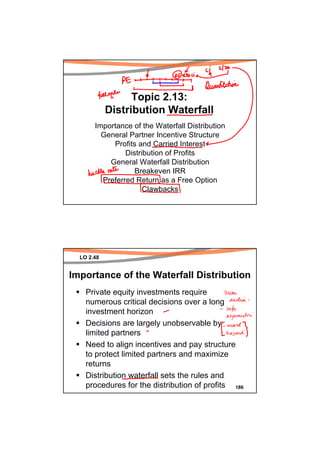
Topic 2.13:
            Distribution Waterfall
       Importance of the Waterfall Distribution
         General Partner Incentive Structure
            Profits and Carried Interest
                Distribution of Profits
           General Waterfall Distribution
                   Breakeven IRR
         Preferred Return as a Free Option
                      Clawbacks


  LO 2.48


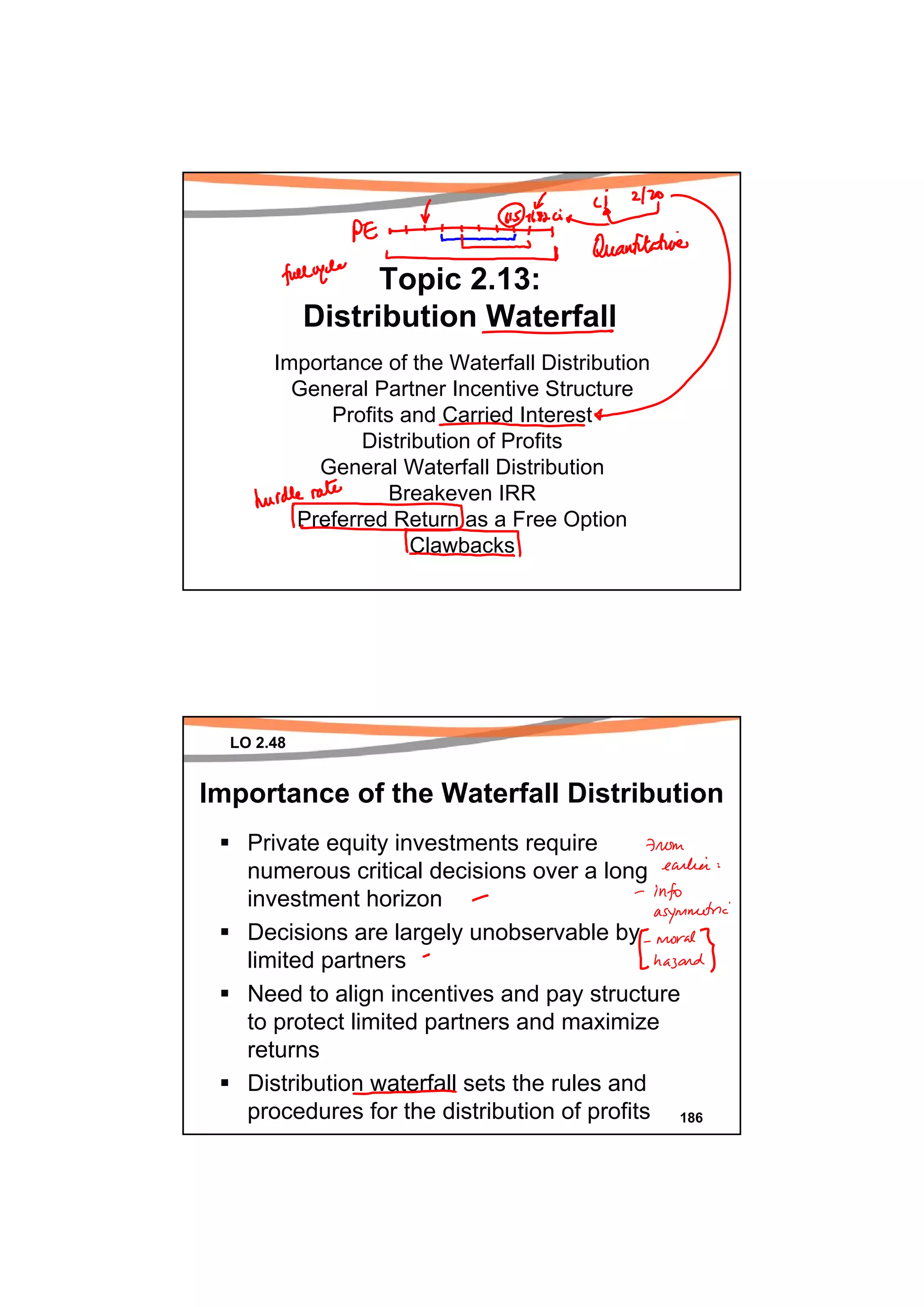
Importance of the Waterfall Distribution
    Private equity investments require
    numerous critical decisions over a long
    investment horizon
    Decisions are largely unobservable by
    limited partners
    Need to align incentives and pay structure
    to protect limited partners and maximize
    returns
    Distribution waterfall sets the rules and
    procedures for the distribution of profits 186
LO 2.49


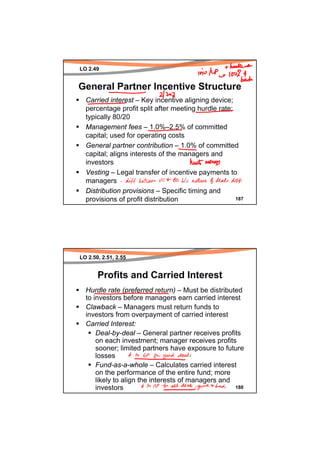
General Partner Incentive Structure
  Carried interest – Key incentive aligning device;
  percentage profit split after meeting hurdle rate;
  typically 80/20
  Management fees – 1.0%–2.5% of committed
  capital; used for operating costs
  General partner contribution – 1.0% of committed
  capital; aligns interests of the managers and
  investors
  Vesting – Legal transfer of incentive payments to
  managers
  Distribution provisions – Specific timing and
  provisions of profit distribution                  187


LO 2.50, 2.51, 2.55


       Profits and Carried Interest
  Hurdle rate (preferred return) – Must be distributed
  to investors before managers earn carried interest
  Clawback – Managers must return funds to
  investors from overpayment of carried interest
  Carried Interest:
      Deal-by-deal – General partner receives profits
      on each investment; manager receives profits
      sooner; limited partners have exposure to future
      losses
      Fund-as-a-whole – Calculates carried interest
      on the performance of the entire fund; more
      likely to align the interests of managers and
      investors                                     188
LO 2.52


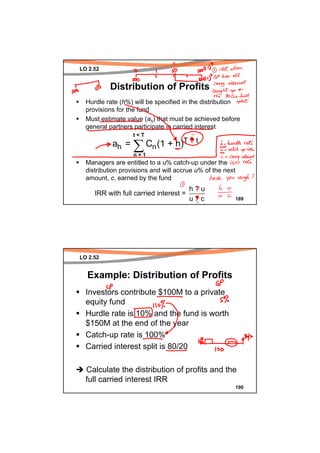
          Distribution of Profits
  Hurdle rate (h%) will be specified in the distribution
  provisions for the fund
  Must estimate value (ah) that must be achieved before
  general partners participate in carried interest
                   t<T
           ah =    ∑
                   n=1
                         Cn (1 + h)T ? t
  Managers are entitled to a u% catch-up under the
  distribution provisions and will accrue u% of the next
  amount, c, earned by the fund
                                        h?u
     IRR with full carried interest =
                                        u?c                189


LO 2.52


  Example: Distribution of Profits
  Investors contribute $100M to a private
  equity fund
  Hurdle rate is 10% and the fund is worth
  $150M at the end of the year
  Catch-up rate is 100%
  Carried interest split is 80/20

  Calculate the distribution of profits and the
  full carried interest IRR
                                                           190
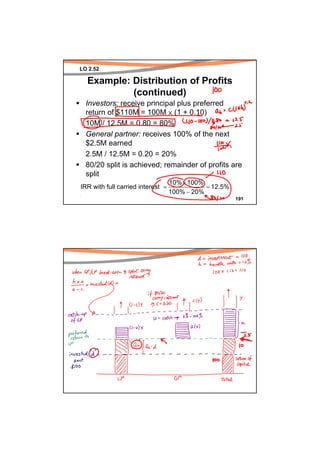
LO 2.52

  Example: Distribution of Profits
           (continued)
  Investors: receive principal plus preferred
  return of $110M = 100M × (1 + 0.10)
  10M / 12.5M = 0.80 = 80%
  General partner: receives 100% of the next
  $2.5M earned
  2.5M / 12.5M = 0.20 = 20%
  80/20 split is achieved; remainder of profits are
  split
                                   10% × 100%
IRR with full carried interest =              = 12.5%
                                   100% − 20%
                                                        191
LO 2.52


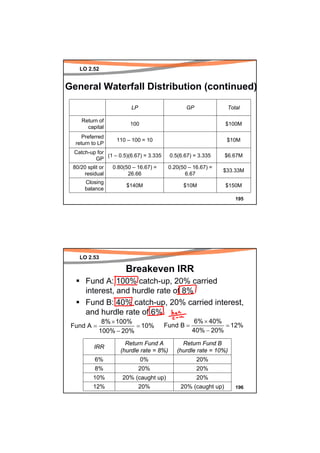
       General Waterfall Distribution
                        LP        GP        Total

  Return of capital      d                    d

  Preferred return
                      ah – d                ah – d
             to LP
  Catch-up for GP     (1 – u)x    u(x)          x
     80/20 split or
                      (1 – c)y    c(y)          y
          residual
                      Sum of     Sum of
  Closing balance                           a–d
                      above      above
                                                    193


   LO 2.52


General Waterfall Distribution (continued)
     Investors contribute $100M to a private
     equity fund
     Hurdle rate is 10% and the fund is worth
     $150M at the end of the year
     Catch-up rate is 50%
     Carried interest split is 80/20

     Determine the waterfall distribution


                                                    194
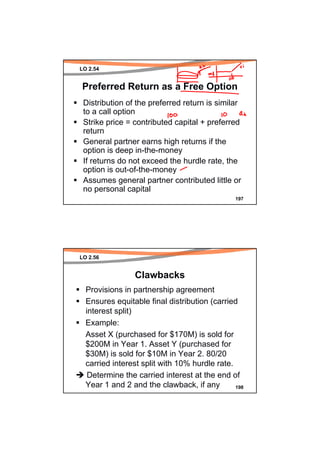
LO 2.52


General Waterfall Distribution (continued)

                         LP                      GP              Total

     Return of
                         100                                     $100M
       capital
     Preferred
                   110 – 100 = 10                                $10M
  return to LP
  Catch-up for
               (1 – 0.5)(6.67) = 3.335    0.5(6.67) = 3.335      $6.67M
          GP
 80/20 split or   0.80(50 – 16.67) =      0.20(50 – 16.67) =
                                                               $33.33M
     residual           26.66                   6.67
      Closing
                       $140M                    $10M             $150M
      balance
                                                                    195


    LO 2.53

                       Breakeven IRR
      Fund A: 100% catch-up, 20% carried
      interest, and hurdle rate of 8%
      Fund B: 40% catch-up, 20% carried interest,
      and hurdle rate of 6%
             8% × 100%                               6% × 40%
 Fund A =              = 10%             Fund B =             = 12%
            100% − 20%                              40% − 20%

                       Return Fund A           Return Fund B
          IRR
                     (hurdle rate = 8%)      (hurdle rate = 10%)
          6%                   0%                     20%
          8%                  20%                     20%
          10%         20% (caught up)                 20%
          12%                 20%              20% (caught up)      196
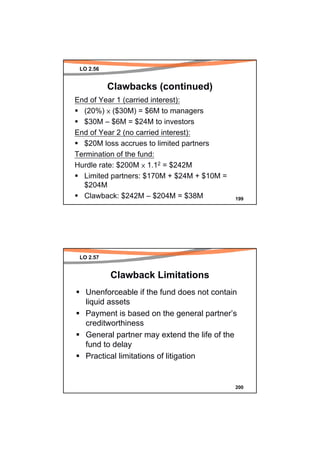
LO 2.54


Preferred Return as a Free Option
 Distribution of the preferred return is similar
 to a call option
 Strike price = contributed capital + preferred
 return
 General partner earns high returns if the
 option is deep in-the-money
 If returns do not exceed the hurdle rate, the
 option is out-of-the-money
 Assumes general partner contributed little or
 no personal capital
                                               197


LO 2.56


                Clawbacks
  Provisions in partnership agreement
  Ensures equitable final distribution (carried
  interest split)
  Example:
  Asset X (purchased for $170M) is sold for
  $200M in Year 1. Asset Y (purchased for
  $30M) is sold for $10M in Year 2. 80/20
  carried interest split with 10% hurdle rate.
   Determine the carried interest at the end of
  Year 1 and 2 and the clawback, if any        198
LO 2.56


           Clawbacks (continued)
End of Year 1 (carried interest):
  (20%) × ($30M) = $6M to managers
  $30M – $6M = $24M to investors
End of Year 2 (no carried interest):
  $20M loss accrues to limited partners
Termination of the fund:
Hurdle rate: $200M × 1.12 = $242M
  Limited partners: $170M + $24M + $10M =
  $204M
  Clawback: $242M – $204M = $38M            199


 LO 2.57


           Clawback Limitations
   Unenforceable if the fund does not contain
   liquid assets
   Payment is based on the general partner’s
   creditworthiness
   General partner may extend the life of the
   fund to delay
   Practical limitations of litigation


                                            200
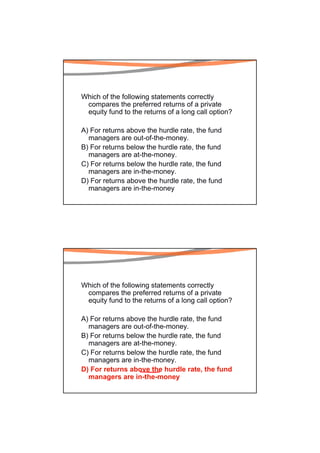
Which of the following statements correctly
 compares the preferred returns of a private
 equity fund to the returns of a long call option?

A) For returns above the hurdle rate, the fund
  managers are out-of-the-money.
B) For returns below the hurdle rate, the fund
  managers are at-the-money.
C) For returns below the hurdle rate, the fund
  managers are in-the-money.
D) For returns above the hurdle rate, the fund
  managers are in-the-money


Which of the following statements correctly
 compares the preferred returns of a private
 equity fund to the returns of a long call option?

A) For returns above the hurdle rate, the fund
  managers are out-of-the-money.
B) For returns below the hurdle rate, the fund
  managers are at-the-money.
C) For returns below the hurdle rate, the fund
  managers are in-the-money.
D) For returns above the hurdle rate, the fund
  managers are in-the-money
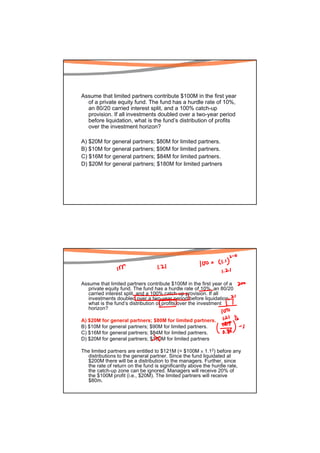
Assume that limited partners contribute $100M in the first year
  of a private equity fund. The fund has a hurdle rate of 10%,
  an 80/20 carried interest split, and a 100% catch-up
  provision. If all investments doubled over a two-year period
  before liquidation, what is the fund’s distribution of profits
  over the investment horizon?

A) $20M for general partners; $80M for limited partners.
B) $10M for general partners; $90M for limited partners.
C) $16M for general partners; $84M for limited partners.
D) $20M for general partners; $180M for limited partners


Assume that limited partners contribute $100M in the first year of a
   private equity fund. The fund has a hurdle rate of 10%, an 80/20
   carried interest split, and a 100% catch-up provision. If all
   investments doubled over a two-year period before liquidation,
   what is the fund’s distribution of profits over the investment
   horizon?

A) $20M for general partners; $80M for limited partners.
B) $10M for general partners; $90M for limited partners.
C) $16M for general partners; $84M for limited partners.
D) $20M for general partners; $180M for limited partners

The limited partners are entitled to $121M (= $100M × 1.12) before any
  distributions to the general partner. Since the fund liquidated at
  $200M there will be a distribution to the managers. Further, since
  the rate of return on the fund is significantly above the hurdle rate,
  the catch-up zone can be ignored. Managers will receive 20% of
  the $100M profit (i.e., $20M). The limited partners will receive
  $80m.

Private Equity Waterfall Notes

  • 1.
    Topic 2.13: Distribution Waterfall Importance of the Waterfall Distribution General Partner Incentive Structure Profits and Carried Interest Distribution of Profits General Waterfall Distribution Breakeven IRR Preferred Return as a Free Option Clawbacks LO 2.48 Importance of the Waterfall Distribution Private equity investments require numerous critical decisions over a long investment horizon Decisions are largely unobservable by limited partners Need to align incentives and pay structure to protect limited partners and maximize returns Distribution waterfall sets the rules and procedures for the distribution of profits 186
  • 2.
    LO 2.49 General PartnerIncentive Structure Carried interest – Key incentive aligning device; percentage profit split after meeting hurdle rate; typically 80/20 Management fees – 1.0%–2.5% of committed capital; used for operating costs General partner contribution – 1.0% of committed capital; aligns interests of the managers and investors Vesting – Legal transfer of incentive payments to managers Distribution provisions – Specific timing and provisions of profit distribution 187 LO 2.50, 2.51, 2.55 Profits and Carried Interest Hurdle rate (preferred return) – Must be distributed to investors before managers earn carried interest Clawback – Managers must return funds to investors from overpayment of carried interest Carried Interest: Deal-by-deal – General partner receives profits on each investment; manager receives profits sooner; limited partners have exposure to future losses Fund-as-a-whole – Calculates carried interest on the performance of the entire fund; more likely to align the interests of managers and investors 188
  • 3.
    LO 2.52 Distribution of Profits Hurdle rate (h%) will be specified in the distribution provisions for the fund Must estimate value (ah) that must be achieved before general partners participate in carried interest t<T ah = ∑ n=1 Cn (1 + h)T ? t Managers are entitled to a u% catch-up under the distribution provisions and will accrue u% of the next amount, c, earned by the fund h?u IRR with full carried interest = u?c 189 LO 2.52 Example: Distribution of Profits Investors contribute $100M to a private equity fund Hurdle rate is 10% and the fund is worth $150M at the end of the year Catch-up rate is 100% Carried interest split is 80/20 Calculate the distribution of profits and the full carried interest IRR 190
  • 4.
    LO 2.52 Example: Distribution of Profits (continued) Investors: receive principal plus preferred return of $110M = 100M × (1 + 0.10) 10M / 12.5M = 0.80 = 80% General partner: receives 100% of the next $2.5M earned 2.5M / 12.5M = 0.20 = 20% 80/20 split is achieved; remainder of profits are split 10% × 100% IRR with full carried interest = = 12.5% 100% − 20% 191
  • 5.
    LO 2.52 General Waterfall Distribution LP GP Total Return of capital d d Preferred return ah – d ah – d to LP Catch-up for GP (1 – u)x u(x) x 80/20 split or (1 – c)y c(y) y residual Sum of Sum of Closing balance a–d above above 193 LO 2.52 General Waterfall Distribution (continued) Investors contribute $100M to a private equity fund Hurdle rate is 10% and the fund is worth $150M at the end of the year Catch-up rate is 50% Carried interest split is 80/20 Determine the waterfall distribution 194
  • 6.
    LO 2.52 General WaterfallDistribution (continued) LP GP Total Return of 100 $100M capital Preferred 110 – 100 = 10 $10M return to LP Catch-up for (1 – 0.5)(6.67) = 3.335 0.5(6.67) = 3.335 $6.67M GP 80/20 split or 0.80(50 – 16.67) = 0.20(50 – 16.67) = $33.33M residual 26.66 6.67 Closing $140M $10M $150M balance 195 LO 2.53 Breakeven IRR Fund A: 100% catch-up, 20% carried interest, and hurdle rate of 8% Fund B: 40% catch-up, 20% carried interest, and hurdle rate of 6% 8% × 100% 6% × 40% Fund A = = 10% Fund B = = 12% 100% − 20% 40% − 20% Return Fund A Return Fund B IRR (hurdle rate = 8%) (hurdle rate = 10%) 6% 0% 20% 8% 20% 20% 10% 20% (caught up) 20% 12% 20% 20% (caught up) 196
  • 7.
    LO 2.54 Preferred Returnas a Free Option Distribution of the preferred return is similar to a call option Strike price = contributed capital + preferred return General partner earns high returns if the option is deep in-the-money If returns do not exceed the hurdle rate, the option is out-of-the-money Assumes general partner contributed little or no personal capital 197 LO 2.56 Clawbacks Provisions in partnership agreement Ensures equitable final distribution (carried interest split) Example: Asset X (purchased for $170M) is sold for $200M in Year 1. Asset Y (purchased for $30M) is sold for $10M in Year 2. 80/20 carried interest split with 10% hurdle rate. Determine the carried interest at the end of Year 1 and 2 and the clawback, if any 198
  • 8.
    LO 2.56 Clawbacks (continued) End of Year 1 (carried interest): (20%) × ($30M) = $6M to managers $30M – $6M = $24M to investors End of Year 2 (no carried interest): $20M loss accrues to limited partners Termination of the fund: Hurdle rate: $200M × 1.12 = $242M Limited partners: $170M + $24M + $10M = $204M Clawback: $242M – $204M = $38M 199 LO 2.57 Clawback Limitations Unenforceable if the fund does not contain liquid assets Payment is based on the general partner’s creditworthiness General partner may extend the life of the fund to delay Practical limitations of litigation 200
  • 9.
    Which of thefollowing statements correctly compares the preferred returns of a private equity fund to the returns of a long call option? A) For returns above the hurdle rate, the fund managers are out-of-the-money. B) For returns below the hurdle rate, the fund managers are at-the-money. C) For returns below the hurdle rate, the fund managers are in-the-money. D) For returns above the hurdle rate, the fund managers are in-the-money Which of the following statements correctly compares the preferred returns of a private equity fund to the returns of a long call option? A) For returns above the hurdle rate, the fund managers are out-of-the-money. B) For returns below the hurdle rate, the fund managers are at-the-money. C) For returns below the hurdle rate, the fund managers are in-the-money. D) For returns above the hurdle rate, the fund managers are in-the-money
  • 10.
    Assume that limitedpartners contribute $100M in the first year of a private equity fund. The fund has a hurdle rate of 10%, an 80/20 carried interest split, and a 100% catch-up provision. If all investments doubled over a two-year period before liquidation, what is the fund’s distribution of profits over the investment horizon? A) $20M for general partners; $80M for limited partners. B) $10M for general partners; $90M for limited partners. C) $16M for general partners; $84M for limited partners. D) $20M for general partners; $180M for limited partners Assume that limited partners contribute $100M in the first year of a private equity fund. The fund has a hurdle rate of 10%, an 80/20 carried interest split, and a 100% catch-up provision. If all investments doubled over a two-year period before liquidation, what is the fund’s distribution of profits over the investment horizon? A) $20M for general partners; $80M for limited partners. B) $10M for general partners; $90M for limited partners. C) $16M for general partners; $84M for limited partners. D) $20M for general partners; $180M for limited partners The limited partners are entitled to $121M (= $100M × 1.12) before any distributions to the general partner. Since the fund liquidated at $200M there will be a distribution to the managers. Further, since the rate of return on the fund is significantly above the hurdle rate, the catch-up zone can be ignored. Managers will receive 20% of the $100M profit (i.e., $20M). The limited partners will receive $80m.