Forms of Business
Ownership
Chapter 4
Forms of Business Ownership
• When an entrepreneur makes the decision to launch a business, one
of the first issues he or she faces is choosing a form of ownership.
• There is no one “best” form of ownership.
• The form of ownership that is best for one entrepreneur may not be
suitable for another.
• Choosing the “right” form of ownership means that entrepreneurs
must understand the characteristics of each form and how well those
characteristics match their business and personal circumstances
Factors to consider when choosing the form
of business ownership
• The following are some of the most important issues entrepreneurs
should consider when they are evaluating the various forms of
ownership:
1. Tax considerations
2. Liability exposure.
3. Start-up and future capital requirements
4. Control
5. Managerial ability
6. Business goals
7. Cost of formation
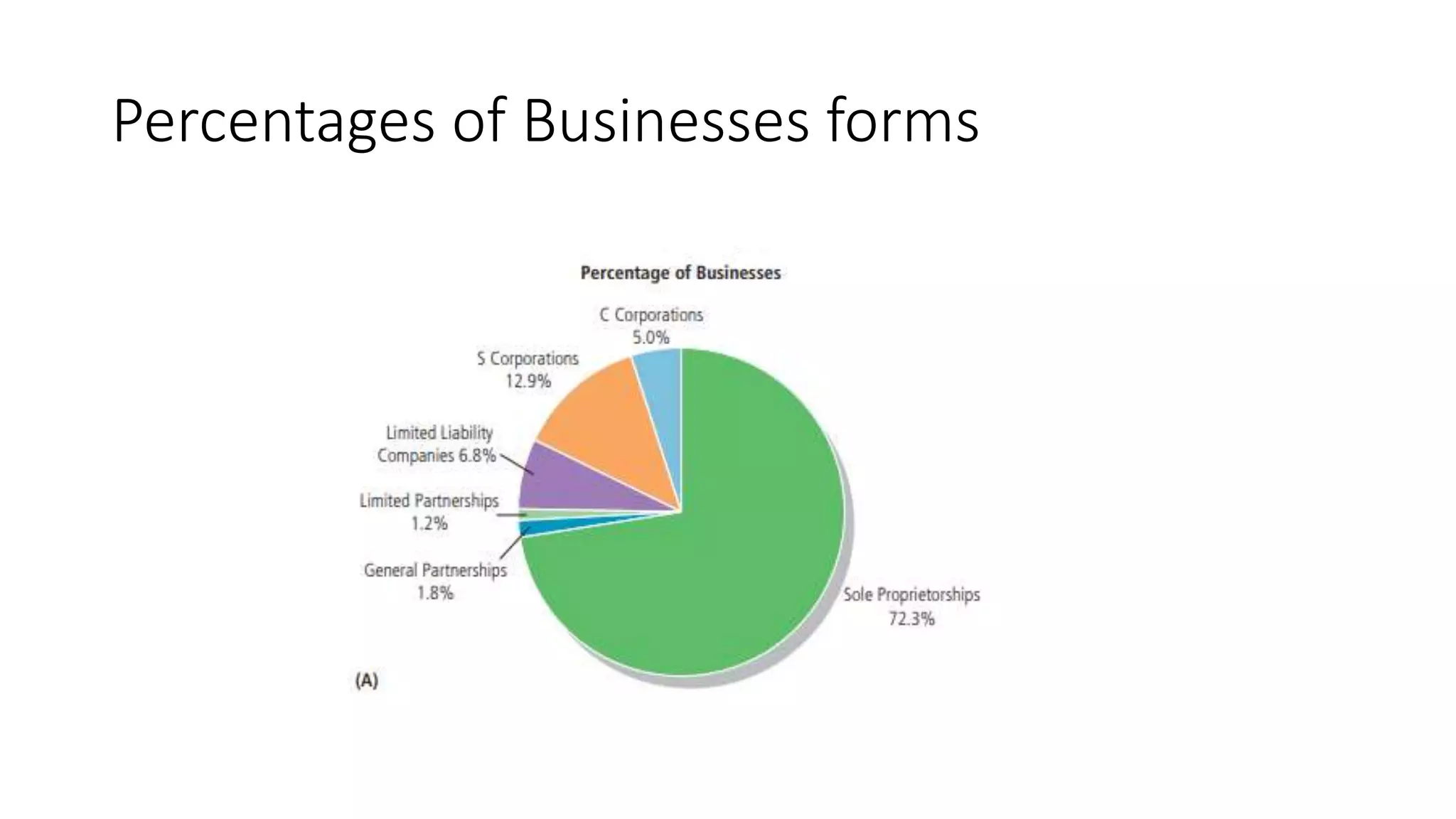
Percentages of Businesses forms
1. Sole Proprietorships
• The simplest and most popular form of ownership remains the sole
proprietorship.
• A sole proprietorship, as its name implies, is a business owned and
managed by one individual.
Advantages of Sole Proprietorships
• Simple to create
• Least costly form of ownership to begin
• Profit incentive
• Total decision-making authority
• No special legal restrictions
• Easy to discontinue
Disadvantages of Sole Proprietorships
• Unlimited personal liability (a situation in which the owner of a
business is personally liable for all of the business’s debts)
• Limited skills and capabilities
• Feelings of isolation
• Limited access to capital
• Lack of continuity of the business
2. Partnerships
• A partnership is an association of two or more people who co-own a
business for the purpose of making a profit.
• In a partnership, the co-owners (partners) share the business’s
assets, liabilities, and profits according to the terms of a previously
established partnership agreement (if one exists)
Partnership agreement
• A document that states in writing the terms under which partners
agree to operate a partnership and that protects each partner’s
interest in the business.
Rights of partnership
• Under the act, each partner has the right to do the following:
Participate in the management and operations of the business
Share in any profits the business might earn from operations
Receive interest on loans made to the business
Be compensated for expenses incurred in the name of the partnership
Receive his or her original capital contributions if the partnership terminates
Have access to the business’s books and records
Receive a formal accounting of the partnership’s business affairs
Obligations of the partnership
• Each partner is obligated to do the following
Share in any losses sustained by the business
Work for the partnership without salary
Submit differences that may arise in the conduct of the business to majority
vote or arbitration
Give the other partners complete information about all business affairs
Give a formal accounting of the partnership’s business affairs
Live up to a fiduciary responsibility of the partnership and place the interest
of the partnership above his or her personal interests
Advantages of Partnerships
• Easy to establish
• Complementary skills
• Division of profits
• Larger pool of capital
• Ability to attract limited partners
1. General partners who have unlimited liability for the partnership’s debts and usually take
an active role in managing the business.
2. Limited partners who are financial investors in a partnership, cannot participate in the
day-to-day management of a company, and have limited liability for the partnership’s
debts.
• Minimal government regulation
• Flexibility
• Taxation
Disadvantages of Partnerships
• Unlimited Liability Of At Least One Partner
• Unlimited Liability Of At Least One Partner ( Can Not Sell Its Shares To
Make A Capital)
• Potential For Personality And Authority Conflicts (Being In A
Partnership Is Much Like Being In A Marriage)
• Partners Are Bound By The Law Of Agency
Limited Liability Partnerships
• A partnership in which all partners in the business are limited
partners, giving them the advantage of limited liability for the
partnership’s debt
Corporations
• The corporation is the most complex of the three major forms of
business ownership. It is a separate entity apart from its owners and
may engage in business, make contracts, sue and be sued, own
property, and pay taxes.
• A separate legal entity apart from its owners that receives the right to
exist from the state in which it is incorporated.
• Creditors of the corporation cannot lay claim to shareholders’
personal assets to satisfy the company’s unpaid debts
Corporations
closely held corporation
• A closely held corporation has
shares that are controlled by a
relatively small number of people,
often family members, friends, or
employees.
• Its stock is not traded on any stock
exchange but instead is passed
from one generation to the next.
• Most small corporations are closely
held.
publicly held corporation
• A publicly held corporation has a
large number of shareholders,
and its stock usually is traded on
one of the large stock
exchanges.

Forms of Business Ownership.pptx

  • 1.
  • 2.
    Forms of BusinessOwnership • When an entrepreneur makes the decision to launch a business, one of the first issues he or she faces is choosing a form of ownership. • There is no one “best” form of ownership. • The form of ownership that is best for one entrepreneur may not be suitable for another. • Choosing the “right” form of ownership means that entrepreneurs must understand the characteristics of each form and how well those characteristics match their business and personal circumstances
  • 3.
    Factors to considerwhen choosing the form of business ownership • The following are some of the most important issues entrepreneurs should consider when they are evaluating the various forms of ownership: 1. Tax considerations 2. Liability exposure. 3. Start-up and future capital requirements 4. Control 5. Managerial ability 6. Business goals 7. Cost of formation
  • 4.
  • 5.
    1. Sole Proprietorships •The simplest and most popular form of ownership remains the sole proprietorship. • A sole proprietorship, as its name implies, is a business owned and managed by one individual.
  • 6.
    Advantages of SoleProprietorships • Simple to create • Least costly form of ownership to begin • Profit incentive • Total decision-making authority • No special legal restrictions • Easy to discontinue
  • 7.
    Disadvantages of SoleProprietorships • Unlimited personal liability (a situation in which the owner of a business is personally liable for all of the business’s debts) • Limited skills and capabilities • Feelings of isolation • Limited access to capital • Lack of continuity of the business
  • 8.
    2. Partnerships • Apartnership is an association of two or more people who co-own a business for the purpose of making a profit. • In a partnership, the co-owners (partners) share the business’s assets, liabilities, and profits according to the terms of a previously established partnership agreement (if one exists)
  • 9.
    Partnership agreement • Adocument that states in writing the terms under which partners agree to operate a partnership and that protects each partner’s interest in the business.
  • 10.
    Rights of partnership •Under the act, each partner has the right to do the following: Participate in the management and operations of the business Share in any profits the business might earn from operations Receive interest on loans made to the business Be compensated for expenses incurred in the name of the partnership Receive his or her original capital contributions if the partnership terminates Have access to the business’s books and records Receive a formal accounting of the partnership’s business affairs
  • 11.
    Obligations of thepartnership • Each partner is obligated to do the following Share in any losses sustained by the business Work for the partnership without salary Submit differences that may arise in the conduct of the business to majority vote or arbitration Give the other partners complete information about all business affairs Give a formal accounting of the partnership’s business affairs Live up to a fiduciary responsibility of the partnership and place the interest of the partnership above his or her personal interests
  • 12.
    Advantages of Partnerships •Easy to establish • Complementary skills • Division of profits • Larger pool of capital • Ability to attract limited partners 1. General partners who have unlimited liability for the partnership’s debts and usually take an active role in managing the business. 2. Limited partners who are financial investors in a partnership, cannot participate in the day-to-day management of a company, and have limited liability for the partnership’s debts. • Minimal government regulation • Flexibility • Taxation
  • 13.
    Disadvantages of Partnerships •Unlimited Liability Of At Least One Partner • Unlimited Liability Of At Least One Partner ( Can Not Sell Its Shares To Make A Capital) • Potential For Personality And Authority Conflicts (Being In A Partnership Is Much Like Being In A Marriage) • Partners Are Bound By The Law Of Agency
  • 14.
    Limited Liability Partnerships •A partnership in which all partners in the business are limited partners, giving them the advantage of limited liability for the partnership’s debt
  • 15.
    Corporations • The corporationis the most complex of the three major forms of business ownership. It is a separate entity apart from its owners and may engage in business, make contracts, sue and be sued, own property, and pay taxes. • A separate legal entity apart from its owners that receives the right to exist from the state in which it is incorporated. • Creditors of the corporation cannot lay claim to shareholders’ personal assets to satisfy the company’s unpaid debts
  • 16.
    Corporations closely held corporation •A closely held corporation has shares that are controlled by a relatively small number of people, often family members, friends, or employees. • Its stock is not traded on any stock exchange but instead is passed from one generation to the next. • Most small corporations are closely held. publicly held corporation • A publicly held corporation has a large number of shareholders, and its stock usually is traded on one of the large stock exchanges.