These guidelines are provided as part of in-class discussion for pre-exam review for Strategic
Management. It is NOT recommended for off-class self reading as many additional points will b e
mentioned in class. It is also NOT to be considered as a spotting document. All candidates need
to read the chapters and lecture notes fully before attempting the examination. Good luck..
1
Geoffrey da Silva
The format of the exam (2 hours)
Section A :MCQ 10 questions 2 marks each. Can be
taken from any topic of the course. Should
practice the MCQ shown in the RMIT BB coming
from Strategy Lab. I have already advised you
how to access this during my earlier lecture.
Section B : Essay Question (from any area of the
course). Answer TWO questions out of Three
provided. 20 marks x 2 = 40 marks.
The exam is marked out of 60.
2
Preparation
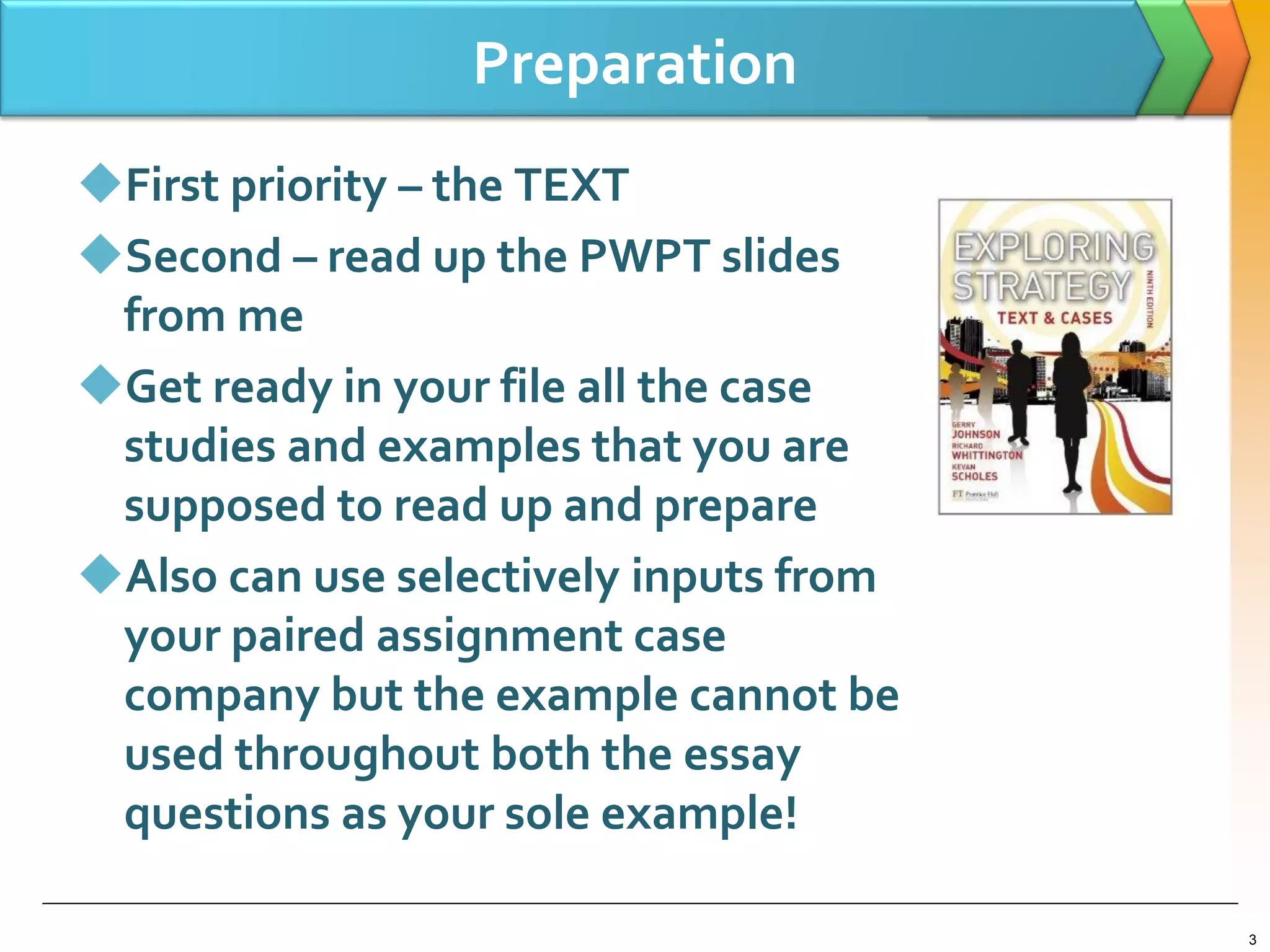
First priority – the TEXT
Second – read up the PWPT slides
from me
Get ready in your file all the case
studies and examples that you are
supposed to read up and prepare
Also can use selectively inputs from
your paired assignment case
company but the example cannot be
used throughout both the essay
questions as your sole example!
3
Comments on the style of essay questions
The questions will not be straightforward so don’t
expect easy definition or write short notes type of
questions.
Considering the time allocated, you can spend
around 45 minutes answering each question
(assuming you take half an hour to do the 10
MCQ).
Therefore for 45 minutes your answer length
could be between 7-8 pages PER question (not
including diagrams.
4
Questions at the end of my lecture notes
Read for understanding the practice exam
questions at the end of each of my lecture notes
No need to write out detailed model answers
BUT try to do skeleton answers
 They key points
 How your answer will be framed (key headings) and points
 Relevant EXAMPLES and Cases to use for each of the
topics – these cases should have been prepared earlier
during your reading of the text and well as the examples I
had asked you to get ready from the start of this course in
relation to ASIAN companies
5
Essay Questions
Dr Huang / Dr Ling will post a set of Review
Questions on BB. Check these questions and work
out the framework answers with your group.
I will not be providing answers 
Use the text closely to extract relevant points
Examples and case studies need to be well-
integrated into your answers. Pure theoretical
discussion will never secure a distinction.
Essay questions are often based on issues of
discussion on topics that are correlated.
 Example how do you see the relationship between ethics
and formulation of corporate strategy
6
Important Note: The Correct Approach to Writing
the Essay Questions on SM
As advised by RMIT teaching team (see the official
guidelines posted on BB by RMIT coordinator)
describe the concepts involved in each essay question to
show your understanding of the concept (s) and/or theories;
–explain how these concepts, theories or managerial
techniques can be used in practice. You need to provide
example(s) selected from case study, assignments, personal
experience, and/or media reports, to demonstrate such
practical applications;
–provide critical comments on the pros (benefits) and cons
(limitations) in applying these concepts, theories, and/or
analytical tools to business organisations
7BUSM 3200- Strategic Management (April 2013) GDS
(Make sure you cover all materials in the text and Lecture Notes)
8
Chapter One - Introduction
Defining Strategy
Levels of Strategy
Elements of strategy – mission, vision, objectives,
scope and advantage
Three branches of strategy – context, content and
process
The Exploring Strategy Model – Strategic
Position, Strategic Choices and Strategy in Action
(read up the summary of each area; good for
overview)
Strategy Lenses (read the appendix)
9
Chapter Two – The Environment
PESTEL – what is it used for
The Five Forces Model : learn all the forces and
show how it is linked to PESTEL
 See pages 61-62 : Implications and key issues
 Also prepare to link (later) the 5 Forces to the Business
Strategies
The Industry Life Cycle
Strategic Groups – use of the model
Blue Ocean Thinking
PESTEL gives rise to Opportunities and Threats
10
Chapter Three: Strategic Capabilities
What is RBV
Resources and Capabilities
VRIN (learn all)
The Value Chain and the Value Network
Summing up with external and internal chapter-
topic of SWOT
How to develop capability in developing of People
(note the strategic importance of people as a key
strategic resource)
11
Chapter Four – Strategic Purpose
Importance of Mission and Vision
Objectives – purpose and types of objectives
Corporate Governance
Shareholder versus Stakeholder models of
Governance
Social Responsibility and Ethics
 Note – questions have come up in the past asking the link
between SR/E and Strategic Management
Stakeholder Expectations
 Influence of power in strategy (between the different
internal and external stakeholder groups)
12
Chapter Five – Culture and Strategy
Not an easy chapter; many areas are not critical
Go straight and read these topics
 What is organizational culture (pg 171
onwards)
 Culture influence on strategy (pg 174)
 The Cultural Web
Just focus on these three areas for this topic
13
Chapter Six – Business Strategy
A key chapter: Learn first ALL the THREE Generic
Strategies (no spotting!) :cost leadership,
differentiation and focus
 What these strategies mean
 How they are manifested in the different areas of business
operations : Here is where you can LINK the business
strategy to the VALUE Chain
 The advantages and disadvantages of each business
strategy
 How to link the Business Strategies to the Five Forces
Model
The Strategy Clock – just read the key points
14
Chapter Six – supporting topics
Just read briefly (overview)
What is Hyper-competition (interactive strategy)
What is Cooperative Strategy?
15
Chapter Seven – Corporate Strategy
Corporate Strategy and Diversification
Learn the Ansoff Matrix – Strategic Direction
Learn the difference between Related and
Unrelated Diversification
What are the advantages and disadvantages of
diversification?
The different types of Portfolio Matrices
Role of Corporate Parent
Also read chapter 7 in conjunction with Chapter
10- mergers and acquisitions
16
Chapter Ten- Mergers, Acquisitions and Alliances
What is organic growth compared to
M&A&A
The three motives for M&A –
strategic, financial and managerial
Definitions, examples, ADV and
DISADV off all the main methods –
mergers, acquisitions and alliances.
17
Chapter Eight- International Strategy
Differences in strategy – international and global
Drivers for global strategy (YIP)
What the benefits and risks of a company
pursuing international expansion
Porter Diamond model
The Four International Strategies (see the matrix)
How to apply the PESTEL framework to
International Strategy
What the main types and ADV + DISADV of each
Market Entry MODE
18
Chapter Eleven- Strategy Evaluation
Cover ALL aspects of the SAFe model
What factors are assessed when looking at
SUITABILITY FACTOR?
What factors are assessed when looking at
ACCEPTIBILITY FACTOR?
What factors are assessed when looking at
FEASIBILITY FACTOR?
19
Chapter Twelve- Strategy Development Process
Focus on the two broad strategy
development approaches – learn the
differences and implications
 INTENDED STRATEGY
 EMERGENT STRATEGY
Learn about the concept of logical
incrementalism
20
Chapter Thirteen : Implementation and Control
How does structure affect strategy?
What is strategy execution?
How does decision making styles
affect strategy implementation?
Types of control systems
Balanced Scorecard
21
Chapter Fourteen: Leadership and Strategic Change
The role of the leader / CEO in SM
How does the leader affect strategic
change?
What is turnaround strategy?
22
Final reminders
Read the question.
Plan the answers.
Expand the theories in detail (you have plenty of
time); elaborate the concepts and list factors
where required.
Draw relevant diagrams and models.
Give good examples (you should have at least 10-
12 examples of good strategy examples from local
and international companies; you cant imagine
examples in the exam!
All the best!!!
23

SM Exam Revision (Oct 2013)

  • 1.
    These guidelines areprovided as part of in-class discussion for pre-exam review for Strategic Management. It is NOT recommended for off-class self reading as many additional points will b e mentioned in class. It is also NOT to be considered as a spotting document. All candidates need to read the chapters and lecture notes fully before attempting the examination. Good luck.. 1 Geoffrey da Silva
  • 2.
    The format ofthe exam (2 hours) Section A :MCQ 10 questions 2 marks each. Can be taken from any topic of the course. Should practice the MCQ shown in the RMIT BB coming from Strategy Lab. I have already advised you how to access this during my earlier lecture. Section B : Essay Question (from any area of the course). Answer TWO questions out of Three provided. 20 marks x 2 = 40 marks. The exam is marked out of 60. 2
  • 3.
    Preparation First priority –the TEXT Second – read up the PWPT slides from me Get ready in your file all the case studies and examples that you are supposed to read up and prepare Also can use selectively inputs from your paired assignment case company but the example cannot be used throughout both the essay questions as your sole example! 3
  • 4.
    Comments on thestyle of essay questions The questions will not be straightforward so don’t expect easy definition or write short notes type of questions. Considering the time allocated, you can spend around 45 minutes answering each question (assuming you take half an hour to do the 10 MCQ). Therefore for 45 minutes your answer length could be between 7-8 pages PER question (not including diagrams. 4
  • 5.
    Questions at theend of my lecture notes Read for understanding the practice exam questions at the end of each of my lecture notes No need to write out detailed model answers BUT try to do skeleton answers  They key points  How your answer will be framed (key headings) and points  Relevant EXAMPLES and Cases to use for each of the topics – these cases should have been prepared earlier during your reading of the text and well as the examples I had asked you to get ready from the start of this course in relation to ASIAN companies 5
  • 6.
    Essay Questions Dr Huang/ Dr Ling will post a set of Review Questions on BB. Check these questions and work out the framework answers with your group. I will not be providing answers  Use the text closely to extract relevant points Examples and case studies need to be well- integrated into your answers. Pure theoretical discussion will never secure a distinction. Essay questions are often based on issues of discussion on topics that are correlated.  Example how do you see the relationship between ethics and formulation of corporate strategy 6
  • 7.
    Important Note: TheCorrect Approach to Writing the Essay Questions on SM As advised by RMIT teaching team (see the official guidelines posted on BB by RMIT coordinator) describe the concepts involved in each essay question to show your understanding of the concept (s) and/or theories; –explain how these concepts, theories or managerial techniques can be used in practice. You need to provide example(s) selected from case study, assignments, personal experience, and/or media reports, to demonstrate such practical applications; –provide critical comments on the pros (benefits) and cons (limitations) in applying these concepts, theories, and/or analytical tools to business organisations 7BUSM 3200- Strategic Management (April 2013) GDS
  • 8.
    (Make sure youcover all materials in the text and Lecture Notes) 8
  • 9.
    Chapter One -Introduction Defining Strategy Levels of Strategy Elements of strategy – mission, vision, objectives, scope and advantage Three branches of strategy – context, content and process The Exploring Strategy Model – Strategic Position, Strategic Choices and Strategy in Action (read up the summary of each area; good for overview) Strategy Lenses (read the appendix) 9
  • 10.
    Chapter Two –The Environment PESTEL – what is it used for The Five Forces Model : learn all the forces and show how it is linked to PESTEL  See pages 61-62 : Implications and key issues  Also prepare to link (later) the 5 Forces to the Business Strategies The Industry Life Cycle Strategic Groups – use of the model Blue Ocean Thinking PESTEL gives rise to Opportunities and Threats 10
  • 11.
    Chapter Three: StrategicCapabilities What is RBV Resources and Capabilities VRIN (learn all) The Value Chain and the Value Network Summing up with external and internal chapter- topic of SWOT How to develop capability in developing of People (note the strategic importance of people as a key strategic resource) 11
  • 12.
    Chapter Four –Strategic Purpose Importance of Mission and Vision Objectives – purpose and types of objectives Corporate Governance Shareholder versus Stakeholder models of Governance Social Responsibility and Ethics  Note – questions have come up in the past asking the link between SR/E and Strategic Management Stakeholder Expectations  Influence of power in strategy (between the different internal and external stakeholder groups) 12
  • 13.
    Chapter Five –Culture and Strategy Not an easy chapter; many areas are not critical Go straight and read these topics  What is organizational culture (pg 171 onwards)  Culture influence on strategy (pg 174)  The Cultural Web Just focus on these three areas for this topic 13
  • 14.
    Chapter Six –Business Strategy A key chapter: Learn first ALL the THREE Generic Strategies (no spotting!) :cost leadership, differentiation and focus  What these strategies mean  How they are manifested in the different areas of business operations : Here is where you can LINK the business strategy to the VALUE Chain  The advantages and disadvantages of each business strategy  How to link the Business Strategies to the Five Forces Model The Strategy Clock – just read the key points 14
  • 15.
    Chapter Six –supporting topics Just read briefly (overview) What is Hyper-competition (interactive strategy) What is Cooperative Strategy? 15
  • 16.
    Chapter Seven –Corporate Strategy Corporate Strategy and Diversification Learn the Ansoff Matrix – Strategic Direction Learn the difference between Related and Unrelated Diversification What are the advantages and disadvantages of diversification? The different types of Portfolio Matrices Role of Corporate Parent Also read chapter 7 in conjunction with Chapter 10- mergers and acquisitions 16
  • 17.
    Chapter Ten- Mergers,Acquisitions and Alliances What is organic growth compared to M&A&A The three motives for M&A – strategic, financial and managerial Definitions, examples, ADV and DISADV off all the main methods – mergers, acquisitions and alliances. 17
  • 18.
    Chapter Eight- InternationalStrategy Differences in strategy – international and global Drivers for global strategy (YIP) What the benefits and risks of a company pursuing international expansion Porter Diamond model The Four International Strategies (see the matrix) How to apply the PESTEL framework to International Strategy What the main types and ADV + DISADV of each Market Entry MODE 18
  • 19.
    Chapter Eleven- StrategyEvaluation Cover ALL aspects of the SAFe model What factors are assessed when looking at SUITABILITY FACTOR? What factors are assessed when looking at ACCEPTIBILITY FACTOR? What factors are assessed when looking at FEASIBILITY FACTOR? 19
  • 20.
    Chapter Twelve- StrategyDevelopment Process Focus on the two broad strategy development approaches – learn the differences and implications  INTENDED STRATEGY  EMERGENT STRATEGY Learn about the concept of logical incrementalism 20
  • 21.
    Chapter Thirteen :Implementation and Control How does structure affect strategy? What is strategy execution? How does decision making styles affect strategy implementation? Types of control systems Balanced Scorecard 21
  • 22.
    Chapter Fourteen: Leadershipand Strategic Change The role of the leader / CEO in SM How does the leader affect strategic change? What is turnaround strategy? 22
  • 23.
    Final reminders Read thequestion. Plan the answers. Expand the theories in detail (you have plenty of time); elaborate the concepts and list factors where required. Draw relevant diagrams and models. Give good examples (you should have at least 10- 12 examples of good strategy examples from local and international companies; you cant imagine examples in the exam! All the best!!! 23