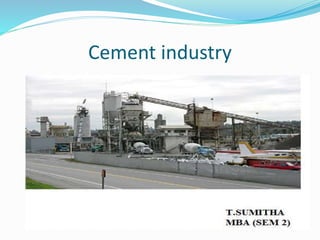
Cement industry
Use of cement
• Production of Concrete
• Construction Purpose
o Building (Floors, Beams, Columns,
Roofing)
o Transport (Roads, Pathways, Crossings,
Bridge)
o Water (Pipes, Drains, Canals)
o Agriculture (Irrigation, Housing)
Type of cement
Ordinary Portland Cement (OPC),
Portland Pozzolana Cement (PPC),
Oil Well Cement,
Rapid Hardening,
White Cement, etc……..,
Raw materials
limestone,
sand,
shale,
clay, and
iron ore
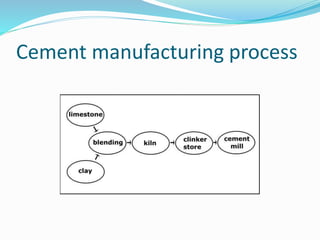
Cement manufacturing process
Tehnology
• The technology is a continuous process and is
highly energy intensive.
• At present 93% of cement production in India is
based on modern and environment-friendly dry
process technology and only 7% of the capacity is
based on old wet and semi-dry process technology.
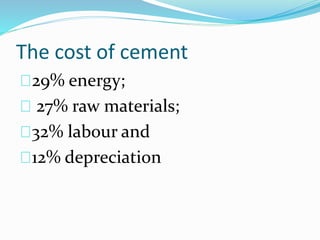
The cost of cement
29% energy;
27% raw materials;
32% labour and
12% depreciation
Evolution of indian cement
industry
• A Kolkata based company started
manufacturing cement in 1889.
• After the economic reform in 1980’s
the government control on cement
industry was liberalized.
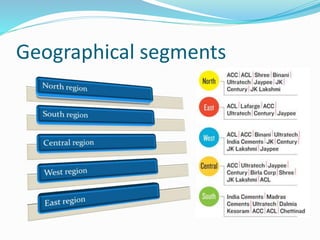
Geographical segments
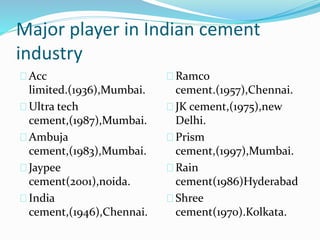
Major player in Indian cement
industry
Acc
limited.(1936),Mumbai.
Ultra tech
cement,(1987),Mumbai.
Ambuja
cement,(1983),Mumbai.
Jaypee
cement(2001),noida.
India
cement,(1946),Chennai.
Ramco
cement.(1957),Chennai.
JK cement,(1975),new
Delhi.
Prism
cement,(1997),Mumbai.
Rain
cement(1986)Hyderabad
Shree
cement(1970).Kolkata.
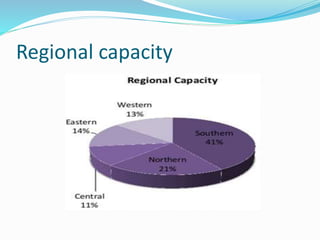
Regional capacity
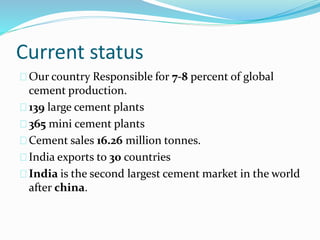
Current status
Our country Responsible for 7-8 percent of global
cement production.
139 large cement plants
365 mini cement plants
Cement sales 16.26 million tonnes.
India exports to 30 countries
India is the second largest cement market in the world
after china.
Growth rate
India would require overall cement capacity of around
480 million tonnes.
This would mean the industry will have to add another
150 million tonnes of capacity during the period.
According to the latest report from the working group
on the industry for the 12th five-year Plan (2012-17).
Factors that will drive growth in
this sector
Housing segment growth is leading to higher demand
for cement for home building.
Government’s 12th Five Year Plan focuses on
increasing infrastructure (upgraded airports, ports,
railway expansion, etc.) to drive construction activity.
Cement and gypsum products sectors in India is
attracted foreign direct investment.
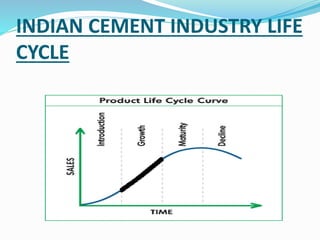
INDIAN CEMENT INDUSTRY LIFE
CYCLE
Constraints:
1).high cost of power.
2).high railway tariff.
3).high incidence of state and central levies and duties.
4).lack of private and public investment in
infrastructure project.
5).low quality coal and inadequate growth of related
infrastructure like sea and rail transport.
6).ports and bulk transports.
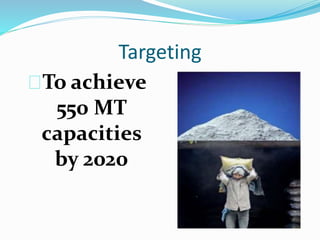
Targeting
To achieve
550 MT
capacities
by 2020
Conclusion
“Cement is one of the fundamental element for
setting up strong and healthy infrastructure of
the country and plays an important role in
economic development and welfare of the
nation”
Thank you

Cement industry

  • 1.
  • 2.
    Use of cement •Production of Concrete • Construction Purpose o Building (Floors, Beams, Columns, Roofing) o Transport (Roads, Pathways, Crossings, Bridge) o Water (Pipes, Drains, Canals) o Agriculture (Irrigation, Housing)
  • 3.
    Type of cement OrdinaryPortland Cement (OPC), Portland Pozzolana Cement (PPC), Oil Well Cement, Rapid Hardening, White Cement, etc……..,
  • 4.
  • 5.
  • 6.
    Tehnology • The technologyis a continuous process and is highly energy intensive. • At present 93% of cement production in India is based on modern and environment-friendly dry process technology and only 7% of the capacity is based on old wet and semi-dry process technology.
  • 7.
    The cost ofcement 29% energy; 27% raw materials; 32% labour and 12% depreciation
  • 8.
    Evolution of indiancement industry • A Kolkata based company started manufacturing cement in 1889. • After the economic reform in 1980’s the government control on cement industry was liberalized.
  • 9.
  • 10.
    Major player inIndian cement industry Acc limited.(1936),Mumbai. Ultra tech cement,(1987),Mumbai. Ambuja cement,(1983),Mumbai. Jaypee cement(2001),noida. India cement,(1946),Chennai. Ramco cement.(1957),Chennai. JK cement,(1975),new Delhi. Prism cement,(1997),Mumbai. Rain cement(1986)Hyderabad Shree cement(1970).Kolkata.
  • 11.
  • 12.
    Current status Our countryResponsible for 7-8 percent of global cement production. 139 large cement plants 365 mini cement plants Cement sales 16.26 million tonnes. India exports to 30 countries India is the second largest cement market in the world after china.
  • 13.
    Growth rate India wouldrequire overall cement capacity of around 480 million tonnes. This would mean the industry will have to add another 150 million tonnes of capacity during the period. According to the latest report from the working group on the industry for the 12th five-year Plan (2012-17).
  • 14.
    Factors that willdrive growth in this sector Housing segment growth is leading to higher demand for cement for home building. Government’s 12th Five Year Plan focuses on increasing infrastructure (upgraded airports, ports, railway expansion, etc.) to drive construction activity. Cement and gypsum products sectors in India is attracted foreign direct investment.
  • 15.
  • 16.
    Constraints: 1).high cost ofpower. 2).high railway tariff. 3).high incidence of state and central levies and duties. 4).lack of private and public investment in infrastructure project. 5).low quality coal and inadequate growth of related infrastructure like sea and rail transport. 6).ports and bulk transports.
  • 17.
  • 18.
    Conclusion “Cement is oneof the fundamental element for setting up strong and healthy infrastructure of the country and plays an important role in economic development and welfare of the nation”
  • 19.