


Workshop: How to Create New Value in Your Business
                       Through Business Model Innovation


                         Prepared and Presented by
                         Marcus Tarrant
                         Managing Director
                         Mission HQ Pty. Ltd. ATF the Innovate Trust

                         Bryce Steele
                         Managing Director
                         Enterprise Accelerators
A thought Starter


       The competition of today
    is between business models,
    not just products or solutions.

                           •   FujiFilm Vs Kodak
                           •   Skype Vs Telstra
                           •   Mailchimp Vs Vertical
                               Response
                           •   Toner Vs Printer


2
Enterprise Connect Introduction
Mission HQ Introduction
About Mission HQ Pty. Ltd.
Marcus Tarrant, BEc MEI
Past Roles
   • Senior Consultant - Strategy at Deloitte Consulting
     • Head of Professional Services – Offspring Ventures/ipernica
Current
     • Managing Director Mission HQ
     • Chargantt.com
     • Business Planning HQ .com
     • HyperQuestion.com


 5
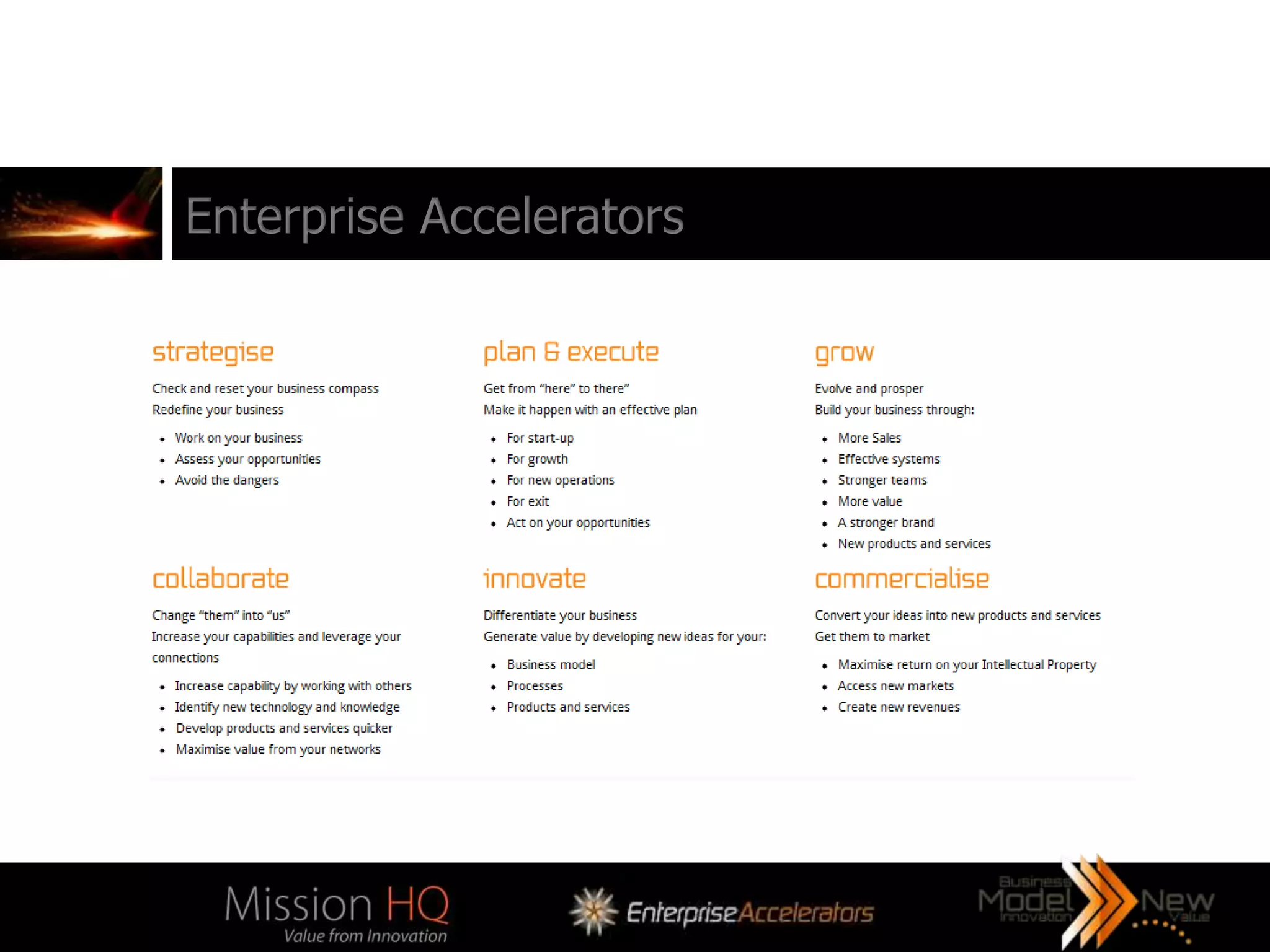
Enterprise Accelerators
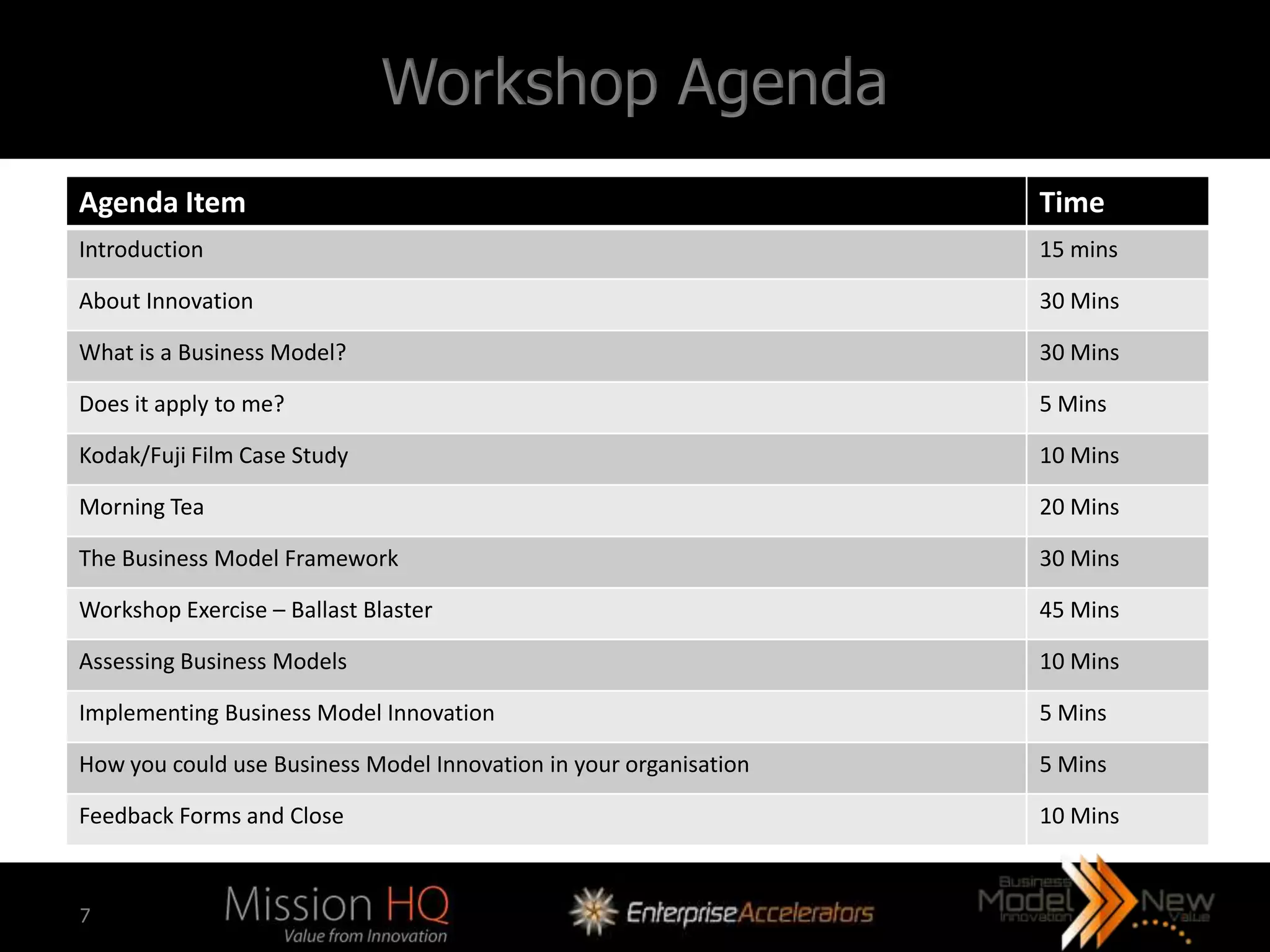
Workshop Agenda
Agenda Item                                                        Time
Introduction                                                       15 mins

About Innovation                                                   30 Mins

What is a Business Model?                                          30 Mins

Does it apply to me?                                               5 Mins

Kodak/Fuji Film Case Study                                         10 Mins

Morning Tea                                                        20 Mins

The Business Model Framework                                       30 Mins

Workshop Exercise – Ballast Blaster                                45 Mins

Assessing Business Models                                          10 Mins

Implementing Business Model Innovation                             5 Mins

How you could use Business Model Innovation in your organisation   5 Mins

Feedback Forms and Close                                           10 Mins


7
What is it all about?
There are three kinds of companies, those that make
      new things happen, those that watch new things
      happen, and those that wonder what happened

    Anonymous


9
10
11
12
13
14
15
16
17
18
19
20
21
22
23
24
25
26
27
28
29
30
31
32
33
34
35
About Innovation


                   What is innovation and
                   how is it used?
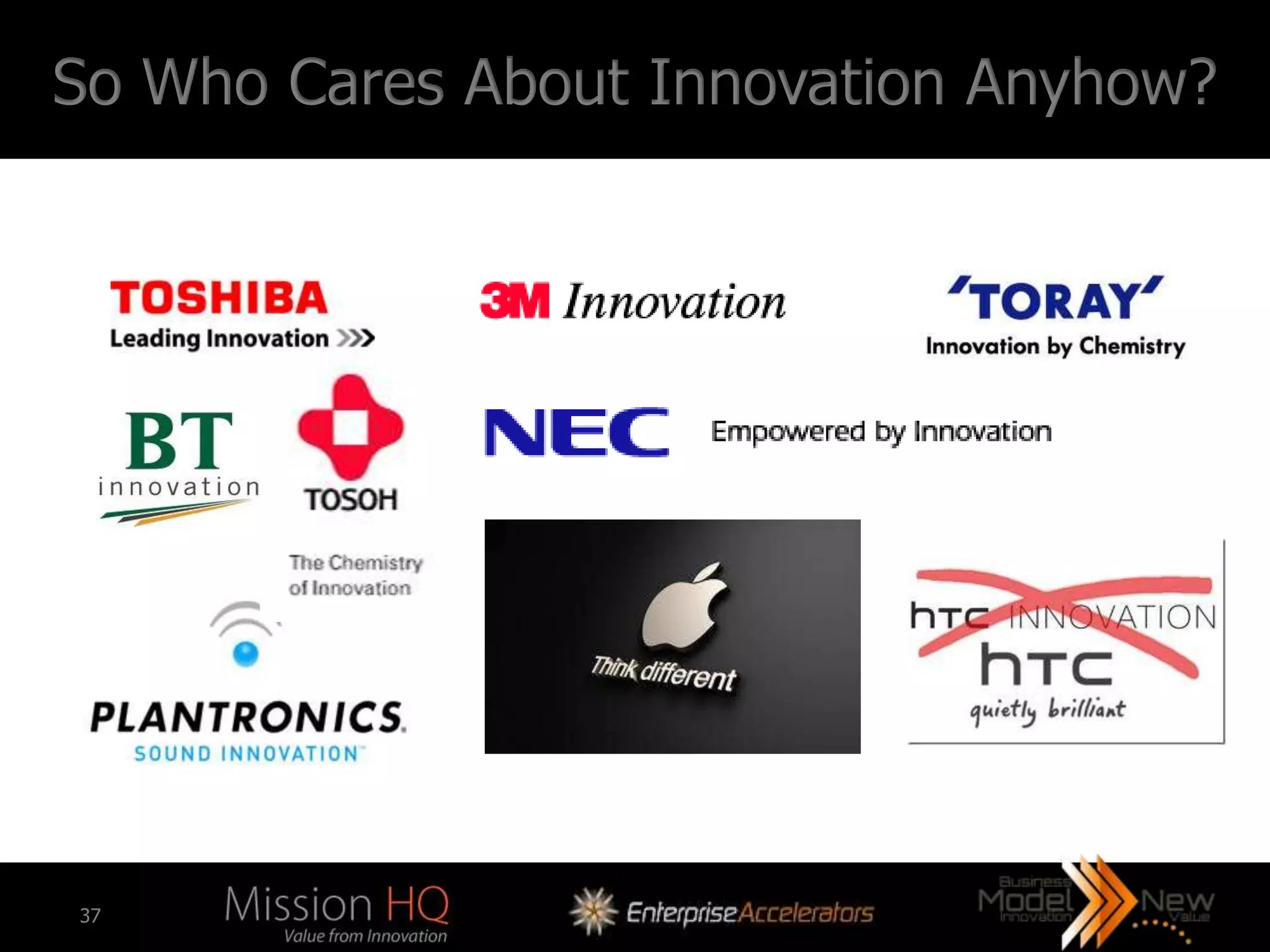
So Who Cares About Innovation Anyhow?


37
Mini-Workshop – What is Innovation?

•    How have you seen it applied in your organisation?
•    Is it core to your business?
•    What type of innovation have you done?
•    Has it contributed value to your business?
•    Can you identify a direct bottom line impact?
•    What effect has it had on your customers and suppliers?
•    What’s hard about doing innovation?


38
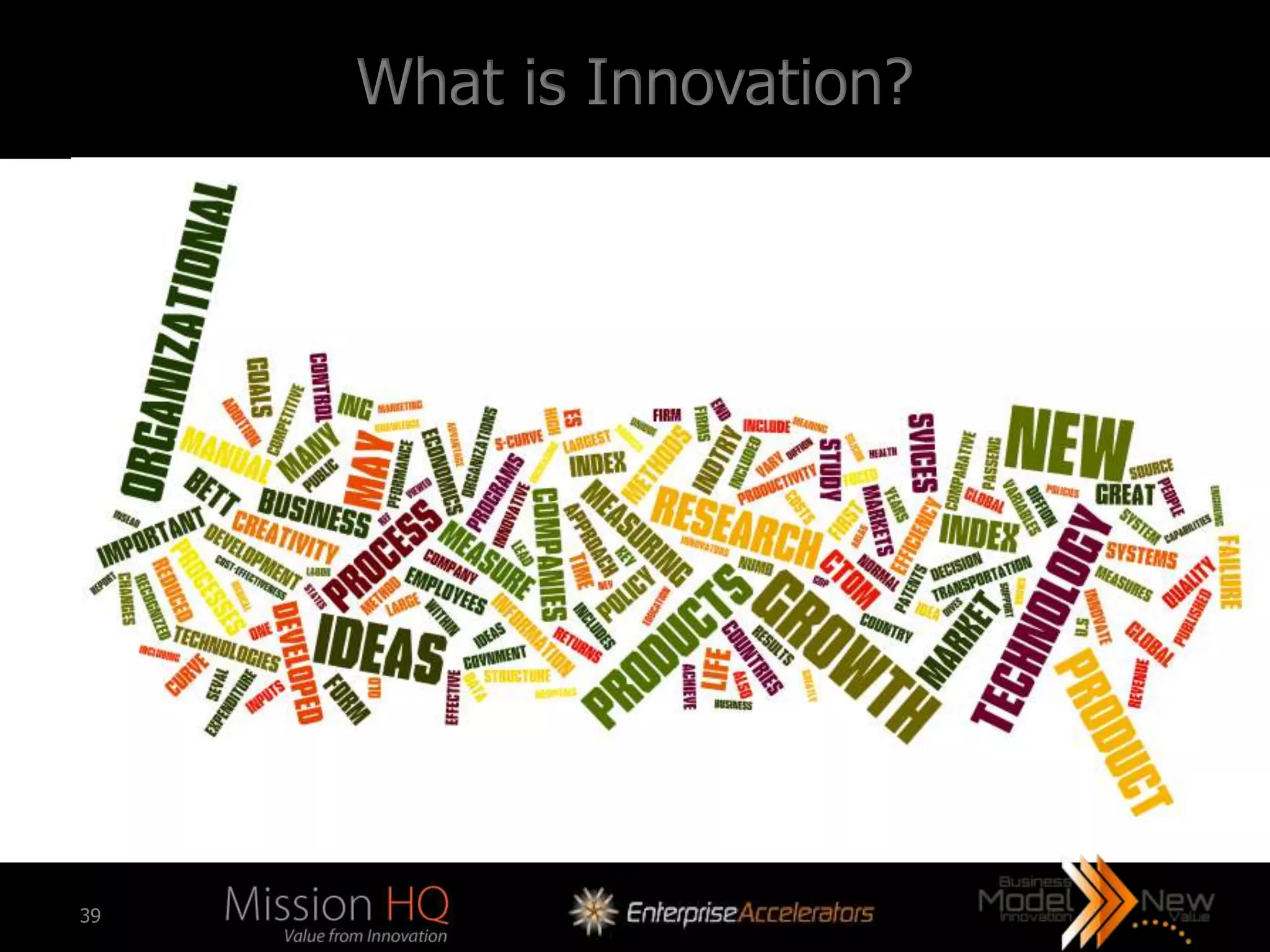
What is Innovation?


39
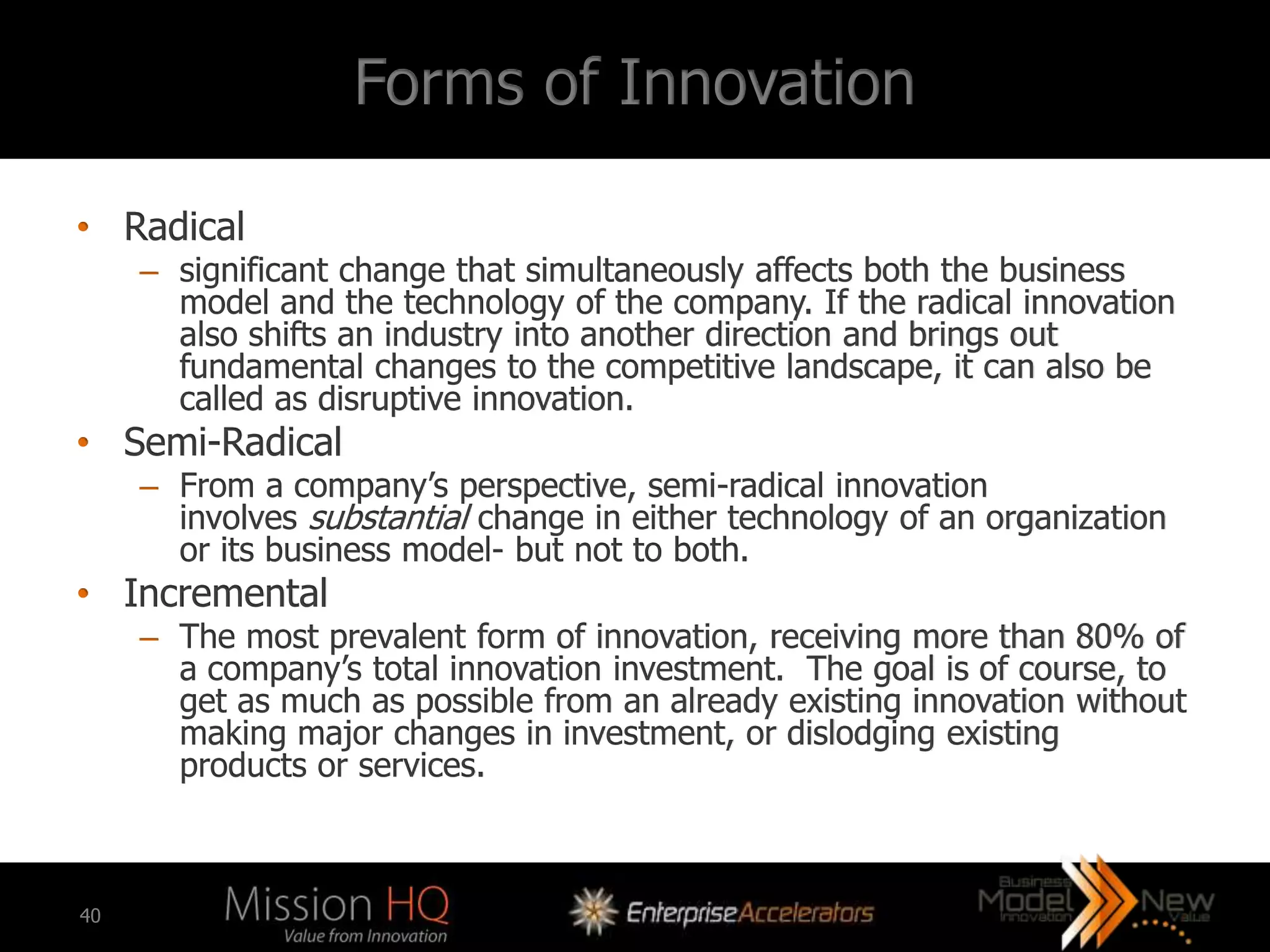
Forms of Innovation

• Radical
     – significant change that simultaneously affects both the business
       model and the technology of the company. If the radical innovation
       also shifts an industry into another direction and brings out
       fundamental changes to the competitive landscape, it can also be
       called as disruptive innovation.
• Semi-Radical
     – From a company’s perspective, semi-radical innovation
       involves substantial change in either technology of an organization
       or its business model- but not to both.
• Incremental
     – The most prevalent form of innovation, receiving more than 80% of
       a company’s total innovation investment. The goal is of course, to
       get as much as possible from an already existing innovation without
       making major changes in investment, or dislodging existing
       products or services.


40
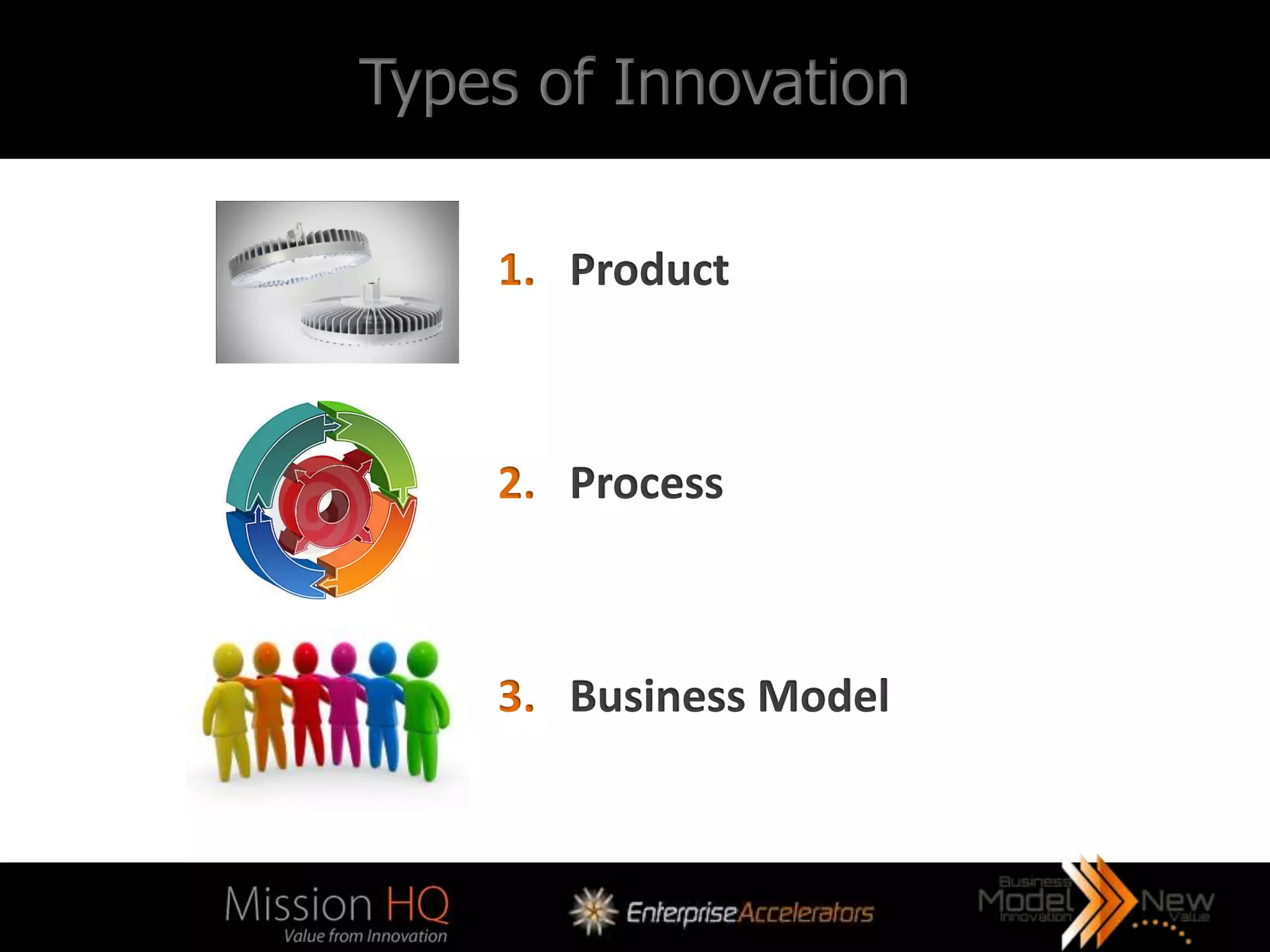
Types of Innovation

    1. Product


    2. Process


    3. Business Model
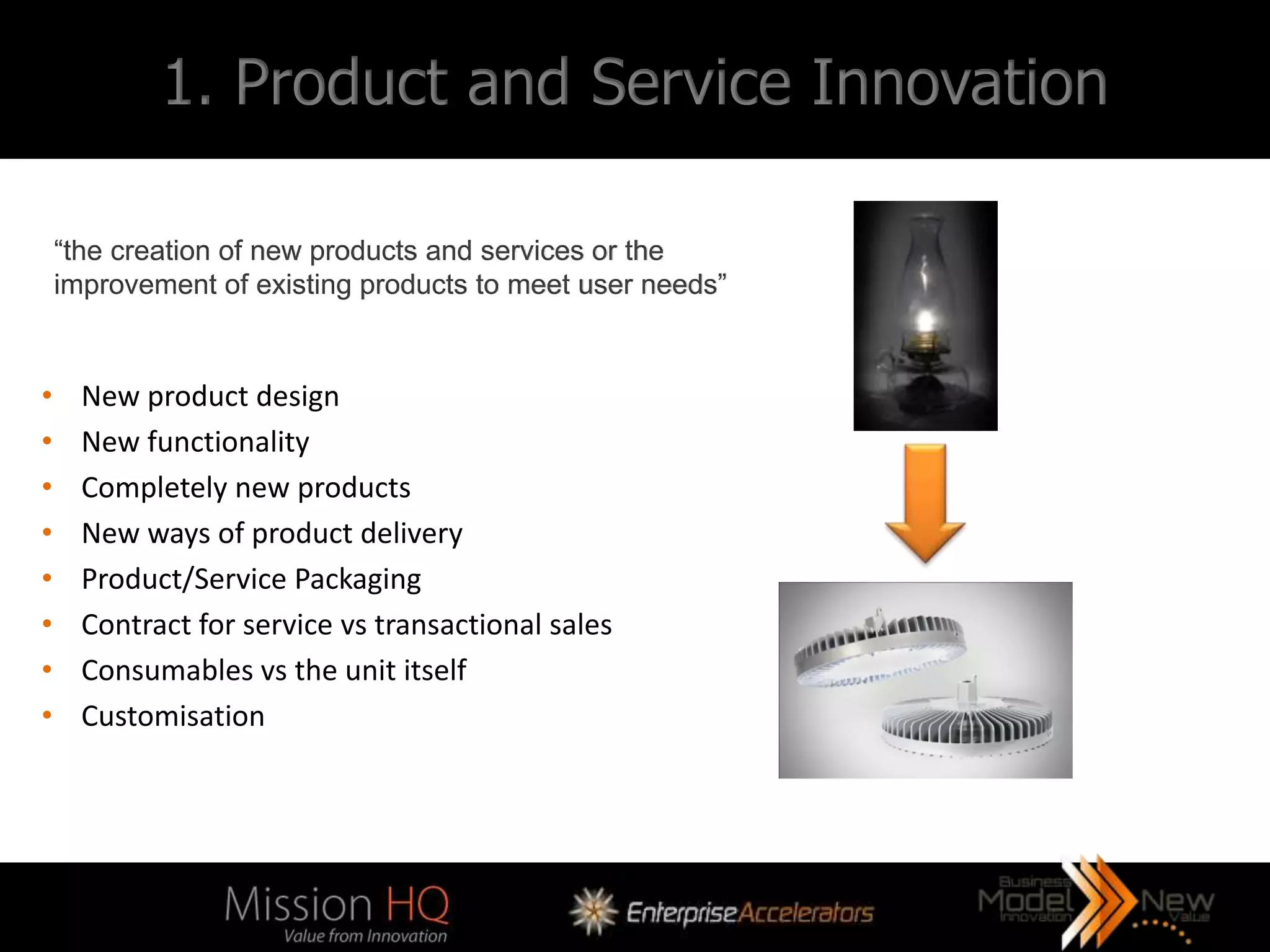
1. Product and Service Innovation

    “the creation of new products and services or the
    improvement of existing products to meet user needs”


•     New product design
•     New functionality
•     Completely new products
•     New ways of product delivery
•     Product/Service Packaging
•     Contract for service vs transactional sales
•     Consumables vs the unit itself
•     Customisation
1. Product and Service Innovation

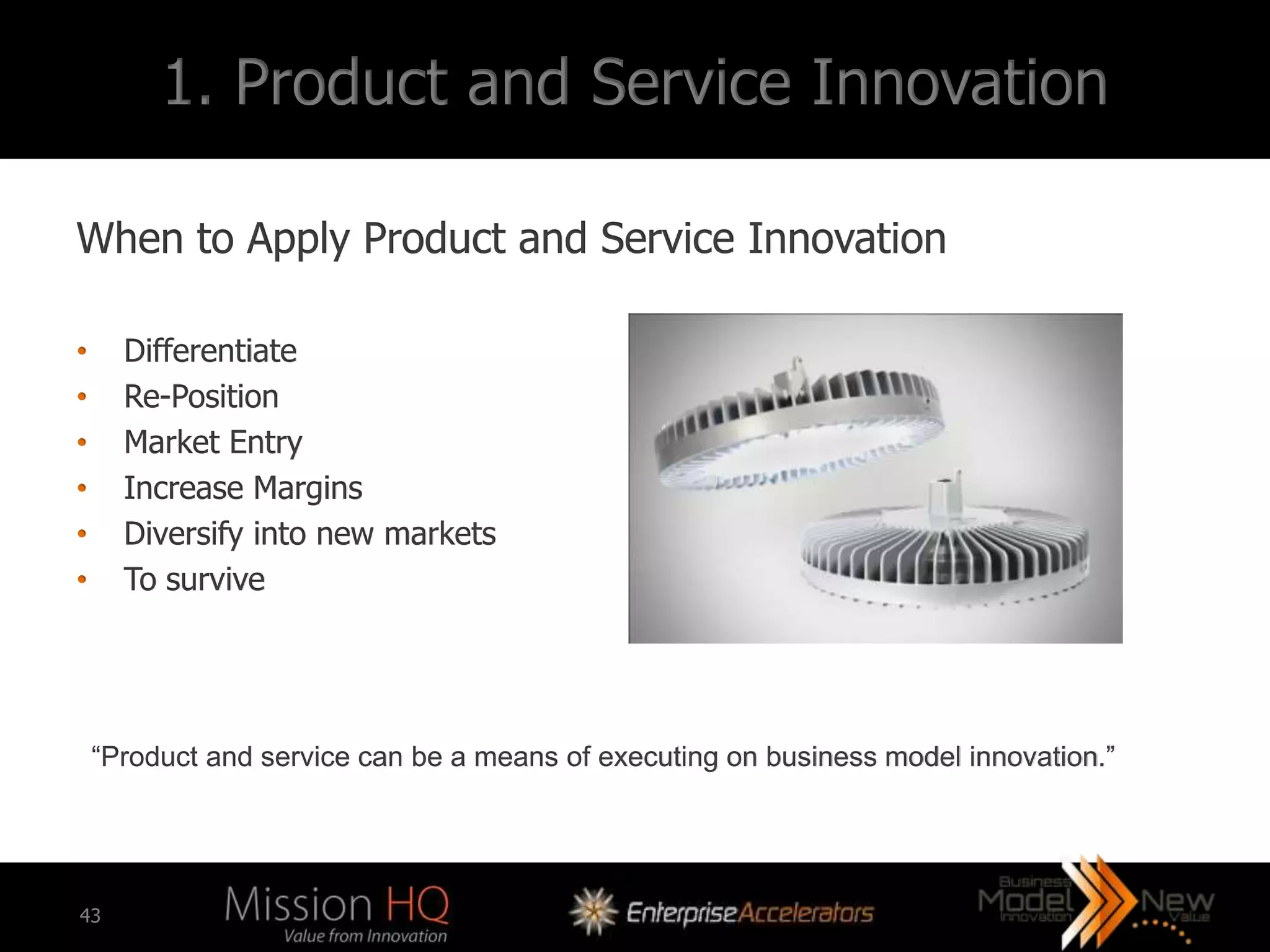
When to Apply Product and Service Innovation

•     Differentiate
•     Re-Position
•     Market Entry
•     Increase Margins
•     Diversify into new markets
•     To survive


    “Product and service can be a means of executing on business model innovation.”


43
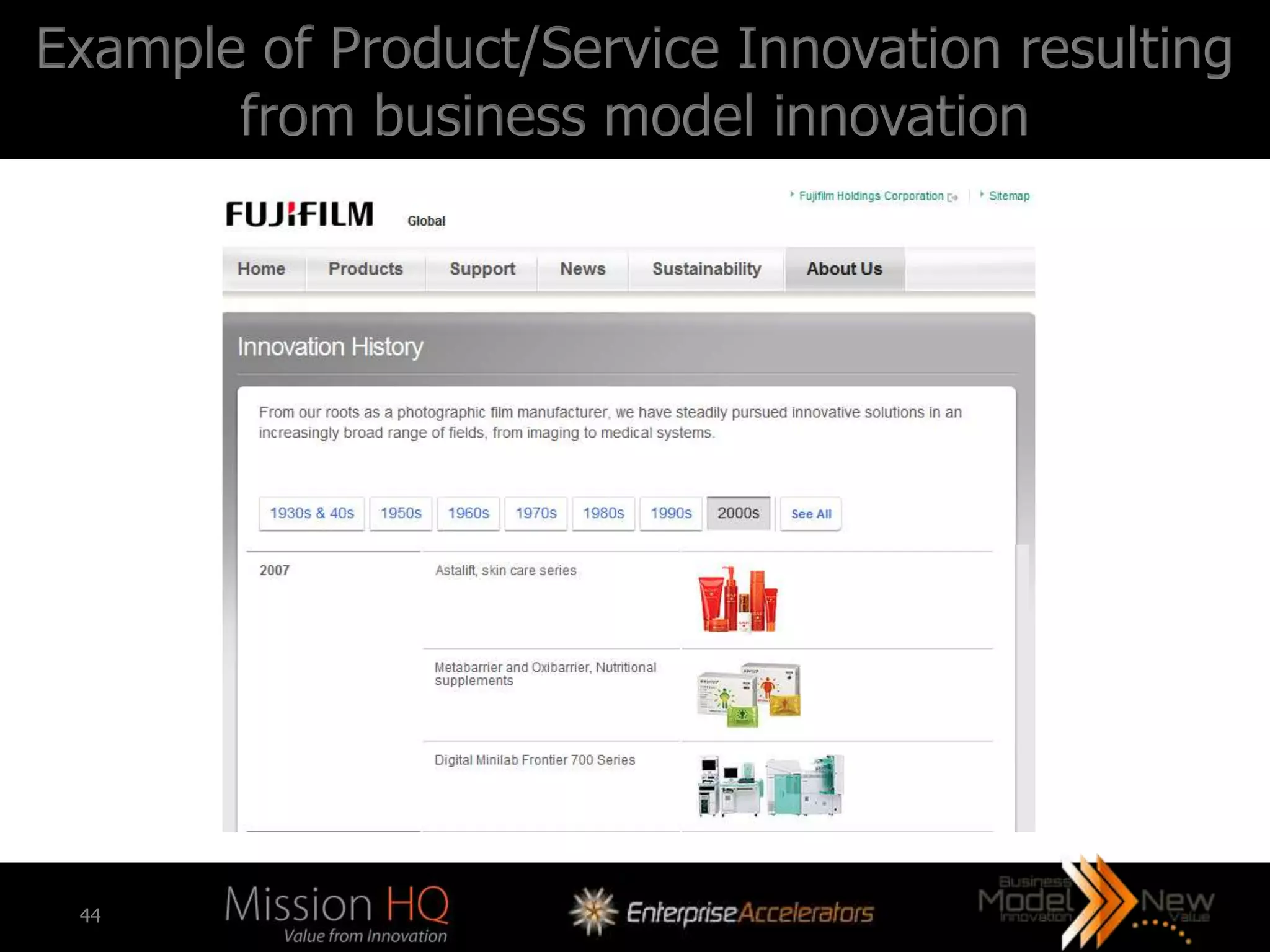
Example of Product/Service Innovation resulting
       from business model innovation


 44
2. Process Innovation

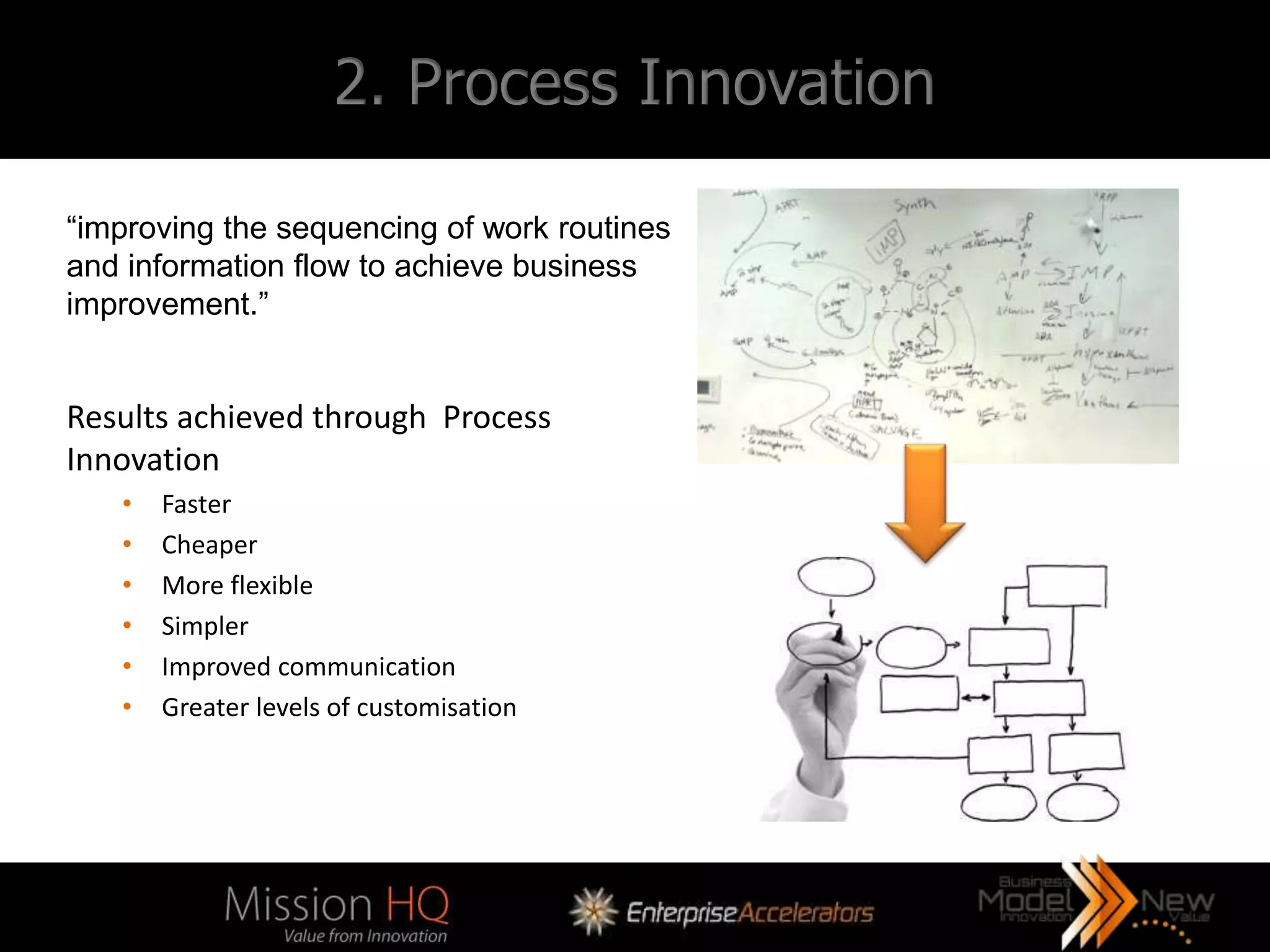
“improving the sequencing of work routines
and information flow to achieve business
improvement.”


Results achieved through Process
Innovation
   •   Faster
   •   Cheaper
   •   More flexible
   •   Simpler
   •   Improved communication
   •   Greater levels of customisation
2. Process Innovation

When and Why?
•   Better meet customer needs
•   Improve cost efficiency
•   Enable greater organisational flexibility
•   Enhanced consistency
•   Improved delivery of “Brand Promise”
•   Focus on “Core Business” – Process Outsourcing
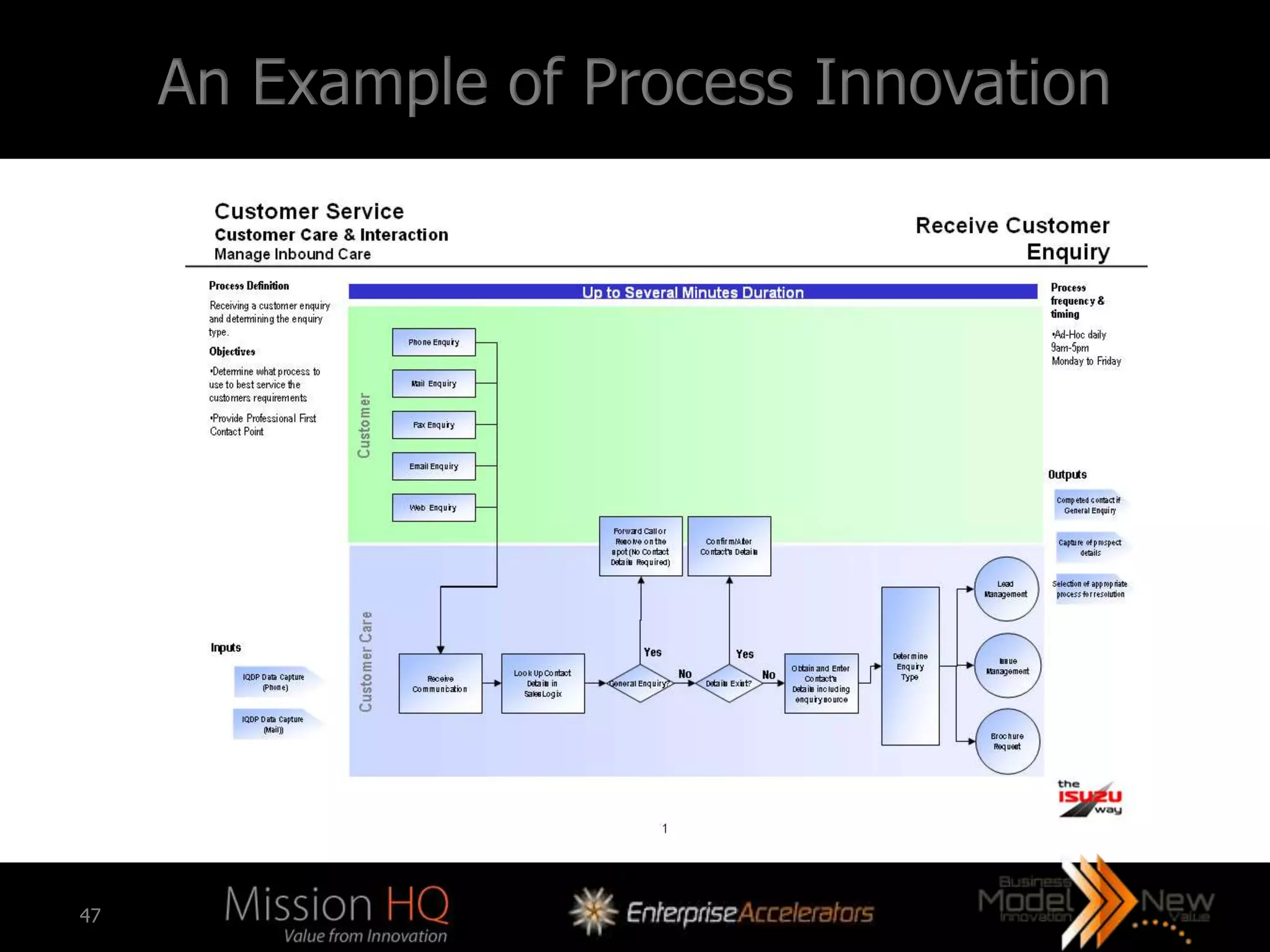
An Example of Process Innovation


47
3. Business Model Innovation

“a conceptual framework for identifying how company creates, delivers and
extracts value”


•   Identifies a market segment and defines the
    customer
•   Articulates the value of the proposed offering
•   Focuses on the key attributes of the offering"
•   Defines the value chain to deliver that offering
•   Creates a way to get paid
•   Establishes a value network that is needed to
    make the model self sustaining
3. Business Model Innovation

When and Why?
   •   Underpin the business planning process
   •   Provide an absolutely IDEAL starting point for the
       creation of a financial model.
   •   Create a deeper understanding of you plans with
       collaborators, partners and suppliers
   •   Provide a clear picture of a planned business to
       investors or internal stakeholders
   •   Develop business cases for market entry
   •   Optimise the value obtainable for a given business
       concept
   •   Assist in evaluating alignment with organisational
       strategy
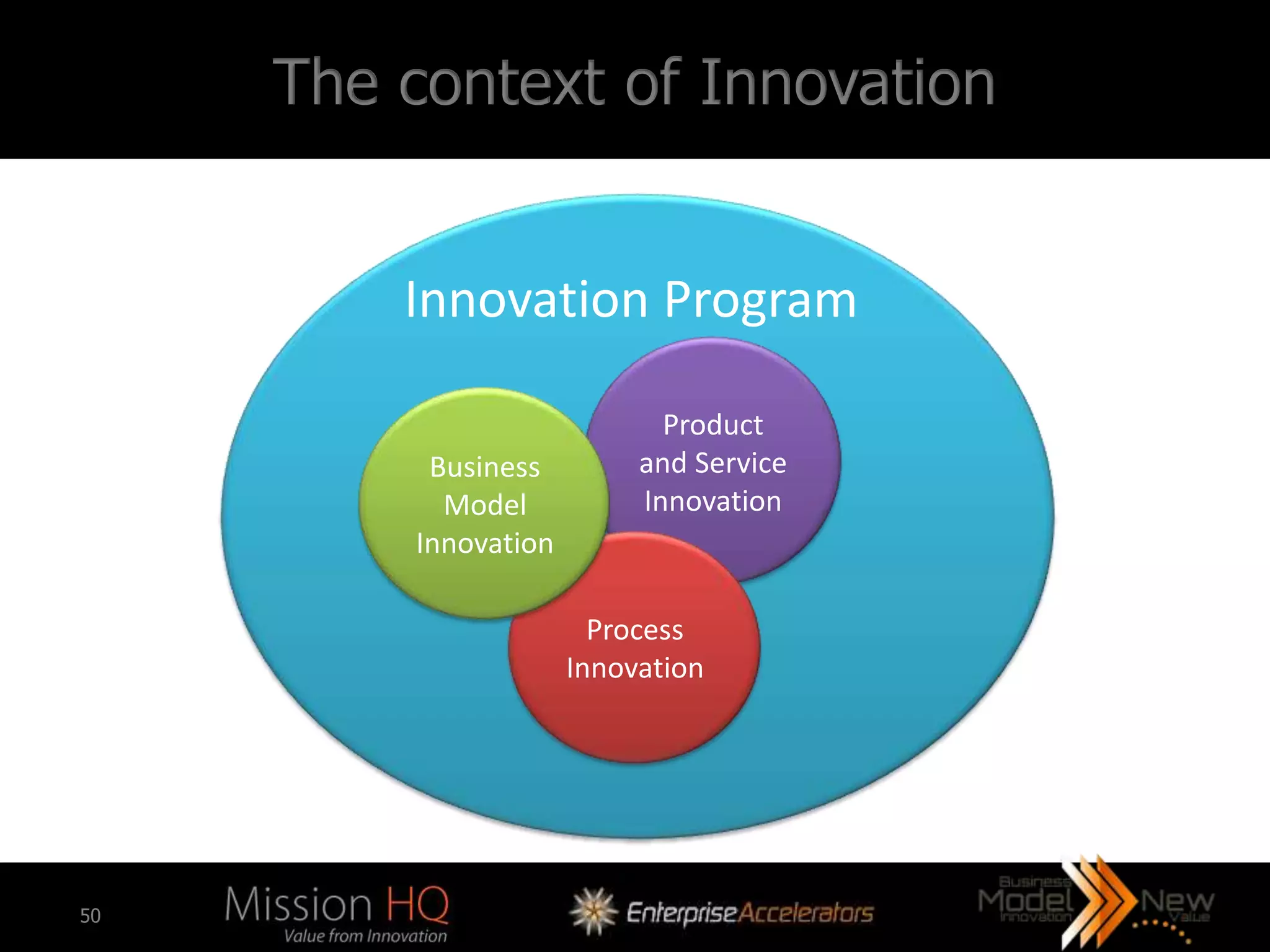
The context of Innovation


         Innovation Program

                             Product
          Business         and Service
           Model           Innovation
         Innovation

                        Process
                      Innovation


50
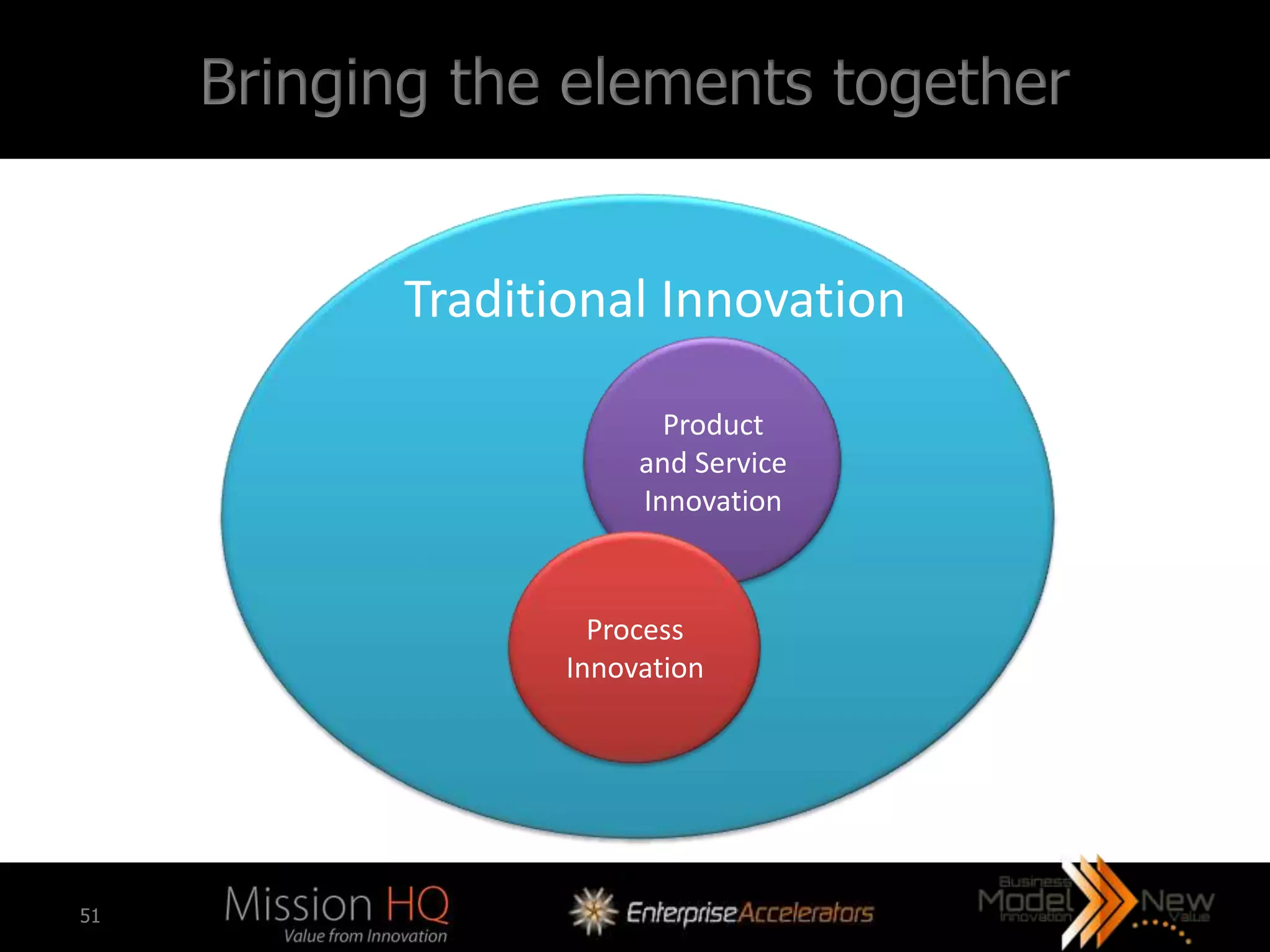
Bringing the elements together


            Traditional Innovation

                          Product
                        and Service
                        Innovation


                     Process
                   Innovation


51
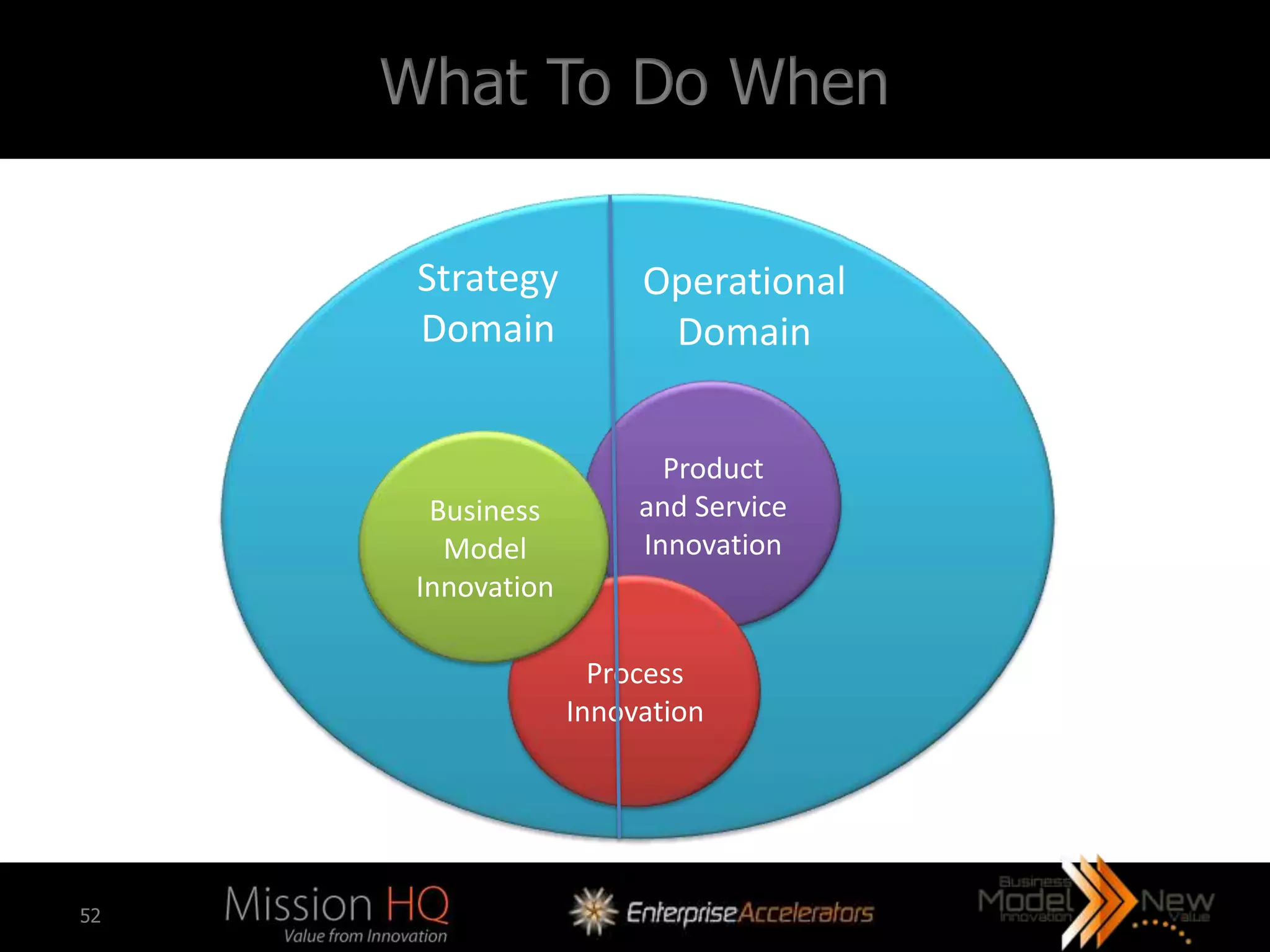
What To Do When

      Strategy          Operational
      Domain             Domain


                          Product
       Business         and Service
        Model           Innovation
      Innovation

                     Process
                   Innovation


52
So where does business model innovation fit
                exactly?
• Business Model Renovation
  [BMR] is presented as the
  highest level of a strategy for
  managing change that usually
  cannot be handled by
  continuous improvement and re-
  engineering methods or
  organizational restructuring
  (Kovacic, 2001).


53
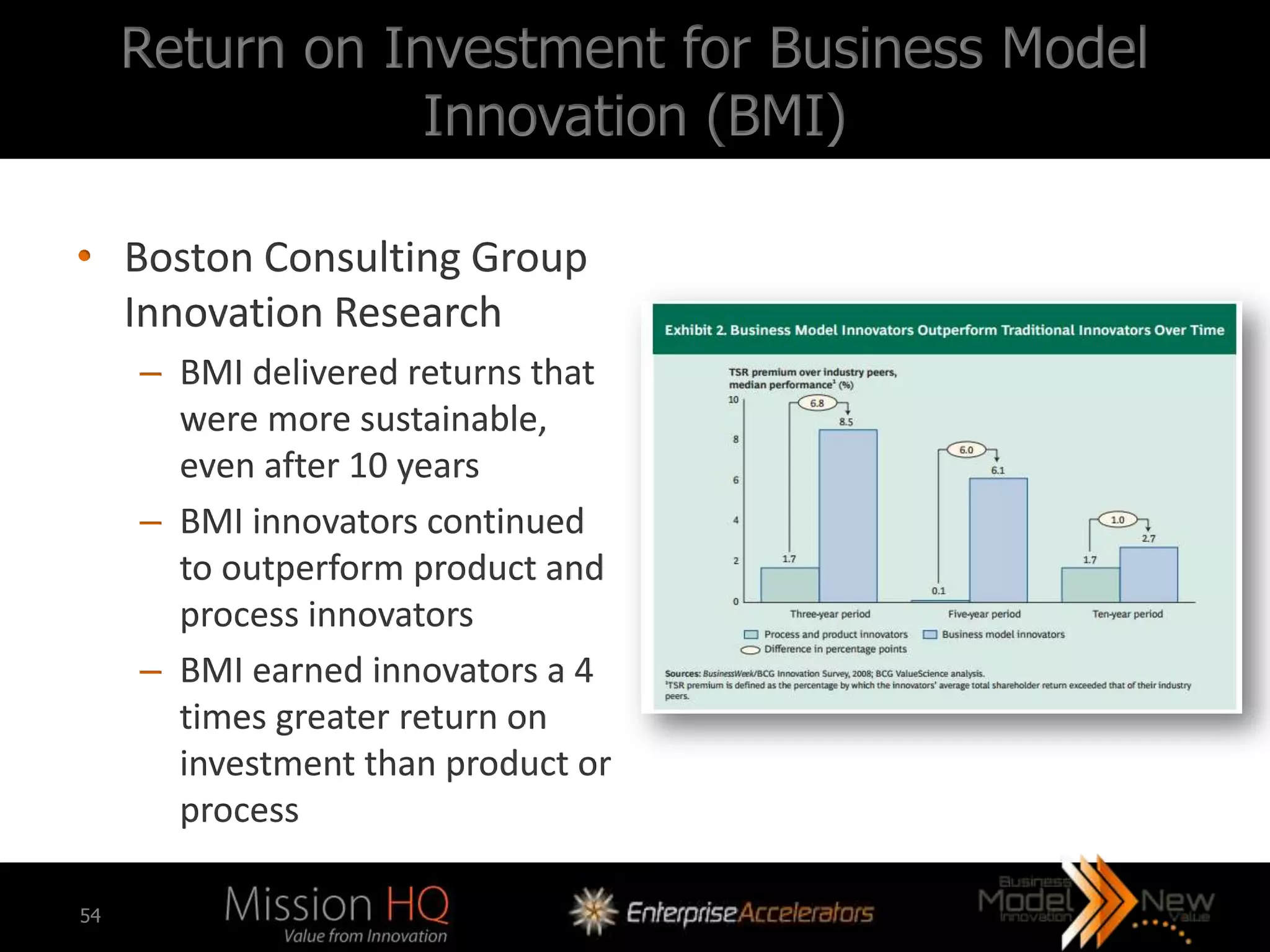
Return on Investment for Business Model
                 Innovation (BMI)
• Boston Consulting Group
  Innovation Research
     – BMI delivered returns that
       were more sustainable,
       even after 10 years
     – BMI innovators continued
       to outperform product and
       process innovators
     – BMI earned innovators a 4
       times greater return on
       investment than product or
       process

54
What is a business model?
White-Board Discussion

• What is a business model
     –   Characteristics of a business model
     –   Relevance to my organisation
     –   Have you heard the term before?
     –   What do people mean when they talk about a business model?


56
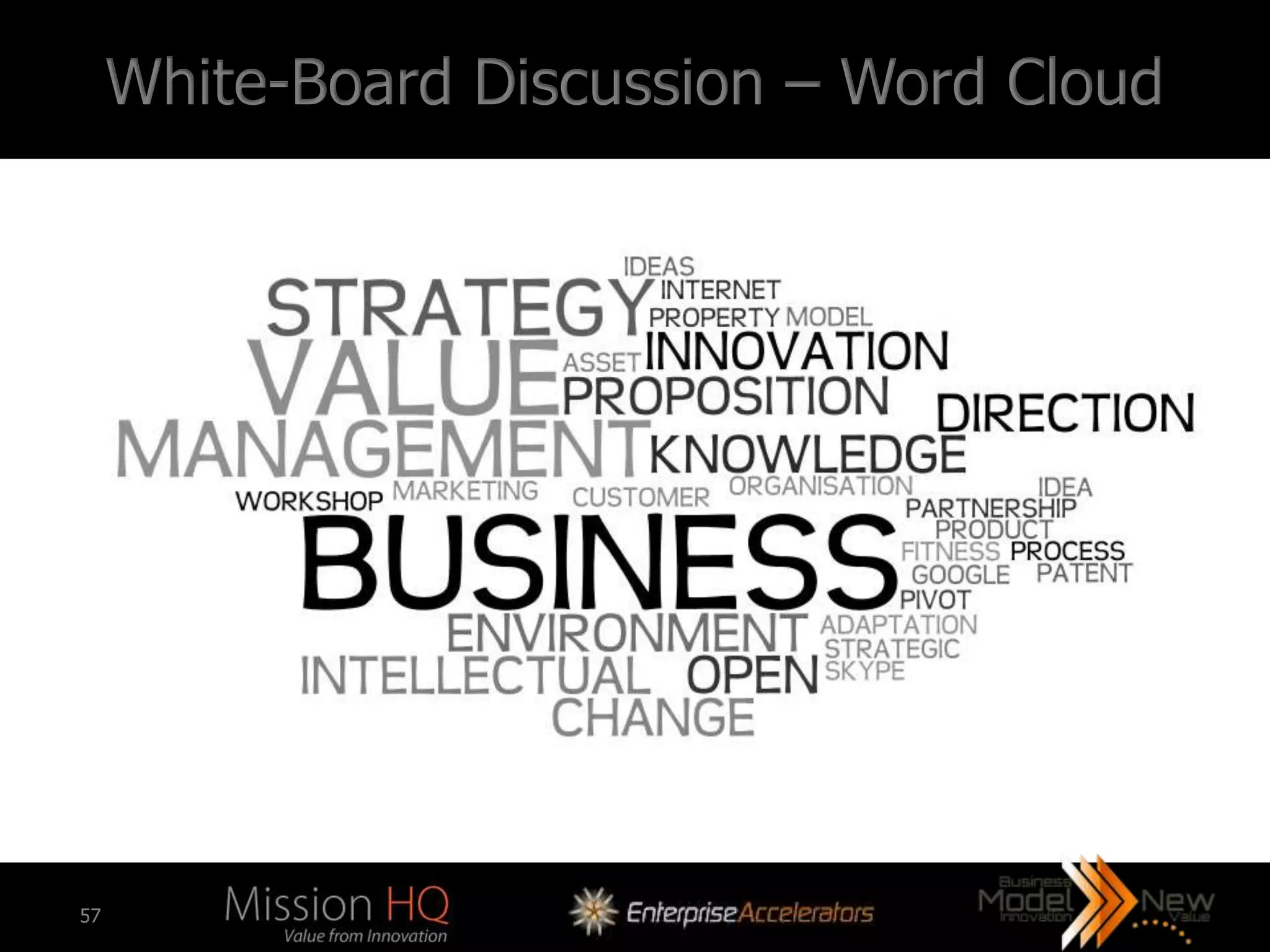
White-Board Discussion – Word Cloud


57
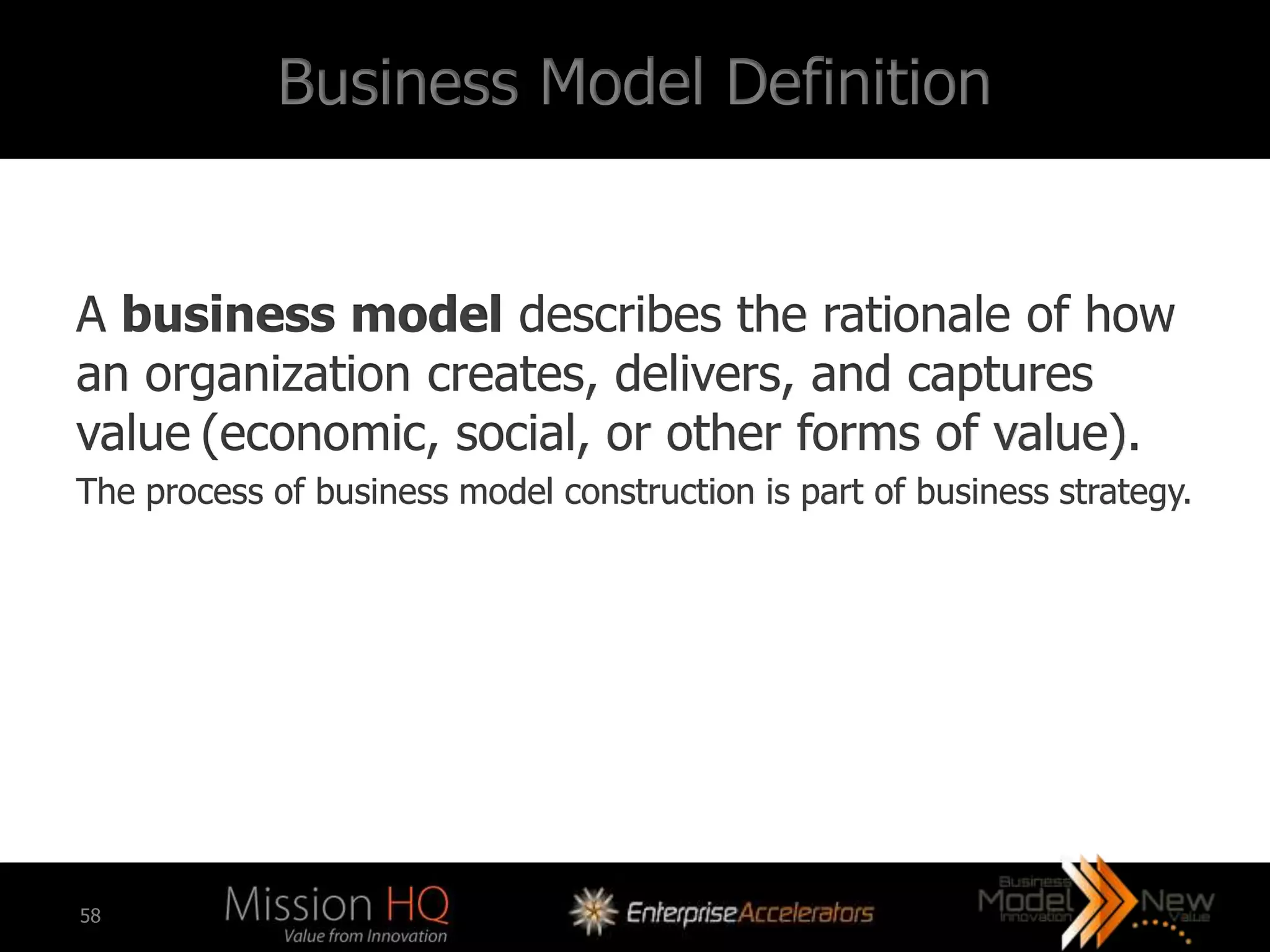
Business Model Definition


A business model describes the rationale of how
an organization creates, delivers, and captures
value (economic, social, or other forms of value).
The process of business model construction is part of business strategy.


58
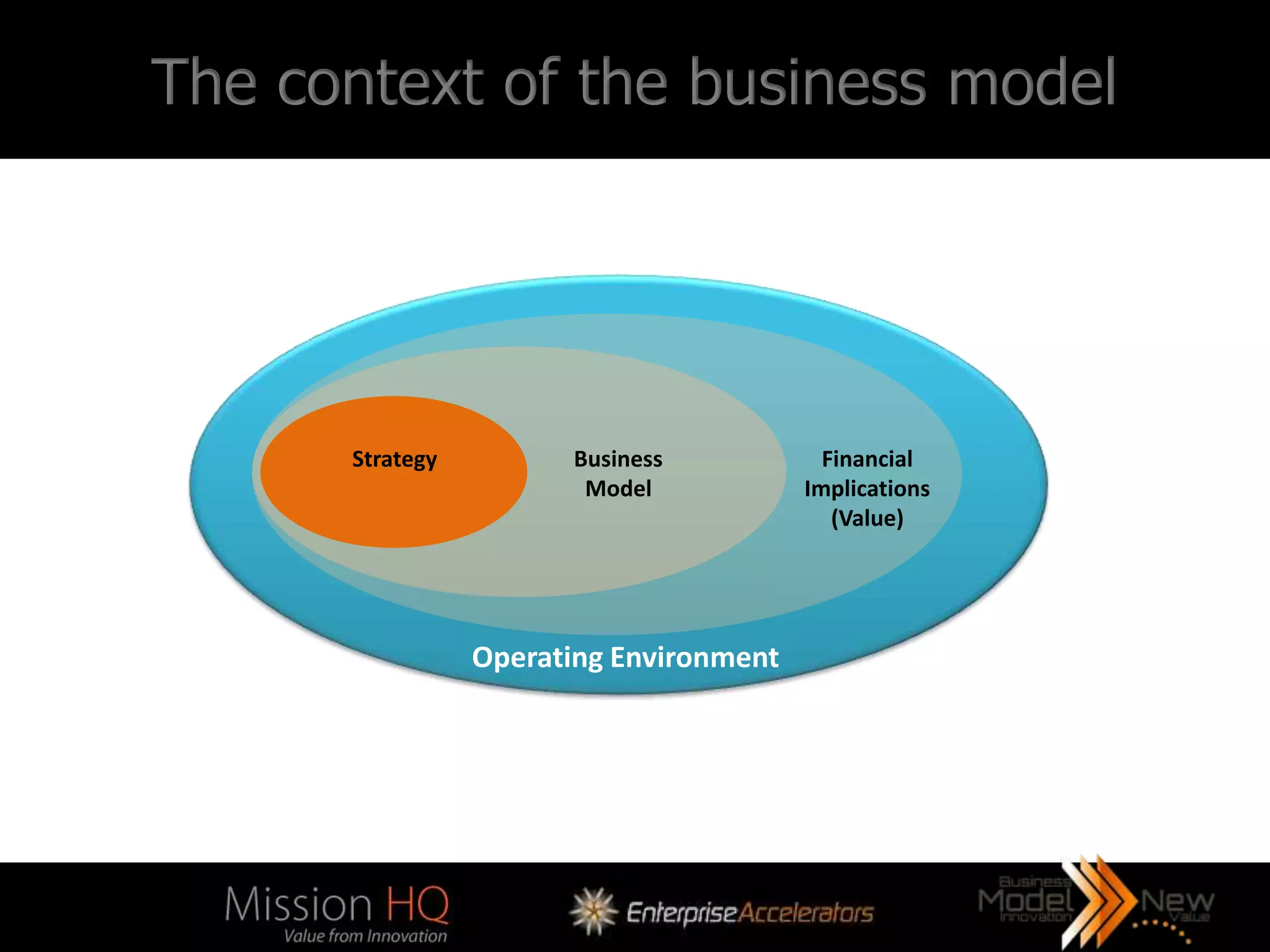
The context of the business model
what are intangible assets?


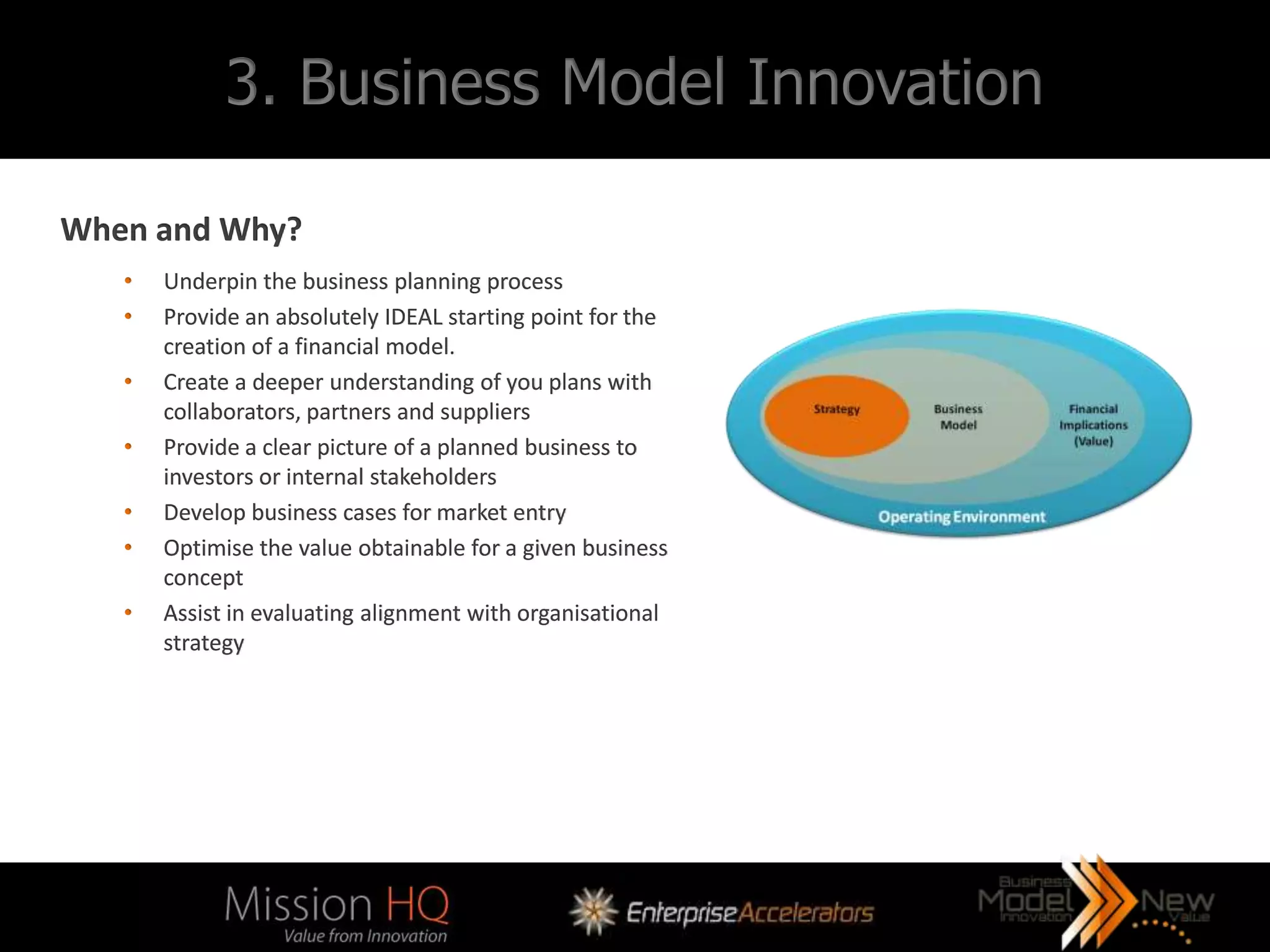
                    Strategy         Business            Financial
                                      Model            Implications
                                                          (Value)


                               Operating Environment
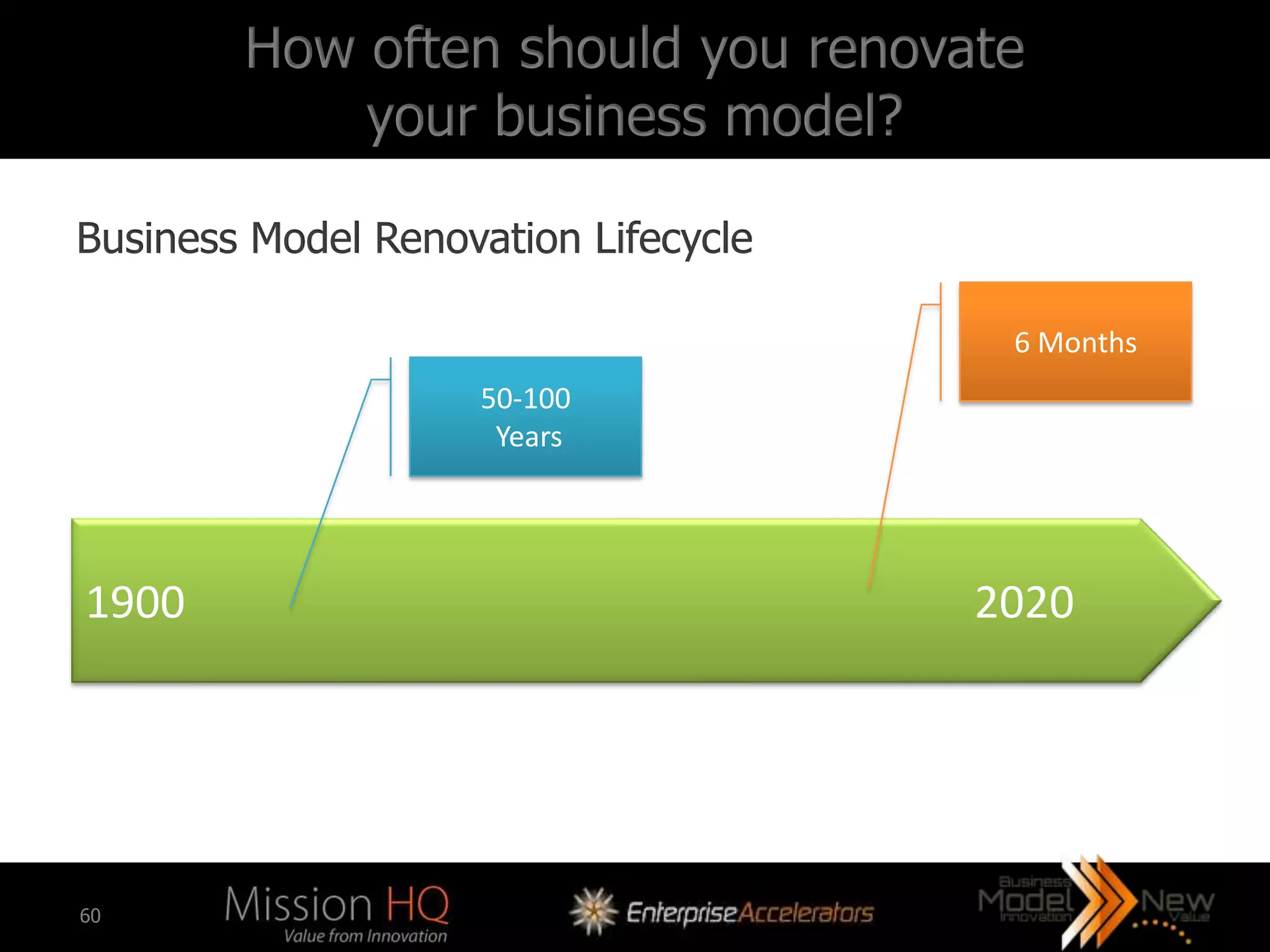
How often should you renovate
            your business model?

Business Model Renovation Lifecycle

                                       6 Months
                    50-100
                     Years


1900                                  2020


60
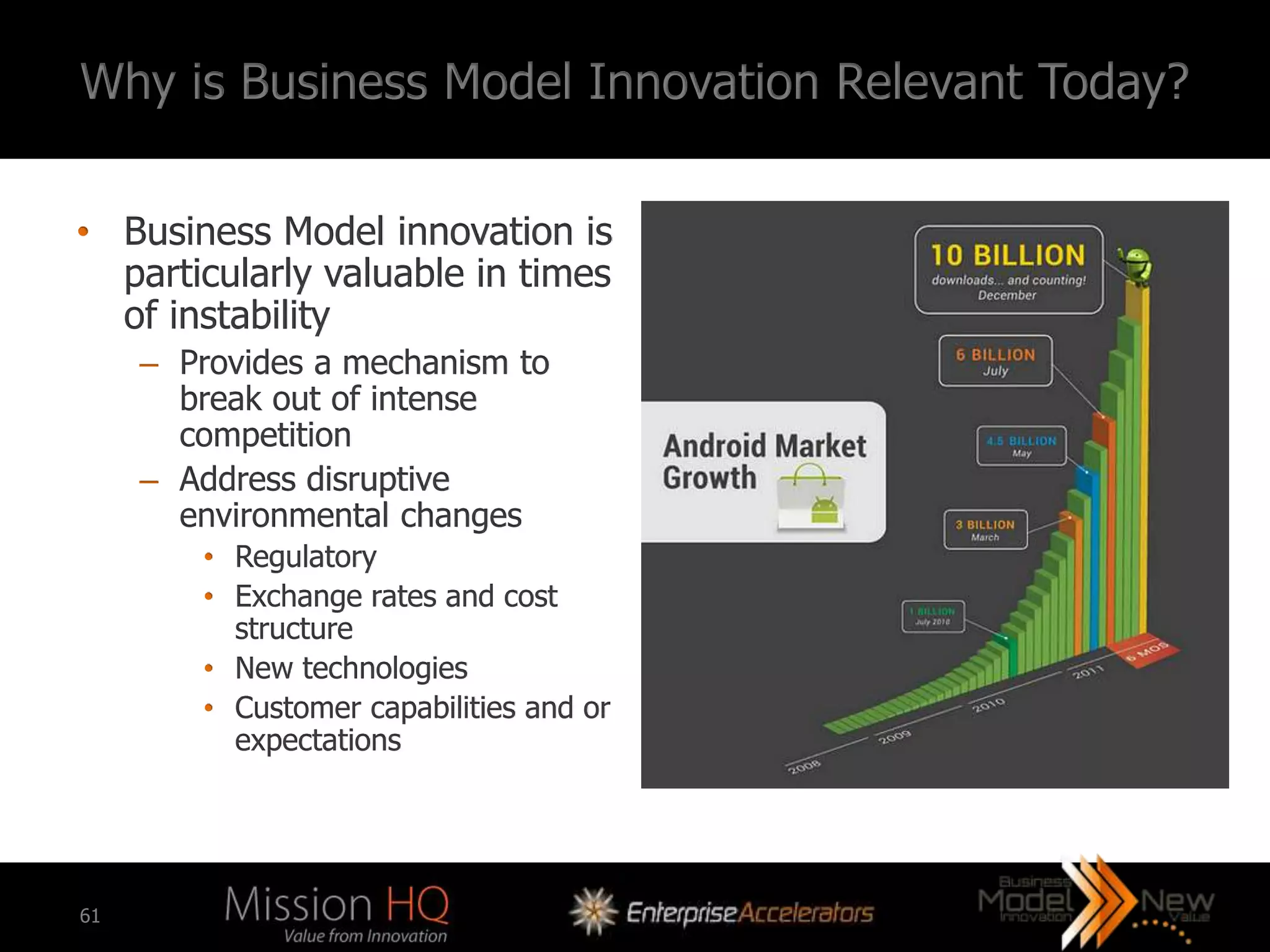
Why is Business Model Innovation Relevant Today?

• Business Model innovation is
  particularly valuable in times
  of instability
     – Provides a mechanism to
       break out of intense
       competition
     – Address disruptive
       environmental changes
        • Regulatory
        • Exchange rates and cost
          structure
        • New technologies
        • Customer capabilities and or
          expectations


61
Does it apply to me?
Does Business Model Innovation Apply to Me?


•    Manufacturing
•    Services
•    Retail
•    Mining                  Need
•    Engineering             Sustainable
•    Infrastructure
                             Revenue to
•    Finance
•    Online
                             Survive
•    Not for profit
•    Government Agencies


63
For how long will you be able to keep charging
       what you are for what you do?
•     Exchange Rate – Aust Red Wine Example
•     Rise of Asia
•     Disruptive technology
•     New products and services
•     New ways of doing business
•     New delivery systems
•     Virtualisation
•     Freemium
•     International Barriers in Communications
•     Customer problem evolution
•     Service Automation
•     ...even the Ipod! Nano 4gb 2007 - $364 Today $149

 64
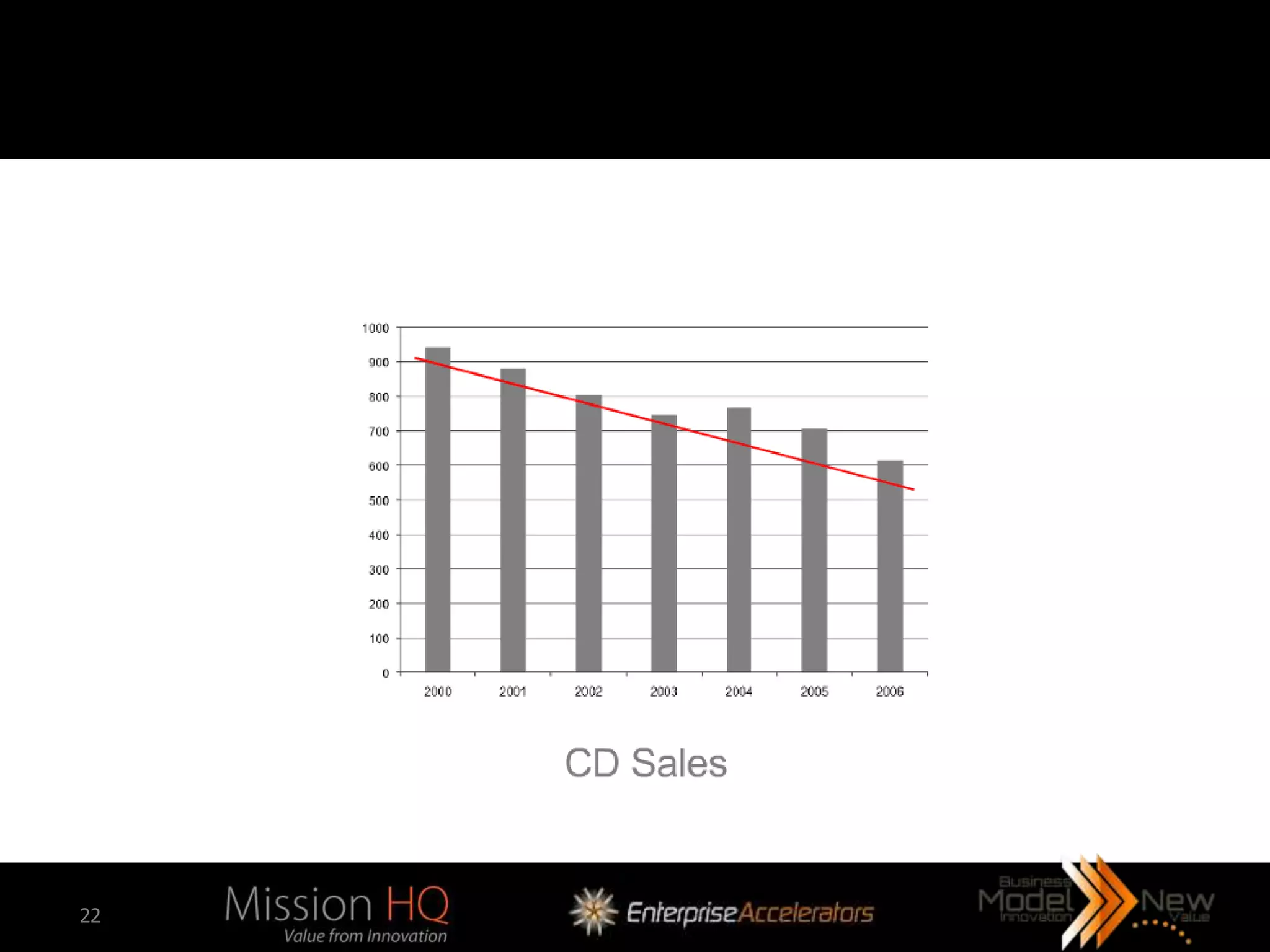
Discussion on Kodak/Fuji Film Case Study
Discussion Points

• Digital photography's impact on the Kodak Business
  Model
• Who invented digital photography?
• What was the Kodak business model?
• What should the Kodak business model take into
  account?
• How did Fuji Film handle the same issues differently?
• Does the business model support the same skills and
  number of resources?
• Does having a great business model today mean that
  you will also have one in the future?

66
Morning Tea – 20 Minute Break
The Business Model Framework
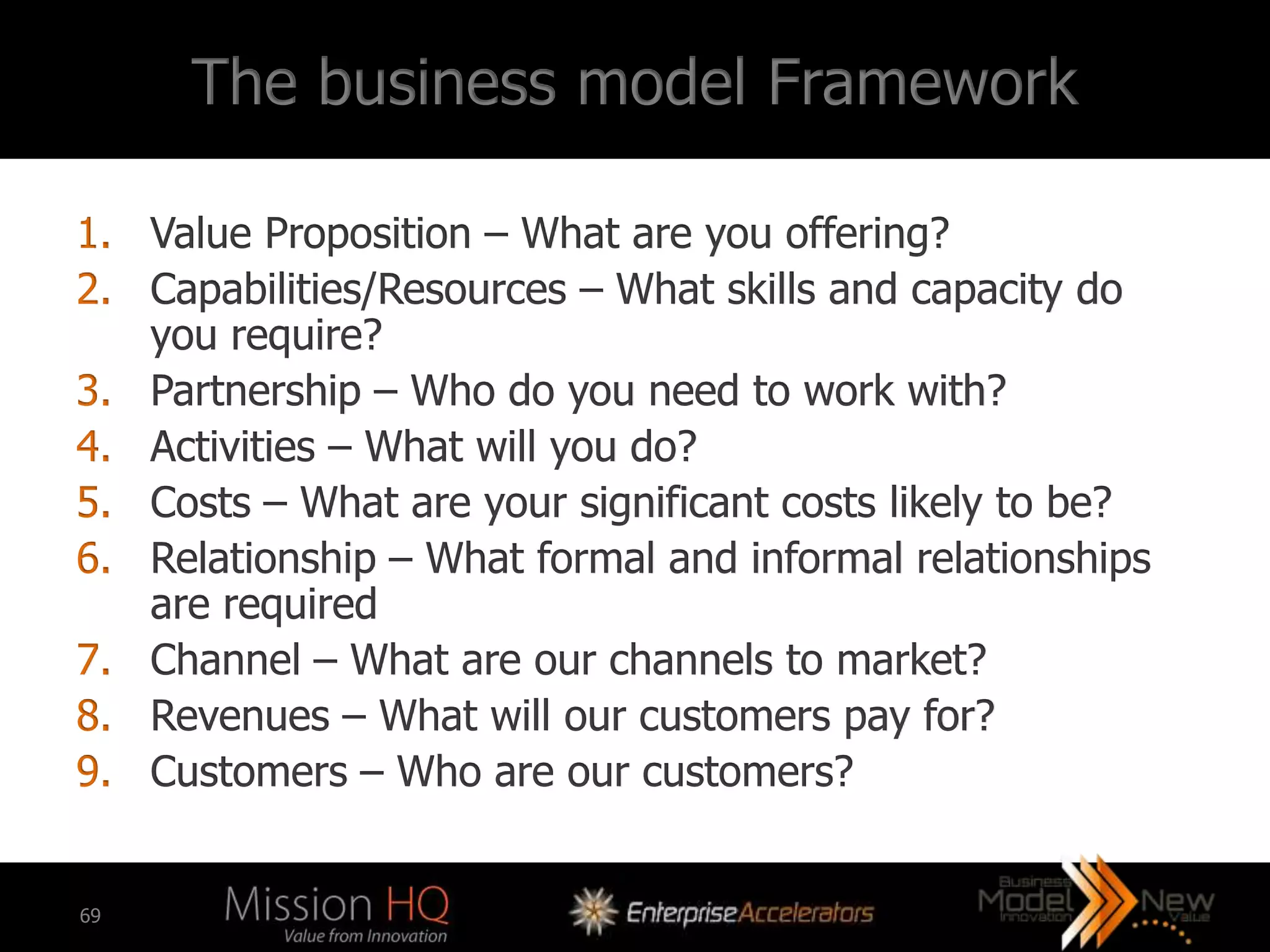
The business model Framework

1. Value Proposition – What are you offering?
2. Capabilities/Resources – What skills and capacity do
   you require?
3. Partnership – Who do you need to work with?
4. Activities – What will you do?
5. Costs – What are your significant costs likely to be?
6. Relationship – What formal and informal relationships
   are required
7. Channel – What are our channels to market?
8. Revenues – What will our customers pay for?
9. Customers – Who are our customers?


69
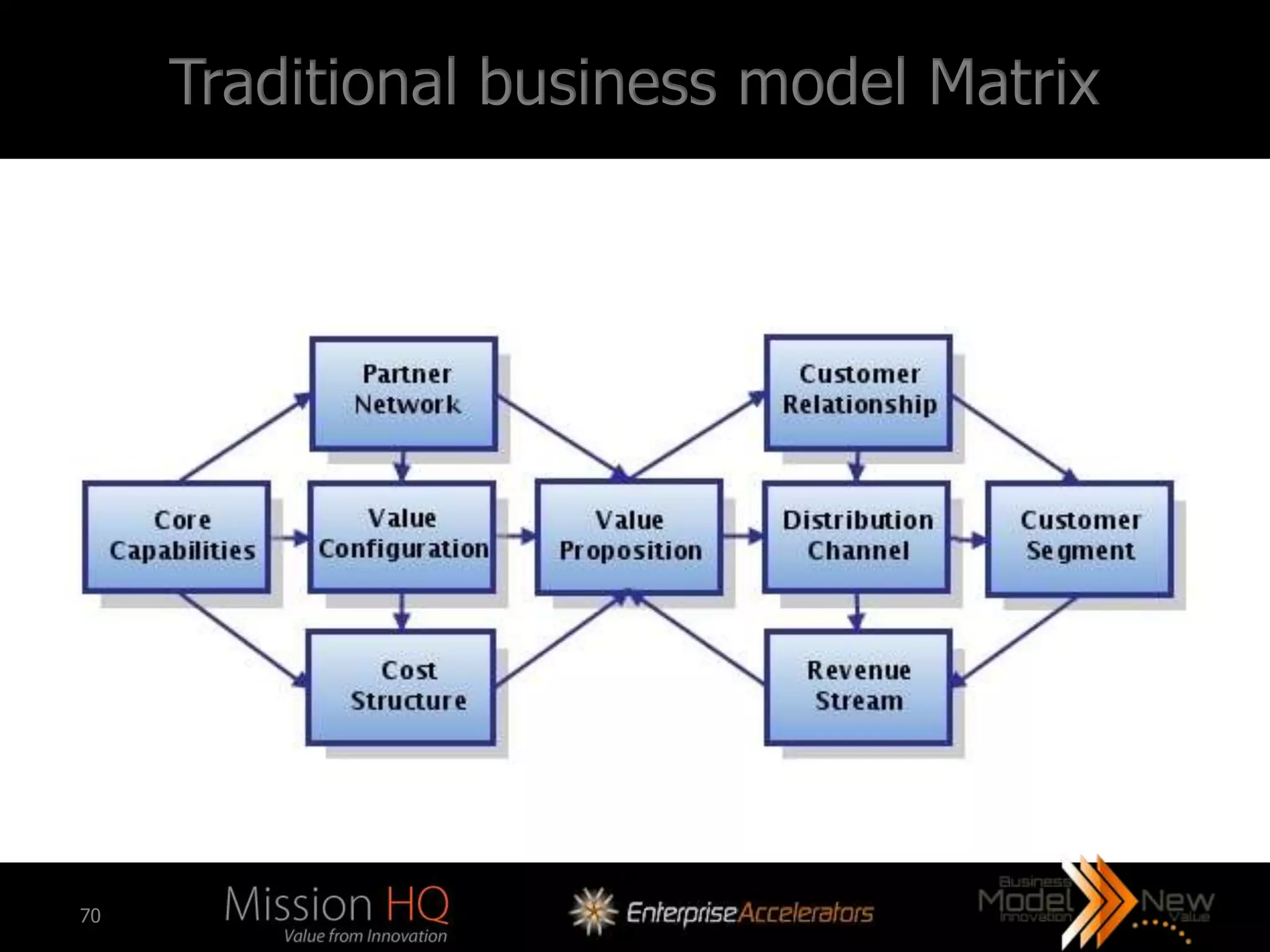
Traditional business model Matrix


70
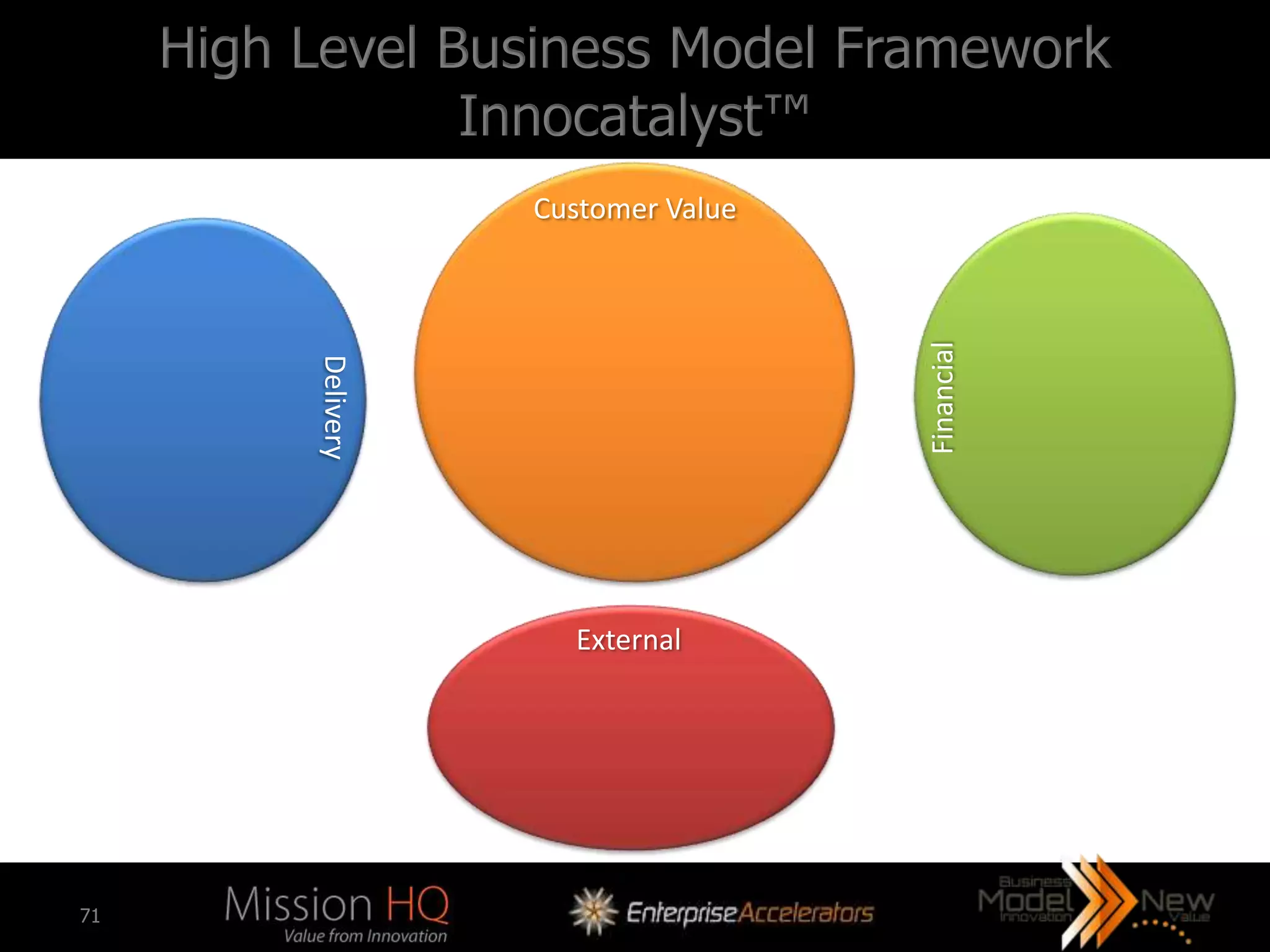
High Level Business Model Framework
                 Innocatalyst™
                     Customer Value


                                      Financial
          Delivery


                       External


71
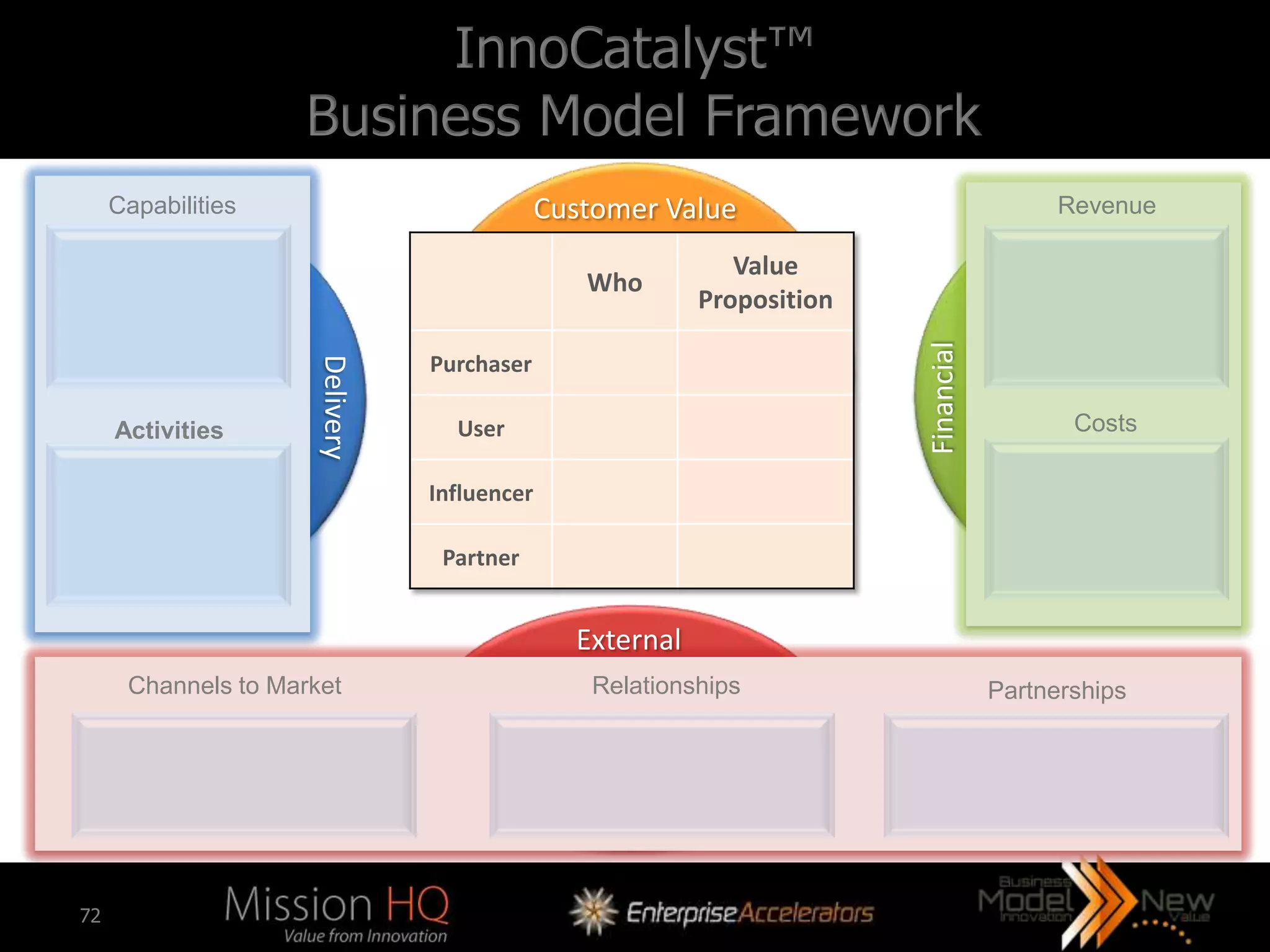
InnoCatalyst™
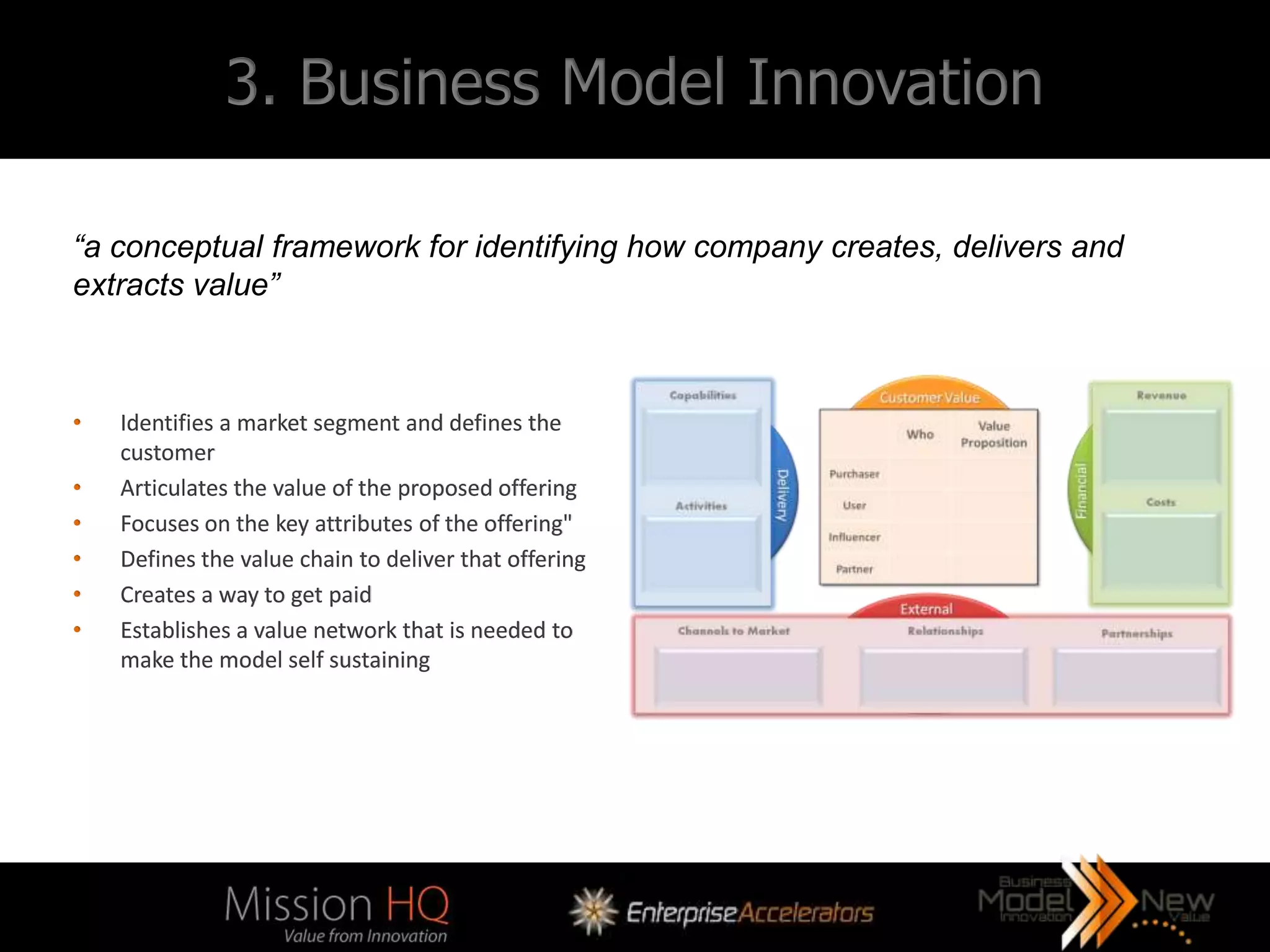
                     Business Model Framework
     Capabilities                            Customer Value                               Revenue

                                                             Value
                                                Who
                                                          Proposition


                                                                        Financial
                                Purchaser
                     Delivery


     Activities                   User                                                     Costs

                                Influencer

                                 Partner


                                               External
      Channels to Market                         Relationships                      Partnerships


72
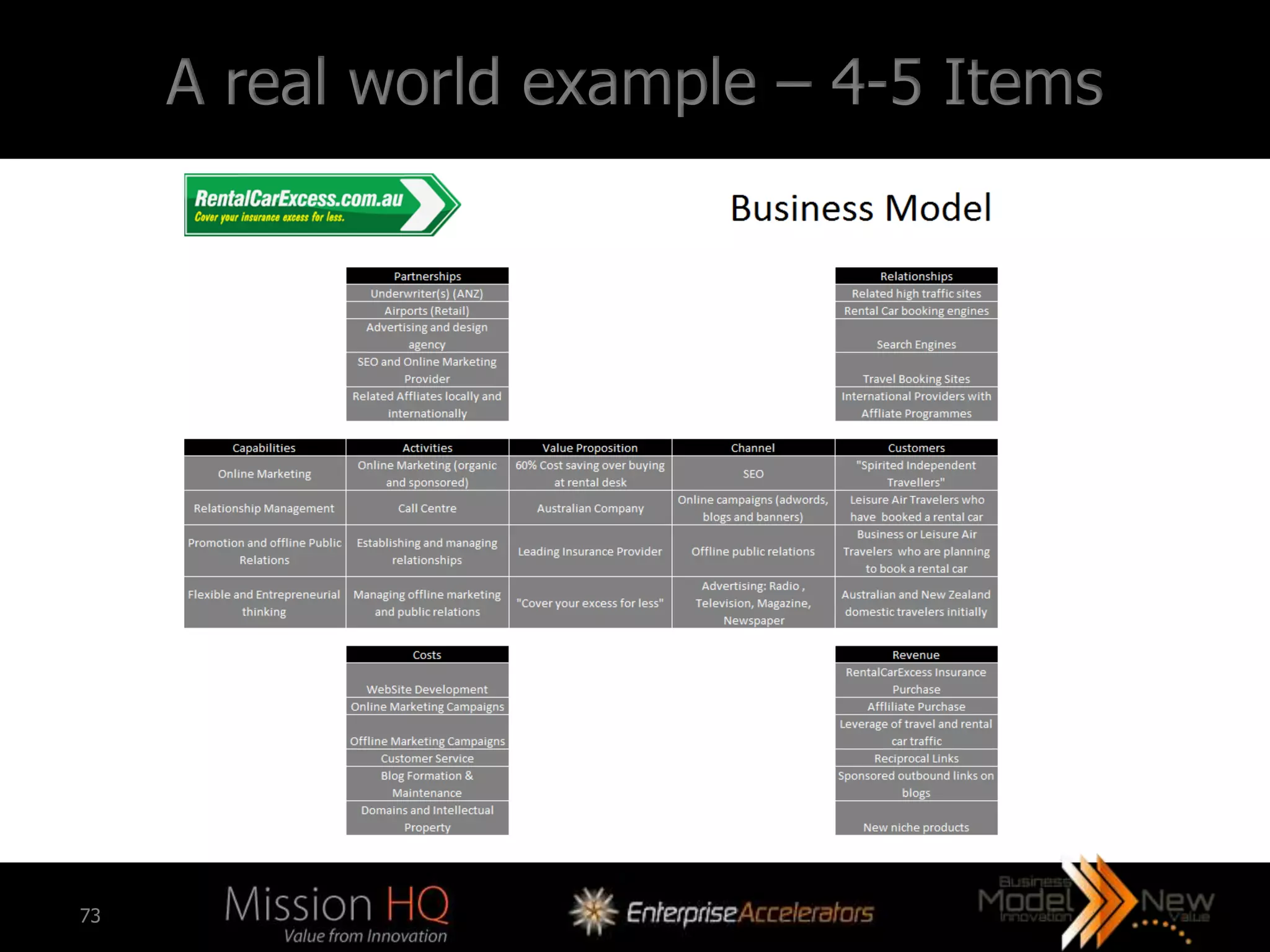
A real world example – 4-5 Items


73
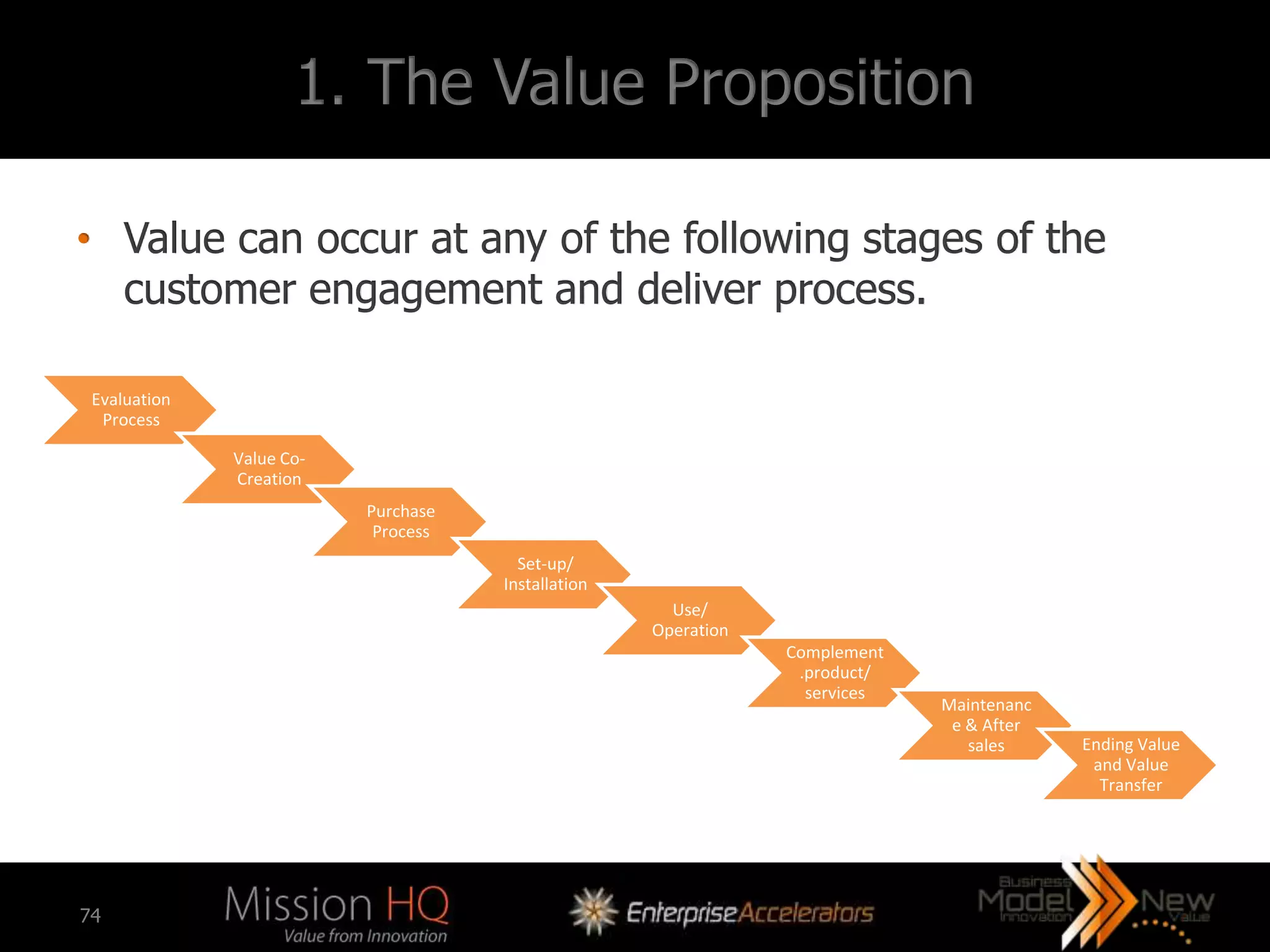
1. The Value Proposition

• Value can occur at any of the following stages of the
  customer engagement and deliver process.

 Evaluation
  Process

              Value Co-
              Creation
                          Purchase
                           Process
                                       Set-up/
                                     Installation
                                                      Use/
                                                    Operation
                                                                Complement
                                                                 .product/
                                                                  services
                                                                             Maintenanc
                                                                              e & After
                                                                                sales     Ending Value
                                                                                           and Value
                                                                                            Transfer


74
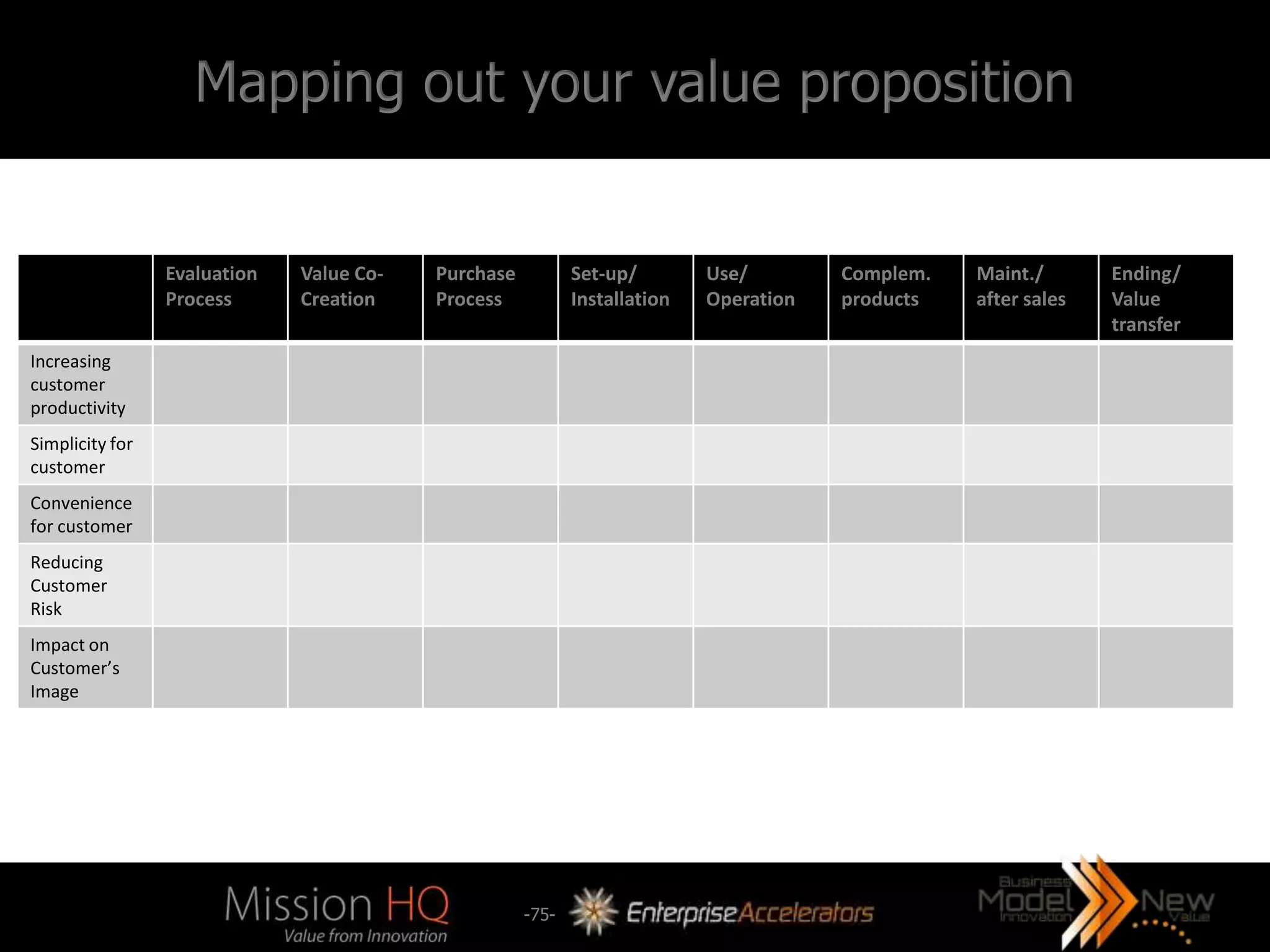
Mapping out your value proposition


                 Evaluation   Value Co-   Purchase          Set-up/        Use/        Complem.   Maint./       Ending/
                 Process      Creation    Process           Installation   Operation   products   after sales   Value
                                                                                                                transfer
Increasing
customer
productivity
Simplicity for
customer
Convenience
for customer
Reducing
Customer
Risk
Impact on
Customer’s
Image


                                                     -75-
Evaluation Process

•   Simplify a
    customer’s
    evaluation process

•   Example: ISELECT


                                 -76-
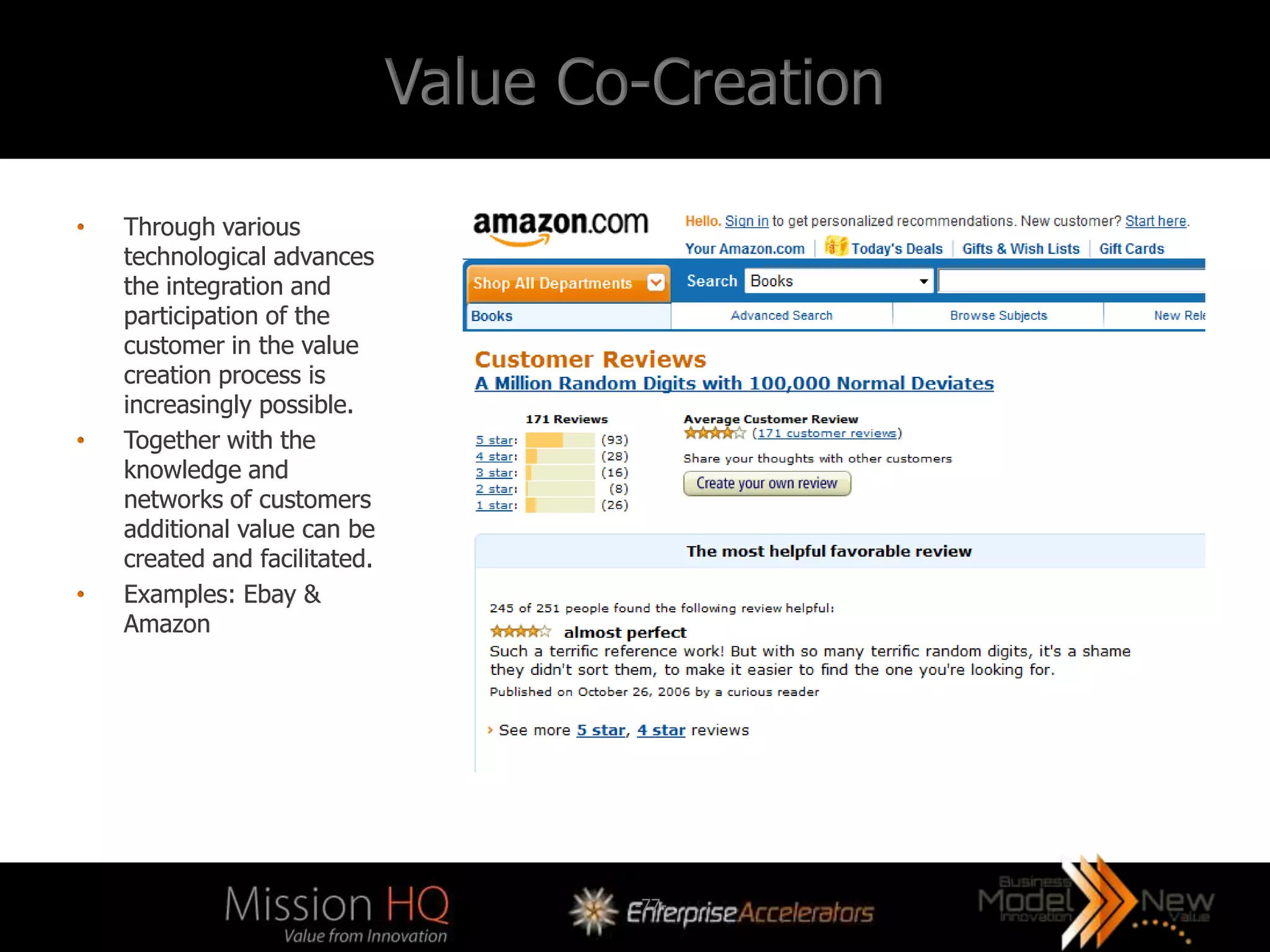
Value Co-Creation

•   Through various
    technological advances
    the integration and
    participation of the
    customer in the value
    creation process is
    increasingly possible.
•   Together with the
    knowledge and
    networks of customers
    additional value can be
    created and facilitated.
•   Examples: Ebay &
    Amazon


                                       -77-
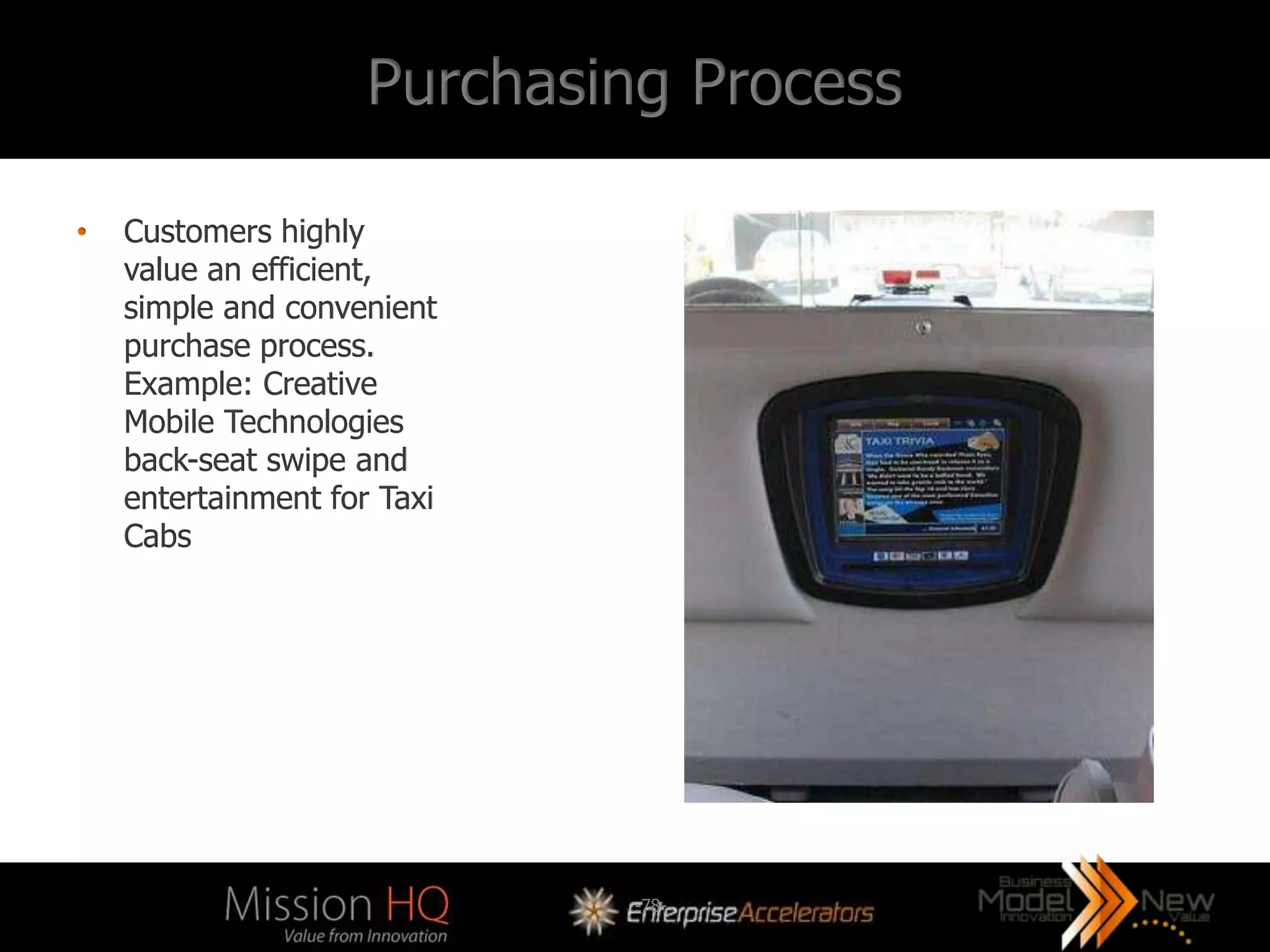
Purchasing Process

•   Customers highly
    value an efficient,
    simple and convenient
    purchase process.
    Example: Creative
    Mobile Technologies
    back-seat swipe and
    entertainment for Taxi
    Cabs


                             -78-
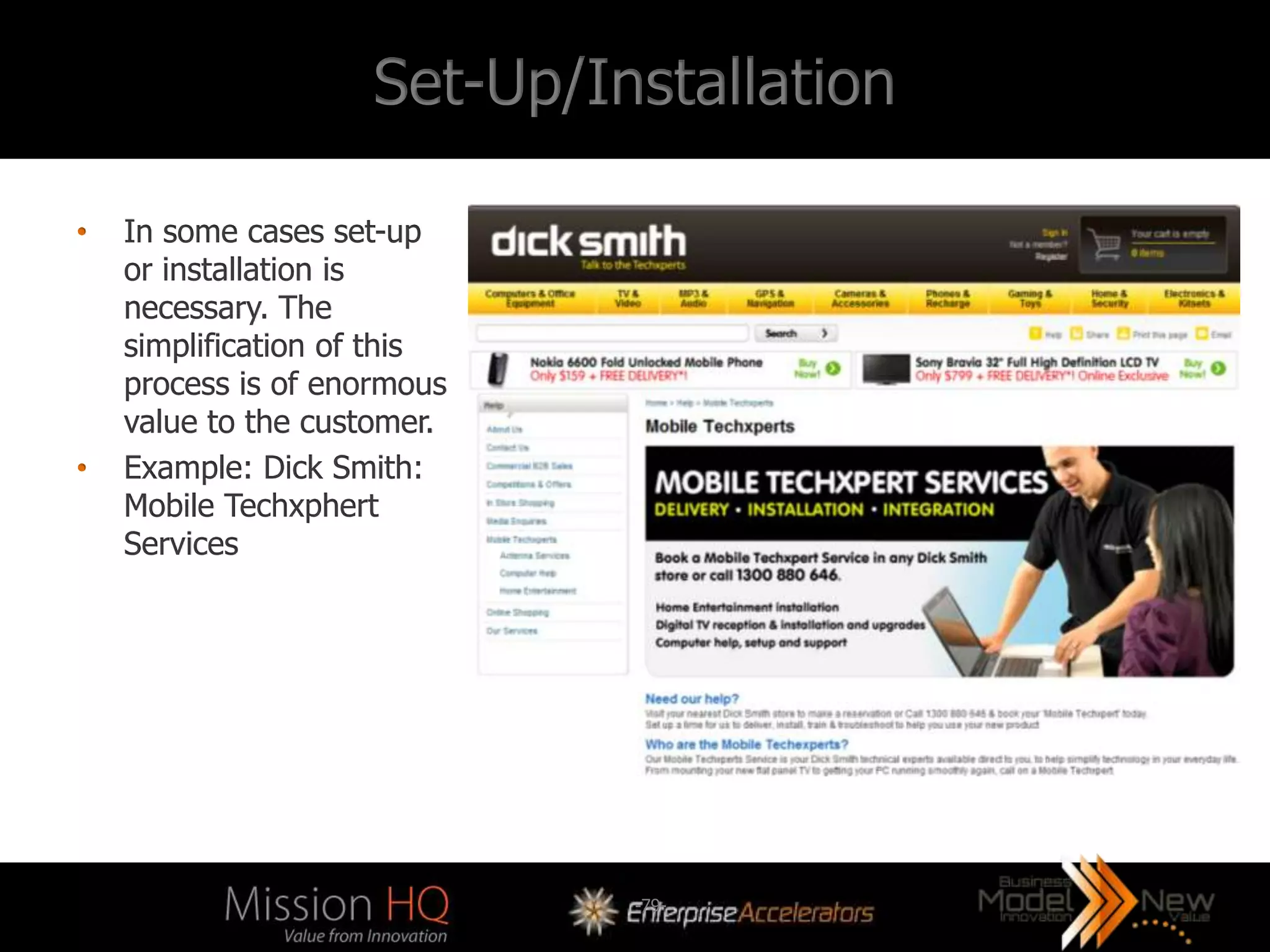
Set-Up/Installation

•   In some cases set-up
    or installation is
    necessary. The
    simplification of this
    process is of enormous
    value to the customer.
•   Example: Dick Smith:
    Mobile Techxphert
    Services


                              -79-
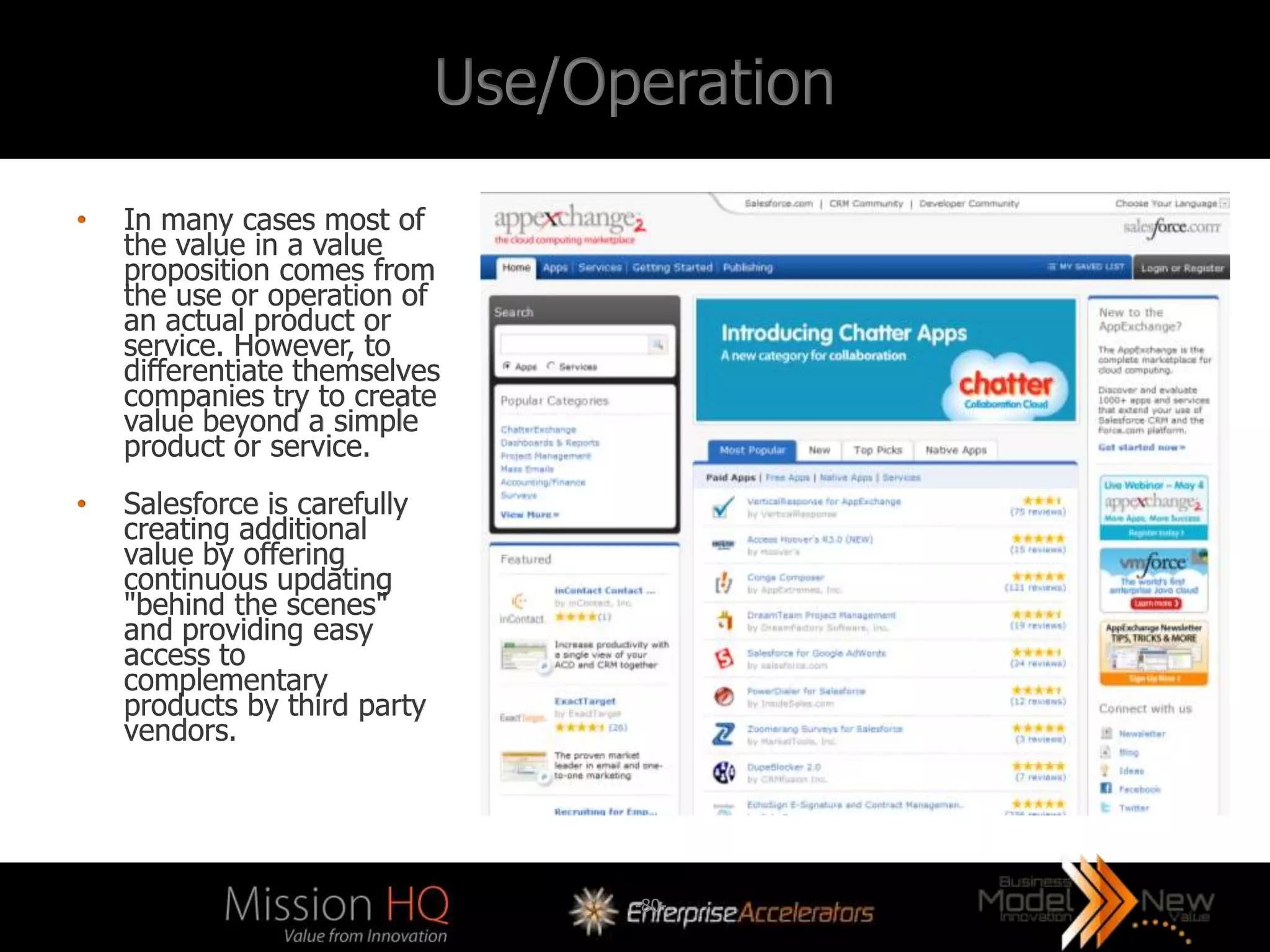
Use/Operation
•   In many cases most of
    the value in a value
    proposition comes from
    the use or operation of
    an actual product or
    service. However, to
    differentiate themselves
    companies try to create
    value beyond a simple
    product or service.
•   Salesforce is carefully
    creating additional
    value by offering
    continuous updating
    "behind the scenes"
    and providing easy
    access to
    complementary
    products by third party
    vendors.


                                    -80-
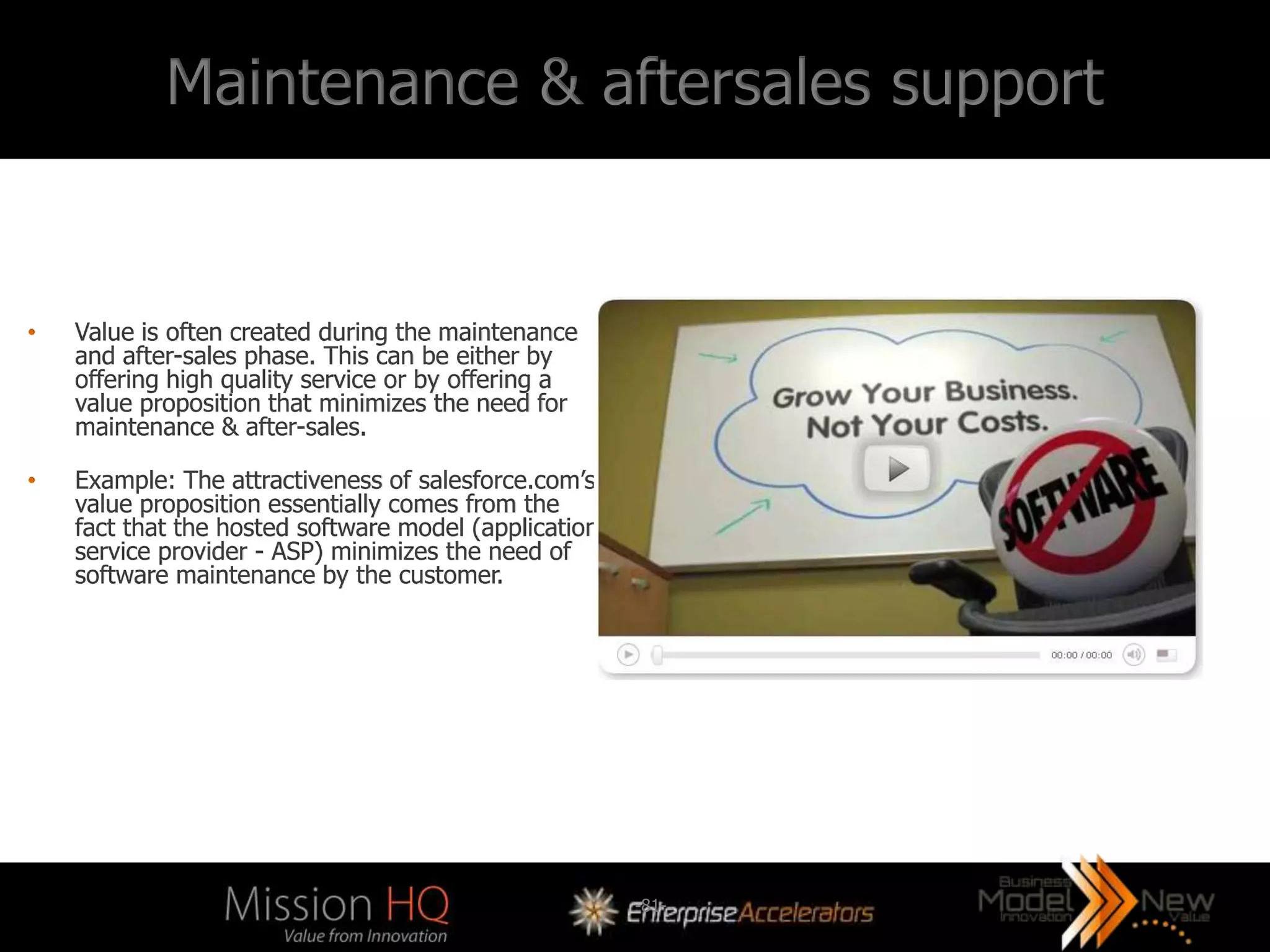
Maintenance & aftersales support


•   Value is often created during the maintenance
    and after-sales phase. This can be either by
    offering high quality service or by offering a
    value proposition that minimizes the need for
    maintenance & after-sales.

•   Example: The attractiveness of salesforce.com’s
    value proposition essentially comes from the
    fact that the hosted software model (application
    service provider - ASP) minimizes the need of
    software maintenance by the customer.


                                                       -81-
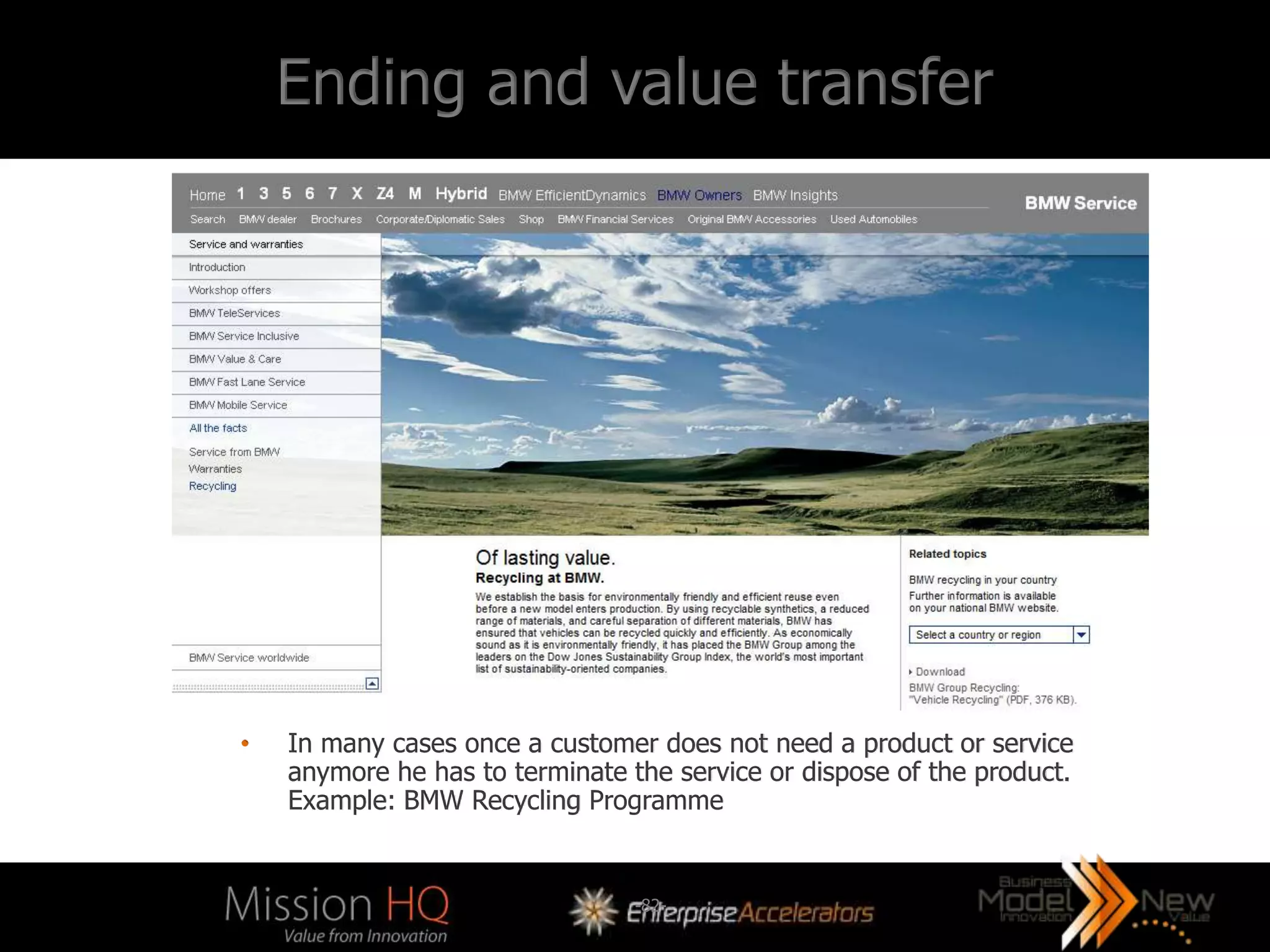
Ending and value transfer


•   In many cases once a customer does not need a product or service
    anymore he has to terminate the service or dispose of the product.
    Example: BMW Recycling Programme


                                 -82-
2. Capabilities/Resources

• What physical assets does our business model require?
     – Factory
     – Machinery
     – Etc.
• Intellectual Assets
     –   Trademarks (licensed or owned)
     –   Patents
     –   Processes
     –   Systems
• Human Resources
     – Skills
     – Team structures
• Financial
     – Access to finance


83
3. Partnerships

• Describes the network of suppliers and partners that will
  make the business model work
     –   Joint Ventures
     –   Strategic Alliances
     –   License agreements
     –   Service agreements
     –   Outsourcing arrangements


84                  © Mission HQ Pty. Ltd. All Rights Reserved
4. Activities

• The activities outline the most important things that the
  organisation will do.
     –   Production
     –   Problem Solving
     –   Platform management
     –   License management


85
5. Costs

• Outlines the primary areas of cost under the business
  model
     –   Fixed Costs
     –   Variable Costs
     –   Economies of scale
     –   Key cost ratchet points


86
6. Relationships

• What relationships other than partnerships may be
  required.
     –   Affiliations (E.g. affiliated companies)
     –   Government Agencies (E.g. CSIRO)
     –   Brand cross licensing (E.g. Australian Made)
     –   Embedded licensing (E.g. Intel Inside, Windows 7)
     –   Accreditations (E.g. CPA)


87
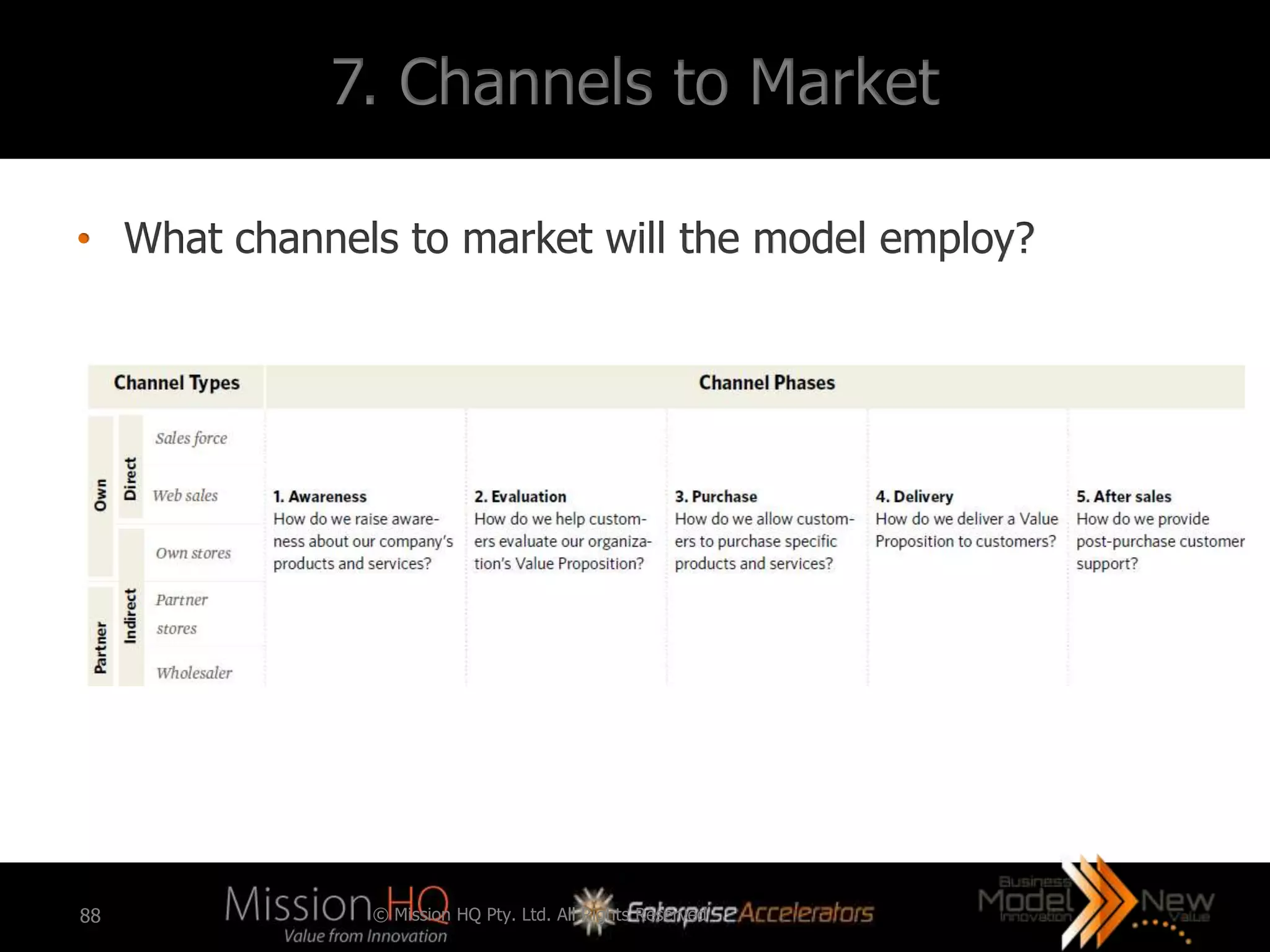
7. Channels to Market

• What channels to market will the model employ?


88            © Mission HQ Pty. Ltd. All Rights Reserved
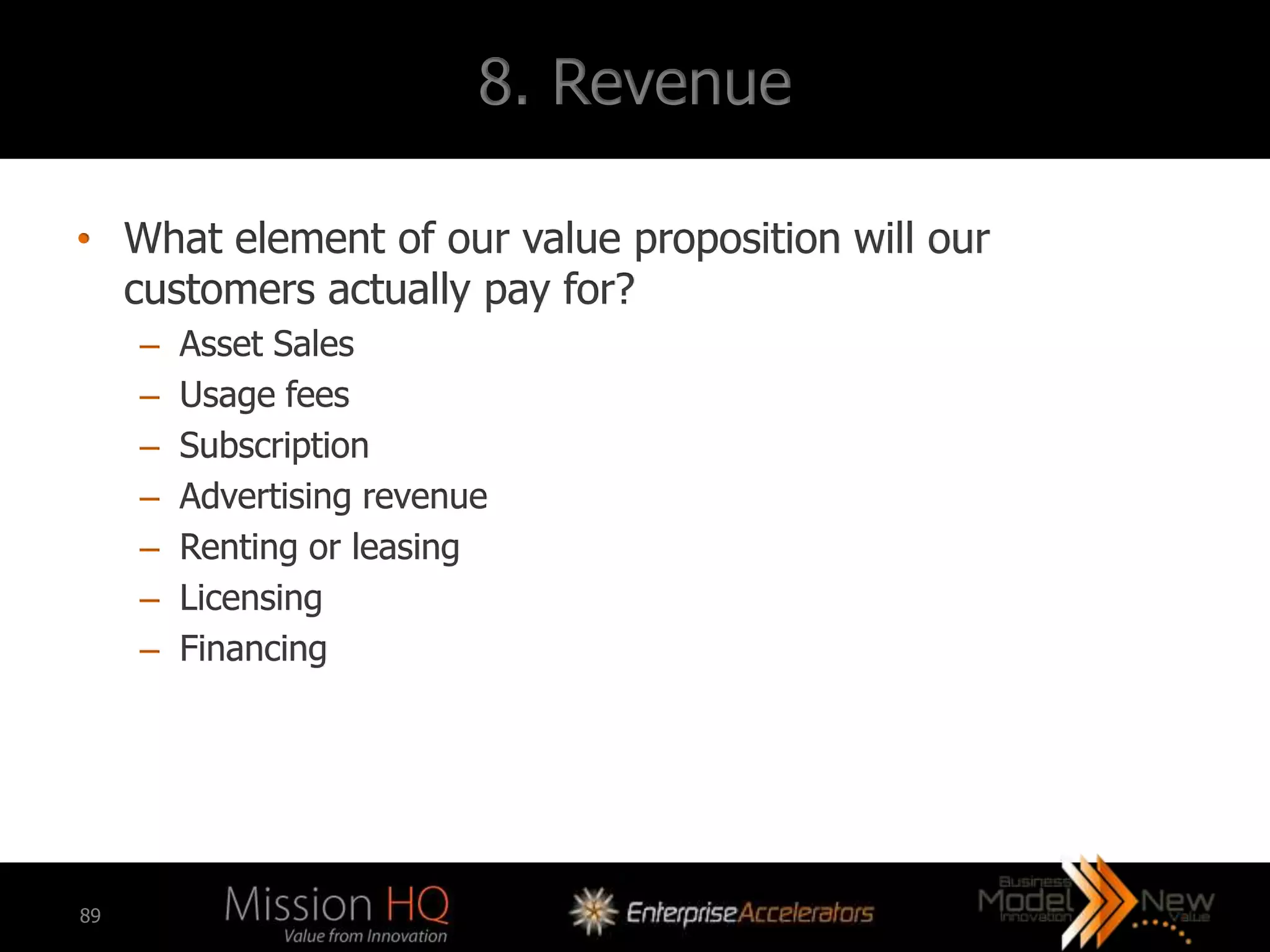
8. Revenue

• What element of our value proposition will our
  customers actually pay for?
     –   Asset Sales
     –   Usage fees
     –   Subscription
     –   Advertising revenue
     –   Renting or leasing
     –   Licensing
     –   Financing


89
9. Customers

• The different groups of people or organisations that the
  organisation hopes to reach and serve.
• Forms of Segmentation:
     – Geographic
     – Demographic - Gender, age, income, housing type, and
       education level are common demographic variables
     – Channel
     – Media
     – Price


90
The Power of Constraints

To be                                    To Have
     –   Biggest                             –   More market share
     –   Best                                –   Profitable customers
     –   Fastest growing                     –   Greater access to capital
     –   Most profitable                     –   More business relationships
     –   Most flexible                       –   Greater revenue

                                To Create
                           – New products/services
                           – New markets


                                                  Innovation
91                                                Catalyst™
                                                  Seminar
Workshop Exercise: Ballast Blaster
Workshop – Ballast Blaster


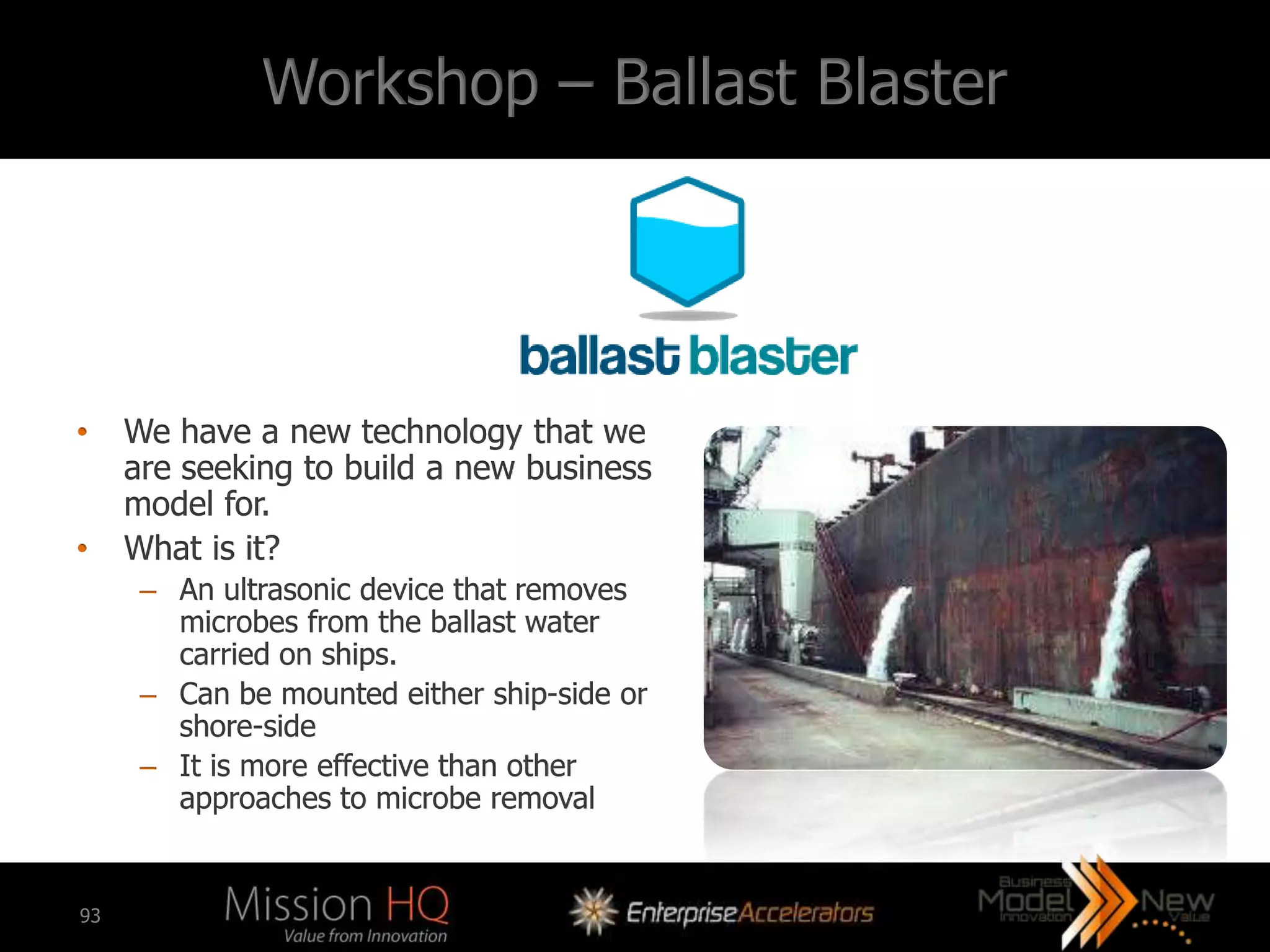
•    We have a new technology that we
     are seeking to build a new business
     model for.
•    What is it?
      – An ultrasonic device that removes
        microbes from the ballast water
        carried on ships.
      – Can be mounted either ship-side or
        shore-side
      – It is more effective than other
        approaches to microbe removal


93
Ballast Blaster Rules and Constraints

                  •   Workshop Rules
                      –    Each table must appoint a team leader
                      –    All ideas are worthy of consideration
                      –    Write down your ideas on the post-it notes
                      –    Add them to the model
                      –    Use only the constraint your table is provided
                      –    Work together as a team
                      –    Develop a holistic, logically consistent model
                      –    You may be asked to present your model
                  •   Constraints – You will be allocated one only!
                      1.   Largest 5 Year Exit
                      2.   Fastest to Market
                      3.   Minimum Start-Up Cost


94
Creating an Ideal Model for Ballast Blaster

 News Flash!
 New information has come to light regarding Ballast Blaster.

 ISO standard 100434 has just been ratified requiring all ballast
 water purified by 2014 to a purity of 99.58%

 The founders have just completed a $16m Capital Raising,
 however the venture capitalist that has backed the project
 needs to exit in 3 years rather than the usual 5.

 He has also demanded that the founders re-locate to Fiji so
 that he can keep an eye on them from his mansion just out of
 Nadi.

 The directors reluctantly agreed.

 He has requested the founders re-cut their Business Model
 prior to the first tranche being paid.

 His core objective is to build value in the business very rapidly.


 95
Assessing Business Models
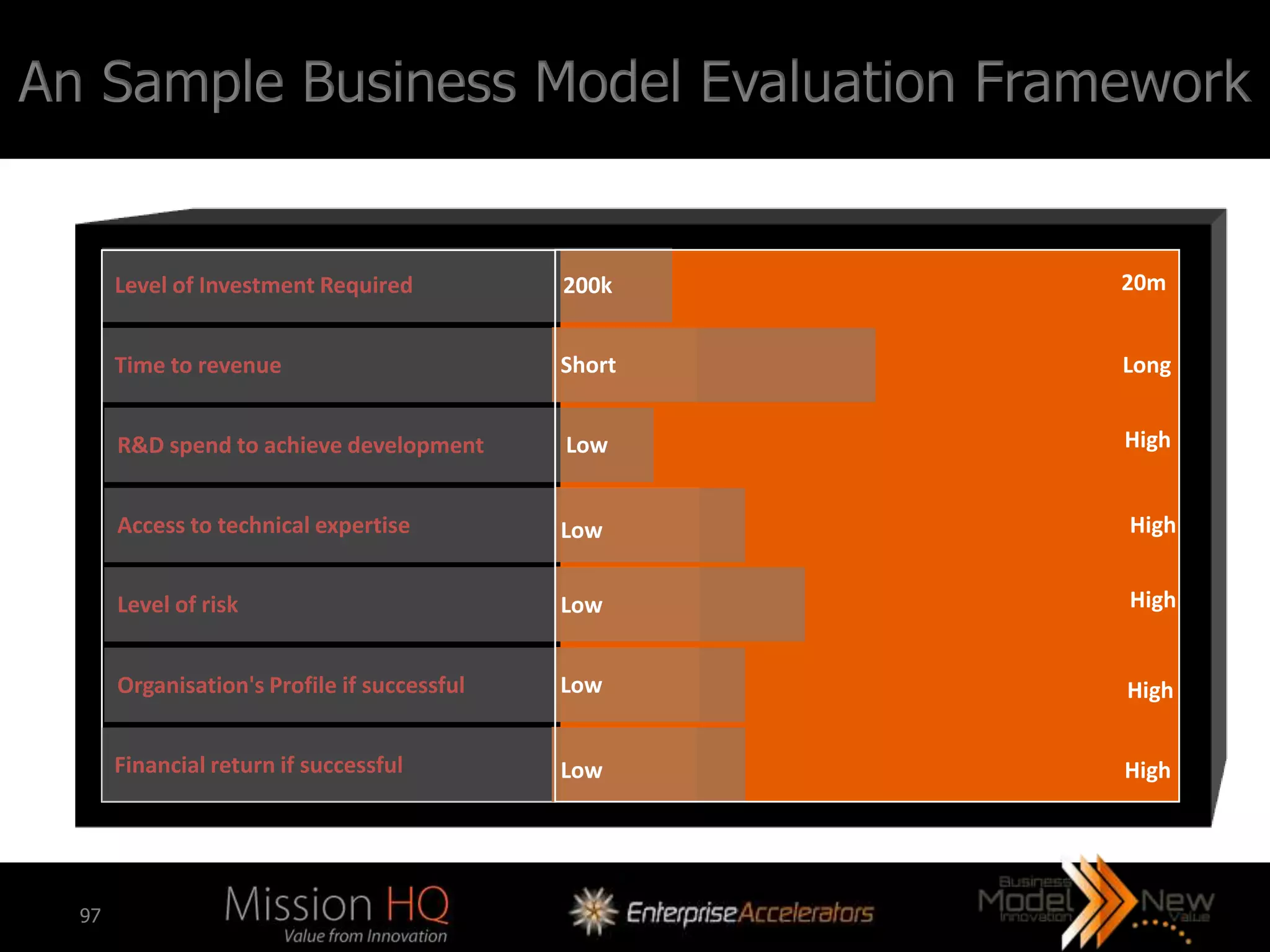
An Sample Business Model Evaluation Framework


       Level of Investment Required           200k    20m


       Time to revenue                        Short   Long


       R&D spend to achieve development       Low     High


       Access to technical expertise          Low     High


       Level of risk                          Low     High


       Organisation's Profile if successful   Low     High


       Financial return if successful         Low     High


  97
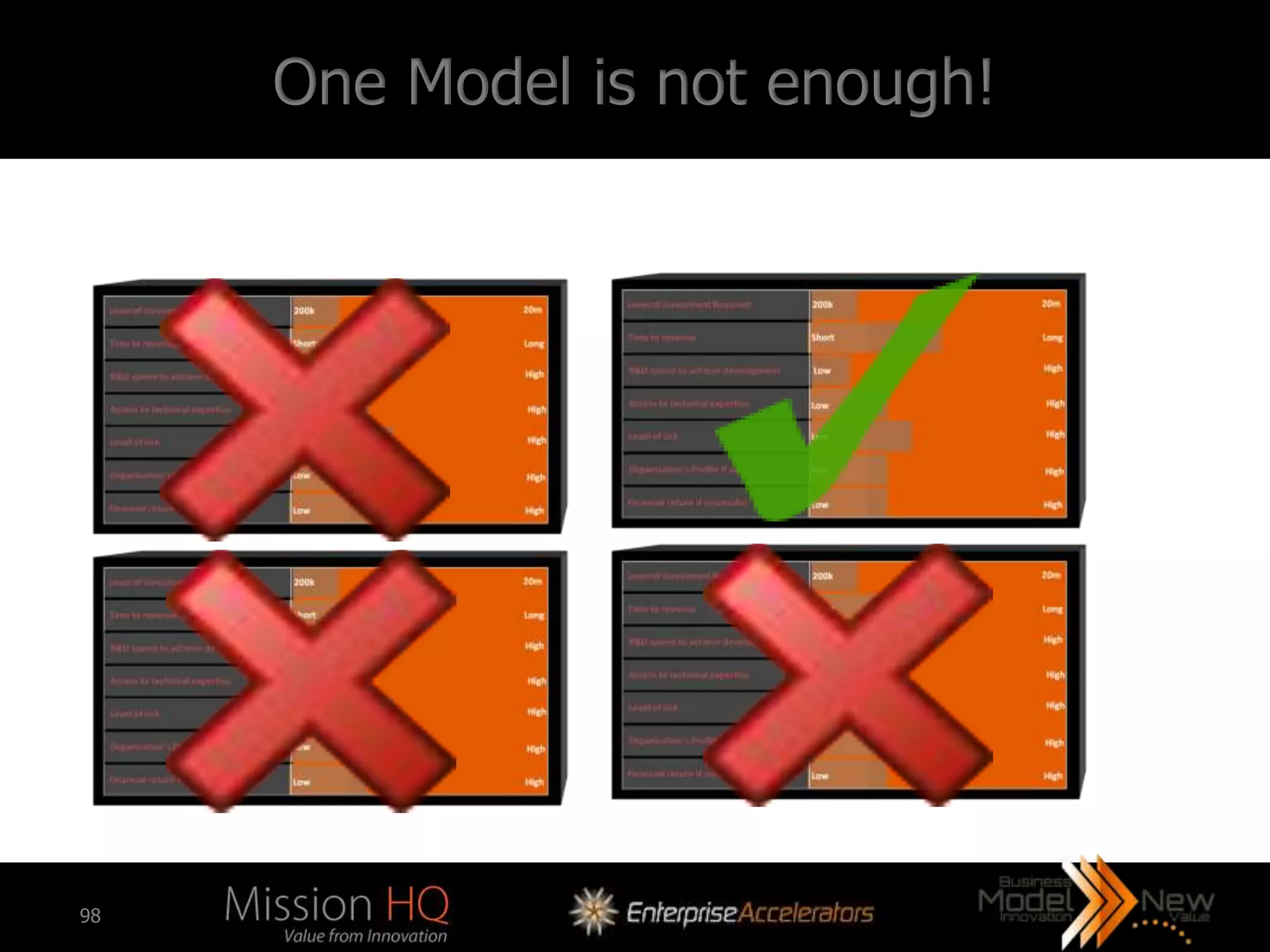
One Model is not enough!


98
Implementing Business Model Innovation
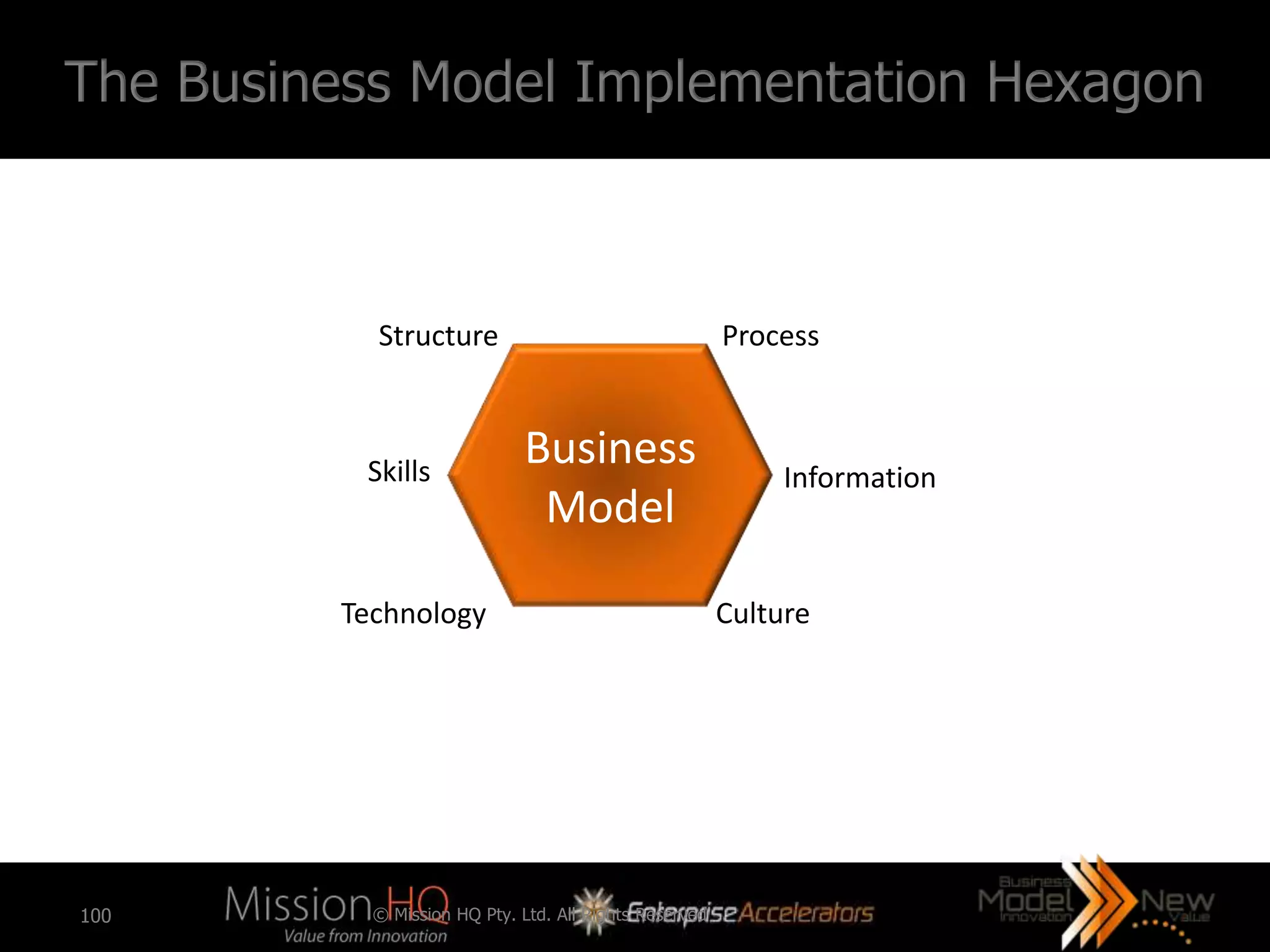
The Business Model Implementation Hexagon


           Structure                                    Process


          Skills
                              Business                       Information
                               Model

         Technology                                     Culture


100        © Mission HQ Pty. Ltd. All Rights Reserved
Use Business Model Innovation To

      – Underpin the business planning process
      – Provide an absolutely IDEAL starting point for the creation of a
        financial model.
      – Create a deeper understanding of you plans with collaborators,
        partners and suppliers
      – Provide a clear picture of a planned business to investors or
        internal stakeholders
      – Develop business cases for market entry
      – Optimise the value obtainable for a given business concept
      – Assist in evaluating alignment with organisational strategy


101
Pivoting Your Business Model

• The pivot can be applied to any element of the business model,
  without changing the underlying vision. Here are some of the
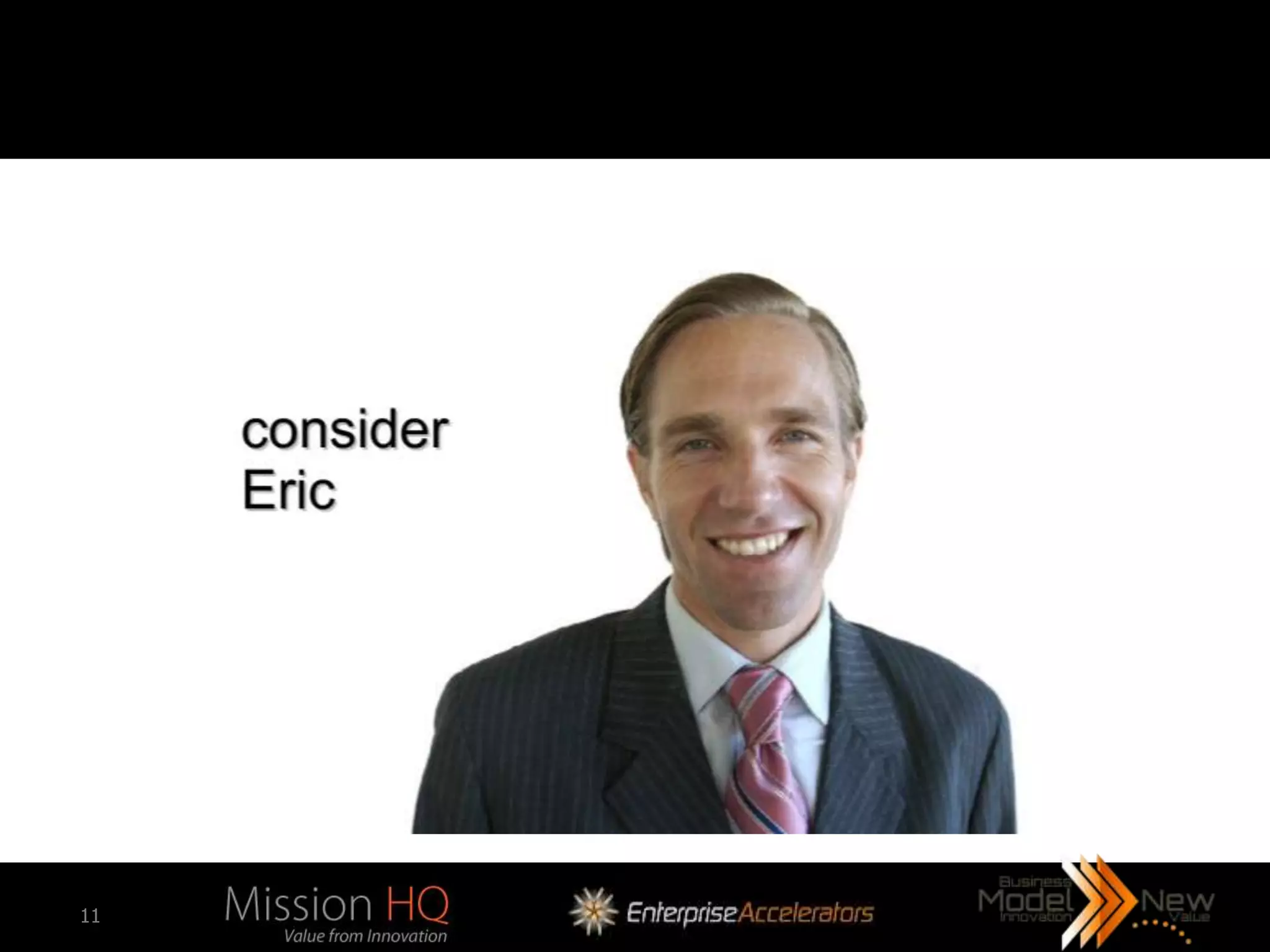
  most common pivot elements that Eric and others have noted:
•     Customer problem pivot. Use essentially the same product to solve a different problem
      for the same customer segment. Starbucks famously did this pivot when they went from
      selling coffee beans and espresso makers to brewing drinks in-house.
•     Market segment pivot. This means you take your existing product and use it to solve a
      similar problem for a different set of customers.
•     Technology pivot. Engineers always fight to take advantage of what they have built so
      far. So the most obvious pivot for them is to repurpose the technology platform.
•     Product feature pivot. Here especially, you need to pay close attention to what real
      customers are doing, rather than your projections of what they should do.
•     Revenue model pivot. One pivot is to change your focus from a premium price,
      customized solution, to a low price commoditized solution.
•     Sales channel pivot. Leverages existing sales channels.
•     Product versus services pivot. Sometimes products are too different or too complex to
      be sold effectively to the customer with the problem. Now is the time for bundling support
      services.
•     Major competitor pivot. What do you do when a major new player or competitor jumps
      into your space?


102
Key Questions to Consider

•     What compromises does our current business model force our customers to make?
•     Why are nonusers or defectors dissatisfied with our offering?
•     Do we offer customers a better value proposition than that of our competition?
•     What alternative models are gaining share at the edges of our industry?
•     If we were an industry outsider, what would we do to take advantage of the gaps or
      weaknesses in our business model?
•     Do we have a plan for identifying potential business models, implementing them, and
      embedding Business model capabilities within the organisation?
•     What do we need to change in our organisation and operations to implement a new
      business model?
•     What information would we need to make a commitment to a new business model?
•     How urgent is the perceived need for a change in our organisation?


103
Discussion: How this could be applied in your company?
Services, Process and Special Event Pricing
Products and Services

• Business Model Renovation Service
      – Ensure you create new value in your business with this unique
        service offering
      – 30% Event Discount for first 5 customers only – must book first
        month within 48hrs of the event.
• Business Planning HQ
      – Totally revolutionary business planning tool that puts the Business
        Model at the heart of the business planning process.
      – Create a 40pg Business Plan, Slide Deck and Business Overview
        document in as little as 4 hours.
      – 20% Discount for first 5 customers only – must book within 48
        hours of event
• Chartgantt
      – Excel based gantt chart and project planning solution built by
        Mission HQ for NASA
      – 20% Discount


106
Questions
Feedback forms
More Events

Please recommend to colleagues in the following areas, or
come again yourself!

Geelong            – Thursday 8th March
Dandenong          – Tuesday 20th March
Bendigo            – Thursday 22nd March

Cross Venue – Best Business Model Prize


109
Event Materials and Networking

We have a linkedin Group (Invitation Only).

All materials and links will be posted in this group. We will
send out a link following the event so please join up.


110
Summary / Wrap-Up
Some Ideas

• Perhaps you already have a great business model buried
  inside your business – pull it out, polish it up and put all
  your resources into it.
• Start with current or desired capability of your
  organisation and assess this against market
  requirements. If there is a fit – design around this.


112
Contact Details

Marcus Tarrant
      Managing Director
      Mission HQ Pty. Ltd. ATF the Innovate Trust
      Marcus.tarrant@missionhq.com.au
      +61 3 9005 9710
      www.missionhq.com.au


113                     © Mission HQ Pty. Ltd. All Rights Reserved

Business model innovation new value

  • 1.
    Workshop: How toCreate New Value in Your Business Through Business Model Innovation Prepared and Presented by Marcus Tarrant Managing Director Mission HQ Pty. Ltd. ATF the Innovate Trust Bryce Steele Managing Director Enterprise Accelerators
  • 2.
    A thought Starter The competition of today is between business models, not just products or solutions. • FujiFilm Vs Kodak • Skype Vs Telstra • Mailchimp Vs Vertical Response • Toner Vs Printer 2
  • 3.
  • 4.
  • 5.
    About Mission HQPty. Ltd. Marcus Tarrant, BEc MEI Past Roles • Senior Consultant - Strategy at Deloitte Consulting • Head of Professional Services – Offspring Ventures/ipernica Current • Managing Director Mission HQ • Chargantt.com • Business Planning HQ .com • HyperQuestion.com 5
  • 6.
  • 7.
    Workshop Agenda Agenda Item Time Introduction 15 mins About Innovation 30 Mins What is a Business Model? 30 Mins Does it apply to me? 5 Mins Kodak/Fuji Film Case Study 10 Mins Morning Tea 20 Mins The Business Model Framework 30 Mins Workshop Exercise – Ballast Blaster 45 Mins Assessing Business Models 10 Mins Implementing Business Model Innovation 5 Mins How you could use Business Model Innovation in your organisation 5 Mins Feedback Forms and Close 10 Mins 7
  • 8.
    What is itall about?
  • 9.
    There are threekinds of companies, those that make new things happen, those that watch new things happen, and those that wonder what happened Anonymous 9
  • 10.
  • 11.
  • 12.
  • 13.
  • 14.
  • 15.
  • 16.
  • 17.
  • 18.
  • 19.
  • 20.
  • 21.
  • 22.
  • 23.
  • 24.
  • 25.
  • 26.
  • 27.
  • 28.
  • 29.
  • 30.
  • 31.
  • 32.
  • 33.
  • 34.
  • 35.
  • 36.
    About Innovation What is innovation and how is it used?
  • 37.
    So Who CaresAbout Innovation Anyhow? 37
  • 38.
    Mini-Workshop – Whatis Innovation? • How have you seen it applied in your organisation? • Is it core to your business? • What type of innovation have you done? • Has it contributed value to your business? • Can you identify a direct bottom line impact? • What effect has it had on your customers and suppliers? • What’s hard about doing innovation? 38
  • 39.
  • 40.
    Forms of Innovation •Radical – significant change that simultaneously affects both the business model and the technology of the company. If the radical innovation also shifts an industry into another direction and brings out fundamental changes to the competitive landscape, it can also be called as disruptive innovation. • Semi-Radical – From a company’s perspective, semi-radical innovation involves substantial change in either technology of an organization or its business model- but not to both. • Incremental – The most prevalent form of innovation, receiving more than 80% of a company’s total innovation investment. The goal is of course, to get as much as possible from an already existing innovation without making major changes in investment, or dislodging existing products or services. 40
  • 41.
    Types of Innovation 1. Product 2. Process 3. Business Model
  • 42.
    1. Product andService Innovation “the creation of new products and services or the improvement of existing products to meet user needs” • New product design • New functionality • Completely new products • New ways of product delivery • Product/Service Packaging • Contract for service vs transactional sales • Consumables vs the unit itself • Customisation
  • 43.
    1. Product andService Innovation When to Apply Product and Service Innovation • Differentiate • Re-Position • Market Entry • Increase Margins • Diversify into new markets • To survive “Product and service can be a means of executing on business model innovation.” 43
  • 44.
    Example of Product/ServiceInnovation resulting from business model innovation 44
  • 45.
    2. Process Innovation “improvingthe sequencing of work routines and information flow to achieve business improvement.” Results achieved through Process Innovation • Faster • Cheaper • More flexible • Simpler • Improved communication • Greater levels of customisation
  • 46.
    2. Process Innovation Whenand Why? • Better meet customer needs • Improve cost efficiency • Enable greater organisational flexibility • Enhanced consistency • Improved delivery of “Brand Promise” • Focus on “Core Business” – Process Outsourcing
  • 47.
    An Example ofProcess Innovation 47
  • 48.
    3. Business ModelInnovation “a conceptual framework for identifying how company creates, delivers and extracts value” • Identifies a market segment and defines the customer • Articulates the value of the proposed offering • Focuses on the key attributes of the offering" • Defines the value chain to deliver that offering • Creates a way to get paid • Establishes a value network that is needed to make the model self sustaining
  • 49.
    3. Business ModelInnovation When and Why? • Underpin the business planning process • Provide an absolutely IDEAL starting point for the creation of a financial model. • Create a deeper understanding of you plans with collaborators, partners and suppliers • Provide a clear picture of a planned business to investors or internal stakeholders • Develop business cases for market entry • Optimise the value obtainable for a given business concept • Assist in evaluating alignment with organisational strategy
  • 50.
    The context ofInnovation Innovation Program Product Business and Service Model Innovation Innovation Process Innovation 50
  • 51.
    Bringing the elementstogether Traditional Innovation Product and Service Innovation Process Innovation 51
  • 52.
    What To DoWhen Strategy Operational Domain Domain Product Business and Service Model Innovation Innovation Process Innovation 52
  • 53.
    So where doesbusiness model innovation fit exactly? • Business Model Renovation [BMR] is presented as the highest level of a strategy for managing change that usually cannot be handled by continuous improvement and re- engineering methods or organizational restructuring (Kovacic, 2001). 53
  • 54.
    Return on Investmentfor Business Model Innovation (BMI) • Boston Consulting Group Innovation Research – BMI delivered returns that were more sustainable, even after 10 years – BMI innovators continued to outperform product and process innovators – BMI earned innovators a 4 times greater return on investment than product or process 54
  • 55.
    What is abusiness model?
  • 56.
    White-Board Discussion • Whatis a business model – Characteristics of a business model – Relevance to my organisation – Have you heard the term before? – What do people mean when they talk about a business model? 56
  • 57.
  • 58.
    Business Model Definition Abusiness model describes the rationale of how an organization creates, delivers, and captures value (economic, social, or other forms of value). The process of business model construction is part of business strategy. 58
  • 59.
    The context ofthe business model what are intangible assets? Strategy Business Financial Model Implications (Value) Operating Environment
  • 60.
    How often shouldyou renovate your business model? Business Model Renovation Lifecycle 6 Months 50-100 Years 1900 2020 60
  • 61.
    Why is BusinessModel Innovation Relevant Today? • Business Model innovation is particularly valuable in times of instability – Provides a mechanism to break out of intense competition – Address disruptive environmental changes • Regulatory • Exchange rates and cost structure • New technologies • Customer capabilities and or expectations 61
  • 62.
  • 63.
    Does Business ModelInnovation Apply to Me? • Manufacturing • Services • Retail • Mining Need • Engineering Sustainable • Infrastructure Revenue to • Finance • Online Survive • Not for profit • Government Agencies 63
  • 64.
    For how longwill you be able to keep charging what you are for what you do? • Exchange Rate – Aust Red Wine Example • Rise of Asia • Disruptive technology • New products and services • New ways of doing business • New delivery systems • Virtualisation • Freemium • International Barriers in Communications • Customer problem evolution • Service Automation • ...even the Ipod! Nano 4gb 2007 - $364 Today $149 64
  • 65.
    Discussion on Kodak/FujiFilm Case Study
  • 66.
    Discussion Points • Digitalphotography's impact on the Kodak Business Model • Who invented digital photography? • What was the Kodak business model? • What should the Kodak business model take into account? • How did Fuji Film handle the same issues differently? • Does the business model support the same skills and number of resources? • Does having a great business model today mean that you will also have one in the future? 66
  • 67.
    Morning Tea –20 Minute Break
  • 68.
  • 69.
    The business modelFramework 1. Value Proposition – What are you offering? 2. Capabilities/Resources – What skills and capacity do you require? 3. Partnership – Who do you need to work with? 4. Activities – What will you do? 5. Costs – What are your significant costs likely to be? 6. Relationship – What formal and informal relationships are required 7. Channel – What are our channels to market? 8. Revenues – What will our customers pay for? 9. Customers – Who are our customers? 69
  • 70.
  • 71.
    High Level BusinessModel Framework Innocatalyst™ Customer Value Financial Delivery External 71
  • 72.
    InnoCatalyst™ Business Model Framework Capabilities Customer Value Revenue Value Who Proposition Financial Purchaser Delivery Activities User Costs Influencer Partner External Channels to Market Relationships Partnerships 72
  • 73.
    A real worldexample – 4-5 Items 73
  • 74.
    1. The ValueProposition • Value can occur at any of the following stages of the customer engagement and deliver process. Evaluation Process Value Co- Creation Purchase Process Set-up/ Installation Use/ Operation Complement .product/ services Maintenanc e & After sales Ending Value and Value Transfer 74
  • 75.
    Mapping out yourvalue proposition Evaluation Value Co- Purchase Set-up/ Use/ Complem. Maint./ Ending/ Process Creation Process Installation Operation products after sales Value transfer Increasing customer productivity Simplicity for customer Convenience for customer Reducing Customer Risk Impact on Customer’s Image -75-
  • 76.
    Evaluation Process • Simplify a customer’s evaluation process • Example: ISELECT -76-
  • 77.
    Value Co-Creation • Through various technological advances the integration and participation of the customer in the value creation process is increasingly possible. • Together with the knowledge and networks of customers additional value can be created and facilitated. • Examples: Ebay & Amazon -77-
  • 78.
    Purchasing Process • Customers highly value an efficient, simple and convenient purchase process. Example: Creative Mobile Technologies back-seat swipe and entertainment for Taxi Cabs -78-
  • 79.
    Set-Up/Installation • In some cases set-up or installation is necessary. The simplification of this process is of enormous value to the customer. • Example: Dick Smith: Mobile Techxphert Services -79-
  • 80.
    Use/Operation • In many cases most of the value in a value proposition comes from the use or operation of an actual product or service. However, to differentiate themselves companies try to create value beyond a simple product or service. • Salesforce is carefully creating additional value by offering continuous updating "behind the scenes" and providing easy access to complementary products by third party vendors. -80-
  • 81.
    Maintenance & aftersalessupport • Value is often created during the maintenance and after-sales phase. This can be either by offering high quality service or by offering a value proposition that minimizes the need for maintenance & after-sales. • Example: The attractiveness of salesforce.com’s value proposition essentially comes from the fact that the hosted software model (application service provider - ASP) minimizes the need of software maintenance by the customer. -81-
  • 82.
    Ending and valuetransfer • In many cases once a customer does not need a product or service anymore he has to terminate the service or dispose of the product. Example: BMW Recycling Programme -82-
  • 83.
    2. Capabilities/Resources • Whatphysical assets does our business model require? – Factory – Machinery – Etc. • Intellectual Assets – Trademarks (licensed or owned) – Patents – Processes – Systems • Human Resources – Skills – Team structures • Financial – Access to finance 83
  • 84.
    3. Partnerships • Describesthe network of suppliers and partners that will make the business model work – Joint Ventures – Strategic Alliances – License agreements – Service agreements – Outsourcing arrangements 84 © Mission HQ Pty. Ltd. All Rights Reserved
  • 85.
    4. Activities • Theactivities outline the most important things that the organisation will do. – Production – Problem Solving – Platform management – License management 85
  • 86.
    5. Costs • Outlinesthe primary areas of cost under the business model – Fixed Costs – Variable Costs – Economies of scale – Key cost ratchet points 86
  • 87.
    6. Relationships • Whatrelationships other than partnerships may be required. – Affiliations (E.g. affiliated companies) – Government Agencies (E.g. CSIRO) – Brand cross licensing (E.g. Australian Made) – Embedded licensing (E.g. Intel Inside, Windows 7) – Accreditations (E.g. CPA) 87
  • 88.
    7. Channels toMarket • What channels to market will the model employ? 88 © Mission HQ Pty. Ltd. All Rights Reserved
  • 89.
    8. Revenue • Whatelement of our value proposition will our customers actually pay for? – Asset Sales – Usage fees – Subscription – Advertising revenue – Renting or leasing – Licensing – Financing 89
  • 90.
    9. Customers • Thedifferent groups of people or organisations that the organisation hopes to reach and serve. • Forms of Segmentation: – Geographic – Demographic - Gender, age, income, housing type, and education level are common demographic variables – Channel – Media – Price 90
  • 91.
    The Power ofConstraints To be To Have – Biggest – More market share – Best – Profitable customers – Fastest growing – Greater access to capital – Most profitable – More business relationships – Most flexible – Greater revenue To Create – New products/services – New markets Innovation 91 Catalyst™ Seminar
  • 92.
  • 93.
    Workshop – BallastBlaster • We have a new technology that we are seeking to build a new business model for. • What is it? – An ultrasonic device that removes microbes from the ballast water carried on ships. – Can be mounted either ship-side or shore-side – It is more effective than other approaches to microbe removal 93
  • 94.
    Ballast Blaster Rulesand Constraints • Workshop Rules – Each table must appoint a team leader – All ideas are worthy of consideration – Write down your ideas on the post-it notes – Add them to the model – Use only the constraint your table is provided – Work together as a team – Develop a holistic, logically consistent model – You may be asked to present your model • Constraints – You will be allocated one only! 1. Largest 5 Year Exit 2. Fastest to Market 3. Minimum Start-Up Cost 94
  • 95.
    Creating an IdealModel for Ballast Blaster News Flash! New information has come to light regarding Ballast Blaster. ISO standard 100434 has just been ratified requiring all ballast water purified by 2014 to a purity of 99.58% The founders have just completed a $16m Capital Raising, however the venture capitalist that has backed the project needs to exit in 3 years rather than the usual 5. He has also demanded that the founders re-locate to Fiji so that he can keep an eye on them from his mansion just out of Nadi. The directors reluctantly agreed. He has requested the founders re-cut their Business Model prior to the first tranche being paid. His core objective is to build value in the business very rapidly. 95
  • 96.
  • 97.
    An Sample BusinessModel Evaluation Framework Level of Investment Required 200k 20m Time to revenue Short Long R&D spend to achieve development Low High Access to technical expertise Low High Level of risk Low High Organisation's Profile if successful Low High Financial return if successful Low High 97
  • 98.
    One Model isnot enough! 98
  • 99.
  • 100.
    The Business ModelImplementation Hexagon Structure Process Skills Business Information Model Technology Culture 100 © Mission HQ Pty. Ltd. All Rights Reserved
  • 101.
    Use Business ModelInnovation To – Underpin the business planning process – Provide an absolutely IDEAL starting point for the creation of a financial model. – Create a deeper understanding of you plans with collaborators, partners and suppliers – Provide a clear picture of a planned business to investors or internal stakeholders – Develop business cases for market entry – Optimise the value obtainable for a given business concept – Assist in evaluating alignment with organisational strategy 101
  • 102.
    Pivoting Your BusinessModel • The pivot can be applied to any element of the business model, without changing the underlying vision. Here are some of the most common pivot elements that Eric and others have noted: • Customer problem pivot. Use essentially the same product to solve a different problem for the same customer segment. Starbucks famously did this pivot when they went from selling coffee beans and espresso makers to brewing drinks in-house. • Market segment pivot. This means you take your existing product and use it to solve a similar problem for a different set of customers. • Technology pivot. Engineers always fight to take advantage of what they have built so far. So the most obvious pivot for them is to repurpose the technology platform. • Product feature pivot. Here especially, you need to pay close attention to what real customers are doing, rather than your projections of what they should do. • Revenue model pivot. One pivot is to change your focus from a premium price, customized solution, to a low price commoditized solution. • Sales channel pivot. Leverages existing sales channels. • Product versus services pivot. Sometimes products are too different or too complex to be sold effectively to the customer with the problem. Now is the time for bundling support services. • Major competitor pivot. What do you do when a major new player or competitor jumps into your space? 102
  • 103.
    Key Questions toConsider • What compromises does our current business model force our customers to make? • Why are nonusers or defectors dissatisfied with our offering? • Do we offer customers a better value proposition than that of our competition? • What alternative models are gaining share at the edges of our industry? • If we were an industry outsider, what would we do to take advantage of the gaps or weaknesses in our business model? • Do we have a plan for identifying potential business models, implementing them, and embedding Business model capabilities within the organisation? • What do we need to change in our organisation and operations to implement a new business model? • What information would we need to make a commitment to a new business model? • How urgent is the perceived need for a change in our organisation? 103
  • 104.
    Discussion: How thiscould be applied in your company?
  • 105.
    Services, Process andSpecial Event Pricing
  • 106.
    Products and Services •Business Model Renovation Service – Ensure you create new value in your business with this unique service offering – 30% Event Discount for first 5 customers only – must book first month within 48hrs of the event. • Business Planning HQ – Totally revolutionary business planning tool that puts the Business Model at the heart of the business planning process. – Create a 40pg Business Plan, Slide Deck and Business Overview document in as little as 4 hours. – 20% Discount for first 5 customers only – must book within 48 hours of event • Chartgantt – Excel based gantt chart and project planning solution built by Mission HQ for NASA – 20% Discount 106
  • 107.
  • 108.
  • 109.
    More Events Please recommendto colleagues in the following areas, or come again yourself! Geelong – Thursday 8th March Dandenong – Tuesday 20th March Bendigo – Thursday 22nd March Cross Venue – Best Business Model Prize 109
  • 110.
    Event Materials andNetworking We have a linkedin Group (Invitation Only). All materials and links will be posted in this group. We will send out a link following the event so please join up. 110
  • 111.
  • 112.
    Some Ideas • Perhapsyou already have a great business model buried inside your business – pull it out, polish it up and put all your resources into it. • Start with current or desired capability of your organisation and assess this against market requirements. If there is a fit – design around this. 112
  • 113.
    Contact Details Marcus Tarrant Managing Director Mission HQ Pty. Ltd. ATF the Innovate Trust Marcus.tarrant@missionhq.com.au +61 3 9005 9710 www.missionhq.com.au 113 © Mission HQ Pty. Ltd. All Rights Reserved

Editor's Notes

  • #55 The Boston Consulting Group (BCG) and BusinessWeek recently conducted their annual survey to identify the most innovative companies. “We analyzed our database of innovators segmenting them into business model innovators and product or process innovators.”Our analysis showed that while both types of innovators achieved a premium over the average total shareholder return for their industries, business model innovators earned an average premium that was more than 4 times greater than that enjoyed by product or process innovators. Business Model Innovation delivered returns that were more sustainable, even after ten years, business model innovators continued to outperform competitors and product and process innovators.Business Model Innovation – When the game gets tough, change the game – The Boston Consulting Group