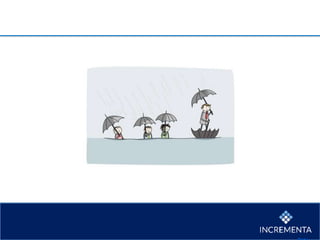
Generating new income
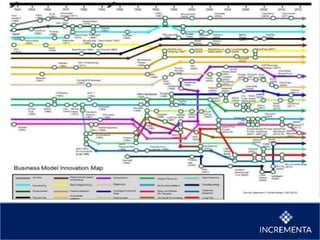
Business Model Innovation
Stuart Hartley
Senior Consultant
Types of Innovation
• Business Model Innovation involves changing the way business is done in
terms of capturing value
• Process Innovation involves the implementation of a new or significantly
improved production or delivery method.
• Product Innovation involves the introduction of a new good or service that is
new or substantially improved. This might include improvements in functional
characteristics, technical abilities, ease of use, or any other dimension.
• Service Innovation is similar to product innovation except that the innovation
relates to services rather than to products
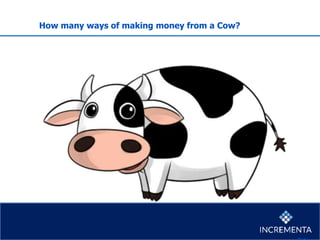
How many ways of making money from a Cow?
Before we start lets understand what the term business model means
“a unit of analysis to describe how the business works”
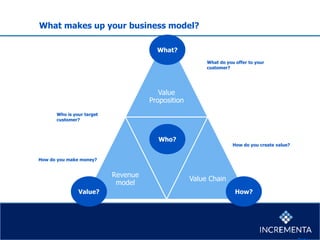
What makes up your business model?
Value
Proposition
Revenue
model
Who?
Value Chain
What do you offer to your
customer?
How do you create value?
How do you make money?
Who is your target
customer?
What?
How?Value?
Who?
• Who – every business model serves a certain customer group. Who,
therefore, is in your target customer segment?
• What – is being offered to the target customer. The important aspect here is
not the actual product or service but the elements which the customer value
(CVP)
• How – To build and distribute the value proposition the business has to master
several processes and activities. This, in addition to, your resources and
capabilities creates your value chain
• Value – How are you going to generate revenue? How are you going to make
money?
• By understanding these 4 associated points we can create a tangible business
model
• The creation and understanding of this existing business model serves as a
benchmark for improvement / innovation
Ikea Case study
Barriers to business model innovation
• Resistance to change: people just get used to doing a particular work in
customized manner and they are just opposed to any new idea or change.
• Restriction on interaction: a free and open environment provides members an
opportunity to interact with members of their own and other groups. Such
interaction facilitates exchange of ideas and information required for creative
work where as in restricted environment creativity is adversely effected.
• Fear of something going wrong: many new ideas may go wrong or prove
impractical. Whenever creative work is to be undertaken the possibility of
success or failure is always there.
• Resource constraints: creativity demands sufficient availability of resources.
Absence of adequate resources may dampen the spirit of creativity.
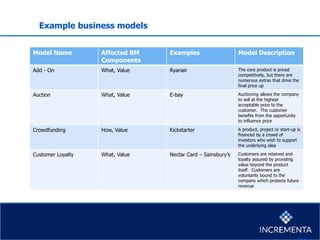
Example business models
Model Name Affected BM
Components
Examples Model Description
Add - On What, Value Ryanair The core product is priced
competitively, but there are
numerous extras that drive the
final price up
Auction What, Value E-bay Auctioning allows the company
to sell at the highest
acceptable price to the
customer. The customer
benefits from the opportunity
to influence price
Crowdfunding How, Value Kickstarter A product, project or start-up is
financed by a crowd of
investors who wish to support
the underlying idea
Customer Loyalty What, Value Nectar Card – Sainsbury’s Customers are retained and
loyalty assured by providing
value beyond the product
itself. Customers are
voluntarily bound to the
company which protects future
revenue
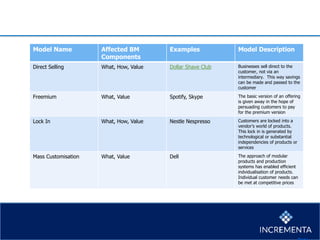
Model Name Affected BM
Components
Examples Model Description
Direct Selling What, How, Value Dollar Shave Club Businesses sell direct to the
customer, not via an
intermediary. This way savings
can be made and passed to the
customer
Freemium What, Value Spotify, Skype The basic version of an offering
is given away in the hope of
persuading customers to pay
for the premium version
Lock In What, How, Value Nestle Nespresso Customers are locked into a
vendor’s world of products.
This lock in is generated by
technological or substantial
independencies of products or
services
Mass Customisation What, Value Dell The approach of modular
products and production
systems has enabled efficient
indvidualisation of products.
Individual customer needs can
be met at competitive prices
Initiation
Ideation
Integration
Implementation
Application of business model innovation
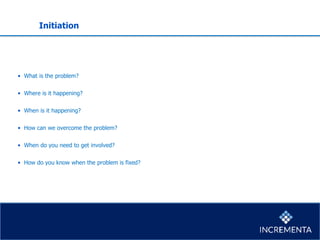
Initiation
• What is the problem?
• Where is it happening?
• When is it happening?
• How can we overcome the problem?
• When do you need to get involved?
• How do you know when the problem is fixed?
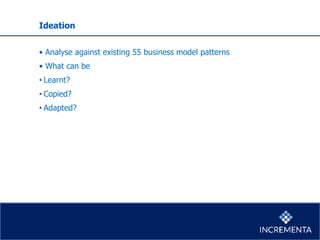
Ideation
• Analyse against existing 55 business model patterns
• What can be
• Learnt?
• Copied?
• Adapted?
Implementation
1.Only implement one business model at a time
2.Clearly communicate the new business model and the need for change
3.Don’t overemphasise short term KPI’s
4.Get management buy in – if required
Pa
ge
17

Business model innovation

  • 1.
    Generating new income BusinessModel Innovation Stuart Hartley Senior Consultant
  • 2.
    Types of Innovation •Business Model Innovation involves changing the way business is done in terms of capturing value • Process Innovation involves the implementation of a new or significantly improved production or delivery method. • Product Innovation involves the introduction of a new good or service that is new or substantially improved. This might include improvements in functional characteristics, technical abilities, ease of use, or any other dimension. • Service Innovation is similar to product innovation except that the innovation relates to services rather than to products
  • 3.
    How many waysof making money from a Cow?
  • 5.
    Before we startlets understand what the term business model means “a unit of analysis to describe how the business works”
  • 6.
    What makes upyour business model? Value Proposition Revenue model Who? Value Chain What do you offer to your customer? How do you create value? How do you make money? Who is your target customer? What? How?Value? Who?
  • 7.
    • Who –every business model serves a certain customer group. Who, therefore, is in your target customer segment? • What – is being offered to the target customer. The important aspect here is not the actual product or service but the elements which the customer value (CVP) • How – To build and distribute the value proposition the business has to master several processes and activities. This, in addition to, your resources and capabilities creates your value chain • Value – How are you going to generate revenue? How are you going to make money?
  • 8.
    • By understandingthese 4 associated points we can create a tangible business model • The creation and understanding of this existing business model serves as a benchmark for improvement / innovation Ikea Case study
  • 9.
    Barriers to businessmodel innovation • Resistance to change: people just get used to doing a particular work in customized manner and they are just opposed to any new idea or change. • Restriction on interaction: a free and open environment provides members an opportunity to interact with members of their own and other groups. Such interaction facilitates exchange of ideas and information required for creative work where as in restricted environment creativity is adversely effected.
  • 10.
    • Fear ofsomething going wrong: many new ideas may go wrong or prove impractical. Whenever creative work is to be undertaken the possibility of success or failure is always there. • Resource constraints: creativity demands sufficient availability of resources. Absence of adequate resources may dampen the spirit of creativity.
  • 12.
    Example business models ModelName Affected BM Components Examples Model Description Add - On What, Value Ryanair The core product is priced competitively, but there are numerous extras that drive the final price up Auction What, Value E-bay Auctioning allows the company to sell at the highest acceptable price to the customer. The customer benefits from the opportunity to influence price Crowdfunding How, Value Kickstarter A product, project or start-up is financed by a crowd of investors who wish to support the underlying idea Customer Loyalty What, Value Nectar Card – Sainsbury’s Customers are retained and loyalty assured by providing value beyond the product itself. Customers are voluntarily bound to the company which protects future revenue
  • 13.
    Model Name AffectedBM Components Examples Model Description Direct Selling What, How, Value Dollar Shave Club Businesses sell direct to the customer, not via an intermediary. This way savings can be made and passed to the customer Freemium What, Value Spotify, Skype The basic version of an offering is given away in the hope of persuading customers to pay for the premium version Lock In What, How, Value Nestle Nespresso Customers are locked into a vendor’s world of products. This lock in is generated by technological or substantial independencies of products or services Mass Customisation What, Value Dell The approach of modular products and production systems has enabled efficient indvidualisation of products. Individual customer needs can be met at competitive prices
  • 14.
  • 15.
    Initiation • What isthe problem? • Where is it happening? • When is it happening? • How can we overcome the problem? • When do you need to get involved? • How do you know when the problem is fixed?
  • 16.
    Ideation • Analyse againstexisting 55 business model patterns • What can be • Learnt? • Copied? • Adapted?
  • 17.
    Implementation 1.Only implement onebusiness model at a time 2.Clearly communicate the new business model and the need for change 3.Don’t overemphasise short term KPI’s 4.Get management buy in – if required Pa ge 17