Business Model Canvas
Tools for Entrepreneurs
By Elena Donets

The original Business Model Generation canvas by Alex Osterwalder
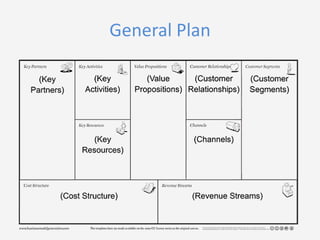
General Plan
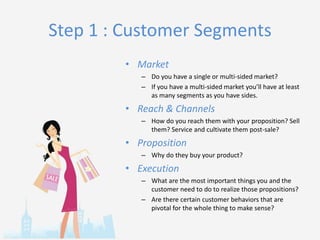
Step 1 : Customer Segments
• Market
– Do you have a single or multi-sided market?
– If you have a multi-sided market you’ll have at least
as many segments as you have sides.

• Reach & Channels
– How do you reach them with your proposition? Sell
them? Service and cultivate them post-sale?

• Proposition
– Why do they buy your product?

• Execution
– What are the most important things you and the
customer need to do to realize those propositions?
– Are there certain customer behaviors that are
pivotal for the whole thing to make sense?
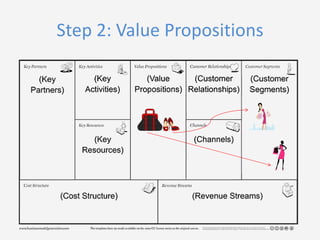
Step 2: Value Propositions
• What need or desire are you fulfilling
for the customer?
• What problem are you solving?
Once you’ve isolated these, try mapping them to the
Customer Segments;
Step 2: Value Propositions
Step 3: Channels

This includes entities you use to
communicate your proposition to your
segments, as well as entities through
which you sell product.
Step 4: Customer Relationships
• How does the customer interact with
you through the sales and product
lifecycle?
• Do they have a dedicated personal
contact they see? Call? Is all the
interaction over the web?
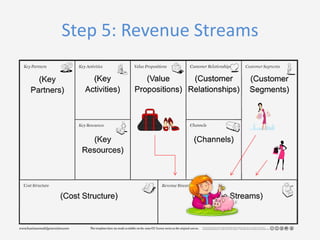
Step 5: Revenue Streams
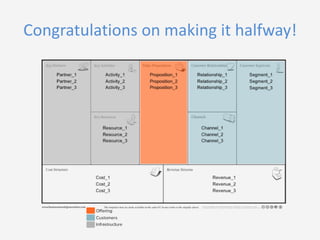
Congratulations on making it halfway!
Step 6: Key Resources
• Key resources are the strategic assets
you need in place, and you need in
place to a greater or more targeted
degree than your competitors.
• Key Resources in product-driven
businesses are typically key talent in
critical areas of expertise and
accumulated intellectual property
related to their offering.
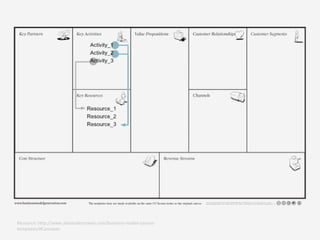
Step 7 : Key Activities
These are the crucial things the
business needs to do to deliver on its
propositions and make the rest of the
business work- for example, if selling
through 3rd parties is part of the
model, then activity around channel
management is probably pretty
important.
Resource: http://www.alexandercowan.com/business-model-canvastemplates/#Canvases
Step 8 : Key Partnerships
• What things that you won’t do are key to the business?
• What partners are most critical? Why? For what?
• If you have partners, how tightly do they map to the Key
Activities that aren’t your core strength?
Step 8 : Key Partnerships
• What things that you won’t do are key to the business?
• What partners are most critical? Why? For what?
• If you have partners, how tightly do they map to the Key
Activities that aren’t your core strength?
Step 9: Cost Structure
• You’ve worked to understand
how your Key Activities drive
your propositions and hence
your revenue.
• How do they drive costs? Are
those costs well aligned with the
key Value Propositions?
• Are the costs more fixed or
variable as you test different
business models? Are they more
linear with your scaling or more
fixed?
Business Canvas Online Tools

Business Model Fiddle
Thank You
Questions?

elenado@startau.co.il
www.startau.co.il

Business model canvas

  • 1.
    Business Model Canvas Toolsfor Entrepreneurs By Elena Donets The original Business Model Generation canvas by Alex Osterwalder
  • 2.
  • 3.
    Step 1 :Customer Segments • Market – Do you have a single or multi-sided market? – If you have a multi-sided market you’ll have at least as many segments as you have sides. • Reach & Channels – How do you reach them with your proposition? Sell them? Service and cultivate them post-sale? • Proposition – Why do they buy your product? • Execution – What are the most important things you and the customer need to do to realize those propositions? – Are there certain customer behaviors that are pivotal for the whole thing to make sense?
  • 4.
    Step 2: ValuePropositions • What need or desire are you fulfilling for the customer? • What problem are you solving? Once you’ve isolated these, try mapping them to the Customer Segments;
  • 5.
    Step 2: ValuePropositions
  • 6.
    Step 3: Channels Thisincludes entities you use to communicate your proposition to your segments, as well as entities through which you sell product.
  • 7.
    Step 4: CustomerRelationships • How does the customer interact with you through the sales and product lifecycle? • Do they have a dedicated personal contact they see? Call? Is all the interaction over the web?
  • 8.
  • 9.
  • 10.
    Step 6: KeyResources • Key resources are the strategic assets you need in place, and you need in place to a greater or more targeted degree than your competitors. • Key Resources in product-driven businesses are typically key talent in critical areas of expertise and accumulated intellectual property related to their offering.
  • 11.
    Step 7 :Key Activities These are the crucial things the business needs to do to deliver on its propositions and make the rest of the business work- for example, if selling through 3rd parties is part of the model, then activity around channel management is probably pretty important.
  • 12.
  • 13.
    Step 8 :Key Partnerships • What things that you won’t do are key to the business? • What partners are most critical? Why? For what? • If you have partners, how tightly do they map to the Key Activities that aren’t your core strength?
  • 14.
    Step 8 :Key Partnerships • What things that you won’t do are key to the business? • What partners are most critical? Why? For what? • If you have partners, how tightly do they map to the Key Activities that aren’t your core strength?
  • 15.
    Step 9: CostStructure • You’ve worked to understand how your Key Activities drive your propositions and hence your revenue. • How do they drive costs? Are those costs well aligned with the key Value Propositions? • Are the costs more fixed or variable as you test different business models? Are they more linear with your scaling or more fixed?
  • 16.
    Business Canvas OnlineTools Business Model Fiddle
  • 17.