Introduction to Business
Law
• Business law consists of all laws that dictate
how to form and run a business.
• Business law includes state law and federal
laws.
• When a person plan on entering into an
agreement with another person, he or she
needs to know the formalities necessary to
create an enforceable agreement.
• Business people need to understand the
nature and consequences of the documents
they are signing.
• Sometimes business people end up in court
because they have entered into a transaction
without consulting a lawyer.
• Business law includes all of the laws that
govern how to start,buy,manage and close or
sell any type of business.
Meaning of business law
• Business law is also called as commercial law
or mercantile law which regulates business
activities.
• Business law is that portion of the legal system
which guarantees an orderly conduct of
business affairs and settlement of legitimate
dispute in a just manner
Definition of business law
• According to S.R Davar,”Mercantile law means
that branch of law which is applicable to or
concerned with trade and commerce in
connection with various business transaction”
• It refers to law that governs the dealings
between people and commercial matter.
• There are two distinct areas of business law,
they are: regulation of commercial entity and
regulation of commercial transaction.
Nature of law
• Everyone in society is subject to a variety of
rules.
• Not all of these rules are laws.
• Eg: many religions set rules of behaviour
• Violating these rules,doesnot mean that a
person has violated the law.
• Rules cannot be enforced in court.
• If a person violates a law, the court generally
imposes some form of penalty called a
sanction.
• Sanctions require a person to do or not to do
something.(eg: buying & selling)
• To pay money to someone else (eg: divorce)
• To impose a prison sentence(eg: theft)
Sources of Business Law
• Indian mercantile law is based largely upon
the English mercantile law
• 1)English mercantile law
Common law
Equity
Statute law
Case Law
Merchant law
• 2) Customs and usages
• 3) Natural law
• 4) Constitution laws
English law
• Most of the Indian Business laws are based on
English law
• Many rules of English law have been
incorporated into Indian law.
Eg:Indian Penal Code formulated by the British
,forms the backbone of criminal law in India.
The sources of English law are as follows
Common law
• It refers to the law that is developed through
decisions of the court rather than relying on
statute.
• It is created by judges
• It is also called judge made law
• It is the oldest unwritten law
Statute/legislation
• A statute is a law passed by a legislative body.
• It is a written law
• Both parliament and state assemblies have
enacted number of legislations.
Eg: Indian Contract Act 1872,Competition Act 2002
Equity
• Many years ago court was divided into court
of law and court of equity.
• People went to law courts for monetary
damages.
• People who desired some remedy other than
money went to equity court.
• It is also unwritten law.
• Here justice is developed by the judges whose
decisions become precedents.
• Eg: A person enters into a contract to
purchase a painting and pays the amount, but
the seller refuses to deliver the painting,
buyer may file a suit, now court ask the
defendant to deliver the painting.
Case law
• It is a law that comes from decisions made by
judges in previous cases.
• This is a source of law based upon previous
judicial decisions which have to be followed in
similar future cases.
Law merchant
• It is a branch of law which was based on
customs and usages prevalent among
merchant.
• It defines the rule to be followed in all
contracts, purchase and sales agreements,
shipping requirement.
Natural law
• No man can be punished twice for same
crime.
• No man is guilty unless the charges are
proved.
Customs and usage
• It plays an important role in regulating
business transaction.
• When custom is accepted by a court,it
becomes a law.
Constitution law
• Constitution is the fundamental law of the
nation.
• Central and state laws should be within the
limitation of Indian constitution law.
Scope of business law
• The scope of mercantile law is very wide and
varied. It includes law relating to contracts,
partnership, sale of goods, negotiable
instruments, companies etc.
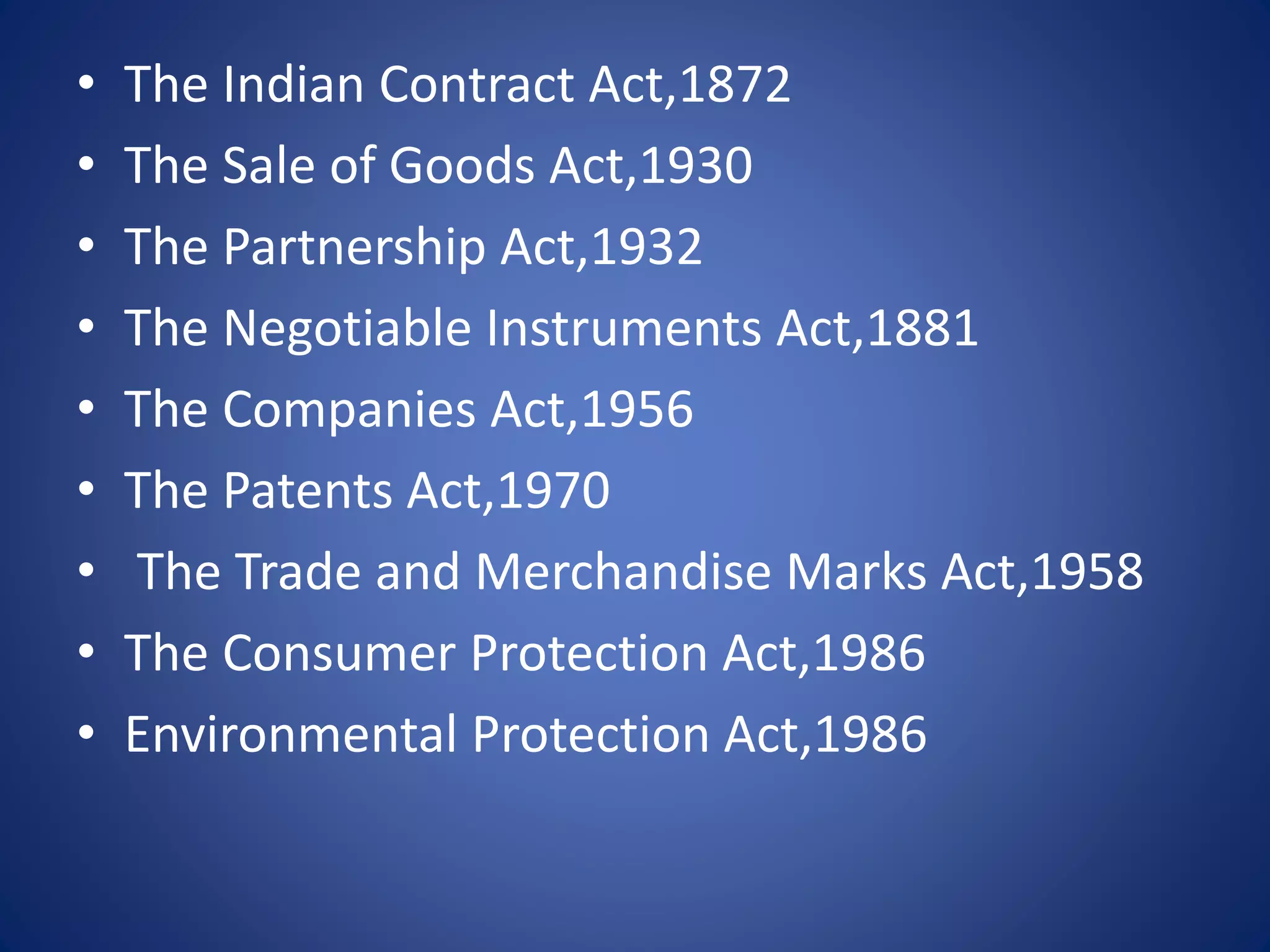
• The Indian Contract Act,1872
• The Sale of Goods Act,1930
• The Partnership Act,1932
• The Negotiable Instruments Act,1881
• The Companies Act,1956
• The Patents Act,1970
• The Trade and Merchandise Marks Act,1958
• The Consumer Protection Act,1986
• Environmental Protection Act,1986

Introduction and sources of business law

  • 1.
  • 2.
    • Business lawconsists of all laws that dictate how to form and run a business. • Business law includes state law and federal laws.
  • 3.
    • When aperson plan on entering into an agreement with another person, he or she needs to know the formalities necessary to create an enforceable agreement.
  • 4.
    • Business peopleneed to understand the nature and consequences of the documents they are signing. • Sometimes business people end up in court because they have entered into a transaction without consulting a lawyer.
  • 5.
    • Business lawincludes all of the laws that govern how to start,buy,manage and close or sell any type of business.
  • 6.
    Meaning of businesslaw • Business law is also called as commercial law or mercantile law which regulates business activities. • Business law is that portion of the legal system which guarantees an orderly conduct of business affairs and settlement of legitimate dispute in a just manner
  • 7.
    Definition of businesslaw • According to S.R Davar,”Mercantile law means that branch of law which is applicable to or concerned with trade and commerce in connection with various business transaction”
  • 8.
    • It refersto law that governs the dealings between people and commercial matter. • There are two distinct areas of business law, they are: regulation of commercial entity and regulation of commercial transaction.
  • 9.
    Nature of law •Everyone in society is subject to a variety of rules. • Not all of these rules are laws. • Eg: many religions set rules of behaviour
  • 10.
    • Violating theserules,doesnot mean that a person has violated the law. • Rules cannot be enforced in court. • If a person violates a law, the court generally imposes some form of penalty called a sanction.
  • 11.
    • Sanctions requirea person to do or not to do something.(eg: buying & selling) • To pay money to someone else (eg: divorce) • To impose a prison sentence(eg: theft)
  • 12.
    Sources of BusinessLaw • Indian mercantile law is based largely upon the English mercantile law
  • 13.
    • 1)English mercantilelaw Common law Equity Statute law Case Law Merchant law
  • 14.
    • 2) Customsand usages • 3) Natural law • 4) Constitution laws
  • 15.
    English law • Mostof the Indian Business laws are based on English law • Many rules of English law have been incorporated into Indian law. Eg:Indian Penal Code formulated by the British ,forms the backbone of criminal law in India.
  • 16.
    The sources ofEnglish law are as follows Common law • It refers to the law that is developed through decisions of the court rather than relying on statute. • It is created by judges • It is also called judge made law • It is the oldest unwritten law
  • 17.
    Statute/legislation • A statuteis a law passed by a legislative body. • It is a written law • Both parliament and state assemblies have enacted number of legislations. Eg: Indian Contract Act 1872,Competition Act 2002
  • 18.
    Equity • Many yearsago court was divided into court of law and court of equity. • People went to law courts for monetary damages. • People who desired some remedy other than money went to equity court.
  • 19.
    • It isalso unwritten law. • Here justice is developed by the judges whose decisions become precedents. • Eg: A person enters into a contract to purchase a painting and pays the amount, but the seller refuses to deliver the painting, buyer may file a suit, now court ask the defendant to deliver the painting.
  • 20.
    Case law • Itis a law that comes from decisions made by judges in previous cases. • This is a source of law based upon previous judicial decisions which have to be followed in similar future cases.
  • 21.
    Law merchant • Itis a branch of law which was based on customs and usages prevalent among merchant. • It defines the rule to be followed in all contracts, purchase and sales agreements, shipping requirement.
  • 22.
    Natural law • Noman can be punished twice for same crime. • No man is guilty unless the charges are proved.
  • 23.
    Customs and usage •It plays an important role in regulating business transaction. • When custom is accepted by a court,it becomes a law.
  • 24.
    Constitution law • Constitutionis the fundamental law of the nation. • Central and state laws should be within the limitation of Indian constitution law.
  • 25.
    Scope of businesslaw • The scope of mercantile law is very wide and varied. It includes law relating to contracts, partnership, sale of goods, negotiable instruments, companies etc.
  • 26.
    • The IndianContract Act,1872 • The Sale of Goods Act,1930 • The Partnership Act,1932 • The Negotiable Instruments Act,1881 • The Companies Act,1956 • The Patents Act,1970 • The Trade and Merchandise Marks Act,1958 • The Consumer Protection Act,1986 • Environmental Protection Act,1986