PRESENTATION ON
 CONTRACT
  ACT,1847
UNDER THE GUIDANCE- PROF. SARITA   PATIL


         PRESENTED BY- NITEEN. P
                        KUSHAL. M
                        LAXMI. B
                         VINAYAK . V
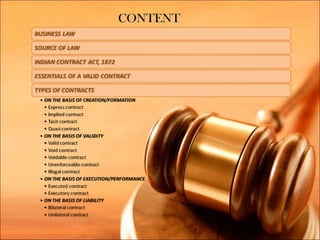
CONTENT
Business Law
         Business law is a rule which helps us to regulate and manage
our business transactions and activities system. It has direct relation
with trade, industry and commerce. e.g. insurance act, contract act,
tax act, sale of goods act, agency act etc.
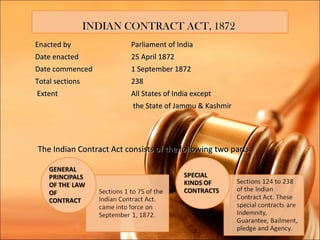
INDIAN CONTRACT ACT, 1872
Enacted by                Parliament of India
Date enacted              25 April 1872
Date commenced            1 September 1872
Total sections            238
Extent                    All States of India except
                          the State of Jammu & Kashmir


The Indian Contract Act consists of the following two parts:
What is a Contract?

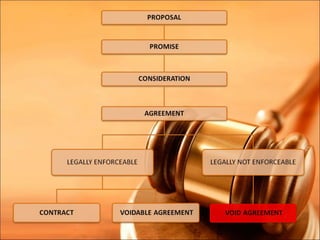
        An agreement which is legally enforceable alone is a contract.
Agreements which are not legally enforceable are not contracts but
remain as void agreements which are not enforceable at all or as
voidable agreements which are enforceable by only one of the parties
to the agreement.


   “All contracts are agreements, But all agreements are not contracts.”
OFFER/PROPOSAL   ACCEPTANCE   PROMISE
Offer/Proposal sec 2(a) - When one person signifies to another his
willingness to do or to abstain from doing anything, with a view to
obtaining the assent of that other person either to such act or abstinence,
he is said to make a proposal.


Acceptance sec 2(b) - When the person to whom the proposal is made,
signifies his assent there to , the proposal is said to be accepted.


Promise sec 2(b) - A Proposal when accepted becomes a promise. In
simple words, when an offer is accepted it becomes promise.


Promisor and promise sec 2(c) - When the proposal is accepted, the
person making the proposal is called as promisor and the person
accepting the proposal is called as promisee.
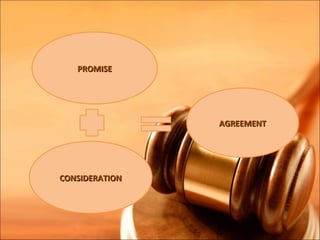
PROMISE


                AGREEMENT


CONSIDERATION
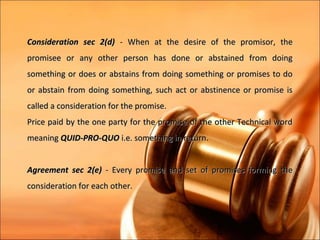
Consideration sec 2(d) - When at the desire of the promisor, the
promisee or any other person has done or abstained from doing
something or does or abstains from doing something or promises to do
or abstain from doing something, such act or abstinence or promise is
called a consideration for the promise.
Price paid by the one party for the promise of the other Technical word
meaning QUID-PRO-QUO i.e. something in return.


Agreement sec 2(e) - Every promise and set of promises forming the
consideration for each other.
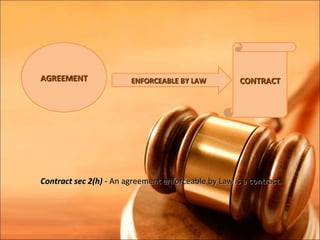
AGREEMENT               ENFORCEABLE BY LAW            CONTRACT


Contract sec 2(h) - An agreement enforceable by Law is a contract.
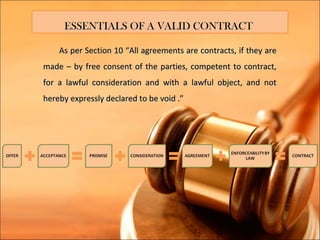
ESSENTIALS OF A VALID CONTRACT

    As per Section 10 “All agreements are contracts, if they are
made – by free consent of the parties, competent to contract,
for a lawful consideration and with a lawful object, and not
hereby expressly declared to be void .”
ESSENTIAL ELEMENTS OF A VALID CONTRACT
  • Offer and acceptance
  • Legal relationship
  • Consensus - ad-idem
  • Free consent.
  • Capacity or competency of parties
  • Lawful object
  • Lawful consideration
  • Certainty and possibility of performance
  • Agreements not declared to be void
  • Legal formalities
Offer and Acceptance: In order to create a valid contract, there must
be an agreement between two parties. An agreement involves a
valid offer by one party and valid acceptance of the same by the
other party.
    CASE: BOULTON (vs) JONES.
    CASE: HARVEY (vs) FACEY.


Legal relationship: The parties must intend their agreement to result in
legal relations. This means that the parties must intend that if one of
them falls to perform his promise, he shall be answerable for that failure
in law. Duties and rights should be legal and not merely moral. [an
agreement of a purely domestic or social nature is not a contract ]
    CASE: WEEKS (vs) TYBALD - 1905
    CASE: BALFOUR (vs) BALFOUR - 1919
Consensus-ad-idem: The minds of both the parties must be ad-idem. In
other words, the tow parties must have agreed about the subject
matter of the contract at the same time and in the same sense.


 Free consent (Permission or Willingness): An agreement must have
 been made by free consent of the parties. consent is said to be free
 when it is not caused by coercion, undue influence, fraud,
 misrepresentation or mistake.
     CASE: RANGANAYAKAMA (vs) ALWAR SETHI
Capacity : The parties to a contract must have capacity (legal ability) to
make valid contract.
Section 11:- of the Indian contract Act specify that every person is
competent to contract provided.
 Is of the age of majority according to the Law which he is subject
 Who is of sound mind and
 Is not disqualified from contracting by any law to which he is subject.

Lawful object :The object of agreement should be lawful and legal.
Consideration or object of an agreement is unlawful if it
is forbidden by law; or
is of such nature that, if permitted, would defeat the provisions of any law; or
is fraudulent; or
Involves or implies, injury to person or property of another; or
Court regards it as immoral, or opposed to public policy .
Lawful consideration : All contracts must be supported by consideration.
Consideration means “something in return” (quid pro quo). It can be cash,
kind, an act or abstinence. It can be past, present or future. However,
consideration should be real and lawful.
A consideration must not be unlawful, immoral or opposed to the public
policy.


Not expressly declared to be void

 Possibility of performance

Necessary legal formalities
   •A contract may be oral or in writing
Review


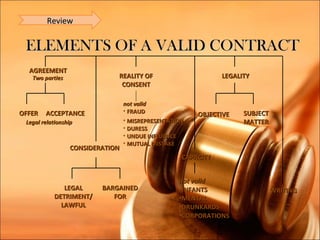
 ELEMENTS OF A VALID CONTRACT
  AGREEMENT
   Two parties               REALITY OF                       LEGALITY
                              CONSENT

                                 not valid
OFFER   ACCEPTANCE               • FRAUD                            SUBJECT
                                                       OBJECTIVE
 Legal relationship              • MISREPRESENTATION                MATTER
                                 • DURESS
                                 • UNDUE INFLUENCE
                                 • MUTUAL MISTAKE
                 CONSIDERATION
                                                   CAPACITY


                                                  not valid
              LEGAL      BARGAINED                •INFANTS                    WRITING
           DETRIMENT/       FOR                   •MENTAL
             LAWFUL                               •DRUNKARDS
                                                  •CORPORATIONS
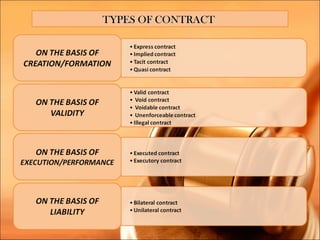
TYPES OF CONTRACT
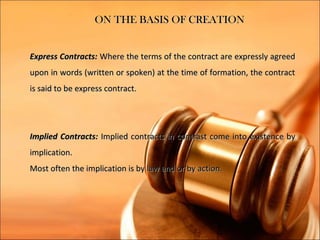
ON THE BASIS OF CREATION


Express Contracts: Where the terms of the contract are expressly agreed
upon in words (written or spoken) at the time of formation, the contract
is said to be express contract.


Implied Contracts: Implied contracts in contrast come into existence by
implication.
Most often the implication is by law and or by action.
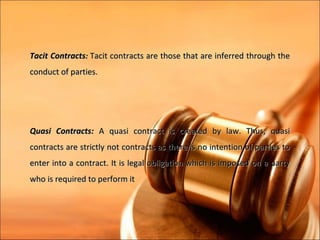
Tacit Contracts: Tacit contracts are those that are inferred through the
conduct of parties.


Quasi Contracts: A quasi contract is created by law. Thus, quasi
contracts are strictly not contracts as there is no intention of parties to
enter into a contract. It is legal obligation which is imposed on a party
who is required to perform it
ON THE BASIS OF VALIDITY

Valid contract : An agreement which has all the essential elements of a
contract is called a valid contract. A valid contract can be enforced by law.


Void contract (2(j) : "A contract which ceases to be enforceable by law
becomes void when it ceases to be enforceable". Thus a void contract is
one which cannot be enforced by a court of law.
         Under a mistake of facts [20]
         Consideration or object of an agreement is unlawful [23]
         Agreement made without consideration [25]
         Agreement in restrain of marriage [26]
         Restraint of trade [27]
         Restrain legal proceeding [28].
         Agreement by wage of wager [30]
Voidable contract Section 2[i] : Defines that an agreement which is
enforceable by law at the option of one or more parties but not at the
option of the other or others is a voidable contract.
Result of coercion, undue influence, fraud and misrepresentation.


Unenforceable contract : Where a contract is good in substance but
because of some technical defect cannot be enforced by law is called
unenforceable contract. These contracts are neither void nor voidable.
Example: Writing registration or stamping.
Illegal contract : Contracts those which are forbidden by law. All illegal
contracts are hence void also, because of the illegality of their nature
they cannot be enforced by any court of law. In fact even associated
contracts cannot be enforced. Contracts which are opposed to public
policy or immoral are also illegal.

“All illegal agreements are void agreements but all void agreements are not
illegal.”
ON THE BASIS OF EXECUTION


Executed contract : An executed contract is one in which both the
 .
parties have performed their respective obligation.


Executory contract : An executory contract is one where one or both
the parties to the contract have still to perform their obligations in
future. Thus, a contract which is partially performed or wholly
unperformed is termed as executory contract.
ON THE BASIS OF LIABILITY


Unilateral contract : A unilateral contract is one in which only one
party has to perform his obligation at the time of the formation of the
contract, the other party having fulfilled his obligation at the time of
the contract or before the contract comes into existence.


Bilateral contract : A bilateral contract is one in which the obligation
on both the parties to the contract is outstanding at the time of the
formation of the contract. Bilateral contracts are also known as
contracts with executory consideration.
THANK YOU
HAVE A FABULOUS DAY   

Business law contract act

  • 1.
    PRESENTATION ON CONTRACT ACT,1847 UNDER THE GUIDANCE- PROF. SARITA PATIL PRESENTED BY- NITEEN. P KUSHAL. M LAXMI. B VINAYAK . V
  • 2.
  • 3.
    Business Law Business law is a rule which helps us to regulate and manage our business transactions and activities system. It has direct relation with trade, industry and commerce. e.g. insurance act, contract act, tax act, sale of goods act, agency act etc.
  • 5.
    INDIAN CONTRACT ACT,1872 Enacted by Parliament of India Date enacted 25 April 1872 Date commenced 1 September 1872 Total sections 238 Extent All States of India except the State of Jammu & Kashmir The Indian Contract Act consists of the following two parts:
  • 6.
    What is aContract? An agreement which is legally enforceable alone is a contract. Agreements which are not legally enforceable are not contracts but remain as void agreements which are not enforceable at all or as voidable agreements which are enforceable by only one of the parties to the agreement. “All contracts are agreements, But all agreements are not contracts.”
  • 7.
    OFFER/PROPOSAL ACCEPTANCE PROMISE
  • 8.
    Offer/Proposal sec 2(a)- When one person signifies to another his willingness to do or to abstain from doing anything, with a view to obtaining the assent of that other person either to such act or abstinence, he is said to make a proposal. Acceptance sec 2(b) - When the person to whom the proposal is made, signifies his assent there to , the proposal is said to be accepted. Promise sec 2(b) - A Proposal when accepted becomes a promise. In simple words, when an offer is accepted it becomes promise. Promisor and promise sec 2(c) - When the proposal is accepted, the person making the proposal is called as promisor and the person accepting the proposal is called as promisee.
  • 9.
    PROMISE AGREEMENT CONSIDERATION
  • 10.
    Consideration sec 2(d)- When at the desire of the promisor, the promisee or any other person has done or abstained from doing something or does or abstains from doing something or promises to do or abstain from doing something, such act or abstinence or promise is called a consideration for the promise. Price paid by the one party for the promise of the other Technical word meaning QUID-PRO-QUO i.e. something in return. Agreement sec 2(e) - Every promise and set of promises forming the consideration for each other.
  • 11.
    AGREEMENT ENFORCEABLE BY LAW CONTRACT Contract sec 2(h) - An agreement enforceable by Law is a contract.
  • 13.
    ESSENTIALS OF AVALID CONTRACT As per Section 10 “All agreements are contracts, if they are made – by free consent of the parties, competent to contract, for a lawful consideration and with a lawful object, and not hereby expressly declared to be void .”
  • 14.
    ESSENTIAL ELEMENTS OFA VALID CONTRACT • Offer and acceptance • Legal relationship • Consensus - ad-idem • Free consent. • Capacity or competency of parties • Lawful object • Lawful consideration • Certainty and possibility of performance • Agreements not declared to be void • Legal formalities
  • 15.
    Offer and Acceptance:In order to create a valid contract, there must be an agreement between two parties. An agreement involves a valid offer by one party and valid acceptance of the same by the other party. CASE: BOULTON (vs) JONES. CASE: HARVEY (vs) FACEY. Legal relationship: The parties must intend their agreement to result in legal relations. This means that the parties must intend that if one of them falls to perform his promise, he shall be answerable for that failure in law. Duties and rights should be legal and not merely moral. [an agreement of a purely domestic or social nature is not a contract ] CASE: WEEKS (vs) TYBALD - 1905 CASE: BALFOUR (vs) BALFOUR - 1919
  • 16.
    Consensus-ad-idem: The mindsof both the parties must be ad-idem. In other words, the tow parties must have agreed about the subject matter of the contract at the same time and in the same sense. Free consent (Permission or Willingness): An agreement must have been made by free consent of the parties. consent is said to be free when it is not caused by coercion, undue influence, fraud, misrepresentation or mistake. CASE: RANGANAYAKAMA (vs) ALWAR SETHI
  • 17.
    Capacity : Theparties to a contract must have capacity (legal ability) to make valid contract. Section 11:- of the Indian contract Act specify that every person is competent to contract provided.  Is of the age of majority according to the Law which he is subject  Who is of sound mind and  Is not disqualified from contracting by any law to which he is subject. Lawful object :The object of agreement should be lawful and legal. Consideration or object of an agreement is unlawful if it is forbidden by law; or is of such nature that, if permitted, would defeat the provisions of any law; or is fraudulent; or Involves or implies, injury to person or property of another; or Court regards it as immoral, or opposed to public policy .
  • 18.
    Lawful consideration :All contracts must be supported by consideration. Consideration means “something in return” (quid pro quo). It can be cash, kind, an act or abstinence. It can be past, present or future. However, consideration should be real and lawful. A consideration must not be unlawful, immoral or opposed to the public policy. Not expressly declared to be void Possibility of performance Necessary legal formalities •A contract may be oral or in writing
  • 19.
    Review ELEMENTS OFA VALID CONTRACT AGREEMENT Two parties REALITY OF LEGALITY CONSENT not valid OFFER ACCEPTANCE • FRAUD SUBJECT OBJECTIVE Legal relationship • MISREPRESENTATION MATTER • DURESS • UNDUE INFLUENCE • MUTUAL MISTAKE CONSIDERATION CAPACITY not valid LEGAL BARGAINED •INFANTS WRITING DETRIMENT/ FOR •MENTAL LAWFUL •DRUNKARDS •CORPORATIONS
  • 20.
  • 21.
    ON THE BASISOF CREATION Express Contracts: Where the terms of the contract are expressly agreed upon in words (written or spoken) at the time of formation, the contract is said to be express contract. Implied Contracts: Implied contracts in contrast come into existence by implication. Most often the implication is by law and or by action.
  • 22.
    Tacit Contracts: Tacitcontracts are those that are inferred through the conduct of parties. Quasi Contracts: A quasi contract is created by law. Thus, quasi contracts are strictly not contracts as there is no intention of parties to enter into a contract. It is legal obligation which is imposed on a party who is required to perform it
  • 23.
    ON THE BASISOF VALIDITY Valid contract : An agreement which has all the essential elements of a contract is called a valid contract. A valid contract can be enforced by law. Void contract (2(j) : "A contract which ceases to be enforceable by law becomes void when it ceases to be enforceable". Thus a void contract is one which cannot be enforced by a court of law. Under a mistake of facts [20] Consideration or object of an agreement is unlawful [23] Agreement made without consideration [25] Agreement in restrain of marriage [26] Restraint of trade [27] Restrain legal proceeding [28]. Agreement by wage of wager [30]
  • 24.
    Voidable contract Section2[i] : Defines that an agreement which is enforceable by law at the option of one or more parties but not at the option of the other or others is a voidable contract. Result of coercion, undue influence, fraud and misrepresentation. Unenforceable contract : Where a contract is good in substance but because of some technical defect cannot be enforced by law is called unenforceable contract. These contracts are neither void nor voidable. Example: Writing registration or stamping.
  • 25.
    Illegal contract :Contracts those which are forbidden by law. All illegal contracts are hence void also, because of the illegality of their nature they cannot be enforced by any court of law. In fact even associated contracts cannot be enforced. Contracts which are opposed to public policy or immoral are also illegal. “All illegal agreements are void agreements but all void agreements are not illegal.”
  • 26.
    ON THE BASISOF EXECUTION Executed contract : An executed contract is one in which both the . parties have performed their respective obligation. Executory contract : An executory contract is one where one or both the parties to the contract have still to perform their obligations in future. Thus, a contract which is partially performed or wholly unperformed is termed as executory contract.
  • 27.
    ON THE BASISOF LIABILITY Unilateral contract : A unilateral contract is one in which only one party has to perform his obligation at the time of the formation of the contract, the other party having fulfilled his obligation at the time of the contract or before the contract comes into existence. Bilateral contract : A bilateral contract is one in which the obligation on both the parties to the contract is outstanding at the time of the formation of the contract. Bilateral contracts are also known as contracts with executory consideration.
  • 28.
    THANK YOU HAVE AFABULOUS DAY 