
Business & Labour Law
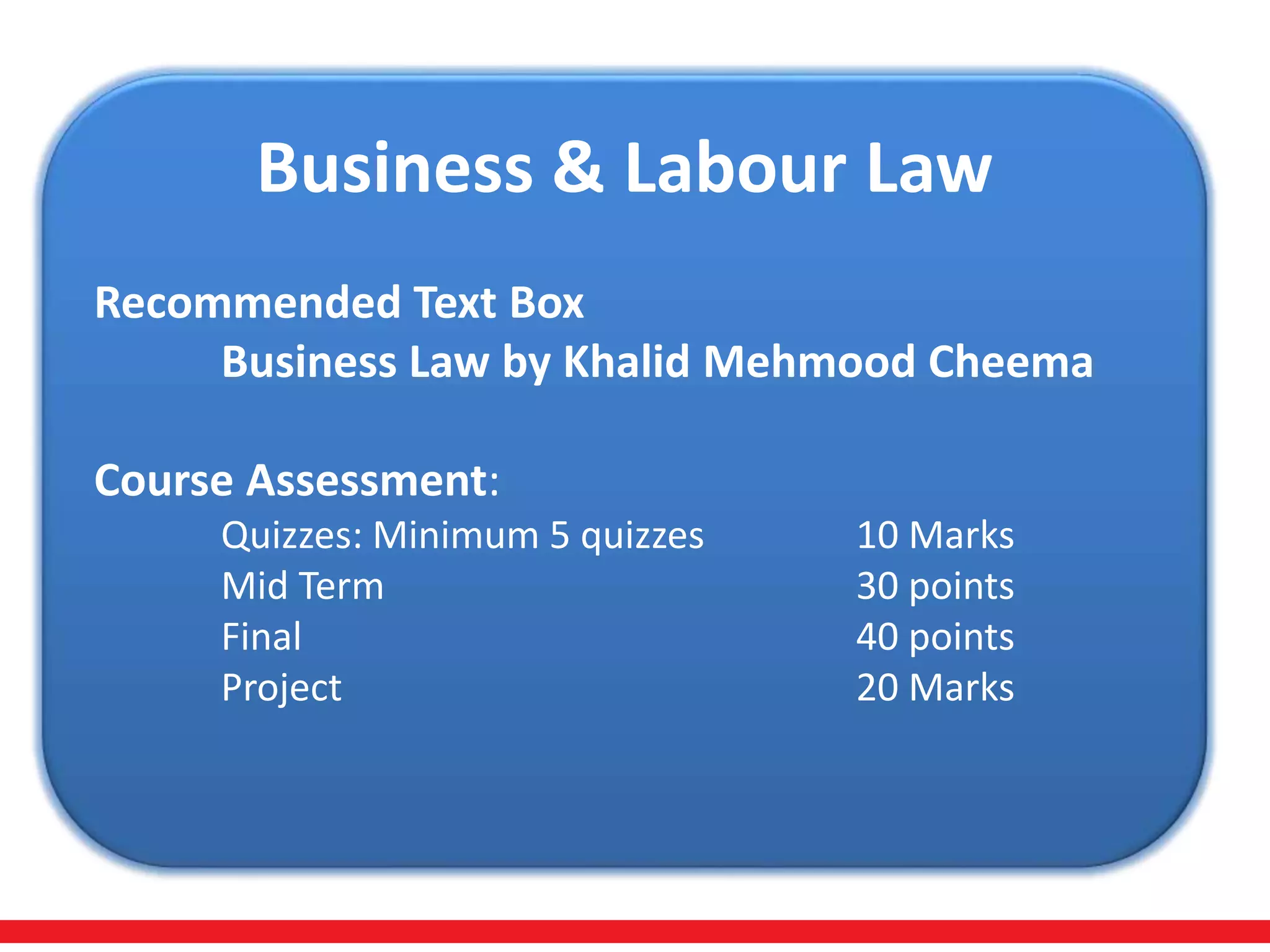
Recommended Text Box
Business Law by Khalid Mehmood Cheema
Course Assessment:
Quizzes: Minimum 5 quizzes 10 Marks
Mid Term 30 points
Final 40 points
Project 20 Marks
Nisar A. Mujahid
Advocate Supreme Court of Pakistan
Corporate, Legal and Policy Consultant,
International Trainer in :-
•Business Management & Intelligence
•Fraud Risk Management
•Law Firms Marketing
nisaramujahid@gmail.com
0334-3637799
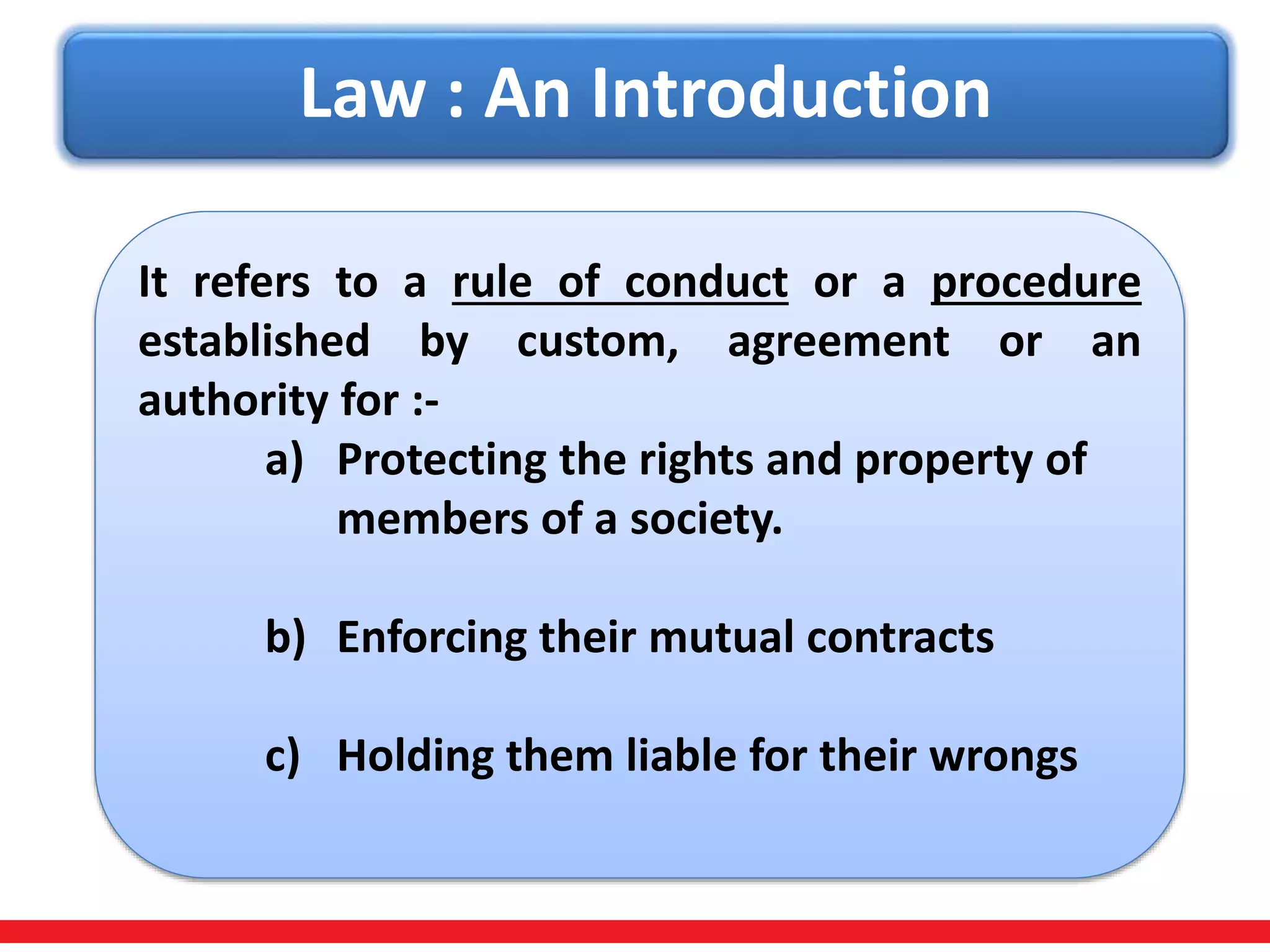
Law : An Introduction
It refers to a rule of conduct or a procedure
established by custom, agreement or an
authority for :-
a) Protecting the rights and property of
members of a society.
b) Enforcing their mutual contracts
c) Holding them liable for their wrongs
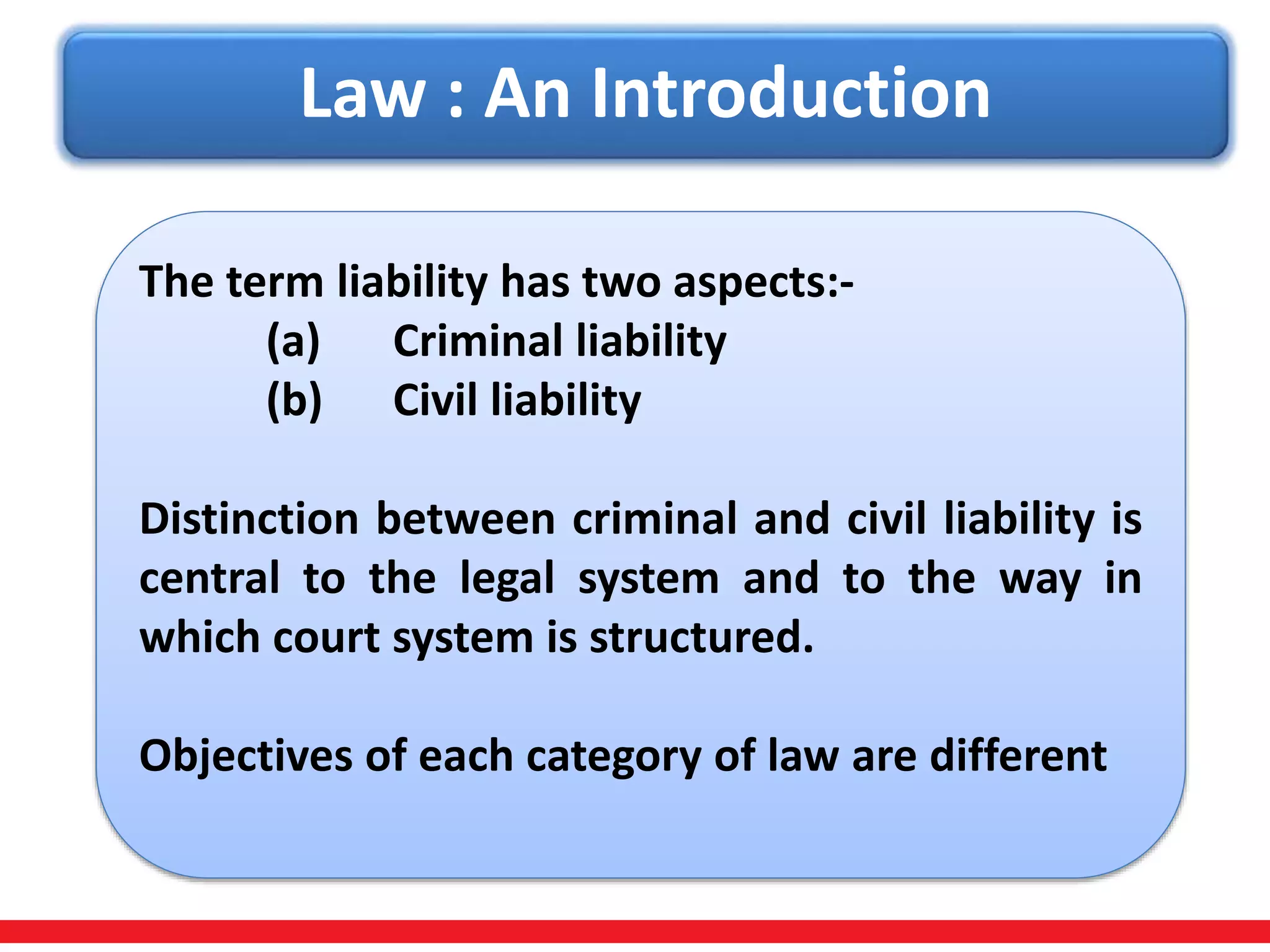
Law : An Introduction
The term liability has two aspects:-
(a) Criminal liability
(b) Civil liability
Distinction between criminal and civil liability is
central to the legal system and to the way in
which court system is structured.
Objectives of each category of law are different
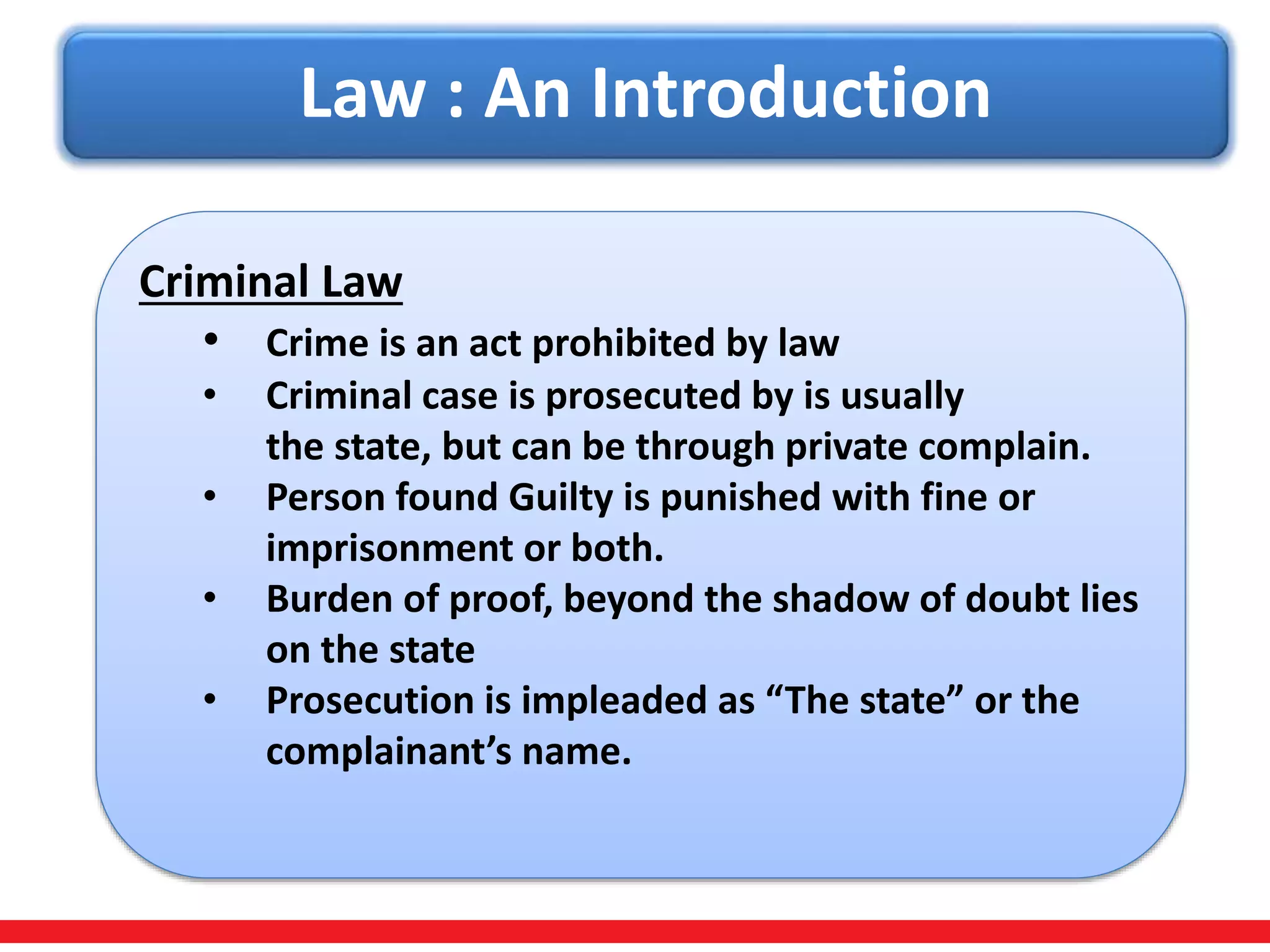
Law : An Introduction
Criminal Law
• Crime is an act prohibited by law
• Criminal case is prosecuted by is usually
the state, but can be through private complain.
• Person found Guilty is punished with fine or
imprisonment or both.
• Burden of proof, beyond the shadow of doubt lies
on the state
• Prosecution is impleaded as “The state” or the
complainant’s name.
Law : An Introduction
Criminal Law
• Sharia law contains the concept of:-
“QISAS” (RETRIBUTION),
In certain cases, gives legal right to
inflict on the wrongdoer same hurt as he
perpetrated on Person the victim, or get
“DIYAT” (COMPENSATION), instead.
• Western law focus on punishment, where
victims have to proceed under civil law
action for compensation.
Law : An Introduction
Civil Law
• Civil law exists to regulate disputes over
the rights and obligations of persons
dealing with each other.
• State has no direct role in dispute over, for
instance, a breach of contract.
• It is up to the persons involved to settle
the matter in the courts if they so wish.
Law : An Introduction
Civil Law
• Purpose of this course of action is
generally to determine the rights and
impose a settlement on matters either by
 financial compensation in the form
of damages
 injunctions other orders
• There is no concept of corpus punishment.
Law : An Introduction
Civil Law
• Case must be proven on the “Balance of
Probability”.
• Absolute proof or proof beyond doubt is
not required.
• Only more probability in favor of one
party over other has to be convinced to
the court.
• Burden of proof may shift between the
two parties.
Law : An Introduction
Civil Law
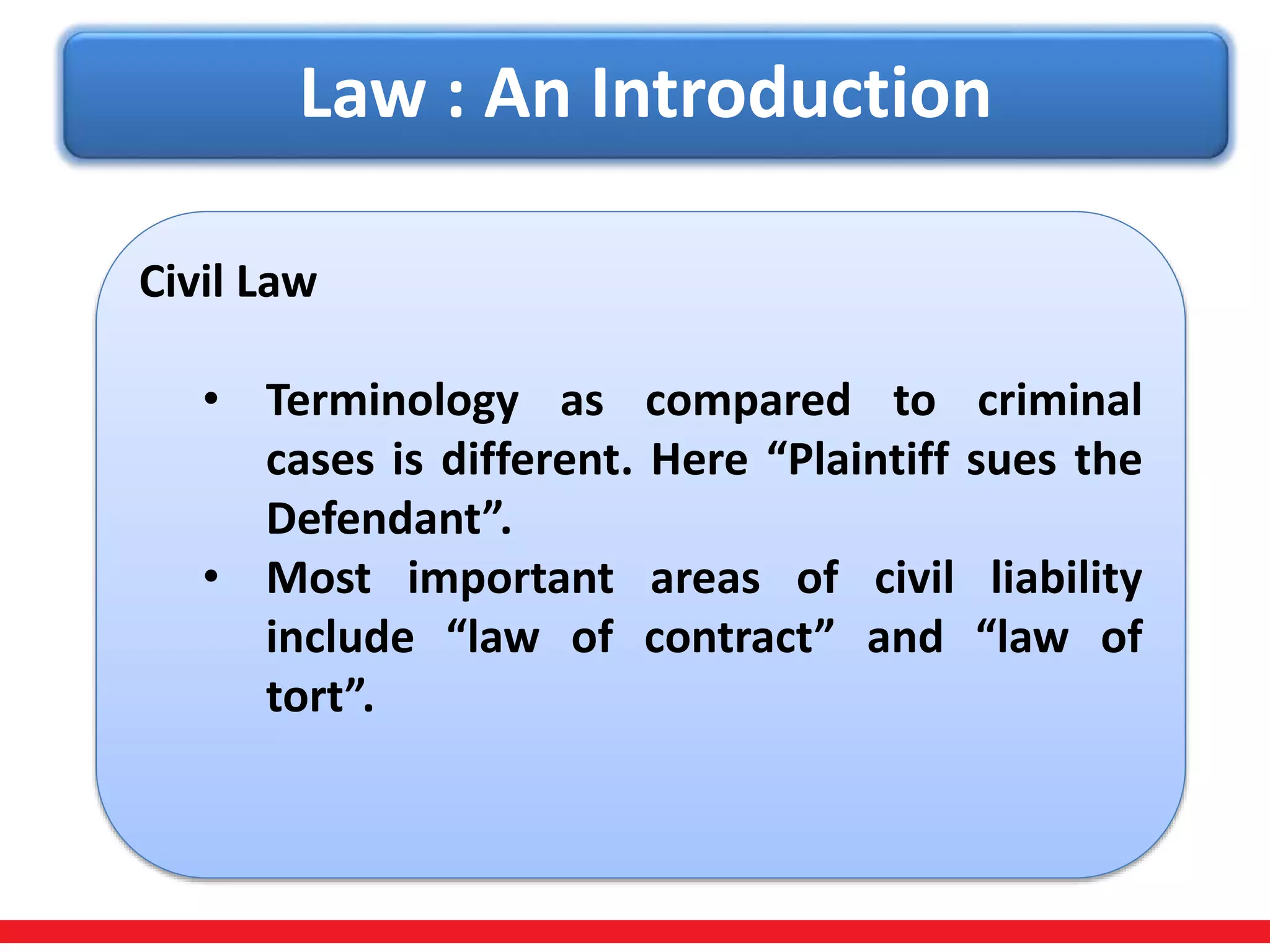
• Terminology as compared to criminal
cases is different. Here “Plaintiff sues the
Defendant”.
• Most important areas of civil liability
include “law of contract” and “law of
tort”.
Law : An Introduction
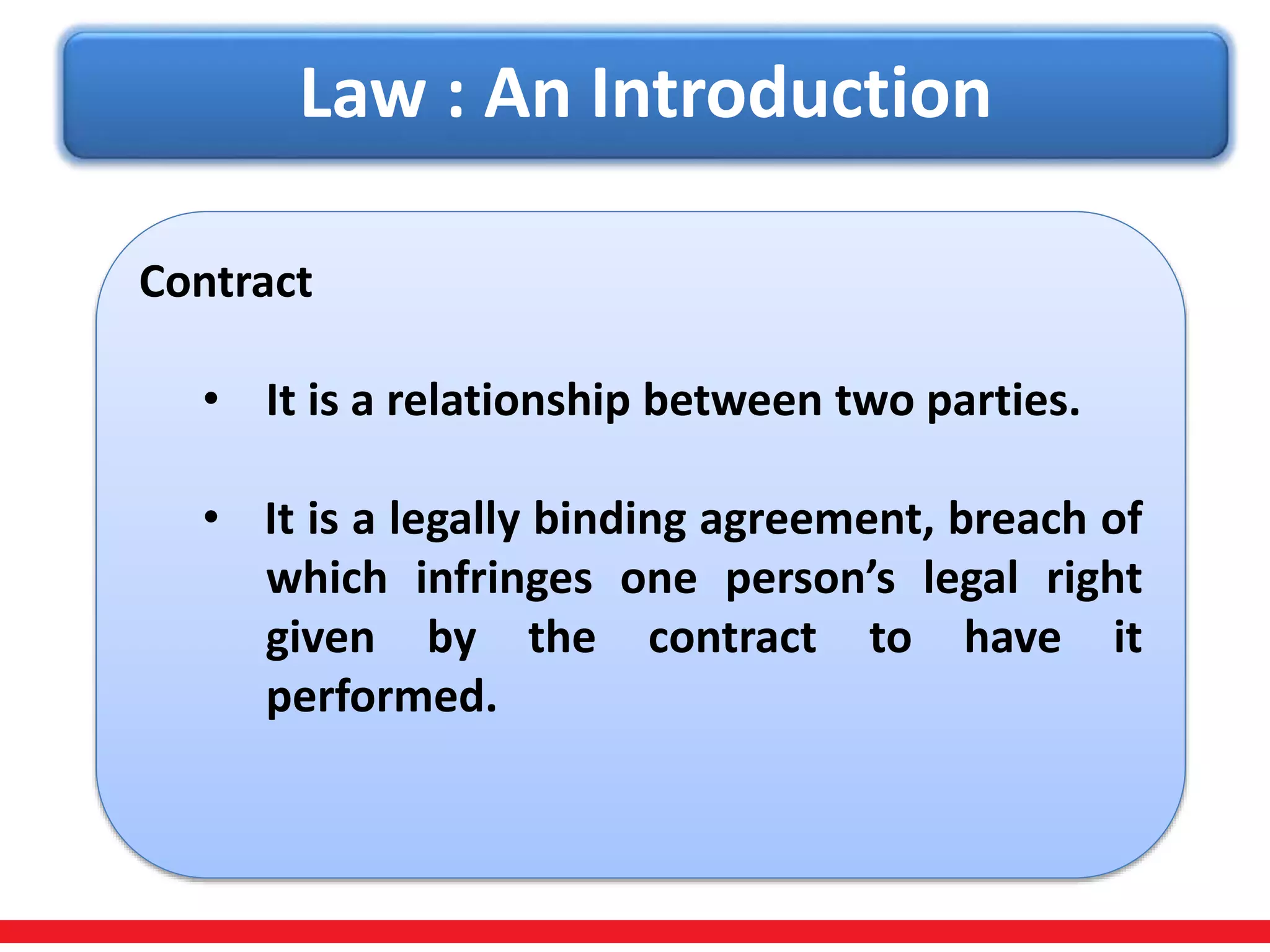
Contract
• It is a relationship between two parties.
• It is a legally binding agreement, breach of
which infringes one person’s legal right
given by the contract to have it
performed.
Law : An Introduction
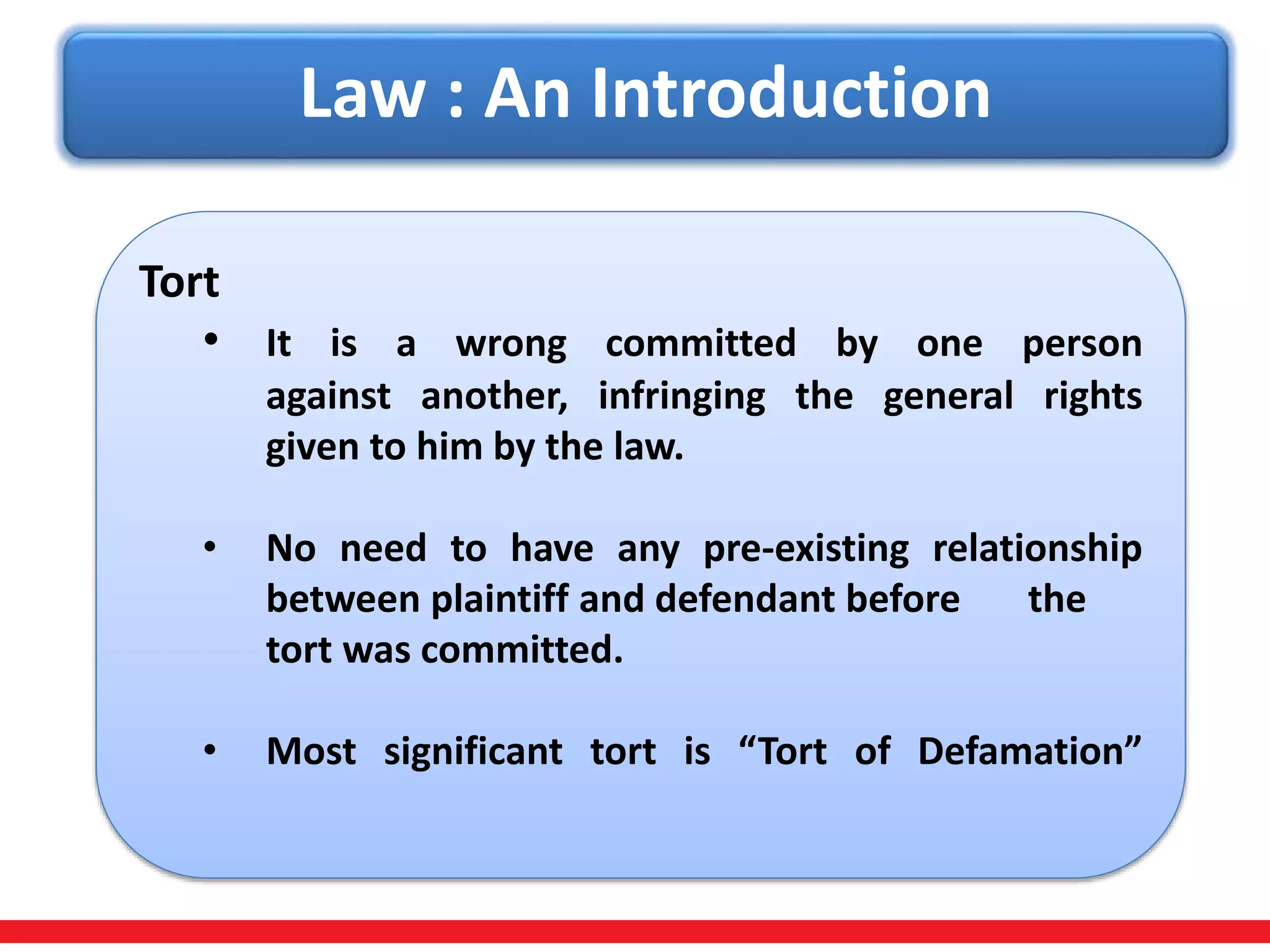
Tort
• It is a wrong committed by one person
against another, infringing the general rights
given to him by the law.
• No need to have any pre-existing relationship
between plaintiff and defendant before the
tort was committed.
• Most significant tort is “Tort of Defamation”
Law : An Introduction
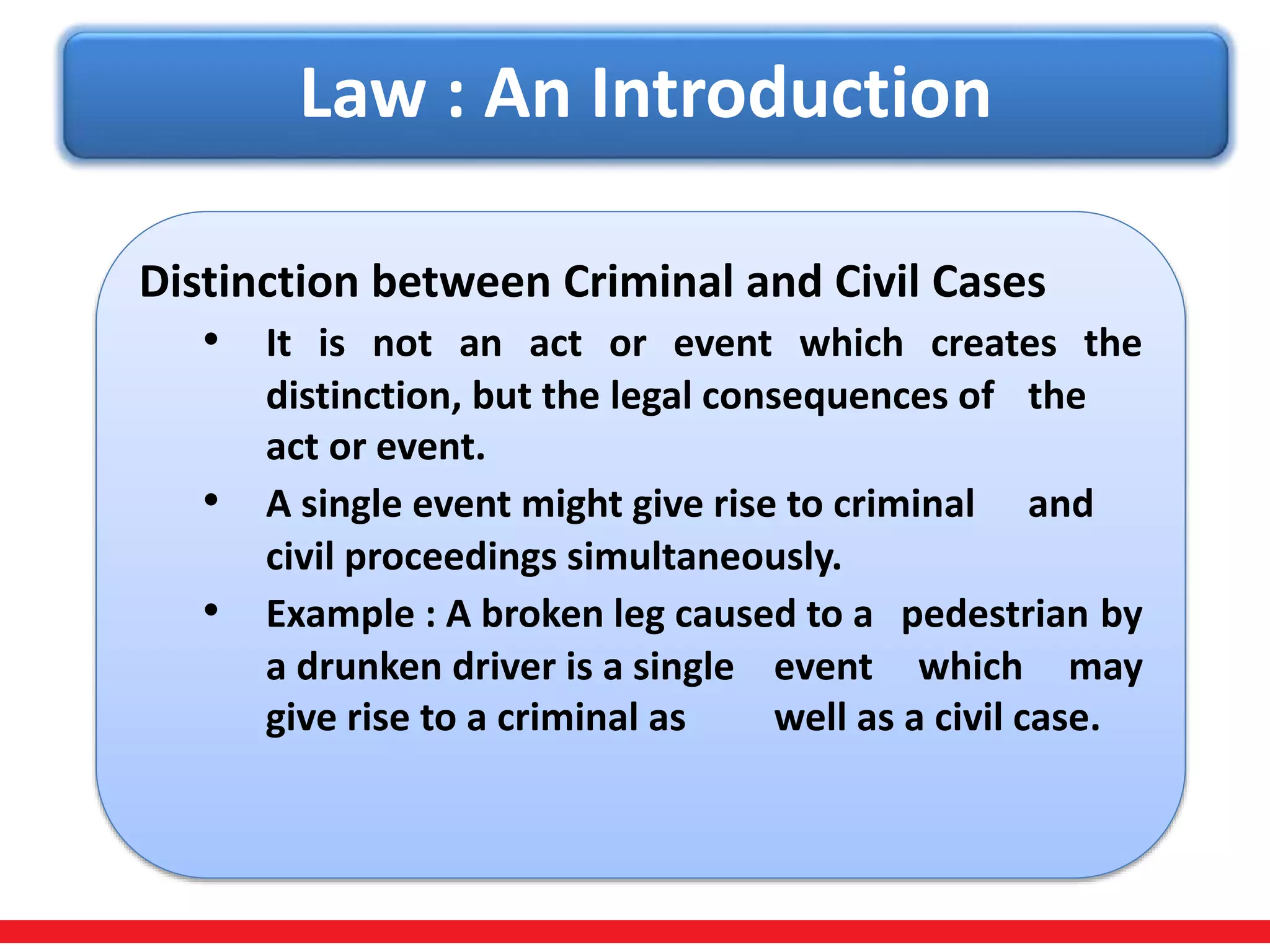
Distinction between Criminal and Civil Cases
• It is not an act or event which creates the
distinction, but the legal consequences of the
act or event.
• A single event might give rise to criminal and
civil proceedings simultaneously.
• Example : A broken leg caused to a pedestrian by
a drunken driver is a single event which may
give rise to a criminal as well as a civil case.
Law : An Introduction
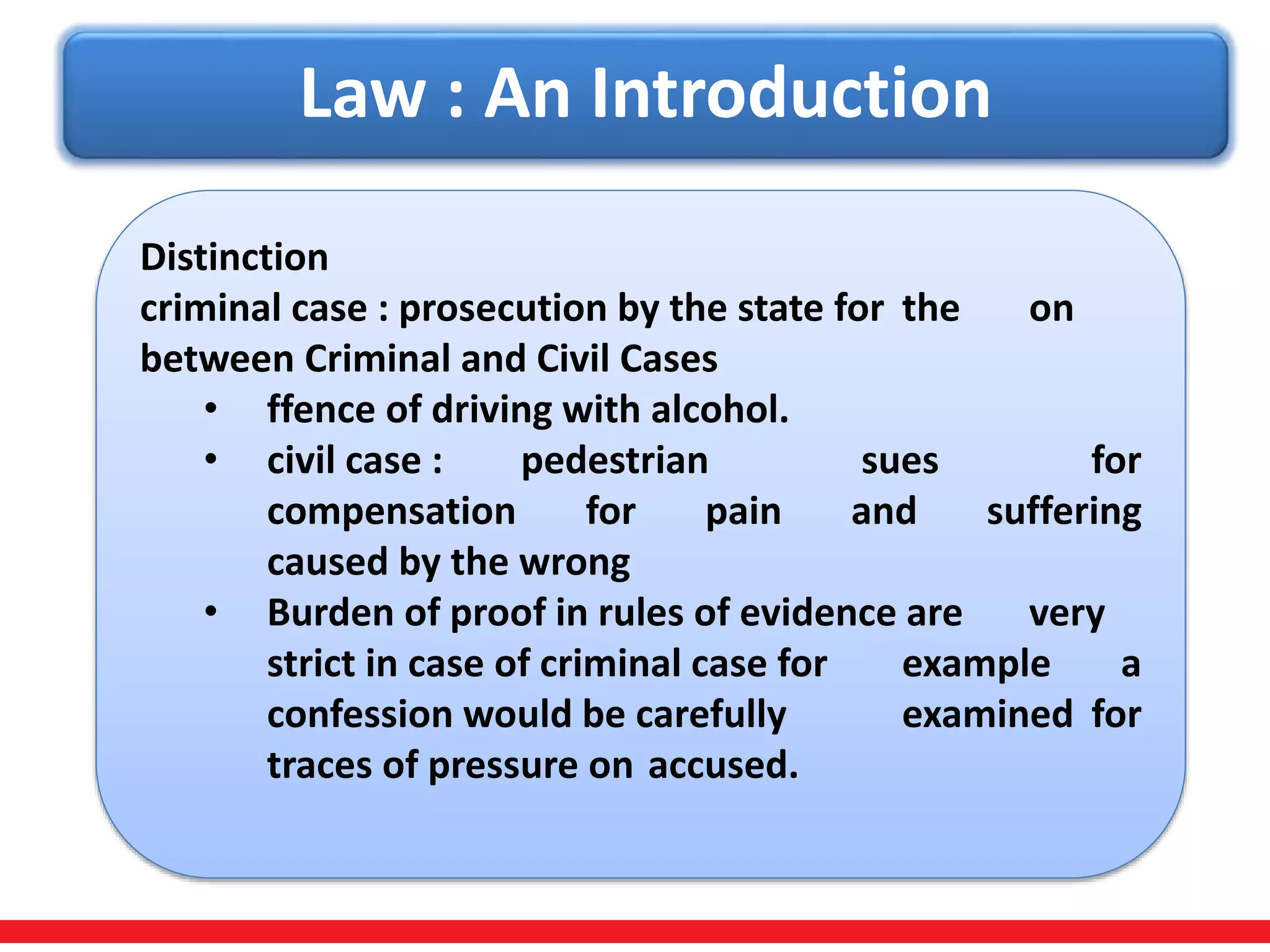
Distinction
criminal case : prosecution by the state for the on
between Criminal and Civil Cases
• ffence of driving with alcohol.
• civil case : pedestrian sues for
compensation for pain and suffering
caused by the wrong
• Burden of proof in rules of evidence are very
strict in case of criminal case for example a
confession would be carefully examined for
traces of pressure on accused.
Law : An Introduction
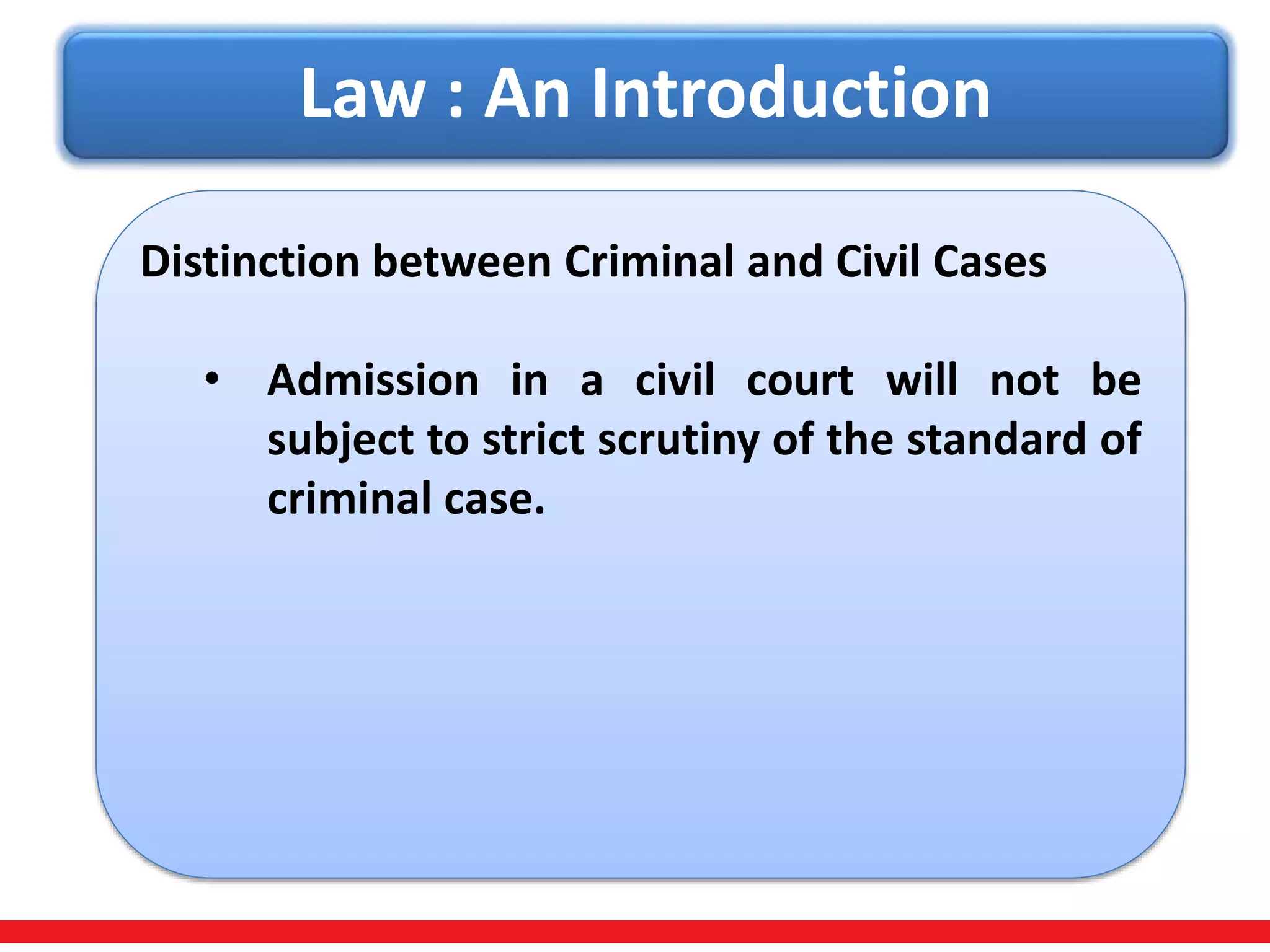
Distinction between Criminal and Civil Cases
• Admission in a civil court will not be
subject to strict scrutiny of the standard of
criminal case.
Law : An Introduction
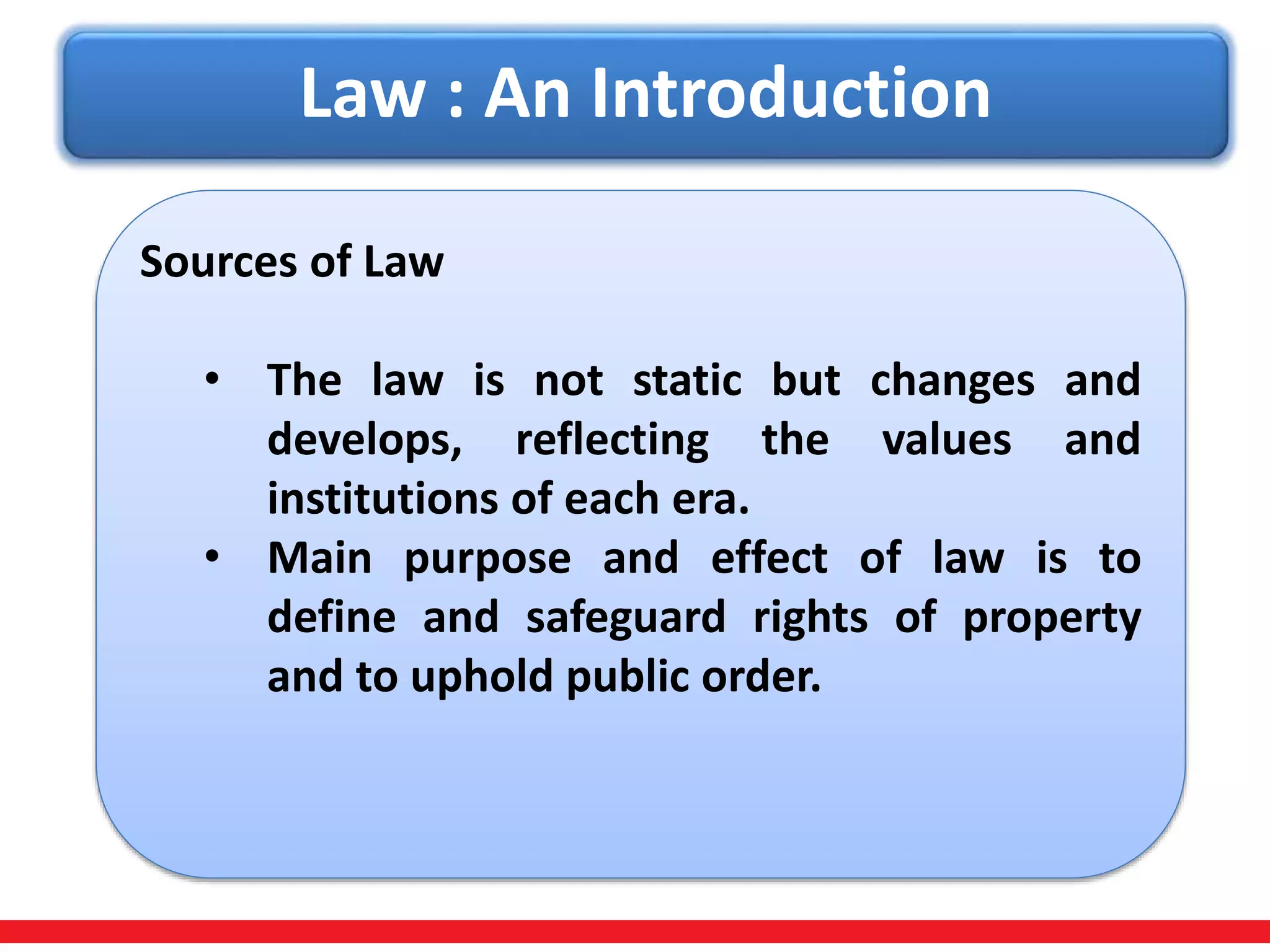
Sources of Law
• The law is not static but changes and
develops, reflecting the values and
institutions of each era.
• Main purpose and effect of law is to
define and safeguard rights of property
and to uphold public order.
Law : An Introduction
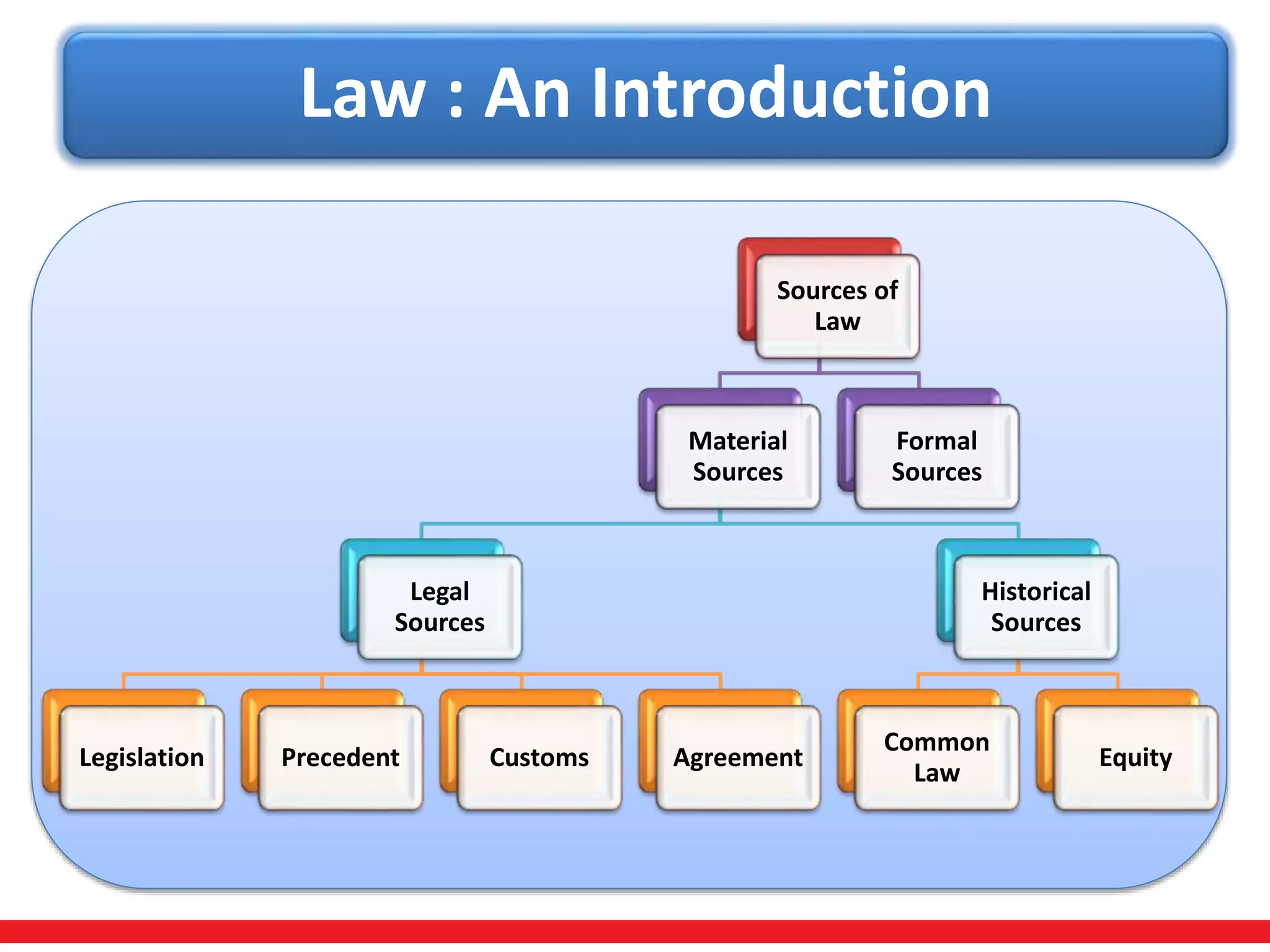
Sources of
Law
Material
Sources
Legal
Sources
Legislation Precedent Customs Agreement
Historical
Sources
Common
Law
Equity
Formal
Sources
Law : An Introduction
Formal Sources of Law
• It is the will of the state as manifested in
statutes or decisions of the courts.
Material Sources of Law
• These sources are those from which it
derived the matter. They are of two kinds;
legal and historical sources.
Law : An Introduction
Historical Sources of Law
• There are two kinds; Common law and
Equity.
Common Law
• King Norman of England in 1066
developed system of common law.
Law : An Introduction
Common Law
• Till 1285, only writs against established
forms only. After, 1285 slight relaxation
given that similar new forms of writs can
be issued provided they are similar to the
existing forms.
• System was rigid and proved to be
inadequate means of providing justice.
Law : An Introduction
Equity
• Where people failed to get remedy in
common law court, petitioned to King for
relief by direct royal intervention. This
created concept of equity.
• Equity was based on fair dealings between
two individuals as equals, however, it was
not a complete alternative of common
law.
Law : An Introduction
Equity
• Equity was a method of adding and
improving common law.
• Interaction between common law and
equity brought three major changes.
 New Rights: Equity recognized and
protected rights for which common law
gave no safeguards.
Law : An Introduction
Equity
 For example : “A” transferred
property to the legal ownership of
“B” to pay the income of the property
to “C” (in modern law “B” is
trustee for “C”), the common law
simply recognized that “B” was the
owner of the property and gave no
recognition to “B’s” obligation to “C”.
Equity however, recognize the “B’s”
obligation to “C”.
Law : An Introduction
Equity
 Better Procedure : Equity could be
more effective than common law in
bringing a disputed matter to decision.
 Better Remedies : Alternate remedies
other than monetary compensation for
the successful plaintiff was able to be
ordered by Equity, such as:-
(i) to do what has agreed to do
(specific performance)
Law : An Introduction
Equity
(ii) to abstain from wrongdoing
(injunction)
(iii) to alter a document so that it
reflects the parties’ true
intentions (rectifications)
(iv) to restore the pre-contract status
quo (rescission)
Law : An Introduction
Relationship between the common law & Equity
 Now the courts of common law and
equity have been amalgamated,
however, both remain distinct.
 Where common law applies, it tends to
be automatic in its effect.
Law : An Introduction
Relationship between the common law & Equity
 Equity recognizes common law, as it
always did; it sometimes offer an
alternate solution.
 The courts have discretion as to
whether or not they will grant an
equitable remedy in lieu of a common
law one.

Lecture 1 & 2 fall 14 bussiness law

  • 1.
    Business & LabourLaw Recommended Text Box Business Law by Khalid Mehmood Cheema Course Assessment: Quizzes: Minimum 5 quizzes 10 Marks Mid Term 30 points Final 40 points Project 20 Marks
  • 2.
    Nisar A. Mujahid AdvocateSupreme Court of Pakistan Corporate, Legal and Policy Consultant, International Trainer in :- •Business Management & Intelligence •Fraud Risk Management •Law Firms Marketing nisaramujahid@gmail.com 0334-3637799
  • 3.
    Law : AnIntroduction It refers to a rule of conduct or a procedure established by custom, agreement or an authority for :- a) Protecting the rights and property of members of a society. b) Enforcing their mutual contracts c) Holding them liable for their wrongs
  • 4.
    Law : AnIntroduction The term liability has two aspects:- (a) Criminal liability (b) Civil liability Distinction between criminal and civil liability is central to the legal system and to the way in which court system is structured. Objectives of each category of law are different
  • 5.
    Law : AnIntroduction Criminal Law • Crime is an act prohibited by law • Criminal case is prosecuted by is usually the state, but can be through private complain. • Person found Guilty is punished with fine or imprisonment or both. • Burden of proof, beyond the shadow of doubt lies on the state • Prosecution is impleaded as “The state” or the complainant’s name.
  • 6.
    Law : AnIntroduction Criminal Law • Sharia law contains the concept of:- “QISAS” (RETRIBUTION), In certain cases, gives legal right to inflict on the wrongdoer same hurt as he perpetrated on Person the victim, or get “DIYAT” (COMPENSATION), instead. • Western law focus on punishment, where victims have to proceed under civil law action for compensation.
  • 7.
    Law : AnIntroduction Civil Law • Civil law exists to regulate disputes over the rights and obligations of persons dealing with each other. • State has no direct role in dispute over, for instance, a breach of contract. • It is up to the persons involved to settle the matter in the courts if they so wish.
  • 8.
    Law : AnIntroduction Civil Law • Purpose of this course of action is generally to determine the rights and impose a settlement on matters either by  financial compensation in the form of damages  injunctions other orders • There is no concept of corpus punishment.
  • 9.
    Law : AnIntroduction Civil Law • Case must be proven on the “Balance of Probability”. • Absolute proof or proof beyond doubt is not required. • Only more probability in favor of one party over other has to be convinced to the court. • Burden of proof may shift between the two parties.
  • 10.
    Law : AnIntroduction Civil Law • Terminology as compared to criminal cases is different. Here “Plaintiff sues the Defendant”. • Most important areas of civil liability include “law of contract” and “law of tort”.
  • 11.
    Law : AnIntroduction Contract • It is a relationship between two parties. • It is a legally binding agreement, breach of which infringes one person’s legal right given by the contract to have it performed.
  • 12.
    Law : AnIntroduction Tort • It is a wrong committed by one person against another, infringing the general rights given to him by the law. • No need to have any pre-existing relationship between plaintiff and defendant before the tort was committed. • Most significant tort is “Tort of Defamation”
  • 13.
    Law : AnIntroduction Distinction between Criminal and Civil Cases • It is not an act or event which creates the distinction, but the legal consequences of the act or event. • A single event might give rise to criminal and civil proceedings simultaneously. • Example : A broken leg caused to a pedestrian by a drunken driver is a single event which may give rise to a criminal as well as a civil case.
  • 14.
    Law : AnIntroduction Distinction criminal case : prosecution by the state for the on between Criminal and Civil Cases • ffence of driving with alcohol. • civil case : pedestrian sues for compensation for pain and suffering caused by the wrong • Burden of proof in rules of evidence are very strict in case of criminal case for example a confession would be carefully examined for traces of pressure on accused.
  • 15.
    Law : AnIntroduction Distinction between Criminal and Civil Cases • Admission in a civil court will not be subject to strict scrutiny of the standard of criminal case.
  • 16.
    Law : AnIntroduction Sources of Law • The law is not static but changes and develops, reflecting the values and institutions of each era. • Main purpose and effect of law is to define and safeguard rights of property and to uphold public order.
  • 17.
    Law : AnIntroduction Sources of Law Material Sources Legal Sources Legislation Precedent Customs Agreement Historical Sources Common Law Equity Formal Sources
  • 18.
    Law : AnIntroduction Formal Sources of Law • It is the will of the state as manifested in statutes or decisions of the courts. Material Sources of Law • These sources are those from which it derived the matter. They are of two kinds; legal and historical sources.
  • 19.
    Law : AnIntroduction Historical Sources of Law • There are two kinds; Common law and Equity. Common Law • King Norman of England in 1066 developed system of common law.
  • 20.
    Law : AnIntroduction Common Law • Till 1285, only writs against established forms only. After, 1285 slight relaxation given that similar new forms of writs can be issued provided they are similar to the existing forms. • System was rigid and proved to be inadequate means of providing justice.
  • 21.
    Law : AnIntroduction Equity • Where people failed to get remedy in common law court, petitioned to King for relief by direct royal intervention. This created concept of equity. • Equity was based on fair dealings between two individuals as equals, however, it was not a complete alternative of common law.
  • 22.
    Law : AnIntroduction Equity • Equity was a method of adding and improving common law. • Interaction between common law and equity brought three major changes.  New Rights: Equity recognized and protected rights for which common law gave no safeguards.
  • 23.
    Law : AnIntroduction Equity  For example : “A” transferred property to the legal ownership of “B” to pay the income of the property to “C” (in modern law “B” is trustee for “C”), the common law simply recognized that “B” was the owner of the property and gave no recognition to “B’s” obligation to “C”. Equity however, recognize the “B’s” obligation to “C”.
  • 24.
    Law : AnIntroduction Equity  Better Procedure : Equity could be more effective than common law in bringing a disputed matter to decision.  Better Remedies : Alternate remedies other than monetary compensation for the successful plaintiff was able to be ordered by Equity, such as:- (i) to do what has agreed to do (specific performance)
  • 25.
    Law : AnIntroduction Equity (ii) to abstain from wrongdoing (injunction) (iii) to alter a document so that it reflects the parties’ true intentions (rectifications) (iv) to restore the pre-contract status quo (rescission)
  • 26.
    Law : AnIntroduction Relationship between the common law & Equity  Now the courts of common law and equity have been amalgamated, however, both remain distinct.  Where common law applies, it tends to be automatic in its effect.
  • 27.
    Law : AnIntroduction Relationship between the common law & Equity  Equity recognizes common law, as it always did; it sometimes offer an alternate solution.  The courts have discretion as to whether or not they will grant an equitable remedy in lieu of a common law one.