Business ethics
 Define business ethics
 Why its important for business
 What is an ethical business
 Ethical challenges for business
 Identifying ethical issues in business
 Rationalization
BUSINESS ETHICS
 How you define business ethics:
Business ethics are moral principles that guide the way a
business behaves. The same principles that determine an
individual’s actions also apply to business.
 Its good for a company to act ethically:
It’s in a company’s best interest to act ethically. Trustworthy
companies are better able to attract and keep customers,
talented employees, and capital.
WHAT IS AN ETHICAL
BUSINESS
 Ethical business must have following attributes:
• Ethical leadership
• Truthfulness
 Obeying laws and regulations
 Treating employees, customers, investors, and the public fairly
 Compete fairly
 Commitment to excellence
 Priority must be given to your employer’s interest rather then your personal
interest. E.g. sales agent
 Clear understanding about right and wrong actions
 Accountability
 Core values and principles
ETHICAL CHALLENGES FOR
BUSINESS
Businesspeople face two types of ethical challenges: ethical dilemmas and
ethical decisions
 An ethical dilemma is a morally problematic situation in which you
must choose between two or more alternatives that aren’t equally
acceptable to different groups
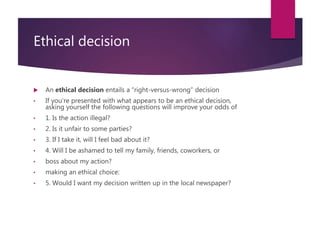
Ethical decision
 An ethical decision entails a “right-versus-wrong” decision
• If you’re presented with what appears to be an ethical decision,
asking yourself the following questions will improve your odds of
• 1. Is the action illegal?
• 2. Is it unfair to some parties?
• 3. If I take it, will I feel bad about it?
• 4. Will I be ashamed to tell my family, friends, coworkers, or
• boss about my action?
• making an ethical choice:
• 5. Would I want my decision written up in the local newspaper?
Ethical lapse
 When you make an unethical decision, its called ethical
lapse
IDENTIFYING ETHICAL ISSUES
 Bribes v/s gifts
 Conflict of interest
 Conflict of loyalty
 Whistle blowing
 Technology/Privacy
RATIONALIZATION
 Rationalizations are fabricated (hence, false) justifications
we make to ourselves and others when we want to do or
have done something we know we shouldn’t. We go to all
the trouble to make up these stories because we care
what others think of us and, more important, we want to
think well of ourselves.
Common justifications for
rationalization
 My behavior isn’t really illegal or immoral no
clear evidence that the action is wrong.
 My action is in everyone’s best interests.
 No one will find out what I’ve done.
 The company will condone my action and
protect me
 Everybody does it
 I’m only human
 It’s a stupid rule
Corporate social responsibility
 Corporate Social responsibility refers to the approach
that an organization takes in balancing its
toward different stakeholders when making legal,
economic, ethical, and social decisions.
 An organization’s obligations to maximize its long term
positive impacts and minimize its negative impacts on
society
Broad categorization of CSR
 Social responsibility towards employees
• Health and Safety
• Freedom from sexual harassment
• Equal Opportunity and Diversity
 Equal Pay and the Wage Gap: equal pay for both men and
women in jobs that entail equal skill, equal effort, equal
responsibility, or similar working conditions.
 Building Diverse Workforces the workforce according to sex,
race, or some other characteristic. In helping to build more
diverse workforces
 Wages and Benefits Businesses should pay appropriate
wages and benefits, treat all workers fairly, and provide
equal opportunities for all employees.
CSR towards customers
 The purpose of any business is to satisfy
customers, who reward businesses by buying
their products. Sellers are also responsible—
both ethically and legally—for treating
customers fairly.
 The right to safe products.
 The right to be informed about a product,
 The right to choose what to buy.
 The right to be heard.
CSR towards communities
Areas in which corporate social objectives may be found
 The environment – preventing damage
 Energy – increasing energy efficiency in
business operations
 Community involvement – involved in
community, education, health projects
Advantages of social involvement of
business
 Creation of a better social environment benefit both
society and business
 Power should be used responsibly
 Social involvement creates a favorable image
 Business has the resources to help solve social problems
 Business and society are interdependent
 Social involvement discourages additional government
intervention
Argument against social involvement
 The primary task of business is to maximize profit
 Social involvement results in higher prices
 Social involvement reduces economic efficiency
 Business people lack the social skills to deal with the
problems of society

Business ethics

  • 1.
    Business ethics  Definebusiness ethics  Why its important for business  What is an ethical business  Ethical challenges for business  Identifying ethical issues in business  Rationalization
  • 2.
    BUSINESS ETHICS  Howyou define business ethics: Business ethics are moral principles that guide the way a business behaves. The same principles that determine an individual’s actions also apply to business.  Its good for a company to act ethically: It’s in a company’s best interest to act ethically. Trustworthy companies are better able to attract and keep customers, talented employees, and capital.
  • 3.
    WHAT IS ANETHICAL BUSINESS  Ethical business must have following attributes: • Ethical leadership • Truthfulness  Obeying laws and regulations  Treating employees, customers, investors, and the public fairly  Compete fairly  Commitment to excellence  Priority must be given to your employer’s interest rather then your personal interest. E.g. sales agent  Clear understanding about right and wrong actions  Accountability  Core values and principles
  • 4.
    ETHICAL CHALLENGES FOR BUSINESS Businesspeopleface two types of ethical challenges: ethical dilemmas and ethical decisions  An ethical dilemma is a morally problematic situation in which you must choose between two or more alternatives that aren’t equally acceptable to different groups
  • 5.
    Ethical decision  Anethical decision entails a “right-versus-wrong” decision • If you’re presented with what appears to be an ethical decision, asking yourself the following questions will improve your odds of • 1. Is the action illegal? • 2. Is it unfair to some parties? • 3. If I take it, will I feel bad about it? • 4. Will I be ashamed to tell my family, friends, coworkers, or • boss about my action? • making an ethical choice: • 5. Would I want my decision written up in the local newspaper?
  • 6.
    Ethical lapse  Whenyou make an unethical decision, its called ethical lapse
  • 7.
    IDENTIFYING ETHICAL ISSUES Bribes v/s gifts  Conflict of interest  Conflict of loyalty  Whistle blowing  Technology/Privacy
  • 8.
    RATIONALIZATION  Rationalizations arefabricated (hence, false) justifications we make to ourselves and others when we want to do or have done something we know we shouldn’t. We go to all the trouble to make up these stories because we care what others think of us and, more important, we want to think well of ourselves.
  • 9.
    Common justifications for rationalization My behavior isn’t really illegal or immoral no clear evidence that the action is wrong.  My action is in everyone’s best interests.  No one will find out what I’ve done.  The company will condone my action and protect me  Everybody does it  I’m only human  It’s a stupid rule
  • 10.
    Corporate social responsibility Corporate Social responsibility refers to the approach that an organization takes in balancing its toward different stakeholders when making legal, economic, ethical, and social decisions.  An organization’s obligations to maximize its long term positive impacts and minimize its negative impacts on society
  • 11.
    Broad categorization ofCSR  Social responsibility towards employees • Health and Safety • Freedom from sexual harassment • Equal Opportunity and Diversity  Equal Pay and the Wage Gap: equal pay for both men and women in jobs that entail equal skill, equal effort, equal responsibility, or similar working conditions.  Building Diverse Workforces the workforce according to sex, race, or some other characteristic. In helping to build more diverse workforces  Wages and Benefits Businesses should pay appropriate wages and benefits, treat all workers fairly, and provide equal opportunities for all employees.
  • 12.
    CSR towards customers The purpose of any business is to satisfy customers, who reward businesses by buying their products. Sellers are also responsible— both ethically and legally—for treating customers fairly.  The right to safe products.  The right to be informed about a product,  The right to choose what to buy.  The right to be heard.
  • 13.
    CSR towards communities Areasin which corporate social objectives may be found  The environment – preventing damage  Energy – increasing energy efficiency in business operations  Community involvement – involved in community, education, health projects
  • 14.
    Advantages of socialinvolvement of business  Creation of a better social environment benefit both society and business  Power should be used responsibly  Social involvement creates a favorable image  Business has the resources to help solve social problems  Business and society are interdependent  Social involvement discourages additional government intervention
  • 15.
    Argument against socialinvolvement  The primary task of business is to maximize profit  Social involvement results in higher prices  Social involvement reduces economic efficiency  Business people lack the social skills to deal with the problems of society