K to 12 BASIC EDUCATION CURRICULUM
Course Title: Business Ethics and Social Responsibility
(BESR)
Grade: 12 (SY 2023-2024)
The Role of Business in Social and Economic Development
1.1 differentiate the forms of business organization.
1.2 Give examples of the forms of business organizations.
1.3 Show how these organizations contribute to socioeconomic development.
1.4 Give examples of how fairness, accountability and transparency is practiced in business and non-profit
organization.
1.5 Share observations on business policies and practices
1.6 Distinguish between good policies/practices and morally unacceptable policies/practices
1. differentiate the forms of business organization.
2. Give examples of the forms of business organizations.
The different types of business organization are sole proprietorships, partnerships, and corporations. Sole
proprietorships are owned by one person while partnerships are started when two parties pull resources.
Corporations are large companies owned by shareholders.
What are the different forms of business organization?
Various forms of business organizations from which one can choose the right one include: (a) Sole proprietorship,
(b) Joint Hindu family business, (c) Partnership, (d) Cooperative societies, and (e) Joint stock company.
How do you differentiate the three forms of businesses?
Here's a rundown of what you need to know about each one.
Sole Proprietorship. In a sole proprietorship, you're the sole owner of the business. ...
Partnership. A partnership is a non-incorporated business created between two or more people. ...
Corporation. A corporation is a legal entity separate from its shareholders.
The five forms of business organizations include the following:
Partnership.
Corporation.
Sole proprietorship.
Cooperative.
Limited liability company.
What is the definition of a form of business organization?
Business Organization is an entity that is formed for the purpose of carrying on the commercial enterprise of
selling and buying. These organizations are based on the systems of law that governs contract and this exchange,
property rights, and incorporation.
Why is it important to know the forms of business organization?
The form of business determines which income tax return form to file and the company's and owners legal
liabilities. This is a big decision that has long-term implications, so if you're unsure of which form of business is best
for your company, you'll want to consult a professional.
What is the purpose of different business organization?
A business organization is a collection of persons working to achieve a common objective through structured and
coordinated activities. The purpose of a business organization is to carry on a business. business. A business
organization exists when two or more people act together to carry on a business.
What are the different types of organization and meaning?
Organizational Structure for Companies With Examples and Benefits
A centralized structure has a defined chain of command, while decentralized structures give almost every employee
receiving a high level of personal agency. Types of organizational structures include functional, divisional, flat
Archy, and matrix structures.
1.3 Show how these organizations contribute to socioeconomic development.
How these organizations contribute to socio-economic development?
Business organizations provide jobs, career advancement, information, and training for employees. They
do this in areas of low, middle, and high income. This contributes to socioeconomic development by
giving community members the opportunity to learn new skills, gain income, and improve their standard
of living.
What contributes to socio-economic development?
Efforts are directed towards risk-informed and sustainable urban and rural planning; income and
employment generation for vulnerable groups, including in agriculture; infrastructure rehabilitation and
development, including housing solutions; and the realization of the country's human capital potential.
What are socio-economic development contributions?
Socio-Economic Development (SED) contributions are any monetary or non-monetary contribution
implemented for individuals (natural individual or group of natural individuals) or communities, where at
least 75% of the beneficiaries are classified as black people in terms of race.
How does a business contribute to economic development?
Attracting and growing businesses strengthens our economy providing locally produced goods and
services. Strong businesses pay taxes that go for vital services such as schools, roads, fire, and police.
Businesses also provide good jobs that put money in people's pockets and allow for a higher quality of
life.
Why are organizations important for social and economic life?
Organizations are important components of social and physical environments, and they exert
considerable influence over the choices people make, the resources they must aid them in those choices,
and the factors in the workplace that could influence health status (e.g., work overload, exposure to toxic
chemicals)
What are its contributions to social and economic development of globalization?
Globalization has paved the way for new markets, enhanced trade, and investment, and fostered cross-
border technology and knowledge transfers. These developments have contributed to greater economic
growth, improved productivity, and job creation in numerous areas worldwide.
What is the importance of business organizations for the economy?
Business organizations play a vital role in the world economy and have significant importance for several
reasons: Economic growth and development: Business organizations are key drivers of economic growth.
They create jobs, generate income, and contribute to overall economic development.
How can a business contribute to the development of a community?
Clearly, one of the most important ways small businesses benefit the community is by creating job growth
and providing locals with job opportunities – an overall positive in terms of a healthy economy and a
happy community.
How can an organization improve their support to the community?
Leads and referrals can be generated, and resources can be made available. Your business, the
community, local vendors, and their cause all benefit. Volunteering, giveaways, and working with local
vendors are three great ways to increase your community-service efforts.
How important is social organization in human development?
Social organizations are essential for human beings as they provide security, support, and a sense of
purpose, allowing individuals to thrive and work together towards success.
What role of business is the most beneficial in the economy and society?
Economic Growth: Business plays a fundamental role in driving economic growth by creating jobs,
generating income, and fostering innovation. It contributes to the overall prosperity of a nation by
providing goods and services that meet the needs and desires of consumers.
What contributes to social and economic development of a nation in relation to
entrepreneurship?
Role of Entrepreneurship in Economic Development: Top 9 Points
Importance of Entrepreneurship
Drives economic growth and creates new job. Encourages innovation by bringing new ideas,
products, and services to the market. Contributes to social change by developing products or
services that reduce people's dependence on outdated technologies.
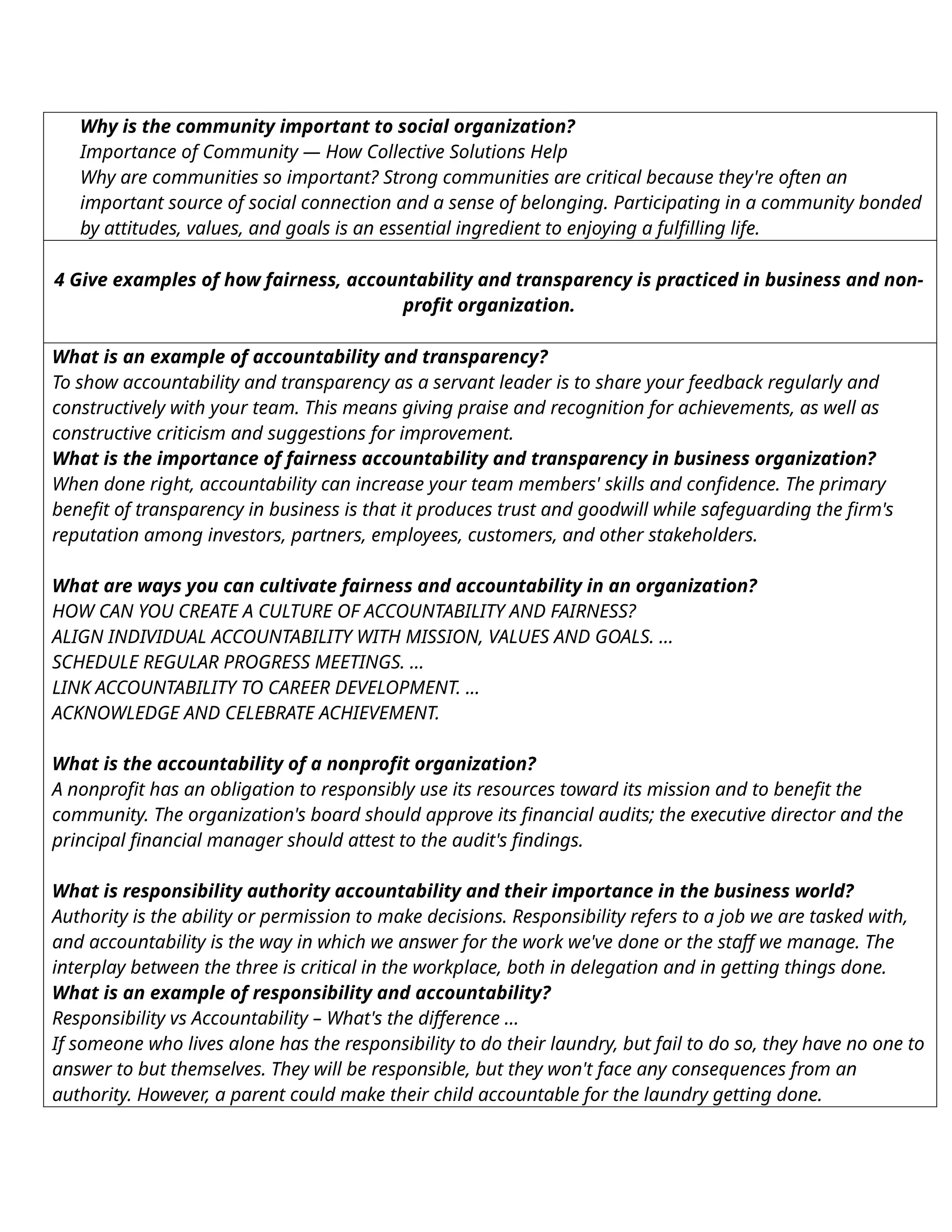
Why is the community important to social organization?
Importance of Community — How Collective Solutions Help
Why are communities so important? Strong communities are critical because they're often an
important source of social connection and a sense of belonging. Participating in a community bonded
by attitudes, values, and goals is an essential ingredient to enjoying a fulfilling life.
4 Give examples of how fairness, accountability and transparency is practiced in business and non-
profit organization.
What is an example of accountability and transparency?
To show accountability and transparency as a servant leader is to share your feedback regularly and
constructively with your team. This means giving praise and recognition for achievements, as well as
constructive criticism and suggestions for improvement.
What is the importance of fairness accountability and transparency in business organization?
When done right, accountability can increase your team members' skills and confidence. The primary
benefit of transparency in business is that it produces trust and goodwill while safeguarding the firm's
reputation among investors, partners, employees, customers, and other stakeholders.
What are ways you can cultivate fairness and accountability in an organization?
HOW CAN YOU CREATE A CULTURE OF ACCOUNTABILITY AND FAIRNESS?
ALIGN INDIVIDUAL ACCOUNTABILITY WITH MISSION, VALUES AND GOALS. ...
SCHEDULE REGULAR PROGRESS MEETINGS. ...
LINK ACCOUNTABILITY TO CAREER DEVELOPMENT. ...
ACKNOWLEDGE AND CELEBRATE ACHIEVEMENT.
What is the accountability of a nonprofit organization?
A nonprofit has an obligation to responsibly use its resources toward its mission and to benefit the
community. The organization's board should approve its financial audits; the executive director and the
principal financial manager should attest to the audit's findings.
What is responsibility authority accountability and their importance in the business world?
Authority is the ability or permission to make decisions. Responsibility refers to a job we are tasked with,
and accountability is the way in which we answer for the work we've done or the staff we manage. The
interplay between the three is critical in the workplace, both in delegation and in getting things done.
What is an example of responsibility and accountability?
Responsibility vs Accountability – What's the difference ...
If someone who lives alone has the responsibility to do their laundry, but fail to do so, they have no one to
answer to but themselves. They will be responsible, but they won't face any consequences from an
authority. However, a parent could make their child accountable for the laundry getting done.
. Which of the following is an example of accountability?
A great example of accountability is when you are focused on achieving your goals and tasks. If you're
able to limit distractions and pressures, you're successful in achieving your goals efficiently. Moreover,
when your team sees this, you're setting a good example for them. You build a strong work ethic for your
team.
Which of these are the best examples of accountability at work?
Here are some common examples of accountability:
Creating solutions to problems. ...
Showing focus. ...
Admitting your errors. ...
Speaking about issues. ...
Going to work. ...
Discuss your career goals with your supervisor. ...
Work independently. ...
Get involved in extracurricular activities.
What is accountability and examples?
7 Accountability in the Workplace Examples to Inspire You ...
When thinking of accountability at work, examples include completing tasks on time, meeting
performance expectations, and teams working together productively and efficiently. Individual
accountability can create a positive work environment where employees feel that everyone is doing their
part to achieve shared goals
1.5 Share observations on business policies and practices
What do you understand by business policy?
A business policy is a formal statement that outlines the rules, regulations, and processes that guide the
behavior and decision-making of employees within an organization. It establishes a framework for
consistency, ensuring that everyone is on the same page when it comes to key aspects of the business.
What is an example of a business policy and procedures?
Company Policies and Procedures: Essential Guide | Factorial
Examples of company policies include employee conduct policies, dress code, attendance policies, equal
opportunity policies, and other areas related to the terms and conditions of employment. Procedures: the
processes by which employees should deal with potential breaches of company policies.
How do you interpret business policies to customers clients?
Make sure your policies are easy to find, read, and understand, and use simple and friendly language.
You can also highlight the benefits of your policies for your customers, such as how they protect their
rights, provide value, or ensure quality.
What are the policies in business?
Company Policies: 17 to Consider for Your Business
What are company policies?
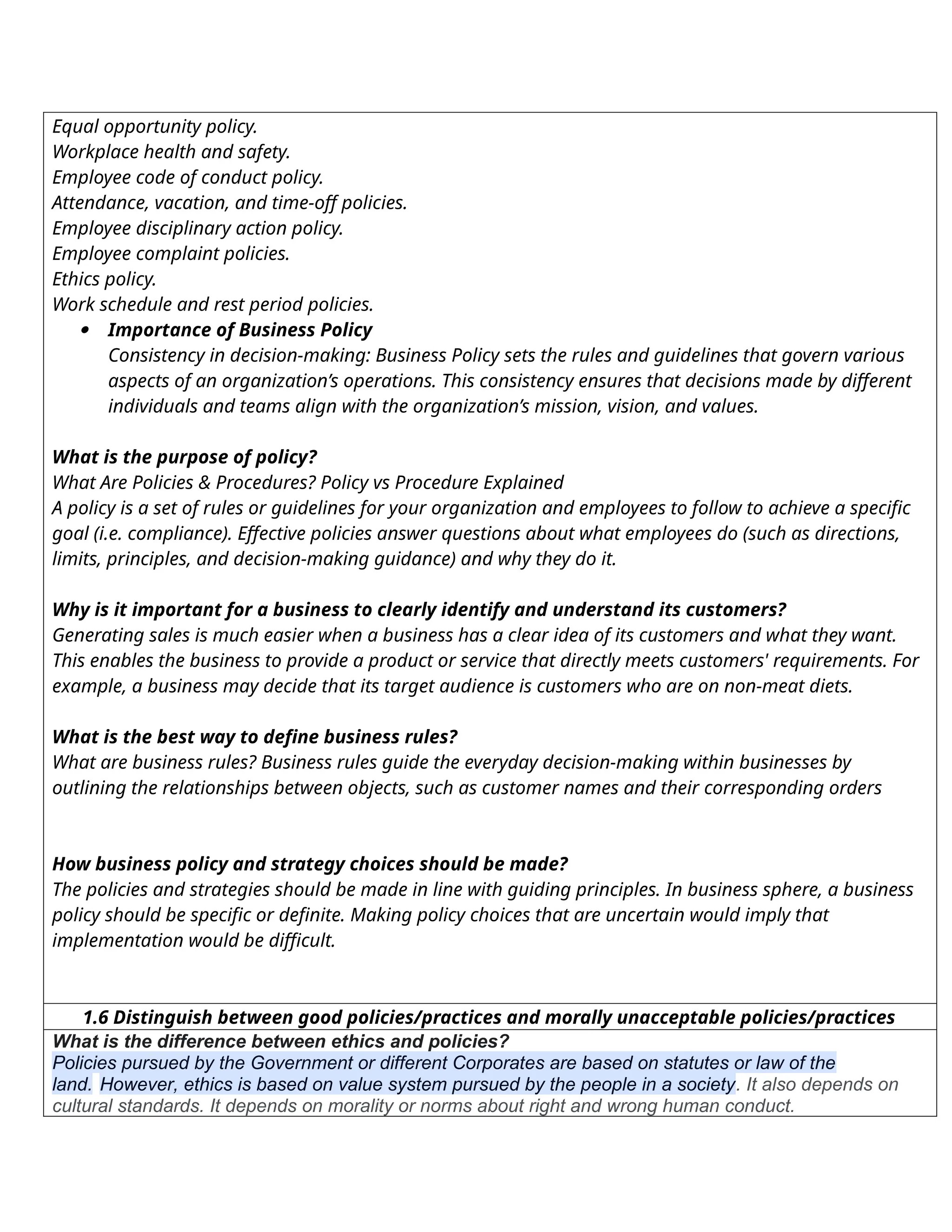
Equal opportunity policy.
Workplace health and safety.
Employee code of conduct policy.
Attendance, vacation, and time-off policies.
Employee disciplinary action policy.
Employee complaint policies.
Ethics policy.
Work schedule and rest period policies.
 Importance of Business Policy
Consistency in decision-making: Business Policy sets the rules and guidelines that govern various
aspects of an organization’s operations. This consistency ensures that decisions made by different
individuals and teams align with the organization’s mission, vision, and values.
What is the purpose of policy?
What Are Policies & Procedures? Policy vs Procedure Explained
A policy is a set of rules or guidelines for your organization and employees to follow to achieve a specific
goal (i.e. compliance). Effective policies answer questions about what employees do (such as directions,
limits, principles, and decision-making guidance) and why they do it.
Why is it important for a business to clearly identify and understand its customers?
Generating sales is much easier when a business has a clear idea of its customers and what they want.
This enables the business to provide a product or service that directly meets customers' requirements. For
example, a business may decide that its target audience is customers who are on non-meat diets.
What is the best way to define business rules?
What are business rules? Business rules guide the everyday decision-making within businesses by
outlining the relationships between objects, such as customer names and their corresponding orders
How business policy and strategy choices should be made?
The policies and strategies should be made in line with guiding principles. In business sphere, a business
policy should be specific or definite. Making policy choices that are uncertain would imply that
implementation would be difficult.
1.6 Distinguish between good policies/practices and morally unacceptable policies/practices
What is the difference between ethics and policies?
Policies pursued by the Government or different Corporates are based on statutes or law of the
land. However, ethics is based on value system pursued by the people in a society. It also depends on
cultural standards. It depends on morality or norms about right and wrong human conduct.
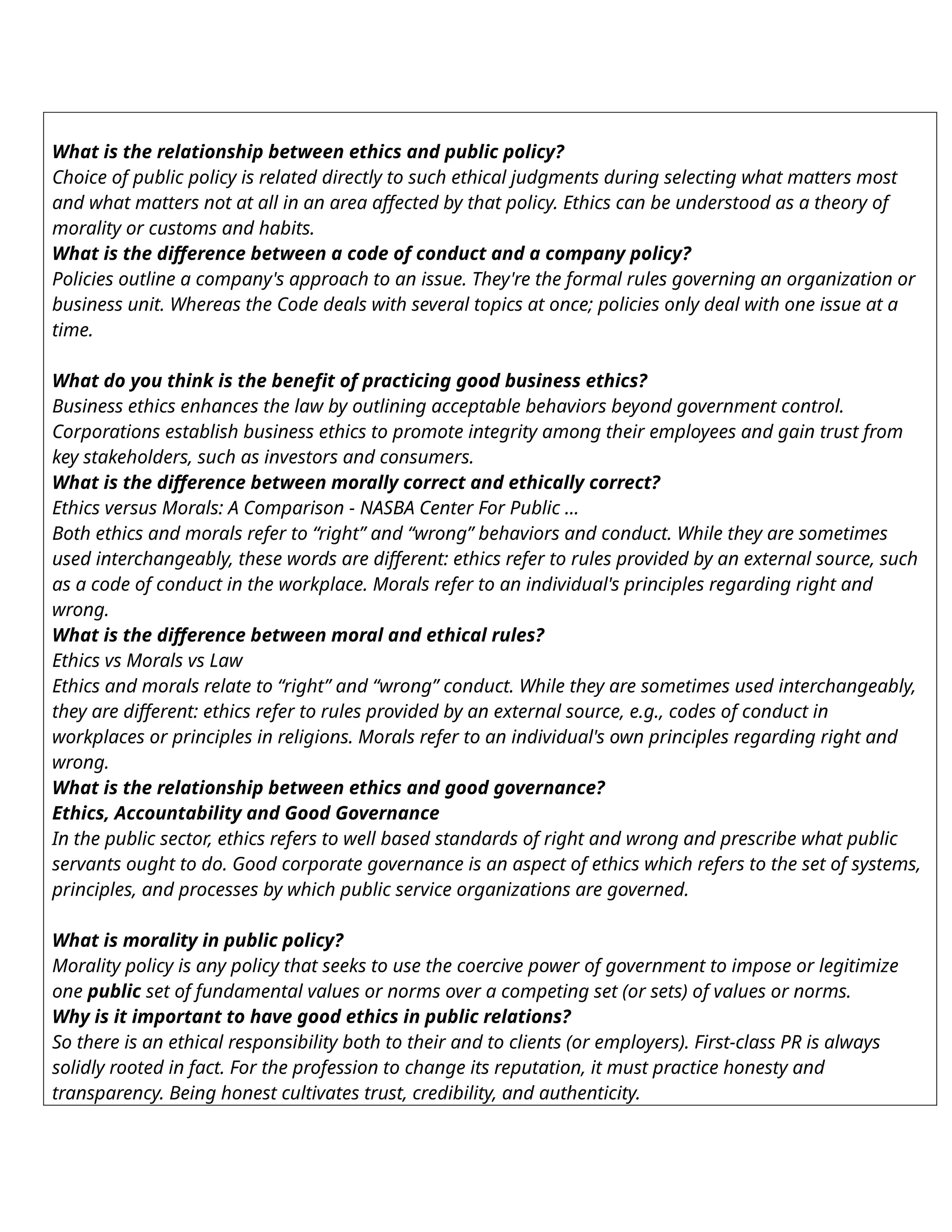
What is the relationship between ethics and public policy?
Choice of public policy is related directly to such ethical judgments during selecting what matters most
and what matters not at all in an area affected by that policy. Ethics can be understood as a theory of
morality or customs and habits.
What is the difference between a code of conduct and a company policy?
Policies outline a company's approach to an issue. They're the formal rules governing an organization or
business unit. Whereas the Code deals with several topics at once; policies only deal with one issue at a
time.
What do you think is the benefit of practicing good business ethics?
Business ethics enhances the law by outlining acceptable behaviors beyond government control.
Corporations establish business ethics to promote integrity among their employees and gain trust from
key stakeholders, such as investors and consumers.
What is the difference between morally correct and ethically correct?
Ethics versus Morals: A Comparison - NASBA Center For Public ...
Both ethics and morals refer to “right” and “wrong” behaviors and conduct. While they are sometimes
used interchangeably, these words are different: ethics refer to rules provided by an external source, such
as a code of conduct in the workplace. Morals refer to an individual's principles regarding right and
wrong.
What is the difference between moral and ethical rules?
Ethics vs Morals vs Law
Ethics and morals relate to “right” and “wrong” conduct. While they are sometimes used interchangeably,
they are different: ethics refer to rules provided by an external source, e.g., codes of conduct in
workplaces or principles in religions. Morals refer to an individual's own principles regarding right and
wrong.
What is the relationship between ethics and good governance?
Ethics, Accountability and Good Governance
In the public sector, ethics refers to well based standards of right and wrong and prescribe what public
servants ought to do. Good corporate governance is an aspect of ethics which refers to the set of systems,
principles, and processes by which public service organizations are governed.
What is morality in public policy?
Morality policy is any policy that seeks to use the coercive power of government to impose or legitimize
one public set of fundamental values or norms over a competing set (or sets) of values or norms.
Why is it important to have good ethics in public relations?
So there is an ethical responsibility both to their and to clients (or employers). First-class PR is always
solidly rooted in fact. For the profession to change its reputation, it must practice honesty and
transparency. Being honest cultivates trust, credibility, and authenticity.
What is the connection between good ethics and good business?
When you have a reputation for consistently being ethical in how you source and build products, and
treat employees, customers and the community, more people will want to do business with you. Even
social media ethics is important for your reputation.
Does good ethics mean business success?
Business ethics play a vital role in a company's long-term success. Good ethics can earn a company a
positive reputation and encourage brand loyalty. Consumers and stakeholders increasingly expect
corporations to have strong values.
Foundations of the Principles of Business Ethics
2.1compare and contrast classical philosophies as they relate to the business setting.
2.2 give examples of how belief systems affect business practices.
2.3 analyze simple business situations as they are affected by the Filipino value system and
recommend ways of confronting ethical challenges in the business setting.
2.4 distinguish what is GOOD vs. what is morally unacceptable among the given Filipino values.
3.1 suggest ways to enhance employer-employee relationship and encourage just and fair
business policies and practices such as recruitment, promotion, retention, marketing and
advertising, intellectual property rights, sources and uses of funds, and the like.
3.2 advocate honest policies and practices in all aspects of business operations
3.3 observes and promote policies and practices in environmental management.
3.4 cite examples of companies that practice social responsibility in the conduct of their business.
Foundations of the Principles of Business Ethics
2.1compare and contrast classical philosophies as they relate to the business setting.
What are the foundations of the principles of business ethics?
What Are the 12 Ethical Principles? Business ethics is an evolving topic. Generally, there are about 12 ethical
principles: honesty, fairness, leadership, integrity, compassion, respect, responsibility, loyalty, law-abiding,
transparency, and environmental concerns.
What classical philosophies specifically virtue ethics?
Virtue ethics is a philosophy developed by Aristotle and other ancient Greeks. It is the quest to understand and live
a life of moral character. This character-based approach to morality assumes that we acquire virtue through
practice.
.
The 12 ethical principles for business executives
COMPASSION. ...
RESPECT. ...
RESPONSIBILITY. ...
LOYALTY. ...
LAW-ABIDING. ...
ACCOUNTABILITY. ...
TRANSPARENCY. ...
ENVIRONMENTAL CONSCIOUSNESS. Organizations and personnel demonstrate a commitment to the
environment by helping mitigate the effects of global climate change.
What is the difference between classic and philosophy?
Studying a Classical subject requires research, assessment, reasoning, organization, and self-management often
on your own or as part of a team. In Philosophy you learn to develop and express reasoned arguments, to use
logical processing and critical analysis to defend your position and debate opposing opinions.
What is the importance of classical philosophies?
Classical philosophy studies the fundamental problems concerning human existence through the eyes of our
intellectual ancestors. Many thinkers from Classical times were pioneers of our modern philosophical and scientific
ideas.
What is the most valuable lesson that can be learned by businesspeople from these Greek philosophers?
Overall, the philosophy of Stoicism offers valuable insights into how businesses can turn obstacles into
opportunities. By focusing on what we can control, being adaptable, and cultivating resilience and perseverance,
we can not only survive, but thrive in the ever-changing world of business.
Why philosophy is important in understanding the self?
Philosophy plays a crucial role in understanding the concept of self as it delves into the fundamental questions of
human existence, consciousness, and identity.
2.2 give examples of how belief systems affect business practices.
Belief systems supply core values and provide a direction for organizational operations. Simons (1995, p.
170) defined belief systems as “formal systems used by top managers to define, communicate, and
reinforce the basic values, purpose, and direction for the organization.
What are the examples of belief system affect business practices?
A few common religious practices that may affect the business practices include - prayer breaks for the Muslim
employees, requests for custom holidays, blessing and performing poojas at office locations, effect of the religious
beliefs on their social behaviors, believing in superstitions and myths, eating habits.
How does religion and beliefs affect business?
One of the most apparent ways entrepreneurs may be affected by religion is through values and beliefs. Many
religions have specific teachings and values that emphasize the importance of honesty, integrity, and social
responsibility. These values can shape the way entrepreneurs conduct their business and make decisions.
Belief in the Business
Pretty much everything in an organization is going to be better when the people working in it believe in
what the business is doing. When they believe, they work harder, they give more, and they put a level of
energy and passion into play that's essential to creating anything great.
How does belief system affect?
Our belief systems impact not only how we think and feel but also how we behave and how we operate in our lives.
When we are holding onto self-deprecating belief systems, we impede our self-confidence and our faith in
ourselves.
What is the belief system of Buddhism in influencing business practices?
What business can learn from Buddhism - Institute of Hospitality
The Noble Eightfold Path, which encapsulates the core Buddhist precepts, talks about cultivating positive emotions
such as generosity, gratitude, loving kindness, and devotion and making a living in an ethical and productive way.
How do belief systems affect society?
Religion and belief - Manual for Human Rights Education with ...
As mental structures, they influence the way we perceive the world around us and the values we accept or reject.
As social structures, they provide a supporting network and a sense of belonging. In many cases, religions have
become the basis of power structures and have become intertwined with it.
You can't claim to believe something but do something else in your business. If you have a belief system, you need
to incorporate that in your business. It's not sustainable to go against your beliefs while you're working and try to
follow them when you aren't. You can't separate your life into pieces.
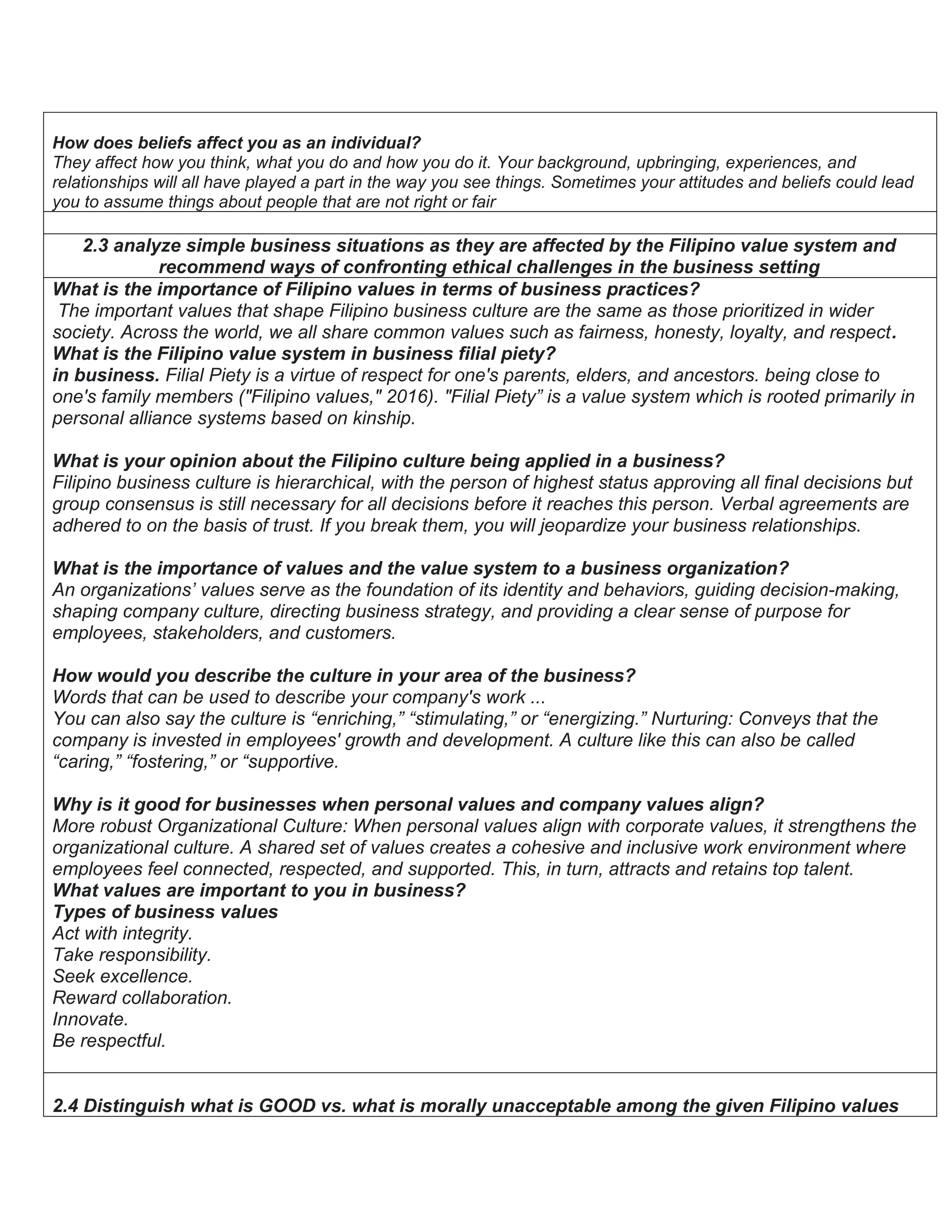
How does beliefs affect you as an individual?
They affect how you think, what you do and how you do it. Your background, upbringing, experiences, and
relationships will all have played a part in the way you see things. Sometimes your attitudes and beliefs could lead
you to assume things about people that are not right or fair
2.3 analyze simple business situations as they are affected by the Filipino value system and
recommend ways of confronting ethical challenges in the business setting
What is the importance of Filipino values in terms of business practices?
The important values that shape Filipino business culture are the same as those prioritized in wider
society. Across the world, we all share common values such as fairness, honesty, loyalty, and respect.
What is the Filipino value system in business filial piety?
in business. Filial Piety is a virtue of respect for one's parents, elders, and ancestors. being close to
one's family members ("Filipino values," 2016). "Filial Piety” is a value system which is rooted primarily in
personal alliance systems based on kinship.
What is your opinion about the Filipino culture being applied in a business?
Filipino business culture is hierarchical, with the person of highest status approving all final decisions but
group consensus is still necessary for all decisions before it reaches this person. Verbal agreements are
adhered to on the basis of trust. If you break them, you will jeopardize your business relationships.
What is the importance of values and the value system to a business organization?
An organizations’ values serve as the foundation of its identity and behaviors, guiding decision-making,
shaping company culture, directing business strategy, and providing a clear sense of purpose for
employees, stakeholders, and customers.
How would you describe the culture in your area of the business?
Words that can be used to describe your company's work ...
You can also say the culture is “enriching,” “stimulating,” or “energizing.” Nurturing: Conveys that the
company is invested in employees' growth and development. A culture like this can also be called
“caring,” “fostering,” or “supportive.
Why is it good for businesses when personal values and company values align?
More robust Organizational Culture: When personal values align with corporate values, it strengthens the
organizational culture. A shared set of values creates a cohesive and inclusive work environment where
employees feel connected, respected, and supported. This, in turn, attracts and retains top talent.
What values are important to you in business?
Types of business values
Act with integrity.
Take responsibility.
Seek excellence.
Reward collaboration.
Innovate.
Be respectful.
2.4 Distinguish what is GOOD vs. what is morally unacceptable among the given Filipino values
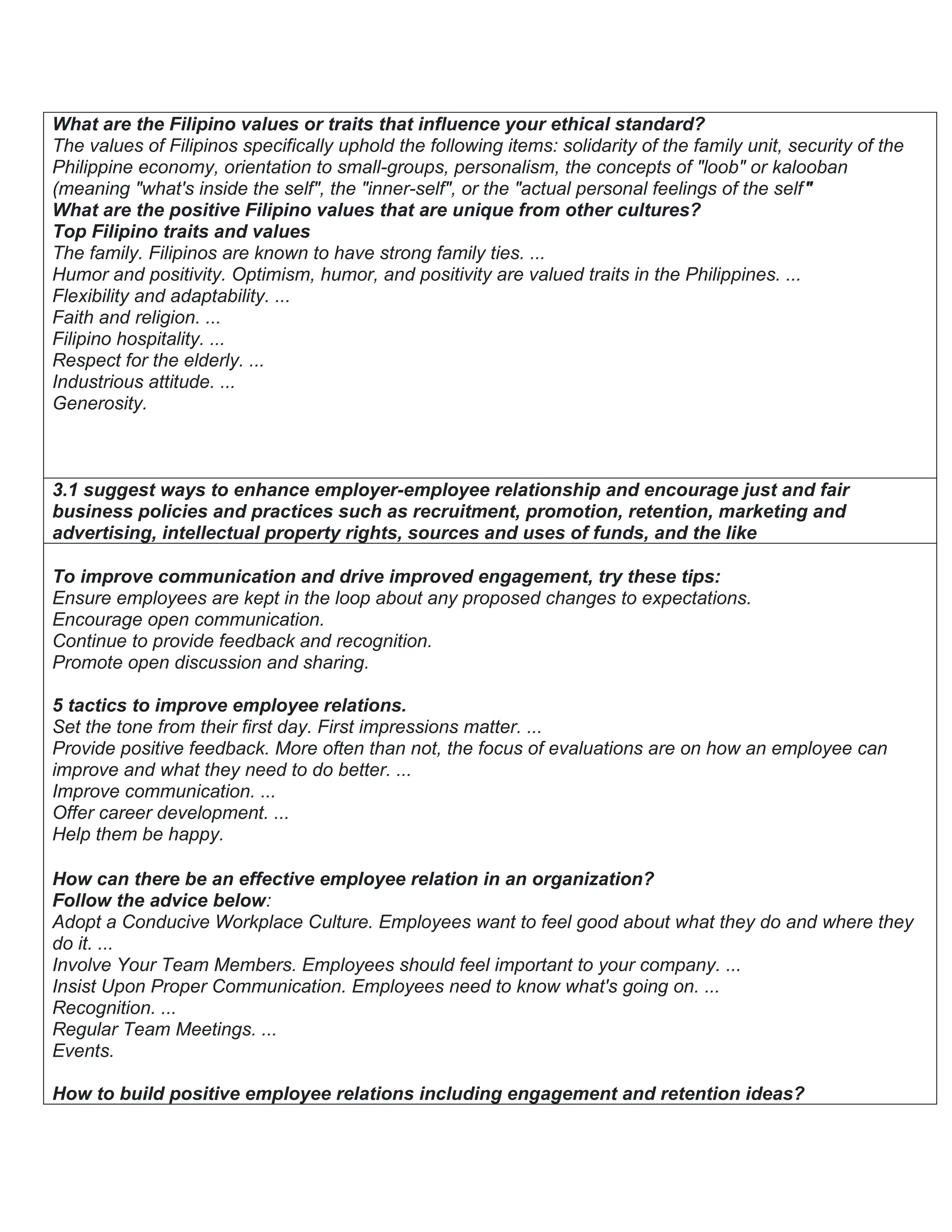
What are the Filipino values or traits that influence your ethical standard?
The values of Filipinos specifically uphold the following items: solidarity of the family unit, security of the
Philippine economy, orientation to small-groups, personalism, the concepts of "loob" or kalooban
(meaning "what's inside the self", the "inner-self", or the "actual personal feelings of the self"
What are the positive Filipino values that are unique from other cultures?
Top Filipino traits and values
The family. Filipinos are known to have strong family ties. ...
Humor and positivity. Optimism, humor, and positivity are valued traits in the Philippines. ...
Flexibility and adaptability. ...
Faith and religion. ...
Filipino hospitality. ...
Respect for the elderly. ...
Industrious attitude. ...
Generosity.
3.1 suggest ways to enhance employer-employee relationship and encourage just and fair
business policies and practices such as recruitment, promotion, retention, marketing and
advertising, intellectual property rights, sources and uses of funds, and the like
To improve communication and drive improved engagement, try these tips:
Ensure employees are kept in the loop about any proposed changes to expectations.
Encourage open communication.
Continue to provide feedback and recognition.
Promote open discussion and sharing.
5 tactics to improve employee relations.
Set the tone from their first day. First impressions matter. ...
Provide positive feedback. More often than not, the focus of evaluations are on how an employee can
improve and what they need to do better. ...
Improve communication. ...
Offer career development. ...
Help them be happy.
How can there be an effective employee relation in an organization?
Follow the advice below:
Adopt a Conducive Workplace Culture. Employees want to feel good about what they do and where they
do it. ...
Involve Your Team Members. Employees should feel important to your company. ...
Insist Upon Proper Communication. Employees need to know what's going on. ...
Recognition. ...
Regular Team Meetings. ...
Events.
How to build positive employee relations including engagement and retention ideas?
9 winning employee relations strategies
Create an employee relations policy. ...
Talk about your company goals and values. ...
Introduce rewards and recognition. ...
Practice open communication. ...
Revisit your onboarding process. ...
Host team-building events. ...
Encourage regular 1:1 meeting. ...
Promote a healthy work-life balance.
How important is effective employee relations?
Maintaining positive employee relations can improve overall individual and organizational engagement
and performance while creating a healthier, more enjoyable day-to-day work environment. In fact, having
positive relationships with fellow employees can increase employee satisfaction by 50%.
How does employee relations affect employee productivity?
It involves maintaining a work environment that satisfies the needs of individual employees and
management. An effective employee relation involves creating and cultivating a motivated and productive
workforce. Happy employees are the Potentials employees and happy employees are always productive
employees.
3.2 Advocate honest policies and practices in all aspects of business operations
What does honesty is the best policy mean in business ethics?
Being honest with your customers, your employees, and your partners is the only way to create a
successful and sustainable business. Honesty creates transparency and builds trust. It's the foundation of
a good reputation. And it's what customers expect from businesses they patronize
What is the importance of business ethics to the ABM students like you?
The Importance of Business Ethics | Maryville Online
Business ethics inform a company's values and goals, as well as how it runs its day-to-day operations. An
ethical company runs on principles such as honesty, integrity, fairness, trustworthiness, accountability,
and respect for others.
What do you understand by business ethics discuss the importance of business ethics and the
ethical issues involved in business?
By definition, business ethics refers to the standards for morally right and wrong conduct in business. Law
partially defines the conduct, but “legal” and “ethical” aren't necessarily the same. Business ethics
enhances the law by outlining acceptable behaviors beyond government control.
Why is ethical behavior the best way to build a successful company?
Displaying good ethical behavior can boost company morale and client relations. It's easier for a business
to retain employees when they work for a company that they believe in. Employees want to work for
companies that treat everyone and their clients fairly and have good and ethical business practices
Observes and promote policies and practices in environmental management.
What are the policies and practices of environmental management?
Environmental policies must include a pledge to continually measure and improve environmental
performance, and many include a promise to seek ways to reduce energy, limit fuel consumption, lessen
emissions, prevent pollution, reduce greenhouse gases, and reduce potable water consumption, or an
infinite number of other.
What are the environment management practices?
Environmental management practices (EMP) refers to a set of skills and strategies adopted by firms with
the aim of monitoring and managing the effect of their operations on the natural environment.
How will you promote environmental awareness?
Environmental Awareness
Avoid buying disposable goods such as paper towels, plastic bottles, and plastic bags. Start a composting
and recycling program in communities where there are none. This will help cut down our waste
production. Support local businesses and farmers, and buy organic and pesticide-free food when you can.
What are the aims of the environmental policy?
The policy aims to protect ecosystems and natural resources through conservation, sustainable use and
good governance. It wants to integrate environmental concerns into all development policies and plans
Ten simple choices for a healthier planet.
Reduce, reuse, and recycle. Cut down on what you throw away. ...
Volunteer. Volunteer for cleanups in your community. ...
Educate. ...
Conserve water. ...
Choose sustainable. ...
Shop wisely. ...
Use long-lasting light bulbs. ...
Plant a tree.
3.4 cite examples of companies that practice social responsibility in the conduct of their business.
5 Corporate Social Responsibility Examples
Lego's Commitment to Sustainability. ...
Salesforce's 1-1-1 Philanthropic Model. ...
Ben & Jerry's Social Mission. ...
Levi Strauss's Social Impact. ...
Starbucks's Commitment to Ethical Sourcing.
What is an example of social responsibility of business and business ethics?
It is a firm's recognition of social obligations even though not covered by law, along with the obligations
laid down by law. In other words, social responsibility involves an element of voluntary action on the part
of business people for the benefit of society.
Which is an example of social responsibility in the business world quizlet?
Social responsibility means that an organization tries to be responsible to society, even if that may mean
reducing profits. Examples are fair employment practices, helping with urban renewal and development,
working with educational institutions, and limiting pollution.
What is a company that has socially responsible human resources management?
A company that has socially responsible human resources management is one that prioritizes the well-
being and fair treatment of its employees while also considering the impact of its actions on society as a
whole.
Social Responsibility of Entrepreneurs
3.1Suggest ways to enhance employer-employee relationship and encourage just and fair
business policies and practices such as recruitment, promotion, retention, marketing and
advertising, intellectual property rights, sources and uses of funds, and the like
3.2 Advocate honest policies and practices in all aspects of business operations
3.3 Observes and promote policies and practices in environmental management
3.4 Cite examples of companies that practice social responsibility in the conduct of their business
3.5 provide evidence that ethical/social responsibility is profitable, i.e., makes good business
sense
Social Responsibility of Entrepreneurs
3.1Suggest ways to enhance employer-employee relationship and encourage just and fair
business policies and practices such as recruitment, promotion, retention, marketing and
advertising, intellectual property rights, sources and uses of funds, and the like
9 Tips To Build a Healthy Work Relationship With Employees
Bond Of Trust.
Merge The Gap With Communication.
Appreciate Your Employees.
Be Friendly To Your Employees.
Respect Your Employees.
Implement Autonomy.
Show Value, Be Empathetic.
One To One Interactions
5 tactics to improve employee relations
Set the tone from their first day. First impressions matter. ...
Provide positive feedback. More often than not, the focus of evaluations are on how an employee can improve and
what they need to do better. ...
Improve communication. ...
Offer career development. ...
Help them be happy.
Why is it important to maintain employee and employer relationships?
Stronger the employee relations, better it is for the organization. This is said because when relations
between employer and employee are great, employees tend to be more satisfied and thus end up being
more productive at work.
How an organization can foster positive employee relations to enhance employee satisfaction and
productivity?
Engage with your employees to keep them happy and productive. Consider their motivations, job
satisfaction, and expectations. Implement a transparent employee relations policy and share it with all
employees. Make sure it includes clear procedures for reporting potential issues.
What is the role of employee relations management in improving employee performance?
More specifically, ERM allows HR professionals to more accurately identify employee's motivations,
needs and preferences as well as better align employment practices to real needs, which minimizes staff
turnover and at the same time maximizes staff retention by the definition of more appropriate recruitment
profiles.
How can a company motivate its employees to be more effective and satisfied?
So if you want to keep your good people and keep them motivated, it's worth starting an incentive program. Maybe
it's a quarterly bonus. Maybe it's a commission structure that's better than the competition. Maybe it's offering to
foot the bill for additional credentials.
What is the relationship between employee relations and organizational performance?
Employee relationships are known to play significant roles in fostering organizational performance.
According to Deming (2007) good relationships with employees can be created through motivating them
and having good working conditions and effective communication systems.
How to Motivate Employees: 9 Helpful Tips
Focus on developing a positive work culture.
Encourage creativity and innovation.
Foster recognition and appreciation within the company.
Offer flexible scheduling.
Promote teamwork and collaboration.
Set clear and measurable goals.
Give your employees a sense of purpose.
How motivation can help improve workplace efficiency and productivity?
Motivated employees are loyal to their organization and find value and social status in their work. Thus,
they are driven to discover their best selves for the organization. Whenever employees are giving their
best in the workplace, the whole workflow becomes more efficient.
How are employees motivated to improve their performance?
Recognise and reward great work. Employees need to know that their managers appreciate their hard
work. Giving well-deserved recognition not only increases self-esteem but also enthusiasm and team
morale. A recognition platform is an effective tool to celebrate star performers who embody your company
values.
3.2 Advocate honest policies and practices in all aspects of business
What does honesty is the best policy mean in business ethics?
Being honest with your customers, your employees, and your partners is the only way to create a successful and
sustainable business. Honesty creates transparency and builds trust. It's the foundation of a good reputation. And
it's what customers expect from businesses they patronize.
What is the ethical policy of a business?
Also known as a code of ethics, an ethics policy outlines how you expect employees to conduct themselves while in
the workplace. It can also make your business more appealing to work for over other companies. Let's take a more
detailed look at why ethics policies are important.
What do you understand by business ethics discuss the importance of business ethics and the ethical
issues involved in business?
By definition, business ethics refers to the standards for morally right and wrong conduct in business. Law partially
defines the conduct, but “legal” and “ethical” aren't necessarily the same. Business ethics enhances the law by
outlining acceptable behaviors beyond government control.
What is the importance of honesty in business?
Honesty has a powerful way of drawing people in and creating trust. It cultivates a positive and communicative
environment, and it is essential for creating a successful small business.
What business ethics is and why it is important?
Why Business Ethics Are Important
Business ethics are the set of practices and policies that companies use to guide them through decisions about
finances, negotiations and deals, corporate social responsibility, and more. Without a strong set of ethics, a
business can run afoul of the law, encounter financial pitfalls and moral dilemmas.
Why are ethics policies or codes important to business managers?
Answer & Explanation. Option 3 is correct because ethics policies help managers assess situations, determine
what is ethically acceptable and make informed decisions that align with the organization's values.
Why is ethical behavior the best way to build a successful company?
Displaying good ethical behavior can boost company morale and client relations. It's easier for a business to retain
employees when they work for a company that they believe in. Employees want to work for companies that treat
everyone and their clients fairly and have good and ethical business practices.
How do you show honesty in business?
“A key part of honesty in business is that you don't make any promises you can't keep. You understand your
capabilities within your industry, and you're not going to try to oversell a potential client on work that you're simply
not capable of.
What is the role of ethics in business communication?
The purpose of business communication ethics is to create good relations between the company and its clients,
colleagues and society. Business communication ethics includes principles such as honesty, integrity,
responsibility, respect, and promoting good social values.
3.3 Observes and promote policies and practices in environmental management
What are the policies and practices of environmental management?
Environmental policies must include a pledge to continually measure and improve environmental performance, and
many include a promise to seek ways to reduce energy, limit fuel consumption, lessen emissions, prevent pollution,
reduce greenhouse gases, and reduce potable water consumption, or an infinite number of other
What is an environmental management policy?
An environmental policy is a written statement, usually signed by senior management, which outlines a
business' aims and principles in relation to managing the environmental effects and aspects of its
operations. Although putting one in place is voluntary, an increasing number of businesses are choosing
to do so.
What are the environment management practices?
Environmental management practices (EMP) refers to a set of skills and strategies adopted by firms with
the aim of monitoring and managing the effect of their operations on the natural environment.
What is the main function of environmental policy?
The main function of environmental policy is to reduce, or possibly eliminate, the undesirable effects of a
business or overall action on the environment. Another function of environmental policies is to aid in the
conservation of natural resources.
Why is it important for environmental policy?
Environmental laws play a crucial role in addressing climate change by regulating greenhouse gas
emissions and promoting sustainable practices. They help limit global warming by setting emissions
standards, encouraging the use of renewable resources, and promoting energy efficiency.
How to write an environmental policy in five steps
Clearly state organisation objectives. The policy needs to make sense in terms of the wider objectives of
the business. ...
Keep it short and concise. Work to condense your message until it is powerful and simple. ...
Use simple language. ...
Be realistic. ...
Circulate the policy.
Why are environmental policies and laws important in our country?
Environmental laws today encompass a wide range of subjects such as air and water quality, hazardous
wastes and biodiversity. The purpose of these environmental laws is to prevent, minimize, remedy and
punish actions that threaten or damage the environment and those that live in it.
Why is it important to be aware of environmental issues and how to protect the environment?
Environmental Awareness Essay | Essay on Environmental ...
Environmental awareness is critical because it can help us to become aware of the impacts on the Earth
created by human activities, leading to global warming. It can also help us to create a more sustainable
world by promoting renewable resources, such as solar, wind and water.
How does the environment sustain life?
Nature conservation is particularly important for biodiversity conservation. Protecting natural areas such
as forests, wetlands, and grasslands helps to preserve the diversity of life forms within these ecosystems.
This, in turn, helps to maintain the ecological processes that support life on Earth.
3.4 Cite examples of companies that practice social responsibility in the conduct of their business
What is an example of social responsibility in business?
Social Responsibility in Business: Meaning, Types, Examples ...
What Are Examples of Social Responsibility? Social responsibility includes companies engaging in
environmental preservation efforts, ethical labor practices, philanthropy, and promoting volunteering
What is an example of social responsibility in business?
Social Responsibility in Business: Meaning, Types, Examples ...
What Are Examples of Social Responsibility? Social responsibility includes companies engaging in
environmental preservation efforts, ethical labor practices, philanthropy, and promoting volunteering.
What is an example of social responsibility of business and business ethics?
It is a firm's recognition of social obligations even though not covered by law, along with the obligations
laid down by law. In other words, social responsibility involves an element of voluntary action on the part
of business people for the benefit of society.
What are examples of social responsibility and ethics?
Social Responsibility
Working for the community, such as volunteering, giving blood donations, and working at a food bank or
animal shelter. Supporting issues that affect society, such as advocating political or social issues that can
help others—for example, advocating for child labor laws, purchasing fair trade products, recycling.
3.5 Provide evidence that ethical/social responsibility is profitable, i.e., makes good business
sense
Why does social responsibility make good business sense?
What Are the Benefits of Corporate Social Responsibility? Embracing CSR increases customer retention
and loyalty, increases employee engagement, improves brand imaging, attracts investment opportunities
and top talent, and makes a difference in bottom-line financials.
Do you think that social responsibility is good for business explain your answer with example?
Social responsibility benefits society and the environment while lessening negative impacts on them.
Companies engaging in social responsibility can do so in a number of ways, including making changes
that benefit the environment, engaging in ethical labor practices, and promoting volunteering, and
philanthropy.
How can ethical and social responsibility help a business?
Being a socially responsible company can bolster a company's image and build its brand. Social
responsibility programs can boost employee morale in the workplace and lead to greater productivity,
which has an impact on how profitable the company can be.
Is it possible for a company to be profitable and socially responsible?
Is it possible for a small business to be socially responsible while maintaining a healthy profit margin? The
short answer is yes. You can contribute without suffering economically. In fact, CSR initiatives can even
save you money.
How can businesses balance profit making with ethical responsibilities?
This can include reducing waste, using renewable energy sources, and sourcing materials ethically. By
doing so, businesses can reduce their environmental impact and contribute positively to society. Another
way businesses can balance profit and social responsibility is by giving back to their communities
Ethical Business Practices Can Reduce Costs
More businesses are discovering that these pursuits can help them reduce costs, thus effectively
increasing their profits. Sustainable Brands, an alliance of organizations committed to sustainability,
recently reported significant savings for many leading businesses.
Here are seven tips you can follow to ensure your company is a responsible corporate citizen.
Adopt a business code of ethics. ...
Follow a workplace health and safety program. ...
Commit to protecting the environment. ...
Get your suppliers on board. ...
Be smart about donating money. ...
Don't greenwash your business
4.Business Beyond Profit Motivation
4.1Explain the importance of establishing and sustaining business enterprises as source of job
opportunities and financial freedom
4.2 encourage employees to play active roles as decision makers in the business enterprise
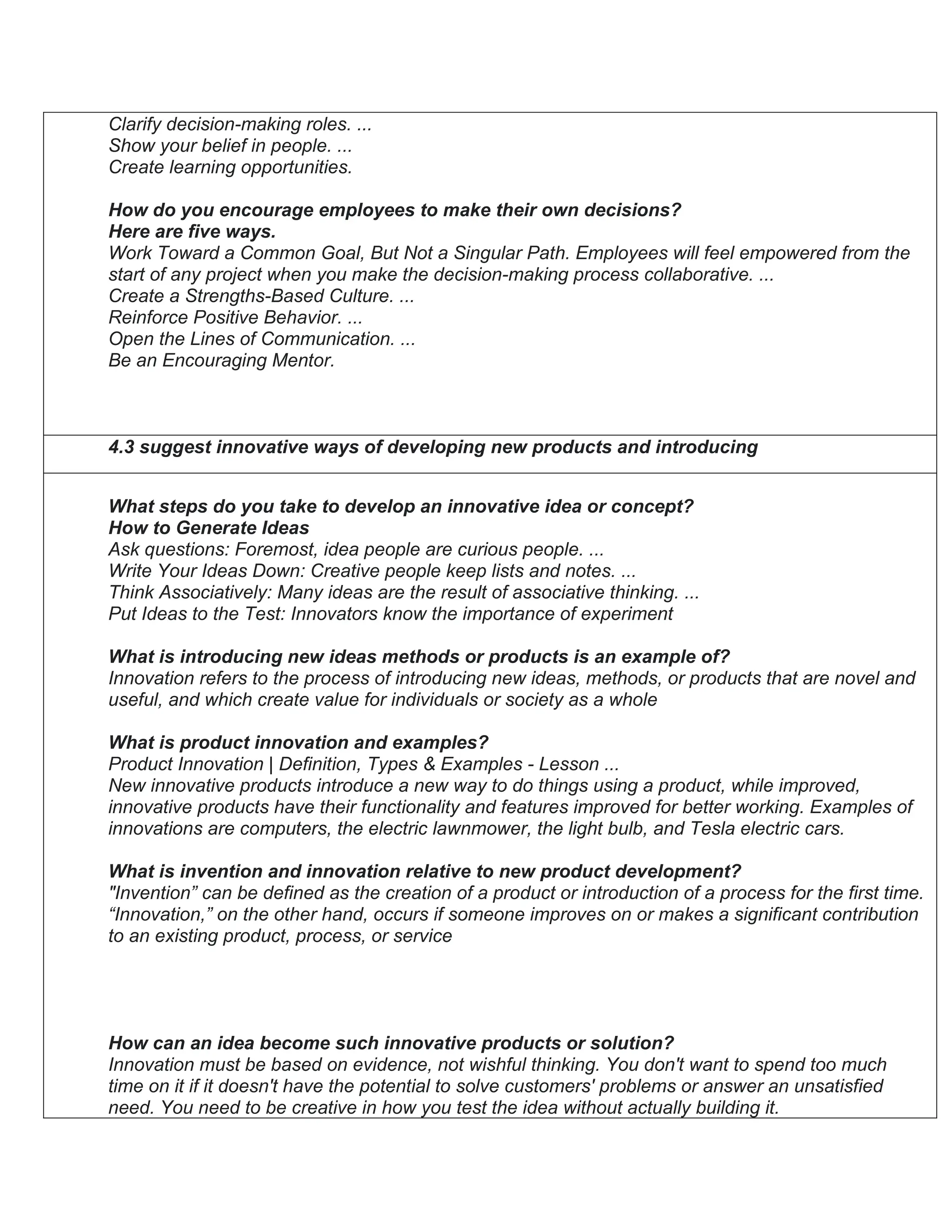
4.3 suggest innovative ways of developing new products and introducing
4.1Explain the importance of establishing and sustaining business enterprises as source of
job opportunities and financial freedom
Why is it important to establish and sustaining business enterprises as source of job
opportunities and financial freedom?
Establishing business enterprises creates job opportunities, which in turn reduces unemployment
and contributes to economic growth. 2. Sustaining business enterprises ensures long-term job
security for employees and continuous economic contribution.
Why do people attract more on sustainable business enterprises?
Reputation and brand value
Sustainable companies enjoy a more positive reputation and increased brand value, which attract
more customers and foster customer loyalty. A study by Cone Communications found that 87% of
consumers are more likely to buy from companies that advocate for social or environmental issues.
What is the importance of employment business or work in general in the life of a person?
Work helps you gain a sense of pride and self-satisfaction by reaffirming that you can support
yourself. With work, you earn money to cover bills and pay for activities in your leisure time. It's
becoming more common to see people with disabilities in a wide range of jobs throughout the
community.
What is the importance of business planning to the survival and growth of business
organizations?
Sets objectives and benchmarks: Proper planning helps a business set realistic objectives and
assign stipulated time for those goals to be met. This results in long-term profitability. It also lets a
company set benchmarks and Key Performance Indicators (KPIs) necessary to reach its goals.
What is business sustainability and its importance?
Business sustainability is when a company conducts its business without harming people or planet,
safeguarding its future business in the process. Reducing greenhouse gas emissions, protecting
nature and delivering social governance are all ways that businesses can make the shift towards
sustainability.
Let's take a look at five reasons sustainability is good for business.
Attracting And Retaining Employees.
Value Creation, Cost Reductions And Innovation.
Brand Reputation And Consumer Demand.
New Opportunities And Emerging Markets.
Competitive Advantage.
Bringing Benefits To The Planet As Well As The Bottom Line.
Why is sustainability important for development?
The issue of sustainability is important for development because if the natural resources are not
used carefully, they may not be available for future generations. The depleting resources of a
country may ultimately result in a lack of development of the country.
Why is sustainability important for the economic development?
Sustainable growth means providing more productive and lucrative possibilities for future
generations. A robust economy means people have more disposable income to buy more
products, build a bigger house, go on holiday or improve their standard of living in other ways.
How does sustainable development impact our society?
Sustainable development provides an approach to making better decisions on the issues that
affect all of our lives. By incorporating health plans into the planning of new communities, for
instance, we can ensure that residents have easy access to healthcare and leisure facilities.
4.2 encourage employees to play active roles as decision makers in the business enterprise
4 ways to involve your team in the decision-making process
Conduct employee surveys. Employee surveys still work when administered in a way that
encourages feedback. ...
Use a suggestion box. ...
Let them set performance targets and goals. ...
Plan brainstorming strategy days.
Why should you encourage employees team members to be involved in decision-making?
By involving others in the decision-making process, you create an opportunity for colleagues to
share ideas, learn from each other, and work toward a common goal. In turn, you foster
collaboration and help break down organizational silos
How do you encourage employees to make their own decisions?
Here are five ways.
Work Toward a Common Goal, But Not a Singular Path. Employees will feel empowered from the
start of any project when you make the decision-making process collaborative. ...
Create a Strengths-Based Culture. ...
Reinforce Positive Behavior. ...
Open the Lines of Communication. ...
Be an Encouraging Mentor.
How can employees participate in business decision-making?
Depending on the nature and complexity of the decision, you may want to involve your employees
in different ways. For example, you can consult them for their opinions and feedback, collaborate
with them to generate and analyze alternatives, or delegate the decision to them entirely.
How you will encourage your employees to think like entrepreneurs?
If you want your employees to think like entrepreneurs, you need to give them some autonomy
over their tasks, goals, and methods. This means trusting them to manage their own time,
resources, and projects, and allowing them to experiment and learn from their mistakes.
What kind of leaders encourage their employees to participate in making decisions?
In summary, participative leaders encourage and support employees to participate in the decision-
making process in order to make effective organizational decisions and to solve work problems
together through a range of measures.
How can employees be motivated and encouraged to work better?
Top 10 ways to motivate your employees:
Make your business a pleasant place to be. ...
Be a respectful, honest and supportive manager. ...
Offer employee rewards. ...
Give them room to grow. ...
Share positive feedback. ...
Be transparent. ...
Offer flexible scheduling. ...
Offer food in the workplace.
How do you motivate people to make decisions?
How to Encourage Your Team to Make Decisions
Commit to it. First you must decide that you want and need to distribute decision making. ...
Set clear expectations. ...
Create criteria. ...
Share information. ...
Encourage the shift. ...
Provide help. ...
Support their decisions.
How do you encourage employee participation?
Managers should strive to create an open culture where they are available for discussions with
employees at all levels. This approach, coupled with active involvement in team activities and an
open-plan working environment, can foster a culture of open dialogue and increased participation.
What is the role of employee participation in decision-making and organizational
commitment?
Decision-making refers to selecting among available alternative solution. Organization
Commitment refers to a task that must be done. Therefore, employee participation in decision–
making and organizational commitment refers to how the employee can take part in the task that
will be done in the organization.
How can entrepreneur motivate and lead the team?
How to Inspire and Motivate Your Team as an Entrepreneur
Lead by Example. ...
Establish a Clear Vision. ...
Create a Supportive Environment. ...
Provide Growth Opportunities. ...
Set Clear Goals and Expectations. ...
Celebrate Success and Encourage Collaboration. ...
Provide Regular Feedback and Support. ...
Encourage Autonomy and Creativity.
How do you encourage employees to make decisions?
Here are five strategies that can help you reduce this decision deficit.
Prepare yourself to empower others. ...
Develop a set of decision principles. ...
Clarify decision-making roles. ...
Show your belief in people. ...
Create learning opportunities.
How do you encourage employees to make their own decisions?
Here are five ways.
Work Toward a Common Goal, But Not a Singular Path. Employees will feel empowered from the
start of any project when you make the decision-making process collaborative. ...
Create a Strengths-Based Culture. ...
Reinforce Positive Behavior. ...
Open the Lines of Communication. ...
Be an Encouraging Mentor.
4.3 suggest innovative ways of developing new products and introducing
What steps do you take to develop an innovative idea or concept?
How to Generate Ideas
Ask questions: Foremost, idea people are curious people. ...
Write Your Ideas Down: Creative people keep lists and notes. ...
Think Associatively: Many ideas are the result of associative thinking. ...
Put Ideas to the Test: Innovators know the importance of experiment
What is introducing new ideas methods or products is an example of?
Innovation refers to the process of introducing new ideas, methods, or products that are novel and
useful, and which create value for individuals or society as a whole
What is product innovation and examples?
Product Innovation | Definition, Types & Examples - Lesson ...
New innovative products introduce a new way to do things using a product, while improved,
innovative products have their functionality and features improved for better working. Examples of
innovations are computers, the electric lawnmower, the light bulb, and Tesla electric cars.
What is invention and innovation relative to new product development?
"Invention” can be defined as the creation of a product or introduction of a process for the first time.
“Innovation,” on the other hand, occurs if someone improves on or makes a significant contribution
to an existing product, process, or service
How can an idea become such innovative products or solution?
Innovation must be based on evidence, not wishful thinking. You don't want to spend too much
time on it if it doesn't have the potential to solve customers' problems or answer an unsatisfied
need. You need to be creative in how you test the idea without actually building it.
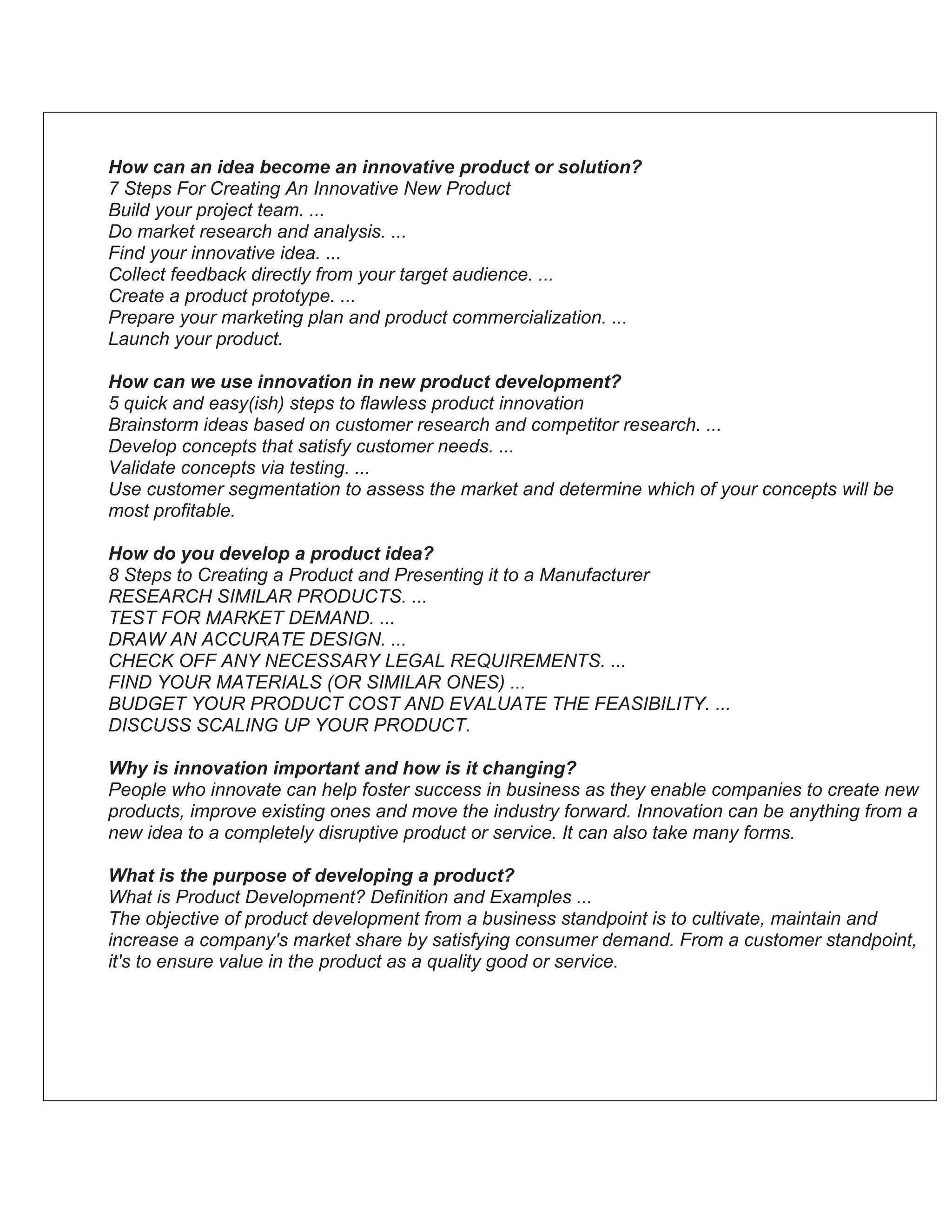
How can an idea become an innovative product or solution?
7 Steps For Creating An Innovative New Product
Build your project team. ...
Do market research and analysis. ...
Find your innovative idea. ...
Collect feedback directly from your target audience. ...
Create a product prototype. ...
Prepare your marketing plan and product commercialization. ...
Launch your product.
How can we use innovation in new product development?
5 quick and easy(ish) steps to flawless product innovation
Brainstorm ideas based on customer research and competitor research. ...
Develop concepts that satisfy customer needs. ...
Validate concepts via testing. ...
Use customer segmentation to assess the market and determine which of your concepts will be
most profitable.
How do you develop a product idea?
8 Steps to Creating a Product and Presenting it to a Manufacturer
RESEARCH SIMILAR PRODUCTS. ...
TEST FOR MARKET DEMAND. ...
DRAW AN ACCURATE DESIGN. ...
CHECK OFF ANY NECESSARY LEGAL REQUIREMENTS. ...
FIND YOUR MATERIALS (OR SIMILAR ONES) ...
BUDGET YOUR PRODUCT COST AND EVALUATE THE FEASIBILITY. ...
DISCUSS SCALING UP YOUR PRODUCT.
Why is innovation important and how is it changing?
People who innovate can help foster success in business as they enable companies to create new
products, improve existing ones and move the industry forward. Innovation can be anything from a
new idea to a completely disruptive product or service. It can also take many forms.
What is the purpose of developing a product?
What is Product Development? Definition and Examples ...
The objective of product development from a business standpoint is to cultivate, maintain and
increase a company's market share by satisfying consumer demand. From a customer standpoint,
it's to ensure value in the product as a quality good or service.
Business Ethics and Social Responsibility (BESR)

Business Ethics and Social Responsibility (BESR)

  • 1.
    K to 12BASIC EDUCATION CURRICULUM Course Title: Business Ethics and Social Responsibility (BESR) Grade: 12 (SY 2023-2024) The Role of Business in Social and Economic Development 1.1 differentiate the forms of business organization. 1.2 Give examples of the forms of business organizations. 1.3 Show how these organizations contribute to socioeconomic development. 1.4 Give examples of how fairness, accountability and transparency is practiced in business and non-profit organization. 1.5 Share observations on business policies and practices 1.6 Distinguish between good policies/practices and morally unacceptable policies/practices 1. differentiate the forms of business organization. 2. Give examples of the forms of business organizations. The different types of business organization are sole proprietorships, partnerships, and corporations. Sole proprietorships are owned by one person while partnerships are started when two parties pull resources. Corporations are large companies owned by shareholders. What are the different forms of business organization? Various forms of business organizations from which one can choose the right one include: (a) Sole proprietorship, (b) Joint Hindu family business, (c) Partnership, (d) Cooperative societies, and (e) Joint stock company. How do you differentiate the three forms of businesses? Here's a rundown of what you need to know about each one. Sole Proprietorship. In a sole proprietorship, you're the sole owner of the business. ... Partnership. A partnership is a non-incorporated business created between two or more people. ... Corporation. A corporation is a legal entity separate from its shareholders. The five forms of business organizations include the following: Partnership. Corporation. Sole proprietorship. Cooperative. Limited liability company.
  • 2.
    What is thedefinition of a form of business organization? Business Organization is an entity that is formed for the purpose of carrying on the commercial enterprise of selling and buying. These organizations are based on the systems of law that governs contract and this exchange, property rights, and incorporation. Why is it important to know the forms of business organization? The form of business determines which income tax return form to file and the company's and owners legal liabilities. This is a big decision that has long-term implications, so if you're unsure of which form of business is best for your company, you'll want to consult a professional. What is the purpose of different business organization? A business organization is a collection of persons working to achieve a common objective through structured and coordinated activities. The purpose of a business organization is to carry on a business. business. A business organization exists when two or more people act together to carry on a business. What are the different types of organization and meaning? Organizational Structure for Companies With Examples and Benefits A centralized structure has a defined chain of command, while decentralized structures give almost every employee receiving a high level of personal agency. Types of organizational structures include functional, divisional, flat Archy, and matrix structures. 1.3 Show how these organizations contribute to socioeconomic development. How these organizations contribute to socio-economic development? Business organizations provide jobs, career advancement, information, and training for employees. They do this in areas of low, middle, and high income. This contributes to socioeconomic development by giving community members the opportunity to learn new skills, gain income, and improve their standard of living. What contributes to socio-economic development? Efforts are directed towards risk-informed and sustainable urban and rural planning; income and employment generation for vulnerable groups, including in agriculture; infrastructure rehabilitation and development, including housing solutions; and the realization of the country's human capital potential. What are socio-economic development contributions? Socio-Economic Development (SED) contributions are any monetary or non-monetary contribution implemented for individuals (natural individual or group of natural individuals) or communities, where at least 75% of the beneficiaries are classified as black people in terms of race. How does a business contribute to economic development? Attracting and growing businesses strengthens our economy providing locally produced goods and services. Strong businesses pay taxes that go for vital services such as schools, roads, fire, and police. Businesses also provide good jobs that put money in people's pockets and allow for a higher quality of
  • 3.
    life. Why are organizationsimportant for social and economic life? Organizations are important components of social and physical environments, and they exert considerable influence over the choices people make, the resources they must aid them in those choices, and the factors in the workplace that could influence health status (e.g., work overload, exposure to toxic chemicals) What are its contributions to social and economic development of globalization? Globalization has paved the way for new markets, enhanced trade, and investment, and fostered cross- border technology and knowledge transfers. These developments have contributed to greater economic growth, improved productivity, and job creation in numerous areas worldwide. What is the importance of business organizations for the economy? Business organizations play a vital role in the world economy and have significant importance for several reasons: Economic growth and development: Business organizations are key drivers of economic growth. They create jobs, generate income, and contribute to overall economic development. How can a business contribute to the development of a community? Clearly, one of the most important ways small businesses benefit the community is by creating job growth and providing locals with job opportunities – an overall positive in terms of a healthy economy and a happy community. How can an organization improve their support to the community? Leads and referrals can be generated, and resources can be made available. Your business, the community, local vendors, and their cause all benefit. Volunteering, giveaways, and working with local vendors are three great ways to increase your community-service efforts. How important is social organization in human development? Social organizations are essential for human beings as they provide security, support, and a sense of purpose, allowing individuals to thrive and work together towards success. What role of business is the most beneficial in the economy and society? Economic Growth: Business plays a fundamental role in driving economic growth by creating jobs, generating income, and fostering innovation. It contributes to the overall prosperity of a nation by providing goods and services that meet the needs and desires of consumers. What contributes to social and economic development of a nation in relation to entrepreneurship? Role of Entrepreneurship in Economic Development: Top 9 Points Importance of Entrepreneurship Drives economic growth and creates new job. Encourages innovation by bringing new ideas, products, and services to the market. Contributes to social change by developing products or services that reduce people's dependence on outdated technologies.
  • 4.
    Why is thecommunity important to social organization? Importance of Community — How Collective Solutions Help Why are communities so important? Strong communities are critical because they're often an important source of social connection and a sense of belonging. Participating in a community bonded by attitudes, values, and goals is an essential ingredient to enjoying a fulfilling life. 4 Give examples of how fairness, accountability and transparency is practiced in business and non- profit organization. What is an example of accountability and transparency? To show accountability and transparency as a servant leader is to share your feedback regularly and constructively with your team. This means giving praise and recognition for achievements, as well as constructive criticism and suggestions for improvement. What is the importance of fairness accountability and transparency in business organization? When done right, accountability can increase your team members' skills and confidence. The primary benefit of transparency in business is that it produces trust and goodwill while safeguarding the firm's reputation among investors, partners, employees, customers, and other stakeholders. What are ways you can cultivate fairness and accountability in an organization? HOW CAN YOU CREATE A CULTURE OF ACCOUNTABILITY AND FAIRNESS? ALIGN INDIVIDUAL ACCOUNTABILITY WITH MISSION, VALUES AND GOALS. ... SCHEDULE REGULAR PROGRESS MEETINGS. ... LINK ACCOUNTABILITY TO CAREER DEVELOPMENT. ... ACKNOWLEDGE AND CELEBRATE ACHIEVEMENT. What is the accountability of a nonprofit organization? A nonprofit has an obligation to responsibly use its resources toward its mission and to benefit the community. The organization's board should approve its financial audits; the executive director and the principal financial manager should attest to the audit's findings. What is responsibility authority accountability and their importance in the business world? Authority is the ability or permission to make decisions. Responsibility refers to a job we are tasked with, and accountability is the way in which we answer for the work we've done or the staff we manage. The interplay between the three is critical in the workplace, both in delegation and in getting things done. What is an example of responsibility and accountability? Responsibility vs Accountability – What's the difference ... If someone who lives alone has the responsibility to do their laundry, but fail to do so, they have no one to answer to but themselves. They will be responsible, but they won't face any consequences from an authority. However, a parent could make their child accountable for the laundry getting done.
  • 5.
    . Which ofthe following is an example of accountability? A great example of accountability is when you are focused on achieving your goals and tasks. If you're able to limit distractions and pressures, you're successful in achieving your goals efficiently. Moreover, when your team sees this, you're setting a good example for them. You build a strong work ethic for your team. Which of these are the best examples of accountability at work? Here are some common examples of accountability: Creating solutions to problems. ... Showing focus. ... Admitting your errors. ... Speaking about issues. ... Going to work. ... Discuss your career goals with your supervisor. ... Work independently. ... Get involved in extracurricular activities. What is accountability and examples? 7 Accountability in the Workplace Examples to Inspire You ... When thinking of accountability at work, examples include completing tasks on time, meeting performance expectations, and teams working together productively and efficiently. Individual accountability can create a positive work environment where employees feel that everyone is doing their part to achieve shared goals 1.5 Share observations on business policies and practices What do you understand by business policy? A business policy is a formal statement that outlines the rules, regulations, and processes that guide the behavior and decision-making of employees within an organization. It establishes a framework for consistency, ensuring that everyone is on the same page when it comes to key aspects of the business. What is an example of a business policy and procedures? Company Policies and Procedures: Essential Guide | Factorial Examples of company policies include employee conduct policies, dress code, attendance policies, equal opportunity policies, and other areas related to the terms and conditions of employment. Procedures: the processes by which employees should deal with potential breaches of company policies. How do you interpret business policies to customers clients? Make sure your policies are easy to find, read, and understand, and use simple and friendly language. You can also highlight the benefits of your policies for your customers, such as how they protect their rights, provide value, or ensure quality. What are the policies in business? Company Policies: 17 to Consider for Your Business What are company policies?
  • 6.
    Equal opportunity policy. Workplacehealth and safety. Employee code of conduct policy. Attendance, vacation, and time-off policies. Employee disciplinary action policy. Employee complaint policies. Ethics policy. Work schedule and rest period policies.  Importance of Business Policy Consistency in decision-making: Business Policy sets the rules and guidelines that govern various aspects of an organization’s operations. This consistency ensures that decisions made by different individuals and teams align with the organization’s mission, vision, and values. What is the purpose of policy? What Are Policies & Procedures? Policy vs Procedure Explained A policy is a set of rules or guidelines for your organization and employees to follow to achieve a specific goal (i.e. compliance). Effective policies answer questions about what employees do (such as directions, limits, principles, and decision-making guidance) and why they do it. Why is it important for a business to clearly identify and understand its customers? Generating sales is much easier when a business has a clear idea of its customers and what they want. This enables the business to provide a product or service that directly meets customers' requirements. For example, a business may decide that its target audience is customers who are on non-meat diets. What is the best way to define business rules? What are business rules? Business rules guide the everyday decision-making within businesses by outlining the relationships between objects, such as customer names and their corresponding orders How business policy and strategy choices should be made? The policies and strategies should be made in line with guiding principles. In business sphere, a business policy should be specific or definite. Making policy choices that are uncertain would imply that implementation would be difficult. 1.6 Distinguish between good policies/practices and morally unacceptable policies/practices What is the difference between ethics and policies? Policies pursued by the Government or different Corporates are based on statutes or law of the land. However, ethics is based on value system pursued by the people in a society. It also depends on cultural standards. It depends on morality or norms about right and wrong human conduct.
  • 7.
    What is therelationship between ethics and public policy? Choice of public policy is related directly to such ethical judgments during selecting what matters most and what matters not at all in an area affected by that policy. Ethics can be understood as a theory of morality or customs and habits. What is the difference between a code of conduct and a company policy? Policies outline a company's approach to an issue. They're the formal rules governing an organization or business unit. Whereas the Code deals with several topics at once; policies only deal with one issue at a time. What do you think is the benefit of practicing good business ethics? Business ethics enhances the law by outlining acceptable behaviors beyond government control. Corporations establish business ethics to promote integrity among their employees and gain trust from key stakeholders, such as investors and consumers. What is the difference between morally correct and ethically correct? Ethics versus Morals: A Comparison - NASBA Center For Public ... Both ethics and morals refer to “right” and “wrong” behaviors and conduct. While they are sometimes used interchangeably, these words are different: ethics refer to rules provided by an external source, such as a code of conduct in the workplace. Morals refer to an individual's principles regarding right and wrong. What is the difference between moral and ethical rules? Ethics vs Morals vs Law Ethics and morals relate to “right” and “wrong” conduct. While they are sometimes used interchangeably, they are different: ethics refer to rules provided by an external source, e.g., codes of conduct in workplaces or principles in religions. Morals refer to an individual's own principles regarding right and wrong. What is the relationship between ethics and good governance? Ethics, Accountability and Good Governance In the public sector, ethics refers to well based standards of right and wrong and prescribe what public servants ought to do. Good corporate governance is an aspect of ethics which refers to the set of systems, principles, and processes by which public service organizations are governed. What is morality in public policy? Morality policy is any policy that seeks to use the coercive power of government to impose or legitimize one public set of fundamental values or norms over a competing set (or sets) of values or norms. Why is it important to have good ethics in public relations? So there is an ethical responsibility both to their and to clients (or employers). First-class PR is always solidly rooted in fact. For the profession to change its reputation, it must practice honesty and transparency. Being honest cultivates trust, credibility, and authenticity.
  • 8.
    What is theconnection between good ethics and good business? When you have a reputation for consistently being ethical in how you source and build products, and treat employees, customers and the community, more people will want to do business with you. Even social media ethics is important for your reputation. Does good ethics mean business success? Business ethics play a vital role in a company's long-term success. Good ethics can earn a company a positive reputation and encourage brand loyalty. Consumers and stakeholders increasingly expect corporations to have strong values. Foundations of the Principles of Business Ethics 2.1compare and contrast classical philosophies as they relate to the business setting. 2.2 give examples of how belief systems affect business practices. 2.3 analyze simple business situations as they are affected by the Filipino value system and recommend ways of confronting ethical challenges in the business setting. 2.4 distinguish what is GOOD vs. what is morally unacceptable among the given Filipino values. 3.1 suggest ways to enhance employer-employee relationship and encourage just and fair business policies and practices such as recruitment, promotion, retention, marketing and advertising, intellectual property rights, sources and uses of funds, and the like. 3.2 advocate honest policies and practices in all aspects of business operations 3.3 observes and promote policies and practices in environmental management. 3.4 cite examples of companies that practice social responsibility in the conduct of their business. Foundations of the Principles of Business Ethics 2.1compare and contrast classical philosophies as they relate to the business setting. What are the foundations of the principles of business ethics? What Are the 12 Ethical Principles? Business ethics is an evolving topic. Generally, there are about 12 ethical principles: honesty, fairness, leadership, integrity, compassion, respect, responsibility, loyalty, law-abiding, transparency, and environmental concerns. What classical philosophies specifically virtue ethics? Virtue ethics is a philosophy developed by Aristotle and other ancient Greeks. It is the quest to understand and live a life of moral character. This character-based approach to morality assumes that we acquire virtue through practice. . The 12 ethical principles for business executives COMPASSION. ... RESPECT. ... RESPONSIBILITY. ... LOYALTY. ... LAW-ABIDING. ... ACCOUNTABILITY. ... TRANSPARENCY. ... ENVIRONMENTAL CONSCIOUSNESS. Organizations and personnel demonstrate a commitment to the environment by helping mitigate the effects of global climate change. What is the difference between classic and philosophy? Studying a Classical subject requires research, assessment, reasoning, organization, and self-management often
  • 9.
    on your ownor as part of a team. In Philosophy you learn to develop and express reasoned arguments, to use logical processing and critical analysis to defend your position and debate opposing opinions. What is the importance of classical philosophies? Classical philosophy studies the fundamental problems concerning human existence through the eyes of our intellectual ancestors. Many thinkers from Classical times were pioneers of our modern philosophical and scientific ideas. What is the most valuable lesson that can be learned by businesspeople from these Greek philosophers? Overall, the philosophy of Stoicism offers valuable insights into how businesses can turn obstacles into opportunities. By focusing on what we can control, being adaptable, and cultivating resilience and perseverance, we can not only survive, but thrive in the ever-changing world of business. Why philosophy is important in understanding the self? Philosophy plays a crucial role in understanding the concept of self as it delves into the fundamental questions of human existence, consciousness, and identity. 2.2 give examples of how belief systems affect business practices. Belief systems supply core values and provide a direction for organizational operations. Simons (1995, p. 170) defined belief systems as “formal systems used by top managers to define, communicate, and reinforce the basic values, purpose, and direction for the organization. What are the examples of belief system affect business practices? A few common religious practices that may affect the business practices include - prayer breaks for the Muslim employees, requests for custom holidays, blessing and performing poojas at office locations, effect of the religious beliefs on their social behaviors, believing in superstitions and myths, eating habits. How does religion and beliefs affect business? One of the most apparent ways entrepreneurs may be affected by religion is through values and beliefs. Many religions have specific teachings and values that emphasize the importance of honesty, integrity, and social responsibility. These values can shape the way entrepreneurs conduct their business and make decisions. Belief in the Business Pretty much everything in an organization is going to be better when the people working in it believe in what the business is doing. When they believe, they work harder, they give more, and they put a level of energy and passion into play that's essential to creating anything great. How does belief system affect? Our belief systems impact not only how we think and feel but also how we behave and how we operate in our lives. When we are holding onto self-deprecating belief systems, we impede our self-confidence and our faith in ourselves. What is the belief system of Buddhism in influencing business practices? What business can learn from Buddhism - Institute of Hospitality The Noble Eightfold Path, which encapsulates the core Buddhist precepts, talks about cultivating positive emotions such as generosity, gratitude, loving kindness, and devotion and making a living in an ethical and productive way. How do belief systems affect society? Religion and belief - Manual for Human Rights Education with ... As mental structures, they influence the way we perceive the world around us and the values we accept or reject. As social structures, they provide a supporting network and a sense of belonging. In many cases, religions have become the basis of power structures and have become intertwined with it. You can't claim to believe something but do something else in your business. If you have a belief system, you need to incorporate that in your business. It's not sustainable to go against your beliefs while you're working and try to follow them when you aren't. You can't separate your life into pieces.
  • 10.
    How does beliefsaffect you as an individual? They affect how you think, what you do and how you do it. Your background, upbringing, experiences, and relationships will all have played a part in the way you see things. Sometimes your attitudes and beliefs could lead you to assume things about people that are not right or fair 2.3 analyze simple business situations as they are affected by the Filipino value system and recommend ways of confronting ethical challenges in the business setting What is the importance of Filipino values in terms of business practices? The important values that shape Filipino business culture are the same as those prioritized in wider society. Across the world, we all share common values such as fairness, honesty, loyalty, and respect. What is the Filipino value system in business filial piety? in business. Filial Piety is a virtue of respect for one's parents, elders, and ancestors. being close to one's family members ("Filipino values," 2016). "Filial Piety” is a value system which is rooted primarily in personal alliance systems based on kinship. What is your opinion about the Filipino culture being applied in a business? Filipino business culture is hierarchical, with the person of highest status approving all final decisions but group consensus is still necessary for all decisions before it reaches this person. Verbal agreements are adhered to on the basis of trust. If you break them, you will jeopardize your business relationships. What is the importance of values and the value system to a business organization? An organizations’ values serve as the foundation of its identity and behaviors, guiding decision-making, shaping company culture, directing business strategy, and providing a clear sense of purpose for employees, stakeholders, and customers. How would you describe the culture in your area of the business? Words that can be used to describe your company's work ... You can also say the culture is “enriching,” “stimulating,” or “energizing.” Nurturing: Conveys that the company is invested in employees' growth and development. A culture like this can also be called “caring,” “fostering,” or “supportive. Why is it good for businesses when personal values and company values align? More robust Organizational Culture: When personal values align with corporate values, it strengthens the organizational culture. A shared set of values creates a cohesive and inclusive work environment where employees feel connected, respected, and supported. This, in turn, attracts and retains top talent. What values are important to you in business? Types of business values Act with integrity. Take responsibility. Seek excellence. Reward collaboration. Innovate. Be respectful. 2.4 Distinguish what is GOOD vs. what is morally unacceptable among the given Filipino values
  • 11.
    What are theFilipino values or traits that influence your ethical standard? The values of Filipinos specifically uphold the following items: solidarity of the family unit, security of the Philippine economy, orientation to small-groups, personalism, the concepts of "loob" or kalooban (meaning "what's inside the self", the "inner-self", or the "actual personal feelings of the self" What are the positive Filipino values that are unique from other cultures? Top Filipino traits and values The family. Filipinos are known to have strong family ties. ... Humor and positivity. Optimism, humor, and positivity are valued traits in the Philippines. ... Flexibility and adaptability. ... Faith and religion. ... Filipino hospitality. ... Respect for the elderly. ... Industrious attitude. ... Generosity. 3.1 suggest ways to enhance employer-employee relationship and encourage just and fair business policies and practices such as recruitment, promotion, retention, marketing and advertising, intellectual property rights, sources and uses of funds, and the like To improve communication and drive improved engagement, try these tips: Ensure employees are kept in the loop about any proposed changes to expectations. Encourage open communication. Continue to provide feedback and recognition. Promote open discussion and sharing. 5 tactics to improve employee relations. Set the tone from their first day. First impressions matter. ... Provide positive feedback. More often than not, the focus of evaluations are on how an employee can improve and what they need to do better. ... Improve communication. ... Offer career development. ... Help them be happy. How can there be an effective employee relation in an organization? Follow the advice below: Adopt a Conducive Workplace Culture. Employees want to feel good about what they do and where they do it. ... Involve Your Team Members. Employees should feel important to your company. ... Insist Upon Proper Communication. Employees need to know what's going on. ... Recognition. ... Regular Team Meetings. ... Events. How to build positive employee relations including engagement and retention ideas?
  • 12.
    9 winning employeerelations strategies Create an employee relations policy. ... Talk about your company goals and values. ... Introduce rewards and recognition. ... Practice open communication. ... Revisit your onboarding process. ... Host team-building events. ... Encourage regular 1:1 meeting. ... Promote a healthy work-life balance. How important is effective employee relations? Maintaining positive employee relations can improve overall individual and organizational engagement and performance while creating a healthier, more enjoyable day-to-day work environment. In fact, having positive relationships with fellow employees can increase employee satisfaction by 50%. How does employee relations affect employee productivity? It involves maintaining a work environment that satisfies the needs of individual employees and management. An effective employee relation involves creating and cultivating a motivated and productive workforce. Happy employees are the Potentials employees and happy employees are always productive employees. 3.2 Advocate honest policies and practices in all aspects of business operations What does honesty is the best policy mean in business ethics? Being honest with your customers, your employees, and your partners is the only way to create a successful and sustainable business. Honesty creates transparency and builds trust. It's the foundation of a good reputation. And it's what customers expect from businesses they patronize What is the importance of business ethics to the ABM students like you? The Importance of Business Ethics | Maryville Online Business ethics inform a company's values and goals, as well as how it runs its day-to-day operations. An ethical company runs on principles such as honesty, integrity, fairness, trustworthiness, accountability, and respect for others. What do you understand by business ethics discuss the importance of business ethics and the ethical issues involved in business? By definition, business ethics refers to the standards for morally right and wrong conduct in business. Law partially defines the conduct, but “legal” and “ethical” aren't necessarily the same. Business ethics enhances the law by outlining acceptable behaviors beyond government control. Why is ethical behavior the best way to build a successful company? Displaying good ethical behavior can boost company morale and client relations. It's easier for a business to retain employees when they work for a company that they believe in. Employees want to work for companies that treat everyone and their clients fairly and have good and ethical business practices
  • 13.
    Observes and promotepolicies and practices in environmental management. What are the policies and practices of environmental management? Environmental policies must include a pledge to continually measure and improve environmental performance, and many include a promise to seek ways to reduce energy, limit fuel consumption, lessen emissions, prevent pollution, reduce greenhouse gases, and reduce potable water consumption, or an infinite number of other. What are the environment management practices? Environmental management practices (EMP) refers to a set of skills and strategies adopted by firms with the aim of monitoring and managing the effect of their operations on the natural environment. How will you promote environmental awareness? Environmental Awareness Avoid buying disposable goods such as paper towels, plastic bottles, and plastic bags. Start a composting and recycling program in communities where there are none. This will help cut down our waste production. Support local businesses and farmers, and buy organic and pesticide-free food when you can. What are the aims of the environmental policy? The policy aims to protect ecosystems and natural resources through conservation, sustainable use and good governance. It wants to integrate environmental concerns into all development policies and plans Ten simple choices for a healthier planet. Reduce, reuse, and recycle. Cut down on what you throw away. ... Volunteer. Volunteer for cleanups in your community. ... Educate. ... Conserve water. ... Choose sustainable. ... Shop wisely. ... Use long-lasting light bulbs. ... Plant a tree. 3.4 cite examples of companies that practice social responsibility in the conduct of their business. 5 Corporate Social Responsibility Examples Lego's Commitment to Sustainability. ... Salesforce's 1-1-1 Philanthropic Model. ... Ben & Jerry's Social Mission. ... Levi Strauss's Social Impact. ... Starbucks's Commitment to Ethical Sourcing. What is an example of social responsibility of business and business ethics? It is a firm's recognition of social obligations even though not covered by law, along with the obligations laid down by law. In other words, social responsibility involves an element of voluntary action on the part of business people for the benefit of society.
  • 14.
    Which is anexample of social responsibility in the business world quizlet? Social responsibility means that an organization tries to be responsible to society, even if that may mean reducing profits. Examples are fair employment practices, helping with urban renewal and development, working with educational institutions, and limiting pollution. What is a company that has socially responsible human resources management? A company that has socially responsible human resources management is one that prioritizes the well- being and fair treatment of its employees while also considering the impact of its actions on society as a whole. Social Responsibility of Entrepreneurs 3.1Suggest ways to enhance employer-employee relationship and encourage just and fair business policies and practices such as recruitment, promotion, retention, marketing and advertising, intellectual property rights, sources and uses of funds, and the like 3.2 Advocate honest policies and practices in all aspects of business operations 3.3 Observes and promote policies and practices in environmental management 3.4 Cite examples of companies that practice social responsibility in the conduct of their business 3.5 provide evidence that ethical/social responsibility is profitable, i.e., makes good business sense Social Responsibility of Entrepreneurs 3.1Suggest ways to enhance employer-employee relationship and encourage just and fair business policies and practices such as recruitment, promotion, retention, marketing and advertising, intellectual property rights, sources and uses of funds, and the like 9 Tips To Build a Healthy Work Relationship With Employees Bond Of Trust. Merge The Gap With Communication. Appreciate Your Employees. Be Friendly To Your Employees. Respect Your Employees. Implement Autonomy. Show Value, Be Empathetic. One To One Interactions 5 tactics to improve employee relations Set the tone from their first day. First impressions matter. ... Provide positive feedback. More often than not, the focus of evaluations are on how an employee can improve and what they need to do better. ... Improve communication. ... Offer career development. ...
  • 15.
    Help them behappy. Why is it important to maintain employee and employer relationships? Stronger the employee relations, better it is for the organization. This is said because when relations between employer and employee are great, employees tend to be more satisfied and thus end up being more productive at work. How an organization can foster positive employee relations to enhance employee satisfaction and productivity? Engage with your employees to keep them happy and productive. Consider their motivations, job satisfaction, and expectations. Implement a transparent employee relations policy and share it with all employees. Make sure it includes clear procedures for reporting potential issues. What is the role of employee relations management in improving employee performance? More specifically, ERM allows HR professionals to more accurately identify employee's motivations, needs and preferences as well as better align employment practices to real needs, which minimizes staff turnover and at the same time maximizes staff retention by the definition of more appropriate recruitment profiles. How can a company motivate its employees to be more effective and satisfied? So if you want to keep your good people and keep them motivated, it's worth starting an incentive program. Maybe it's a quarterly bonus. Maybe it's a commission structure that's better than the competition. Maybe it's offering to foot the bill for additional credentials. What is the relationship between employee relations and organizational performance? Employee relationships are known to play significant roles in fostering organizational performance. According to Deming (2007) good relationships with employees can be created through motivating them and having good working conditions and effective communication systems. How to Motivate Employees: 9 Helpful Tips Focus on developing a positive work culture. Encourage creativity and innovation. Foster recognition and appreciation within the company. Offer flexible scheduling. Promote teamwork and collaboration. Set clear and measurable goals. Give your employees a sense of purpose. How motivation can help improve workplace efficiency and productivity? Motivated employees are loyal to their organization and find value and social status in their work. Thus, they are driven to discover their best selves for the organization. Whenever employees are giving their best in the workplace, the whole workflow becomes more efficient. How are employees motivated to improve their performance? Recognise and reward great work. Employees need to know that their managers appreciate their hard work. Giving well-deserved recognition not only increases self-esteem but also enthusiasm and team morale. A recognition platform is an effective tool to celebrate star performers who embody your company
  • 16.
    values. 3.2 Advocate honestpolicies and practices in all aspects of business What does honesty is the best policy mean in business ethics? Being honest with your customers, your employees, and your partners is the only way to create a successful and sustainable business. Honesty creates transparency and builds trust. It's the foundation of a good reputation. And it's what customers expect from businesses they patronize. What is the ethical policy of a business? Also known as a code of ethics, an ethics policy outlines how you expect employees to conduct themselves while in the workplace. It can also make your business more appealing to work for over other companies. Let's take a more detailed look at why ethics policies are important. What do you understand by business ethics discuss the importance of business ethics and the ethical issues involved in business? By definition, business ethics refers to the standards for morally right and wrong conduct in business. Law partially defines the conduct, but “legal” and “ethical” aren't necessarily the same. Business ethics enhances the law by outlining acceptable behaviors beyond government control. What is the importance of honesty in business? Honesty has a powerful way of drawing people in and creating trust. It cultivates a positive and communicative environment, and it is essential for creating a successful small business. What business ethics is and why it is important? Why Business Ethics Are Important Business ethics are the set of practices and policies that companies use to guide them through decisions about finances, negotiations and deals, corporate social responsibility, and more. Without a strong set of ethics, a business can run afoul of the law, encounter financial pitfalls and moral dilemmas. Why are ethics policies or codes important to business managers? Answer & Explanation. Option 3 is correct because ethics policies help managers assess situations, determine what is ethically acceptable and make informed decisions that align with the organization's values. Why is ethical behavior the best way to build a successful company? Displaying good ethical behavior can boost company morale and client relations. It's easier for a business to retain employees when they work for a company that they believe in. Employees want to work for companies that treat everyone and their clients fairly and have good and ethical business practices. How do you show honesty in business? “A key part of honesty in business is that you don't make any promises you can't keep. You understand your capabilities within your industry, and you're not going to try to oversell a potential client on work that you're simply not capable of. What is the role of ethics in business communication? The purpose of business communication ethics is to create good relations between the company and its clients, colleagues and society. Business communication ethics includes principles such as honesty, integrity, responsibility, respect, and promoting good social values. 3.3 Observes and promote policies and practices in environmental management
  • 17.
    What are thepolicies and practices of environmental management? Environmental policies must include a pledge to continually measure and improve environmental performance, and many include a promise to seek ways to reduce energy, limit fuel consumption, lessen emissions, prevent pollution, reduce greenhouse gases, and reduce potable water consumption, or an infinite number of other What is an environmental management policy? An environmental policy is a written statement, usually signed by senior management, which outlines a business' aims and principles in relation to managing the environmental effects and aspects of its operations. Although putting one in place is voluntary, an increasing number of businesses are choosing to do so. What are the environment management practices? Environmental management practices (EMP) refers to a set of skills and strategies adopted by firms with the aim of monitoring and managing the effect of their operations on the natural environment. What is the main function of environmental policy? The main function of environmental policy is to reduce, or possibly eliminate, the undesirable effects of a business or overall action on the environment. Another function of environmental policies is to aid in the conservation of natural resources. Why is it important for environmental policy? Environmental laws play a crucial role in addressing climate change by regulating greenhouse gas emissions and promoting sustainable practices. They help limit global warming by setting emissions standards, encouraging the use of renewable resources, and promoting energy efficiency. How to write an environmental policy in five steps Clearly state organisation objectives. The policy needs to make sense in terms of the wider objectives of the business. ... Keep it short and concise. Work to condense your message until it is powerful and simple. ... Use simple language. ... Be realistic. ... Circulate the policy. Why are environmental policies and laws important in our country? Environmental laws today encompass a wide range of subjects such as air and water quality, hazardous wastes and biodiversity. The purpose of these environmental laws is to prevent, minimize, remedy and punish actions that threaten or damage the environment and those that live in it. Why is it important to be aware of environmental issues and how to protect the environment? Environmental Awareness Essay | Essay on Environmental ... Environmental awareness is critical because it can help us to become aware of the impacts on the Earth created by human activities, leading to global warming. It can also help us to create a more sustainable world by promoting renewable resources, such as solar, wind and water. How does the environment sustain life? Nature conservation is particularly important for biodiversity conservation. Protecting natural areas such as forests, wetlands, and grasslands helps to preserve the diversity of life forms within these ecosystems. This, in turn, helps to maintain the ecological processes that support life on Earth.
  • 18.
    3.4 Cite examplesof companies that practice social responsibility in the conduct of their business What is an example of social responsibility in business? Social Responsibility in Business: Meaning, Types, Examples ... What Are Examples of Social Responsibility? Social responsibility includes companies engaging in environmental preservation efforts, ethical labor practices, philanthropy, and promoting volunteering What is an example of social responsibility in business? Social Responsibility in Business: Meaning, Types, Examples ... What Are Examples of Social Responsibility? Social responsibility includes companies engaging in environmental preservation efforts, ethical labor practices, philanthropy, and promoting volunteering. What is an example of social responsibility of business and business ethics? It is a firm's recognition of social obligations even though not covered by law, along with the obligations laid down by law. In other words, social responsibility involves an element of voluntary action on the part of business people for the benefit of society. What are examples of social responsibility and ethics? Social Responsibility Working for the community, such as volunteering, giving blood donations, and working at a food bank or animal shelter. Supporting issues that affect society, such as advocating political or social issues that can help others—for example, advocating for child labor laws, purchasing fair trade products, recycling. 3.5 Provide evidence that ethical/social responsibility is profitable, i.e., makes good business sense Why does social responsibility make good business sense? What Are the Benefits of Corporate Social Responsibility? Embracing CSR increases customer retention and loyalty, increases employee engagement, improves brand imaging, attracts investment opportunities and top talent, and makes a difference in bottom-line financials. Do you think that social responsibility is good for business explain your answer with example? Social responsibility benefits society and the environment while lessening negative impacts on them. Companies engaging in social responsibility can do so in a number of ways, including making changes that benefit the environment, engaging in ethical labor practices, and promoting volunteering, and philanthropy. How can ethical and social responsibility help a business? Being a socially responsible company can bolster a company's image and build its brand. Social responsibility programs can boost employee morale in the workplace and lead to greater productivity, which has an impact on how profitable the company can be. Is it possible for a company to be profitable and socially responsible? Is it possible for a small business to be socially responsible while maintaining a healthy profit margin? The short answer is yes. You can contribute without suffering economically. In fact, CSR initiatives can even
  • 19.
    save you money. Howcan businesses balance profit making with ethical responsibilities? This can include reducing waste, using renewable energy sources, and sourcing materials ethically. By doing so, businesses can reduce their environmental impact and contribute positively to society. Another way businesses can balance profit and social responsibility is by giving back to their communities Ethical Business Practices Can Reduce Costs More businesses are discovering that these pursuits can help them reduce costs, thus effectively increasing their profits. Sustainable Brands, an alliance of organizations committed to sustainability, recently reported significant savings for many leading businesses. Here are seven tips you can follow to ensure your company is a responsible corporate citizen. Adopt a business code of ethics. ... Follow a workplace health and safety program. ... Commit to protecting the environment. ... Get your suppliers on board. ... Be smart about donating money. ... Don't greenwash your business 4.Business Beyond Profit Motivation 4.1Explain the importance of establishing and sustaining business enterprises as source of job opportunities and financial freedom 4.2 encourage employees to play active roles as decision makers in the business enterprise 4.3 suggest innovative ways of developing new products and introducing 4.1Explain the importance of establishing and sustaining business enterprises as source of job opportunities and financial freedom Why is it important to establish and sustaining business enterprises as source of job opportunities and financial freedom? Establishing business enterprises creates job opportunities, which in turn reduces unemployment and contributes to economic growth. 2. Sustaining business enterprises ensures long-term job security for employees and continuous economic contribution. Why do people attract more on sustainable business enterprises? Reputation and brand value Sustainable companies enjoy a more positive reputation and increased brand value, which attract
  • 20.
    more customers andfoster customer loyalty. A study by Cone Communications found that 87% of consumers are more likely to buy from companies that advocate for social or environmental issues. What is the importance of employment business or work in general in the life of a person? Work helps you gain a sense of pride and self-satisfaction by reaffirming that you can support yourself. With work, you earn money to cover bills and pay for activities in your leisure time. It's becoming more common to see people with disabilities in a wide range of jobs throughout the community. What is the importance of business planning to the survival and growth of business organizations? Sets objectives and benchmarks: Proper planning helps a business set realistic objectives and assign stipulated time for those goals to be met. This results in long-term profitability. It also lets a company set benchmarks and Key Performance Indicators (KPIs) necessary to reach its goals. What is business sustainability and its importance? Business sustainability is when a company conducts its business without harming people or planet, safeguarding its future business in the process. Reducing greenhouse gas emissions, protecting nature and delivering social governance are all ways that businesses can make the shift towards sustainability. Let's take a look at five reasons sustainability is good for business. Attracting And Retaining Employees. Value Creation, Cost Reductions And Innovation. Brand Reputation And Consumer Demand. New Opportunities And Emerging Markets. Competitive Advantage. Bringing Benefits To The Planet As Well As The Bottom Line. Why is sustainability important for development? The issue of sustainability is important for development because if the natural resources are not used carefully, they may not be available for future generations. The depleting resources of a country may ultimately result in a lack of development of the country. Why is sustainability important for the economic development? Sustainable growth means providing more productive and lucrative possibilities for future generations. A robust economy means people have more disposable income to buy more products, build a bigger house, go on holiday or improve their standard of living in other ways. How does sustainable development impact our society? Sustainable development provides an approach to making better decisions on the issues that affect all of our lives. By incorporating health plans into the planning of new communities, for
  • 21.
    instance, we canensure that residents have easy access to healthcare and leisure facilities. 4.2 encourage employees to play active roles as decision makers in the business enterprise 4 ways to involve your team in the decision-making process Conduct employee surveys. Employee surveys still work when administered in a way that encourages feedback. ... Use a suggestion box. ... Let them set performance targets and goals. ... Plan brainstorming strategy days. Why should you encourage employees team members to be involved in decision-making? By involving others in the decision-making process, you create an opportunity for colleagues to share ideas, learn from each other, and work toward a common goal. In turn, you foster collaboration and help break down organizational silos How do you encourage employees to make their own decisions? Here are five ways. Work Toward a Common Goal, But Not a Singular Path. Employees will feel empowered from the start of any project when you make the decision-making process collaborative. ... Create a Strengths-Based Culture. ... Reinforce Positive Behavior. ... Open the Lines of Communication. ... Be an Encouraging Mentor. How can employees participate in business decision-making? Depending on the nature and complexity of the decision, you may want to involve your employees in different ways. For example, you can consult them for their opinions and feedback, collaborate with them to generate and analyze alternatives, or delegate the decision to them entirely. How you will encourage your employees to think like entrepreneurs? If you want your employees to think like entrepreneurs, you need to give them some autonomy over their tasks, goals, and methods. This means trusting them to manage their own time, resources, and projects, and allowing them to experiment and learn from their mistakes. What kind of leaders encourage their employees to participate in making decisions? In summary, participative leaders encourage and support employees to participate in the decision- making process in order to make effective organizational decisions and to solve work problems together through a range of measures. How can employees be motivated and encouraged to work better? Top 10 ways to motivate your employees: Make your business a pleasant place to be. ... Be a respectful, honest and supportive manager. ...
  • 22.
    Offer employee rewards.... Give them room to grow. ... Share positive feedback. ... Be transparent. ... Offer flexible scheduling. ... Offer food in the workplace. How do you motivate people to make decisions? How to Encourage Your Team to Make Decisions Commit to it. First you must decide that you want and need to distribute decision making. ... Set clear expectations. ... Create criteria. ... Share information. ... Encourage the shift. ... Provide help. ... Support their decisions. How do you encourage employee participation? Managers should strive to create an open culture where they are available for discussions with employees at all levels. This approach, coupled with active involvement in team activities and an open-plan working environment, can foster a culture of open dialogue and increased participation. What is the role of employee participation in decision-making and organizational commitment? Decision-making refers to selecting among available alternative solution. Organization Commitment refers to a task that must be done. Therefore, employee participation in decision– making and organizational commitment refers to how the employee can take part in the task that will be done in the organization. How can entrepreneur motivate and lead the team? How to Inspire and Motivate Your Team as an Entrepreneur Lead by Example. ... Establish a Clear Vision. ... Create a Supportive Environment. ... Provide Growth Opportunities. ... Set Clear Goals and Expectations. ... Celebrate Success and Encourage Collaboration. ... Provide Regular Feedback and Support. ... Encourage Autonomy and Creativity. How do you encourage employees to make decisions? Here are five strategies that can help you reduce this decision deficit. Prepare yourself to empower others. ... Develop a set of decision principles. ...
  • 23.
    Clarify decision-making roles.... Show your belief in people. ... Create learning opportunities. How do you encourage employees to make their own decisions? Here are five ways. Work Toward a Common Goal, But Not a Singular Path. Employees will feel empowered from the start of any project when you make the decision-making process collaborative. ... Create a Strengths-Based Culture. ... Reinforce Positive Behavior. ... Open the Lines of Communication. ... Be an Encouraging Mentor. 4.3 suggest innovative ways of developing new products and introducing What steps do you take to develop an innovative idea or concept? How to Generate Ideas Ask questions: Foremost, idea people are curious people. ... Write Your Ideas Down: Creative people keep lists and notes. ... Think Associatively: Many ideas are the result of associative thinking. ... Put Ideas to the Test: Innovators know the importance of experiment What is introducing new ideas methods or products is an example of? Innovation refers to the process of introducing new ideas, methods, or products that are novel and useful, and which create value for individuals or society as a whole What is product innovation and examples? Product Innovation | Definition, Types & Examples - Lesson ... New innovative products introduce a new way to do things using a product, while improved, innovative products have their functionality and features improved for better working. Examples of innovations are computers, the electric lawnmower, the light bulb, and Tesla electric cars. What is invention and innovation relative to new product development? "Invention” can be defined as the creation of a product or introduction of a process for the first time. “Innovation,” on the other hand, occurs if someone improves on or makes a significant contribution to an existing product, process, or service How can an idea become such innovative products or solution? Innovation must be based on evidence, not wishful thinking. You don't want to spend too much time on it if it doesn't have the potential to solve customers' problems or answer an unsatisfied need. You need to be creative in how you test the idea without actually building it.
  • 24.
    How can anidea become an innovative product or solution? 7 Steps For Creating An Innovative New Product Build your project team. ... Do market research and analysis. ... Find your innovative idea. ... Collect feedback directly from your target audience. ... Create a product prototype. ... Prepare your marketing plan and product commercialization. ... Launch your product. How can we use innovation in new product development? 5 quick and easy(ish) steps to flawless product innovation Brainstorm ideas based on customer research and competitor research. ... Develop concepts that satisfy customer needs. ... Validate concepts via testing. ... Use customer segmentation to assess the market and determine which of your concepts will be most profitable. How do you develop a product idea? 8 Steps to Creating a Product and Presenting it to a Manufacturer RESEARCH SIMILAR PRODUCTS. ... TEST FOR MARKET DEMAND. ... DRAW AN ACCURATE DESIGN. ... CHECK OFF ANY NECESSARY LEGAL REQUIREMENTS. ... FIND YOUR MATERIALS (OR SIMILAR ONES) ... BUDGET YOUR PRODUCT COST AND EVALUATE THE FEASIBILITY. ... DISCUSS SCALING UP YOUR PRODUCT. Why is innovation important and how is it changing? People who innovate can help foster success in business as they enable companies to create new products, improve existing ones and move the industry forward. Innovation can be anything from a new idea to a completely disruptive product or service. It can also take many forms. What is the purpose of developing a product? What is Product Development? Definition and Examples ... The objective of product development from a business standpoint is to cultivate, maintain and increase a company's market share by satisfying consumer demand. From a customer standpoint, it's to ensure value in the product as a quality good or service.