Infertility has often been defined as failure to
achieve pregnancy within 1 year of unprotected
intercourse.
Delays in the time it takes to become pregnant
or loss of pregnancy before term have been
considered as evidence for sub-fertility.
Reproductive function has been shown to be
sensitive to changes in the physical, psychosocial
and chemical environments.
categories examples
Physical Light, temperature, radiation
Chemical Natural or synthetic
Biological Viruses, microorganism
Behavioral Stress, drug addiction
Socioeconomic Nutrition, habitat,
occupation
Temperature:
The enzymes required for the production of
sperm are very sensitive to heat. Men who
frequently use hot tubs, wear tight pants, sit at
a desk all day, or stand in front of a hot stove
may cause heating their testicles to such a
degree that they can’t make sperm and get
their partners pregnant.
“The reason that the testicles should be
about 4 degrees cooler than the normal body
temperature,”
Being overweight: Body fat levels that are
10 to 15 percent above normal can overload
the body with estrogen, throwing off the
reproductive cycle.
Being underweight: Body fat levels 10 to
15 percent below normal can completely
shut down the reproductive process
Age :By the time a woman is in her middle
30s, she has lost many of her viable eggs
through menstruation and natural attrition.
“The optimal age for a women to become
pregnant, at least in terms of biology, is in
her 20s,” (mostly women are affected by this
factor).
Although reproductive effects of occupational
exposure to hazardous chemicals have been well
documented .
Endocrine-disrupting chemicals (EDC) are synthetic
and naturally occurring chemicals that cannot be
classified by any unique physical or chemical properties
but are characterized by their ability to mimic the
effects of endogenous hormones.
Specifically EDC can mimic and antogonize the action
of endogenous hormones , induces the changes in
steroid hormone level. These characteristics will leads
to the harmful effect of human fertility.
Other cases such as, E. co li cause s ag g lutinatio n
o f hum an spe rm ato zo a and thus, le ading to
infe rtility. This study e valuate d if the ne g ative
influe nce o f Esche richia co li o n the m o tility o f
hum an spe rm ato zo a is a co nse q ue nce o f E. co li
adhe sio n.
Colony of Candida albicans can cause spe rm
clum ping . 50 % o f the spe rm in the specimen
undergo clumping, thereby greatly reducing the
effective sperm motile count.
Myco plasm a g e nitalium was de m o nstrate d to
adhe re to allparts o f the spe rm ato zo a. Numerous
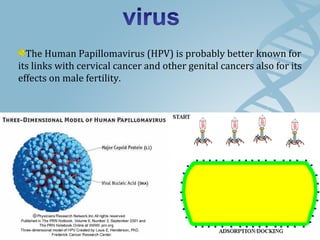
The Human Papillomavirus (HPV) is probably better known for
its links with cervical cancer and other genital cancers also for its
effects on male fertility.
Viral DNA from members of the Herpesviridae
family, such
as herpes simplex virus (HSV) and ,
cytomegalovirus
(CMV), Epstein-Barr virus (EBV), and human
herpes virus
(HHV) , has been detected in the semen of
asymptomatic
infertile patients .
In particular,HSV-2 and CMV,which are sexually
transmissible, have been extensively studied and
• Stress and Other Environmental Factors Affecting Fertility in
Men and Women:Overview by Andres Negro-Vilar (Environmental
Health Perspectives Supplements101 (Suppl. 2): 59-64 (1993)
• Environmental and occupational factors affecting fertility and
IVF success by Edward V.Younglai1, Alison C.Holloway and
Warren G.Foster (Human Reproduction Update, Vol.11, No.1 pp.
43–57, 2005 doi:10.1093/humupd/dmh055Advance Access
publication December 15, 2004.)
• http://www.parents.com/getting-
pregnant/infertility/causes/factors-affecting-fertility/.
• http://www.conceiveonline.com/articles/12-most-common-factors-
affecting-female-and-male-fertility.
• http://scholarsresearchlibrary.com/aasr-vol3-iss5/AASR-2011-3-5-
618-623.pdf.
Environmental factors affecting infertility

Environmental factors affecting infertility

  • 2.
    Infertility has oftenbeen defined as failure to achieve pregnancy within 1 year of unprotected intercourse. Delays in the time it takes to become pregnant or loss of pregnancy before term have been considered as evidence for sub-fertility. Reproductive function has been shown to be sensitive to changes in the physical, psychosocial and chemical environments.
  • 4.
    categories examples Physical Light,temperature, radiation Chemical Natural or synthetic Biological Viruses, microorganism Behavioral Stress, drug addiction Socioeconomic Nutrition, habitat, occupation
  • 5.
    Temperature: The enzymes requiredfor the production of sperm are very sensitive to heat. Men who frequently use hot tubs, wear tight pants, sit at a desk all day, or stand in front of a hot stove may cause heating their testicles to such a degree that they can’t make sperm and get their partners pregnant. “The reason that the testicles should be about 4 degrees cooler than the normal body temperature,”
  • 6.
    Being overweight: Bodyfat levels that are 10 to 15 percent above normal can overload the body with estrogen, throwing off the reproductive cycle. Being underweight: Body fat levels 10 to 15 percent below normal can completely shut down the reproductive process Age :By the time a woman is in her middle 30s, she has lost many of her viable eggs through menstruation and natural attrition. “The optimal age for a women to become pregnant, at least in terms of biology, is in her 20s,” (mostly women are affected by this factor).
  • 7.
    Although reproductive effectsof occupational exposure to hazardous chemicals have been well documented . Endocrine-disrupting chemicals (EDC) are synthetic and naturally occurring chemicals that cannot be classified by any unique physical or chemical properties but are characterized by their ability to mimic the effects of endogenous hormones. Specifically EDC can mimic and antogonize the action of endogenous hormones , induces the changes in steroid hormone level. These characteristics will leads to the harmful effect of human fertility.
  • 10.
    Other cases suchas, E. co li cause s ag g lutinatio n o f hum an spe rm ato zo a and thus, le ading to infe rtility. This study e valuate d if the ne g ative influe nce o f Esche richia co li o n the m o tility o f hum an spe rm ato zo a is a co nse q ue nce o f E. co li adhe sio n. Colony of Candida albicans can cause spe rm clum ping . 50 % o f the spe rm in the specimen undergo clumping, thereby greatly reducing the effective sperm motile count. Myco plasm a g e nitalium was de m o nstrate d to adhe re to allparts o f the spe rm ato zo a. Numerous
  • 11.
    The Human Papillomavirus(HPV) is probably better known for its links with cervical cancer and other genital cancers also for its effects on male fertility.
  • 13.
    Viral DNA frommembers of the Herpesviridae family, such as herpes simplex virus (HSV) and , cytomegalovirus (CMV), Epstein-Barr virus (EBV), and human herpes virus (HHV) , has been detected in the semen of asymptomatic infertile patients . In particular,HSV-2 and CMV,which are sexually transmissible, have been extensively studied and
  • 15.
    • Stress andOther Environmental Factors Affecting Fertility in Men and Women:Overview by Andres Negro-Vilar (Environmental Health Perspectives Supplements101 (Suppl. 2): 59-64 (1993) • Environmental and occupational factors affecting fertility and IVF success by Edward V.Younglai1, Alison C.Holloway and Warren G.Foster (Human Reproduction Update, Vol.11, No.1 pp. 43–57, 2005 doi:10.1093/humupd/dmh055Advance Access publication December 15, 2004.) • http://www.parents.com/getting- pregnant/infertility/causes/factors-affecting-fertility/. • http://www.conceiveonline.com/articles/12-most-common-factors- affecting-female-and-male-fertility. • http://scholarsresearchlibrary.com/aasr-vol3-iss5/AASR-2011-3-5- 618-623.pdf.