c o n s u l t a n t s a n d a u d i t o r s
sayervincent
Business
cases
made simple
◗ Introduction 3
◗ Aims of the business case 4
◗ Writing the business case 5
◗ Gaining support for the business case 11
◗ Updating the business case 14
◗ Conclusion 15
◗ References and further information 16
Acknowledgements
This guide was produced with help from the partners and staff at Sayer
Vincent, as well as support from staff and trustees of CFDG.
CFDG (Charity Finance Directors’ Group) is the professional body for
finance directors within the sector, and has nearly 1,600 members. CFDG
provides assistance to charities on a range of issues, such as accounting,
taxation, audit and other finance-related functions. CFDG’s mission is to
deliver services that are valued by members and enable those with financial
responsibility in the charity sector to develop and adopt best practice.
For more information go to www.cfdg.org.uk
Sayer Vincent only works with charities and not-for-profit organisations.
Our work focuses on making charities more effective through improved
infrastructure, reporting and governance. We help charities with mergers,
systems implementations and training. Charities appoint us as consultants,
internal auditors or external auditors. Working with a diverse portfolio of
charities, we deliver rapid insights into your issues and problems and help
you to find effective solutions to them.
For more information, go to www.sayervincent.co.uk
Published by CFDG
First published 2009
Copyright © CFDG and Sayer Vincent
All rights reserved
No part of this book may be reproduced by any means, or transmitted,
or translated into a machine language without prior permission in
writing from the publisher. Full acknowledgement of the author and
source must be given.
CFDG and Sayer Vincent shall not be liable for loss or damage arising
out of or in connection with the use of this publication. This is a
comprehensive limitation of liability that applies to all damages of any
kind, including, (without limitation), compensatory, direct, indirect or
consequential damages, loss of data, income or profit, loss of or
damage to property and claims of third parties.
c o n s u l t a n t s a n d a u d i t o r s
sayervincent
Business cases made simple 3
We all make decisions every day. These may be very simple, like
whether to have cereals or toast for breakfast. Or they could be more
complex, such as resigning from a job to return to studying with a
future goal in mind. Life is full of decisions and many of them contain
elements of uncertainty.
For an individual, decisions may be made based on past experiences or
advice from friends and family. A decision about what to have for
breakfast could be instantaneous based on what you find in the
cupboard. But some decisions may involve taking time to gather
information and attempting to balance the positives and negatives.
For organisations, decisions involving investment in IT tend to be of the
complex variety. The decision is likely to affect current and future
activities. A business case is a document that describes the need for
change and projects that will enable the change. Implementing projects
requires resources to be invested, including management and staff time
and money. There are many competing demands on an organisation’s
resources and some projects may not be worth this effort. Documenting
the need for change and how the change will be achieved in a business
case provides senior managers and trustees with information to
evaluate the project and understand the impact the project will have on
the organisation.
The business case also provides the framework for the approved project
and organisations refer to it throughout the project when people
suggest changes – typically to the scope of the project, timescale or
costs. It is helpful to review and update the business case at key points
to make sure that the reasons for the project are still valid and that it is
achieving what it set out to do.
This guide is to help you put together business cases to support good
decision-making, particularly for investment in IT. It suggests ways
which may help provide a structure to the decision-making process, and
for presenting this information in a way that makes decision-making
easier. A sound business case will help secure commitment and
engagement across the organisation and ultimately lead to a greater
chance of success for the project.
Introduction
Business cases made simple 4
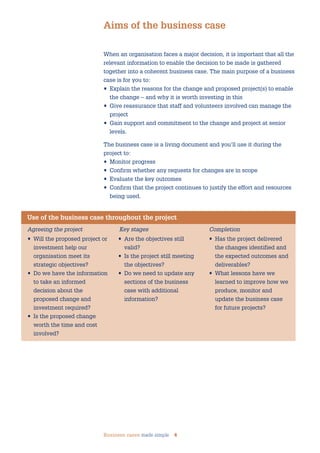
When an organisation faces a major decision, it is important that all the
relevant information to enable the decision to be made is gathered
together into a coherent business case. The main purpose of a business
case is for you to:
• Explain the reasons for the change and proposed project(s) to enable
the change – and why it is worth investing in this
• Give reassurance that staff and volunteers involved can manage the
project
• Gain support and commitment to the change and project at senior
levels.
The business case is a living document and you’ll use it during the
project to:
• Monitor progress
• Confirm whether any requests for changes are in scope
• Evaluate the key outcomes
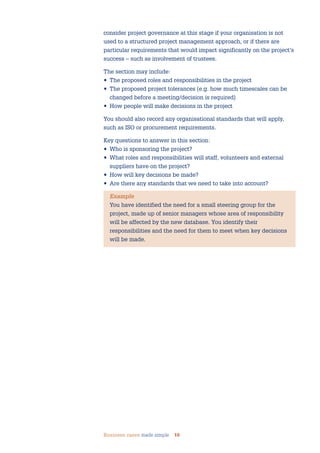
• Confirm that the project continues to justify the effort and resources
being used.
Aims of the business case
Use of the business case throughout the project
Agreeing the project Key stages Completion
• Will the proposed project or
investment help our
organisation meet its
strategic objectives?
• Do we have the information
to take an informed
decision about the
proposed change and
investment required?
• Is the proposed change
worth the time and cost
involved?
• Are the objectives still
valid?
• Is the project still meeting
the objectives?
• Do we need to update any
sections of the business
case with additional
information?
• Has the project delivered
the changes identified and
the expected outcomes and
deliverables?
• What lessons have we
learned to improve how we
produce, monitor and
update the business case
for future projects?
Business cases made simple 5
Usually a small group of people or one member of staff will write a
business case. The format of a document setting out a business case
can vary, and your organisation may have specific information
requirements for decision-making, but if the following components are
present, it will form a good basis for a collective decision.
Writing the business case
The document has a logical sequence:
1 Introduction
This is a short section that gives the aim of the business case. It
summarises the change and how this will be achieved. It can also
include the purpose of the business case, how it is structured, how and
when it was compiled, how it should be used, how it relates to any
other documents that have already been produced, and how it will be
updated as the project progresses.
Section Purpose for decision-makers
1 Introduction States the aim of the business case – the proposed change and
purpose of the project
2 Reasons Explains current issues and why the project is needed
3 Key outcomes and Highlights the expected immediate and long-term benefits of the
success criteria change
4 Options and costs Outlines the main options for addressing the issues, including
summary costs
5 Recommendation Expands on and justifies the recommended solution
The following sections are written based on the recommendation
6 Impact analysis Presents an assessment of the impact of the project on the
organisation including financial and cultural impact, and an
assessment of the organisation’s capability and readiness to carry
out the project
7 Risk assessment Summarises the key risks and how they will be managed
8 Outline plan Gives a high level plan of main activities, timescale and key decision
points
9 Project governance Shows how the project will be structured and levels of decision-
and organisational making; also includes any standards that need to be considered
standards
Business cases made simple 6
Key questions to answer in this section:
• What is the proposal?
• What is the scope of the change?
• What will be the main output?
Example
Currently you’re managing supporter contact details using an Access
database developed in-house, spreadsheets and paper records, and
you’d like to communicate with supporters more frequently and
efficiently. You expect to achieve that by using a new database; this
will involve a project to select and implement the database.
2 Reasons
This section explains the background to the proposed project, including
any work that you’ve carried out already. It is important to summarise
the strategic issues that the proposed project will address. You may
have supporting material gathered from meetings and workshops with
staff and volunteers and you could include this as an appendix.
Key questions to answer in this section:
• What is the problem you are trying to solve?
• What change is needed?
• Why does this need to happen now?
• What are the implications if your organisation doesn’t carry out the
change?
Example
Various members of staff are keeping their own records and some
supporters receive letters – often with similar information from
different people about your work. You need to manage
communications with supporters so that they remain committed to
your organisation. You are concerned that if you don’t change then
you will lose supporters.
3 Key outcomes and success criteria
This section describes the key outcomes and main benefits anticipated
from the change or decision. The benefits may be tangible and
quantifiable but could also be intangible. Where possible it is helpful to
provide measures which will be used during the project and afterwards
to assess the impact of what the project has achieved.
Key questions to answer in this section:
• How will the change contribute to the achievement of the strategic
objectives?
• Are there any services or events that are dependent on the
successful outcome of the project?
Business cases made simple 7
• What are the benefits – during and at the end of the project, and
longer term?
• What are the key success criteria? How will you know that the
project has achieved its aims?
Example
Overall benefits of your organisation having one system for supporter
information could be that you are able to build up a picture of your
supporters and manage communications with them more efficiently.
This could be measured by ensuring that all information is held in the
database and you receive fewer complaints.
4 Options and costs
This section describes the main options for addressing the issues. You
should examine each option in turn, as objectively as possible, and set
out:
• An overall description of the option
• An analysis of the extent to which the option could be expected to
achieve the key outcomes
• The inherent strengths of the option and the opportunities which the
option might present to the organisation
• The inherent weaknesses of the option and any risks to which the
option would expose the organisation
• The resourcing implications for the organisation, including:
– The likely implementation timescale
– The demand for staff/volunteer involvement
– The indicative external costs
– The likely on-going maintenance costs
Key questions to answer in this section:
• What are the main characteristics of each option?
• What is the timescale?
• What would be the internal and external costs?
• What are the pros and cons of each option?
Example
When considering purchasing a new database, options could include
developing your current database, carrying out a new bespoke
development or procuring an off-the-shelf, package-based solution.
5 Recommendation
This section describes the recommended option, including a summary
of the reasons why it is the most likely to achieve the key outcomes.
Key questions to answer in this section:
• Why is the recommended solution the best one for your organisation?
• What assumptions are you making?
Business cases made simple 8
Example
You may decide that the best option is to purchase an off-the-shelf,
package-based solution. You explain that the reasons for this
recommendation include having on-going support and maintenance
for the database. You assume that there are software packages
available that will meet your organisation’s needs.
6 Impact analysis
This section aims to provide an overall assessment of how the change
and the project will affect your organisation. The areas to consider
include:
• Financial impact: detailed costings for the project and budget
required, and expected return on investment
• Cultural impact: any change to, or reinforcement of, the
organisation’s values and approach
• Capability: an assessment of the organisation’s ability to carry out
the project in the proposed timescale, previous experience of change
projects, and overall commitment to the change
In this section you will need to include summary financial forecasts,
explaining the key assumptions you have made. You may include more
detailed financial forecasts in the appendices.
When considering the impact, it’s important to be aware of any
activities that will be affected during the project – for example, if staff
are helping with the project, does that affect their ability to carry out
their day-to-day responsibilities? You should also highlight any cost
savings as a result of the change.
Key questions to answer in this section:
• Do the benefits outweigh the costs?
• What is the financial impact of this decision?
• How much initial funding will be required?
• How will it affect the longer-term finances of the organisation?
• Will the change affect the values of the organisation?
• How does this affect overall ways of working (e.g. changing from
working in small offices to an open plan office)?
• Do people accept the change and will they be committed to it?
• What experience does the organisation have of this type of project?
• What lessons can be learned from previous projects?
Example
The financial forecasts include probable one-off costs such as new
equipment and software licences, and probable recurring costs, such
as support. You also include likely notional costs including time
required from staff and volunteers in selecting the database and
project activities.
Business cases made simple 9
7 Risk assessment
This section summarises the key risks that you’ve identified. The risks
cover those that could arise from the change, and those related to your
organisation’s ability to carry out the project. The section should refer
to a risk register which will analyse each risk in terms of likelihood and
of the degree to which the risk would, if realised, prevent any of the
key outcomes from being achieved. The risk register will record the
overall response to managing each risk and suggest mitigating
countermeasures should the risk be realised. You should also consider
any opportunity risks.
Key questions to answer in this section:
• What are the risks involved?
• What are the consequences of them materialising?
• Do you have contingency plans to help you deal with these risks?
• What opportunity risks might arise too?
Example
You identify the risk that staff may not have the time to help with the
project and that this could lead to delays. To manage this, you
identify the need to recruit temporary staff to work on the day to day
administration to free up staff time, although this will obviously have
cost implications and will therefore need to be factored into the costs
section.
8 Outline plan
This section is a high level project plan showing the main activities and
the overall timescale for the project, through to achievement of the key
outcomes. It’s helpful to divide this into stages. You should also make
sure that you include activities to manage the risks you’ve identified.
Key questions to answer in this section:
• What is the timetable for any decisions and the major stages of this
plan?
• Which staff and volunteers would need to be involved in the project,
how much time would they need to spend, and when?
Example
You identify the key stages as selecting the new database, purchasing
the equipment, developing the database, and staff/volunteer training.
9 Project governance and organisational standards
This section describes the governance framework (e.g. steering group,
project management, project team) that will support the project during
the subsequent stages. You could look at this in later stages after the
business case has been agreed. However, it is particularly useful to
Business cases made simple 10
consider project governance at this stage if your organisation is not
used to a structured project management approach, or if there are
particular requirements that would impact significantly on the project’s
success – such as involvement of trustees.
The section may include:
• The proposed roles and responsibilities in the project
• The proposed project tolerances (e.g. how much timescales can be
changed before a meeting/decision is required)
• How people will make decisions in the project
You should also record any organisational standards that will apply,
such as ISO or procurement requirements.
Key questions to answer in this section:
• Who is sponsoring the project?
• What roles and responsibilities will staff, volunteers and external
suppliers have on the project?
• How will key decisions be made?
• Are there any standards that we need to take into account?
Example
You have identified the need for a small steering group for the
project, made up of senior managers whose area of responsibility
will be affected by the new database. You identify their
responsibilities and the need for them to meet when key decisions
will be made.
Business cases made simple 11
The findings of proper consultation or research will be valuable in
supporting a decision that involves a long-term commitment or a
significant change in direction for the organisation. Sometimes
gathering information for the business case can be the easy part – it
can be harder to persuade people that the change is worth the effort. It
helps if you identify the “stakeholders” in the change project – they are
the people who have an interest in the project and can affect its
outcome – and discuss the project with them while you’re creating the
business case.
A good test is to consider the questions a sceptical friend might ask
and try to answer them as you write it. For example:
• What evidence do you have to suggest that there is a problem?
• How will what you propose address the problem?
• Have you tested your suggestion in a small way to see if your theory
is valid?
• What will you do if beneficiaries or funders do not like your proposal?
• Have you checked whether they consider this to be an appropriate
course of action?
• Do people support your idea?
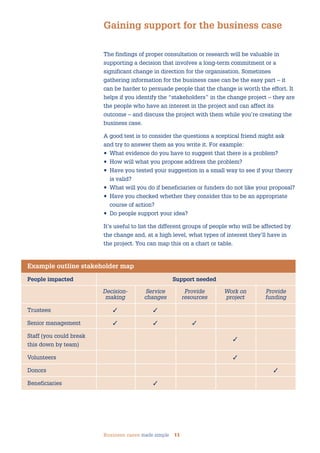
It’s useful to list the different groups of people who will be affected by
the change and, at a high level, what types of interest they’ll have in
the project. You can map this on a chart or table.
Gaining support for the business case
Example outline stakeholder map
People impacted Support needed
Decision- Service Provide Work on Provide
making changes resources project funding
Trustees ✓ ✓
Senior management ✓ ✓ ✓
Staff (you could break
this down by team)
✓
Volunteers ✓
Donors ✓
Beneficiaries ✓
Business cases made simple 12
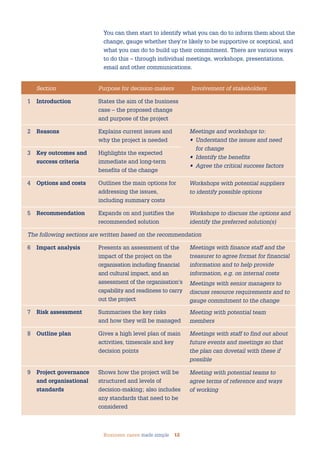
You can then start to identify what you can do to inform them about the
change, gauge whether they’re likely to be supportive or sceptical, and
what you can do to build up their commitment. There are various ways
to do this – through individual meetings, workshops, presentations,
email and other communications.
Meetings and workshops to:
• Understand the issues and need
for change
• Identify the benefits
• Agree the critical success factors
Workshops with potential suppliers
to identify possible options
Workshops to discuss the options and
identify the preferred solution(s)
Meetings with finance staff and the
treasurer to agree format for financial
information and to help provide
information, e.g. on internal costs
Meetings with senior managers to
discuss resource requirements and to
gauge commitment to the change
Meeting with potential team
members
Meetings with staff to find out about
future events and meetings so that
the plan can dovetail with these if
possible
Meeting with potential teams to
agree terms of reference and ways
of working
Section Purpose for decision-makers Involvement of stakeholders
1 Introduction States the aim of the business
case – the proposed change
and purpose of the project
2 Reasons Explains current issues and
why the project is needed
3 Key outcomes and Highlights the expected
success criteria immediate and long-term
benefits of the change
4 Options and costs Outlines the main options for
addressing the issues,
including summary costs
5 Recommendation Expands on and justifies the
recommended solution
The following sections are written based on the recommendation
6 Impact analysis Presents an assessment of the
impact of the project on the
organisation including financial
and cultural impact, and an
assessment of the organisation’s
capability and readiness to carry
out the project
7 Risk assessment Summarises the key risks
and how they will be managed
8 Outline plan Gives a high level plan of main
activities, timescale and key
decision points
9 Project governance Shows how the project will be
and organisational structured and levels of
standards decision-making; also includes
any standards that need to be
considered
Business cases made simple 13
It’s worth the effort in building up a good relationship with decision-
makers so that they have a good understanding of what you’re aiming
to achieve, and will trust and support you throughout the project. By
involving stakeholders you’ll help them build up ownership and
commitment to the change.
Key questions to answer:
• Who will this decision affect?
• What will be the impact on beneficiaries, staff, donors and others?
• Have you asked them about this decision or researched the effects on
them?
• What support will you need from them?
• What actions do you need to take to gain this support?
Business cases made simple 14
After the project has been approved, you’ll find that the business case
needs to be updated with new information. You’ll need to review the
document to make sure that it’s still relevant – that the needs and the
solution are still valid. Senior managers will want confirmation that the
project is still viable and achievable and that the investment is still
worth it.
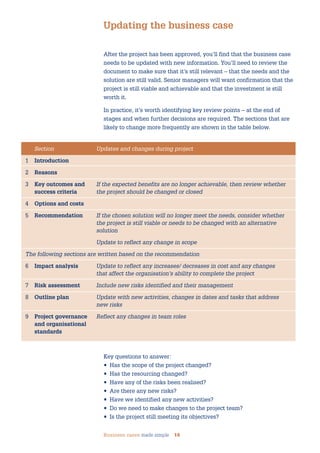
In practice, it’s worth identifying key review points – at the end of
stages and when further decisions are required. The sections that are
likely to change more frequently are shown in the table below.
Updating the business case
Section Updates and changes during project
1 Introduction
2 Reasons
3 Key outcomes and If the expected benefits are no longer achievable, then review whether
success criteria the project should be changed or closed
4 Options and costs
5 Recommendation If the chosen solution will no longer meet the needs, consider whether
the project is still viable or needs to be changed with an alternative
solution
Update to reflect any change in scope
The following sections are written based on the recommendation
6 Impact analysis Update to reflect any increases/ decreases in cost and any changes
that affect the organisation’s ability to complete the project
7 Risk assessment Include new risks identified and their management
8 Outline plan Update with new activities, changes in dates and tasks that address
new risks
9 Project governance Reflect any changes in team roles
and organisational
standards
Key questions to answer:
• Has the scope of the project changed?
• Has the resourcing changed?
• Have any of the risks been realised?
• Are there any new risks?
• Have we identified any new activities?
• Do we need to make changes to the project team?
• Is the project still meeting its objectives?
Business cases made simple 15
Conclusion
We all make decisions every day. However, for organisations, the way
in which decisions are made and ensuring that all risks in respect of a
particular decision have been considered, including financial risks, can
be critical to their long-term survival.
While a risk can be a threat to an organisation, an appropriate level of
risk-taking may also create opportunities. Using a structured approach
to discussing and categorising risk within your organisation, together
with the appropriate tools to assess any financial risk, should enable
decision makers to be presented with a coherent business case,
allowing an informed decision to be made.
The construction of the business case for a proposed activity is an
important and valuable process in itself. It can greatly enhance the
quality of the project plan and ensure that you have support for the
project before the implementation begins. You will then need to review
the business case at key stages to make sure that the project remains
viable and is still achieving its objectives. You’ll use it at the end of the
project to compare achievements against the original aims.
Business cases made simple 16
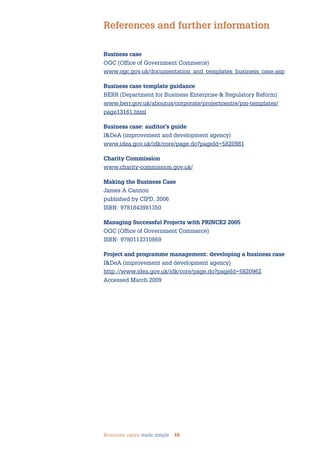
References and further information
Business case
OGC (Office of Government Commerce)
www.ogc.gov.uk/documentation_and_templates_business_case.asp
Business case template guidance
BERR (Department for Business Enterprise & Regulatory Reform)
www.berr.gov.uk/aboutus/corporate/projectcentre/pm-templates/
page13161.html
Business case: auditor’s guide
I&DeA (improvement and development agency)
www.idea.gov.uk/idk/core/page.do?pageId=5820981
Charity Commission
www.charity-commission.gov.uk/
Making the Business Case
James A Cannon
published by CIPD, 2006
ISBN: 9781843981350
Managing Successful Projects with PRINCE2 2005
OGC (Office of Government Commerce)
ISBN: 9780113310869
Project and programme management: developing a business case
I&DeA (improvement and development agency)
http://www.idea.gov.uk/idk/core/page.do?pageId=5820962
Accessed March 2009
Business cases made simple 17
made simple guides
Made Simple guides are aimed at finance professionals and other
managers working in charities. They cover technical areas such
as tax and VAT treatments as well as information management
areas and aim to provide practical guidance to busy managers
and trustees in charities.
The content of guides is correct at the time of going to print, but
inevitably legal changes, case law and new financial reporting
standards will change. You are therefore advised to check any
particular actions you plan to take with the appropriate authority
before committing yourself. No responsibility is accepted by the
authors for reliance placed on the content of this guide.
Other guides in the series
Risk assessment made simple
Reserves policies made simple
Trading issues made simple
Subsidiaries made simple
VAT made simple
Grants and contracts made simple
Pricing made simple
Gift aid made simple
Tax effective giving made simple
Employee and volunteer taxation made simple
Accounting software made simple
Mergers made simple
Information security management made simple
IT strategy made simple

Business cases made_simple

  • 1.
    c o ns u l t a n t s a n d a u d i t o r s sayervincent Business cases made simple ◗ Introduction 3 ◗ Aims of the business case 4 ◗ Writing the business case 5 ◗ Gaining support for the business case 11 ◗ Updating the business case 14 ◗ Conclusion 15 ◗ References and further information 16
  • 2.
    Acknowledgements This guide wasproduced with help from the partners and staff at Sayer Vincent, as well as support from staff and trustees of CFDG. CFDG (Charity Finance Directors’ Group) is the professional body for finance directors within the sector, and has nearly 1,600 members. CFDG provides assistance to charities on a range of issues, such as accounting, taxation, audit and other finance-related functions. CFDG’s mission is to deliver services that are valued by members and enable those with financial responsibility in the charity sector to develop and adopt best practice. For more information go to www.cfdg.org.uk Sayer Vincent only works with charities and not-for-profit organisations. Our work focuses on making charities more effective through improved infrastructure, reporting and governance. We help charities with mergers, systems implementations and training. Charities appoint us as consultants, internal auditors or external auditors. Working with a diverse portfolio of charities, we deliver rapid insights into your issues and problems and help you to find effective solutions to them. For more information, go to www.sayervincent.co.uk Published by CFDG First published 2009 Copyright © CFDG and Sayer Vincent All rights reserved No part of this book may be reproduced by any means, or transmitted, or translated into a machine language without prior permission in writing from the publisher. Full acknowledgement of the author and source must be given. CFDG and Sayer Vincent shall not be liable for loss or damage arising out of or in connection with the use of this publication. This is a comprehensive limitation of liability that applies to all damages of any kind, including, (without limitation), compensatory, direct, indirect or consequential damages, loss of data, income or profit, loss of or damage to property and claims of third parties. c o n s u l t a n t s a n d a u d i t o r s sayervincent
  • 3.
    Business cases madesimple 3 We all make decisions every day. These may be very simple, like whether to have cereals or toast for breakfast. Or they could be more complex, such as resigning from a job to return to studying with a future goal in mind. Life is full of decisions and many of them contain elements of uncertainty. For an individual, decisions may be made based on past experiences or advice from friends and family. A decision about what to have for breakfast could be instantaneous based on what you find in the cupboard. But some decisions may involve taking time to gather information and attempting to balance the positives and negatives. For organisations, decisions involving investment in IT tend to be of the complex variety. The decision is likely to affect current and future activities. A business case is a document that describes the need for change and projects that will enable the change. Implementing projects requires resources to be invested, including management and staff time and money. There are many competing demands on an organisation’s resources and some projects may not be worth this effort. Documenting the need for change and how the change will be achieved in a business case provides senior managers and trustees with information to evaluate the project and understand the impact the project will have on the organisation. The business case also provides the framework for the approved project and organisations refer to it throughout the project when people suggest changes – typically to the scope of the project, timescale or costs. It is helpful to review and update the business case at key points to make sure that the reasons for the project are still valid and that it is achieving what it set out to do. This guide is to help you put together business cases to support good decision-making, particularly for investment in IT. It suggests ways which may help provide a structure to the decision-making process, and for presenting this information in a way that makes decision-making easier. A sound business case will help secure commitment and engagement across the organisation and ultimately lead to a greater chance of success for the project. Introduction
  • 4.
    Business cases madesimple 4 When an organisation faces a major decision, it is important that all the relevant information to enable the decision to be made is gathered together into a coherent business case. The main purpose of a business case is for you to: • Explain the reasons for the change and proposed project(s) to enable the change – and why it is worth investing in this • Give reassurance that staff and volunteers involved can manage the project • Gain support and commitment to the change and project at senior levels. The business case is a living document and you’ll use it during the project to: • Monitor progress • Confirm whether any requests for changes are in scope • Evaluate the key outcomes • Confirm that the project continues to justify the effort and resources being used. Aims of the business case Use of the business case throughout the project Agreeing the project Key stages Completion • Will the proposed project or investment help our organisation meet its strategic objectives? • Do we have the information to take an informed decision about the proposed change and investment required? • Is the proposed change worth the time and cost involved? • Are the objectives still valid? • Is the project still meeting the objectives? • Do we need to update any sections of the business case with additional information? • Has the project delivered the changes identified and the expected outcomes and deliverables? • What lessons have we learned to improve how we produce, monitor and update the business case for future projects?
  • 5.
    Business cases madesimple 5 Usually a small group of people or one member of staff will write a business case. The format of a document setting out a business case can vary, and your organisation may have specific information requirements for decision-making, but if the following components are present, it will form a good basis for a collective decision. Writing the business case The document has a logical sequence: 1 Introduction This is a short section that gives the aim of the business case. It summarises the change and how this will be achieved. It can also include the purpose of the business case, how it is structured, how and when it was compiled, how it should be used, how it relates to any other documents that have already been produced, and how it will be updated as the project progresses. Section Purpose for decision-makers 1 Introduction States the aim of the business case – the proposed change and purpose of the project 2 Reasons Explains current issues and why the project is needed 3 Key outcomes and Highlights the expected immediate and long-term benefits of the success criteria change 4 Options and costs Outlines the main options for addressing the issues, including summary costs 5 Recommendation Expands on and justifies the recommended solution The following sections are written based on the recommendation 6 Impact analysis Presents an assessment of the impact of the project on the organisation including financial and cultural impact, and an assessment of the organisation’s capability and readiness to carry out the project 7 Risk assessment Summarises the key risks and how they will be managed 8 Outline plan Gives a high level plan of main activities, timescale and key decision points 9 Project governance Shows how the project will be structured and levels of decision- and organisational making; also includes any standards that need to be considered standards
  • 6.
    Business cases madesimple 6 Key questions to answer in this section: • What is the proposal? • What is the scope of the change? • What will be the main output? Example Currently you’re managing supporter contact details using an Access database developed in-house, spreadsheets and paper records, and you’d like to communicate with supporters more frequently and efficiently. You expect to achieve that by using a new database; this will involve a project to select and implement the database. 2 Reasons This section explains the background to the proposed project, including any work that you’ve carried out already. It is important to summarise the strategic issues that the proposed project will address. You may have supporting material gathered from meetings and workshops with staff and volunteers and you could include this as an appendix. Key questions to answer in this section: • What is the problem you are trying to solve? • What change is needed? • Why does this need to happen now? • What are the implications if your organisation doesn’t carry out the change? Example Various members of staff are keeping their own records and some supporters receive letters – often with similar information from different people about your work. You need to manage communications with supporters so that they remain committed to your organisation. You are concerned that if you don’t change then you will lose supporters. 3 Key outcomes and success criteria This section describes the key outcomes and main benefits anticipated from the change or decision. The benefits may be tangible and quantifiable but could also be intangible. Where possible it is helpful to provide measures which will be used during the project and afterwards to assess the impact of what the project has achieved. Key questions to answer in this section: • How will the change contribute to the achievement of the strategic objectives? • Are there any services or events that are dependent on the successful outcome of the project?
  • 7.
    Business cases madesimple 7 • What are the benefits – during and at the end of the project, and longer term? • What are the key success criteria? How will you know that the project has achieved its aims? Example Overall benefits of your organisation having one system for supporter information could be that you are able to build up a picture of your supporters and manage communications with them more efficiently. This could be measured by ensuring that all information is held in the database and you receive fewer complaints. 4 Options and costs This section describes the main options for addressing the issues. You should examine each option in turn, as objectively as possible, and set out: • An overall description of the option • An analysis of the extent to which the option could be expected to achieve the key outcomes • The inherent strengths of the option and the opportunities which the option might present to the organisation • The inherent weaknesses of the option and any risks to which the option would expose the organisation • The resourcing implications for the organisation, including: – The likely implementation timescale – The demand for staff/volunteer involvement – The indicative external costs – The likely on-going maintenance costs Key questions to answer in this section: • What are the main characteristics of each option? • What is the timescale? • What would be the internal and external costs? • What are the pros and cons of each option? Example When considering purchasing a new database, options could include developing your current database, carrying out a new bespoke development or procuring an off-the-shelf, package-based solution. 5 Recommendation This section describes the recommended option, including a summary of the reasons why it is the most likely to achieve the key outcomes. Key questions to answer in this section: • Why is the recommended solution the best one for your organisation? • What assumptions are you making?
  • 8.
    Business cases madesimple 8 Example You may decide that the best option is to purchase an off-the-shelf, package-based solution. You explain that the reasons for this recommendation include having on-going support and maintenance for the database. You assume that there are software packages available that will meet your organisation’s needs. 6 Impact analysis This section aims to provide an overall assessment of how the change and the project will affect your organisation. The areas to consider include: • Financial impact: detailed costings for the project and budget required, and expected return on investment • Cultural impact: any change to, or reinforcement of, the organisation’s values and approach • Capability: an assessment of the organisation’s ability to carry out the project in the proposed timescale, previous experience of change projects, and overall commitment to the change In this section you will need to include summary financial forecasts, explaining the key assumptions you have made. You may include more detailed financial forecasts in the appendices. When considering the impact, it’s important to be aware of any activities that will be affected during the project – for example, if staff are helping with the project, does that affect their ability to carry out their day-to-day responsibilities? You should also highlight any cost savings as a result of the change. Key questions to answer in this section: • Do the benefits outweigh the costs? • What is the financial impact of this decision? • How much initial funding will be required? • How will it affect the longer-term finances of the organisation? • Will the change affect the values of the organisation? • How does this affect overall ways of working (e.g. changing from working in small offices to an open plan office)? • Do people accept the change and will they be committed to it? • What experience does the organisation have of this type of project? • What lessons can be learned from previous projects? Example The financial forecasts include probable one-off costs such as new equipment and software licences, and probable recurring costs, such as support. You also include likely notional costs including time required from staff and volunteers in selecting the database and project activities.
  • 9.
    Business cases madesimple 9 7 Risk assessment This section summarises the key risks that you’ve identified. The risks cover those that could arise from the change, and those related to your organisation’s ability to carry out the project. The section should refer to a risk register which will analyse each risk in terms of likelihood and of the degree to which the risk would, if realised, prevent any of the key outcomes from being achieved. The risk register will record the overall response to managing each risk and suggest mitigating countermeasures should the risk be realised. You should also consider any opportunity risks. Key questions to answer in this section: • What are the risks involved? • What are the consequences of them materialising? • Do you have contingency plans to help you deal with these risks? • What opportunity risks might arise too? Example You identify the risk that staff may not have the time to help with the project and that this could lead to delays. To manage this, you identify the need to recruit temporary staff to work on the day to day administration to free up staff time, although this will obviously have cost implications and will therefore need to be factored into the costs section. 8 Outline plan This section is a high level project plan showing the main activities and the overall timescale for the project, through to achievement of the key outcomes. It’s helpful to divide this into stages. You should also make sure that you include activities to manage the risks you’ve identified. Key questions to answer in this section: • What is the timetable for any decisions and the major stages of this plan? • Which staff and volunteers would need to be involved in the project, how much time would they need to spend, and when? Example You identify the key stages as selecting the new database, purchasing the equipment, developing the database, and staff/volunteer training. 9 Project governance and organisational standards This section describes the governance framework (e.g. steering group, project management, project team) that will support the project during the subsequent stages. You could look at this in later stages after the business case has been agreed. However, it is particularly useful to
  • 10.
    Business cases madesimple 10 consider project governance at this stage if your organisation is not used to a structured project management approach, or if there are particular requirements that would impact significantly on the project’s success – such as involvement of trustees. The section may include: • The proposed roles and responsibilities in the project • The proposed project tolerances (e.g. how much timescales can be changed before a meeting/decision is required) • How people will make decisions in the project You should also record any organisational standards that will apply, such as ISO or procurement requirements. Key questions to answer in this section: • Who is sponsoring the project? • What roles and responsibilities will staff, volunteers and external suppliers have on the project? • How will key decisions be made? • Are there any standards that we need to take into account? Example You have identified the need for a small steering group for the project, made up of senior managers whose area of responsibility will be affected by the new database. You identify their responsibilities and the need for them to meet when key decisions will be made.
  • 11.
    Business cases madesimple 11 The findings of proper consultation or research will be valuable in supporting a decision that involves a long-term commitment or a significant change in direction for the organisation. Sometimes gathering information for the business case can be the easy part – it can be harder to persuade people that the change is worth the effort. It helps if you identify the “stakeholders” in the change project – they are the people who have an interest in the project and can affect its outcome – and discuss the project with them while you’re creating the business case. A good test is to consider the questions a sceptical friend might ask and try to answer them as you write it. For example: • What evidence do you have to suggest that there is a problem? • How will what you propose address the problem? • Have you tested your suggestion in a small way to see if your theory is valid? • What will you do if beneficiaries or funders do not like your proposal? • Have you checked whether they consider this to be an appropriate course of action? • Do people support your idea? It’s useful to list the different groups of people who will be affected by the change and, at a high level, what types of interest they’ll have in the project. You can map this on a chart or table. Gaining support for the business case Example outline stakeholder map People impacted Support needed Decision- Service Provide Work on Provide making changes resources project funding Trustees ✓ ✓ Senior management ✓ ✓ ✓ Staff (you could break this down by team) ✓ Volunteers ✓ Donors ✓ Beneficiaries ✓
  • 12.
    Business cases madesimple 12 You can then start to identify what you can do to inform them about the change, gauge whether they’re likely to be supportive or sceptical, and what you can do to build up their commitment. There are various ways to do this – through individual meetings, workshops, presentations, email and other communications. Meetings and workshops to: • Understand the issues and need for change • Identify the benefits • Agree the critical success factors Workshops with potential suppliers to identify possible options Workshops to discuss the options and identify the preferred solution(s) Meetings with finance staff and the treasurer to agree format for financial information and to help provide information, e.g. on internal costs Meetings with senior managers to discuss resource requirements and to gauge commitment to the change Meeting with potential team members Meetings with staff to find out about future events and meetings so that the plan can dovetail with these if possible Meeting with potential teams to agree terms of reference and ways of working Section Purpose for decision-makers Involvement of stakeholders 1 Introduction States the aim of the business case – the proposed change and purpose of the project 2 Reasons Explains current issues and why the project is needed 3 Key outcomes and Highlights the expected success criteria immediate and long-term benefits of the change 4 Options and costs Outlines the main options for addressing the issues, including summary costs 5 Recommendation Expands on and justifies the recommended solution The following sections are written based on the recommendation 6 Impact analysis Presents an assessment of the impact of the project on the organisation including financial and cultural impact, and an assessment of the organisation’s capability and readiness to carry out the project 7 Risk assessment Summarises the key risks and how they will be managed 8 Outline plan Gives a high level plan of main activities, timescale and key decision points 9 Project governance Shows how the project will be and organisational structured and levels of standards decision-making; also includes any standards that need to be considered
  • 13.
    Business cases madesimple 13 It’s worth the effort in building up a good relationship with decision- makers so that they have a good understanding of what you’re aiming to achieve, and will trust and support you throughout the project. By involving stakeholders you’ll help them build up ownership and commitment to the change. Key questions to answer: • Who will this decision affect? • What will be the impact on beneficiaries, staff, donors and others? • Have you asked them about this decision or researched the effects on them? • What support will you need from them? • What actions do you need to take to gain this support?
  • 14.
    Business cases madesimple 14 After the project has been approved, you’ll find that the business case needs to be updated with new information. You’ll need to review the document to make sure that it’s still relevant – that the needs and the solution are still valid. Senior managers will want confirmation that the project is still viable and achievable and that the investment is still worth it. In practice, it’s worth identifying key review points – at the end of stages and when further decisions are required. The sections that are likely to change more frequently are shown in the table below. Updating the business case Section Updates and changes during project 1 Introduction 2 Reasons 3 Key outcomes and If the expected benefits are no longer achievable, then review whether success criteria the project should be changed or closed 4 Options and costs 5 Recommendation If the chosen solution will no longer meet the needs, consider whether the project is still viable or needs to be changed with an alternative solution Update to reflect any change in scope The following sections are written based on the recommendation 6 Impact analysis Update to reflect any increases/ decreases in cost and any changes that affect the organisation’s ability to complete the project 7 Risk assessment Include new risks identified and their management 8 Outline plan Update with new activities, changes in dates and tasks that address new risks 9 Project governance Reflect any changes in team roles and organisational standards Key questions to answer: • Has the scope of the project changed? • Has the resourcing changed? • Have any of the risks been realised? • Are there any new risks? • Have we identified any new activities? • Do we need to make changes to the project team? • Is the project still meeting its objectives?
  • 15.
    Business cases madesimple 15 Conclusion We all make decisions every day. However, for organisations, the way in which decisions are made and ensuring that all risks in respect of a particular decision have been considered, including financial risks, can be critical to their long-term survival. While a risk can be a threat to an organisation, an appropriate level of risk-taking may also create opportunities. Using a structured approach to discussing and categorising risk within your organisation, together with the appropriate tools to assess any financial risk, should enable decision makers to be presented with a coherent business case, allowing an informed decision to be made. The construction of the business case for a proposed activity is an important and valuable process in itself. It can greatly enhance the quality of the project plan and ensure that you have support for the project before the implementation begins. You will then need to review the business case at key stages to make sure that the project remains viable and is still achieving its objectives. You’ll use it at the end of the project to compare achievements against the original aims.
  • 16.
    Business cases madesimple 16 References and further information Business case OGC (Office of Government Commerce) www.ogc.gov.uk/documentation_and_templates_business_case.asp Business case template guidance BERR (Department for Business Enterprise & Regulatory Reform) www.berr.gov.uk/aboutus/corporate/projectcentre/pm-templates/ page13161.html Business case: auditor’s guide I&DeA (improvement and development agency) www.idea.gov.uk/idk/core/page.do?pageId=5820981 Charity Commission www.charity-commission.gov.uk/ Making the Business Case James A Cannon published by CIPD, 2006 ISBN: 9781843981350 Managing Successful Projects with PRINCE2 2005 OGC (Office of Government Commerce) ISBN: 9780113310869 Project and programme management: developing a business case I&DeA (improvement and development agency) http://www.idea.gov.uk/idk/core/page.do?pageId=5820962 Accessed March 2009
  • 17.
    Business cases madesimple 17 made simple guides Made Simple guides are aimed at finance professionals and other managers working in charities. They cover technical areas such as tax and VAT treatments as well as information management areas and aim to provide practical guidance to busy managers and trustees in charities. The content of guides is correct at the time of going to print, but inevitably legal changes, case law and new financial reporting standards will change. You are therefore advised to check any particular actions you plan to take with the appropriate authority before committing yourself. No responsibility is accepted by the authors for reliance placed on the content of this guide. Other guides in the series Risk assessment made simple Reserves policies made simple Trading issues made simple Subsidiaries made simple VAT made simple Grants and contracts made simple Pricing made simple Gift aid made simple Tax effective giving made simple Employee and volunteer taxation made simple Accounting software made simple Mergers made simple Information security management made simple IT strategy made simple