Information Handling for
      Researchers
     Towards a More
  Cohesive Environment
       Sheila Corrall
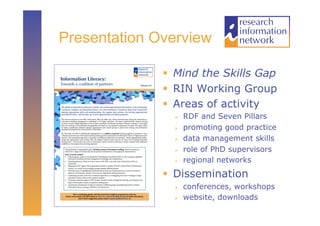
Presentation Overview

                Mind the Skills Gap
                RIN Working Group
                Areas of activity
                    RDF and Seven Pillars
                    promoting good practice
                    data management skills
                    role of PhD supervisors
                    regional networks
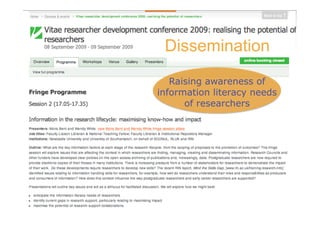
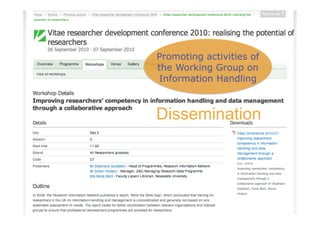
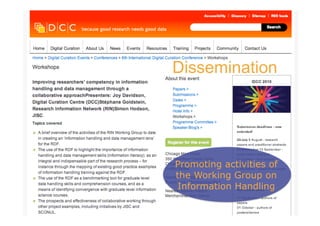
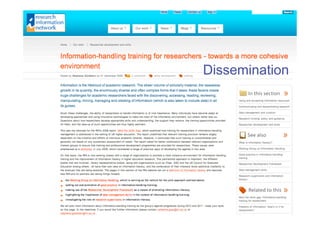
                Dissemination
                    conferences, workshops
                    website, downloads
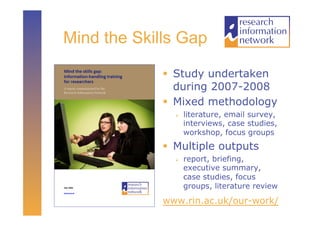
Mind the Skills Gap

               Study undertaken
                during 2007-2008
               Mixed methodology
                   literature, email survey,
                    interviews, case studies,
                    workshop, focus groups
               Multiple outputs
                   report, briefing,
                    executive summary,
                    case studies, focus
                    groups, literature review
             www.rin.ac.uk/our-work/
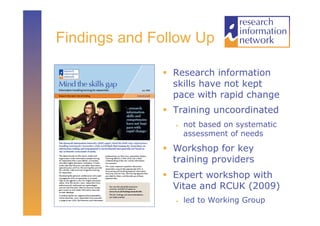
Findings and Follow Up

                Research information
                 skills have not kept
                 pace with rapid change
                Training uncoordinated
                    not based on systematic
                     assessment of needs

                Workshop for key
                 training providers
                Expert workshop with
                 Vitae and RCUK (2009)
                    led to Working Group
A New Advocacy Group

Working Group on Information Handling
Terms of reference
•    act as a focal point for discussion of the development
     of information-handling training for researchers in HE
•    raise profile of such training in context of professional
     development for researchers at all career stages
•    advocate for greater coordination and a more strategic
     approach to the provision of training across the UK
•    become a collective interlocutor for research funders
     and other agencies with an interest in such training
•    initiate and disseminate work to develop evidence
     base and advance policy and strategy at national level
•    prepare joint responses to consultation exercises
A Coalition of Partners

Stakeholder organisations in the Working Group
  BAILER                   JISC
  British Library          JORUM
  CILIP Information        RIN
   Literacy Group           RLUK
  Digital Curation         SCONUL WG on IL
   Centre
                            UKCGE
  HE Academy
                            UUK
  Information Literacy
   Website                  Vitae
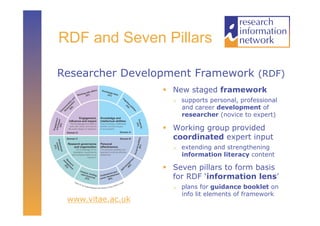
RDF and Seven Pillars

Researcher Development Framework (RDF)
                     New staged framework
                         supports personal, professional
                          and career development of
                          researcher (novice to expert)

                     Working group provided
                      coordinated expert input
                         extending and strengthening
                          information literacy content

                     Seven pillars to form basis
                      for RDF ‘information lens’
                         plans for guidance booklet on
                          info lit elements of framework
 www.vitae.ac.uk
Promoting Good Practice

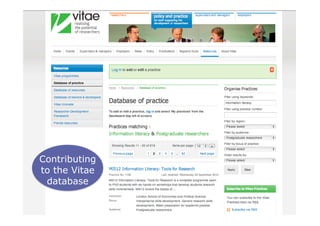
  Collecting examples of training courses and
   learning resources for the Vitae database
       see www.vitae.ac.uk/policy-practice/34837/
        Database-of-practice.htm
  Working with relevant stakeholders towards
   greater coordination and a strategic approach
       e.g. Information Literacy Website, JORUM, projects
  Exploring ways of encouraging more deposits
   to facilitate resource-sharing and re-use
  Investigating means of improving facilities for
   effective search and retrieval of resources
       e.g. creating or adapting a taxonomy and thesaurus
Contributing
to the Vitae
 database
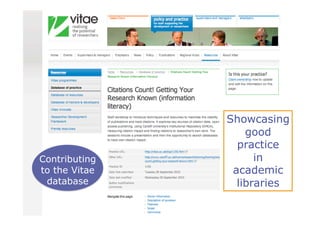
Showcasing
                   good
                 practice
Contributing         in
to the Vitae    academic
 database        libraries
Data Management and
  Information Literacy

Data Management Skills Support Initiative
Summary of aims and objectives
  facilitate use of the Seven Pillars Model and RDF to
   plan data management skills development and training
  test effectiveness of tools in mapping and describing
   DM skills and skills development paths for PG courses
  analyse and synthesise training needs and approaches
  assess tools in relation to career stages and discipline-
   specific needs identified via the JISC RDMTrain projects
  assist RDMTrain projects in describing their training
   materials and depositing them in relevant repositories
  produce guidance and recommendations for educators,
   professional bodies, SCONUL, Vitae, JISC and others
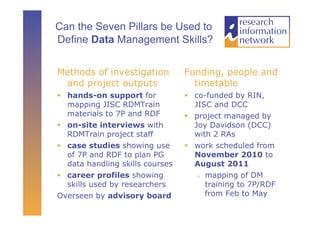
Can the Seven Pillars be Used to
Define Data Management Skills?


Methods of investigation          Funding, people and
 and project outputs                timetable
  hands-on support for             co-funded by RIN,
   mapping JISC RDMTrain             JISC and DCC
   materials to 7P and RDF          project managed by
  on-site interviews with           Joy Davidson (DCC)
   RDMTrain project staff            with 2 RAs
  case studies showing use         work scheduled from
   of 7P and RDF to plan PG          November 2010 to
   data handling skills courses      August 2011
  career profiles showing              mapping of DM

   skills used by researchers            training to 7P/RDF
Overseen by advisory board               from Feb to May
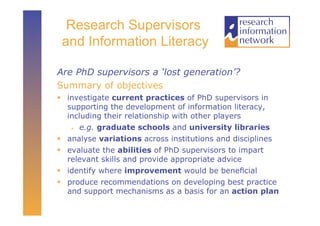
Research Supervisors
 and Information Literacy

Are PhD supervisors a ‘lost generation’?
Summary of objectives
  investigate current practices of PhD supervisors in
   supporting the development of information literacy,
   including their relationship with other players
      e.g. graduate schools and university libraries

  analyse variations across institutions and disciplines
  evaluate the abilities of PhD supervisors to impart
   relevant skills and provide appropriate advice
  identify where improvement would be beneficial
  produce recommendations on developing best practice
   and support mechanisms as a basis for an action plan
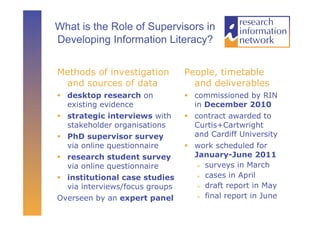
What is the Role of Supervisors in
Developing Information Literacy?


Methods of investigation         People, timetable
 and sources of data               and deliverables
  desktop research on             commissioned by RIN
   existing evidence                in December 2010
  strategic interviews with       contract awarded to
   stakeholder organisations        Curtis+Cartwright
  PhD supervisor survey            and Cardiff University
   via online questionnaire        work scheduled for
  research student survey          January-June 2011
   via online questionnaire            surveys in March

                                       cases in April
  institutional case studies
   via interviews/focus groups         draft report in May

                                       final report in June
Overseen by an expert panel
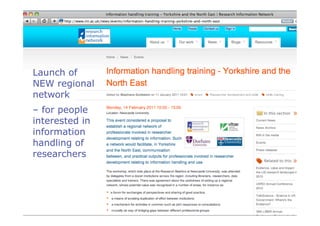
Launch of
NEW regional
network
– for people
interested in
information
handling of
researchers
Dissemination
   Raising awareness of
information literacy needs
      of researchers
Promoting activities of
the Working Group on
Information Handling


Dissemination
Dissemination


Promoting activities of
the Working Group on
Information Handling
Dissemination
Information Handling
Training for Researchers

Towards a More Cohesive Environment
  For further details, downloads and updates on
   our activities, please visit
  www.rin.ac.uk/info-handling-training
  For any questions or comments arising from
   the presentation, please email
  s.m.corrall@sheffield.ac.uk

  Thank you for listening!

Corrall - Information-handling training for researchers: towards a more cohesive environment

  • 1.
    Information Handling for Researchers Towards a More Cohesive Environment Sheila Corrall
  • 2.
    Presentation Overview   Mind the Skills Gap   RIN Working Group   Areas of activity   RDF and Seven Pillars   promoting good practice   data management skills   role of PhD supervisors   regional networks   Dissemination   conferences, workshops   website, downloads
  • 3.
    Mind the SkillsGap   Study undertaken during 2007-2008   Mixed methodology   literature, email survey, interviews, case studies, workshop, focus groups   Multiple outputs   report, briefing, executive summary, case studies, focus groups, literature review www.rin.ac.uk/our-work/
  • 4.
    Findings and FollowUp   Research information skills have not kept pace with rapid change   Training uncoordinated   not based on systematic assessment of needs   Workshop for key training providers   Expert workshop with Vitae and RCUK (2009)   led to Working Group
  • 5.
    A New AdvocacyGroup Working Group on Information Handling Terms of reference •  act as a focal point for discussion of the development of information-handling training for researchers in HE •  raise profile of such training in context of professional development for researchers at all career stages •  advocate for greater coordination and a more strategic approach to the provision of training across the UK •  become a collective interlocutor for research funders and other agencies with an interest in such training •  initiate and disseminate work to develop evidence base and advance policy and strategy at national level •  prepare joint responses to consultation exercises
  • 6.
    A Coalition ofPartners Stakeholder organisations in the Working Group   BAILER   JISC   British Library   JORUM   CILIP Information   RIN Literacy Group   RLUK   Digital Curation   SCONUL WG on IL Centre   UKCGE   HE Academy   UUK   Information Literacy Website   Vitae
  • 7.
    RDF and SevenPillars Researcher Development Framework (RDF)   New staged framework   supports personal, professional and career development of researcher (novice to expert)   Working group provided coordinated expert input   extending and strengthening information literacy content   Seven pillars to form basis for RDF ‘information lens’   plans for guidance booklet on info lit elements of framework www.vitae.ac.uk
  • 8.
    Promoting Good Practice  Collecting examples of training courses and learning resources for the Vitae database   see www.vitae.ac.uk/policy-practice/34837/ Database-of-practice.htm   Working with relevant stakeholders towards greater coordination and a strategic approach   e.g. Information Literacy Website, JORUM, projects   Exploring ways of encouraging more deposits to facilitate resource-sharing and re-use   Investigating means of improving facilities for effective search and retrieval of resources   e.g. creating or adapting a taxonomy and thesaurus
  • 9.
  • 10.
    Showcasing good practice Contributing in to the Vitae academic database libraries
  • 11.
    Data Management and Information Literacy Data Management Skills Support Initiative Summary of aims and objectives   facilitate use of the Seven Pillars Model and RDF to plan data management skills development and training   test effectiveness of tools in mapping and describing DM skills and skills development paths for PG courses   analyse and synthesise training needs and approaches   assess tools in relation to career stages and discipline- specific needs identified via the JISC RDMTrain projects   assist RDMTrain projects in describing their training materials and depositing them in relevant repositories   produce guidance and recommendations for educators, professional bodies, SCONUL, Vitae, JISC and others
  • 12.
    Can the SevenPillars be Used to Define Data Management Skills? Methods of investigation Funding, people and and project outputs timetable   hands-on support for   co-funded by RIN, mapping JISC RDMTrain JISC and DCC materials to 7P and RDF   project managed by   on-site interviews with Joy Davidson (DCC) RDMTrain project staff with 2 RAs   case studies showing use   work scheduled from of 7P and RDF to plan PG November 2010 to data handling skills courses August 2011   career profiles showing   mapping of DM skills used by researchers training to 7P/RDF Overseen by advisory board from Feb to May
  • 13.
    Research Supervisors andInformation Literacy Are PhD supervisors a ‘lost generation’? Summary of objectives   investigate current practices of PhD supervisors in supporting the development of information literacy, including their relationship with other players   e.g. graduate schools and university libraries   analyse variations across institutions and disciplines   evaluate the abilities of PhD supervisors to impart relevant skills and provide appropriate advice   identify where improvement would be beneficial   produce recommendations on developing best practice and support mechanisms as a basis for an action plan
  • 14.
    What is theRole of Supervisors in Developing Information Literacy? Methods of investigation People, timetable and sources of data and deliverables   desktop research on   commissioned by RIN existing evidence in December 2010   strategic interviews with   contract awarded to stakeholder organisations Curtis+Cartwright   PhD supervisor survey and Cardiff University via online questionnaire   work scheduled for   research student survey January-June 2011 via online questionnaire   surveys in March   cases in April   institutional case studies via interviews/focus groups   draft report in May   final report in June Overseen by an expert panel
  • 15.
    Launch of NEW regional network –for people interested in information handling of researchers
  • 16.
    Dissemination Raising awareness of information literacy needs of researchers
  • 17.
    Promoting activities of theWorking Group on Information Handling Dissemination
  • 18.
    Dissemination Promoting activities of theWorking Group on Information Handling
  • 19.
  • 20.
    Information Handling Training forResearchers Towards a More Cohesive Environment   For further details, downloads and updates on our activities, please visit www.rin.ac.uk/info-handling-training   For any questions or comments arising from the presentation, please email s.m.corrall@sheffield.ac.uk   Thank you for listening!