Reimagining &
Reclaiming Assessment
as a High-Impact Practice
Bryan Figura & Dr. Sylvia Gale
University of Richmond
Bonner Center for Civic Engagement
Goals
• Reclaim assessment as something we do and
own
• Reimagine assessment in the context of the
values we already hold in our community-
engaged work
Grounding Idea 1:
Reclaiming Assessment
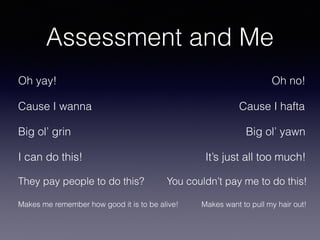
Assessment and Me
Oh yay! Oh no!
Cause I wanna Cause I hafta
Big ol’ grin Big ol’ yawn
I can do this! It’s just all too much!
They pay people to do this? You couldn’t pay me to do this!
Makes me remember how good it is to be alive! Makes want to pull my hair out!
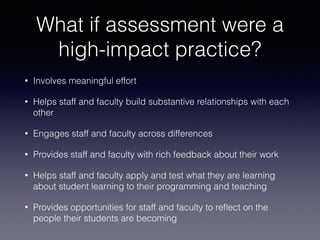
What if assessment were a
high-impact practice?
• Involves meaningful effort
• Helps staff and faculty build substantive relationships with each
other
• Engages staff and faculty across differences
• Provides staff and faculty with rich feedback about their work
• Helps staff and faculty apply and test what they are learning
about student learning to their programming and teaching
• Provides opportunities for staff and faculty to reflect on the
people their students are becoming
What difference could reimagining
assessment as a high-impact
practice make to you?
What gets in the way of
your reimagining
assessment this way?
Grounding Idea 2:
Beyond Outcomes
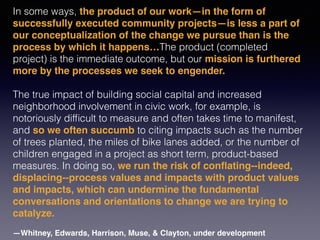
In some ways, the product of our work—in the form of
successfully executed community projects—is less a part of
our conceptualization of the change we pursue than is the
process by which it happens…The product (completed
project) is the immediate outcome, but our mission is furthered
more by the processes we seek to engender.
The true impact of building social capital and increased
neighborhood involvement in civic work, for example, is
notoriously difficult to measure and often takes time to manifest,
and so we often succumb to citing impacts such as the number
of trees planted, the miles of bike lanes added, or the number of
children engaged in a project as short term, product-based
measures. In doing so, we run the risk of conflating--indeed,
displacing--process values and impacts with product values
and impacts, which can undermine the fundamental
conversations and orientations to change we are trying to
catalyze.
—Whitney, Edwards, Harrison, Muse, & Clayton, under development
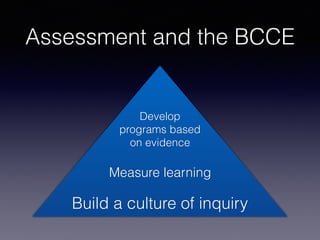
Assessment and the BCCE
Develop
programs based
on evidence
Measure learning
Build a culture of inquiry
In Data Labs…
...stakeholders with a common investment (in a
program, center, class, experience, etc.) come together
to look carefully at artifacts (data) that emerge from the
program, and to ask a series of guided questions about
these artifacts.
• What are we learning about (focus of the data lab)
from this data?
• What do we wish we knew? or, What does the data not
tell us that we want to know?
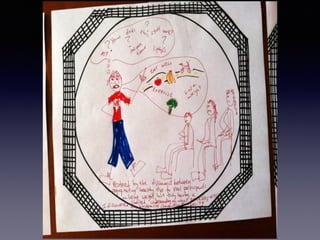
Example: Pensieve
Pick one essay and read it. The assignment in this
class was for students to notice something at their
service site that raised a biochemical question that they
could answer while researching biochemical literature.
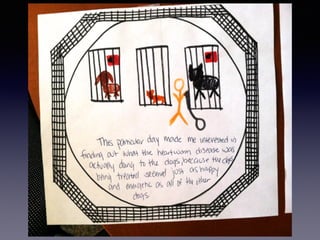
Using the pensieve worksheet, draw a picture of the
moment that you see in the pensive (in the student
essay), in which the student identifies the connection to
biochemistry.
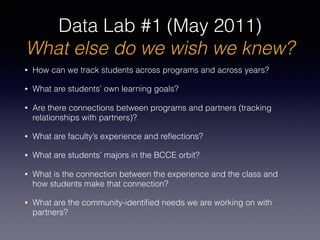
Data Lab #1 (May 2011)
What else do we wish we knew?
• How can we track students across programs and across years?
• What are students’ own learning goals?
• Are there connections between programs and partners (tracking
relationships with partners)?
• What are faculty’s experience and reflections?
• What are students’ majors in the BCCE orbit?
• What is the connection between the experience and the class and
how students make that connection?
• What are the community-identified needs we are working on with
partners?
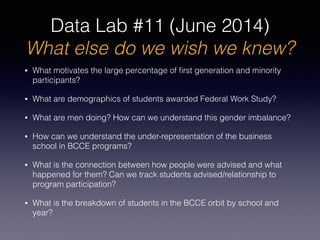
Data Lab #11 (June 2014)
What else do we wish we knew?
• What motivates the large percentage of first generation and minority
participants?
• What are demographics of students awarded Federal Work Study?
• What are men doing? How can we understand this gender imbalance?
• How can we understand the under-representation of the business
school in BCCE programs?
• What is the connection between how people were advised and what
happened for them? Can we track students advised/relationship to
program participation?
• What is the breakdown of students in the BCCE orbit by school and
year?
What happens when our focus
beyond outcomes comes into
conflict with our institution’s desire
for outcomes?
Grounding Idea 3:
Walking the talk of our
values
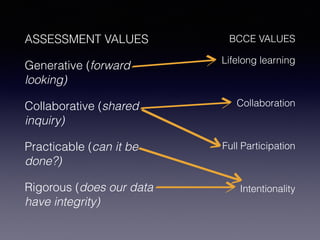
ASSESSMENT VALUES
Generative (forward
looking)
Collaborative (shared
inquiry)
Practicable (can it be
done?)
Rigorous (does our data
have integrity)
BCCE VALUES
Lifelong learning
Collaboration
Full Participation
Intentionality
What is one value that
grounds you in your civic
engagement work?
Pose these questions to your
own work
• How am I walking the talk of (insert value) in
assessment? or How could I walk the talk of
(insert value) in assessment?
• What gets in the way of that?
Grounding Ideas
1) Reclaiming assessment
2) Beyond outcomes
3) Walking the talk of our values

Reclaiming and Reimagining Assessment

  • 1.
    Reimagining & Reclaiming Assessment asa High-Impact Practice Bryan Figura & Dr. Sylvia Gale University of Richmond Bonner Center for Civic Engagement
  • 2.
    Goals • Reclaim assessmentas something we do and own • Reimagine assessment in the context of the values we already hold in our community- engaged work
  • 3.
  • 4.
    Assessment and Me Ohyay! Oh no! Cause I wanna Cause I hafta Big ol’ grin Big ol’ yawn I can do this! It’s just all too much! They pay people to do this? You couldn’t pay me to do this! Makes me remember how good it is to be alive! Makes want to pull my hair out!
  • 5.
    What if assessmentwere a high-impact practice? • Involves meaningful effort • Helps staff and faculty build substantive relationships with each other • Engages staff and faculty across differences • Provides staff and faculty with rich feedback about their work • Helps staff and faculty apply and test what they are learning about student learning to their programming and teaching • Provides opportunities for staff and faculty to reflect on the people their students are becoming
  • 6.
    What difference couldreimagining assessment as a high-impact practice make to you?
  • 7.
    What gets inthe way of your reimagining assessment this way?
  • 8.
  • 9.
    In some ways,the product of our work—in the form of successfully executed community projects—is less a part of our conceptualization of the change we pursue than is the process by which it happens…The product (completed project) is the immediate outcome, but our mission is furthered more by the processes we seek to engender. The true impact of building social capital and increased neighborhood involvement in civic work, for example, is notoriously difficult to measure and often takes time to manifest, and so we often succumb to citing impacts such as the number of trees planted, the miles of bike lanes added, or the number of children engaged in a project as short term, product-based measures. In doing so, we run the risk of conflating--indeed, displacing--process values and impacts with product values and impacts, which can undermine the fundamental conversations and orientations to change we are trying to catalyze. —Whitney, Edwards, Harrison, Muse, & Clayton, under development
  • 10.
    Assessment and theBCCE Develop programs based on evidence Measure learning Build a culture of inquiry
  • 11.
    In Data Labs… ...stakeholderswith a common investment (in a program, center, class, experience, etc.) come together to look carefully at artifacts (data) that emerge from the program, and to ask a series of guided questions about these artifacts. • What are we learning about (focus of the data lab) from this data? • What do we wish we knew? or, What does the data not tell us that we want to know?
  • 12.
    Example: Pensieve Pick oneessay and read it. The assignment in this class was for students to notice something at their service site that raised a biochemical question that they could answer while researching biochemical literature. Using the pensieve worksheet, draw a picture of the moment that you see in the pensive (in the student essay), in which the student identifies the connection to biochemistry.
  • 15.
    Data Lab #1(May 2011) What else do we wish we knew? • How can we track students across programs and across years? • What are students’ own learning goals? • Are there connections between programs and partners (tracking relationships with partners)? • What are faculty’s experience and reflections? • What are students’ majors in the BCCE orbit? • What is the connection between the experience and the class and how students make that connection? • What are the community-identified needs we are working on with partners?
  • 16.
    Data Lab #11(June 2014) What else do we wish we knew? • What motivates the large percentage of first generation and minority participants? • What are demographics of students awarded Federal Work Study? • What are men doing? How can we understand this gender imbalance? • How can we understand the under-representation of the business school in BCCE programs? • What is the connection between how people were advised and what happened for them? Can we track students advised/relationship to program participation? • What is the breakdown of students in the BCCE orbit by school and year?
  • 17.
    What happens whenour focus beyond outcomes comes into conflict with our institution’s desire for outcomes?
  • 18.
    Grounding Idea 3: Walkingthe talk of our values
  • 19.
    ASSESSMENT VALUES Generative (forward looking) Collaborative(shared inquiry) Practicable (can it be done?) Rigorous (does our data have integrity) BCCE VALUES Lifelong learning Collaboration Full Participation Intentionality
  • 20.
    What is onevalue that grounds you in your civic engagement work?
  • 21.
    Pose these questionsto your own work • How am I walking the talk of (insert value) in assessment? or How could I walk the talk of (insert value) in assessment? • What gets in the way of that?
  • 22.
    Grounding Ideas 1) Reclaimingassessment 2) Beyond outcomes 3) Walking the talk of our values