© 2014 Paradigm Learning, Inc. | ParadigmLearning.com
THE IMPORTANCE OF
BUSINESS ACUMEN:
One manager’s Journey
Meet Ted...
Ted manages an operations
department. An experienced
leader who’s been around for
many years, he runs a very
tight ship. He knows what his
people need to do and makes
sure it gets done. Ted doesn’t
agree with all the changes
going on in the organization
and keeps his staff away
from what he calls the
“turmoil” and “fuss.”
SUCCESSFUL MANAGER, RIGHT?
© 2014 Paradigm Learning, Inc. ParadigmLearning.com
Here’s the other side
of the story
Ted doesn’t want anything to
change. He has all his processes
in place and thinks the company
is fine just the way it is. He doesn’t
know—or really care—where the
company is going or what the
competition is doing, and neither
do his people. His department
runs well.
ISN’T THAT THE NAME
OF THE GAME?
© 2014 Paradigm Learning, Inc. ParadigmLearning.com
Is he a bad manager?
MAYBE. MAYBE NOT.
BUT ONE THING IS CERTAIN: HE’D BE A BETTER MANAGER IF HE HAD
AN ENHANCED UNDERSTANDING OF BUSINESS ACUMEN.
© 2014 Paradigm Learning, Inc. ParadigmLearning.com
What is
Business Acumen?
BUSINESS ACUMEN is an understanding
of how a business works and what it takes
for the enterprise to make money. It combines
financial literacy—the ability to understand
numbers on financial statements—with
business literacy: recognizing how strategies,
behaviors, actions, and decisions not only
affect the numbers but also drive profitable
and sustainable growth.
© 2014 Paradigm Learning, Inc. ParadigmLearning.com
Here’s an example:
In team sports, players need to know how the
game is scored. To affect the score, they need
to know how to play the game. In business,
financial literacy is understanding the score
and business acumen is knowing how
to impact it.
© 2014 Paradigm Learning, Inc. ParadigmLearning.com
On any business team, managers with basic
financial literacy can read a company’s
income statement by relying on a
fundamental understanding of financial
terms, ratios, and what the numbers
represent. But that’s about it.
SIMPLE.
IT’S BIG PICTURE THINKING...CLEAR UNDERSTANDING
OF HOW THE BUSINESS WORKS AND HOW IT SUSTAINS PROFITABILITY.
ASK:
© 2014 Paradigm Learning, Inc. ParadigmLearning.com
How do I positively
impact the bottom line?
© 2014 Paradigm Learning, Inc. ParadigmLearning.com
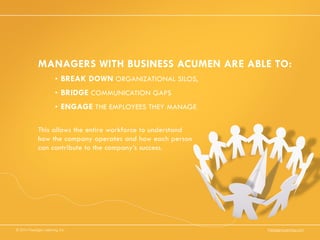
MANAGERS WITH BUSINESS ACUMEN ARE ABLE TO:
•	BREAK DOWN ORGANIZATIONAL SILOS,
•	BRIDGE COMMUNICATION GAPS
•	ENGAGE THE EMPLOYEES THEY MANAGE
This allows the entire workforce to understand
how the company operates and how each person
can contribute to the company’s success.
For organizations today, no matter how
successful, it’s critical for leaders to be able
to accurately assess the competitive landscape
and connect day-to-day decisions and activities
with key financial, functional, and business
performance metrics and goals.
Every key player must have a comfort level
with how their company makes money and
every enterprise must depend on the ability
of these key players to connect and manage
human, financial, and information resources
strategically.
© 2014 Paradigm Learning, Inc. ParadigmLearning.com
Why is Business Acumen
so important?
© 2014 Paradigm Learning, Inc. ParadigmLearning.com
Too often, however, managers don’t understand enough about the
business of the business to make solid strategic decisions. In fact,
at many companies if you asked non-financial managers—like our
friend Ted—the following questions, you might get more blank stares
than answers...
•	WHAT ARE THE MOST IMPORTANT WAYS THAT
OUR BUSINESS MAKES (OR LOSES) MONEY?
•	WHAT’S THE DIFFERENCE BETWEEN PROFIT AND
CASH—AND WHY IS IT IMPORTANT TO CLOSELY
MONITOR BOTH?
Without adequate
BUSINESS ACUMEN,
managers can’t ALIGN THEIR PRIORITIES
with those of the company or
HELP EMPLOYEES ENGAGE with the
company’s vision and goals.
© 2014 Paradigm Learning, Inc. ParadigmLearning.com
Multiplied by
HUNDREDS or even
THOUSANDS of employees,
this gap in understanding the
basics of the business, operating
goals, and competitive comparisons
means that too many decisions
are being made and too many
actions are being taken that
don’t align with business
objectives.
© 2014 Paradigm Learning, Inc. ParadigmLearning.com
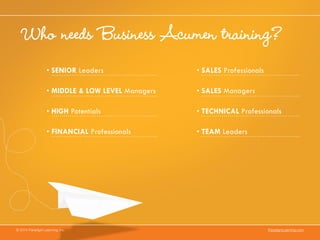
Who needs Business Acumen training?
© 2014 Paradigm Learning, Inc. ParadigmLearning.com
•	SENIOR Leaders
•	MIDDLE & LOW LEVEL Managers
•	HIGH Potentials
•	FINANCIAL Professionals
•	SALES Professionals
•	SALES Managers
•	TECHNICAL Professionals
•	TEAM Leaders
AFTER HE COMPLETED
BUSINESS ACUMEN TRAINING:
Ted’s no longer averse to
change. He’s able to SEE
NEW PROCESSES that affect
his department in the context
of how they support and align
with the company’s financial
and strategic objectives. He is now
able to CONFIDENTLY DEFINE and
use common financial terms, and
explain department/team goals in
relation to the numbers. He can
communicate the company’s strategies
effectively and ENGAGE and enlist his
department in ACHIEVING them.
© 2014 Paradigm Learning, Inc. ParadigmLearning.com
Let’s take a look at
our manager,Ted...
© 2014 Paradigm Learning, Inc.
IF YOU ARE INTERESTED IN TAKING THE Journey
THROUGH BUSINESS ACUMEN TRAINING,
CONTACT PARADIGM LEARNING AT
INFO@PARADIGMLEARNING.COM
or visit us on the web at
PARADIGMLEARNING.COM

The Importance of Business Acumen: One Manager's Journey

  • 1.
    © 2014 ParadigmLearning, Inc. | ParadigmLearning.com THE IMPORTANCE OF BUSINESS ACUMEN: One manager’s Journey
  • 2.
    Meet Ted... Ted managesan operations department. An experienced leader who’s been around for many years, he runs a very tight ship. He knows what his people need to do and makes sure it gets done. Ted doesn’t agree with all the changes going on in the organization and keeps his staff away from what he calls the “turmoil” and “fuss.” SUCCESSFUL MANAGER, RIGHT? © 2014 Paradigm Learning, Inc. ParadigmLearning.com
  • 3.
    Here’s the otherside of the story Ted doesn’t want anything to change. He has all his processes in place and thinks the company is fine just the way it is. He doesn’t know—or really care—where the company is going or what the competition is doing, and neither do his people. His department runs well. ISN’T THAT THE NAME OF THE GAME? © 2014 Paradigm Learning, Inc. ParadigmLearning.com
  • 4.
    Is he abad manager? MAYBE. MAYBE NOT. BUT ONE THING IS CERTAIN: HE’D BE A BETTER MANAGER IF HE HAD AN ENHANCED UNDERSTANDING OF BUSINESS ACUMEN. © 2014 Paradigm Learning, Inc. ParadigmLearning.com
  • 5.
    What is Business Acumen? BUSINESSACUMEN is an understanding of how a business works and what it takes for the enterprise to make money. It combines financial literacy—the ability to understand numbers on financial statements—with business literacy: recognizing how strategies, behaviors, actions, and decisions not only affect the numbers but also drive profitable and sustainable growth. © 2014 Paradigm Learning, Inc. ParadigmLearning.com
  • 6.
    Here’s an example: Inteam sports, players need to know how the game is scored. To affect the score, they need to know how to play the game. In business, financial literacy is understanding the score and business acumen is knowing how to impact it. © 2014 Paradigm Learning, Inc. ParadigmLearning.com On any business team, managers with basic financial literacy can read a company’s income statement by relying on a fundamental understanding of financial terms, ratios, and what the numbers represent. But that’s about it.
  • 7.
    SIMPLE. IT’S BIG PICTURETHINKING...CLEAR UNDERSTANDING OF HOW THE BUSINESS WORKS AND HOW IT SUSTAINS PROFITABILITY. ASK: © 2014 Paradigm Learning, Inc. ParadigmLearning.com How do I positively impact the bottom line?
  • 8.
    © 2014 ParadigmLearning, Inc. ParadigmLearning.com MANAGERS WITH BUSINESS ACUMEN ARE ABLE TO: • BREAK DOWN ORGANIZATIONAL SILOS, • BRIDGE COMMUNICATION GAPS • ENGAGE THE EMPLOYEES THEY MANAGE This allows the entire workforce to understand how the company operates and how each person can contribute to the company’s success.
  • 9.
    For organizations today,no matter how successful, it’s critical for leaders to be able to accurately assess the competitive landscape and connect day-to-day decisions and activities with key financial, functional, and business performance metrics and goals. Every key player must have a comfort level with how their company makes money and every enterprise must depend on the ability of these key players to connect and manage human, financial, and information resources strategically. © 2014 Paradigm Learning, Inc. ParadigmLearning.com Why is Business Acumen so important?
  • 10.
    © 2014 ParadigmLearning, Inc. ParadigmLearning.com Too often, however, managers don’t understand enough about the business of the business to make solid strategic decisions. In fact, at many companies if you asked non-financial managers—like our friend Ted—the following questions, you might get more blank stares than answers... • WHAT ARE THE MOST IMPORTANT WAYS THAT OUR BUSINESS MAKES (OR LOSES) MONEY? • WHAT’S THE DIFFERENCE BETWEEN PROFIT AND CASH—AND WHY IS IT IMPORTANT TO CLOSELY MONITOR BOTH?
  • 11.
    Without adequate BUSINESS ACUMEN, managerscan’t ALIGN THEIR PRIORITIES with those of the company or HELP EMPLOYEES ENGAGE with the company’s vision and goals. © 2014 Paradigm Learning, Inc. ParadigmLearning.com
  • 12.
    Multiplied by HUNDREDS oreven THOUSANDS of employees, this gap in understanding the basics of the business, operating goals, and competitive comparisons means that too many decisions are being made and too many actions are being taken that don’t align with business objectives. © 2014 Paradigm Learning, Inc. ParadigmLearning.com
  • 13.
    Who needs BusinessAcumen training? © 2014 Paradigm Learning, Inc. ParadigmLearning.com • SENIOR Leaders • MIDDLE & LOW LEVEL Managers • HIGH Potentials • FINANCIAL Professionals • SALES Professionals • SALES Managers • TECHNICAL Professionals • TEAM Leaders
  • 14.
    AFTER HE COMPLETED BUSINESSACUMEN TRAINING: Ted’s no longer averse to change. He’s able to SEE NEW PROCESSES that affect his department in the context of how they support and align with the company’s financial and strategic objectives. He is now able to CONFIDENTLY DEFINE and use common financial terms, and explain department/team goals in relation to the numbers. He can communicate the company’s strategies effectively and ENGAGE and enlist his department in ACHIEVING them. © 2014 Paradigm Learning, Inc. ParadigmLearning.com Let’s take a look at our manager,Ted...
  • 15.
    © 2014 ParadigmLearning, Inc. IF YOU ARE INTERESTED IN TAKING THE Journey THROUGH BUSINESS ACUMEN TRAINING, CONTACT PARADIGM LEARNING AT INFO@PARADIGMLEARNING.COM or visit us on the web at PARADIGMLEARNING.COM