Chapter 7 - Products, Services, and Brands: Building Customer
value
Strategic Marketing, MASY1-GC 1230
Nike: More Than Just Innovative Sports Gear—a Total Brand
Experience
Nike House of Innovation, Paris: The 3rd installation of HOI,
and Nike’s largest, most digitally connected and immersive
retail concept in the world
Provides consumers access to Nike’s best innovations, athlete
storytelling and experiences.
Creates an immersive and digitally-powered end-to-end
consumer journey.
To customers, the Nike brand means much more than just
innovative running shoes and apparel. Deep down, Nike means
sports inspiration, a just-do-it attitude, and a total brand
experience. Nike draws on a wide range of
experiences to connect with consumers.
Nike’s innovative use of digital marketing recently earned the
brand the title of “top genius” in “digital IQ” among 70
activewear companies in one digital consultancy’s rankings.
Another firm ranked Nike the number one apparel brand in
social media.
2
What Is a Product?
A product is anything that can be offered to a market for
attention, acquisition, use, or consumption that might satisfy a
want or need.
A service is an activity, benefit, or satisfaction offered for sale;
it is intangible and does not result in ownership of anything.
A product is anything that can be offered to a market for
attention, acquisition, use, or consumption that might satisfy a
want or need. Broadly defined, products include services,
events, persons, places, organizations, and ideas, or a mixture
of these.
Services are a form of product that consists of activities,
benefits, or satisfactions offered for sale that are essentially
intangible and do not result in the ownership of anything.
3
Products, Services, and Experiences
Market offerings include both tangible goods and services.
Companies create and manage customer experiences with their
brands or companies.
To differentiate their offers from that of the competitors
A company’s market offering often includes both tangible goods
and services. At one extreme, the market offering may consist
of a pure tangible good and at the other extreme a pure service.
Between these two extremes, however, many goods-and-services
combinations are possible. Today, as products and services
become more commoditized, many companies are moving to a
new level in creating value for their customers. To differentiate
their offers, beyond simply making products and delivering
services, firms are creating and managing customer experiences
with their brands or companies.
4
Products, Services, and Experiences (CONT’D)
More than just selling products, Apple’s highly successful retail
stores create engaging life-feels-good brand experiences.
Apple’s retail stores are very seductive places, where “life -
feels-good” experiences abound. The store design is clean,
simple, and just oozing with style—much like an Apple iPad or
a featherweight MacBook Air.
The stores encourage a lot of purchasing, to be sure. But they
also encourage lingering, with tables full of fully functioning
Macs, iPads, and iPhones sitting out for visitors to try.
5
Three Levels of Product
Core customer value deals with what is bought by the customer.
For example, people who buy an Apple iPad are buying much
more than just a tablet computer. They are buying
entertainment, self-expression, productivity, and connectivity
with friends and family—a mobile and personal window to the
world.
At the second level, product planners must turn the core benefit
into an actual product. They need to develop product and
service features, a design, a quality level, a brand name, and
packaging. For example, the iPad is an actual product. Its name,
parts, styling, operating system, features, packaging, and other
attributes have all been carefully combined to deliver the core
customer value of staying connected.
Finally, product planners must build an augmented product
around the core benefit and actual product by offering
additional consumer services and benefits. For example, when
consumers buy an iPad, Apple and its resellers also might give
buyers a warranty on parts and workmanship, quick repair
services when needed, and a Web site to use if they have
problems or questions. Apple also provides access to a huge
assortment of apps and accessories.
6
Product and Service Classifications
Consumer products are bought by final consumers for personal
consumption.
Industrial products are bought by individuals and organizations
for further processing or for use in conducting a business.
Materials and parts, capital items, and supplies and services
Products and services fall into two broad classes based on the
types of consumers who use them: consumer products and
industrial products.
Consumer products are bought by final consumers for personal
consumption. Consumer products include convenience products,
shopping products, specialty products, and unsought products.
These products differ in the ways consumers buy them and,
therefore, in how they are marketed. This is explained by the
table on the next slide.
Industrial products are those products purchased for further
processing or for use in conducting a business. The three groups
of industrial products and services are materials and parts,
capital items, and supplies and services.
Materials and parts include raw materials as well as
manufactured materials and parts. Raw materials consist of farm
products and natural products. Manufactured materials and parts
consist of component materials and parts.
Capital items are industrial products that aid in the buyer’s
production or operations, including installations and accessory
equipment.
Installations consist of major purchases such as buildings and
fixed equipment.
The final group of industrial products is supplies and services.
Supplies include operating supplies and repair and maintenance
items. Supplies are the convenience products of the industrial
field because they are usually purchased with a minimum of
effort or comparison.
7
Convenience AND shopping productsProduct
typeDescriptionExamples?Convenience productsConsumer
products and services that customers usually buy frequently,
immediately, and with a minimum of comparison and buying
effortShopping productsLess frequently purchased consumer
products and services that customers compare carefully on
suitability, quality, price, and style
Marketing Considerations, Convenience and Shopping
ProductsMarketing
ConsiderationsConvenienceShoppingCustomer buying
behaviorFrequent purchase; little
planning, little comparison
or shopping effort; low
customer involvementLess frequent purchase; much planning
and shopping effort; comparison of brands on price, quality, and
stylePriceLow priceHigher priceDistributionWidespread
distribution;
convenient locationsSelective distribution in fewer
outletsPromotionMass promotion by the
producerAdvertising and personal selling by both the producer
and resellersExamplesToothpaste, magazines,
and laundry detergentMajor appliances, televisions, furniture,
and clothing
This table illustrates the marketing considerations for
convenience and shopping products.
9
specialty and unsought productsProduct
typeDescriptionExamples?Specialty productsConsumer products
and services with unique characteristics or brand identifications
for which a significant group of buyers is willing to make a
special purchase effort. Unsought productsConsumer products
that the consumer either does not know about, or knows about
but does not normally think of buying.
Marketing Considerations, Specialty and Unsought
ProductsMarketing
ConsiderationsSpecialtyUnsoughtCustomer buying
behaviorStrong brand preference and loyalty; special purchase
effort; little comparison of brands; low price sensitivityLittle
product awareness or knowledge (or, if aware, little or even
negative interest)PriceHigh price VariesDistributionExclusive
distribution in only one or a few outlets per market
areaVariesPromotionMore carefully targeted promotion by both
the producer and resellersAggressive advertising and personal
selling by the producer and resellersExamplesLuxury goods,
such as Rolex watches or fine crystalLife insurance and Red
Cross blood donations
This table illustrates the marketing considerations for specialty
and unsought products.
11
Other Market Offerings
Organizations: activities undertaken to create, maintain, or
change the attitudes and behavior of target consumers toward an
organization
Persons: activities undertaken to create, maintain, or change
attitudes or behavior toward particular people.
Places: activities undertaken to create, maintain, or change
attitudes or behavior toward particular places.
Social Ideas: use of commercial marketing concepts and tools in
programs designed to influence individuals’ behavior to
improve their well-being and that of society. (social ideas)
In addition to tangible products and services, marketers have
broadened the concept of a product to include other market
offerings.
Organization marketing consists of activities undertaken to
create, maintain, or change the attitudes and behavior of target
consumers toward an organization. Business firms sponsor
public relations or corporate image marketing campaigns to
market themselves and polish their images.
Person marketing consists of activities undertaken to create,
maintain, or change attitudes or behavior toward particular
people. The skillful use of marketing can turn a person’s name
into a powerhouse brand. For example, The Food Network’s
celebrity chef, Rachael Ray, is a one-woman marketing
phenomenon, with her own daytime talk show, cookware and
cutlery brands, dog food brand, and even her own brand of
EVOO (Extra Virgin Olive Oil.)
Place marketing involves activities undertaken to create,
maintain, or change attitudes or behavior toward particular
places.
Ideas can also be marketed. We will narrow our focus to the
marketing of social ideas. This area has been called social
marketing, which consists of using traditional business
marketing concepts and tools to create behaviors that will create
individual and societal well-being. Social marketing involves
much more than just advertising. It involves a broad range of
marketing strategies and marketing mix tools designed to bring
about beneficial social change.
12
Individual Product Decisions
This figure shows the important decisions in the development
and marketing of individual products and services.
Developing a product or service involves defining the benefits
that it will offer. The characteristics of a product or service that
bear on its ability to satisfy stated or implied customer needs is
known as product quality, one of the marketer’s major
positioning tools. Total quality management (TQM) is an
approach in which all of the company’s people are involved in
constantly improving the quality of products, services, and
business processes. A product can be offered with varying
features. Another way to add customer value is through
distinctive product style and design.
A brand is a name, term, sign, symbol, or design or a
combination of these that identifies the maker or seller of a
product or service. Consumers view a brand as an important part
of a product, and branding can add value to a consumer’s
purchase. Brand names help consumers identify products that
might benefit them. Brands also say something about product
quality and consistency.
Packaging involves designing the container or wrapper for a
product. Increased competition means that packages must now
perform many sales tasks—from attracting buyers to
communicating brand positioning to closing the sale.
Labels help to identify and describe the product or brand as well
as promote the brand, support its positioning and engage
customers.
The first step in designing product support services is to survey
customers periodically. Once the company has assessed the
quality of various support services, it can take steps to fix
problems and add new services that will both delight customers
and yield profits to the company.
13
Product and Service Decisions
Individual Product Decisions
Product Line Decisions
Product Mix Decisions
Marketers make product and service decisions at three levels:
individual product decisions, product line decisions, and
product mix decisions. Each of these decisions is discussed in
greater detail in the following slides.
14
Product and Service Attributes
Product quality is one of the marketer’s major positioning tools.
A product can be offered with varying features.
Another way to add customer value is through distinctive
product style and design.
Developing a product or service involves defining the benefits
that it will offer. The characteristics of a product or service that
bear on its ability to satisfy stated or implied customer needs is
known as product quality, one of the marketer’s major
positioning tools. Total quality management (TQM) is an
approach in which all of the company’s people are involved in
constantly improving the quality of products, services, and
business processes. A product can be offered with varying
features. Another way to add customer value is through
distinctive product style and design.
15
Branding
Consumers view a brand as an important part of a product, and
branding can add value to a consumer’s purchase.
A brand is a name, term, sign, symbol, or design or a
combination of these that identifies the maker or seller of a
product or service. Consumers view a brand as an important part
of a product, and branding can add value to a consumer’s
purchase. Brand names help consumers identify products that
might benefit them. Brands also say something about product
quality and consistency.
16
Packaging
Innovative Child Guard safety packaging likely saved P&G’s
fast-growing Tide PODS and other unit-dose laundry detergent
brands.
Packaging involves designing the container or wrapper for a
product. Increased competition means that packages must now
perform many sales tasks—from attracting buyers to
communicating brand positioning to closing the sale.
17
Product Line Decisions
A product line is closely related products that:
Have similar functions and customer groups
Are sold through similar outlets or fall within given price
ranges
Product line length is the number of items in the product line.
Product line filling: adding more items within the present range
of the line.
Product line stretching: lengthens its product line beyond its
current range.
A product line is a group of products that are closely related
because they function in a similar manner, are sold to the same
customer groups, are marketed through the same types of
outlets, or fall within given price ranges. For example, Nike
produces several lines of athletic shoes and apparel.
The major product line decision involves product line length,
which is the number of items in the product line. A company
can expand its product line in two ways: line filling and line
stretching.
Line filling involves adding more items within the present range
of the line. There are several reasons for product line filling.
These reasons include reaching for extra profits, satisfying
dealers, using excess capacity, being the leading full-line
company, and plugging holes to keep out competitors.
Line stretching occurs when a company lengthens its product
line beyond its current range. The company can stretch its line
downward, upward, or both ways. A reason for downward
product line stretching is to plug a market hole that would
attract a potential competitor. The reason for upward product
line stretching is to add prestige to the current product.
18
Product Line Decisions
Product line stretching (cont’d)
Companies located at the upper end of the market can stretch
their lines downward.
Companies located at the lower end of the market can stretch
their product lines upward.
Companies located in the middle range of the market can stretch
their lines in both directions.
A product line is a group of products that are closely related
because they function in a similar manner, are sold to the same
customer groups, are marketed through the same types of
outlets, or fall within given price ranges. For example, Nike
produces several lines of athletic shoes and apparel.
The major product line decision involves product line length,
which is the number of items in the product line. A company
can expand its product line in two ways: line filling and line
stretching.
Line filling involves adding more items within the present range
of the line. There are several reasons for product line filling.
These reasons include reaching for extra profits, satisfying
dealers, using excess capacity, being the leading full-line
company, and plugging holes to keep out competitors.
Line stretching occurs when a company lengthens its product
line beyond its current range. The company can stretch its line
downward, upward, or both ways. A reason for downward
product line stretching is to plug a market hole that would
attract a potential competitor. The reason for upward product
line stretching is to add prestige to the current product.
19
Product Line Decisions (CONT’D)
Through skillful line stretching and filling,
BMW now has brands and lines that successfully appeal to the
rich, the super-rich, and the hope-to-be-rich.
Over the years, BMW Group has transformed itself from a
single-brand, five-model automaker into a powerhouse with
three brands, 14 “Series,” and dozens of distinct models. The
company has expanded downward with its MINI Cooper line
and upward with Rolls-Royce.
20
BMW PRODUCT LINE: https://www.bmwusa.com/all-
bmws.html
Product Mix (or Product Portfolio)
“Colgate World of Care”—products that “every day, people like
you trust to care for themselves and the ones they love.”
Colgate is a $15.2 billion consumer products company that
makes and markets a full product mix consisting of dozens of
familiar lines and brands. Colgate divides its overall product
mix into four major lines: oral care, personal care, home care,
and pet nutrition. Each product line consists of many brands and
item.
22
Product Mix Decisions
Width
Number of different product lines the company carries
Length
Total number of items a company carries within its product
lines
Depth
Number of versions offered for each product in the line
Consistency
Relativity of the various product lines in end use, production
requirements, distribution channels, or some other aspect
A company’s product mix has four important dimensions: width,
length, depth, and consistency.
The mix width refers to the number of different product lines
the company carries. Product mix length refers to the total
number of items a company carries within its product lines.
Product mix depth refers to the number of versions offered for
each product in the line. Finally, the consistency of the product
mix refers to how closely related the various product lines are
in end use, production requirements, distribution channels, or
some other aspect.
A company can increase its business in four ways. It can add
new product lines, widening its product mix. The company can
lengthen its existing product lines to become a more full -line
company. It can add more versions of each product and thus
deepen its product mix. Finally, the company can pursue more
product line consistency or less depending on whether it wants
to have a strong reputation in a single field or in several fields.
Finally, a company can pursue more product line consistency—
or less—depending on whether it wants to have a strong
reputation in a single field or in several fields.
23
Services accounted for 64% of US GDP in 2020, ABOUT 65%
GWP. There are Four Service Characteristics:
FKA THE FOUR I’S OF SERVICE: INTANGIBILITY,
INCONSISTENCY, INSEPARABILITY, INVENTORY
This figure depicts the four special service characteristics a
company must consider when designing marketing programs:
intangibility, inseparability, variability, and perishability.
Service intangibility means that services cannot be seen, tasted,
felt, heard, or smelled before they are bought. To reduce
uncertainty, buyers look for signals of service quality. They
draw conclusions about quality from the place, people, price,
equipment, and communications that they can see.
Service inseparability means that services cannot be separated
from their providers, whether the providers are people or
machines. Customer coproduction makes provider–customer
interaction a special feature of services marketing. Both the
provider and the customer affect the service outcome.
Service variability means that the quality of services depends on
who provides them as well as when, where, and how they are
provided. For example, within a Marriott hotel, one registration-
counter employee may be cheerful and efficient, whereas
another standing just a few feet away may be grumpy and slow.
Service perishability means that services cannot be stored for
later sale or use. Some doctors charge patients for missed
appointments because the service value existed only at that
point and disappeared when the patient did not show up.
24
Service Profit Chain
Links service firm profits with employee and customer
satisfaction
The chain consists of five links:
Internal service quality
Satisfied and productive service employees
Greater service value
Satisfied and loyal customers
Healthy service profits and growth
Successful service companies focus their attention on both their
customers and their employees. They understand the service
profit chain, which links service firm profits with employee and
customer satisfaction. This chain consists of five links: internal
service quality, satisfied and productive service employees,
greater service value, satisfied and loyal customers, and healthy
service profits and growth. For example, the supermarket chain
Wegmans believes that happy, superbly trained employees
create a superior customer experience.
25
Three Types of Services Marketing
Services marketing requires more than just traditional external
marketing using the four Ps. This figure shows that services
marketing also requires internal marketing and interactive
marketing.
Internal marketing means that the service firm must orient and
motivate its customer-contact employees and supporting service
employees to work as a team to provide customer satisfaction.
For example, Zappos starts by hiring the right people and
carefully orienting and inspiring them to give unparalleled
customer service.
Interactive marketing means that service quality depends
heavily on the quality of the buyer-seller interaction during the
service encounter. In services marketing, service quality
depends on both the service deliverer and the quality of
delivery. All new hires at Zappos —at all levels of the
company—complete a four-week customer-loyalty training
regimen.
26
Service Profit Chain (CONT’D)
Zappos knows that delivering customer happiness begins with
happy, dedicated, energetic employees. Zappos is “Powered by
Service.”
Marketing Tasks for Service Companies
Managing service differentiation
Developing a differentiated offer, delivery, and image
Managing service quality
Delivering consistently higher quality than the competitors
Managing service productivity
Training current employees or hiring new ones
Increasing the quantity of service by giving up some quality
Harnessing the power of technology
Service companies face three major marketing tasks: They want
to increase their service differentiation, service quality, and
service productivity.
In these days of intense price competition, service marketers
often complain about the difficulty of differentiating their
services from those of competitors. The solution to price
competition is to develop a differentiated offer, delivery, and
image. For example, Dick’s Sporting Goods’ customers can
sample shoes on Dick’s indoor footwear track, test golf clubs
with an on-site golf swing analyzer and putting green, shoot
bows in its archery range, and receive personalized fitness
product guidance from an in-store team of fitness trainers.
A service firm can differentiate itself by delivering consistently
higher quality than its competitors provide. Service providers
need to identify what target customers expect in regard to
service quality. As hard as they may try, even the best
companies will have an occasional late delivery, burned steak,
or grumpy employee. However, good service recovery can turn
angry customers into loyal ones.
With their costs rising rapidly, service firms are under great
pressure to increase service productivity. They can do so in
several ways. They can train current employees better or hire
new ones who will work harder or more skillfully. Or they can
increase the quantity of their service by giving up some quality.
Finally, a service provider can harness the power of technology.
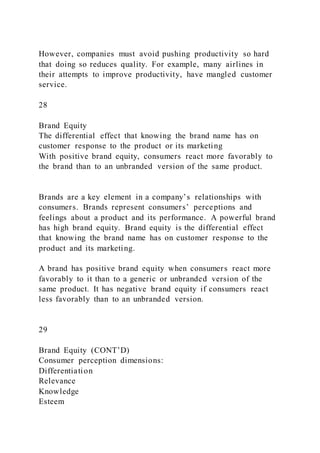
However, companies must avoid pushing productivity so hard
that doing so reduces quality. For example, many airlines in
their attempts to improve productivity, have mangled customer
service.
28
Brand Equity
The differential effect that knowing the brand name has on
customer response to the product or its marketing
With positive brand equity, consumers react more favorably to
the brand than to an unbranded version of the same product.
Brands are a key element in a company’s relationships with
consumers. Brands represent consumers’ perceptions and
feelings about a product and its performance. A powerful brand
has high brand equity. Brand equity is the differential effect
that knowing the brand name has on customer response to the
product and its marketing.
A brand has positive brand equity when consumers react more
favorably to it than to a generic or unbranded version of the
same product. It has negative brand equity if consumers react
less favorably than to an unbranded version.
29
Brand Equity (CONT’D)
Consumer perception dimensions:
Differentiation
Relevance
Knowledge
Esteem
Brand value is the total financial value of a brand.
Customer equity is the value of customer relationships that the
brand creates.
Ad agency Young & Rubicam’s Brand Asset Valuator measures
brand strength along four consumer perception dimensions:
differentiation, relevance, knowledge, and esteem. Brands with
strong brand equity rate high on all four dimensions.
A brand with high brand equity is a very valuable asset. Brand
value is the total financial value of a brand. High brand equity
provides a company with many competitive advantages. A
powerful brand enjoys a high level of consumer brand
awareness and loyalty.
A powerful brand forms the basis for building strong and
profitable customer relationships. The fundamental asset
underlying brand equity is customer equity. This refers to the
value of customer relationships that the brand creates. The
proper focus of marketing is building customer equity, with
brand management serving as a major marketing tool.
According to one estimate, the brand value of Google is a
whopping $159 billion and Apple is at $148 billion.
30
Best 100 global brands, 2020: cumulative brand value
Source: “Best Global Brands, 2020”, Interbrand
Best 100 global brands, 2020: brands 1-25
Source: “Best Global Brands, 2020”, Interbrand
Best 100 global brands, 2020: brands 26-50
Source: “Best Global Brands, 2020”, Interbrand
Best 100 global brands, 2020: brands 51-75
Source: “Best Global Brands, 2020”, Interbrand
Best 100 global brands, 2020: brands 76-100
Source: “Best Global Brands, 2020”, Interbrand
Best 100 global brands, 2020: brand strength
Source: “Best Global Brands, 2020”, Interbrand
INTERBRAND 2021 BREAKTHROUGH BRANDS
30 brands that best exemplify Interbrand’s tenets of brand
growth: understanding human truths, creating exceptional brand
experiences, and delivering superior business results.
Major Brand Strategy Decisions
Brands are powerful assets that must be carefully developed and
managed. As this figure suggests, building strong brands
involves many challenging decisions.
This figure shows that the major brand strategy decisions
involve brand positioning, brand name selection, brand
sponsorship, and brand development.
38
Major Brand Strategy Decisions (CONT’D)
Kroger’s store brands—from Private Selection to Simple
Truth—account for 25% of the grocery retailer’s sales.
Kroger’s private brands—the Kroger house brand, Private
Selection, Heritage Farm, Simple Truth (natural and organic),
Psst, Check This Out (savings), and others—add up to a
whopping 25 percent of the giant grocery retailer’s sales, nearly
$23 billion worth annually.
Kroger even offers a Kroger brand guarantee —“Try it, like it,
or get the national brand free.”
39
Target’s private label strategy
45 private labels ("owned brands")
Differentiating with owned brands and a curated selection of
national brand products is core to their strategy
What guests expect from Target: there's something for
everybody to love
Target’s largest owned food brand. Products are 10-30% less
expensive than national brand equivalents
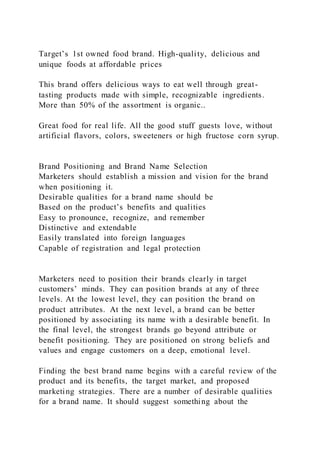
Target’s 1st owned food brand. High-quality, delicious and
unique foods at affordable prices
This brand offers delicious ways to eat well through great-
tasting products made with simple, recognizable ingredients.
More than 50% of the assortment is organic..
Great food for real life. All the good stuff guests love, without
artificial flavors, colors, sweeteners or high fructose corn syrup.
Brand Positioning and Brand Name Selection
Marketers should establish a mission and vision for the brand
when positioning it.
Desirable qualities for a brand name should be
Based on the product’s benefits and qualities
Easy to pronounce, recognize, and remember
Distinctive and extendable
Easily translated into foreign languages
Capable of registration and legal protection
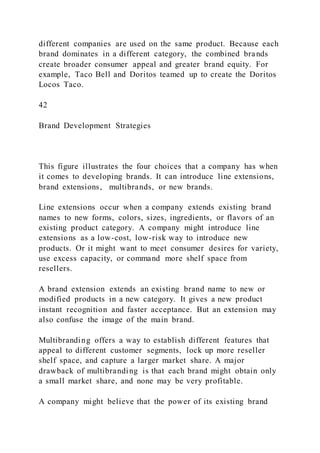
Marketers need to position their brands clearly in target
customers’ minds. They can position brands at any of three
levels. At the lowest level, they can position the brand on
product attributes. At the next level, a brand can be better
positioned by associating its name with a desirable benefit. In
the final level, the strongest brands go beyond attribute or
benefit positioning. They are positioned on strong beliefs and
values and engage customers on a deep, emotional level.
Finding the best brand name begins with a careful review of the
product and its benefits, the target market, and proposed
marketing strategies. There are a number of desirable qualities
for a brand name. It should suggest something about the
product’s benefits and qualities, and it should be easy to
pronounce, recognize, and remember. The brand name should be
distinctive, be extendable, translate easily into foreign
languages, and be capable of registration and legal protection.
41
Brand Sponsorship
Four sponsorship options
Marketed under the manufacturer’s own brand name: National
or Manufacturer’s brand
Created and owned by a reseller of a product or service: Private
or Store brand
Use names and symbols created by other companies or well-
known movie characters or celebrities for a fee: Licensing
Use the established brand names of two different companies on
the same product: Co-branding
A manufacturer has four sponsorship options:
National brands or manufacturers’ brands are marketed under
the manufacturer’s own name. The Samsung Galaxy tablet or
Kellogg’s Frosted Flakes are examples of national brands.
An increasing numbers of retailers and wholesalers have created
their own store brands or private brands To compete with store
brands, national brands must sharpen their value propositions,
especially when appealing to today’s more frugal consumers.
Some companies license names or symbols previously created
by other manufacturers, the names of well-known celebrities, or
characters from popular movies and books. For a fee, licensing
any of these can provide an instant and proven brand name. For
example, consider the Kodak brand with its familiar red and
yellow colors, which has retained its value even after the
company went bankrupt and discontinued its consumer products.
Co-branding occurs when two established brand names of
different companies are used on the same product. Because each
brand dominates in a different category, the combined brands
create broader consumer appeal and greater brand equity. For
example, Taco Bell and Doritos teamed up to create the Doritos
Locos Taco.
42
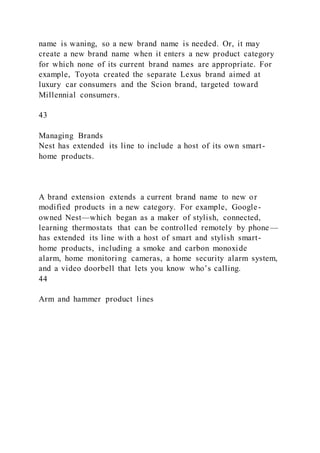
Brand Development Strategies
This figure illustrates the four choices that a company has when
it comes to developing brands. It can introduce line extensions,
brand extensions, multibrands, or new brands.
Line extensions occur when a company extends existing brand
names to new forms, colors, sizes, ingredients, or flavors of an
existing product category. A company might introduce line
extensions as a low-cost, low-risk way to introduce new
products. Or it might want to meet consumer desires for variety,
use excess capacity, or command more shelf space from
resellers.
A brand extension extends an existing brand name to new or
modified products in a new category. It gives a new product
instant recognition and faster acceptance. But an extension may
also confuse the image of the main brand.
Multibranding offers a way to establish different features that
appeal to different customer segments, lock up more reseller
shelf space, and capture a larger market share. A major
drawback of multibranding is that each brand might obtain only
a small market share, and none may be very profitable.
A company might believe that the power of its existing brand
name is waning, so a new brand name is needed. Or, it may
create a new brand name when it enters a new product category
for which none of its current brand names are appropriate. For
example, Toyota created the separate Lexus brand aimed at
luxury car consumers and the Scion brand, targeted toward
Millennial consumers.
43
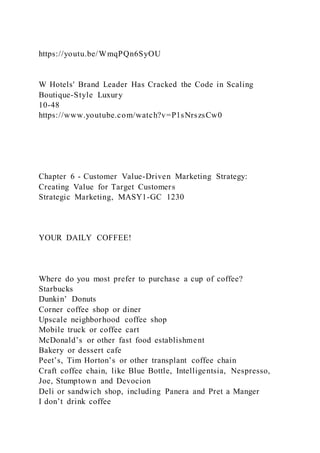
Managing Brands
Nest has extended its line to include a host of its own smart-
home products.
A brand extension extends a current brand name to new or
modified products in a new category. For example, Google-
owned Nest—which began as a maker of stylish, connected,
learning thermostats that can be controlled remotely by phone—
has extended its line with a host of smart and stylish smart-
home products, including a smoke and carbon monoxide
alarm, home monitoring cameras, a home security alarm system,
and a video doorbell that lets you know who’s calling.
44
Arm and hammer product lines
Managing Brands (CONT’D)
Communicate the brand’s positioning
Manage all brand touch points
Train employees to be customer centered
Audit the brand’s strengths and weaknesses
Companies must manage their brands carefully.
First, the brand’s positioning must be continuously
communicated to consumers. Major brand marketers often spend
huge amounts on advertising to create brand awareness and
build preference and loyalty.
Today, customers come to know a brand through a wide range
of contacts and touch points. These include advertising but also
personal experience with the brand, word of mouth, social
media, company Web pages, mobile apps, and many others.
The brand’s positioning will not take hold fully unless everyone
in the company lives the brand. Therefore, the company needs
to train its people to be customer centered. Many companies go
even further by training and encouraging their distributors and
dealers to serve their customers well.
Finally, companies need to periodically audit their brands’
strengths and weaknesses. The brand audit may turn up brands
that need more support, brands that need to be dropped, or
brands that must be rebranded or repositioned because of
changing customer preferences or new competitors.
46
Kendra Scott Brand: How to Scale a Small Business into a
Billion Dollar Brand
https://youtu.be/WmqPQn6SyOU
W Hotels' Brand Leader Has Cracked the Code in Scaling
Boutique-Style Luxury
10-48
https://www.youtube.com/watch?v=P1sNrszsCw0
Chapter 6 - Customer Value-Driven Marketing Strategy:
Creating Value for Target Customers
Strategic Marketing, MASY1-GC 1230
YOUR DAILY COFFEE!
Where do you most prefer to purchase a cup of coffee?
Starbucks
Dunkin’ Donuts
Corner coffee shop or diner
Upscale neighborhood coffee shop
Mobile truck or coffee cart
McDonald’s or other fast food establishment
Bakery or dessert cafe
Peet’s, Tim Horton’s or other transplant coffee chain
Craft coffee chain, like Blue Bottle, Intelligentsia, Nespresso,
Joe, Stumptown and Devocion
Deli or sandwich shop, including Panera and Pret a Manger
I don’t drink coffee
Other
Dunkin’ Donuts Targeting the Average Joe
Dunkin’ Donuts targets everyday Joes who just don’t get what
Starbucks is all about.
Dunkin’ Donuts targets the “Dunkin’ tribe”—not the Starbucks
coffee snob but the average Joe. Dunkin’ isn’t like Starbucks; it
doesn’t want to be.
5
Designing a Customer Value-Driven Market Strategy
This figure shows the four major steps in designing a customer -
driven marketing strategy.
In the first two steps, the company selects the customers that it
will serve. Market segmentation involves dividing a market into
smaller segments of buyers with distinct needs, characteristics,
or behaviors that might require separate marketing strategies or
mixes. Market targeting (or targeting) consists of evaluating
each market segment’s attractiveness and selecting one or more
market segments to enter.
In the final two steps, the company decides on a value
proposition. Differentiation involves actually differentiating the
firm’s market offering to create superior customer value.
Positioning consists of arranging for a market offering to
occupy a clear, distinctive, and desirable place, relative to
competing products in the minds of target consumers.
6
Major Segmentation Variables for Consumer
MarketsSegmentation VariableExamplesGeographic Nations,
regions, states, counties, cities, neighborhoods, population
density (urban, suburban, rural), climate Demographic Age,
life-cycle stage, gender, income, occupation, education,
religion, ethnicity, generationPsychographic Social class,
lifestyle, personalityBehavioral Occasions, benefits, user status,
usage rate, loyalty status
This table outlines variables that might be used in segmenting
consumer markets. Each of these variables are discussed in the
forthcoming slides.
7
Geographic and Demographic Segmentation
Geographic segmentation: Dividing a market into different
geographical units
Such as nations, states, regions, counties, cities, or
neighborhoods
Demographic segmentation: Dividing a market into segments
based on variables
Such as age, life-cycle stage, gender, income, occupation,
education, religion, ethnicity, and generation
Geographic segmentation calls for dividing the market into
different geographical units, such as nations, regions, states,
counties, cities, or even neighborhoods. For example, many
large retailers—from Target and Walmart to Kohl’s and
Staples—are now opening smaller format stores designed to fit
the needs of densely packed urban neighborhoods not suited to
their typical large suburban superstores.
Demographic segmentation divides the market into segments
based on variables such as age, life-cycle stage, gender, income,
occupation, education, religion, ethnicity, and generation.
Demographic factors are the most popular bases for segmenting
customer groups. These factors are discussed in detail in the
following slide.
8
Demographic Segmentation
Age and life-cycle segmentation
Dividing a market into different age and life-cycle groups
Gender segmentation
Dividing a market into different segments based on gender
Income segmentation
Dividing a market into different income segments
Some companies use age and life-cycle segmentation, offering
different products or using different marketing approaches for
different age and life-cycle groups. For example, Kraft’s Oscar
Mayer brand markets Lunchables, convenient prepackaged
lunches for children. To extend the substantial success of
Lunchables, however, Oscar Mayer later introduced Lunchables
Uploaded for teenagers and an adult version, P3 (Portable
Protein Pack).
Gender segmentation divides a market into different segments
based on gender, and has long been used in marketing clothing,
cosmetics, toiletries, toys, and magazines For example, the
men’s personal care industry has exploded, and many cosmetics
brands that previously catered mostly to women, now
successfully market men’s lines.
Income segmentation involves dividing a market into different
income segments. For example, many retailers—such as the
Dollar General, Family Dollar, and Dollar Tree store
chains—successfully target low- and middle-income groups.
The core market for such stores is represented by families with
incomes under $30,000. With their low-income strategies, dollar
stores are now the fastest-growing retailers in the nation.
9
FOUR CONSUMER GROUPS DRIVING SPENDING SHIFTS
IN 2021
The NielsenIQ study breaks down the four groups in the
following way:
Existing Constrained – were already watching what they spent
prior to COVID-19, and this has not changed
Newly Constrained – experienced worsening household income/
financial situations and are consciously watching what they now
spend
Cautious Insulated – limited impact to income/ financial
situation, but are watching what they spend a lot or much more
than before
Unrestricted Insulated – similar or improved income/ financial
situation and do not feel the need to watch what they spend
Psychographic Segmentation
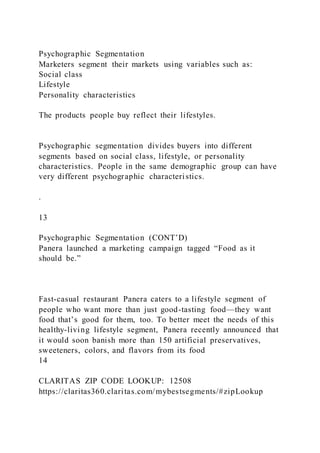
Marketers segment their markets using variables such as:
Social class
Lifestyle
Personality characteristics
The products people buy reflect their lifestyles.
Psychographic segmentation divides buyers into different
segments based on social class, lifestyle, or personality
characteristics. People in the same demographic group can have
very different psychographic characteristics.
.
13
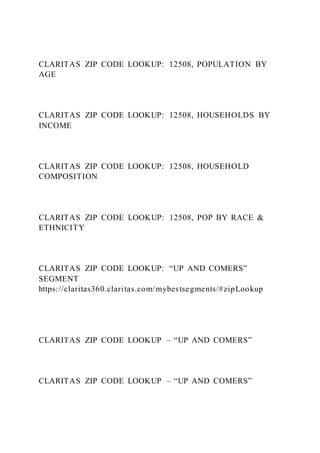
Psychographic Segmentation (CONT’D)
Panera launched a marketing campaign tagged “Food as it
should be.”
Fast-casual restaurant Panera caters to a lifestyle segment of
people who want more than just good-tasting food—they want
food that’s good for them, too. To better meet the needs of this
healthy-living lifestyle segment, Panera recently announced that
it would soon banish more than 150 artificial preservatives,
sweeteners, colors, and flavors from its food
14
CLARITAS ZIP CODE LOOKUP: 12508
https://claritas360.claritas.com/mybestsegments/#zipLookup
CLARITAS ZIP CODE LOOKUP: 12508, POPULATION BY
AGE
CLARITAS ZIP CODE LOOKUP: 12508, HOUSEHOLDS BY
INCOME
CLARITAS ZIP CODE LOOKUP: 12508, HOUSEHOLD
COMPOSITION
CLARITAS ZIP CODE LOOKUP: 12508, POP BY RACE &
ETHNICITY
CLARITAS ZIP CODE LOOKUP: “UP AND COMERS”
SEGMENT
https://claritas360.claritas.com/mybestsegments/#zipLookup
CLARITAS ZIP CODE LOOKUP – “UP AND COMERS”
CLARITAS PRISM SEGMENTS
Behavioral Segmentation
Occasion segmentation: Segments divided according to
occasions, when the buyers
Get the idea to buy
Make their purchase
Use the purchased item
Benefit segmentation: Segments divided according to the
different benefits that consumers seek from the product.
Many marketers believe that behavior variables are the best
starting point for building market segments.
Occasion segmentation divides the market into segments
according to occasions when buyers get the idea to buy, actually
make their purchase, or use the purchased item. This
segmentation can help firms build up product usage. Companies
try to boost consumption by promoting usage during
nontraditional occasions. For example, most consumers drink
orange juice in the morning, but orange growers have promoted
drinking orange juice as a cool, healthful refresher at other
times of the day.
24
Behavioral Segmentation (CONT’D)
“There’s a Fitbit for Everyone.”
Benefit segmentation divides the market into segments
according to the different benefits that consumers seek from the
product. For example, to meet varying benefit preferences,
Fitbit makes health and fitness tracking devices aimed at buyers
in three major benefit segments: Everyday Fitness, Active
Fitness, and Performance Fitness.
25
Behavioral Segmentation (CONT’D)
User status: Markets can be segmented into nonusers, ex-users,
potential users, first-time users, and regular users.
Usage rate: Markets can be segmented into light, medium, and
heavy product users.
Loyalty status: Consumers can be loyal to brands, stores, and
companies.
User status segments markets into nonusers, ex-users, potential
users, first-time users, and regular users of a product. Marketers
want to reinforce and retain regular users, attract targeted
nonusers, and reinvigorate relationships with ex-users. Included
in the potential users group are consumers facing life-stage
changes who can be turned into heavy users.
Usage rate segments markets into light, medium, and heavy
product users. Heavy users are often a small percentage of the
market but account for a high percentage of total consumption.
A market can also be segmented by loyalty status. Consumers
can be loyal to brands, stores, and companies. Highly loyal
customers promote the brand through personal word of mouth
and social media. In contrast, by studying its less-loyal buyers,
a company can detect which brands are most competitive with
its own. By looking at customers who are shifting away from its
brand, the company can learn about its marketing weaknesses
and take actions to correct them.
26
Multiple Segmentation Bases
Segmentation bases help companies to:
Identify smaller, better-defined target groups
Identify and understand key customer segments
Reach customers more efficiently by tailoring market offerings
and messages to customers’ specific needs
Segmentation systems help marketers segment people and
locations into marketable groups of like-minded consumers.
Marketers rarely limit their segmentation analysis to onl y one or
a few variables. Rather, they often use multiple segmentation
bases in an effort to identify smaller, better-defined target
groups.
One of the leading consumer segmentation systems is
Experian’s Mosaic USA system. It classifies U.S. households
into one of 71 lifestyle segments and 19 levels of affluence,
based on specific consumer demographics, interests, behaviors,
and passions. For example, the Birkenstocks and Beemers group
is located in the Middle Class Melting Pot level of affluence
and consists of 40- to 65-year-olds who have achieved financial
security and left the urban rat race for rustic and artsy
communities located near small cities.
Such segmentation helps companies identify and better
understand key customer segments, reach them more efficiently,
and tailor market offerings and messages to their specific needs.
27
Segmenting Business Markets
Consumer and business markets use many of the same variables
for segmentation.
Variables used by business marketers for segmentation include
Operating characteristics
Purchasing approaches
Situational factors
Personal characteristics
Consumer and business marketers use many of the same
variables to segment their markets. Business buyers can be
segmented geographically, demographically (industry, company
size), or by benefits sought, user status, usage rate, and loyalty
status. Yet, business marketers also use some additional
variables, such as customer operating characteristics,
purchasing approaches, situational factors, and personal
characteristics.
28
Segmenting International Markets
Variables include
Geographic location
Economic factors
Political and legal factors
Cultural factors
Intermarket (cross-market) segmentation: Grouping consumers
with similar needs and buying behaviors irrespective of their
location.
Companies can segment international markets using one or a
combination of several variables.
Geographic segmentation assumes that nations close to one
another will have many common traits and behaviors. For
example, some U.S. marketers lump all Central and South
American countries together.
World markets can also be segmented based on economic
factors. Countries might be grouped by population income
levels or by their overall level of economic development. For
example, many companies are now targeting the BRIC countries
– Brazil, Russia, India, and China – which are fast-growing
developing economies with rapidly increasing buying power.
Countries can also be segmented by political and legal factors
such as the type and stability of government, receptivity to
foreign firms, monetary regulations, and amount of bureaucracy.
Cultural factors can also be used by grouping markets according
to common languages, religions, values and attitudes, customs,
and behavioral patterns.
Using intermarket segmentation (also called cross-market
segmentation), marketers form segments of consumers who have
similar needs and buying behaviors even though they are
located in different countries.
29
Requirements for Effective Segmentation
Measurable
Accessible
Substantial
Differentiable
Actionable
To be useful, the size, purchasing power, and profiles of market
segments should be measurable. The market segments must be
accessible – effectively reached and served. The market
segments should be substantial – large or profitable enough to
serve. They should be differentiable, which means they are
conceptually distinguishable and respond differently to different
marketing mix elements and programs. Finally, the segments
should be actionable, which means that effective programs can
be designed for attracting and serving the segments.
30
Market Targeting
Evaluating the various segments based on
Segment size and growth
Segment structural attractiveness
Company objectives and resources
Selecting target market segments
Target market: Set of buyers sharing common needs or
characteristics that the company decides to serve
Market segmentation reveals the firm’s market segment
opportunities. The firm has to evaluate the various segments
and decide how many and which segments it can serve best. In
evaluating different market segments, a firm must look at three
factors.
First, a company wants to select segments that have the right
size and growth characteristics. Second, the company needs to
examine major structural factors that affect long-run segment
attractiveness like strong and aggressive competitors or if it is
easy for new entrants to come into the segment. The existence
of actual or potential substitute products, the relative power of
buyers, and powerful suppliers also affects segment
attractiveness. Finally, the company must consider its own
objectives and resources. Some attractive segments can be
dismissed quickly because they do not mesh with the company’s
long-run objectives. Or, the company may lack the skills and
resources needed to succeed in an attractive segment.
After evaluating different segments, the company must decide
which and how many segments it will target. A target market
consists of a set of buyers who share common needs or
characteristics that the company decides to serve. Market
targeting can be carried out at several different levels.
31
Market-Targeting Strategies
This figure shows that companies can target very broadly, very
narrowly, or somewhere in between. Undifferentiated (or mass
marketing) refers to a market-coverage strategy in which a firm
decides to ignore market segment differences and go after the
whole market with one offer. Differentiated (or segmented
marketing) refers to a market-coverage strategy in which a firm
decides to target several market segments and designs separate
offers for each. Concentrated (or niche marketing) refers to a
market-coverage strategy in which a firm goes after a large
share of one or a few smaller segments or niches.
Micromarketing is the practice of tailoring products and
marketing programs to suit the tastes of specific individuals and
locations. Rather than seeing a customer in every individual,
micromarketers see the individual in every customer.
Micromarketing includes local marketing and individual
marketing. Local marketing involves tailoring brands and
marketing to the needs and wants of local customer segments
like cities, neighborhoods, and even specific stores. Individual
marketing involves tailoring products and marketing programs
to the needs and preferences of individual customers.
Mass customization is the process by which firms interact one
to one with masses of customers to design products, services,
and marketing programs tailor-made to individual needs.
32
Market Targeting (CONT’D)
P&G markets multiple laundry detergent brands and then further
segments each brand to service even narrower niches.
Using a differentiated marketing (or segmented marketing)
strategy, a firm decides to target several market segments and
designs separate offers for each. For example, P&G markets at
least six different laundry detergent brands in the United States
(Tide, Gain, Cheer, Era, Dreft, and Bold), which compete with
each other on supermarket shelves. Thanks to its differentiated
approach, P&G is really cleaning up in the $15 billion U.S.
laundry detergent market, capturing a 61 percent market share.
33
Choosing a Targeting Strategy
Factors to consider
Company resources
Product variability
Product’s life-cycle stage
Market variability
Competitors’ marketing strategies
Companies need to consider many factors when choosing a
market-targeting strategy. Which strategy is best depends on the
company’s resources. When the firm’s resources are limited,
concentrated marketing makes the most sense. The best strategy
also depends on the degree of product variability. The product’s
life-cycle stage also must be considered. When a firm
introduces a new product, it may be practical to launch one
version only, and undifferentiated marketing or concentrated
marketing may make the most sense. In the mature stage of the
product life cycle, however, differentiated marketing can be
useful.
Another factor is market variability. If most buyers have the
same tastes, buy the same amounts, and react the same way to
marketing efforts, undifferentiated marketing is appropriate.
Finally, competitors’ marketing strategies are important. When
competitors use differentiated or concentrated marketing,
undifferentiated marketing can be suicidal.
34
Socially Responsible Target Marketing
Controversy and concern of target marketing
Vulnerable or disadvantaged consumers are targeted with
controversial or potentially harmful products.
Socially responsible target marketing should be done to serve
both the interests of the company and the interests of those
targeted.
Target marketing sometimes generates controversy and concern.
The biggest issues usually involve the targeting of vulnerable or
disadvantaged consumers with controversial or potentially
harmful products.
In target marketing, the issue is not really who is targeted but
rather how and for what. Controversies arise when marketers
attempt to profit at the expense of targeted segments—when
they unfairly target vulnerable segments or target them with
questionable products or tactics. Socially responsible marketing
calls for segmentation and targeting that serve not just the
interests of the company but also the interests of those targeted.
35
Differentiation and Positioning
Firms must decide which segments to target and on the value
proposition.
Product position is the way a product is defined by consumers
on important attributes.
Beyond deciding which segments of the market it will target,
the company must decide on a value proposition—how it will
create differentiated value for targeted segments and what
positions it wants to occupy in those segments. A product
position is the way a product is defined by consumers on
important attributes—the place the product occupies in
consumers’ minds relative to competing products.
36
Differentiation and Positioning (CONT’D)
Sonos does more than just sell speakers; it unleashes “All the
music on earth, in every room of your house, wirelessly.”
37
Positioning Map: Large Luxury SUVs
Marketers prepare perceptual positioning maps that show
consumer perceptions of their brands versus those of competing
products on important buying dimensions to plan their
differentiation and positioning strategies.
This figure shows a positioning map for the U.S. large luxury
SUV market. The position of each circle on the map indicates
the brand’s perceived positioning on two dimensions: price and
orientation (luxury versus performance). The size of each circle
indicates the brand’s relative market share.
38
Mapping your brand’s sweet spot – Harvard business review
https://hbr.org/2015/06/a-better-way-to-map-brand-strategy
Choosing a Differentiation and Positioning Strategy
The differentiation and positioning task consists of three steps,
which include identifying a set of differentiating competitive
advantages on which to build a position, choosing the right
competitive advantages, and selecting an overall positioning
strategy. The company must then effectively communicate and
deliver the chosen position to the market.
The following slides discuss each of these steps in greater
detail.
40
Identifying Possible Value Differences and Competitive
Advantages
Competitive advantage: An advantage over competitors gained
by offering greater customer value either by
Having lower prices, or
Providing more benefits that justify higher prices
Firms can differentiate in terms of product, services, channels,
people, or image.
Competitive advantage refers to an advantage over competitors
gained by offering greater customer value, either by having
lower prices or providing more benefits that justify higher
prices.
To find points of differentiation, marketers must think through
the customer’s entire experience with the company’s product or
service. Through product differentiation, brands can be
differentiated on features, performance, or style and design.
Some companies gain services differentiation through speedy,
convenient service.
Firms that practice channel differentiation gain competitive
advantage through the way they design their channel’s
coverage, expertise, and performance. Companies can also gain
a strong competitive advantage through people differentiation
that is, hiring and training better people than their competitors.
Even when competing offers look the same, buyers may
perceive a difference based on company or brand image
differentiation. A company or brand image should convey a
product’s distinctive benefits and positioning.
41
Choosing the Right Competitive Advantages
Number of differences to promote
Developing a unique selling proposition (USP) for each brand
and sticking to it
Positioning on more than one differentiator
Many marketers think that companies should aggressively
promote only one benefit to the target market. A company
should develop a unique selling proposition (USP) for each
brand and stick to it. Each brand should pick an attribute and
tout itself as “number one” on that attribute. Other marketers
think that companies should position themselves on more than
one differentiator. Today, in a time when the mass market is
fragmenting into many small segments, companies and brands
are trying to broaden their positioning strategies to appeal to
more segments.
42
Which Differences to Promote
Important
Distinctive
Superior
Communicable
Preemptive
Affordable
Profitable
Each brand difference has the potential to create company costs
as well as customer benefits. A difference is worth establishing
to the extent that it satisfies the criteria of being important,
distinctive, superior, communicable, preemptive, affordable,
and profitable.
Important. The difference delivers a highly valued benefit to
target buyers.
Distinctive. Competitors do not offer the difference, or the
company can offer it in a more distinctive way.
Superior. The difference is superior to other ways that
customers might obtain the same benefit.
Communicable. The difference is communicable and visible to
buyers.
Preemptive. Competitors cannot easily copy the difference.
Affordable. Buyers can afford to pay for the difference.
Profitable. The company can introduce the difference profitably.
43
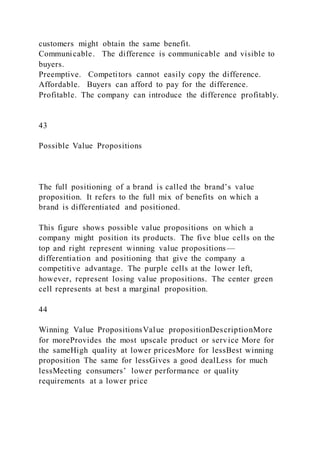
Possible Value Propositions
The full positioning of a brand is called the brand’s value
proposition. It refers to the full mix of benefits on which a
brand is differentiated and positioned.
This figure shows possible value propositions on which a
company might position its products. The five blue cells on the
top and right represent winning value propositions—
differentiation and positioning that give the company a
competitive advantage. The purple cells at the lower left,
however, represent losing value propositions. The center green
cell represents at best a marginal proposition.
44
Winning Value PropositionsValue propositionDescriptionMore
for moreProvides the most upscale product or service More for
the sameHigh quality at lower pricesMore for lessBest winning
proposition The same for lessGives a good dealLess for much
lessMeeting consumers’ lower performance or quality
requirements at a lower price
The table describes the five winning value propositions.
More-for-more positioning involves providing the most upscale
product or service and charging a higher price to cover the
higher costs.
With a more-for-the-same value proposition, companies can
attack a competitor’s more-for-more positioning by introducing
a brand offering comparable quality at a lower price.
Offering the same for less can be a powerful value proposition,
as it is a good deal. Discount stores offer many of the same
brands as department stores and specialty stores but at deep
discounts based on superior purchasing power and lower-cost
operations.
Less-for-much-less positioning involves meeting consumers’
lower performance or quality requirements at a much lower
price. For example, Family Dollar and Dollar General stores
offer more affordable goods at very low prices.
The winning value proposition would be to offer more for less.
Companies find it very difficult to sustain such best-of-both
positioning. Offering more usually costs more, making it
difficult to deliver on the “for-less” promise. Companies that
try to deliver both may lose out to more focused competitors.
45
DEVELOPING A POSITIONING STATEMENT
Positioning statement: Summarizes company or brand
positioning
For [your target market] who [target market need],
[your brand name] provides [main benefit that differentiates
your offering from competitors]
because [reason why target market should believe your
differentiation statement.]
Source: “Positioning Statement Template and Examples”,
Hubspot, 12.9.19
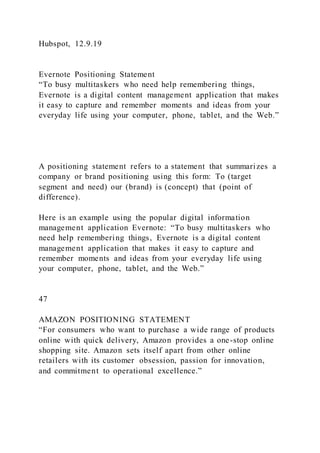
Evernote Positioning Statement
“To busy multitaskers who need help remembering things,
Evernote is a digital content management application that makes
it easy to capture and remember moments and ideas from your
everyday life using your computer, phone, tablet, and the Web.”
A positioning statement refers to a statement that summarizes a
company or brand positioning using this form: To (target
segment and need) our (brand) is (concept) that (point of
difference).
Here is an example using the popular digital information
management application Evernote: “To busy multitaskers who
need help remembering things, Evernote is a digital content
management application that makes it easy to capture and
remember moments and ideas from your everyday life using
your computer, phone, tablet, and the Web.”
47
AMAZON POSITIONING STATEMENT
“For consumers who want to purchase a wide range of products
online with quick delivery, Amazon provides a one-stop online
shopping site. Amazon sets itself apart from other online
retailers with its customer obsession, passion for innovation,
and commitment to operational excellence.”
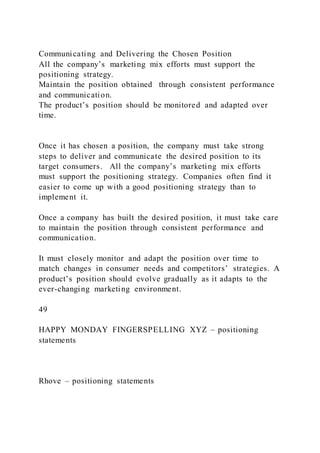
Communicating and Delivering the Chosen Position
All the company’s marketing mix efforts must support the
positioning strategy.
Maintain the position obtained through consistent performance
and communication.
The product’s position should be monitored and adapted over
time.
Once it has chosen a position, the company must take strong
steps to deliver and communicate the desired position to its
target consumers. All the company’s marketing mix efforts
must support the positioning strategy. Companies often find it
easier to come up with a good positioning strategy than to
implement it.
Once a company has built the desired position, it must take care
to maintain the position through consistent performance and
communication.
It must closely monitor and adapt the position over time to
match changes in consumer needs and competitors’ strategies. A
product’s position should evolve gradually as it adapts to the
ever-changing marketing environment.
49
HAPPY MONDAY FINGERSPELLING XYZ – positioning
statements
Rhove – positioning statements
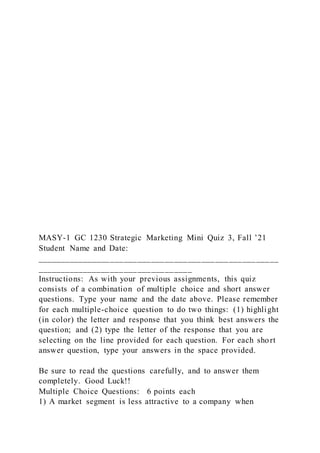
MASY-1 GC 1230 Strategic Marketing Mini Quiz 3, Fall ’21
Student Name and Date:
_____________________________________________________
__________________________________
Instructions: As with your previous assignments, this quiz
consists of a combination of multiple choice and short answer
questions. Type your name and the date above. Please remember
for each multiple-choice question to do two things: (1) highlight
(in color) the letter and response that you think best answers the
question; and (2) type the letter of the response that you are
selecting on the line provided for each question. For each short
answer question, type your answers in the space provided.
Be sure to read the questions carefully, and to answer them
completely. Good Luck!!
Multiple Choice Questions: 6 points each
1) A market segment is less attractive to a company when
________.
A) there are few aggressive competitors in the segment
B) it is difficult for new entrants to enter the segment
C) substitute products are unavailable in the segment
D) it contains powerful suppliers who can control prices
E) buyers in the market segment have weak bargaining powers
2) Breedworthy, a dog food company, divides the market
according to the dog owners' gender, occupation, income, and
family life cycle. In this case, which of the following variables
has the company used for market segmentation? __________
A) geographic
B) psychographic
C) demographic
D) benefit
E) occasion
3) Takashimaya, a luxury retailer, charges higher prices for its
products than its competitors. Despite the high prices, the
retailer is popular among customers for its quality and service
in comparison to other retailers in the market. In this case,
Takashimaya offers a(n) ________ value proposition.
A) more-for-the-same
B) more-for-more
C) more-for-less
D) all-or-nothing
E) same-for-less
4) The marketing manager of Jones Soda, a leading producer of
soft drinks, is considering a differentiated marketing strategy.
An important consideration is weighing increased sales against
________ before selecting this strategy.
A) increased costs
B) increased demand
C) decreased production
D) decreased prices
E) increased profits
5) GoDaddy, an international domain registration and web
hosting company, is embarking on a niche marketing campaign
post-pandemic to attract local restaurant accounts in the top 10
US markets. The success of their niche marketing strategy will
most rely on their ________.
A) affordable pricing
B) product positioning
C) superior products
D) availability of services
E) knowledge of customer needs
6) Wanderer is a popular automobile brand, and its positioning
statement is: "For adventure-seeking American families who
require large vehicles, Wanderer is the automobile of choice."
Which of the following mandatory elements is missing from the
positioning statement? __________
A) product category
B) target audience
C) brand name
D) point of difference
E) need
7) Delilah has been redecorating her new condo for a year. She
is carefully selecting every item. Delilah finds a Moroccan rug
that matches her color scheme and décor perfectly and
purchases it immediately without engaging in comparison
shopping. This is an example of a(n) ________.
A) shopping product
B) specialty product
C) convenience product
D) industrial product
E) capital product
8) L.L. Bean promotes its clothing by emphasizing the
durability and quality of the fabrics it uses. The company has
positioned its brand based on ________.
A) product attributes
B) product benefits
C) beliefs and values
D) market share
E) brand loyalty
9) To increase ridership in 2021-22, product planners for Lyft
are considering offering additional consumer services and
benefits in all markets. To do so, they must build a(n)
________product around the core benefit and actual product.
A) specialty
B) convenience
C) augmented
D) shopping
E) industrial
10) Hearthland, a leading kitchen appliance manufacturer,
markets gas stoves under the brand name "Chef’s Choice" and
electric stoves under the brand name "EcoVate" in order to
target the two different market segments. What branding
strategy is most likely being used by Hearthland? _________
A) brand extensions
B) line extensions
C) multibrands
D) new brands
E) co-brands
11) A dental technician performing an annual cleaning for a
patient illustrates how a service can be produced and consumed
simultaneously. This is an example of which service
characteristic? __________
A) tangibility
B) intangibility
C) inseparability
D) variability
E) perishability
12) Invicta, a high-end maker of designer watches, has started
making inexpensive watches to take advantage of enormous
growth rates in low-end market segments. Invicta is most likely
engaging in ________.
A) franchising
B) line filling
C) two-way stretching
D) downward stretching
E) upward stretching
Short Answer Questions: maximum of 7 points each
13) (Maximum of 7 points) Define industrial products, and
describe the various categories, with examples of each. Given
the current US infrastructure recovery plan,
https://www.whitehouse.gov/briefing-room/statements-
releases/2021/03/31/fact-sheet-the-american-jobs-plan/ which
category would you expect to have the most growth over the
next year, and why?
14) (Maximum of 7 points) Describe how marketers segment
markets based on occasions, benefits sought, and user status.
Using Storm King Art Center as your brand,
https://stormking.org/about/ provide examples of each.
15) (Maximum of 7 points) Define a product line. For
Moleskine Smart, https://www.moleskine.com/en-
us/shop/moleskine-smart/ , what are the two ways in which they
can extend their product line? Provide examples of each, and
discuss the pros and cons of each approach.
16) (Maximum of 7 points) Brand differences are worth
promoting if they satisfy certain criteria. Using the upcoming
Impossible Chicken Nuggets launch as an example, identify and
discuss the criteria. https://fortune.com/2021/07/16/impossible-
foods-nuggets-plant-based-faux-chicken-wars/
MASY
-
1 GC 1230 Strategic Marketing Mini Quiz
3
,
Fall
’
2
1
Student
Name
and Date
:
__________________________________________________
_____________________________________
Instructions
:
As with your previous assignment
s
,
this quiz consists of a combination of multiple choice and
short answer questions.
Type your name and the date above.
Please remember
f
or each multiple
-
choice
question
to
do two things:
(1)
highlight
(in color)
the letter and response that you think best answers the
question
; and (2)
type the letter of the response th
at you are selecting on the line provided for each questi on.
For each short answer question, type your answers in the space
provided
.
Be sure to read the questions carefully
,
and to answer them completely.
Good Luck!!
Multiple Choice Questions
:
6
points each
1
)
A market segment is less attractive
to a company
when ________.
A) t
here are few aggressive competitors in the segment
B) it is difficult for new entrants to enter the segment
C)
substitute products are unavailable in the segment
D)
it contains powerful suppliers who can control prices
E) buyers in the market
segment have weak bargaining powers
2
)
Breedworthy, a dog food company, divides the market according
to the dog owners' gender, occupation,
income, and family life cycle. In this case,
which of the following variables has the company used for
market
segmentation?
__________
A) geographic
B) psychographic
C)
demographic
D)
benefit
E) occasion
3
)
Takashimaya
, a
luxury
retailer
, charges
higher
price
s
for its products than its competitors. Despite the high
prices, the
retailer
is popular among customers for its quality and service in
comparison to
other
retailers
in
the market. In this case,
Takashim
aya
offers a(n) ________ value proposition.
A)
more
-
for
-
the
-
same
B)
more
-
for
-
more
C) more
-
for
-
less
D) all
-
or
-
nothing
E) same
-
for
-
less
4)
The marketing manager of
Jones Soda
, a leadin
g producer of soft drinks, is considering a differentiated
marketing strategy. An important consideration is weighing
increased sales against ________ before
selecting this strategy.
A)
increased costs
B) increased demand
C)
decreased production
D) decreas
ed prices
E) increased profits
MASY-1 GC 1230 Strategic Marketing Mini Quiz 3, Fall ’21
Student Name and Date:
_____________________________________________________
__________________________________
Instructions: As with your previous assignments, this quiz
consists of a combination of multiple choice and
short answer questions. Type your name and the date above.
Please remember for each multiple-choice
question to do two things: (1) highlight (in color) the letter and
response that you think best answers the
question; and (2) type the letter of the response that you are
selecting on the line provided for each question.
For each short answer question, type your answers in the space
provided.
Be sure to read the questions carefully, and to answer them
completely. Good Luck!!
Multiple Choice Questions: 6 points each
1) A market segment is less attractive to a company when
________.
A) there are few aggressive competitors in the segment
B) it is difficult for new entrants to enter the segment
C) substitute products are unavailable in the segment
D) it contains powerful suppliers who can control prices
E) buyers in the market segment have weak bargaining powers
2) Breedworthy, a dog food company, divides the market
according to the dog owners' gender, occupation,
income, and family life cycle. In this case, which of the
following variables has the company used for market
segmentation? __________
A) geographic
B) psychographic
C) demographic
D) benefit
E) occasion
3) Takashimaya, a luxury retailer, charges higher prices for its
products than its competitors. Despite the high
prices, the retailer is popular among customers for its quality
and service in comparison to other retailers in
the market. In this case, Takashimaya offers a(n) ________
value proposition.
A) more-for-the-same
B) more-for-more
C) more-for-less
D) all-or-nothing
E) same-for-less
4) The marketing manager of Jones Soda, a leading producer of
soft drinks, is considering a differentiated
marketing strategy. An important consideration is weighing
increased sales against ________ before
selecting this strategy.
A) increased costs
B) increased demand
C) decreased production
D) decreased prices
E) increased profits

Chapter 7 - Products, Services, and Brands Building Customer

  • 1.
    Chapter 7 -Products, Services, and Brands: Building Customer value Strategic Marketing, MASY1-GC 1230 Nike: More Than Just Innovative Sports Gear—a Total Brand Experience Nike House of Innovation, Paris: The 3rd installation of HOI, and Nike’s largest, most digitally connected and immersive retail concept in the world Provides consumers access to Nike’s best innovations, athlete storytelling and experiences. Creates an immersive and digitally-powered end-to-end consumer journey. To customers, the Nike brand means much more than just innovative running shoes and apparel. Deep down, Nike means sports inspiration, a just-do-it attitude, and a total brand experience. Nike draws on a wide range of experiences to connect with consumers. Nike’s innovative use of digital marketing recently earned the brand the title of “top genius” in “digital IQ” among 70 activewear companies in one digital consultancy’s rankings. Another firm ranked Nike the number one apparel brand in social media. 2
  • 2.
    What Is aProduct? A product is anything that can be offered to a market for attention, acquisition, use, or consumption that might satisfy a want or need. A service is an activity, benefit, or satisfaction offered for sale; it is intangible and does not result in ownership of anything. A product is anything that can be offered to a market for attention, acquisition, use, or consumption that might satisfy a want or need. Broadly defined, products include services, events, persons, places, organizations, and ideas, or a mixture of these. Services are a form of product that consists of activities, benefits, or satisfactions offered for sale that are essentially intangible and do not result in the ownership of anything. 3 Products, Services, and Experiences Market offerings include both tangible goods and services. Companies create and manage customer experiences with their brands or companies. To differentiate their offers from that of the competitors A company’s market offering often includes both tangible goods and services. At one extreme, the market offering may consist of a pure tangible good and at the other extreme a pure service. Between these two extremes, however, many goods-and-services combinations are possible. Today, as products and services become more commoditized, many companies are moving to a new level in creating value for their customers. To differentiate their offers, beyond simply making products and delivering
  • 3.
    services, firms arecreating and managing customer experiences with their brands or companies. 4 Products, Services, and Experiences (CONT’D) More than just selling products, Apple’s highly successful retail stores create engaging life-feels-good brand experiences. Apple’s retail stores are very seductive places, where “life - feels-good” experiences abound. The store design is clean, simple, and just oozing with style—much like an Apple iPad or a featherweight MacBook Air. The stores encourage a lot of purchasing, to be sure. But they also encourage lingering, with tables full of fully functioning Macs, iPads, and iPhones sitting out for visitors to try. 5 Three Levels of Product Core customer value deals with what is bought by the customer. For example, people who buy an Apple iPad are buying much more than just a tablet computer. They are buying entertainment, self-expression, productivity, and connectivity with friends and family—a mobile and personal window to the world. At the second level, product planners must turn the core benefit into an actual product. They need to develop product and service features, a design, a quality level, a brand name, and packaging. For example, the iPad is an actual product. Its name, parts, styling, operating system, features, packaging, and other
  • 4.
    attributes have allbeen carefully combined to deliver the core customer value of staying connected. Finally, product planners must build an augmented product around the core benefit and actual product by offering additional consumer services and benefits. For example, when consumers buy an iPad, Apple and its resellers also might give buyers a warranty on parts and workmanship, quick repair services when needed, and a Web site to use if they have problems or questions. Apple also provides access to a huge assortment of apps and accessories. 6 Product and Service Classifications Consumer products are bought by final consumers for personal consumption. Industrial products are bought by individuals and organizations for further processing or for use in conducting a business. Materials and parts, capital items, and supplies and services Products and services fall into two broad classes based on the types of consumers who use them: consumer products and industrial products. Consumer products are bought by final consumers for personal consumption. Consumer products include convenience products, shopping products, specialty products, and unsought products. These products differ in the ways consumers buy them and, therefore, in how they are marketed. This is explained by the table on the next slide. Industrial products are those products purchased for further processing or for use in conducting a business. The three groups of industrial products and services are materials and parts, capital items, and supplies and services.
  • 5.
    Materials and partsinclude raw materials as well as manufactured materials and parts. Raw materials consist of farm products and natural products. Manufactured materials and parts consist of component materials and parts. Capital items are industrial products that aid in the buyer’s production or operations, including installations and accessory equipment. Installations consist of major purchases such as buildings and fixed equipment. The final group of industrial products is supplies and services. Supplies include operating supplies and repair and maintenance items. Supplies are the convenience products of the industrial field because they are usually purchased with a minimum of effort or comparison. 7 Convenience AND shopping productsProduct typeDescriptionExamples?Convenience productsConsumer products and services that customers usually buy frequently, immediately, and with a minimum of comparison and buying effortShopping productsLess frequently purchased consumer products and services that customers compare carefully on suitability, quality, price, and style Marketing Considerations, Convenience and Shopping ProductsMarketing ConsiderationsConvenienceShoppingCustomer buying behaviorFrequent purchase; little planning, little comparison or shopping effort; low customer involvementLess frequent purchase; much planning
  • 6.
    and shopping effort;comparison of brands on price, quality, and stylePriceLow priceHigher priceDistributionWidespread distribution; convenient locationsSelective distribution in fewer outletsPromotionMass promotion by the producerAdvertising and personal selling by both the producer and resellersExamplesToothpaste, magazines, and laundry detergentMajor appliances, televisions, furniture, and clothing This table illustrates the marketing considerations for convenience and shopping products. 9 specialty and unsought productsProduct typeDescriptionExamples?Specialty productsConsumer products and services with unique characteristics or brand identifications for which a significant group of buyers is willing to make a special purchase effort. Unsought productsConsumer products that the consumer either does not know about, or knows about but does not normally think of buying. Marketing Considerations, Specialty and Unsought ProductsMarketing ConsiderationsSpecialtyUnsoughtCustomer buying behaviorStrong brand preference and loyalty; special purchase effort; little comparison of brands; low price sensitivityLittle product awareness or knowledge (or, if aware, little or even negative interest)PriceHigh price VariesDistributionExclusive distribution in only one or a few outlets per market areaVariesPromotionMore carefully targeted promotion by both the producer and resellersAggressive advertising and personal selling by the producer and resellersExamplesLuxury goods,
  • 7.
    such as Rolexwatches or fine crystalLife insurance and Red Cross blood donations This table illustrates the marketing considerations for specialty and unsought products. 11 Other Market Offerings Organizations: activities undertaken to create, maintain, or change the attitudes and behavior of target consumers toward an organization Persons: activities undertaken to create, maintain, or change attitudes or behavior toward particular people. Places: activities undertaken to create, maintain, or change attitudes or behavior toward particular places. Social Ideas: use of commercial marketing concepts and tools in programs designed to influence individuals’ behavior to improve their well-being and that of society. (social ideas) In addition to tangible products and services, marketers have broadened the concept of a product to include other market offerings. Organization marketing consists of activities undertaken to create, maintain, or change the attitudes and behavior of target consumers toward an organization. Business firms sponsor public relations or corporate image marketing campaigns to market themselves and polish their images. Person marketing consists of activities undertaken to create, maintain, or change attitudes or behavior toward particular people. The skillful use of marketing can turn a person’s name into a powerhouse brand. For example, The Food Network’s
  • 8.
    celebrity chef, RachaelRay, is a one-woman marketing phenomenon, with her own daytime talk show, cookware and cutlery brands, dog food brand, and even her own brand of EVOO (Extra Virgin Olive Oil.) Place marketing involves activities undertaken to create, maintain, or change attitudes or behavior toward particular places. Ideas can also be marketed. We will narrow our focus to the marketing of social ideas. This area has been called social marketing, which consists of using traditional business marketing concepts and tools to create behaviors that will create individual and societal well-being. Social marketing involves much more than just advertising. It involves a broad range of marketing strategies and marketing mix tools designed to bring about beneficial social change. 12 Individual Product Decisions This figure shows the important decisions in the development and marketing of individual products and services. Developing a product or service involves defining the benefits that it will offer. The characteristics of a product or service that bear on its ability to satisfy stated or implied customer needs is known as product quality, one of the marketer’s major positioning tools. Total quality management (TQM) is an approach in which all of the company’s people are involved in constantly improving the quality of products, services, and business processes. A product can be offered with varying features. Another way to add customer value is through distinctive product style and design. A brand is a name, term, sign, symbol, or design or a
  • 9.
    combination of thesethat identifies the maker or seller of a product or service. Consumers view a brand as an important part of a product, and branding can add value to a consumer’s purchase. Brand names help consumers identify products that might benefit them. Brands also say something about product quality and consistency. Packaging involves designing the container or wrapper for a product. Increased competition means that packages must now perform many sales tasks—from attracting buyers to communicating brand positioning to closing the sale. Labels help to identify and describe the product or brand as well as promote the brand, support its positioning and engage customers. The first step in designing product support services is to survey customers periodically. Once the company has assessed the quality of various support services, it can take steps to fix problems and add new services that will both delight customers and yield profits to the company. 13 Product and Service Decisions Individual Product Decisions Product Line Decisions Product Mix Decisions Marketers make product and service decisions at three levels: individual product decisions, product line decisions, and product mix decisions. Each of these decisions is discussed in greater detail in the following slides. 14 Product and Service Attributes Product quality is one of the marketer’s major positioning tools.
  • 10.
    A product canbe offered with varying features. Another way to add customer value is through distinctive product style and design. Developing a product or service involves defining the benefits that it will offer. The characteristics of a product or service that bear on its ability to satisfy stated or implied customer needs is known as product quality, one of the marketer’s major positioning tools. Total quality management (TQM) is an approach in which all of the company’s people are involved in constantly improving the quality of products, services, and business processes. A product can be offered with varying features. Another way to add customer value is through distinctive product style and design. 15 Branding Consumers view a brand as an important part of a product, and branding can add value to a consumer’s purchase. A brand is a name, term, sign, symbol, or design or a combination of these that identifies the maker or seller of a product or service. Consumers view a brand as an important part of a product, and branding can add value to a consumer’s purchase. Brand names help consumers identify products that might benefit them. Brands also say something about product quality and consistency. 16
  • 11.
    Packaging Innovative Child Guardsafety packaging likely saved P&G’s fast-growing Tide PODS and other unit-dose laundry detergent brands. Packaging involves designing the container or wrapper for a product. Increased competition means that packages must now perform many sales tasks—from attracting buyers to communicating brand positioning to closing the sale. 17 Product Line Decisions A product line is closely related products that: Have similar functions and customer groups Are sold through similar outlets or fall within given price ranges Product line length is the number of items in the product line. Product line filling: adding more items within the present range of the line. Product line stretching: lengthens its product line beyond its current range. A product line is a group of products that are closely related because they function in a similar manner, are sold to the same customer groups, are marketed through the same types of outlets, or fall within given price ranges. For example, Nike produces several lines of athletic shoes and apparel. The major product line decision involves product line length, which is the number of items in the product line. A company can expand its product line in two ways: line filling and line stretching.
  • 12.
    Line filling involvesadding more items within the present range of the line. There are several reasons for product line filling. These reasons include reaching for extra profits, satisfying dealers, using excess capacity, being the leading full-line company, and plugging holes to keep out competitors. Line stretching occurs when a company lengthens its product line beyond its current range. The company can stretch its line downward, upward, or both ways. A reason for downward product line stretching is to plug a market hole that would attract a potential competitor. The reason for upward product line stretching is to add prestige to the current product. 18 Product Line Decisions Product line stretching (cont’d) Companies located at the upper end of the market can stretch their lines downward. Companies located at the lower end of the market can stretch their product lines upward. Companies located in the middle range of the market can stretch their lines in both directions. A product line is a group of products that are closely related because they function in a similar manner, are sold to the same customer groups, are marketed through the same types of outlets, or fall within given price ranges. For example, Nike produces several lines of athletic shoes and apparel. The major product line decision involves product line length, which is the number of items in the product line. A company can expand its product line in two ways: line filling and line stretching. Line filling involves adding more items within the present range
  • 13.
    of the line.There are several reasons for product line filling. These reasons include reaching for extra profits, satisfying dealers, using excess capacity, being the leading full-line company, and plugging holes to keep out competitors. Line stretching occurs when a company lengthens its product line beyond its current range. The company can stretch its line downward, upward, or both ways. A reason for downward product line stretching is to plug a market hole that would attract a potential competitor. The reason for upward product line stretching is to add prestige to the current product. 19 Product Line Decisions (CONT’D) Through skillful line stretching and filling, BMW now has brands and lines that successfully appeal to the rich, the super-rich, and the hope-to-be-rich. Over the years, BMW Group has transformed itself from a single-brand, five-model automaker into a powerhouse with three brands, 14 “Series,” and dozens of distinct models. The company has expanded downward with its MINI Cooper line and upward with Rolls-Royce. 20 BMW PRODUCT LINE: https://www.bmwusa.com/all- bmws.html Product Mix (or Product Portfolio) “Colgate World of Care”—products that “every day, people like you trust to care for themselves and the ones they love.”
  • 14.
    Colgate is a$15.2 billion consumer products company that makes and markets a full product mix consisting of dozens of familiar lines and brands. Colgate divides its overall product mix into four major lines: oral care, personal care, home care, and pet nutrition. Each product line consists of many brands and item. 22 Product Mix Decisions Width Number of different product lines the company carries Length Total number of items a company carries within its product lines Depth Number of versions offered for each product in the line Consistency Relativity of the various product lines in end use, production requirements, distribution channels, or some other aspect A company’s product mix has four important dimensions: width, length, depth, and consistency. The mix width refers to the number of different product lines the company carries. Product mix length refers to the total number of items a company carries within its product lines. Product mix depth refers to the number of versions offered for each product in the line. Finally, the consistency of the product mix refers to how closely related the various product lines are in end use, production requirements, distribution channels, or some other aspect.
  • 15.
    A company canincrease its business in four ways. It can add new product lines, widening its product mix. The company can lengthen its existing product lines to become a more full -line company. It can add more versions of each product and thus deepen its product mix. Finally, the company can pursue more product line consistency or less depending on whether it wants to have a strong reputation in a single field or in several fields. Finally, a company can pursue more product line consistency— or less—depending on whether it wants to have a strong reputation in a single field or in several fields. 23 Services accounted for 64% of US GDP in 2020, ABOUT 65% GWP. There are Four Service Characteristics: FKA THE FOUR I’S OF SERVICE: INTANGIBILITY, INCONSISTENCY, INSEPARABILITY, INVENTORY This figure depicts the four special service characteristics a company must consider when designing marketing programs: intangibility, inseparability, variability, and perishability. Service intangibility means that services cannot be seen, tasted, felt, heard, or smelled before they are bought. To reduce uncertainty, buyers look for signals of service quality. They draw conclusions about quality from the place, people, price, equipment, and communications that they can see. Service inseparability means that services cannot be separated from their providers, whether the providers are people or machines. Customer coproduction makes provider–customer interaction a special feature of services marketing. Both the provider and the customer affect the service outcome. Service variability means that the quality of services depends on
  • 16.
    who provides themas well as when, where, and how they are provided. For example, within a Marriott hotel, one registration- counter employee may be cheerful and efficient, whereas another standing just a few feet away may be grumpy and slow. Service perishability means that services cannot be stored for later sale or use. Some doctors charge patients for missed appointments because the service value existed only at that point and disappeared when the patient did not show up. 24 Service Profit Chain Links service firm profits with employee and customer satisfaction The chain consists of five links: Internal service quality Satisfied and productive service employees Greater service value Satisfied and loyal customers Healthy service profits and growth Successful service companies focus their attention on both their customers and their employees. They understand the service profit chain, which links service firm profits with employee and customer satisfaction. This chain consists of five links: internal service quality, satisfied and productive service employees, greater service value, satisfied and loyal customers, and healthy service profits and growth. For example, the supermarket chain Wegmans believes that happy, superbly trained employees create a superior customer experience. 25 Three Types of Services Marketing
  • 17.
    Services marketing requiresmore than just traditional external marketing using the four Ps. This figure shows that services marketing also requires internal marketing and interactive marketing. Internal marketing means that the service firm must orient and motivate its customer-contact employees and supporting service employees to work as a team to provide customer satisfaction. For example, Zappos starts by hiring the right people and carefully orienting and inspiring them to give unparalleled customer service. Interactive marketing means that service quality depends heavily on the quality of the buyer-seller interaction during the service encounter. In services marketing, service quality depends on both the service deliverer and the quality of delivery. All new hires at Zappos —at all levels of the company—complete a four-week customer-loyalty training regimen. 26 Service Profit Chain (CONT’D) Zappos knows that delivering customer happiness begins with happy, dedicated, energetic employees. Zappos is “Powered by Service.” Marketing Tasks for Service Companies Managing service differentiation Developing a differentiated offer, delivery, and image Managing service quality
  • 18.
    Delivering consistently higherquality than the competitors Managing service productivity Training current employees or hiring new ones Increasing the quantity of service by giving up some quality Harnessing the power of technology Service companies face three major marketing tasks: They want to increase their service differentiation, service quality, and service productivity. In these days of intense price competition, service marketers often complain about the difficulty of differentiating their services from those of competitors. The solution to price competition is to develop a differentiated offer, delivery, and image. For example, Dick’s Sporting Goods’ customers can sample shoes on Dick’s indoor footwear track, test golf clubs with an on-site golf swing analyzer and putting green, shoot bows in its archery range, and receive personalized fitness product guidance from an in-store team of fitness trainers. A service firm can differentiate itself by delivering consistently higher quality than its competitors provide. Service providers need to identify what target customers expect in regard to service quality. As hard as they may try, even the best companies will have an occasional late delivery, burned steak, or grumpy employee. However, good service recovery can turn angry customers into loyal ones. With their costs rising rapidly, service firms are under great pressure to increase service productivity. They can do so in several ways. They can train current employees better or hire new ones who will work harder or more skillfully. Or they can increase the quantity of their service by giving up some quality. Finally, a service provider can harness the power of technology.
  • 19.
    However, companies mustavoid pushing productivity so hard that doing so reduces quality. For example, many airlines in their attempts to improve productivity, have mangled customer service. 28 Brand Equity The differential effect that knowing the brand name has on customer response to the product or its marketing With positive brand equity, consumers react more favorably to the brand than to an unbranded version of the same product. Brands are a key element in a company’s relationships with consumers. Brands represent consumers’ perceptions and feelings about a product and its performance. A powerful brand has high brand equity. Brand equity is the differential effect that knowing the brand name has on customer response to the product and its marketing. A brand has positive brand equity when consumers react more favorably to it than to a generic or unbranded version of the same product. It has negative brand equity if consumers react less favorably than to an unbranded version. 29 Brand Equity (CONT’D) Consumer perception dimensions: Differentiation Relevance Knowledge Esteem
  • 20.
    Brand value isthe total financial value of a brand. Customer equity is the value of customer relationships that the brand creates. Ad agency Young & Rubicam’s Brand Asset Valuator measures brand strength along four consumer perception dimensions: differentiation, relevance, knowledge, and esteem. Brands with strong brand equity rate high on all four dimensions. A brand with high brand equity is a very valuable asset. Brand value is the total financial value of a brand. High brand equity provides a company with many competitive advantages. A powerful brand enjoys a high level of consumer brand awareness and loyalty. A powerful brand forms the basis for building strong and profitable customer relationships. The fundamental asset underlying brand equity is customer equity. This refers to the value of customer relationships that the brand creates. The proper focus of marketing is building customer equity, with brand management serving as a major marketing tool. According to one estimate, the brand value of Google is a whopping $159 billion and Apple is at $148 billion. 30 Best 100 global brands, 2020: cumulative brand value Source: “Best Global Brands, 2020”, Interbrand
  • 21.
    Best 100 globalbrands, 2020: brands 1-25 Source: “Best Global Brands, 2020”, Interbrand Best 100 global brands, 2020: brands 26-50 Source: “Best Global Brands, 2020”, Interbrand Best 100 global brands, 2020: brands 51-75 Source: “Best Global Brands, 2020”, Interbrand Best 100 global brands, 2020: brands 76-100 Source: “Best Global Brands, 2020”, Interbrand Best 100 global brands, 2020: brand strength Source: “Best Global Brands, 2020”, Interbrand INTERBRAND 2021 BREAKTHROUGH BRANDS 30 brands that best exemplify Interbrand’s tenets of brand growth: understanding human truths, creating exceptional brand experiences, and delivering superior business results. Major Brand Strategy Decisions
  • 22.
    Brands are powerfulassets that must be carefully developed and managed. As this figure suggests, building strong brands involves many challenging decisions. This figure shows that the major brand strategy decisions involve brand positioning, brand name selection, brand sponsorship, and brand development. 38 Major Brand Strategy Decisions (CONT’D) Kroger’s store brands—from Private Selection to Simple Truth—account for 25% of the grocery retailer’s sales. Kroger’s private brands—the Kroger house brand, Private Selection, Heritage Farm, Simple Truth (natural and organic), Psst, Check This Out (savings), and others—add up to a whopping 25 percent of the giant grocery retailer’s sales, nearly $23 billion worth annually. Kroger even offers a Kroger brand guarantee —“Try it, like it, or get the national brand free.” 39 Target’s private label strategy 45 private labels ("owned brands") Differentiating with owned brands and a curated selection of national brand products is core to their strategy What guests expect from Target: there's something for everybody to love Target’s largest owned food brand. Products are 10-30% less expensive than national brand equivalents
  • 23.
    Target’s 1st ownedfood brand. High-quality, delicious and unique foods at affordable prices This brand offers delicious ways to eat well through great- tasting products made with simple, recognizable ingredients. More than 50% of the assortment is organic.. Great food for real life. All the good stuff guests love, without artificial flavors, colors, sweeteners or high fructose corn syrup. Brand Positioning and Brand Name Selection Marketers should establish a mission and vision for the brand when positioning it. Desirable qualities for a brand name should be Based on the product’s benefits and qualities Easy to pronounce, recognize, and remember Distinctive and extendable Easily translated into foreign languages Capable of registration and legal protection Marketers need to position their brands clearly in target customers’ minds. They can position brands at any of three levels. At the lowest level, they can position the brand on product attributes. At the next level, a brand can be better positioned by associating its name with a desirable benefit. In the final level, the strongest brands go beyond attribute or benefit positioning. They are positioned on strong beliefs and values and engage customers on a deep, emotional level. Finding the best brand name begins with a careful review of the product and its benefits, the target market, and proposed marketing strategies. There are a number of desirable qualities for a brand name. It should suggest something about the
  • 24.
    product’s benefits andqualities, and it should be easy to pronounce, recognize, and remember. The brand name should be distinctive, be extendable, translate easily into foreign languages, and be capable of registration and legal protection. 41 Brand Sponsorship Four sponsorship options Marketed under the manufacturer’s own brand name: National or Manufacturer’s brand Created and owned by a reseller of a product or service: Private or Store brand Use names and symbols created by other companies or well- known movie characters or celebrities for a fee: Licensing Use the established brand names of two different companies on the same product: Co-branding A manufacturer has four sponsorship options: National brands or manufacturers’ brands are marketed under the manufacturer’s own name. The Samsung Galaxy tablet or Kellogg’s Frosted Flakes are examples of national brands. An increasing numbers of retailers and wholesalers have created their own store brands or private brands To compete with store brands, national brands must sharpen their value propositions, especially when appealing to today’s more frugal consumers. Some companies license names or symbols previously created by other manufacturers, the names of well-known celebrities, or characters from popular movies and books. For a fee, licensing any of these can provide an instant and proven brand name. For example, consider the Kodak brand with its familiar red and yellow colors, which has retained its value even after the company went bankrupt and discontinued its consumer products. Co-branding occurs when two established brand names of
  • 25.
    different companies areused on the same product. Because each brand dominates in a different category, the combined brands create broader consumer appeal and greater brand equity. For example, Taco Bell and Doritos teamed up to create the Doritos Locos Taco. 42 Brand Development Strategies This figure illustrates the four choices that a company has when it comes to developing brands. It can introduce line extensions, brand extensions, multibrands, or new brands. Line extensions occur when a company extends existing brand names to new forms, colors, sizes, ingredients, or flavors of an existing product category. A company might introduce line extensions as a low-cost, low-risk way to introduce new products. Or it might want to meet consumer desires for variety, use excess capacity, or command more shelf space from resellers. A brand extension extends an existing brand name to new or modified products in a new category. It gives a new product instant recognition and faster acceptance. But an extension may also confuse the image of the main brand. Multibranding offers a way to establish different features that appeal to different customer segments, lock up more reseller shelf space, and capture a larger market share. A major drawback of multibranding is that each brand might obtain only a small market share, and none may be very profitable. A company might believe that the power of its existing brand
  • 26.
    name is waning,so a new brand name is needed. Or, it may create a new brand name when it enters a new product category for which none of its current brand names are appropriate. For example, Toyota created the separate Lexus brand aimed at luxury car consumers and the Scion brand, targeted toward Millennial consumers. 43 Managing Brands Nest has extended its line to include a host of its own smart- home products. A brand extension extends a current brand name to new or modified products in a new category. For example, Google- owned Nest—which began as a maker of stylish, connected, learning thermostats that can be controlled remotely by phone— has extended its line with a host of smart and stylish smart- home products, including a smoke and carbon monoxide alarm, home monitoring cameras, a home security alarm system, and a video doorbell that lets you know who’s calling. 44 Arm and hammer product lines
  • 27.
    Managing Brands (CONT’D) Communicatethe brand’s positioning Manage all brand touch points Train employees to be customer centered Audit the brand’s strengths and weaknesses Companies must manage their brands carefully. First, the brand’s positioning must be continuously communicated to consumers. Major brand marketers often spend huge amounts on advertising to create brand awareness and build preference and loyalty. Today, customers come to know a brand through a wide range of contacts and touch points. These include advertising but also personal experience with the brand, word of mouth, social media, company Web pages, mobile apps, and many others. The brand’s positioning will not take hold fully unless everyone in the company lives the brand. Therefore, the company needs to train its people to be customer centered. Many companies go even further by training and encouraging their distributors and dealers to serve their customers well. Finally, companies need to periodically audit their brands’ strengths and weaknesses. The brand audit may turn up brands that need more support, brands that need to be dropped, or brands that must be rebranded or repositioned because of changing customer preferences or new competitors. 46 Kendra Scott Brand: How to Scale a Small Business into a Billion Dollar Brand
  • 28.
    https://youtu.be/WmqPQn6SyOU W Hotels' BrandLeader Has Cracked the Code in Scaling Boutique-Style Luxury 10-48 https://www.youtube.com/watch?v=P1sNrszsCw0 Chapter 6 - Customer Value-Driven Marketing Strategy: Creating Value for Target Customers Strategic Marketing, MASY1-GC 1230 YOUR DAILY COFFEE! Where do you most prefer to purchase a cup of coffee? Starbucks Dunkin’ Donuts Corner coffee shop or diner Upscale neighborhood coffee shop Mobile truck or coffee cart McDonald’s or other fast food establishment Bakery or dessert cafe Peet’s, Tim Horton’s or other transplant coffee chain Craft coffee chain, like Blue Bottle, Intelligentsia, Nespresso, Joe, Stumptown and Devocion Deli or sandwich shop, including Panera and Pret a Manger I don’t drink coffee
  • 29.
    Other Dunkin’ Donuts Targetingthe Average Joe Dunkin’ Donuts targets everyday Joes who just don’t get what Starbucks is all about. Dunkin’ Donuts targets the “Dunkin’ tribe”—not the Starbucks coffee snob but the average Joe. Dunkin’ isn’t like Starbucks; it doesn’t want to be. 5 Designing a Customer Value-Driven Market Strategy This figure shows the four major steps in designing a customer - driven marketing strategy. In the first two steps, the company selects the customers that it will serve. Market segmentation involves dividing a market into smaller segments of buyers with distinct needs, characteristics, or behaviors that might require separate marketing strategies or mixes. Market targeting (or targeting) consists of evaluating each market segment’s attractiveness and selecting one or more market segments to enter. In the final two steps, the company decides on a value proposition. Differentiation involves actually differentiating the firm’s market offering to create superior customer value.
  • 30.
    Positioning consists ofarranging for a market offering to occupy a clear, distinctive, and desirable place, relative to competing products in the minds of target consumers. 6 Major Segmentation Variables for Consumer MarketsSegmentation VariableExamplesGeographic Nations, regions, states, counties, cities, neighborhoods, population density (urban, suburban, rural), climate Demographic Age, life-cycle stage, gender, income, occupation, education, religion, ethnicity, generationPsychographic Social class, lifestyle, personalityBehavioral Occasions, benefits, user status, usage rate, loyalty status This table outlines variables that might be used in segmenting consumer markets. Each of these variables are discussed in the forthcoming slides. 7 Geographic and Demographic Segmentation Geographic segmentation: Dividing a market into different geographical units Such as nations, states, regions, counties, cities, or neighborhoods Demographic segmentation: Dividing a market into segments based on variables Such as age, life-cycle stage, gender, income, occupation, education, religion, ethnicity, and generation Geographic segmentation calls for dividing the market into different geographical units, such as nations, regions, states,
  • 31.
    counties, cities, oreven neighborhoods. For example, many large retailers—from Target and Walmart to Kohl’s and Staples—are now opening smaller format stores designed to fit the needs of densely packed urban neighborhoods not suited to their typical large suburban superstores. Demographic segmentation divides the market into segments based on variables such as age, life-cycle stage, gender, income, occupation, education, religion, ethnicity, and generation. Demographic factors are the most popular bases for segmenting customer groups. These factors are discussed in detail in the following slide. 8 Demographic Segmentation Age and life-cycle segmentation Dividing a market into different age and life-cycle groups Gender segmentation Dividing a market into different segments based on gender Income segmentation Dividing a market into different income segments Some companies use age and life-cycle segmentation, offering different products or using different marketing approaches for different age and life-cycle groups. For example, Kraft’s Oscar Mayer brand markets Lunchables, convenient prepackaged lunches for children. To extend the substantial success of Lunchables, however, Oscar Mayer later introduced Lunchables Uploaded for teenagers and an adult version, P3 (Portable Protein Pack). Gender segmentation divides a market into different segments based on gender, and has long been used in marketing clothing, cosmetics, toiletries, toys, and magazines For example, the
  • 32.
    men’s personal careindustry has exploded, and many cosmetics brands that previously catered mostly to women, now successfully market men’s lines. Income segmentation involves dividing a market into different income segments. For example, many retailers—such as the Dollar General, Family Dollar, and Dollar Tree store chains—successfully target low- and middle-income groups. The core market for such stores is represented by families with incomes under $30,000. With their low-income strategies, dollar stores are now the fastest-growing retailers in the nation. 9 FOUR CONSUMER GROUPS DRIVING SPENDING SHIFTS IN 2021 The NielsenIQ study breaks down the four groups in the following way: Existing Constrained – were already watching what they spent prior to COVID-19, and this has not changed Newly Constrained – experienced worsening household income/ financial situations and are consciously watching what they now spend Cautious Insulated – limited impact to income/ financial situation, but are watching what they spend a lot or much more than before Unrestricted Insulated – similar or improved income/ financial situation and do not feel the need to watch what they spend
  • 33.
    Psychographic Segmentation Marketers segmenttheir markets using variables such as: Social class Lifestyle Personality characteristics The products people buy reflect their lifestyles. Psychographic segmentation divides buyers into different segments based on social class, lifestyle, or personality characteristics. People in the same demographic group can have very different psychographic characteristics. . 13 Psychographic Segmentation (CONT’D) Panera launched a marketing campaign tagged “Food as it should be.” Fast-casual restaurant Panera caters to a lifestyle segment of people who want more than just good-tasting food—they want food that’s good for them, too. To better meet the needs of this healthy-living lifestyle segment, Panera recently announced that it would soon banish more than 150 artificial preservatives, sweeteners, colors, and flavors from its food 14 CLARITAS ZIP CODE LOOKUP: 12508 https://claritas360.claritas.com/mybestsegments/#zipLookup
  • 34.
    CLARITAS ZIP CODELOOKUP: 12508, POPULATION BY AGE CLARITAS ZIP CODE LOOKUP: 12508, HOUSEHOLDS BY INCOME CLARITAS ZIP CODE LOOKUP: 12508, HOUSEHOLD COMPOSITION CLARITAS ZIP CODE LOOKUP: 12508, POP BY RACE & ETHNICITY CLARITAS ZIP CODE LOOKUP: “UP AND COMERS” SEGMENT https://claritas360.claritas.com/mybestsegments/#zipLookup CLARITAS ZIP CODE LOOKUP – “UP AND COMERS” CLARITAS ZIP CODE LOOKUP – “UP AND COMERS”
  • 35.
    CLARITAS PRISM SEGMENTS BehavioralSegmentation Occasion segmentation: Segments divided according to occasions, when the buyers Get the idea to buy Make their purchase Use the purchased item Benefit segmentation: Segments divided according to the different benefits that consumers seek from the product. Many marketers believe that behavior variables are the best starting point for building market segments. Occasion segmentation divides the market into segments according to occasions when buyers get the idea to buy, actually make their purchase, or use the purchased item. This segmentation can help firms build up product usage. Companies try to boost consumption by promoting usage during nontraditional occasions. For example, most consumers drink orange juice in the morning, but orange growers have promoted drinking orange juice as a cool, healthful refresher at other times of the day. 24 Behavioral Segmentation (CONT’D) “There’s a Fitbit for Everyone.”
  • 36.
    Benefit segmentation dividesthe market into segments according to the different benefits that consumers seek from the product. For example, to meet varying benefit preferences, Fitbit makes health and fitness tracking devices aimed at buyers in three major benefit segments: Everyday Fitness, Active Fitness, and Performance Fitness. 25 Behavioral Segmentation (CONT’D) User status: Markets can be segmented into nonusers, ex-users, potential users, first-time users, and regular users. Usage rate: Markets can be segmented into light, medium, and heavy product users. Loyalty status: Consumers can be loyal to brands, stores, and companies. User status segments markets into nonusers, ex-users, potential users, first-time users, and regular users of a product. Marketers want to reinforce and retain regular users, attract targeted nonusers, and reinvigorate relationships with ex-users. Included in the potential users group are consumers facing life-stage changes who can be turned into heavy users. Usage rate segments markets into light, medium, and heavy product users. Heavy users are often a small percentage of the market but account for a high percentage of total consumption. A market can also be segmented by loyalty status. Consumers can be loyal to brands, stores, and companies. Highly loyal customers promote the brand through personal word of mouth and social media. In contrast, by studying its less-loyal buyers, a company can detect which brands are most competitive with its own. By looking at customers who are shifting away from its brand, the company can learn about its marketing weaknesses and take actions to correct them.
  • 37.
    26 Multiple Segmentation Bases Segmentationbases help companies to: Identify smaller, better-defined target groups Identify and understand key customer segments Reach customers more efficiently by tailoring market offerings and messages to customers’ specific needs Segmentation systems help marketers segment people and locations into marketable groups of like-minded consumers. Marketers rarely limit their segmentation analysis to onl y one or a few variables. Rather, they often use multiple segmentation bases in an effort to identify smaller, better-defined target groups. One of the leading consumer segmentation systems is Experian’s Mosaic USA system. It classifies U.S. households into one of 71 lifestyle segments and 19 levels of affluence, based on specific consumer demographics, interests, behaviors, and passions. For example, the Birkenstocks and Beemers group is located in the Middle Class Melting Pot level of affluence and consists of 40- to 65-year-olds who have achieved financial security and left the urban rat race for rustic and artsy communities located near small cities. Such segmentation helps companies identify and better understand key customer segments, reach them more efficiently, and tailor market offerings and messages to their specific needs. 27 Segmenting Business Markets Consumer and business markets use many of the same variables
  • 38.
    for segmentation. Variables usedby business marketers for segmentation include Operating characteristics Purchasing approaches Situational factors Personal characteristics Consumer and business marketers use many of the same variables to segment their markets. Business buyers can be segmented geographically, demographically (industry, company size), or by benefits sought, user status, usage rate, and loyalty status. Yet, business marketers also use some additional variables, such as customer operating characteristics, purchasing approaches, situational factors, and personal characteristics. 28 Segmenting International Markets Variables include Geographic location Economic factors Political and legal factors Cultural factors Intermarket (cross-market) segmentation: Grouping consumers with similar needs and buying behaviors irrespective of their location. Companies can segment international markets using one or a combination of several variables. Geographic segmentation assumes that nations close to one another will have many common traits and behaviors. For example, some U.S. marketers lump all Central and South American countries together.
  • 39.
    World markets canalso be segmented based on economic factors. Countries might be grouped by population income levels or by their overall level of economic development. For example, many companies are now targeting the BRIC countries – Brazil, Russia, India, and China – which are fast-growing developing economies with rapidly increasing buying power. Countries can also be segmented by political and legal factors such as the type and stability of government, receptivity to foreign firms, monetary regulations, and amount of bureaucracy. Cultural factors can also be used by grouping markets according to common languages, religions, values and attitudes, customs, and behavioral patterns. Using intermarket segmentation (also called cross-market segmentation), marketers form segments of consumers who have similar needs and buying behaviors even though they are located in different countries. 29 Requirements for Effective Segmentation Measurable Accessible Substantial Differentiable Actionable To be useful, the size, purchasing power, and profiles of market segments should be measurable. The market segments must be accessible – effectively reached and served. The market segments should be substantial – large or profitable enough to serve. They should be differentiable, which means they are conceptually distinguishable and respond differently to different marketing mix elements and programs. Finally, the segments should be actionable, which means that effective programs can be designed for attracting and serving the segments.
  • 40.
    30 Market Targeting Evaluating thevarious segments based on Segment size and growth Segment structural attractiveness Company objectives and resources Selecting target market segments Target market: Set of buyers sharing common needs or characteristics that the company decides to serve Market segmentation reveals the firm’s market segment opportunities. The firm has to evaluate the various segments and decide how many and which segments it can serve best. In evaluating different market segments, a firm must look at three factors. First, a company wants to select segments that have the right size and growth characteristics. Second, the company needs to examine major structural factors that affect long-run segment attractiveness like strong and aggressive competitors or if it is easy for new entrants to come into the segment. The existence of actual or potential substitute products, the relative power of buyers, and powerful suppliers also affects segment attractiveness. Finally, the company must consider its own objectives and resources. Some attractive segments can be dismissed quickly because they do not mesh with the company’s long-run objectives. Or, the company may lack the skills and resources needed to succeed in an attractive segment. After evaluating different segments, the company must decide which and how many segments it will target. A target market consists of a set of buyers who share common needs or
  • 41.
    characteristics that thecompany decides to serve. Market targeting can be carried out at several different levels. 31 Market-Targeting Strategies This figure shows that companies can target very broadly, very narrowly, or somewhere in between. Undifferentiated (or mass marketing) refers to a market-coverage strategy in which a firm decides to ignore market segment differences and go after the whole market with one offer. Differentiated (or segmented marketing) refers to a market-coverage strategy in which a firm decides to target several market segments and designs separate offers for each. Concentrated (or niche marketing) refers to a market-coverage strategy in which a firm goes after a large share of one or a few smaller segments or niches. Micromarketing is the practice of tailoring products and marketing programs to suit the tastes of specific individuals and locations. Rather than seeing a customer in every individual, micromarketers see the individual in every customer. Micromarketing includes local marketing and individual marketing. Local marketing involves tailoring brands and marketing to the needs and wants of local customer segments like cities, neighborhoods, and even specific stores. Individual marketing involves tailoring products and marketing programs to the needs and preferences of individual customers. Mass customization is the process by which firms interact one to one with masses of customers to design products, services, and marketing programs tailor-made to individual needs.
  • 42.
    32 Market Targeting (CONT’D) P&Gmarkets multiple laundry detergent brands and then further segments each brand to service even narrower niches. Using a differentiated marketing (or segmented marketing) strategy, a firm decides to target several market segments and designs separate offers for each. For example, P&G markets at least six different laundry detergent brands in the United States (Tide, Gain, Cheer, Era, Dreft, and Bold), which compete with each other on supermarket shelves. Thanks to its differentiated approach, P&G is really cleaning up in the $15 billion U.S. laundry detergent market, capturing a 61 percent market share. 33 Choosing a Targeting Strategy Factors to consider Company resources Product variability Product’s life-cycle stage Market variability Competitors’ marketing strategies Companies need to consider many factors when choosing a market-targeting strategy. Which strategy is best depends on the company’s resources. When the firm’s resources are limited, concentrated marketing makes the most sense. The best strategy also depends on the degree of product variability. The product’s life-cycle stage also must be considered. When a firm introduces a new product, it may be practical to launch one
  • 43.
    version only, andundifferentiated marketing or concentrated marketing may make the most sense. In the mature stage of the product life cycle, however, differentiated marketing can be useful. Another factor is market variability. If most buyers have the same tastes, buy the same amounts, and react the same way to marketing efforts, undifferentiated marketing is appropriate. Finally, competitors’ marketing strategies are important. When competitors use differentiated or concentrated marketing, undifferentiated marketing can be suicidal. 34 Socially Responsible Target Marketing Controversy and concern of target marketing Vulnerable or disadvantaged consumers are targeted with controversial or potentially harmful products. Socially responsible target marketing should be done to serve both the interests of the company and the interests of those targeted. Target marketing sometimes generates controversy and concern. The biggest issues usually involve the targeting of vulnerable or disadvantaged consumers with controversial or potentially harmful products. In target marketing, the issue is not really who is targeted but rather how and for what. Controversies arise when marketers attempt to profit at the expense of targeted segments—when they unfairly target vulnerable segments or target them with questionable products or tactics. Socially responsible marketing calls for segmentation and targeting that serve not just the
  • 44.
    interests of thecompany but also the interests of those targeted. 35 Differentiation and Positioning Firms must decide which segments to target and on the value proposition. Product position is the way a product is defined by consumers on important attributes. Beyond deciding which segments of the market it will target, the company must decide on a value proposition—how it will create differentiated value for targeted segments and what positions it wants to occupy in those segments. A product position is the way a product is defined by consumers on important attributes—the place the product occupies in consumers’ minds relative to competing products. 36 Differentiation and Positioning (CONT’D) Sonos does more than just sell speakers; it unleashes “All the music on earth, in every room of your house, wirelessly.” 37 Positioning Map: Large Luxury SUVs Marketers prepare perceptual positioning maps that show consumer perceptions of their brands versus those of competing
  • 45.
    products on importantbuying dimensions to plan their differentiation and positioning strategies. This figure shows a positioning map for the U.S. large luxury SUV market. The position of each circle on the map indicates the brand’s perceived positioning on two dimensions: price and orientation (luxury versus performance). The size of each circle indicates the brand’s relative market share. 38 Mapping your brand’s sweet spot – Harvard business review https://hbr.org/2015/06/a-better-way-to-map-brand-strategy Choosing a Differentiation and Positioning Strategy The differentiation and positioning task consists of three steps, which include identifying a set of differentiating competitive advantages on which to build a position, choosing the right competitive advantages, and selecting an overall positioning strategy. The company must then effectively communicate and deliver the chosen position to the market. The following slides discuss each of these steps in greater detail. 40 Identifying Possible Value Differences and Competitive Advantages Competitive advantage: An advantage over competitors gained by offering greater customer value either by
  • 46.
    Having lower prices,or Providing more benefits that justify higher prices Firms can differentiate in terms of product, services, channels, people, or image. Competitive advantage refers to an advantage over competitors gained by offering greater customer value, either by having lower prices or providing more benefits that justify higher prices. To find points of differentiation, marketers must think through the customer’s entire experience with the company’s product or service. Through product differentiation, brands can be differentiated on features, performance, or style and design. Some companies gain services differentiation through speedy, convenient service. Firms that practice channel differentiation gain competitive advantage through the way they design their channel’s coverage, expertise, and performance. Companies can also gain a strong competitive advantage through people differentiation that is, hiring and training better people than their competitors. Even when competing offers look the same, buyers may perceive a difference based on company or brand image differentiation. A company or brand image should convey a product’s distinctive benefits and positioning. 41 Choosing the Right Competitive Advantages Number of differences to promote Developing a unique selling proposition (USP) for each brand and sticking to it Positioning on more than one differentiator
  • 47.
    Many marketers thinkthat companies should aggressively promote only one benefit to the target market. A company should develop a unique selling proposition (USP) for each brand and stick to it. Each brand should pick an attribute and tout itself as “number one” on that attribute. Other marketers think that companies should position themselves on more than one differentiator. Today, in a time when the mass market is fragmenting into many small segments, companies and brands are trying to broaden their positioning strategies to appeal to more segments. 42 Which Differences to Promote Important Distinctive Superior Communicable Preemptive Affordable Profitable Each brand difference has the potential to create company costs as well as customer benefits. A difference is worth establishing to the extent that it satisfies the criteria of being important, distinctive, superior, communicable, preemptive, affordable, and profitable. Important. The difference delivers a highly valued benefit to target buyers. Distinctive. Competitors do not offer the difference, or the company can offer it in a more distinctive way. Superior. The difference is superior to other ways that
  • 48.
    customers might obtainthe same benefit. Communicable. The difference is communicable and visible to buyers. Preemptive. Competitors cannot easily copy the difference. Affordable. Buyers can afford to pay for the difference. Profitable. The company can introduce the difference profitably. 43 Possible Value Propositions The full positioning of a brand is called the brand’s value proposition. It refers to the full mix of benefits on which a brand is differentiated and positioned. This figure shows possible value propositions on which a company might position its products. The five blue cells on the top and right represent winning value propositions— differentiation and positioning that give the company a competitive advantage. The purple cells at the lower left, however, represent losing value propositions. The center green cell represents at best a marginal proposition. 44 Winning Value PropositionsValue propositionDescriptionMore for moreProvides the most upscale product or service More for the sameHigh quality at lower pricesMore for lessBest winning proposition The same for lessGives a good dealLess for much lessMeeting consumers’ lower performance or quality requirements at a lower price
  • 49.
    The table describesthe five winning value propositions. More-for-more positioning involves providing the most upscale product or service and charging a higher price to cover the higher costs. With a more-for-the-same value proposition, companies can attack a competitor’s more-for-more positioning by introducing a brand offering comparable quality at a lower price. Offering the same for less can be a powerful value proposition, as it is a good deal. Discount stores offer many of the same brands as department stores and specialty stores but at deep discounts based on superior purchasing power and lower-cost operations. Less-for-much-less positioning involves meeting consumers’ lower performance or quality requirements at a much lower price. For example, Family Dollar and Dollar General stores offer more affordable goods at very low prices. The winning value proposition would be to offer more for less. Companies find it very difficult to sustain such best-of-both positioning. Offering more usually costs more, making it difficult to deliver on the “for-less” promise. Companies that try to deliver both may lose out to more focused competitors. 45 DEVELOPING A POSITIONING STATEMENT Positioning statement: Summarizes company or brand positioning For [your target market] who [target market need], [your brand name] provides [main benefit that differentiates your offering from competitors] because [reason why target market should believe your differentiation statement.] Source: “Positioning Statement Template and Examples”,
  • 50.
    Hubspot, 12.9.19 Evernote PositioningStatement “To busy multitaskers who need help remembering things, Evernote is a digital content management application that makes it easy to capture and remember moments and ideas from your everyday life using your computer, phone, tablet, and the Web.” A positioning statement refers to a statement that summarizes a company or brand positioning using this form: To (target segment and need) our (brand) is (concept) that (point of difference). Here is an example using the popular digital information management application Evernote: “To busy multitaskers who need help remembering things, Evernote is a digital content management application that makes it easy to capture and remember moments and ideas from your everyday life using your computer, phone, tablet, and the Web.” 47 AMAZON POSITIONING STATEMENT “For consumers who want to purchase a wide range of products online with quick delivery, Amazon provides a one-stop online shopping site. Amazon sets itself apart from other online retailers with its customer obsession, passion for innovation, and commitment to operational excellence.”
  • 51.
    Communicating and Deliveringthe Chosen Position All the company’s marketing mix efforts must support the positioning strategy. Maintain the position obtained through consistent performance and communication. The product’s position should be monitored and adapted over time. Once it has chosen a position, the company must take strong steps to deliver and communicate the desired position to its target consumers. All the company’s marketing mix efforts must support the positioning strategy. Companies often find it easier to come up with a good positioning strategy than to implement it. Once a company has built the desired position, it must take care to maintain the position through consistent performance and communication. It must closely monitor and adapt the position over time to match changes in consumer needs and competitors’ strategies. A product’s position should evolve gradually as it adapts to the ever-changing marketing environment. 49 HAPPY MONDAY FINGERSPELLING XYZ – positioning statements Rhove – positioning statements
  • 52.
    MASY-1 GC 1230Strategic Marketing Mini Quiz 3, Fall ’21 Student Name and Date: _____________________________________________________ __________________________________ Instructions: As with your previous assignments, this quiz consists of a combination of multiple choice and short answer questions. Type your name and the date above. Please remember for each multiple-choice question to do two things: (1) highlight (in color) the letter and response that you think best answers the question; and (2) type the letter of the response that you are selecting on the line provided for each question. For each short answer question, type your answers in the space provided. Be sure to read the questions carefully, and to answer them completely. Good Luck!! Multiple Choice Questions: 6 points each 1) A market segment is less attractive to a company when
  • 53.
    ________. A) there arefew aggressive competitors in the segment B) it is difficult for new entrants to enter the segment C) substitute products are unavailable in the segment D) it contains powerful suppliers who can control prices E) buyers in the market segment have weak bargaining powers 2) Breedworthy, a dog food company, divides the market according to the dog owners' gender, occupation, income, and family life cycle. In this case, which of the following variables has the company used for market segmentation? __________ A) geographic B) psychographic C) demographic D) benefit E) occasion 3) Takashimaya, a luxury retailer, charges higher prices for its products than its competitors. Despite the high prices, the retailer is popular among customers for its quality and service in comparison to other retailers in the market. In this case, Takashimaya offers a(n) ________ value proposition. A) more-for-the-same B) more-for-more C) more-for-less D) all-or-nothing E) same-for-less 4) The marketing manager of Jones Soda, a leading producer of soft drinks, is considering a differentiated marketing strategy. An important consideration is weighing increased sales against ________ before selecting this strategy. A) increased costs B) increased demand C) decreased production D) decreased prices
  • 54.
    E) increased profits 5)GoDaddy, an international domain registration and web hosting company, is embarking on a niche marketing campaign post-pandemic to attract local restaurant accounts in the top 10 US markets. The success of their niche marketing strategy will most rely on their ________. A) affordable pricing B) product positioning C) superior products D) availability of services E) knowledge of customer needs 6) Wanderer is a popular automobile brand, and its positioning statement is: "For adventure-seeking American families who require large vehicles, Wanderer is the automobile of choice." Which of the following mandatory elements is missing from the positioning statement? __________ A) product category B) target audience C) brand name D) point of difference E) need 7) Delilah has been redecorating her new condo for a year. She is carefully selecting every item. Delilah finds a Moroccan rug that matches her color scheme and décor perfectly and purchases it immediately without engaging in comparison shopping. This is an example of a(n) ________. A) shopping product
  • 55.
    B) specialty product C)convenience product D) industrial product E) capital product 8) L.L. Bean promotes its clothing by emphasizing the durability and quality of the fabrics it uses. The company has positioned its brand based on ________. A) product attributes B) product benefits C) beliefs and values D) market share E) brand loyalty 9) To increase ridership in 2021-22, product planners for Lyft are considering offering additional consumer services and benefits in all markets. To do so, they must build a(n) ________product around the core benefit and actual product. A) specialty B) convenience C) augmented D) shopping E) industrial 10) Hearthland, a leading kitchen appliance manufacturer, markets gas stoves under the brand name "Chef’s Choice" and electric stoves under the brand name "EcoVate" in order to target the two different market segments. What branding strategy is most likely being used by Hearthland? _________ A) brand extensions B) line extensions C) multibrands D) new brands E) co-brands
  • 56.
    11) A dentaltechnician performing an annual cleaning for a patient illustrates how a service can be produced and consumed simultaneously. This is an example of which service characteristic? __________ A) tangibility B) intangibility C) inseparability D) variability E) perishability 12) Invicta, a high-end maker of designer watches, has started making inexpensive watches to take advantage of enormous growth rates in low-end market segments. Invicta is most likely engaging in ________. A) franchising B) line filling C) two-way stretching D) downward stretching E) upward stretching Short Answer Questions: maximum of 7 points each 13) (Maximum of 7 points) Define industrial products, and describe the various categories, with examples of each. Given the current US infrastructure recovery plan, https://www.whitehouse.gov/briefing-room/statements- releases/2021/03/31/fact-sheet-the-american-jobs-plan/ which category would you expect to have the most growth over the next year, and why?
  • 57.
    14) (Maximum of7 points) Describe how marketers segment markets based on occasions, benefits sought, and user status. Using Storm King Art Center as your brand, https://stormking.org/about/ provide examples of each. 15) (Maximum of 7 points) Define a product line. For Moleskine Smart, https://www.moleskine.com/en- us/shop/moleskine-smart/ , what are the two ways in which they can extend their product line? Provide examples of each, and discuss the pros and cons of each approach. 16) (Maximum of 7 points) Brand differences are worth promoting if they satisfy certain criteria. Using the upcoming Impossible Chicken Nuggets launch as an example, identify and discuss the criteria. https://fortune.com/2021/07/16/impossible- foods-nuggets-plant-based-faux-chicken-wars/
  • 58.
    MASY - 1 GC 1230Strategic Marketing Mini Quiz 3 , Fall ’ 2 1 Student
  • 59.
    Name and Date : __________________________________________________ _____________________________________ Instructions : As withyour previous assignment s , this quiz consists of a combination of multiple choice and short answer questions. Type your name and the date above. Please remember f or each multiple - choice question to do two things: (1) highlight (in color) the letter and response that you think best answers the question ; and (2) type the letter of the response th at you are selecting on the line provided for each questi on. For each short answer question, type your answers in the space provided
  • 60.
    . Be sure toread the questions carefully , and to answer them completely. Good Luck!! Multiple Choice Questions : 6 points each 1 ) A market segment is less attractive to a company when ________. A) t here are few aggressive competitors in the segment B) it is difficult for new entrants to enter the segment C) substitute products are unavailable in the segment D) it contains powerful suppliers who can control prices E) buyers in the market segment have weak bargaining powers
  • 61.
    2 ) Breedworthy, a dogfood company, divides the market according to the dog owners' gender, occupation, income, and family life cycle. In this case, which of the following variables has the company used for market segmentation? __________ A) geographic B) psychographic C) demographic D) benefit E) occasion 3 ) Takashimaya , a luxury retailer
  • 62.
    , charges higher price s for itsproducts than its competitors. Despite the high prices, the retailer is popular among customers for its quality and service in comparison to other retailers in the market. In this case, Takashim aya offers a(n) ________ value proposition. A) more - for - the - same B) more - for
  • 63.
    - more C) more - for - less D) all - or - nothing E)same - for - less 4) The marketing manager of Jones Soda , a leadin g producer of soft drinks, is considering a differentiated marketing strategy. An important consideration is weighing increased sales against ________ before selecting this strategy. A) increased costs
  • 64.
    B) increased demand C) decreasedproduction D) decreas ed prices E) increased profits MASY-1 GC 1230 Strategic Marketing Mini Quiz 3, Fall ’21
  • 65.
    Student Name andDate: _____________________________________________________ __________________________________ Instructions: As with your previous assignments, this quiz consists of a combination of multiple choice and short answer questions. Type your name and the date above. Please remember for each multiple-choice question to do two things: (1) highlight (in color) the letter and response that you think best answers the question; and (2) type the letter of the response that you are selecting on the line provided for each question. For each short answer question, type your answers in the space provided. Be sure to read the questions carefully, and to answer them completely. Good Luck!! Multiple Choice Questions: 6 points each 1) A market segment is less attractive to a company when ________. A) there are few aggressive competitors in the segment B) it is difficult for new entrants to enter the segment C) substitute products are unavailable in the segment D) it contains powerful suppliers who can control prices E) buyers in the market segment have weak bargaining powers 2) Breedworthy, a dog food company, divides the market according to the dog owners' gender, occupation, income, and family life cycle. In this case, which of the following variables has the company used for market segmentation? __________ A) geographic B) psychographic C) demographic D) benefit E) occasion
  • 66.
    3) Takashimaya, aluxury retailer, charges higher prices for its products than its competitors. Despite the high prices, the retailer is popular among customers for its quality and service in comparison to other retailers in the market. In this case, Takashimaya offers a(n) ________ value proposition. A) more-for-the-same B) more-for-more C) more-for-less D) all-or-nothing E) same-for-less 4) The marketing manager of Jones Soda, a leading producer of soft drinks, is considering a differentiated marketing strategy. An important consideration is weighing increased sales against ________ before selecting this strategy. A) increased costs B) increased demand C) decreased production D) decreased prices E) increased profits