DON’T BURN YOUR BRIDGES
(AND DROWN IN FLUID)
DR CLAIRE SEIFFERT
INTENSIVIST, RNSH, SYDNEY
Burn
Shock
Distributive
shock
Hypovolaemic
shock
CO initially
reduced
Restore +
preserve tissue
perfusion
Avoid initial
over
resuscitation
Accurate Ax
Early Colloid
Permissive
hypotension
Urine 0.5-
1ml/kg av over
2 hrs
Goals
Fluid
Creep
Skin Oedema
Compartment
Syndrome
Pulmonary
and cerebral
oedema
ARDS, MODS
Increased cost
+ mortality
How?
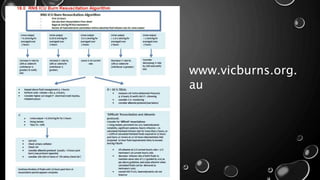
Modified Parkland
Burn
Budget
Evans
Monafo
Demling
Modified
Brooke
www.vicburns.org.
au
THE CHALLENGES
Extreme age Delayed resus
Major
inhalation,
Major
electrical
injury
Extensive
burns
Underlying
comorbidities
BEYOND THE FLUID
Early referral
Early ETT
Exclude
other
trauma
Warming
Lines
Opthal
Nutrition
No
prophylactic
Abx
Psychological

Burns Fluid Resuscitation

Editor's Notes

  • #3 Burn shock = combination of distributive seicondary to release of local and systemic inflammatory mediators and hypovolaemic shock caused by generalized microcirculatory injury and loss of fluid into the interstitial space. CO additionally reduced within the first 4 hrs of injury and recovers gradually over the next 24-48hrs.
  • #4 Resoration of preload + CO an resuscitation takes 24-48hrs. In that time allow permissive hypotension, permissive hyperlactataemia
  • #6 Begin fluid resuscitation with Hartmann’s Solution for burns >15%TBSA in adults, and for burns >10%TBSA in children <16 years old. Where appropriate, warm IV fluid administration should be considered to help minimise heat loss.
  • #8 http://www.anzbaasm.com/3234