BURNS MANAGEMENT
Introduction
• Burns are a form of traumatic injury caused by
thermal, electrical, chemical, or radioactive agents.
• 50% to 60% of fire deaths are secondary to
inhalation injury.
• Most accidents occur at home.
• Flame injury is the leading cause of accidents for
adults.
• Scalding is the leading cause of accidents for
children.
• The very young and the elderly are at greatest risk
for burn injuries.
• Burn injury is a result of heat transfer from one site
to another.
• The skin and the mucosa of the upper airways are
sites of tissue destruction.
• Tissue destruction results from coagulation, protein
denaturation, or ionization of cellular contents.
• Burns that do not exceed 20% TBSA produce a
primarily local response.
• Burns that exceed 20% TBSA may produce both a
local and a systemic response and are considered
major burn injuries.
Pathophysiology of Burn Injury
• The extent of a burn injury is determined by the
degree of heat and duration of exposure of the
tissue to the source.
• The mechanism of injury can provide a useful guide
to the possible severity; e.g., fat scalds produce a
deeper injury than water scalds due to the density.
• Coagulation, stasis, and hyperemia are the 3
recognized zones of burn injury.
• Zone of coagulation – here, irreversible
coagulation of tissue protein has occurred and this
area is therefore unsalvageable.
• Zone of stasis – this is characterized by
decreased tissue perfusion. Thus the aim of
initial burns management is to improve blood
flow to this area to prevent extension of the
injury.
• Zone of hyperemia – this has increased
perfusion and therefore is not at risk unless
there are added factors such as infection.
• Physiologic reaction to a burn is similar to the
inflammatory process:
o Adjacent intact vessels dilate, causing redness and
blanching with pressure.
o Platelets and leukocytes begin to adhere to the
vascular endothelium
o Increased capillary permeability produces wound
edema.
o An influx of polymorphonuclear leukocytes and
monocytes occurs at the injury site.
Systemic Changes in Major Burns
• Major burns involving more than 25% of total body
surface area (TBSA):
(1) Fluid Shifts –
o There are alterations and disruptions in the
vascular and other systems of the body.
o Capillary permeability increases, permitting fluid
and protein to move from vascular to interstitial
spaces (edema results) for the first 24 to 36 hrs,
peaking at 12 hrs postburn.
o There is loss of protein-rich fluid in burned tissues
and by weeping of 2nd-degree wounds and
surface of full-thickness wounds.
• With reduced vascular volume, the patient will go
into shock if untreated.
• Capillary permeability starts to change in about 48
hrs, but protein lost in interstitial spaces may remain
there for 5 days to 2 wks before returning to the
vascular system.
o When fluid mobilizes (moves from interstitial
spaces back to vascular compartment), patients
with good cardiac and renal function will diurese.
o Patients with impaired cardiac or renal function
are in danger of fluid overload and pulmonary
edema at this time.
• Red blood cell (RBC) mass is also diminished bcoz of
thrombosis, sludging, and RBC death from thermal
injury.
• As fluid escapes from the capillary walls, blood
concentrates and the hematocrit rises, causing
sluggish flow.
• Capillary stasis may cause ischemia and necrosis.
• The body attempts to compensate for losses of
plasma volume.
– Constriction of vessels.
– Withdrawal of fluid from undamaged extracellular
space.
– The patient is thirsty. (Oral fluids are not given
until bowel sounds are heard or until patient is no
longer intubated).
(2) Hemodynamic Changes –
o Lessened circulating blood volume results in
decreased cardiac output (CO) and increased PR.
o There is a decreased stroke volume and a marked rise
in peripheral resistance (due to constriction of
arterioles and increased hemoviscosity).
o This results in inadequate tissue perfusion, which may
in turn cause acidosis, renal failure, and irreversible
burn shock.
o Electrolyte imbalance may also occur.
• Hyponatremia usually occurs during the 3rd to
10th day due to fluid shift.
• The burn injury also causes hyperkalemia initially
due to cell destruction, followed by hypokalemia as
fluid shifts occur and potassium is not replaced.
(3) Metabolic Demands –
o Catecholamine release mediates the
hypermetabolic response to burn injury.
o “Burn fever” (first wk), is common and is
dependent on depth of burn and percentage of
TBSA involved.
o Healing a large surface area requires much energy;
and glucose is the primary metabolic fuel.
o Because total body glucose stores are limited and
stored liver and muscle glycogen is exhausted
within the first few days postburn, hepatic glucose
synthesis (gluconeogenesis) increases.
• Insulin levels decrease early postburn, and patients
develop hyperglycemia.
• They continue to be hyperglycemic when insulin
levels increase, probably due to increased
gluconeogenesis.
• Skeletal and visceral protein are mobilized to meet
increased nutritional demands.
(4) Renal Needs –
o Glomerular filtration may be decreased in
extensive injury.
o Without resuscitation or with delay, decreased
renal blood flow may lead to high output or
oliguric renal failure and decreased creatinine
clearance.
o Hemoglobin and myoglobin, present in the urine
of patients with deep muscle damage commonly
associated with electrical injury, may cause acute
tubular necrosis and call for a greater amount of
initial fluid therapy and osmotic diuresis.
(5) Pulmonary Changes –
o Hyperventilation and increased oxygen
consumption are associated with major burns.
o The majority of deaths from fire are due to smoke
inhalation.
o Overzealous fluid resuscitation and the effects of
burn shock on cell membrane potential may cause
pulmonary edema, contributing to decreased
alveolar exchange.
(6) Hematologic Changes –
o Hematological changes in postburn period –
 Thrombocytopenia
 Abnormal platelet function
 Depressed fibrinogen levels
 Inhibition of fibrinolysis
 Deficit in several plasma clotting factors
o Anemia results from the direct effect of –
 Destruction of RBCs due to burn injury
 Reduced life span of surviving RBCs
 Overt or occult blood loss from duodenal or gastric
ulcers
 Blood loss during diagnostic and therapeutic
procedures
(7) Immunologic Activity –
o The loss of the skin barrier and presence of eschar
favor bacterial growth.
o Abnormal inflammatory response after burn injury
causes a decreased delivery of antibiotics, WBCs
and oxygen to the injured area.
o Hypoxia, acidosis, and thrombosis of vessels in the
wound area impair host resistance to pathogenic
bacteria.
o Several major immunoglobulins, complement, and
serum albumin are decreased soon after the burn
occurs.
(8) GI Impact –
o As a result of sympathetic nervous system
response to trauma, peristalsis decreases and
gastric distention, nausea, vomiting, and paralytic
ileus may occur.
o Ischemia of the gastric mucosa and other etiologic
factors put the burn patient at risk for duodenal
and gastric ulcers, manifested by occult bleeding
and, in some cases, life-threatening hemorrhage.
Burn Depths
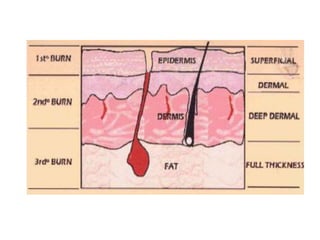
• The 3 main categories of burn depth are –
o Superficial (1st degree)
o Partial thickness (2nd degree)
o Full thickness (3rd degree)
• Partial thickness injuries are further subdivided
into superficial and deep.
• In day-to-day clinical practice, the burn depth is
assessed based on clinical evaluation using a
combination of characteristics; e.g., pain,
appearance, color, blisters (presence or absence),
sensation, and capillary refill.
Superficial Burns –
o Red and painful.
o Only involve the epidermis.
o Usually heal within 7 days.
o In the very superficial burn with no epidermal loss, no
dressing will be required.
o These burns are very painful and a topical analgesic
cream may be useful.
Superficial partial thickness burns –
o Produce blistering,
o Once debrided, appear pink and wet with brisk
capillary refill.
o They are painful and will usually heal within 14 days.
Deep partial thickness burns –
o Less painful.
o Have a dry and fixed blotchy red appearance, and
do not blanch under pressure.
o May take longer to heal (about 21 days or more).
Full thickness burns –
o Appear dry but with a white or brown leathery
appearance.
o They are not painful and generally require excision
and skin grafting to allow healing.
Severity of Burns
• Severity of burns is determined by:
1) Depth: 1st , 2nd (partial-thickness), 3rd degree
(full thickness).
2) Extent: Percentage of TBSA.
3) Age: The very young and very old have a poor
prognosis.
4) Area of the body burned: Face, hands, feet,
perineum, and circumferential burns require
special care.
5) Medical history and concomitant injuries and
illness.
6) Inhalation injury.
Burns requiring hospitalization
o Greater than 10% TBSA in children
o Any burn in the very young
o Full thickness burns
o Burns to the face, hands, feet or perineum
o Circumferential burns
o Inhalation injuries
Assessment for Inhalation Injury
• If victim was burned in a closed area, there should be
a high index of suspicion that smoke inhalation has
occurred.
• Evaluate all pts in closed-space fires for symptoms of
CO poisoning—headache, visual changes, confusion,
irritability, decreased judgment, nausea, ataxia, and
collapse.
• Ask about types of things that burned in this room—
type of carpet, vinyl articles, and synthetics – reason
- with the increasing use of synthetics, toxicity from
aldehydes, cyanide, and other substances is
increasing and must be considered.
• Listen for hoarseness and crackles. Increasing
hoarseness, stridor, and drooling are indicators of
increasing need for intubation.
• Extent of Body Surface Burned –
o Anatomic location—burns affecting hands, feet,
face, and perineum require specialized care.
o Circumferential burns also require special
attention, possibly escharotomy.
o Determination is based on the use of tables for
this purpose, such as the “rule of nines” or the
rule of the palm.
o The patient's palm (including the fingers) is
approximately 1% of the TBSA burned.
Treatment of Burn Injury
• INITIAL ASSESSMENT
Primary Survey
• A – Airway
 Secure the airway first.
 Get history as much as reasonably possible before
intubation
 Soot or singed nasal hairs?
• B – Breathing
 High flow Oxygen for all.
 Escharotomy? - Monitor chest wall excursion in
presence of FT torso burns
 Listen: verify breath sounds
 Assess rate & depth
• C – Circulation
 Monitor BP
 pulse rate
 skin color
 Establish IV access
 Warm IV fluids
 Monitor peripheral pulses in circumferential burns
• D - Disability
 Associated Injuries?
 CO poisoning?
 Substance abuse?
 Hypoxia?
 Pre-existing medical condition
• E – Exposure
 Remove all clothing and jewelry
 Ensure warm environment
 Clean DRY blankets
 It is OK to use water to stop the burning process
and clean but not at the expense of reducing body
core temperature.
• Secondary survey
o Repeat Primary
o Complete head to toe evaluation
o Start after resuscitation fully established
• Complete the HPI
 What type of burn (flame, chemical, scald)
 Duration of exposure
 What time did burn occur?
 What treatment already provided.(chemical brushed
off, water to cool, etc)
 Did burn occur in house fire/enclosed space (think
inhalation injury)
• Order labs and x rays
 CBC, BUN, Cr, electroytes
 Carboxyhemoglobin
 CXR
 Blood gas
 Insert Foley catheter
 EKG (especially in electrical injury)
Special considerations;
 Abuse patterns
 Children, elderly
 Concomitant trauma
 C-spine precautions
 Trauma protocols if trauma is majority of injuries
• Determine TBSA
 Use Lund Browder chart.
 Can start with patients palm = 1% of patients BSA
Management of the Acute Burn Injury
• Hemodynamic stabilization
• Metabolic support
• Wound debridement
• Use of topical antibacterial therapy
• Biologic dressings
• Wound closure
• Prevention and treatment of complications
• Rehabilitation
Hemodynamic Stabilization
• Immediate I.V. fluid resuscitation is indicated for:
– Adults with burns involving more than 18% to 20%
of TBSA.
– Children with burns involving more than 12% to
15% of TBSA.
– Patients with electrical injury, elderly patients, or
those with cardiac or pulmonary disease and
compromised response to burn injury.
• The goal is to give sufficient fluid to allow
perfusion of vital organs without over-
hydrating the patient and risking later
complications and circulatory overload.
• Generally, a crystalloid (Ringer's lactate)
solution is used initially.
• Colloid is used during the second day (5%
albumin, Plasmanate, or hetastarch).
Fluid resuscitation –
• Fluid is key for:
o Restoring adequate intravascular volume to
prevent hypotension and shock.
o Correcting electrolyte abnormalities.
o Minimize renal insufficiency.
• If burns >15%:
o Massive fluid shifts will likely occur due to
systemic inflammatory response syndrome (SIRS)
o Fluid needs will be greater than anticipated based
on appearance of burn alone
Initial fluid resuscitation for burns >15% -
• Parkland formula:
o 3-4 ml x kg x % total burn surface area (TBSA)
½ in first 8 hours
Remaining in next 16 hours
• Galveston Shriner’s formula
o 5000 mL/m2 TBSA burn + 2000 mL/m2 body
surface area (BSA)
• Fluid: Lactate Ringer
- plus 12.5 g 25% albumin per L
- plus D5W as needed for hypoglycemia
• NB: Remember to monitor glucose levels
SINCE glycogen stores of children < 5 year old
run out quickly.
• Goal of fluid resuscitation - adequate urine
output (>1ml/kg/hr).
• Enzymatic agents applied to the burn wound may be
used for more rapid debridement of eschar.
• Fluids may be titrated to achieve a urine output of 30
to 50 mL/hour (0.5 mL to 1.0 mL/kg/hour in an adult,
and approximately 1 mL/kg/hour in a child).
• An indwelling urinary catheter is needed to monitor
response to fluid therapy.
• Weigh the patient on admission and then daily.
• Elevate extremities.
• Monitor peripheral pulses.
• Administer humidified oxygen through a nasal
cannula, mask, or ventilator support.
Metabolic Support
• Initially, institute nothing-by-mouth (NPO) status
until bowel sounds return (1 to 2 days).
• Small amounts of erythromycin may be used to
encourage GI motility.
• Reduce metabolic stress by allaying pain, fear, and
anxiety and maintaining a warm environment.
• Nutritional management must be aggressive to
combat acute nutritional deficiency and weight loss;
a positive nitrogen balance should be the goal
throughout the postburn care.
• When bowel sounds return, administer oral fluids
and advance diet as tolerated.
Wound Cleansing and Debridement
• Treatment of the burn wound includes daily or twice-
daily wound cleansing with debridement or
hydrotherapy (tubbing/showering) and dressing
changes.
• Nonviable tissue (eschar) may be removed through
natural, enzymatic, mechanical, and/or surgical
debridement.
• Burn eschar will begin to separate from the
underlying viable tissue by a natural process of
bacterial growth, which causes a lysis of protein at
the viable-nonviable tissue interface.
Hydrotherapy
• Hydrotherapy is bathing of the burn patient in
a tub of water or with a water shower to
facilitate cleansing and debridement of the
burned area.
Topical Antimicrobials
• Topical medications are used to cover burn areas and
to reduce the number of organisms.
• They are applied directly to the burn area as
ointments, creams, or solutions that do not stick to
the wound but permit drainage.
Immediate post-burn wound care
o Tetanus prophylaxis
o Debride all bullae and necrotic tissue
o Cleanse with mild water-based antiseptic
o Apply thin layer antibiotic cream
o Dress with petroleum gauze and dry gauze

BURNS MANAGEMENT-1.ppt

  • 1.
  • 2.
    Introduction • Burns area form of traumatic injury caused by thermal, electrical, chemical, or radioactive agents. • 50% to 60% of fire deaths are secondary to inhalation injury. • Most accidents occur at home. • Flame injury is the leading cause of accidents for adults. • Scalding is the leading cause of accidents for children. • The very young and the elderly are at greatest risk for burn injuries.
  • 3.
    • Burn injuryis a result of heat transfer from one site to another. • The skin and the mucosa of the upper airways are sites of tissue destruction. • Tissue destruction results from coagulation, protein denaturation, or ionization of cellular contents. • Burns that do not exceed 20% TBSA produce a primarily local response. • Burns that exceed 20% TBSA may produce both a local and a systemic response and are considered major burn injuries.
  • 4.
    Pathophysiology of BurnInjury • The extent of a burn injury is determined by the degree of heat and duration of exposure of the tissue to the source. • The mechanism of injury can provide a useful guide to the possible severity; e.g., fat scalds produce a deeper injury than water scalds due to the density. • Coagulation, stasis, and hyperemia are the 3 recognized zones of burn injury. • Zone of coagulation – here, irreversible coagulation of tissue protein has occurred and this area is therefore unsalvageable.
  • 5.
    • Zone ofstasis – this is characterized by decreased tissue perfusion. Thus the aim of initial burns management is to improve blood flow to this area to prevent extension of the injury. • Zone of hyperemia – this has increased perfusion and therefore is not at risk unless there are added factors such as infection.
  • 7.
    • Physiologic reactionto a burn is similar to the inflammatory process: o Adjacent intact vessels dilate, causing redness and blanching with pressure. o Platelets and leukocytes begin to adhere to the vascular endothelium o Increased capillary permeability produces wound edema. o An influx of polymorphonuclear leukocytes and monocytes occurs at the injury site.
  • 8.
    Systemic Changes inMajor Burns • Major burns involving more than 25% of total body surface area (TBSA): (1) Fluid Shifts – o There are alterations and disruptions in the vascular and other systems of the body. o Capillary permeability increases, permitting fluid and protein to move from vascular to interstitial spaces (edema results) for the first 24 to 36 hrs, peaking at 12 hrs postburn. o There is loss of protein-rich fluid in burned tissues and by weeping of 2nd-degree wounds and surface of full-thickness wounds.
  • 9.
    • With reducedvascular volume, the patient will go into shock if untreated. • Capillary permeability starts to change in about 48 hrs, but protein lost in interstitial spaces may remain there for 5 days to 2 wks before returning to the vascular system. o When fluid mobilizes (moves from interstitial spaces back to vascular compartment), patients with good cardiac and renal function will diurese. o Patients with impaired cardiac or renal function are in danger of fluid overload and pulmonary edema at this time.
  • 10.
    • Red bloodcell (RBC) mass is also diminished bcoz of thrombosis, sludging, and RBC death from thermal injury. • As fluid escapes from the capillary walls, blood concentrates and the hematocrit rises, causing sluggish flow. • Capillary stasis may cause ischemia and necrosis. • The body attempts to compensate for losses of plasma volume. – Constriction of vessels. – Withdrawal of fluid from undamaged extracellular space. – The patient is thirsty. (Oral fluids are not given until bowel sounds are heard or until patient is no longer intubated).
  • 11.
    (2) Hemodynamic Changes– o Lessened circulating blood volume results in decreased cardiac output (CO) and increased PR. o There is a decreased stroke volume and a marked rise in peripheral resistance (due to constriction of arterioles and increased hemoviscosity). o This results in inadequate tissue perfusion, which may in turn cause acidosis, renal failure, and irreversible burn shock. o Electrolyte imbalance may also occur. • Hyponatremia usually occurs during the 3rd to 10th day due to fluid shift. • The burn injury also causes hyperkalemia initially due to cell destruction, followed by hypokalemia as fluid shifts occur and potassium is not replaced.
  • 12.
    (3) Metabolic Demands– o Catecholamine release mediates the hypermetabolic response to burn injury. o “Burn fever” (first wk), is common and is dependent on depth of burn and percentage of TBSA involved. o Healing a large surface area requires much energy; and glucose is the primary metabolic fuel. o Because total body glucose stores are limited and stored liver and muscle glycogen is exhausted within the first few days postburn, hepatic glucose synthesis (gluconeogenesis) increases.
  • 13.
    • Insulin levelsdecrease early postburn, and patients develop hyperglycemia. • They continue to be hyperglycemic when insulin levels increase, probably due to increased gluconeogenesis. • Skeletal and visceral protein are mobilized to meet increased nutritional demands.
  • 15.
    (4) Renal Needs– o Glomerular filtration may be decreased in extensive injury. o Without resuscitation or with delay, decreased renal blood flow may lead to high output or oliguric renal failure and decreased creatinine clearance. o Hemoglobin and myoglobin, present in the urine of patients with deep muscle damage commonly associated with electrical injury, may cause acute tubular necrosis and call for a greater amount of initial fluid therapy and osmotic diuresis.
  • 16.
    (5) Pulmonary Changes– o Hyperventilation and increased oxygen consumption are associated with major burns. o The majority of deaths from fire are due to smoke inhalation. o Overzealous fluid resuscitation and the effects of burn shock on cell membrane potential may cause pulmonary edema, contributing to decreased alveolar exchange.
  • 17.
    (6) Hematologic Changes– o Hematological changes in postburn period –  Thrombocytopenia  Abnormal platelet function  Depressed fibrinogen levels  Inhibition of fibrinolysis  Deficit in several plasma clotting factors o Anemia results from the direct effect of –  Destruction of RBCs due to burn injury  Reduced life span of surviving RBCs  Overt or occult blood loss from duodenal or gastric ulcers  Blood loss during diagnostic and therapeutic procedures
  • 18.
    (7) Immunologic Activity– o The loss of the skin barrier and presence of eschar favor bacterial growth. o Abnormal inflammatory response after burn injury causes a decreased delivery of antibiotics, WBCs and oxygen to the injured area. o Hypoxia, acidosis, and thrombosis of vessels in the wound area impair host resistance to pathogenic bacteria. o Several major immunoglobulins, complement, and serum albumin are decreased soon after the burn occurs.
  • 19.
    (8) GI Impact– o As a result of sympathetic nervous system response to trauma, peristalsis decreases and gastric distention, nausea, vomiting, and paralytic ileus may occur. o Ischemia of the gastric mucosa and other etiologic factors put the burn patient at risk for duodenal and gastric ulcers, manifested by occult bleeding and, in some cases, life-threatening hemorrhage.
  • 20.
    Burn Depths • The3 main categories of burn depth are – o Superficial (1st degree) o Partial thickness (2nd degree) o Full thickness (3rd degree) • Partial thickness injuries are further subdivided into superficial and deep. • In day-to-day clinical practice, the burn depth is assessed based on clinical evaluation using a combination of characteristics; e.g., pain, appearance, color, blisters (presence or absence), sensation, and capillary refill.
  • 21.
    Superficial Burns – oRed and painful. o Only involve the epidermis. o Usually heal within 7 days. o In the very superficial burn with no epidermal loss, no dressing will be required. o These burns are very painful and a topical analgesic cream may be useful. Superficial partial thickness burns – o Produce blistering, o Once debrided, appear pink and wet with brisk capillary refill. o They are painful and will usually heal within 14 days.
  • 22.
    Deep partial thicknessburns – o Less painful. o Have a dry and fixed blotchy red appearance, and do not blanch under pressure. o May take longer to heal (about 21 days or more). Full thickness burns – o Appear dry but with a white or brown leathery appearance. o They are not painful and generally require excision and skin grafting to allow healing.
  • 25.
    Severity of Burns •Severity of burns is determined by: 1) Depth: 1st , 2nd (partial-thickness), 3rd degree (full thickness). 2) Extent: Percentage of TBSA. 3) Age: The very young and very old have a poor prognosis. 4) Area of the body burned: Face, hands, feet, perineum, and circumferential burns require special care. 5) Medical history and concomitant injuries and illness. 6) Inhalation injury.
  • 26.
    Burns requiring hospitalization oGreater than 10% TBSA in children o Any burn in the very young o Full thickness burns o Burns to the face, hands, feet or perineum o Circumferential burns o Inhalation injuries
  • 27.
    Assessment for InhalationInjury • If victim was burned in a closed area, there should be a high index of suspicion that smoke inhalation has occurred. • Evaluate all pts in closed-space fires for symptoms of CO poisoning—headache, visual changes, confusion, irritability, decreased judgment, nausea, ataxia, and collapse. • Ask about types of things that burned in this room— type of carpet, vinyl articles, and synthetics – reason - with the increasing use of synthetics, toxicity from aldehydes, cyanide, and other substances is increasing and must be considered.
  • 28.
    • Listen forhoarseness and crackles. Increasing hoarseness, stridor, and drooling are indicators of increasing need for intubation. • Extent of Body Surface Burned – o Anatomic location—burns affecting hands, feet, face, and perineum require specialized care. o Circumferential burns also require special attention, possibly escharotomy. o Determination is based on the use of tables for this purpose, such as the “rule of nines” or the rule of the palm. o The patient's palm (including the fingers) is approximately 1% of the TBSA burned.
  • 30.
    Treatment of BurnInjury • INITIAL ASSESSMENT Primary Survey • A – Airway  Secure the airway first.  Get history as much as reasonably possible before intubation  Soot or singed nasal hairs? • B – Breathing  High flow Oxygen for all.  Escharotomy? - Monitor chest wall excursion in presence of FT torso burns  Listen: verify breath sounds  Assess rate & depth
  • 31.
    • C –Circulation  Monitor BP  pulse rate  skin color  Establish IV access  Warm IV fluids  Monitor peripheral pulses in circumferential burns • D - Disability  Associated Injuries?  CO poisoning?  Substance abuse?  Hypoxia?  Pre-existing medical condition
  • 32.
    • E –Exposure  Remove all clothing and jewelry  Ensure warm environment  Clean DRY blankets  It is OK to use water to stop the burning process and clean but not at the expense of reducing body core temperature. • Secondary survey o Repeat Primary o Complete head to toe evaluation o Start after resuscitation fully established
  • 33.
    • Complete theHPI  What type of burn (flame, chemical, scald)  Duration of exposure  What time did burn occur?  What treatment already provided.(chemical brushed off, water to cool, etc)  Did burn occur in house fire/enclosed space (think inhalation injury) • Order labs and x rays  CBC, BUN, Cr, electroytes  Carboxyhemoglobin  CXR  Blood gas  Insert Foley catheter  EKG (especially in electrical injury)
  • 34.
    Special considerations;  Abusepatterns  Children, elderly  Concomitant trauma  C-spine precautions  Trauma protocols if trauma is majority of injuries • Determine TBSA  Use Lund Browder chart.  Can start with patients palm = 1% of patients BSA
  • 35.
    Management of theAcute Burn Injury • Hemodynamic stabilization • Metabolic support • Wound debridement • Use of topical antibacterial therapy • Biologic dressings • Wound closure • Prevention and treatment of complications • Rehabilitation
  • 36.
    Hemodynamic Stabilization • ImmediateI.V. fluid resuscitation is indicated for: – Adults with burns involving more than 18% to 20% of TBSA. – Children with burns involving more than 12% to 15% of TBSA. – Patients with electrical injury, elderly patients, or those with cardiac or pulmonary disease and compromised response to burn injury. • The goal is to give sufficient fluid to allow perfusion of vital organs without over- hydrating the patient and risking later complications and circulatory overload.
  • 37.
    • Generally, acrystalloid (Ringer's lactate) solution is used initially. • Colloid is used during the second day (5% albumin, Plasmanate, or hetastarch).
  • 38.
    Fluid resuscitation – •Fluid is key for: o Restoring adequate intravascular volume to prevent hypotension and shock. o Correcting electrolyte abnormalities. o Minimize renal insufficiency. • If burns >15%: o Massive fluid shifts will likely occur due to systemic inflammatory response syndrome (SIRS) o Fluid needs will be greater than anticipated based on appearance of burn alone
  • 39.
    Initial fluid resuscitationfor burns >15% - • Parkland formula: o 3-4 ml x kg x % total burn surface area (TBSA) ½ in first 8 hours Remaining in next 16 hours • Galveston Shriner’s formula o 5000 mL/m2 TBSA burn + 2000 mL/m2 body surface area (BSA) • Fluid: Lactate Ringer - plus 12.5 g 25% albumin per L - plus D5W as needed for hypoglycemia
  • 40.
    • NB: Rememberto monitor glucose levels SINCE glycogen stores of children < 5 year old run out quickly. • Goal of fluid resuscitation - adequate urine output (>1ml/kg/hr).
  • 41.
    • Enzymatic agentsapplied to the burn wound may be used for more rapid debridement of eschar. • Fluids may be titrated to achieve a urine output of 30 to 50 mL/hour (0.5 mL to 1.0 mL/kg/hour in an adult, and approximately 1 mL/kg/hour in a child). • An indwelling urinary catheter is needed to monitor response to fluid therapy. • Weigh the patient on admission and then daily. • Elevate extremities. • Monitor peripheral pulses. • Administer humidified oxygen through a nasal cannula, mask, or ventilator support.
  • 42.
    Metabolic Support • Initially,institute nothing-by-mouth (NPO) status until bowel sounds return (1 to 2 days). • Small amounts of erythromycin may be used to encourage GI motility. • Reduce metabolic stress by allaying pain, fear, and anxiety and maintaining a warm environment. • Nutritional management must be aggressive to combat acute nutritional deficiency and weight loss; a positive nitrogen balance should be the goal throughout the postburn care. • When bowel sounds return, administer oral fluids and advance diet as tolerated.
  • 43.
    Wound Cleansing andDebridement • Treatment of the burn wound includes daily or twice- daily wound cleansing with debridement or hydrotherapy (tubbing/showering) and dressing changes. • Nonviable tissue (eschar) may be removed through natural, enzymatic, mechanical, and/or surgical debridement. • Burn eschar will begin to separate from the underlying viable tissue by a natural process of bacterial growth, which causes a lysis of protein at the viable-nonviable tissue interface.
  • 44.
    Hydrotherapy • Hydrotherapy isbathing of the burn patient in a tub of water or with a water shower to facilitate cleansing and debridement of the burned area.
  • 45.
    Topical Antimicrobials • Topicalmedications are used to cover burn areas and to reduce the number of organisms. • They are applied directly to the burn area as ointments, creams, or solutions that do not stick to the wound but permit drainage. Immediate post-burn wound care o Tetanus prophylaxis o Debride all bullae and necrotic tissue o Cleanse with mild water-based antiseptic o Apply thin layer antibiotic cream o Dress with petroleum gauze and dry gauze