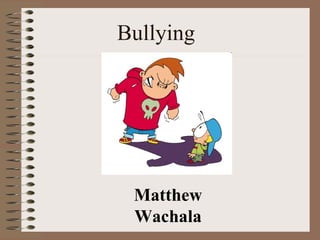
Bullying Matthew Wachala
Background Bullying  is a form of abuse. It involves repeated acts over time attempting to create or enforce one person's (or group's) power over another person (or group) , thus an "imbalance of power". The "imbalance of power" may be social power and/or physical power. The victim of bullying is sometimes referred to as a target.  Bullying consists of three basic types of abuse – emotional, verbal and physical. It typically involves subtle methods of coercion such as psychological manipulation. Bullying can be defined in many different ways. Although the UK currently has no legal definition of bullying, some US states have laws against it.
Background Continued Bullying can occur in any context in which human beings interact with each other. This includes school, church, family, the workplace, home and neighborhoods. It is even a common push factor in migration. Bullying can exist between social groups, social classes and even between countries (see Jingoism). In fact on an international scale, perceived or real imbalances of power between nations, in both economic systems and in treaty systems, are often cited as some of the primary causes of both World War I and World War II. Put simply, historically and from this perspective, certain international 'bullying' between nations is seen as having resulted in at least two very major and costly international wars.
Statistical Information  1 out of 4 kids is Bullied.  Surveys Show That  77%  of students are bullied mentally, verbally, & physically.   In a recent study, 77% of the students said they had been bullied. And 14% of those who were bullied said they experienced severe (bad) reactions to the abuse.   43% fear harassment in the bathroom at school.   86% said, "other kids picking on them, making fun of them or bullying them" causes teenagers to turn to lethal violence in the schools.
Statistical Information Continued Playground statistics - Every 7 minutes a child is bullied. Adult intervention - 4%. Peer intervention - 11%. No intervention - 85%. 87% said shootings are motivated by a desire to "get back at those who have hurt them."  28% of youths who carry weapons have witnessed violence at home.   Bullying is increasingly viewed as an important contributor to youth violence, including homicide and suicide. Case studies of the shooting at Colombine High School and other U.S. schools have suggested that bullying was a factor in many of the incidents.
Statistical Information Continued  Students recognize that being a victim of abuse at home or witnessing others being abused at home may cause violence in school.  61% said students shoot others because they have been victims of physical abuse at home.  54% said witnessing physical abuse at home can lead to violence in school.  100,000 students carry a gun to school.   Teenagers say revenge is the strongest motivation for school shootings  282,000 students are physically attacked in secondary schools each month
Statistical Information Continued Among students, homicide perpetrators were more than twice as likely as homicide victims to have been bullied by peers. (School-Associated Violent Deaths in the United States 1994-1999, Centers for Disease Control and Prevention and U.S. Departments of Education and Justice, 2001; findings published by the Journal of the American Medical Association, 2001) The study authors also reported that bullies were more likely to be involved in other problem behaviors, such as smoking and drinking alcohol, and to do more poorly academically. However, youth who were both bullies and recipients of bullying tended to fare the most poorly of all, experiencing social isolation, as well as doing poorly in school and engaging in problem behaviors, like smoking and drinking.
Bullying Effects Fighting Vandalism Truancy Dropping out of school Stealing Smoking Alcohol/and or drug abuse
Survey Questions 1. Have you or someone else been bullied? A) YES B)NO 2. What kind of bullying was it? A) Verbal B) Physical C) Mental 3. Have you ever bullied someone? A) YES B)NO 4. What can you do to stop bullying? 5. Have you ever tried to stop someone from being bullied? 6.Have you ever seen destructive decisions from being bullied? A) YES B) NO 7. If, yes, what was the destructive decisions? 8. Has you life been changed because of bulling you?  A) YES B)NO If you answered yes, how so has your life changed?
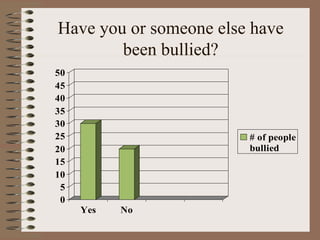
Have you or someone else have been bullied?
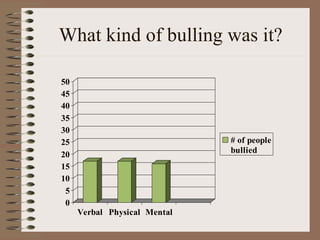
What kind of bulling was it?
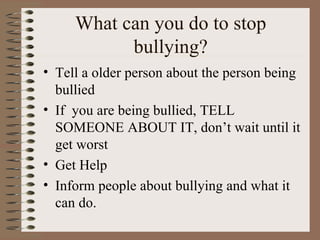
What can you do to stop bullying? Tell a older person about the person being bullied If  you are being bullied, TELL SOMEONE ABOUT IT, don’t wait until it get worst  Get Help Inform people about bullying and what it can do.
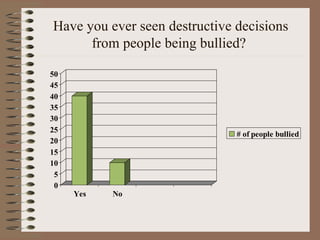
Have you ever seen destructive decisions from people being bullied?
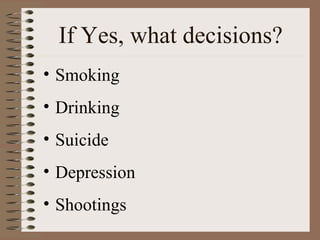
If Yes, what decisions? Smoking Drinking Suicide Depression Shootings
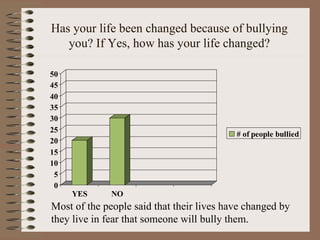
Has your life been changed because of bullying you? If Yes, how has your life changed? Most of the people said that their lives have changed by they live in fear that someone will bully them.
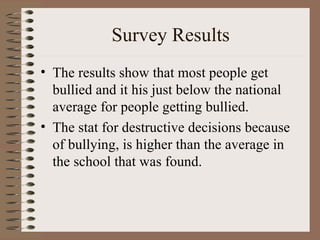
Survey Results The results show that most people get bullied and it his just below the national average for people getting bullied. The stat for destructive decisions because of bullying, is higher than the average in the school that was found.
Work Cited http://en.wikipedia.org/wiki/Bullying http://www.pascack.k12.nj.us/70271919141818/lib/70271919141818/Bullying_Statistics.htm http://www.images.google.com

Bullying

  • 1.
  • 2.
    Background Bullying is a form of abuse. It involves repeated acts over time attempting to create or enforce one person's (or group's) power over another person (or group) , thus an "imbalance of power". The "imbalance of power" may be social power and/or physical power. The victim of bullying is sometimes referred to as a target. Bullying consists of three basic types of abuse – emotional, verbal and physical. It typically involves subtle methods of coercion such as psychological manipulation. Bullying can be defined in many different ways. Although the UK currently has no legal definition of bullying, some US states have laws against it.
  • 3.
    Background Continued Bullyingcan occur in any context in which human beings interact with each other. This includes school, church, family, the workplace, home and neighborhoods. It is even a common push factor in migration. Bullying can exist between social groups, social classes and even between countries (see Jingoism). In fact on an international scale, perceived or real imbalances of power between nations, in both economic systems and in treaty systems, are often cited as some of the primary causes of both World War I and World War II. Put simply, historically and from this perspective, certain international 'bullying' between nations is seen as having resulted in at least two very major and costly international wars.
  • 4.
    Statistical Information 1 out of 4 kids is Bullied.  Surveys Show That  77%  of students are bullied mentally, verbally, & physically. In a recent study, 77% of the students said they had been bullied. And 14% of those who were bullied said they experienced severe (bad) reactions to the abuse. 43% fear harassment in the bathroom at school. 86% said, "other kids picking on them, making fun of them or bullying them" causes teenagers to turn to lethal violence in the schools.
  • 5.
    Statistical Information ContinuedPlayground statistics - Every 7 minutes a child is bullied. Adult intervention - 4%. Peer intervention - 11%. No intervention - 85%. 87% said shootings are motivated by a desire to "get back at those who have hurt them." 28% of youths who carry weapons have witnessed violence at home. Bullying is increasingly viewed as an important contributor to youth violence, including homicide and suicide. Case studies of the shooting at Colombine High School and other U.S. schools have suggested that bullying was a factor in many of the incidents.
  • 6.
    Statistical Information Continued Students recognize that being a victim of abuse at home or witnessing others being abused at home may cause violence in school. 61% said students shoot others because they have been victims of physical abuse at home. 54% said witnessing physical abuse at home can lead to violence in school. 100,000 students carry a gun to school. Teenagers say revenge is the strongest motivation for school shootings 282,000 students are physically attacked in secondary schools each month
  • 7.
    Statistical Information ContinuedAmong students, homicide perpetrators were more than twice as likely as homicide victims to have been bullied by peers. (School-Associated Violent Deaths in the United States 1994-1999, Centers for Disease Control and Prevention and U.S. Departments of Education and Justice, 2001; findings published by the Journal of the American Medical Association, 2001) The study authors also reported that bullies were more likely to be involved in other problem behaviors, such as smoking and drinking alcohol, and to do more poorly academically. However, youth who were both bullies and recipients of bullying tended to fare the most poorly of all, experiencing social isolation, as well as doing poorly in school and engaging in problem behaviors, like smoking and drinking.
  • 8.
    Bullying Effects FightingVandalism Truancy Dropping out of school Stealing Smoking Alcohol/and or drug abuse
  • 9.
    Survey Questions 1.Have you or someone else been bullied? A) YES B)NO 2. What kind of bullying was it? A) Verbal B) Physical C) Mental 3. Have you ever bullied someone? A) YES B)NO 4. What can you do to stop bullying? 5. Have you ever tried to stop someone from being bullied? 6.Have you ever seen destructive decisions from being bullied? A) YES B) NO 7. If, yes, what was the destructive decisions? 8. Has you life been changed because of bulling you? A) YES B)NO If you answered yes, how so has your life changed?
  • 10.
    Have you orsomeone else have been bullied?
  • 11.
    What kind ofbulling was it?
  • 12.
    What can youdo to stop bullying? Tell a older person about the person being bullied If you are being bullied, TELL SOMEONE ABOUT IT, don’t wait until it get worst Get Help Inform people about bullying and what it can do.
  • 13.
    Have you everseen destructive decisions from people being bullied?
  • 14.
    If Yes, whatdecisions? Smoking Drinking Suicide Depression Shootings
  • 15.
    Has your lifebeen changed because of bullying you? If Yes, how has your life changed? Most of the people said that their lives have changed by they live in fear that someone will bully them.
  • 16.
    Survey Results Theresults show that most people get bullied and it his just below the national average for people getting bullied. The stat for destructive decisions because of bullying, is higher than the average in the school that was found.
  • 17.
    Work Cited http://en.wikipedia.org/wiki/Bullyinghttp://www.pascack.k12.nj.us/70271919141818/lib/70271919141818/Bullying_Statistics.htm http://www.images.google.com