PHOTO:
HARRY
JAMES
CREO
FOR
USAID
BASA
PILIPINAS
ABC+: Advancing Basic Education in the Philippines
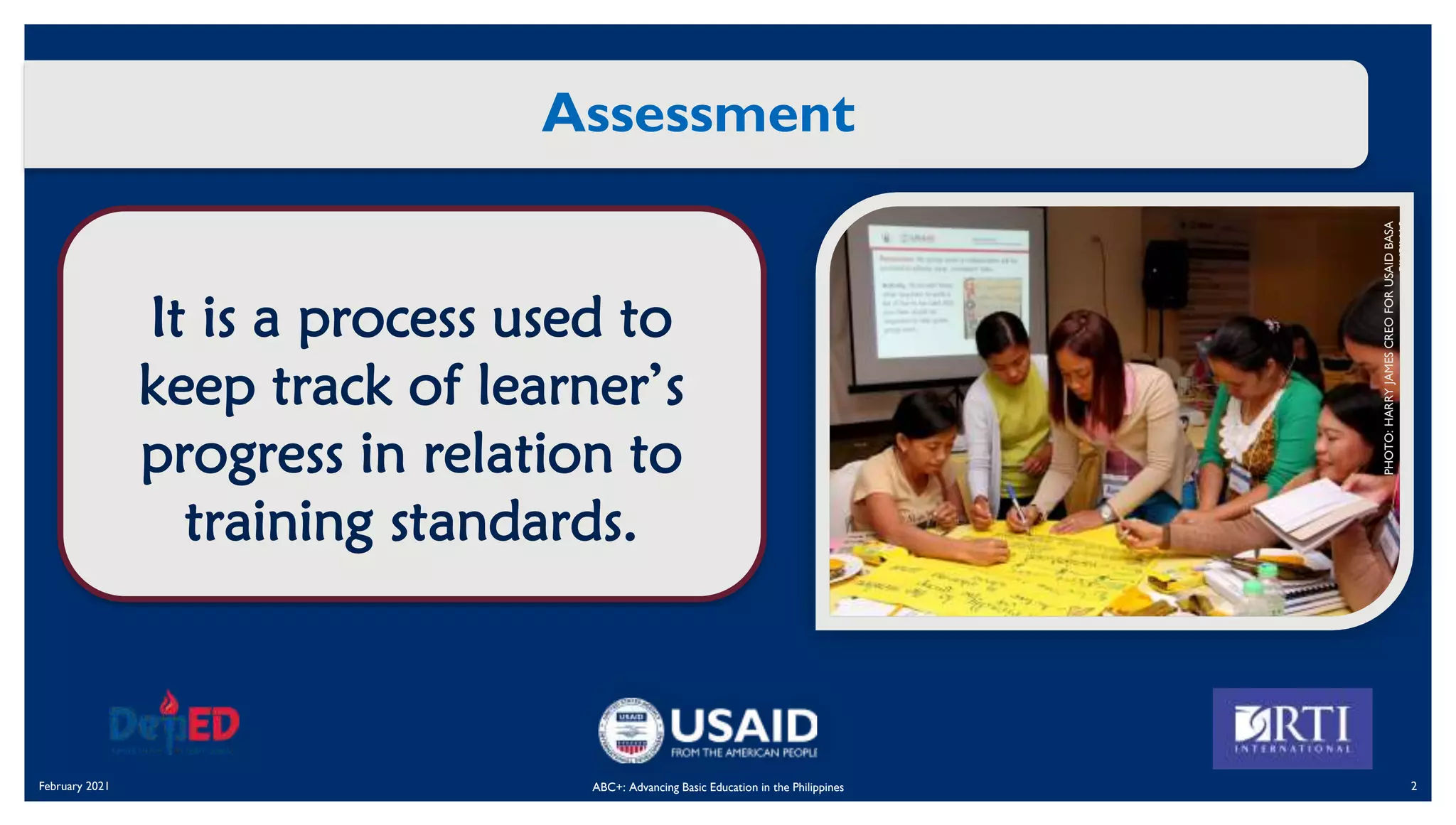
Assessment
February 2021 2
ABC+: Advancing Basic Education in the Philippines
It is a process used to
keep track of learner’s
progress in relation to
training standards.
PHOTO:
HARRY
JAMES
CREO
FOR
USAID
BASA
PILIPINAS
WHAT MAY BE THE
REASONS WHY A
CHILD CANNOT READ
YET?
3
4
CREDIT:
HARRY
JAMES
CREO
FOR
USAID
BASA
PILIPINAS
Assessment Tools
Mother Tongue | Filipino | English
● Listening Comprehension
● Fluency and Reading
Comprehension (CRLA EoSY)
● Sentence Reading and
Comprehension
● Word Reading
○ Combined Sounds
○ Sight words
○ Non-words
● Phonological Awareness
○ Syllable Analysis
○ Phoneme Analysis
○ Initial Sound
○ Final Sound
● Alphabet Knowledge
5
English | Filipino | Math
• MT - ℅ Core
Writers/ CLMD
(follow the pattern in
Filipino)
• To determine where
to start
• Will serve as pre and
post- assessment
tools
Assessment Tools
Filipino/ English/ Mother Tongue
Grade 1 (Mother Tongue) & Grade
2 (English)
Alphabet Knowledge;
Phonological Awareness (syllable
analysis, phoneme analysis, first
sound, last sound); Listening
Comprehension
6
English | Filipino | Math
• MT - ℅ Core
Writers/ CLMD
(follow the pattern in
Filipino)
• To determine where
to start
• Will serve as pre and
post- assessment
tools
Assessment Tools
Filipino/ English/ Mother Tongue
GRADE 2 (Filipino) & Grade 3 (English)
Alphabet Knowledge; Phonological
Awareness (syllable analysis, phoneme
analysis, first sound, last sound);
Listening Comprehension, Listening
Comprehension,
Word Reading ((word families, high-
frequency sight words; & non-words);
Learning Recovery Program
February 2021 7
ABC+: Advancing Basic Education in the Philippines
Assessment Tools &
Processes - English
8
PHOTO:
https://ph.usembassy.gov/wp-content/uploads/sites/82/2016/07/B51T0151.jpg
The Assessment Tools for the Learning Recovery
1. We will follow the CRLA EoSY
grouping for our ability groups
in the LRP for those grade
levels and subjects with EoSY.
For those subjects with no
CRLA EoSY, the ability groups
will be based on the result of
the LRP Assessment Tools:
Alphabet Knowledge Test for
Grade 1 Mother Tongue and
Listening Comprehension for
Grade 2 English.
9
PHOTO:
https://ph.usembassy.gov/wp-content/uploads/sites/82/2016/07/B51T0151.jpg
The Assessment Tools for the Learning Recovery
For similar tests in CRLA, we will
gather more information from
additional record sheets and tools
that will be provided in this
assessment. For Math, we will get
the scores of the ALNAT number
sense items and the assessment
for incoming Grade 1 learners.
The gathered data will be the
basis for the content of the
lessons for each ability group.
10
PHOTO:
https://ph.usembassy.gov/wp-content/uploads/sites/82/2016/07/B51T0151.jpg
The Assessment Tools for the Learning Recovery
The result of the assessment will
tell us how the students learn best
and where we can start in our
Lesson Map in teaching them how
to read and make sense of
numbers. It will give us an idea of
their strengths and weaknesses in
terms of how they learn and what
skills they already know and do
not know yet.
11
PHOTO:
https://ph.usembassy.gov/wp-content/uploads/sites/82/2016/07/B51T0151.jpg
Things to Prepare:
1. Assessment schedule of the
students
2. Printed Learner’s Sheets/
Stimuli
3. Printed Teacher’s Record
Forms
4. 2 Pencils
5. A folder
6. A table and 2 chairs
Grade 2- English
Score: 0-2
Score 3-5
Grade 2 pupil (English)
Syllable
Awareness
Listening Comprehension
Score: 0-2
Phonemic
Awareness
Score 3-5
First
Sound
Last
Sound
Score 3-5
Score: 0-2
Full Intervention Moderate Intervention Light Intervention Grade Ready
(Meets Expectation)
GRADE 2 English ABILITY GROUPINGS
Listening Comprehension
Full Intervention (0 - 33%) = 0 – 2 out of 6
Moderate & Light Intervention (50 - 67%) = 3 – 4 out of 6
Grade Ready (83%-100%) = 5 – 6 out of 6
Grade 2 - English: Listening Comprehension
It’s School Time
by June Kate Perello
Questions and Answers Child’s
Answers
Scoring
It’s school time once again!
I wonder who the people we
will meet and the places we will
go to in my teacher’s stories!
Thinking about the Science
experiments makes me
excited! I hope to solve a lot of
Math problems, too.
Most of all, I think about my
teacher and classmates. It will
be my first time to meet them.
Will my teacher be kind? Will
my classmates be friendly? Will
they like me?
1. What is the story about? (School time./ It’s about a child who is excited
about going to school./ It is about a child who is thinking about what he/
she will learn and the people he/ she will meet for the first time in school.)
2. How does the child feel about school? (He/She likes it/ excited/ happy/
hopeful/curious/looking forward. Any of these or a similar answer is good.)
3. What do you think he/ she did to prepare for the first day of school?
(Maybe he/she took a bath; prepared his/ her clothes, shoes, and bag;
woke up early; ate breakfast. Any of these or a similar answer is good.)
4. What does he/ she wants to learn in school? (The answer is any from
the second paragraph. At least one answer is good. )
5. How do you think he/ she feels about meeting her teacher and
classmates? (Maybe he/ she is happy/ excited/ hopeful/scared/ worried/
curious/ anxious. Any of these or a similar answer is good.)
6. Why do you think he/ she feels this way about meeting them? (Maybe
because he/ she felt the same on his/ her first day in the previous grade.
Maybe he/ she feels this way for people he/ she hasn’t met yet. Any of
these or a similar answer is good.)
Total
(75 words)
Literal- #s 1, 2, 4
Inferential- #s 3, 5, 6
Literal =
Inferential =
Script: I will read the selection two times. Listen very well because I will ask you some questions about the selection. (Read the selection and questions twice)
Scoring: Write the child’s answer under “Child’s Answer”. Under “Scoring,” put a ✔️ if the answer is correct and put an ✖️ if it is wrong. Put a ➖ no answer was
given. Write the total score under ”Total Score.” A score of 0 for a wrong answer and a score of 1 is given to a correct answer.
Assessment Tool Rubric for Filipino, English, and Mother Tongue
Put a check under YES or NO.
15
Procedure-related Questions YES NO
1. Did I read the story to the child twice?
2. Did I read the questions to the child twice?
3. Did I mark all correct answers with a check (✔️) and give a score of 1 per correct answer?
4. Did I mark all wrong answers with an ✖️and give a score of 0 per wrong answer ?
5. Did I place a ➖ for unanswered questions?
6. Did I count and write the correct answers to the literal questions?
7. Did I count and write the correct answers to the inferential questions?
8. Did I count and write the total score?
LISTENING COMPREHENSION
Grades 2-3 English: Phonological Awareness
Syllable Analysis
Script: Let’s clap our hands like this. Copy what I am doing. (The teacher will clap her hands three times and guide the child in copying
him/her.) I will mention some words. Let’s clap each syllable or sound that we hear. After that, we will count how many syllables/sounds there
are in the word. Let’s use my name as an example. (Clap the syllables in the name of the teacher; 1 clap for each syllable). My name is
________. (Clap the syllables in the name of the teacher). My name has _____ syllables or sounds. Now, let’s clap the syllables or sounds in
your name. (Clap the syllables in the name of the child; 1 clap for each syllable.) How many syllables does your name have? (Guide the child
in clapping the syllables in his/ her name). Your name has ______ syllables or sounds.This time, I will read some words, and you will clap
and count the syllables and sounds of the words. I will write down your answers. (If there are 3 consecutive errors, you may stop this test, and
proceed to the next test.)
Scoring: Write the actual syllabication that the child did under “Syllabication.” Then write the number of syllables according to the child under
”No. of Syllables.” Put a ✔️ if the number of syllables is correct and an ✖️ if it is wrong. Place all your other observations under “Remarks.”
Write the total score in the row, ”Total Score.” The perfect total score is 5/5 x 100% = 100%.
Words Syllabication Number of Syllables Remarks
1. basket
2. tree
3. animal
4. name
5. birthday
Total Score
Phoneme Analysis
Materials: 2 pencils
Script: (Give the child a pencil.) Tap the pencil like this. Copy what I am doing. (The teacher will tap the pencil three times and guide the
child in copying him/her.) I will mention some words. Let’s tap the smallest sound that we can hear in the word. After that, we will count how
many sounds there are in the word. Let’s use my name as an example. My name is ________. (Tap the phonemes in the name of the
teacher; 1 tap for each sound). My name has _____ sounds. Now, let’s tap the sounds in your name. (Tap the phonemes in the name of the
child; 1 tap for each phoneme.) How many sounds does your name have? (Guide the child in tapping the phonemes in his/her name). Your
name has ______ sounds. (If there are 3 errors, you may stop the test.) This time, I will read some words, and you will tap and count the
sounds of the words. I will write down your answers. (If there are 3 consecutive errors, you may stop this test, and proceed to the next test.)
Scoring: Write the actual phonemes that the child gave under under “Phonemes.” Then write the number of phonemes according to the child
under ”No. of Syllables.” Put a ✔️ if the number of phonemes is correct and an ✖️ if it is wrong. Place all your other observations under
“Remarks.” Write the total score in the row, ”Total Score.” The perfect total score is 5/5 x 100% = 100%.
Words Phonemes Number of Phonemes Remarks
1. to
2. and
3. cold
4. on
5. tree
Total Score
Grades 2-3 English: Phonological Awareness
First Sound
Script: I will mention some words. Give me the first sound of these words. Let’s try the word, “cat.” What is the first sound of
the word, “cat.” The word, “cat” begins with the sound, /k/. Now, let’s try another word. What is the first sound of the word,
“donut”? (Help the child if needed).
What is the first sound of the word, _______? (If there are three consecutive errors, you may stop this test and proceed to the
next test.)
Scoring: Write the actual answer of the child under “First Sound.” Place a ✔️ if the first sound is correct and an ✖️ if it is wrong. Write your
other observations under “Remarks.” Write the total score beside ”Total Score.” The perfect total score is 5/5 x 100% = 100%.
Word First Sound Remarks
1. boat
2. mango
3. sun
4. apple
5. doll
Total; Score
Grades 2-3 English: Phonological Awareness
Last Sound
Script: I will mention some words. Give me the last sound of these words. Let’s try the word, “bag.” What is the last sound
of the word, “bag.” The word, “bag” ends with the sound, /g/. Now, let’s try another word. What is the last sound of the
word, “mat”? (Help the child if needed.)
What is the last sound of the word, _______? (If there are three consecutive errors, you may stop this test, and proceed to
the next test.)
Scoring: Write the actual answer of the child under “Last Sound.” Place a ✔️ if the first sound is correct and an ✖️ if it is wrong. Write
your other observations under “Remarks.” Write the total score beside ”Total Score.” The perfect total score is 5/5 x 100% = 100%.
Word Last Sound Remarks
1. ham /m/
2. boat
3. kiss
4. pan
5. cub
Total Score
Grades 2-3 English: Phonological Awareness
Self-Assessment Tool for Filipino, English, and Mother Tongue (For Teachers Only)
Put a check under YES or NO.
20
Procedure-related Questions YES NO
1. Did I demonstrate the procedure first?
2. Did I guide the child until he/ she understood the procedure?
3. Did I stop the test when 3 consecutive errors were committed? (Answer this only if applicable.)
4.1. Did I write exactly the way the child segmented the words into:
a. syllables?
b. phonemes?
4.2. Did I write the:
a. initial
b. final
letter sound?
5. Did I write the number of syllables/ phonemes?
(Not applicable to Initial and Final Sound)
6. Did I mark all correct answers with a check (✔️), all wrong answers with an ✖️, and all unread unanswered items with a ➖?
7. Did I count and write the total score?
PHONOLOGICAL AWARENESS
Self-Assessment Tool for Filipino, English, and Mother Tongue (For teachers only)
Put a check under YES or NO.
21
General Procedure-related Questions YES NO
1. Did I greet the child?
2. Did I tell him/ her the purpose of our task and that is to know what he/ she can do and
it’s like playing with and listening to sounds, letters, and words?
3. Did I use a friendly tone?
4. Did I have a neutral facial expression whether the child’s answer is correct or wrong?
5. Did I use the correct assessment tools for the grade level?
6. Did I follow the diagram correctly?:
a. for the grade level tool
b. sequence
c. flow of the system
7. Did I use all the necessary learner’s sheets/ stimuli?
8. Did I accomplish all the record sheets correctly?
Full Intervention Moderate Intervention Light Intervention Grade Ready
(Meets Expectation)
Grade 3 English Listening Comprehension (CRLA)
Word Reading
Syllable
Awareness
Alphabet Knowledge
Score 3-5
Score: 0-2
Phonemic
Awareness
Score 3-5
First
Sound
Last
Sound
Score 3-5
Score: 0-2
Score: 0-2
Grade 3- English: Listening Comprehension
Use the result on the record form of EoSY Grade 2
Grade 3- English: Listening Comprehension
Use the result on the record form of EoSY Grade 2
Grade 3 - English: Word Reading
Word Reading- Word Families
Script: Read the words.
Scoring: Write exactly how the child read the word under “Reading”. Put a ✔️if the child’s reading
is correct and if it is wrong. Place a ➖ if it was not read under “Remarks.” Write the total score
beside “TOTAL”. The perfect score is 5/5 X 100% =100%.
Word Reading Remarks
1. bet
2. hat
3. cot
4. fit
5. tub
Total
Grade 2- English: Word Reading
Word Reading- Sight Words
Script: Read the words.
Scoring: Write exactly how the child read the word under “Reading”. Put a ✔️if the child’s reading is
correct and if it is wrong. Place a ➖ if it was not read under “Remarks.” Write the total score
beside “TOTAL”. The perfect score is 5/5 X 100% =100%.
Word Reading Remarks
1. the
2. you
3. and
4. today
5. sunny
TOTAL
Word Reading- Non-words
Script: Read the words.
Scoring: Write exactly how the child read the word under “Reading”. Put a ✔️if the child’s reading is correct
and if it is wrong. Place a ➖ if it was not read under “Remarks.” Write the total score beside “TOTAL”.
The perfect score is 5/5 X 100% =100%.
Word Reading Remarks
1. feg (as in leg)
2. id (as in if)
3. ross (as in moss)
4. dack (as in back)
5. lut (as in hut)
TOTAL
Grade 3 - English: Word Reading
Scoring: For each group of words- Word Families, Sight Words, and Non-words, write the words that the child was
supposed to read but read incorrectly and also those missed under “Words” and in the appropriate row. Then, write
exactly how the child read the words under “Actual Answers of the Child”. You may also write your observations
under the same column.
Summary Words Actual Answers of the Child/ Other
Observations
Words Read Incorrectly
(Word Families)
Words Unread (Word Families)
Words Read Incorrectly
(Sight Words)
Words Unread (Sight Words)
Words Read Incorrectly
(Non-words)
Words Unread (Non-words)
Grade 3 - English: Word Reading
Assessment Tool Rubric for Filipino, English, and Mother Tongue
Put a check under YES or NO.
29
Procedure-related Questions YES NO
1. Did I ask the child to read all the words in the 3 sets?
2. Did I write exactly how the child read the words?
3. Did I mark all words read correctly with a check (✔️), all words read
incorrectly with an ✖️, and all unread words with a ➖?
4. Did I stop after 3 consecutive errors? (Answer this only if applicable.)
5. Did I count and write the total score?
6. Did I write the words that were read incorrectly?
7. Did I write the words that were not read?
WORD READING (Grades 2 & 3 only)
Grades 2-3 English: Phonological Awareness
Syllable Analysis
Script: Let’s clap our hands like this. Copy what I am doing. (The teacher will clap her hands three times and guide the child in copying
him/her.) I will mention some words. Let’s clap each syllable or sound that we hear. After that, we will count how many syllables/sounds there
are in the word. Let’s use my name as an example. (Clap the syllables in the name of the teacher; 1 clap for each syllable). My name is
________. (Clap the syllables in the name of the teacher). My name has _____ syllables or sounds. Now, let’s clap the syllables or sounds in
your name. (Clap the syllables in the name of the child; 1 clap for each syllable.) How many syllables does your name have? (Guide the child in
clapping the syllables in his/ her name). Your name has ______ syllables or sounds.This time, I will read some words, and you will clap and
count the syllables and sounds of the words. I will write down your answers. (If there are 3 consecutive errors, you may stop this test, and
proceed to the next test.)
Scoring: Write the actual syllabication that the child did under “Syllabication.” Then write the number of syllables according to the child under
”No. of Syllables.” Put a ✔️ if the number of syllables is correct and an ✖️ if it is wrong. Place all your other observations under “Remarks.”
Write the total score in the row, ”Total Score.” The perfect total score is 5/5 x 100% = 100%.
Words Syllabication Number of Syllables Remarks
1. basket
2. tree
3. animal
4. name
5. birthday
Total Score
Phoneme Analysis
Materials: 2 pencils
Script: (Give the child a pencil.) Tap the pencil like this. Copy what I am doing. (The teacher will tap the pencil three times and guide the child
in copying him/her.) I will mention some words. Let’s tap the smallest sound that we can hear in the word. After that, we will count how
many sounds there are in the word. Let’s use my name as an example. My name is ________. (Tap the phonemes in the name of the teacher; 1
tap for each sound). My name has _____ sounds. Now, let’s tap the sounds in your name. (Tap the phonemes in the name of the child; 1 tap
for each phoneme.) How many sounds does your name have? (Guide the child in tapping the phonemes in his/her name). Your name has
______ sounds. (If there are 3 errors, you may stop the test.) This time, I will read some words, and you will tap and count the sounds of the
words. I will write down your answers. (If there are 3 consecutive errors, you may stop this test, and proceed to the next test.)
Scoring: Write the actual phonemes that the child gave under under “Phonemes.” Then write the number of phonemes according to the child
under ”No. of Syllables.” Put a ✔️ if the number of phonemes is correct and an if it is wrong. Place all your other observations under
“Remarks.” Write the total score in the row, ”Total Score.” The perfect total score is 5/5 x 100% = 100%.
Words Phonemes Number of Phonemes Remarks
1. to
2. and
3. cold
4. on
5. tree
Total Score
Grades 2-3 English: Phonological Awareness
First Sound
Script: I will mention some words. Give me the first sound of these words. Let’s try the word, “cat.” What is the first sound of
the word, “cat.” The word, “cat” begins with the sound, /k/. Now, let’s try another word. What is the first sound of the word,
“donut”? (Help the child if needed).
What is the first sound of the word, _______? (If there are three consecutive errors, you may stop this test and proceed to the
next test.)
Scoring: Write the actual answer of the child under “First Sound.” Place a ✔️ if the first sound is correct and an ✖️ if it is wrong. Write your
other observations under “Remarks.” Write the total score beside ”Total Score.” The perfect total score is 5/5 x 100% = 100%.
Word First Sound Remarks
1. boat
2. mango
3. sun
4. apple
5. doll
Total; Score
Grades 2-3 English: Phonological Awareness
Last Sound
Script: I will mention some words. Give me the last sound of these words. Let’s try the word, “bag.” What is the last sound
of the word, “bag.” The word, “bag” ends with the sound, /g/. Now, let’s try another word. What is the last sound of the
word, “mat”? (Help the child if needed.)
What is the last sound of the word, _______? (If there are three consecutive errors, you may stop this test, and proceed to
the next test.)
Scoring: Write the actual answer of the child under “Last Sound.” Place a ✔️ if the first sound is correct and an ✖️ if it is wrong. Write
your other observations under “Remarks.” Write the total score beside ”Total Score.” The perfect total score is 5/5 x 100% = 100%.
Word Last Sound Remarks
1. ham
2. boat
3. kiss
4. pan
5. cub
Total Score
Grades 2-3 English: Phonological Awareness
Assessment Tool Rubric for Filipino, English, and Mother Tongue
Put a check under YES or NO.
34
Procedure-related Questions YES NO
1. Did I demonstrate the procedure first?
2. Did I guide the child until he/ she understood the procedure?
3. Did I stop the test when 3 consecutive errors were committed? (Answer this only if applicable.)
4.1. Did I write exactly the way the child segmented the words into:
a. syllables?
b. phonemes?
4.2. Did I write the:
a. initial
b. final
letter sound?
5. Did I write the number of syllables/ phonemes?
(Not applicable to Initial and Final Sound)
6. Did I mark all correct answers with a check (✔️), all wrong answers with an ✖️, and all unread unanswered
items with a ➖?
7. Did I count and write the total score?
PHONOLOGICAL AWARENESS
Grade 3 Alphabet Knowledge
ALPHABET KNOWLEDGE
Materials: Alphabet Learner’s Sheet (big and
small letters)
Script: I am going to show you some letters.
Tell me their name and sound. Then, I will
just write what you’ll say.
(The teacher will put a check if the student is
able to give the name and sound of the letter.
The teacher will write the student’s actual
answer if he/ she got the answer wrong.)
Scoring: Write the child’s actual answer under
”name” and “sound”. Put a ✔️ beside the
child’s actual answer if it is correct and an ✖️ if
it is wrong. Put a ➖ if no answer is given.
Count the number of correct answers and
write it beside “Score” on the left for the
total score in naming the letters. Write the
score for producing the sound beside the
“Score” on the right. The perfect total score is
26/26 X 100% = 100%. Then write the
summary in the next table.
Assessment Tool Rubric for Filipino, English, and Mother Tongue
Put a check under YES or NO.
36
Procedure-related Questions YES NO
1. Did I show all the letters of the alphabet?
2. Did I ask the child to give the name and sound of the letters?
3. Did I write the answers of the child under the appropriate column, “Name” and
“Sound”?
4. Did I mark all correct letter names and sounds with a check (✔️), all wrong letter names
and sounds with an ✖️, and all unidentified letters and not sounded out letter sounds with
a ➖?
5. Did I count and write the total score?
6. Did I write all the letters that were named and sounded out incorrectly?
7. Did I write all the letters that were not named and not sounded out?
ALPHABET KNOWLEDGE
Assessment Tool Rubric for Filipino, English, and Mother Tongue
Put a check under YES or NO.
37
General Procedure-related Questions YES NO
1. Did I greet the child?
2. Did I tell him/ her the purpose of our task and that is to know what he/ she can do and it’s
like playing with and listening to sounds, letters, and words?
3. Did I use a friendly tone?
4. Did I have a neutral facial expression whether the child’s answer is correct or wrong?
5. Did I use the correct assessment tools for the grade level?
6. Did I follow the diagram correctly?:
a. for the grade level tool
b. sequence
c. flow of the system
7. Did I use all the necessary learner’s sheets/ stimuli?
8. Did I accomplish all the record sheets correctly?
PHOTO:
KAYE
SUCGANG
FOR
USAID
BASA
PILIPINAS
6/16/2020 38
Thank you!
ABC+: Advancing Basic Education in the Philippines

2 -Assessment Tools in English.pptx

  • 1.
  • 2.
    Assessment February 2021 2 ABC+:Advancing Basic Education in the Philippines It is a process used to keep track of learner’s progress in relation to training standards. PHOTO: HARRY JAMES CREO FOR USAID BASA PILIPINAS
  • 3.
    WHAT MAY BETHE REASONS WHY A CHILD CANNOT READ YET? 3
  • 4.
    4 CREDIT: HARRY JAMES CREO FOR USAID BASA PILIPINAS Assessment Tools Mother Tongue| Filipino | English ● Listening Comprehension ● Fluency and Reading Comprehension (CRLA EoSY) ● Sentence Reading and Comprehension ● Word Reading ○ Combined Sounds ○ Sight words ○ Non-words ● Phonological Awareness ○ Syllable Analysis ○ Phoneme Analysis ○ Initial Sound ○ Final Sound ● Alphabet Knowledge
  • 5.
    5 English | Filipino| Math • MT - ℅ Core Writers/ CLMD (follow the pattern in Filipino) • To determine where to start • Will serve as pre and post- assessment tools Assessment Tools Filipino/ English/ Mother Tongue Grade 1 (Mother Tongue) & Grade 2 (English) Alphabet Knowledge; Phonological Awareness (syllable analysis, phoneme analysis, first sound, last sound); Listening Comprehension
  • 6.
    6 English | Filipino| Math • MT - ℅ Core Writers/ CLMD (follow the pattern in Filipino) • To determine where to start • Will serve as pre and post- assessment tools Assessment Tools Filipino/ English/ Mother Tongue GRADE 2 (Filipino) & Grade 3 (English) Alphabet Knowledge; Phonological Awareness (syllable analysis, phoneme analysis, first sound, last sound); Listening Comprehension, Listening Comprehension, Word Reading ((word families, high- frequency sight words; & non-words);
  • 7.
    Learning Recovery Program February2021 7 ABC+: Advancing Basic Education in the Philippines Assessment Tools & Processes - English
  • 8.
    8 PHOTO: https://ph.usembassy.gov/wp-content/uploads/sites/82/2016/07/B51T0151.jpg The Assessment Toolsfor the Learning Recovery 1. We will follow the CRLA EoSY grouping for our ability groups in the LRP for those grade levels and subjects with EoSY. For those subjects with no CRLA EoSY, the ability groups will be based on the result of the LRP Assessment Tools: Alphabet Knowledge Test for Grade 1 Mother Tongue and Listening Comprehension for Grade 2 English.
  • 9.
    9 PHOTO: https://ph.usembassy.gov/wp-content/uploads/sites/82/2016/07/B51T0151.jpg The Assessment Toolsfor the Learning Recovery For similar tests in CRLA, we will gather more information from additional record sheets and tools that will be provided in this assessment. For Math, we will get the scores of the ALNAT number sense items and the assessment for incoming Grade 1 learners. The gathered data will be the basis for the content of the lessons for each ability group.
  • 10.
    10 PHOTO: https://ph.usembassy.gov/wp-content/uploads/sites/82/2016/07/B51T0151.jpg The Assessment Toolsfor the Learning Recovery The result of the assessment will tell us how the students learn best and where we can start in our Lesson Map in teaching them how to read and make sense of numbers. It will give us an idea of their strengths and weaknesses in terms of how they learn and what skills they already know and do not know yet.
  • 11.
    11 PHOTO: https://ph.usembassy.gov/wp-content/uploads/sites/82/2016/07/B51T0151.jpg Things to Prepare: 1.Assessment schedule of the students 2. Printed Learner’s Sheets/ Stimuli 3. Printed Teacher’s Record Forms 4. 2 Pencils 5. A folder 6. A table and 2 chairs
  • 12.
    Grade 2- English Score:0-2 Score 3-5 Grade 2 pupil (English) Syllable Awareness Listening Comprehension Score: 0-2 Phonemic Awareness Score 3-5 First Sound Last Sound Score 3-5 Score: 0-2 Full Intervention Moderate Intervention Light Intervention Grade Ready (Meets Expectation)
  • 13.
    GRADE 2 EnglishABILITY GROUPINGS Listening Comprehension Full Intervention (0 - 33%) = 0 – 2 out of 6 Moderate & Light Intervention (50 - 67%) = 3 – 4 out of 6 Grade Ready (83%-100%) = 5 – 6 out of 6
  • 14.
    Grade 2 -English: Listening Comprehension It’s School Time by June Kate Perello Questions and Answers Child’s Answers Scoring It’s school time once again! I wonder who the people we will meet and the places we will go to in my teacher’s stories! Thinking about the Science experiments makes me excited! I hope to solve a lot of Math problems, too. Most of all, I think about my teacher and classmates. It will be my first time to meet them. Will my teacher be kind? Will my classmates be friendly? Will they like me? 1. What is the story about? (School time./ It’s about a child who is excited about going to school./ It is about a child who is thinking about what he/ she will learn and the people he/ she will meet for the first time in school.) 2. How does the child feel about school? (He/She likes it/ excited/ happy/ hopeful/curious/looking forward. Any of these or a similar answer is good.) 3. What do you think he/ she did to prepare for the first day of school? (Maybe he/she took a bath; prepared his/ her clothes, shoes, and bag; woke up early; ate breakfast. Any of these or a similar answer is good.) 4. What does he/ she wants to learn in school? (The answer is any from the second paragraph. At least one answer is good. ) 5. How do you think he/ she feels about meeting her teacher and classmates? (Maybe he/ she is happy/ excited/ hopeful/scared/ worried/ curious/ anxious. Any of these or a similar answer is good.) 6. Why do you think he/ she feels this way about meeting them? (Maybe because he/ she felt the same on his/ her first day in the previous grade. Maybe he/ she feels this way for people he/ she hasn’t met yet. Any of these or a similar answer is good.) Total (75 words) Literal- #s 1, 2, 4 Inferential- #s 3, 5, 6 Literal = Inferential = Script: I will read the selection two times. Listen very well because I will ask you some questions about the selection. (Read the selection and questions twice) Scoring: Write the child’s answer under “Child’s Answer”. Under “Scoring,” put a ✔️ if the answer is correct and put an ✖️ if it is wrong. Put a ➖ no answer was given. Write the total score under ”Total Score.” A score of 0 for a wrong answer and a score of 1 is given to a correct answer.
  • 15.
    Assessment Tool Rubricfor Filipino, English, and Mother Tongue Put a check under YES or NO. 15 Procedure-related Questions YES NO 1. Did I read the story to the child twice? 2. Did I read the questions to the child twice? 3. Did I mark all correct answers with a check (✔️) and give a score of 1 per correct answer? 4. Did I mark all wrong answers with an ✖️and give a score of 0 per wrong answer ? 5. Did I place a ➖ for unanswered questions? 6. Did I count and write the correct answers to the literal questions? 7. Did I count and write the correct answers to the inferential questions? 8. Did I count and write the total score? LISTENING COMPREHENSION
  • 16.
    Grades 2-3 English:Phonological Awareness Syllable Analysis Script: Let’s clap our hands like this. Copy what I am doing. (The teacher will clap her hands three times and guide the child in copying him/her.) I will mention some words. Let’s clap each syllable or sound that we hear. After that, we will count how many syllables/sounds there are in the word. Let’s use my name as an example. (Clap the syllables in the name of the teacher; 1 clap for each syllable). My name is ________. (Clap the syllables in the name of the teacher). My name has _____ syllables or sounds. Now, let’s clap the syllables or sounds in your name. (Clap the syllables in the name of the child; 1 clap for each syllable.) How many syllables does your name have? (Guide the child in clapping the syllables in his/ her name). Your name has ______ syllables or sounds.This time, I will read some words, and you will clap and count the syllables and sounds of the words. I will write down your answers. (If there are 3 consecutive errors, you may stop this test, and proceed to the next test.) Scoring: Write the actual syllabication that the child did under “Syllabication.” Then write the number of syllables according to the child under ”No. of Syllables.” Put a ✔️ if the number of syllables is correct and an ✖️ if it is wrong. Place all your other observations under “Remarks.” Write the total score in the row, ”Total Score.” The perfect total score is 5/5 x 100% = 100%. Words Syllabication Number of Syllables Remarks 1. basket 2. tree 3. animal 4. name 5. birthday Total Score
  • 17.
    Phoneme Analysis Materials: 2pencils Script: (Give the child a pencil.) Tap the pencil like this. Copy what I am doing. (The teacher will tap the pencil three times and guide the child in copying him/her.) I will mention some words. Let’s tap the smallest sound that we can hear in the word. After that, we will count how many sounds there are in the word. Let’s use my name as an example. My name is ________. (Tap the phonemes in the name of the teacher; 1 tap for each sound). My name has _____ sounds. Now, let’s tap the sounds in your name. (Tap the phonemes in the name of the child; 1 tap for each phoneme.) How many sounds does your name have? (Guide the child in tapping the phonemes in his/her name). Your name has ______ sounds. (If there are 3 errors, you may stop the test.) This time, I will read some words, and you will tap and count the sounds of the words. I will write down your answers. (If there are 3 consecutive errors, you may stop this test, and proceed to the next test.) Scoring: Write the actual phonemes that the child gave under under “Phonemes.” Then write the number of phonemes according to the child under ”No. of Syllables.” Put a ✔️ if the number of phonemes is correct and an ✖️ if it is wrong. Place all your other observations under “Remarks.” Write the total score in the row, ”Total Score.” The perfect total score is 5/5 x 100% = 100%. Words Phonemes Number of Phonemes Remarks 1. to 2. and 3. cold 4. on 5. tree Total Score Grades 2-3 English: Phonological Awareness
  • 18.
    First Sound Script: Iwill mention some words. Give me the first sound of these words. Let’s try the word, “cat.” What is the first sound of the word, “cat.” The word, “cat” begins with the sound, /k/. Now, let’s try another word. What is the first sound of the word, “donut”? (Help the child if needed). What is the first sound of the word, _______? (If there are three consecutive errors, you may stop this test and proceed to the next test.) Scoring: Write the actual answer of the child under “First Sound.” Place a ✔️ if the first sound is correct and an ✖️ if it is wrong. Write your other observations under “Remarks.” Write the total score beside ”Total Score.” The perfect total score is 5/5 x 100% = 100%. Word First Sound Remarks 1. boat 2. mango 3. sun 4. apple 5. doll Total; Score Grades 2-3 English: Phonological Awareness
  • 19.
    Last Sound Script: Iwill mention some words. Give me the last sound of these words. Let’s try the word, “bag.” What is the last sound of the word, “bag.” The word, “bag” ends with the sound, /g/. Now, let’s try another word. What is the last sound of the word, “mat”? (Help the child if needed.) What is the last sound of the word, _______? (If there are three consecutive errors, you may stop this test, and proceed to the next test.) Scoring: Write the actual answer of the child under “Last Sound.” Place a ✔️ if the first sound is correct and an ✖️ if it is wrong. Write your other observations under “Remarks.” Write the total score beside ”Total Score.” The perfect total score is 5/5 x 100% = 100%. Word Last Sound Remarks 1. ham /m/ 2. boat 3. kiss 4. pan 5. cub Total Score Grades 2-3 English: Phonological Awareness
  • 20.
    Self-Assessment Tool forFilipino, English, and Mother Tongue (For Teachers Only) Put a check under YES or NO. 20 Procedure-related Questions YES NO 1. Did I demonstrate the procedure first? 2. Did I guide the child until he/ she understood the procedure? 3. Did I stop the test when 3 consecutive errors were committed? (Answer this only if applicable.) 4.1. Did I write exactly the way the child segmented the words into: a. syllables? b. phonemes? 4.2. Did I write the: a. initial b. final letter sound? 5. Did I write the number of syllables/ phonemes? (Not applicable to Initial and Final Sound) 6. Did I mark all correct answers with a check (✔️), all wrong answers with an ✖️, and all unread unanswered items with a ➖? 7. Did I count and write the total score? PHONOLOGICAL AWARENESS
  • 21.
    Self-Assessment Tool forFilipino, English, and Mother Tongue (For teachers only) Put a check under YES or NO. 21 General Procedure-related Questions YES NO 1. Did I greet the child? 2. Did I tell him/ her the purpose of our task and that is to know what he/ she can do and it’s like playing with and listening to sounds, letters, and words? 3. Did I use a friendly tone? 4. Did I have a neutral facial expression whether the child’s answer is correct or wrong? 5. Did I use the correct assessment tools for the grade level? 6. Did I follow the diagram correctly?: a. for the grade level tool b. sequence c. flow of the system 7. Did I use all the necessary learner’s sheets/ stimuli? 8. Did I accomplish all the record sheets correctly?
  • 22.
    Full Intervention ModerateIntervention Light Intervention Grade Ready (Meets Expectation) Grade 3 English Listening Comprehension (CRLA) Word Reading Syllable Awareness Alphabet Knowledge Score 3-5 Score: 0-2 Phonemic Awareness Score 3-5 First Sound Last Sound Score 3-5 Score: 0-2 Score: 0-2
  • 23.
    Grade 3- English:Listening Comprehension Use the result on the record form of EoSY Grade 2
  • 24.
    Grade 3- English:Listening Comprehension Use the result on the record form of EoSY Grade 2
  • 25.
    Grade 3 -English: Word Reading Word Reading- Word Families Script: Read the words. Scoring: Write exactly how the child read the word under “Reading”. Put a ✔️if the child’s reading is correct and if it is wrong. Place a ➖ if it was not read under “Remarks.” Write the total score beside “TOTAL”. The perfect score is 5/5 X 100% =100%. Word Reading Remarks 1. bet 2. hat 3. cot 4. fit 5. tub Total
  • 26.
    Grade 2- English:Word Reading Word Reading- Sight Words Script: Read the words. Scoring: Write exactly how the child read the word under “Reading”. Put a ✔️if the child’s reading is correct and if it is wrong. Place a ➖ if it was not read under “Remarks.” Write the total score beside “TOTAL”. The perfect score is 5/5 X 100% =100%. Word Reading Remarks 1. the 2. you 3. and 4. today 5. sunny TOTAL
  • 27.
    Word Reading- Non-words Script:Read the words. Scoring: Write exactly how the child read the word under “Reading”. Put a ✔️if the child’s reading is correct and if it is wrong. Place a ➖ if it was not read under “Remarks.” Write the total score beside “TOTAL”. The perfect score is 5/5 X 100% =100%. Word Reading Remarks 1. feg (as in leg) 2. id (as in if) 3. ross (as in moss) 4. dack (as in back) 5. lut (as in hut) TOTAL Grade 3 - English: Word Reading
  • 28.
    Scoring: For eachgroup of words- Word Families, Sight Words, and Non-words, write the words that the child was supposed to read but read incorrectly and also those missed under “Words” and in the appropriate row. Then, write exactly how the child read the words under “Actual Answers of the Child”. You may also write your observations under the same column. Summary Words Actual Answers of the Child/ Other Observations Words Read Incorrectly (Word Families) Words Unread (Word Families) Words Read Incorrectly (Sight Words) Words Unread (Sight Words) Words Read Incorrectly (Non-words) Words Unread (Non-words) Grade 3 - English: Word Reading
  • 29.
    Assessment Tool Rubricfor Filipino, English, and Mother Tongue Put a check under YES or NO. 29 Procedure-related Questions YES NO 1. Did I ask the child to read all the words in the 3 sets? 2. Did I write exactly how the child read the words? 3. Did I mark all words read correctly with a check (✔️), all words read incorrectly with an ✖️, and all unread words with a ➖? 4. Did I stop after 3 consecutive errors? (Answer this only if applicable.) 5. Did I count and write the total score? 6. Did I write the words that were read incorrectly? 7. Did I write the words that were not read? WORD READING (Grades 2 & 3 only)
  • 30.
    Grades 2-3 English:Phonological Awareness Syllable Analysis Script: Let’s clap our hands like this. Copy what I am doing. (The teacher will clap her hands three times and guide the child in copying him/her.) I will mention some words. Let’s clap each syllable or sound that we hear. After that, we will count how many syllables/sounds there are in the word. Let’s use my name as an example. (Clap the syllables in the name of the teacher; 1 clap for each syllable). My name is ________. (Clap the syllables in the name of the teacher). My name has _____ syllables or sounds. Now, let’s clap the syllables or sounds in your name. (Clap the syllables in the name of the child; 1 clap for each syllable.) How many syllables does your name have? (Guide the child in clapping the syllables in his/ her name). Your name has ______ syllables or sounds.This time, I will read some words, and you will clap and count the syllables and sounds of the words. I will write down your answers. (If there are 3 consecutive errors, you may stop this test, and proceed to the next test.) Scoring: Write the actual syllabication that the child did under “Syllabication.” Then write the number of syllables according to the child under ”No. of Syllables.” Put a ✔️ if the number of syllables is correct and an ✖️ if it is wrong. Place all your other observations under “Remarks.” Write the total score in the row, ”Total Score.” The perfect total score is 5/5 x 100% = 100%. Words Syllabication Number of Syllables Remarks 1. basket 2. tree 3. animal 4. name 5. birthday Total Score
  • 31.
    Phoneme Analysis Materials: 2pencils Script: (Give the child a pencil.) Tap the pencil like this. Copy what I am doing. (The teacher will tap the pencil three times and guide the child in copying him/her.) I will mention some words. Let’s tap the smallest sound that we can hear in the word. After that, we will count how many sounds there are in the word. Let’s use my name as an example. My name is ________. (Tap the phonemes in the name of the teacher; 1 tap for each sound). My name has _____ sounds. Now, let’s tap the sounds in your name. (Tap the phonemes in the name of the child; 1 tap for each phoneme.) How many sounds does your name have? (Guide the child in tapping the phonemes in his/her name). Your name has ______ sounds. (If there are 3 errors, you may stop the test.) This time, I will read some words, and you will tap and count the sounds of the words. I will write down your answers. (If there are 3 consecutive errors, you may stop this test, and proceed to the next test.) Scoring: Write the actual phonemes that the child gave under under “Phonemes.” Then write the number of phonemes according to the child under ”No. of Syllables.” Put a ✔️ if the number of phonemes is correct and an if it is wrong. Place all your other observations under “Remarks.” Write the total score in the row, ”Total Score.” The perfect total score is 5/5 x 100% = 100%. Words Phonemes Number of Phonemes Remarks 1. to 2. and 3. cold 4. on 5. tree Total Score Grades 2-3 English: Phonological Awareness
  • 32.
    First Sound Script: Iwill mention some words. Give me the first sound of these words. Let’s try the word, “cat.” What is the first sound of the word, “cat.” The word, “cat” begins with the sound, /k/. Now, let’s try another word. What is the first sound of the word, “donut”? (Help the child if needed). What is the first sound of the word, _______? (If there are three consecutive errors, you may stop this test and proceed to the next test.) Scoring: Write the actual answer of the child under “First Sound.” Place a ✔️ if the first sound is correct and an ✖️ if it is wrong. Write your other observations under “Remarks.” Write the total score beside ”Total Score.” The perfect total score is 5/5 x 100% = 100%. Word First Sound Remarks 1. boat 2. mango 3. sun 4. apple 5. doll Total; Score Grades 2-3 English: Phonological Awareness
  • 33.
    Last Sound Script: Iwill mention some words. Give me the last sound of these words. Let’s try the word, “bag.” What is the last sound of the word, “bag.” The word, “bag” ends with the sound, /g/. Now, let’s try another word. What is the last sound of the word, “mat”? (Help the child if needed.) What is the last sound of the word, _______? (If there are three consecutive errors, you may stop this test, and proceed to the next test.) Scoring: Write the actual answer of the child under “Last Sound.” Place a ✔️ if the first sound is correct and an ✖️ if it is wrong. Write your other observations under “Remarks.” Write the total score beside ”Total Score.” The perfect total score is 5/5 x 100% = 100%. Word Last Sound Remarks 1. ham 2. boat 3. kiss 4. pan 5. cub Total Score Grades 2-3 English: Phonological Awareness
  • 34.
    Assessment Tool Rubricfor Filipino, English, and Mother Tongue Put a check under YES or NO. 34 Procedure-related Questions YES NO 1. Did I demonstrate the procedure first? 2. Did I guide the child until he/ she understood the procedure? 3. Did I stop the test when 3 consecutive errors were committed? (Answer this only if applicable.) 4.1. Did I write exactly the way the child segmented the words into: a. syllables? b. phonemes? 4.2. Did I write the: a. initial b. final letter sound? 5. Did I write the number of syllables/ phonemes? (Not applicable to Initial and Final Sound) 6. Did I mark all correct answers with a check (✔️), all wrong answers with an ✖️, and all unread unanswered items with a ➖? 7. Did I count and write the total score? PHONOLOGICAL AWARENESS
  • 35.
    Grade 3 AlphabetKnowledge ALPHABET KNOWLEDGE Materials: Alphabet Learner’s Sheet (big and small letters) Script: I am going to show you some letters. Tell me their name and sound. Then, I will just write what you’ll say. (The teacher will put a check if the student is able to give the name and sound of the letter. The teacher will write the student’s actual answer if he/ she got the answer wrong.) Scoring: Write the child’s actual answer under ”name” and “sound”. Put a ✔️ beside the child’s actual answer if it is correct and an ✖️ if it is wrong. Put a ➖ if no answer is given. Count the number of correct answers and write it beside “Score” on the left for the total score in naming the letters. Write the score for producing the sound beside the “Score” on the right. The perfect total score is 26/26 X 100% = 100%. Then write the summary in the next table.
  • 36.
    Assessment Tool Rubricfor Filipino, English, and Mother Tongue Put a check under YES or NO. 36 Procedure-related Questions YES NO 1. Did I show all the letters of the alphabet? 2. Did I ask the child to give the name and sound of the letters? 3. Did I write the answers of the child under the appropriate column, “Name” and “Sound”? 4. Did I mark all correct letter names and sounds with a check (✔️), all wrong letter names and sounds with an ✖️, and all unidentified letters and not sounded out letter sounds with a ➖? 5. Did I count and write the total score? 6. Did I write all the letters that were named and sounded out incorrectly? 7. Did I write all the letters that were not named and not sounded out? ALPHABET KNOWLEDGE
  • 37.
    Assessment Tool Rubricfor Filipino, English, and Mother Tongue Put a check under YES or NO. 37 General Procedure-related Questions YES NO 1. Did I greet the child? 2. Did I tell him/ her the purpose of our task and that is to know what he/ she can do and it’s like playing with and listening to sounds, letters, and words? 3. Did I use a friendly tone? 4. Did I have a neutral facial expression whether the child’s answer is correct or wrong? 5. Did I use the correct assessment tools for the grade level? 6. Did I follow the diagram correctly?: a. for the grade level tool b. sequence c. flow of the system 7. Did I use all the necessary learner’s sheets/ stimuli? 8. Did I accomplish all the record sheets correctly?
  • 38.