Building the Business  Connection
Seeing Ourselves Through the Eyes of Our Customers Accurate or not, perception is  reality . Has the history and past performance of the workforce system influenced what business thinks of us today?  Do they see a seamless, integrated One Stop system designed to meet the demands of business? Do they see that we continually adapt and change the way we work with business?
Seeing Ourselves Through the Eyes of Our Customers Who does business think we are? Who do they think we serve? What do they think we are good at doing? What makes us different from others providing similar services?
Seeing Ourselves Through the Eyes of Our Customers Who would we like to be known as? What businesses would we like to  serve? What would we like to be good at doing? What would make us different from others providing similar services?
Improving the Business Connection When serving business we need to . . . Be aware of the challenges our business customers face. Relate our services to the solutions they need.
An Overall Strategy for Improving the Business Connection Study & understand the business environment. Identify customers and identify their needs, expectations & preferences. Analyze current product/service offerings. Identify gaps between customer needs and current products or services. Improve or create new product and service offerings.
Improving the Business Connection How well do we know the general business environment?  How well do we know our local business customers, both current and future? How can we learn more?
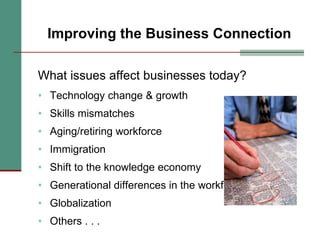
Improving the Business Connection What issues affect businesses today? Technology change & growth Skills mismatches Aging/retiring workforce Immigration Shift to the knowledge economy Generational differences in the workforce Globalization Others . . .
Improving the Business Connection What issues affect the industries and businesses in our local community? Changing sales volume or market share? New products or services? Changing workforce demographics? Understaffed Human Resource functions? New companies or industries Others?
Conduct an Environmental Scan Identify and discuss the issues, events, gaps, circumstances, etc. that affect the  general business environment .  Identify the issues, events, gaps,  circumstances, etc. that are affecting  your  local business community .
How Can We Educate Ourselves  About Business Concerns? Local Business Community Association and industry journals  Industry directories Business section of newspaper Feature articles and classified ads Chambers of Commerce & economic development entities Business and industry organizations Trade shows, industry/association meetings
Learning More About  Our Business Customers Focus groups Customer interviews Point of service customer feedback surveys Exit surveys Analysis of customer inquiries, comments and complaints Shared information among staff, partner agencies
Service/Product Inventory What services/products do we offer now? How well do the current products and services available to employers address the business needs and issues we just discussed? Are there services needed but not offered?
Business Services should be… Comprehensive & System-wide Consultative HR Services that address: Information and research needs Recruitment Retention Training Business growth Engaging key business sectors and local employers in program design
A Portfolio of Solutions Reduce recruitment costs and increase retention through screening and referral of job-ready candidates Develop a more competitive workforce by connecting to customized training Use real-time information about local wages and economic trends to inform your business decisions Increase profitability through an analysis of available tax credits and business incentives http://www.doleta.gov/business/pdf/Employers%20and%20the%20Public%20Workforce%20System_final.pdf
Customer Relationship Management More than job development Not just “selling “ product and services Helping customers solve problems Providing help even when there may be no immediate gain Creates a long-term relationship Builds credibility, confidence and trust
Customer Relationship Management Workforce systems with very active business services operations: Have a passion for resolving the employer’s need. Go to great lengths to find or develop the help needed. Broker a wide array of business services, even when outside the scope of job matching and training. Build partner relationships with other providers (public and private) who can provide needed services. Make it easy for customers to use their services!
Lessons Learned In studies of local workforce areas, several successful key factors emerge in the design of business services: Make business services a priority. Embrace a “Never Say No” attitude. Unified team of account representatives. Strategically choosing businesses to serve. Involve customers in service design. Consider fee-supported services as part of service mix.
Lessons Learned Develop knowledge base on key industries and businesses. One-on-one relationships with business accounts. Define your market niche in the community. Solicit customer satisfaction feedback. Use performance data to make changes. Pay attention to what others are doing.
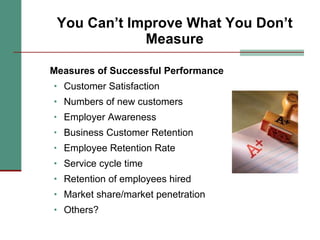
You Can’t Improve What You Don’t Measure Measures of Successful Performance Customer Satisfaction Numbers of new customers Employer Awareness Business Customer Retention Employee Retention Rate Service cycle time Retention of employees hired Market share/market penetration Others?
You Can’t Improve What You Don’t Measure How do we know we are doing the right things and doing them well? Measure performance at the One Stop Center level. Document trends over time. Measure processes as well as outcomes. Differentiate results among industries and various sizes of employers. Ask businesses what is most critical. Use a variety of touch points and methodologies to gather feedback.
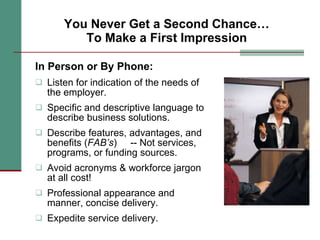
You Never Get a Second Chance… To Make a First Impression In Person or By Phone: Listen for indication of the needs of the employer. Specific and descriptive language to describe business solutions. Describe features, advantages, and benefits ( FAB’s )  -- Not services, programs, or funding sources. Avoid acronyms & workforce jargon at all cost!  Professional appearance and manner, concise delivery. Expedite service delivery.
You Never Get a Second Chance… To Make a First Impression Brochures, flyers, advertisements: Know who your target audience is. Focus on the audience, not on your agency. Choose only key points to highlight the organization.  If there are other  important  elements, list them in simple bullet points or in a chart.  Define and focus on  key benefits  of using the service.  Use “You get” language,  not  “We offer”. Promote the benefits to business, not the features of the programs.
You Never Get a Second Chance… To Make a First Impression Brochures, flyers, advertisements: Use customer quotes to demonstrate customer’s value & appreciation.  Don’t cram everything in; make it easy on the eye by using plenty of blank/white space.  Use professional photographs to enhance the look-and-feel of the brochure.  Include a contact name, number, and website address.  Don’t list every system partner.  Businesses don’t care. Use the language of your customers.  Review brochures, ads and other marketing tools from local businesses to ensure compatible language.
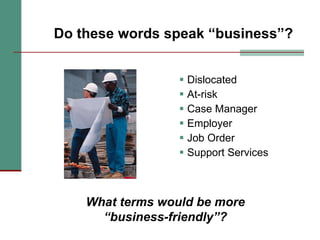
Do these words speak “business”? Dislocated At-risk Case Manager Employer Job Order Support Services What terms would be more “business-friendly”?
Challenges to consider - but not hold us back! Limited resources:  Thousands of businesses for each Business Services Staff Person Can’t be all things to all customers Spread too thin without focus reduces effectiveness Existing resources are divided among different organizations with different cultures and missions
Carol Wargo Workforce Dimensions 614-565-5902 [email_address] Thank you for your participation!

Building the business connection

  • 1.
  • 2.
    Seeing Ourselves Throughthe Eyes of Our Customers Accurate or not, perception is reality . Has the history and past performance of the workforce system influenced what business thinks of us today? Do they see a seamless, integrated One Stop system designed to meet the demands of business? Do they see that we continually adapt and change the way we work with business?
  • 3.
    Seeing Ourselves Throughthe Eyes of Our Customers Who does business think we are? Who do they think we serve? What do they think we are good at doing? What makes us different from others providing similar services?
  • 4.
    Seeing Ourselves Throughthe Eyes of Our Customers Who would we like to be known as? What businesses would we like to serve? What would we like to be good at doing? What would make us different from others providing similar services?
  • 5.
    Improving the BusinessConnection When serving business we need to . . . Be aware of the challenges our business customers face. Relate our services to the solutions they need.
  • 6.
    An Overall Strategyfor Improving the Business Connection Study & understand the business environment. Identify customers and identify their needs, expectations & preferences. Analyze current product/service offerings. Identify gaps between customer needs and current products or services. Improve or create new product and service offerings.
  • 7.
    Improving the BusinessConnection How well do we know the general business environment? How well do we know our local business customers, both current and future? How can we learn more?
  • 8.
    Improving the BusinessConnection What issues affect businesses today? Technology change & growth Skills mismatches Aging/retiring workforce Immigration Shift to the knowledge economy Generational differences in the workforce Globalization Others . . .
  • 9.
    Improving the BusinessConnection What issues affect the industries and businesses in our local community? Changing sales volume or market share? New products or services? Changing workforce demographics? Understaffed Human Resource functions? New companies or industries Others?
  • 10.
    Conduct an EnvironmentalScan Identify and discuss the issues, events, gaps, circumstances, etc. that affect the general business environment . Identify the issues, events, gaps, circumstances, etc. that are affecting your local business community .
  • 11.
    How Can WeEducate Ourselves About Business Concerns? Local Business Community Association and industry journals Industry directories Business section of newspaper Feature articles and classified ads Chambers of Commerce & economic development entities Business and industry organizations Trade shows, industry/association meetings
  • 12.
    Learning More About Our Business Customers Focus groups Customer interviews Point of service customer feedback surveys Exit surveys Analysis of customer inquiries, comments and complaints Shared information among staff, partner agencies
  • 13.
    Service/Product Inventory Whatservices/products do we offer now? How well do the current products and services available to employers address the business needs and issues we just discussed? Are there services needed but not offered?
  • 14.
    Business Services shouldbe… Comprehensive & System-wide Consultative HR Services that address: Information and research needs Recruitment Retention Training Business growth Engaging key business sectors and local employers in program design
  • 15.
    A Portfolio ofSolutions Reduce recruitment costs and increase retention through screening and referral of job-ready candidates Develop a more competitive workforce by connecting to customized training Use real-time information about local wages and economic trends to inform your business decisions Increase profitability through an analysis of available tax credits and business incentives http://www.doleta.gov/business/pdf/Employers%20and%20the%20Public%20Workforce%20System_final.pdf
  • 16.
    Customer Relationship ManagementMore than job development Not just “selling “ product and services Helping customers solve problems Providing help even when there may be no immediate gain Creates a long-term relationship Builds credibility, confidence and trust
  • 17.
    Customer Relationship ManagementWorkforce systems with very active business services operations: Have a passion for resolving the employer’s need. Go to great lengths to find or develop the help needed. Broker a wide array of business services, even when outside the scope of job matching and training. Build partner relationships with other providers (public and private) who can provide needed services. Make it easy for customers to use their services!
  • 18.
    Lessons Learned Instudies of local workforce areas, several successful key factors emerge in the design of business services: Make business services a priority. Embrace a “Never Say No” attitude. Unified team of account representatives. Strategically choosing businesses to serve. Involve customers in service design. Consider fee-supported services as part of service mix.
  • 19.
    Lessons Learned Developknowledge base on key industries and businesses. One-on-one relationships with business accounts. Define your market niche in the community. Solicit customer satisfaction feedback. Use performance data to make changes. Pay attention to what others are doing.
  • 20.
    You Can’t ImproveWhat You Don’t Measure Measures of Successful Performance Customer Satisfaction Numbers of new customers Employer Awareness Business Customer Retention Employee Retention Rate Service cycle time Retention of employees hired Market share/market penetration Others?
  • 21.
    You Can’t ImproveWhat You Don’t Measure How do we know we are doing the right things and doing them well? Measure performance at the One Stop Center level. Document trends over time. Measure processes as well as outcomes. Differentiate results among industries and various sizes of employers. Ask businesses what is most critical. Use a variety of touch points and methodologies to gather feedback.
  • 22.
    You Never Geta Second Chance… To Make a First Impression In Person or By Phone: Listen for indication of the needs of the employer. Specific and descriptive language to describe business solutions. Describe features, advantages, and benefits ( FAB’s ) -- Not services, programs, or funding sources. Avoid acronyms & workforce jargon at all cost! Professional appearance and manner, concise delivery. Expedite service delivery.
  • 23.
    You Never Geta Second Chance… To Make a First Impression Brochures, flyers, advertisements: Know who your target audience is. Focus on the audience, not on your agency. Choose only key points to highlight the organization. If there are other important elements, list them in simple bullet points or in a chart. Define and focus on key benefits of using the service. Use “You get” language, not “We offer”. Promote the benefits to business, not the features of the programs.
  • 24.
    You Never Geta Second Chance… To Make a First Impression Brochures, flyers, advertisements: Use customer quotes to demonstrate customer’s value & appreciation. Don’t cram everything in; make it easy on the eye by using plenty of blank/white space. Use professional photographs to enhance the look-and-feel of the brochure. Include a contact name, number, and website address. Don’t list every system partner. Businesses don’t care. Use the language of your customers. Review brochures, ads and other marketing tools from local businesses to ensure compatible language.
  • 25.
    Do these wordsspeak “business”? Dislocated At-risk Case Manager Employer Job Order Support Services What terms would be more “business-friendly”?
  • 26.
    Challenges to consider- but not hold us back! Limited resources: Thousands of businesses for each Business Services Staff Person Can’t be all things to all customers Spread too thin without focus reduces effectiveness Existing resources are divided among different organizations with different cultures and missions
  • 27.
    Carol Wargo WorkforceDimensions 614-565-5902 [email_address] Thank you for your participation!