Course Objective
To provide the framework and insights to
establish and utilize an Advisory Board.
Key Learning Outcomes
● Understand the importance of utilizing an
  Advisory Board in a financial transaction
● Define the right Advisory Board members
● Delegating tasks to Advisory Board
  members
● How to incorporate accountability with the
  Advisory Board
● Quantify support mechanisms of the
  Advisory Board
What is an Advisory Board
An Advisory Board serves an entity much like a
board of directors, with the important difference
being no legal obligation for governance and
the attendant legal liability in the event issues
arise.
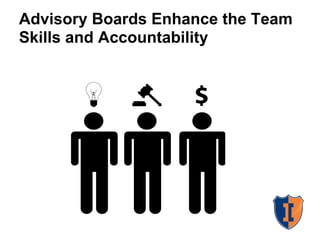
Advisory Boards Enhance the Team
Skills and Accountability
Why Have an Advisory Board?
●   Fill Strengths of the Team
●   Leverage Core Competencies
●   Broader Points of Connection
●   Accountability Mechanism
●   Sounding Board / Stop Gate
An advisory board is a cost-effective source of industry
skills, business contacts, access to capital, strategic advice,
accountability, and technical help.
Advisory Board Team
● At least 3 Members
● Key Strengths:
  ○   Sales and Marketing
  ○   Finance
  ○   Technical
  ○   Strategy
  ○   Operations
  ○   Legal and Human Resources
● Passionate about the Purpose and Vision
● Is an Advocate for the Company
Who Needs an Advisory Board?
Every entity should have an advisory board.

If a company has a formal board of directors,
then an advisory board can play a specialty
role. For example, many medical device
companies have Scientific Advisory Boards.
How to Find Members
1. Identify Key Skills the Team requires
2. Draft "Job Descriptions" for Skills
3. Incorporate those Skills into a Advisory
   Board Job Description
4. Distribute the Job Description
5. Create a list of Candidates
6. Meet with Candidates. Passion? Admiration?
Compensating Members
● First Four Meetings: Cash Compensation
  that is within your budget
● Get to know each other during these
  meetings and make sure it is the right fit
● Equity participation (if available) is the most
  logical for all parties long-term.
Note: DO NOT give rewards-based compensation for
introducing investors. This is a commission and can cause
securities regulation issues.
An Advisory Board
● Meets every 1 to 3 Months
● Meeting are 2 to 5 Hours
● Maintains Communication Between
  Meetings
● Is a Highly Functioning Working Group
  ○   Superior Communications
  ○   Transparent with everything
  ○   Respects viewpoints
  ○   Makes decisions quickly
Expectations of an Advisory Board
● Learn the Vision and Mission of the Entity
● Actively Assist the Entity to Achieve its
   Goals
● Speak Positively about the Entity and its
   Founders / Executives in Public
● Constructive Criticism
Advisory Boards will provide the most value in
very specific roles such as:
Technical
Finance (fundraising)
Sales and Marketing
Life of an Advisory Board
Growth Companies always have a highly
functional Advisory Board.

The composition of the Board should change
over time so new skills are brought on board to
meet current needs and provide fresh
perspectives.
What Strengths / Skills Do You Want
List:
Member Disqualifiers
List:
Build your List, Recruit, Complete
● Create a list of 10+ Candidates
● Provide them with the Job Description
● Have 1:1 Meetings
● Write 2-3 things next to each Person of what
  they would do to fulfill this role
● Select 5. Contact Candidates / Extend Offer
● Goal is to get at least 3 to commit
Sample First Meeting Agenda
Introductions: (icebreakers)
   ○ Top business and personal passions
   ○ What you hope to gain from this advisory board
Advisory Board - Best Practices and Goals
   ○ Share board experiences and best practices
   ○ Goals and expectations for this board
Company Presentation
Company Goals / Plans
What was your biggest takeaway from today?
Future Meetings / Communication Plan
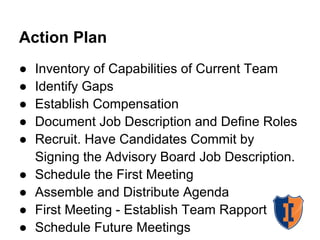
Action Plan
●   Inventory of Capabilities of Current Team
●   Identify Gaps
●   Establish Compensation
●   Document Job Description and Define Roles
●   Recruit. Have Candidates Commit by
    Signing the Advisory Board Job Description.
●   Schedule the First Meeting
●   Assemble and Distribute Agenda
●   First Meeting - Establish Team Rapport
●   Schedule Future Meetings

Guide to a Great Advisory Board

  • 2.
    Course Objective To providethe framework and insights to establish and utilize an Advisory Board.
  • 3.
    Key Learning Outcomes ●Understand the importance of utilizing an Advisory Board in a financial transaction ● Define the right Advisory Board members ● Delegating tasks to Advisory Board members ● How to incorporate accountability with the Advisory Board ● Quantify support mechanisms of the Advisory Board
  • 4.
    What is anAdvisory Board An Advisory Board serves an entity much like a board of directors, with the important difference being no legal obligation for governance and the attendant legal liability in the event issues arise.
  • 5.
    Advisory Boards Enhancethe Team Skills and Accountability
  • 6.
    Why Have anAdvisory Board? ● Fill Strengths of the Team ● Leverage Core Competencies ● Broader Points of Connection ● Accountability Mechanism ● Sounding Board / Stop Gate An advisory board is a cost-effective source of industry skills, business contacts, access to capital, strategic advice, accountability, and technical help.
  • 7.
    Advisory Board Team ●At least 3 Members ● Key Strengths: ○ Sales and Marketing ○ Finance ○ Technical ○ Strategy ○ Operations ○ Legal and Human Resources ● Passionate about the Purpose and Vision ● Is an Advocate for the Company
  • 8.
    Who Needs anAdvisory Board? Every entity should have an advisory board. If a company has a formal board of directors, then an advisory board can play a specialty role. For example, many medical device companies have Scientific Advisory Boards.
  • 9.
    How to FindMembers 1. Identify Key Skills the Team requires 2. Draft "Job Descriptions" for Skills 3. Incorporate those Skills into a Advisory Board Job Description 4. Distribute the Job Description 5. Create a list of Candidates 6. Meet with Candidates. Passion? Admiration?
  • 10.
    Compensating Members ● FirstFour Meetings: Cash Compensation that is within your budget ● Get to know each other during these meetings and make sure it is the right fit ● Equity participation (if available) is the most logical for all parties long-term. Note: DO NOT give rewards-based compensation for introducing investors. This is a commission and can cause securities regulation issues.
  • 11.
    An Advisory Board ●Meets every 1 to 3 Months ● Meeting are 2 to 5 Hours ● Maintains Communication Between Meetings ● Is a Highly Functioning Working Group ○ Superior Communications ○ Transparent with everything ○ Respects viewpoints ○ Makes decisions quickly
  • 12.
    Expectations of anAdvisory Board ● Learn the Vision and Mission of the Entity ● Actively Assist the Entity to Achieve its Goals ● Speak Positively about the Entity and its Founders / Executives in Public ● Constructive Criticism Advisory Boards will provide the most value in very specific roles such as: Technical Finance (fundraising) Sales and Marketing
  • 13.
    Life of anAdvisory Board Growth Companies always have a highly functional Advisory Board. The composition of the Board should change over time so new skills are brought on board to meet current needs and provide fresh perspectives.
  • 14.
    What Strengths /Skills Do You Want List:
  • 15.
  • 16.
    Build your List,Recruit, Complete ● Create a list of 10+ Candidates ● Provide them with the Job Description ● Have 1:1 Meetings ● Write 2-3 things next to each Person of what they would do to fulfill this role ● Select 5. Contact Candidates / Extend Offer ● Goal is to get at least 3 to commit
  • 17.
    Sample First MeetingAgenda Introductions: (icebreakers) ○ Top business and personal passions ○ What you hope to gain from this advisory board Advisory Board - Best Practices and Goals ○ Share board experiences and best practices ○ Goals and expectations for this board Company Presentation Company Goals / Plans What was your biggest takeaway from today? Future Meetings / Communication Plan
  • 18.
    Action Plan ● Inventory of Capabilities of Current Team ● Identify Gaps ● Establish Compensation ● Document Job Description and Define Roles ● Recruit. Have Candidates Commit by Signing the Advisory Board Job Description. ● Schedule the First Meeting ● Assemble and Distribute Agenda ● First Meeting - Establish Team Rapport ● Schedule Future Meetings