

MAKING THE BUSINESS CASE
FOR CHANGE MANAGEMENT
INTRODUCTION
SPEAKER:
Beth Banks Cohn
• Founder and President of ADRA Change Architects
• 20+ years of change management and coaching experience
• MA in Human Resources Education, MA in Organization
Development, PhD in Human and Organizational Systems
• Clients include Johnson & Johnson, Novo Nordisk, Shire, Fougera
• @bethbankscohn
MODERATOR:
Sarah Welstead
• Communications strategist
• @sarahwelstead
OVERVIEW
 The problem
 The reality
 The big question
 How do you get to the ROI of Change?
 5 tactics to get buy-in from almost everyone
THE PROBLEM:
No one wants to pay for change management
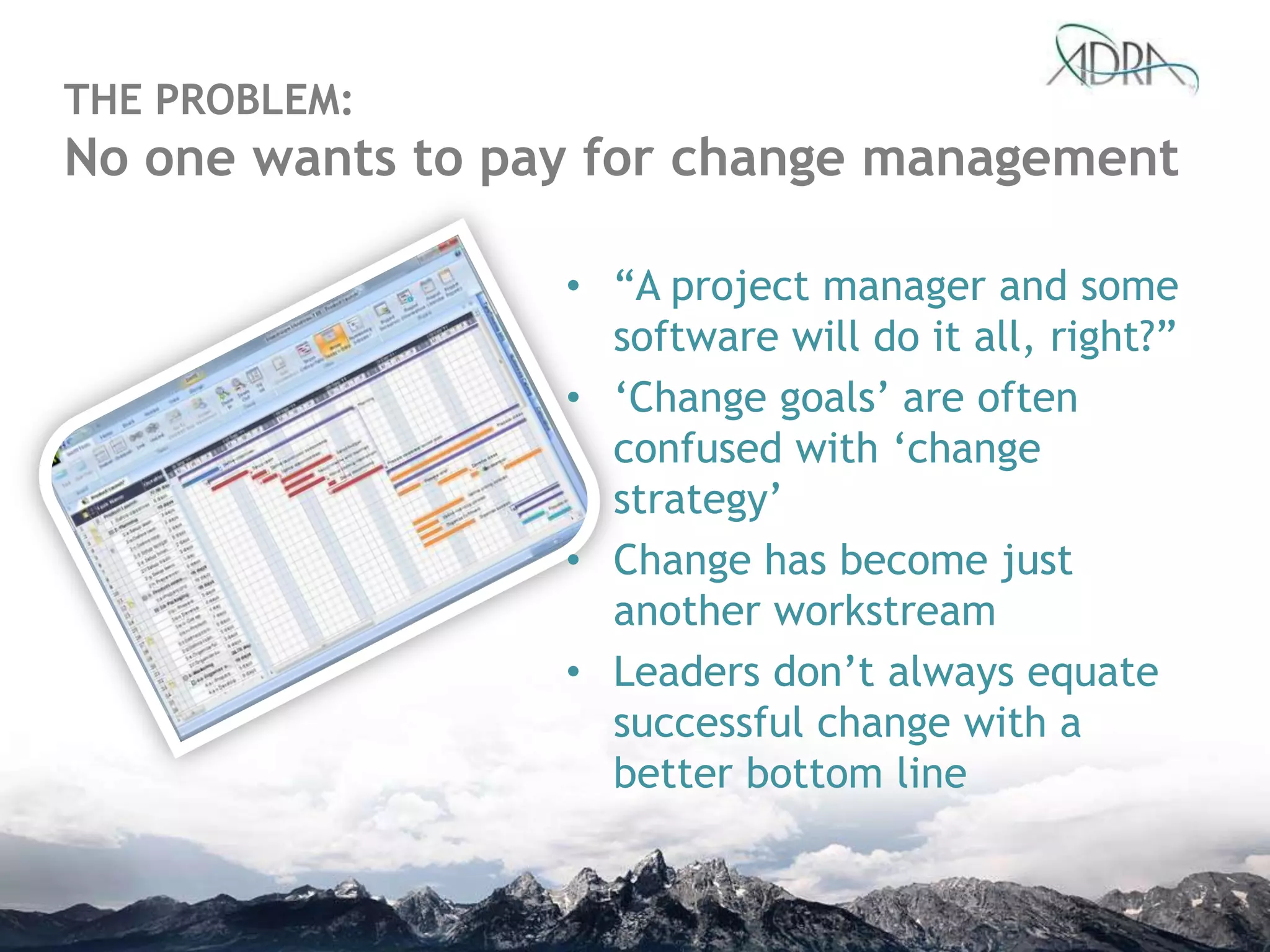
• “A project manager and some
software will do it all, right?”
• „Change goals‟ are often
confused with „change
strategy‟
• Change has become just
another workstream
• Leaders don‟t always equate
successful change with a
better bottom line
THE REALITY:
‘Change’ without ‘change management’
means less money on the bottom line
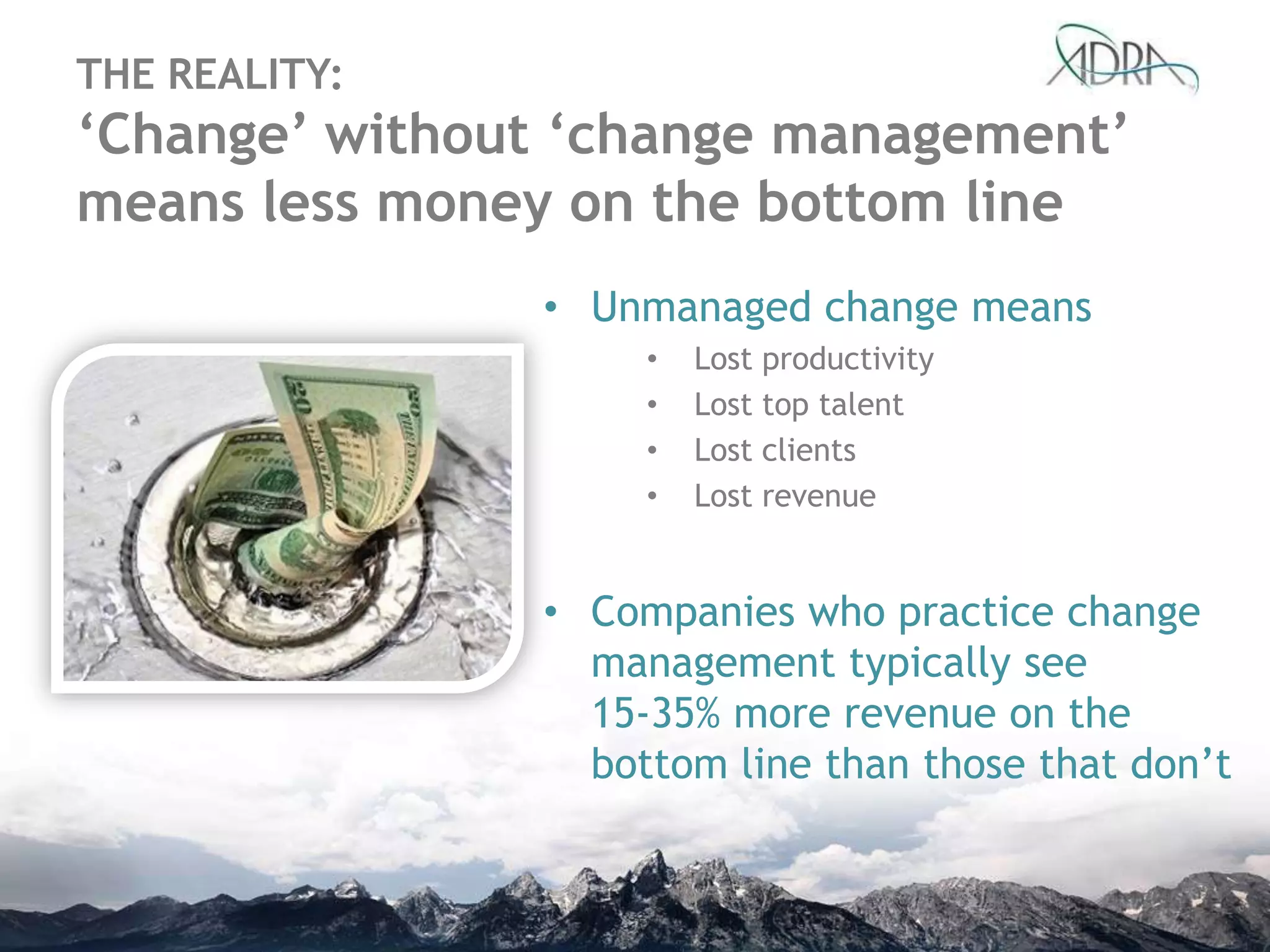
• Unmanaged change means
• Lost productivity
• Lost top talent
• Lost clients
• Lost revenue
• Companies who practice change
management typically see
15-35% more revenue on the
bottom line than those that don‟t
THE BIG QUESTION:
Why doesn’t everyone know this?
• Change management is still seen
as a touchy-feely HR function –
and a cost centre
• “Business moves at the speed of
change – employees are used to
it by now.”
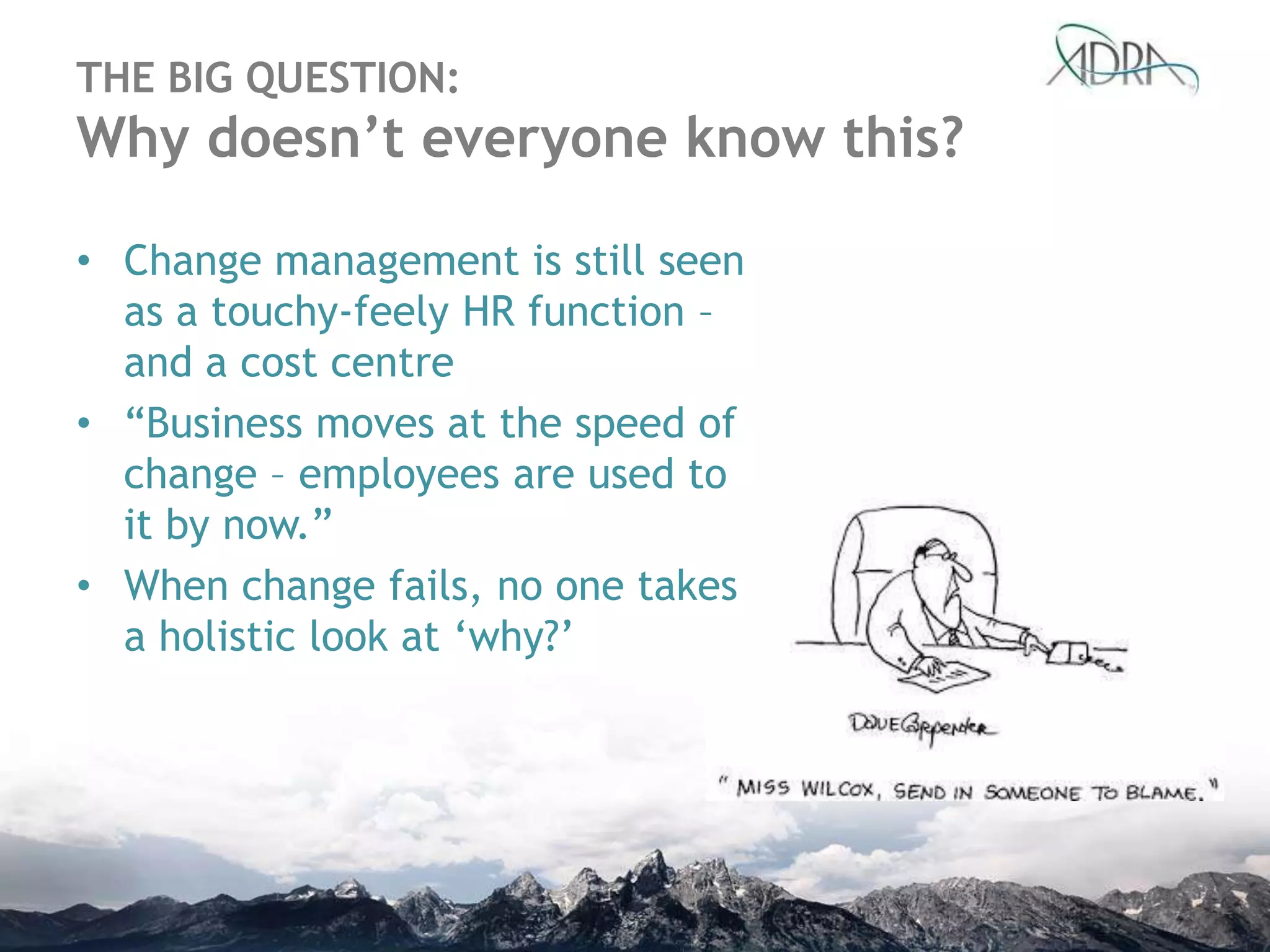
• When change fails, no one takes
a holistic look at „why?‟
• Start with a business case – don‟t „build‟ a
business case
• Focus on the bottom line
• Communicate in business
terms – and don‟t be vague
• Keep it simple
CHANGE AS A STRATEGIC BUSINESS FUNCTION:
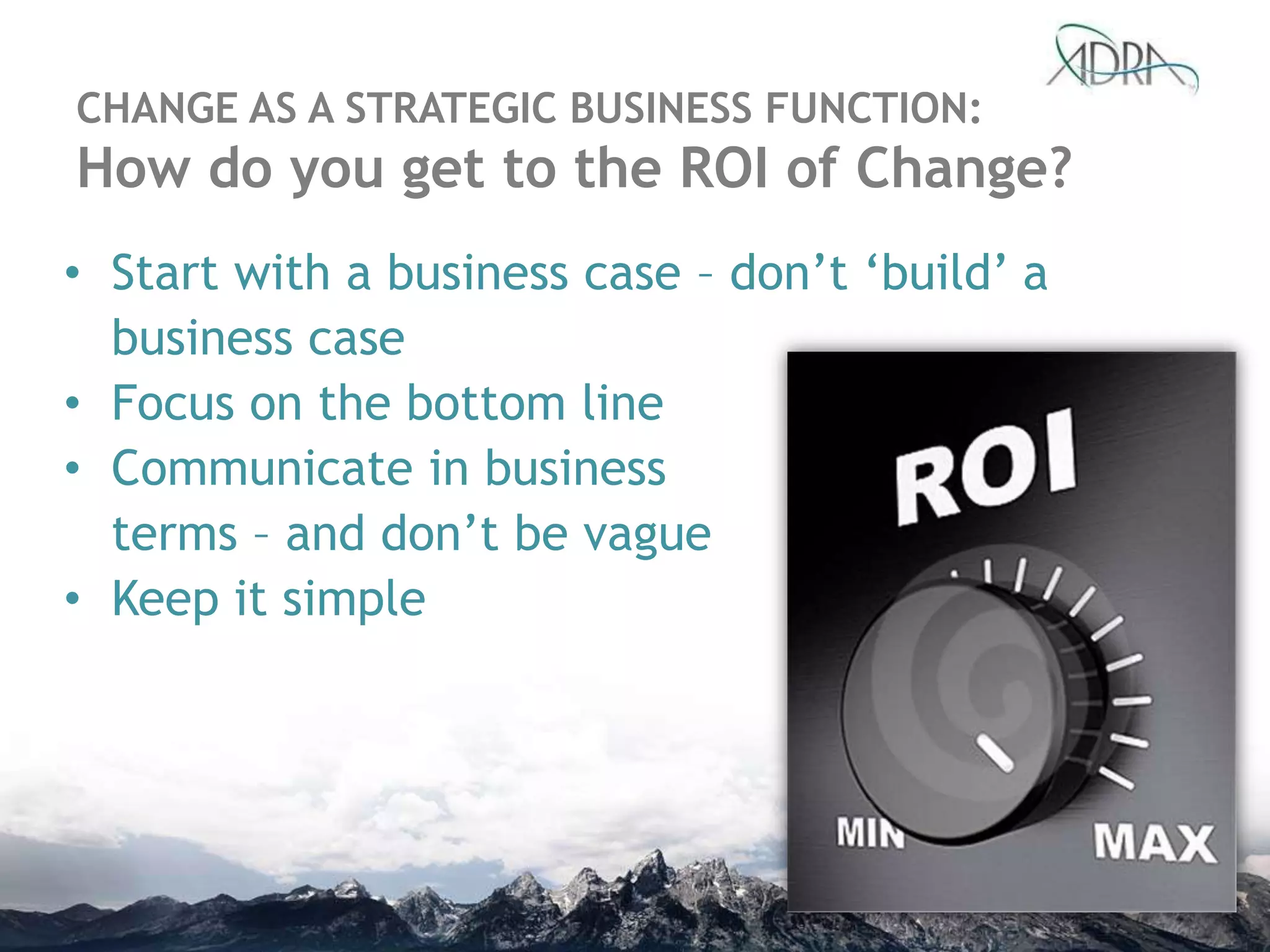
How do you get to the ROI of Change?
But how do you convince
the eye-rollers who think
you’re just another cost
centre?
Start talking in terms your
audience will understand:
Dollars and cents.
5 tactics to help you get
buy-in from almost
everyone
• Badly managed change can drive your „A‟ players and
critical employees out the door
• Using the Drake staffing calculator, losing 5 senior
managers with an average salary of $110,000 each
represents a cost of $5.7 million
TACTIC #1:
Quantify the cost of losing key employees
• This doesn‟t have to be some vague, possible outcome
• You can quantify it - and the numbers start to add up:
• 2000 employees
• Each spends 30 minutes a week for 3 months overcoming
change challenges (lost productivity, lack of engagement)
• That‟s 12,000 hours of lost time
• At a blended cost of $150/hour, that just cost the company
$1.8 million
TACTIC #2:
Quantify the loss of productivity
• “Company X seems to be in some sort of transition
period and I‟m not sure where they‟re going. So
instead I‟ll…
• …take my business elsewhere.”
• …take my A-list employability elsewhere.”
• …take my investment dollars elsewhere.”
TACTIC #3:
Cost of the loss of market confidence
TACTIC #4:
Demonstrate how it will meet business goals
- and what this means for revenue
• Look beyond the 3- or 6-month change timeline:
• A successful change will lead to $X million increased
sales in Year 1
• …which will lead to $X million increased sales in Year 2
• Today‟s change investment will deliver ROI for several
years to come
• Focusing on change management makes your project:
• More efficient
• Run smoother, faster
• Able to hit milestones effectively
• When communication around change isn‟t handled
skillfully, negative leaks can cost money, reputation
and PR fees
• Change communication can‟t be managed with an
Excel spreadsheet or MSProject Plan from the PMO
• Change communication is also not typical PR. It is a
specialized type of communication.
TACTIC #5:
Cost of potential PR disasters
• “What‟s in it for me?”
• Spend less time talking about concepts like „the
employees‟ or „the shareholders‟ and more time
demonstrating how the people in the room will
personally benefit from well-managed change
BONUS TACTIC:
The WIIFM approach
THE BOTTOM LINE
• Effective change management directly affects
success and the bottom line. The „bottom line‟
never goes out of style.
• It‟s easier than you think to quantify the ROI of
good change management
• Change handled badly is never over – and never
stops costing money. Change handled well delivers
an immediate, measurable and sustained ROI
DON’T LOSE HOPE
• Good change management is about increasing a
company‟s bottom line. Period.
• Change management isn‟t dying – it‟s changing
• It‟s easier to get what you need when you make the
business case – not the emotional one
DISCUSSION
END
Want to talk more? Email Beth at
beth@adrachangearchitects.com
to set up an appointment.

The ROI of Change: Making the Business Case for Change Management

  • 1.
    MAKING THE BUSINESSCASE FOR CHANGE MANAGEMENT
  • 2.
    INTRODUCTION SPEAKER: Beth Banks Cohn •Founder and President of ADRA Change Architects • 20+ years of change management and coaching experience • MA in Human Resources Education, MA in Organization Development, PhD in Human and Organizational Systems • Clients include Johnson & Johnson, Novo Nordisk, Shire, Fougera • @bethbankscohn MODERATOR: Sarah Welstead • Communications strategist • @sarahwelstead
  • 3.
    OVERVIEW  The problem The reality  The big question  How do you get to the ROI of Change?  5 tactics to get buy-in from almost everyone
  • 4.
    THE PROBLEM: No onewants to pay for change management • “A project manager and some software will do it all, right?” • „Change goals‟ are often confused with „change strategy‟ • Change has become just another workstream • Leaders don‟t always equate successful change with a better bottom line
  • 5.
    THE REALITY: ‘Change’ without‘change management’ means less money on the bottom line • Unmanaged change means • Lost productivity • Lost top talent • Lost clients • Lost revenue • Companies who practice change management typically see 15-35% more revenue on the bottom line than those that don‟t
  • 6.
    THE BIG QUESTION: Whydoesn’t everyone know this? • Change management is still seen as a touchy-feely HR function – and a cost centre • “Business moves at the speed of change – employees are used to it by now.” • When change fails, no one takes a holistic look at „why?‟
  • 7.
    • Start witha business case – don‟t „build‟ a business case • Focus on the bottom line • Communicate in business terms – and don‟t be vague • Keep it simple CHANGE AS A STRATEGIC BUSINESS FUNCTION: How do you get to the ROI of Change?
  • 8.
    But how doyou convince the eye-rollers who think you’re just another cost centre?
  • 9.
    Start talking interms your audience will understand: Dollars and cents.
  • 10.
    5 tactics tohelp you get buy-in from almost everyone
  • 11.
    • Badly managedchange can drive your „A‟ players and critical employees out the door • Using the Drake staffing calculator, losing 5 senior managers with an average salary of $110,000 each represents a cost of $5.7 million TACTIC #1: Quantify the cost of losing key employees
  • 12.
    • This doesn‟thave to be some vague, possible outcome • You can quantify it - and the numbers start to add up: • 2000 employees • Each spends 30 minutes a week for 3 months overcoming change challenges (lost productivity, lack of engagement) • That‟s 12,000 hours of lost time • At a blended cost of $150/hour, that just cost the company $1.8 million TACTIC #2: Quantify the loss of productivity
  • 13.
    • “Company Xseems to be in some sort of transition period and I‟m not sure where they‟re going. So instead I‟ll… • …take my business elsewhere.” • …take my A-list employability elsewhere.” • …take my investment dollars elsewhere.” TACTIC #3: Cost of the loss of market confidence
  • 14.
    TACTIC #4: Demonstrate howit will meet business goals - and what this means for revenue • Look beyond the 3- or 6-month change timeline: • A successful change will lead to $X million increased sales in Year 1 • …which will lead to $X million increased sales in Year 2 • Today‟s change investment will deliver ROI for several years to come • Focusing on change management makes your project: • More efficient • Run smoother, faster • Able to hit milestones effectively
  • 15.
    • When communicationaround change isn‟t handled skillfully, negative leaks can cost money, reputation and PR fees • Change communication can‟t be managed with an Excel spreadsheet or MSProject Plan from the PMO • Change communication is also not typical PR. It is a specialized type of communication. TACTIC #5: Cost of potential PR disasters
  • 16.
    • “What‟s init for me?” • Spend less time talking about concepts like „the employees‟ or „the shareholders‟ and more time demonstrating how the people in the room will personally benefit from well-managed change BONUS TACTIC: The WIIFM approach
  • 17.
    THE BOTTOM LINE •Effective change management directly affects success and the bottom line. The „bottom line‟ never goes out of style. • It‟s easier than you think to quantify the ROI of good change management • Change handled badly is never over – and never stops costing money. Change handled well delivers an immediate, measurable and sustained ROI
  • 18.
    DON’T LOSE HOPE •Good change management is about increasing a company‟s bottom line. Period. • Change management isn‟t dying – it‟s changing • It‟s easier to get what you need when you make the business case – not the emotional one
  • 19.
  • 20.
  • 21.
    Want to talkmore? Email Beth at beth@adrachangearchitects.com to set up an appointment.

Editor's Notes

  • #4 Making the Business case for Change Management has gotten more and more challenging in the years since I started my business.The believers believe strongly and the non-believers believe even stronger. Today I want to touch briefly on what the problem looks like – although if you work in the field you already see this and how this manifests itself in the reality.Most of our time today, however, will be spent on getting to the ROI of change and 5 tactics you can use right now in your companies to make the case for focusing on change management.So, what is the problem exactly?
  • #5 This shows up in several ways:This is the age of the PMO for large and medium-sized companies. If leaders don’t understand change they think it is just a bunch of activities and a project manager can handle that. Of course, that puts the PM in a difficult position – they can manage the activities but they don’t have the expertise to carry them out.That’s because change goals are often mistaken for a change strategy. A goal is “announce change” the strategy is who announces, how they talk about it, what happens before the announcement, how are directors and managers prepared for the announcement – things like that.Sadly, change has become just another workstream.Leaders don’t always equate successful change with a better bottom line, and vice versa. After all, companies undergo change to make money but when they do they don’t connect the dots back to why.We all know that
  • #6 It doesn’t get any simpler than that. We know this to be true because 75% of change efforts fail and that can lead to lost productivity, etc.Companies that practice change management are the other 25% and they typically see more revenue on the bottom line – overall.So if it is this simple, why don’t all companies engage change management professionals to help them manage their changes? I would say because we haven’t been speaking about change as the strategic business function that it is.
  • #7 There is a trend I see that is quite worrying. Business units are phoning it in and letting HR take the lead in all aspects of change. I have nothing against HR but it isn’t their job alone. When the change is done, you will be in front of your teams, you will be leading the new organization. If you haven’t been leading the charge and the change, how will your employees know who is in control? How will they have confidence that you back the change and that you understand their concerns and difficulties. HR can help with the HR aspects, but they shouldn’t be standing up in front of your teams delivering the message. They shouldn’t be asking for feedback and recommending changes. HR can be your partner, but you as business leaders need to be in the lead.
  • #8 Change in a company is an investment. You are investing in changing the way your company works in some way. You invest your employees’ time, the project team’s time. You invest in the loss of productivity. You invest in the potential loss of employees or customers or both.As with all investments, you want to see a return on this change. A 10 million dollar lift in business. A 5 million dollar savings in production costs. If there is no return on your investment then you shouldn’t be changing. So ROI is important. It is important to the company and its top leadership, to the Board of Directors, to stakeholders and stockholders. Being able to show that ROI is critical to the success of your change.This is a phrase that makes me cringe. When I see this on project plans I want to scribble it out. When you change you should not be building the case. Building the case happens when a company is considering a change of some kind. It is when you look at the recommendations and punch holes in them. All of that takes place BEFORE you make the decision to change. And always focus on the bottom line. As I’ve said before, companies decide to make changes to be more profitable – period. So focusing on the bottom line and how having professional change management will help them get there.Communicate in business terms – and don’t be vague. Don’t say, we’ll meet our business goals or the project will run smoother. Say, We will see that 10 million dollar lift in sales or we will see that 5 million dollar savings in operations because we are focused on how change is made and sustained throughout the project.And of course, keep it simple. There are many theories and models about change that honestly businesses should not care about. As a change professional I might care and use them to guide me, but don’t pull them out tell the business they need to engage with them.
  • #9 Of course if you are on this call you are probably a believer, so how do you convince the person in the room who still rolls their eyes as you talk about the importance of change management?
  • #10 You just keep the conversation on dollars and cents
  • #11 And I’m going to give you five tactics you can use to get you the buy-in you need from almost everyone. So let’s look at tactic 1
  • #12 A change best practice is to identify your ‘a’ players and your critical employees (they may not be the same) and have a plan to actively keep them during a change. This is rarely done, and most certainly is not done if you don’t have a change professional involved.30-45% may fall into those categoriesA 1% downsizing can cause a 31% increase in turnoverThose who can leave will, those you can’t will stay30-45% is from a McKinsey White Paper from 2009. 1%-31% is from a study in the Academy of Management Journal April/May 2008. Study by Trevor and Nyberg.Drake International calculator is readily available online. ‘Hidden’ costs – costs of covering the vacant position, cost to fill, cost of productivity ramp up
  • #13 Those 30 minutes can easily be 60 minutes or 90. Especially if there is a lack of engagement because of lack of information or lack of attention. This doesn’t take into account the fact that those who have marketable skills and are disengaged will also be actively looking for work.
  • #14 Bank of America example, lost hundreds of millions this quarter because of loss of customer and investor confidence – why? Huge legal bill.RadioShak took a hit years ago when they laid off people via email.
  • #15 You notice I’m not talking about the people side of change or doing the right thing. This is about how their investment in change management makes them money in the long term.
  • #16 Now of course this doesn’t happen all the time, but there are also the urban legends. Like that Radio Shack example. (True) or The letter to the editor published in the Wall Street Journal by an employee of Goldman Sacks who was resigning that day. Ouch!. Those are high profile, but there are many other examples. This is like the old hair commercials – an affected person tells two friends who tell two friends and so on. Plus think how this affects the people who are staying. How effective are you if you are waiting for the other shoe to drop?Old Coke/New Coke
  • #17 This is about how you will make them a hero, or increase their bonus or their stock options. You don’t have to blatantly say any of those things, but you can certainly imply them.
  • #18 Transition: so if you’ve been struggling with skepticism in how change management is a revenue generator not a cost center….
  • #19 Becoming more focused on the business value change management brings is a good thing.