HERA Joint Research
     Programme
 Cultural Encounters
Information Sessions

       Lucy Parnall
          AHRC
Joint Research Programme
                Key Facts
•   Pooling national and European funding: research funding
    organisations in 18 countries and the European Commission

•   18,5 M € available for Humanities-led research in “Cultural
    Encounters”

•   Supporting excellent collaborative research projects (CRP)

•   Supporting knowledge exchange with non-academic audiences

•   2 stage assessment with Outline Proposals

•   1 Handling Agency for the centrally managed selection process:
    European Science Foundation
HERA JRP timeline
9 Feb 2012      Launch of the Call for Outline Proposals
4 May 2012      Deadline for the submission of Outline
                Proposals
Jun 2012        Review Panel: selection of Outline Proposals
Jul 2012        Invitation for the submission of Full Proposals
Oct 2012        Deadline for the submission of Full Proposals
Oct-Nov 2012    Peer review of Full Proposals
Dec 2012        Rebuttal by applicants – PI response (one
        week)
Jan 2013        Review Panel: ranking of Full Proposals
Feb 2013        HERA JRP Board meeting: funding decisions
Feb-Jun 2013    Contract negotiations
Jun 2013        Start of Collaborative Research Projects
Jun 2016        End of Collaborative Research Projects
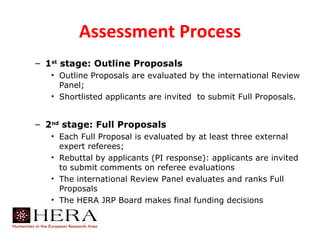
Assessment Process
– 1st stage: Outline Proposals
   • Outline Proposals are evaluated by the international Review
     Panel;
   • Shortlisted applicants are invited to submit Full Proposals.


– 2nd stage: Full Proposals
   • Each Full Proposal is evaluated by at least three external
     expert referees;
   • Rebuttal by applicants (PI response): applicants are invited
     to submit comments on referee evaluations
   • The international Review Panel evaluates and ranks Full
     Proposals
   • The HERA JRP Board makes final funding decisions
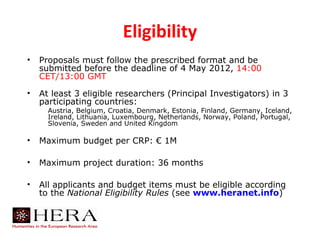
Eligibility
•   Proposals must follow the prescribed format and be
    submitted before the deadline of 4 May 2012, 14:00
    CET/13:00 GMT
•   At least 3 eligible researchers (Principal Investigators) in 3
    participating countries:
      Austria, Belgium, Croatia, Denmark, Estonia, Finland, Germany, Iceland,
      Ireland, Lithuania, Luxembourg, Netherlands, Norway, Poland, Portugal,
      Slovenia, Sweden and United Kingdom

•   Maximum budget per CRP: € 1M

•   Maximum project duration: 36 months

•   All applicants and budget items must be eligible according
    to the National Eligibility Rules (see www.heranet.info)
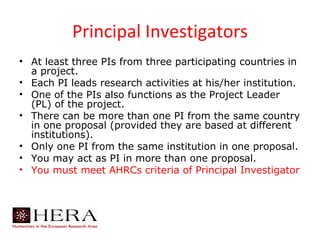
Principal Investigators
• At least three PIs from three participating countries in
  a project.
• Each PI leads research activities at his/her institution.
• One of the PIs also functions as the Project Leader
  (PL) of the project.
• There can be more than one PI from the same country
  in one proposal (provided they are based at different
  institutions).
• Only one PI from the same institution in one proposal.
• You may act as PI in more than one proposal.
• You must meet AHRCs criteria of Principal Investigator
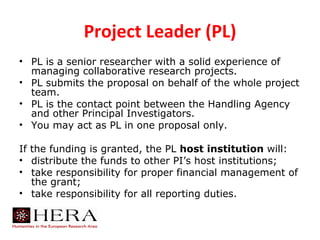
Project Leader (PL)
• PL is a senior researcher with a solid experience of
  managing collaborative research projects.
• PL submits the proposal on behalf of the whole project
  team.
• PL is the contact point between the Handling Agency
  and other Principal Investigators.
• You may act as PL in one proposal only.

If the funding is granted, the PL host institution will:
• distribute the funds to other PI’s host institutions;
• take responsibility for proper financial management of
   the grant;
• take responsibility for all reporting duties.
Other Staff - UK
– Co-Investigator
– Research Assistant
– PhD Students (must be complementary but stand
  alone)
– Other staff as needed eg co-ordinator/admin
  support
– Co-I’s etc can not be listed as investigators in
  application form but can be mentioned in text
– Academic staff must meet AHRC’s eligibility
  criteria
Non Academic Partner
• Non-academic APs – stakeholders in the cultural,
  heritage or educational sector, media, or creative
  industries, who may provide significant added value
  and valuable insights to the project from the user’s
  perspective.

• APs are encouraged to participate in an advisory and
  collaborative capacity to help explore the knowledge
  exchange potential of the proposed research.

• Time of APs must be self-funded; only their travel and
  subsistence costs can be covered from the project
  budget.
Outline Proposals - Application
               Format
•   Your application must be written in English.

•   Access the online application system via the link on
    www.heranet.info and enter the following details:
     – Proposal title, acronym, keywords and abstract;
     – Contact details of the applicants.

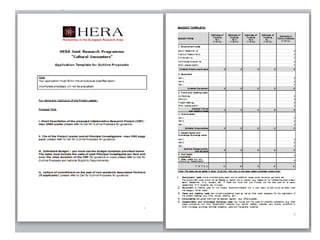
•   Upload the filled out application template containing:
    –   A short description of the project;
    –   CVs of the Principal Investigators;
    –   Estimated budget in Euros;
    –   Letters of commitment from non academic Associated
        Partners, if applicable.
Short Description of CRP
               (Max 2000 Words)
•   What research question(s) does the CRP seek to answer?
•   In what way is the project original and/or innovative?
•   What are the objectives of the CRP?
•   By what methods will the research question(s) be tackled?
•   How are the skills of the partners complementary?
•   What is the added value in tackling your research question(s)
    from a trans-national perspective?
•   How will partners work together? What management and
    coordination structures are proposed?
•   What is the significance of the research question(s)? How will
    these contribute to the “Cultural Encounters” theme?
•   What is the potential impact of the proposed research to both
    academic disciplines, and relevant stakeholders and user
    communities?
•   How will the CRP engage in knowledge exchange or active
    dissemination engaging user communities and audiences outside
    academia?
Finances
• Each partner costs on their own rules; no matter
  the country is ‘leading’
• For UK follow FeC rules
• Budget must be in Euros
• Outline budget is an estimate; can change
• For budget table:
– Enter in 80% Figure (except students)
– Combine estates and indirects for the overheads line
– For students – enter 100% of costs stated in guidance
  (do not count towards researcher FTE)
Outline Proposal
           Assessment Criteria
• Potential for research excellence

• Novelty and originality of research

• Qualification of the applicants and coordination
  structures proposed

• European added value of collaboration

• Relevance to the theme “Cultural Encounters”,
  including potential impact of the proposed
  research beyond academia
What to do to succeed
•   Read all the guidance documentation published on the
    HERA website www.heranet.info.
•   Verify the eligibility of the applicants and budget items
    according to the National Eligibility Rules.
•   Contact the HERA office, your research office or your
    National Contact Point, if you have questions.
•   Make sure you understand the evaluation criteria.
•   Describe your project idea (incl. objectives, methodology,
    collaboration and potential impact) within the given space
    of 2000 words!
•   Don’t forget why does your project fit ‘Cultural Encounters’
•   Arrange face-to-face meetings with your project partners
    when writing the proposal to ensure coherency of ideas.
•   Use clear and straightforward language.
•   Upload your proposal well ahead of the submission
    deadline!
Relevant documents
•   Call for Proposals
•   National Eligibility Rules
•   FAQ
•   Glossary
•   Application template

All documents are available online at
  www.heranet.info
Who to contact?
      Application Process etc
    Julia Boman hera@esf.org

        UK Eligibility Queries
  Lucy Parnall l.parnall@ahrc.ac.uk
Kelly Sidgwick k.sidgwick@ahrc.ac.uk


         Thanks to Julia Boman at ESF for draft slides

HERA Cultural Encounters Information Sessions – Application Process

  • 1.
    HERA Joint Research Programme Cultural Encounters Information Sessions Lucy Parnall AHRC
  • 2.
    Joint Research Programme Key Facts • Pooling national and European funding: research funding organisations in 18 countries and the European Commission • 18,5 M € available for Humanities-led research in “Cultural Encounters” • Supporting excellent collaborative research projects (CRP) • Supporting knowledge exchange with non-academic audiences • 2 stage assessment with Outline Proposals • 1 Handling Agency for the centrally managed selection process: European Science Foundation
  • 3.
    HERA JRP timeline 9Feb 2012 Launch of the Call for Outline Proposals 4 May 2012 Deadline for the submission of Outline Proposals Jun 2012 Review Panel: selection of Outline Proposals Jul 2012 Invitation for the submission of Full Proposals Oct 2012 Deadline for the submission of Full Proposals Oct-Nov 2012 Peer review of Full Proposals Dec 2012 Rebuttal by applicants – PI response (one week) Jan 2013 Review Panel: ranking of Full Proposals Feb 2013 HERA JRP Board meeting: funding decisions Feb-Jun 2013 Contract negotiations Jun 2013 Start of Collaborative Research Projects Jun 2016 End of Collaborative Research Projects
  • 4.
    Assessment Process – 1ststage: Outline Proposals • Outline Proposals are evaluated by the international Review Panel; • Shortlisted applicants are invited to submit Full Proposals. – 2nd stage: Full Proposals • Each Full Proposal is evaluated by at least three external expert referees; • Rebuttal by applicants (PI response): applicants are invited to submit comments on referee evaluations • The international Review Panel evaluates and ranks Full Proposals • The HERA JRP Board makes final funding decisions
  • 5.
    Eligibility • Proposals must follow the prescribed format and be submitted before the deadline of 4 May 2012, 14:00 CET/13:00 GMT • At least 3 eligible researchers (Principal Investigators) in 3 participating countries: Austria, Belgium, Croatia, Denmark, Estonia, Finland, Germany, Iceland, Ireland, Lithuania, Luxembourg, Netherlands, Norway, Poland, Portugal, Slovenia, Sweden and United Kingdom • Maximum budget per CRP: € 1M • Maximum project duration: 36 months • All applicants and budget items must be eligible according to the National Eligibility Rules (see www.heranet.info)
  • 6.
    Principal Investigators • Atleast three PIs from three participating countries in a project. • Each PI leads research activities at his/her institution. • One of the PIs also functions as the Project Leader (PL) of the project. • There can be more than one PI from the same country in one proposal (provided they are based at different institutions). • Only one PI from the same institution in one proposal. • You may act as PI in more than one proposal. • You must meet AHRCs criteria of Principal Investigator
  • 7.
    Project Leader (PL) •PL is a senior researcher with a solid experience of managing collaborative research projects. • PL submits the proposal on behalf of the whole project team. • PL is the contact point between the Handling Agency and other Principal Investigators. • You may act as PL in one proposal only. If the funding is granted, the PL host institution will: • distribute the funds to other PI’s host institutions; • take responsibility for proper financial management of the grant; • take responsibility for all reporting duties.
  • 8.
    Other Staff -UK – Co-Investigator – Research Assistant – PhD Students (must be complementary but stand alone) – Other staff as needed eg co-ordinator/admin support – Co-I’s etc can not be listed as investigators in application form but can be mentioned in text – Academic staff must meet AHRC’s eligibility criteria
  • 9.
    Non Academic Partner •Non-academic APs – stakeholders in the cultural, heritage or educational sector, media, or creative industries, who may provide significant added value and valuable insights to the project from the user’s perspective. • APs are encouraged to participate in an advisory and collaborative capacity to help explore the knowledge exchange potential of the proposed research. • Time of APs must be self-funded; only their travel and subsistence costs can be covered from the project budget.
  • 10.
    Outline Proposals -Application Format • Your application must be written in English. • Access the online application system via the link on www.heranet.info and enter the following details: – Proposal title, acronym, keywords and abstract; – Contact details of the applicants. • Upload the filled out application template containing: – A short description of the project; – CVs of the Principal Investigators; – Estimated budget in Euros; – Letters of commitment from non academic Associated Partners, if applicable.
  • 11.
    Short Description ofCRP (Max 2000 Words) • What research question(s) does the CRP seek to answer? • In what way is the project original and/or innovative? • What are the objectives of the CRP? • By what methods will the research question(s) be tackled? • How are the skills of the partners complementary? • What is the added value in tackling your research question(s) from a trans-national perspective? • How will partners work together? What management and coordination structures are proposed? • What is the significance of the research question(s)? How will these contribute to the “Cultural Encounters” theme? • What is the potential impact of the proposed research to both academic disciplines, and relevant stakeholders and user communities? • How will the CRP engage in knowledge exchange or active dissemination engaging user communities and audiences outside academia?
  • 12.
    Finances • Each partnercosts on their own rules; no matter the country is ‘leading’ • For UK follow FeC rules • Budget must be in Euros • Outline budget is an estimate; can change • For budget table: – Enter in 80% Figure (except students) – Combine estates and indirects for the overheads line – For students – enter 100% of costs stated in guidance (do not count towards researcher FTE)
  • 14.
    Outline Proposal Assessment Criteria • Potential for research excellence • Novelty and originality of research • Qualification of the applicants and coordination structures proposed • European added value of collaboration • Relevance to the theme “Cultural Encounters”, including potential impact of the proposed research beyond academia
  • 15.
    What to doto succeed • Read all the guidance documentation published on the HERA website www.heranet.info. • Verify the eligibility of the applicants and budget items according to the National Eligibility Rules. • Contact the HERA office, your research office or your National Contact Point, if you have questions. • Make sure you understand the evaluation criteria. • Describe your project idea (incl. objectives, methodology, collaboration and potential impact) within the given space of 2000 words! • Don’t forget why does your project fit ‘Cultural Encounters’ • Arrange face-to-face meetings with your project partners when writing the proposal to ensure coherency of ideas. • Use clear and straightforward language. • Upload your proposal well ahead of the submission deadline!
  • 16.
    Relevant documents • Call for Proposals • National Eligibility Rules • FAQ • Glossary • Application template All documents are available online at www.heranet.info
  • 17.
    Who to contact? Application Process etc Julia Boman hera@esf.org UK Eligibility Queries Lucy Parnall l.parnall@ahrc.ac.uk Kelly Sidgwick k.sidgwick@ahrc.ac.uk Thanks to Julia Boman at ESF for draft slides

Editor's Notes

  • #3 The aim of HERA JRP is to support trans-national collaborative research projects through one call in two research areas Austria, Croatia, Denmark, Estonia, Finland, Iceland, Ireland, Luxembourg, Netherlands, Norway, Slovenia, Sweden, UK JRP to be funded from a common pot consisting of 13 national contributions determined according to the percentage of the public R&D expenditure in respective countries
  • #4 Online submission system open on 5 February 3mths between invitation of full proposals and deadline for submission Sept/Oct: Peer review: referees’ assessment and applicant right to reply CRP ahve to start by June 2010
  • #5 Panel is made up of international arts and humanities academics – chosen for their research standing also aim to get a geographical and subject spread 24 down to 12
  • #6 CRP must be submitted online via the HERA website Must be written in English Must follow the proposal structure as per template Can have more than 3 countries and when do this can have more than 1 from a country eg 2 from the UK but need to ensure a balance – 8 from UK and 1 from Lithuania and 1 from Luxembourg isnt very balanced
  • #9 Will vary from country to country
  • #13 Rules – as project leader get other PI’s to contactr
  • #14 Each line for each instiution