








Building
Employee Commitment
David Nicoll, Ph.D.
Transformational Learning Opportunities, Inc.
http://transformationallearningopportunities.com
July 2015
Building Employee Commitment
For more than four decades, managers have been trying to
improve their organization’s productivity by focusing on the issue of
employee satisfaction.
Today, managers are discovering there is a more powerful way of
improving productivity.
Building Employee Commitment
Employee Commitment, while presenting a more complex
approach to productivity improvement, actually offers managers more
leverage and higher performance payoffs.
Building Employee Empowerment
The difference between a focus on employee satisfaction and a
focus on employee commitment is subtle. But substantial...
- Employee Satisfaction is concerned with an employee’s feelingsfeelings about
their job.
- Employee Commitment is concerned with the judgmentsjudgments employees
make about their work, the people they’re interacting with, and the
company they work for.
The Essence of this Approach
Building Employee Commitment
The companies that have successfully built and capitalized on a reservoir
of employee commitment have accomplished this by mastering three concepts, and
one basic equation.
Discretionary
Organizational Effort
Concept #1
Building Employee CommitmentBuilding Employee Commitment
Discretionary Organizational Effort is…Discretionary Organizational Effort is…
the voluntary effort employees can give to their company that takes them beyond their
role requirements and contractually rewarded job assignments.
the employee behaviors that are not formally prescribed by job contracts, but that are
nonetheless needed by the company to succeed.
in short, the kind of behavior which a company can neither expect nor require, but that
is nonetheless essential to the company’s success.
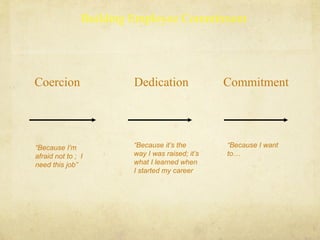
Coercion
Building Employee Commitment
Dedication Commitment
“Because I’m
afraid not to ; I
need this job”
“Because it’s the
way I was raised; it’s
what I learned when
I started my career
“Because I want
to…
High levels of discretionary effort on the part of all employees are especially
critical because…
• The extreme competitive and financial situation confronting most companies demands
extraordinary levels of commitment by every employee - normal curves of energy,
attention, and performance won’t suffice.
• The nature of most businesses rely on a large population of lightly supervised
employees who are at the leading edge of customer interaction, safety, and
operational effectiveness.
Building Employee Commitment
Concept #2
Employee
Commitment
Building Employee CommitmentBuilding Employee Commitment
Building Employee Commitment
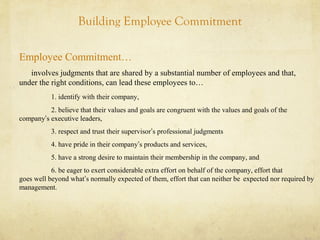
Employee Commitment…
involves judgments that are shared by a substantial number of employees and that,
under the right conditions, can lead these employees to…
1. identify with their company,
2. believe that their values and goals are congruent with the values and goals of the
company’s executive leaders,
3. respect and trust their supervisor’s professional judgments
4. have pride in their company’s products and services,
5. have a strong desire to maintain their membership in the company, and
6. be eager to exert considerable extra effort on behalf of the company, effort that
goes well beyond what’s normally expected of them, effort that can neither be expected nor required by
management.
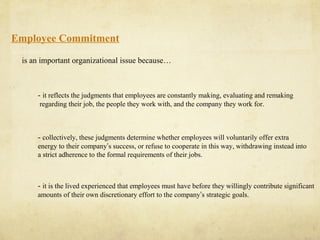
Employee Commitment
- collectively, these judgments determine whether employees will voluntarily offer extra
energy to their company’s success, or refuse to cooperate in this way, withdrawing instead into
a strict adherence to the formal requirements of their jobs.
- it is the lived experienced that employees must have before they willingly contribute significant
amounts of their own discretionary effort to the company’s strategic goals.
- it reflects the judgments that employees are constantly making, evaluating and remaking
regarding their job, the people they work with, and the company they work for.
is an important organizational issue because…
Empowerment
Outcome Fairness
Process Fairness
Membership
Employee-Supervisor
Interaction
Job Structure
Appreciation, Respect, & Dignity
My Job Characteristics
Me & My Supervisor’s Interactions
Our Ability to Influence
Resources, Rewards, & Assignments
Policies, Procedures & Processes
In American Airlines
Concept #3 Seven Judgments
Inclusion & Recognition
Building Employee Commitment
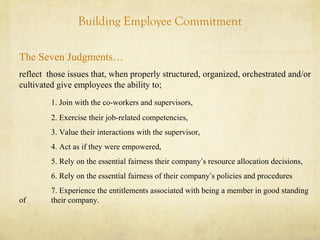
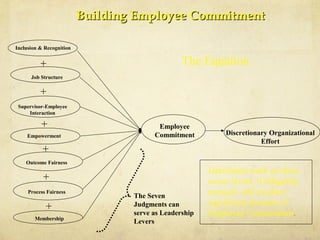
The Seven Judgments…
reflect those issues that, when properly structured, organized, orchestrated and/or
cultivated give employees the ability to;
1. Join with the co-workers and supervisors,
2. Exercise their job-related competencies,
3. Value their interactions with the supervisor,
4. Act as if they were empowered,
5. Rely on the essential fairness their company’s resource allocation decisions,
6. Rely on the essential fairness of their company’s policies and procedures
7. Experience the entitlements associated with being a member in good standing
of their company.
Empowerment
Outcome Fairness
Process Fairness
Membership
Supervisor-Employee
Interaction
Job Structure
Inclusion & Recognition
Employee
Commitment Discretionary Organizational
Effort
The Seven
Judgments can
serve as Leadership
Levers
Intentional work on these
seven levers, if diligently
pursued, will produce
significant amounts of
Employee Commitment.
+
+
+
+
+
+
The Equation
Building Employee CommitmentBuilding Employee Commitment
Definitions & Judgments
Building Employee Commitment
1. perceived Inclusion & Recognition; the definition
“The positive predispositions that emerge when employees conclude that;
1. American Airlines values them as employees and human beings.
2. They are being treated with dignity and respect by their supervisors and co-
workers.
3. They have been and/or will be invited to participate in activities that are
important to them and American Airlines.”
Building Employee Commitment
perceived Inclusion and Recognition; the judgments
1.“My co-workers try to involve me in their activities.
2. “My co-workers acknowledge the contributions I make.
3.“American Airlines makes a serious effort to include me in all the
decision-making processes that impact my job.
4. “My supervisor makes a serious effort to involve me in those activities
that can make use of my experience and expertise.
5. “My supervisor acts in ways that demonstrate he/she understands and
respects my personal and professional values.
6. “Almost all the managers and supervisors who work for American
Airlines treat me and my co-workers with respect and dignity.
Building Employee Commitment
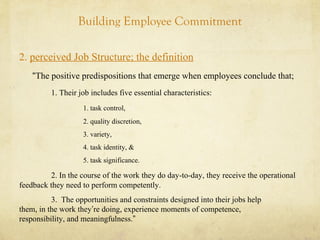
2. perceived Job Structure; the definition
“The positive predispositions that emerge when employees conclude that;
1. Their job includes five essential characteristics:
1. task control,
2. quality discretion,
3. variety,
4. task identity, &
5. task significance.
2. In the course of the work they do day-to-day, they receive the operational
feedback they need to perform competently.
3. The opportunities and constraints designed into their jobs help
them, in the work they’re doing, experience moments of competence,
responsibility, and meaningfulness.”
Building Employee Commitment
perceived Job Structure; the judgments
1. “The work I do day-to-day offers me plenty of opportunities to tackle a variety of
tasks.
2. “American Airlines has organized the job I’m hired to do so that I can see each of
my tasks through to its final completion.
3. “The work I do day-to-day is significant to American Airlines overall success.
4. “The work I do day-to-day gives me, in terms of how I do my work, considerable
opportunity for independence and freedom.
5. “Day in and day out, I receive the feedback I need to determine whether I am
performing competently and producing useful results for American Airlines.
Building Employee Commitment
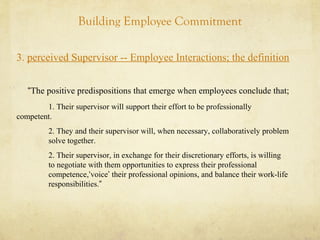
3. perceived Supervisor -- Employee Interactions; the definition
“The positive predispositions that emerge when employees conclude that;
1. Their supervisor will support their effort to be professionally
competent.
2. They and their supervisor will, when necessary, collaboratively problem
solve together.
2. Their supervisor, in exchange for their discretionary efforts, is willing
to negotiate with them opportunities to express their professional
competence,‘voice’ their professional opinions, and balance their work-life
responsibilities.”
Building Employee Commitment
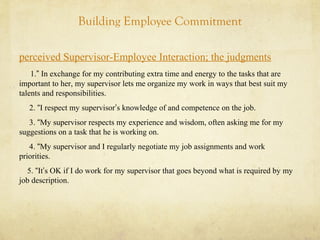
perceived Supervisor-Employee Interaction; the judgments
1.” In exchange for my contributing extra time and energy to the tasks that are
important to her, my supervisor lets me organize my work in ways that best suit my
talents and responsibilities.
2. “I respect my supervisor’s knowledge of and competence on the job.
3. “My supervisor respects my experience and wisdom, often asking me for my
suggestions on a task that he is working on.
4. “My supervisor and I regularly negotiate my job assignments and work
priorities.
5. “It’s OK if I do work for my supervisor that goes beyond what is required by my
job description.
Building Employee Commitment
4. perceived Empowerment; the definition
“The positive predispositions that emerge when employees conclude that;
1. They have access to the resources, the technical expertise, and the business
information they need to perform competently.
2. They have access to the operational support they need to perform
competently.
3. They have concrete opportunities to be heard with regard to those decisions
impacting their expression of job-related competency.
4. The company, in practical ways, recognizes the rights that
employees have to be involved in the governance of the company, and
consequently they, either directly or through appropriate representatives are
actively participating in important decision making opportunities.
5. The company, in a practical ways, offers employees the
opportunity to be involved in the orchestration of the change processes to which
they’re subject.”
Building Employee Commitment
perceived Empowerment; the judgments
1. “I have a significant impact on the decisions that are made in my department.
2. “I clearly have opportunities to voice my opinions to those in charge with regard
to organizational changes that will impact my work or my career.
3. “I have easy and timely access to those company experts whose technical
decisions impact my work.
4.” I have easy and timely access to the tools, equipment and other resources I
need to complete my work satisfactorily.
5. “When it comes to significant organizational change efforts, the company goes
out of its way to create structures and processes that give me and my co-workers
ample opportunities to share our expertise and experience.
Building Employee Commitment
5. perceived Output Fairness; the definition
“The positive predispositions that emerge when employees conclude that;
1. The resource allocation decisions the company makes are fair and equitable.
2. The company’s distribution of organizational rewards and
punishments is fair and equitable.
3. The company’s distribution of developmental opportunities is fair and
equitable.
4. The company always offers me believable explanations for the decisions
they make that impact my professional and personal lives.”
Building Employee Commitment
perceived Output Fairness; the judgments
1. “When I consider the responsibilities I have, I believe my supervisor is
rewarding me in an appropriate way.
2. “When I consider the amount of education and experience I have, I believe the
company is offering me a fair shot at the available promotion opportunities.
3. “When I think about what I have accomplished in the last six months, I think my
supervisor has appraised my contributions fairly.
4. “Overall, I think my supervisor allocates the company resources available to her
(e.g., salary, bonuses, time off, and other perks) in a fair and equitable manner.
5. “The company, either through my supervisor or some other channel, always
offers logical explanations for the decisions being made.
Building Employee Commitment
6. perceived Process Fairness; the definition
“The positive predispositions that emerge when employees conclude that;
1. The policies, procedures and processes to which they’re directly
subject are fairly administered.
2. The decisions effecting them are made and implemented in ways that
respect their human dignity.
3. The policies, procedures and processes to which they’re subject include
provisions for employees to voice their perspectives and preferences.
3. The policies and procedures they’re subject to;
[1] use accurate information,
[2] are consistent,
[3] are administered by people who are neutral and unbiased,
[4] are open to their participation,
[5] are open to appeal, and
[6] are transparent.”
Building Employee Commitment
perceived Process Fairness; the judgments
1. “My supervisor administers the company’s policies and procedures in an
unbiased manner.
2. “My supervisor makes sure that all her employees’ concerns are heard before
she makes decisions that will impact our jobs.
3. “When she makes important job decisions, my supervisor always collects
accurate and complete information.
4. “The employees in my unit are always encouraged to challenge or appeal job
decisions that they believe are inappropriate or unfair.
5. “The company policies that my supervisor administers, at least with regard to
the sequence of steps involved, are always clear and easily understood.
Building Employee Commitment
7. perceived Membership; the definition
“The positive predispositions that emerge when employees conclude that;
1. They have information, opportunities, and responsibilities others don’t
because they ‘belong’ to the organization.
2. Their values and beliefs are congruent with the values and beliefs held by
the leaders of their company.
3. They can safely ‘identify’ with and become ‘attached to’ the company for
which they work.”
Building Employee Commitment
perceived Membership; the judgments
1. “I am proud to tell others that I am part of American Airlines.
2. I really care about the fate of American Airlines.
3. I find that my values and American Airline’s values are very similar.
4. For me, American Airlines is the best of all possible organizations to work for.
5. I receive information, responsibilities and opportunities others don’t because I’m a
‘member in good standing’ of American Airlines.
Building Employee Commitment
In sum, Employee Commitment is…In sum, Employee Commitment is…
the judgments employees make about their work, their interactions with
their co-workers, and the company they work for. In particular, this includes;
1. An employee’s sense of being included and recognized.
2. An employee’s sense of the structure of their job.
3. An employee’s sense of the interactions between them and their supervisor.
4. An employee’s sense of their role in key decisions.
5. An employee’s sense of a fair ‘return’ for their efforts.
6. An employee’s sense of being subject to fair processes.
7. An employee’s sense of being an ‘entitled’ member of their organization.
Taken together, these judgments create the seven intervention levers that
managers and/or intact teams can use to foster employee commitment.
Powerful Places To Intervene
Building Employee Commitment
Of the seven levers that influence Employee Commitment, only four
turn out to be both easily accessible and powerful enough to exercise direct
leverage;
1. perceived Job Structure
2. perceived Supervisor-Employee Interactions
3. perceived Empowerment
4. perceived Procedural Justice
perceived Job Structure
Building Employee Commitment
When an employee judges their job, they assess two core
issues;
1. The basic structure of their job.
2. The information available to them about their work.
Building Employee Commitment
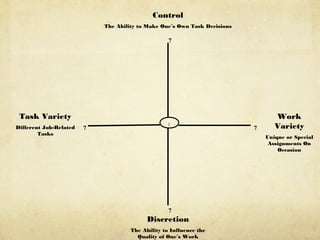
When assessing the structure of their job, employees look at three
key dimensions;
1. The control they have over key task decisions
2. The discretion they have over the quality of their work.
3. The variety of tasks available to them.
Discretion
The Ability to Influence the
Quality of One’s Work
Control
The Ability to Make One’s Own Task Decisions
Task Variety
Different Job-Related
Tasks
Work
Variety
Unique or Special
Assignments On
Occasion
1
7 7
7
7
Building Employee Commitment
When assessing the information available to them, employees
look for two key things;
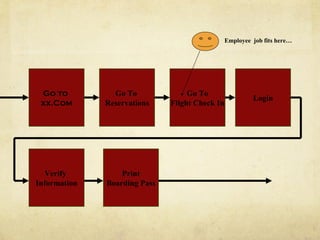
1. Information about where their job fits in the workflow(s) of which
they’re a part, and
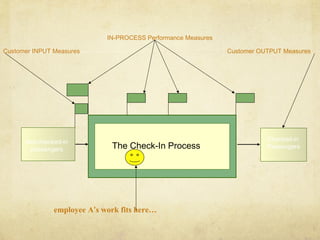
2. Input, in-process, and output data about the performance of their
workflow(s),
Go to
xx.Com
Login
Go To
Reservations
Go To
Flight Check In
Verify
Information
Print
Boarding Pass
Employee job fits here…
IN-PROCESS Performance Measures
Not-checked-in
passengers The Check-In Process
Checked-in
Passengers
employee A’s work fits here…
Customer OUTPUT MeasuresCustomer INPUT Measures
Building Employee Commitment
Only after employees have this placement and performance data will they
make judgments about the the structure of their jobs.
Building Employee Commitment
When their structure and information judgments are positive, employees;
a. have a sense that he or she knows where they fit and what they’re
contributing,
b. feel responsible for the quality of work they’re doing, and
consequently,
c. have a sense of a having a meaningful work experience.
When these kinds of judgments are present, employees will be predisposed
toward being committed to the success of their company.
perceived Employee-Supervisor Interactions
Building Employee Commitment
Employees are constantly assessing the interactions they’re having with
their organizational leaders, especially their immediate supervisor.
Building Employee Commitment
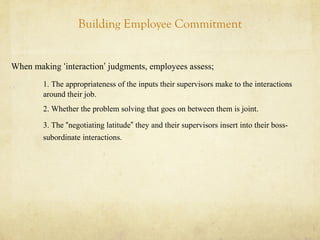
When making ‘interaction’ judgments, employees assess;
1. The appropriateness of the inputs their supervisors make to the interactions
around their job.
2. Whether the problem solving that goes on between them is joint.
3. The “negotiating latitude” they and their supervisors insert into their boss-
subordinate interactions.
Building Employee CommitmentBuilding Employee Commitment
Day to Day Work
Job Redesign & Process Improvement
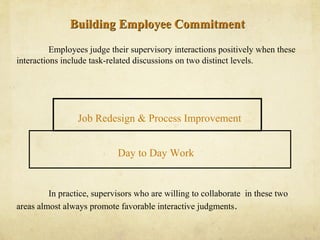
Employees judge their supervisory interactions positively when these
interactions include task-related discussions on two distinct levels.
In practice, supervisors who are willing to collaborate in these two
areas almost always promote favorable interactive judgments.
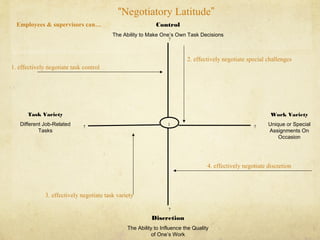
Building Employee CommitmentBuilding Employee Commitment
Employees almost always judge their supervisory interactions
favorably when their supervisors are willing to inject some ‘negotiatory
latitude’ into their interactions.
Discretion
The Ability to Influence the Quality
of One’s Work
Control
The Ability to Make One’s Own Task Decisions
Task Variety
Different Job-Related
Tasks
Work Variety
Unique or Special
Assignments On
Occasion
1
7 7
7
7
1. effectively negotiate task control
4. effectively negotiate discretion
2. effectively negotiate special challenges
“Negotiatory Latitude”
3. effectively negotiate task variety
Employees & supervisors can…
Building Employee Commitment
Additionally, employees positively assess interactions that take place
with supervisors who are willing to negotiate an exchange of
a. inside information,
b. opportunities to influence resource allocations, and/or
c. task-related decisions in return
for their employees’ discretionary organizational efforts.
perceived Empowerment
Building Employee Commitment
Employees are constantly making judgments about whether or not their
company has empowered them to do their job.
Building Employee Commitment
In this context, they make four basic judgments.
1. Whether they are supported in the work they do by their colleagues and co-
workers.
2. Whether they have access to the resources they need to do their work effectively.
3. Whether they have access to enough business information to truly know what
their company is doing
4. Whether they have access to opportunities for development that the company
supports.
Again, positive judgments here predispose employees toward commitment.
perceived Organizational Justice
Building Employee Commitment
Employees constantly make two kinds of ‘fairness’ judgments.
A. Assessments about the fairness of the rewards and other outcomes that the
organization distributes.
B. Assessments about the fairness of the organization’s processes, especially its
supervisory and decision making processes, as well as its HR policies and
procedures.
Building Employee Commitment
Of these two, employee judgments about the fairness of their
organization’s processes, policies and procedures are by far the more
important, at least for the purpose of influencing employee commitment.*
---------
* This is because most employees firmly believe that fair procedures are the best guarantee of fair
outcomes. And that fair procedures are the best bulwark against unfair outcomes
Building Employee Commitment
Experience shows that the processes, procedures and policies that employees
judge to be fair invariably have six distinct characteristics;
1. The use of accurate information
2. Consistent application of process policies and procedures
3. The neutrality of process administrators
4. Opportunities for participation, representation and ‘voice’
5. Opportunities for appeal
6. Transparency
Building Employee Commitment
When employees judge their organization’s procedures to be fair, these
procedures…
• inspire feelings of loyalty
• legitimize the authority of organizational leaders
• help ensure voluntary compliance with organizational rules
• inspire discretionary organizational effort.
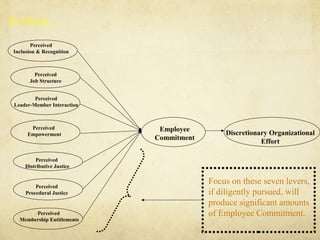
In Sum…
Perceived
Empowerment
Perceived
Distributive Justice
Perceived
Procedural Justice
Perceived
Membership Entitlements
Perceived
Leader-Member Interaction
Perceived
Inclusion & Recognition
Perceived
Job Structure
Employee
Commitment
Discretionary Organizational
Effort
Focus on these seven levers,
if diligently pursued, will
produce significant amounts
of Employee Commitment.
Building Employee Commitment
David Nicoll, Ph.D.
Transformational Learning Opportunities
http://transformationallearningopportunities.com
January 2015

Building Employee Commitment

  • 1.
    Building Employee Commitment David Nicoll,Ph.D. Transformational Learning Opportunities, Inc. http://transformationallearningopportunities.com July 2015
  • 2.
    Building Employee Commitment Formore than four decades, managers have been trying to improve their organization’s productivity by focusing on the issue of employee satisfaction. Today, managers are discovering there is a more powerful way of improving productivity.
  • 3.
    Building Employee Commitment EmployeeCommitment, while presenting a more complex approach to productivity improvement, actually offers managers more leverage and higher performance payoffs.
  • 4.
    Building Employee Empowerment Thedifference between a focus on employee satisfaction and a focus on employee commitment is subtle. But substantial... - Employee Satisfaction is concerned with an employee’s feelingsfeelings about their job. - Employee Commitment is concerned with the judgmentsjudgments employees make about their work, the people they’re interacting with, and the company they work for.
  • 5.
    The Essence ofthis Approach
  • 6.
    Building Employee Commitment Thecompanies that have successfully built and capitalized on a reservoir of employee commitment have accomplished this by mastering three concepts, and one basic equation.
  • 7.
    Discretionary Organizational Effort Concept #1 BuildingEmployee CommitmentBuilding Employee Commitment
  • 8.
    Discretionary Organizational Effortis…Discretionary Organizational Effort is… the voluntary effort employees can give to their company that takes them beyond their role requirements and contractually rewarded job assignments. the employee behaviors that are not formally prescribed by job contracts, but that are nonetheless needed by the company to succeed. in short, the kind of behavior which a company can neither expect nor require, but that is nonetheless essential to the company’s success.
  • 9.
    Coercion Building Employee Commitment DedicationCommitment “Because I’m afraid not to ; I need this job” “Because it’s the way I was raised; it’s what I learned when I started my career “Because I want to…
  • 10.
    High levels ofdiscretionary effort on the part of all employees are especially critical because… • The extreme competitive and financial situation confronting most companies demands extraordinary levels of commitment by every employee - normal curves of energy, attention, and performance won’t suffice. • The nature of most businesses rely on a large population of lightly supervised employees who are at the leading edge of customer interaction, safety, and operational effectiveness. Building Employee Commitment
  • 11.
    Concept #2 Employee Commitment Building EmployeeCommitmentBuilding Employee Commitment
  • 12.
    Building Employee Commitment EmployeeCommitment… involves judgments that are shared by a substantial number of employees and that, under the right conditions, can lead these employees to… 1. identify with their company, 2. believe that their values and goals are congruent with the values and goals of the company’s executive leaders, 3. respect and trust their supervisor’s professional judgments 4. have pride in their company’s products and services, 5. have a strong desire to maintain their membership in the company, and 6. be eager to exert considerable extra effort on behalf of the company, effort that goes well beyond what’s normally expected of them, effort that can neither be expected nor required by management.
  • 13.
    Employee Commitment - collectively,these judgments determine whether employees will voluntarily offer extra energy to their company’s success, or refuse to cooperate in this way, withdrawing instead into a strict adherence to the formal requirements of their jobs. - it is the lived experienced that employees must have before they willingly contribute significant amounts of their own discretionary effort to the company’s strategic goals. - it reflects the judgments that employees are constantly making, evaluating and remaking regarding their job, the people they work with, and the company they work for. is an important organizational issue because…
  • 14.
    Empowerment Outcome Fairness Process Fairness Membership Employee-Supervisor Interaction JobStructure Appreciation, Respect, & Dignity My Job Characteristics Me & My Supervisor’s Interactions Our Ability to Influence Resources, Rewards, & Assignments Policies, Procedures & Processes In American Airlines Concept #3 Seven Judgments Inclusion & Recognition
  • 15.
    Building Employee Commitment TheSeven Judgments… reflect those issues that, when properly structured, organized, orchestrated and/or cultivated give employees the ability to; 1. Join with the co-workers and supervisors, 2. Exercise their job-related competencies, 3. Value their interactions with the supervisor, 4. Act as if they were empowered, 5. Rely on the essential fairness their company’s resource allocation decisions, 6. Rely on the essential fairness of their company’s policies and procedures 7. Experience the entitlements associated with being a member in good standing of their company.
  • 16.
    Empowerment Outcome Fairness Process Fairness Membership Supervisor-Employee Interaction JobStructure Inclusion & Recognition Employee Commitment Discretionary Organizational Effort The Seven Judgments can serve as Leadership Levers Intentional work on these seven levers, if diligently pursued, will produce significant amounts of Employee Commitment. + + + + + + The Equation Building Employee CommitmentBuilding Employee Commitment
  • 17.
  • 18.
    Building Employee Commitment 1.perceived Inclusion & Recognition; the definition “The positive predispositions that emerge when employees conclude that; 1. American Airlines values them as employees and human beings. 2. They are being treated with dignity and respect by their supervisors and co- workers. 3. They have been and/or will be invited to participate in activities that are important to them and American Airlines.”
  • 19.
    Building Employee Commitment perceivedInclusion and Recognition; the judgments 1.“My co-workers try to involve me in their activities. 2. “My co-workers acknowledge the contributions I make. 3.“American Airlines makes a serious effort to include me in all the decision-making processes that impact my job. 4. “My supervisor makes a serious effort to involve me in those activities that can make use of my experience and expertise. 5. “My supervisor acts in ways that demonstrate he/she understands and respects my personal and professional values. 6. “Almost all the managers and supervisors who work for American Airlines treat me and my co-workers with respect and dignity.
  • 20.
    Building Employee Commitment 2.perceived Job Structure; the definition “The positive predispositions that emerge when employees conclude that; 1. Their job includes five essential characteristics: 1. task control, 2. quality discretion, 3. variety, 4. task identity, & 5. task significance. 2. In the course of the work they do day-to-day, they receive the operational feedback they need to perform competently. 3. The opportunities and constraints designed into their jobs help them, in the work they’re doing, experience moments of competence, responsibility, and meaningfulness.”
  • 21.
    Building Employee Commitment perceivedJob Structure; the judgments 1. “The work I do day-to-day offers me plenty of opportunities to tackle a variety of tasks. 2. “American Airlines has organized the job I’m hired to do so that I can see each of my tasks through to its final completion. 3. “The work I do day-to-day is significant to American Airlines overall success. 4. “The work I do day-to-day gives me, in terms of how I do my work, considerable opportunity for independence and freedom. 5. “Day in and day out, I receive the feedback I need to determine whether I am performing competently and producing useful results for American Airlines.
  • 22.
    Building Employee Commitment 3.perceived Supervisor -- Employee Interactions; the definition “The positive predispositions that emerge when employees conclude that; 1. Their supervisor will support their effort to be professionally competent. 2. They and their supervisor will, when necessary, collaboratively problem solve together. 2. Their supervisor, in exchange for their discretionary efforts, is willing to negotiate with them opportunities to express their professional competence,‘voice’ their professional opinions, and balance their work-life responsibilities.”
  • 23.
    Building Employee Commitment perceivedSupervisor-Employee Interaction; the judgments 1.” In exchange for my contributing extra time and energy to the tasks that are important to her, my supervisor lets me organize my work in ways that best suit my talents and responsibilities. 2. “I respect my supervisor’s knowledge of and competence on the job. 3. “My supervisor respects my experience and wisdom, often asking me for my suggestions on a task that he is working on. 4. “My supervisor and I regularly negotiate my job assignments and work priorities. 5. “It’s OK if I do work for my supervisor that goes beyond what is required by my job description.
  • 24.
    Building Employee Commitment 4.perceived Empowerment; the definition “The positive predispositions that emerge when employees conclude that; 1. They have access to the resources, the technical expertise, and the business information they need to perform competently. 2. They have access to the operational support they need to perform competently. 3. They have concrete opportunities to be heard with regard to those decisions impacting their expression of job-related competency. 4. The company, in practical ways, recognizes the rights that employees have to be involved in the governance of the company, and consequently they, either directly or through appropriate representatives are actively participating in important decision making opportunities. 5. The company, in a practical ways, offers employees the opportunity to be involved in the orchestration of the change processes to which they’re subject.”
  • 25.
    Building Employee Commitment perceivedEmpowerment; the judgments 1. “I have a significant impact on the decisions that are made in my department. 2. “I clearly have opportunities to voice my opinions to those in charge with regard to organizational changes that will impact my work or my career. 3. “I have easy and timely access to those company experts whose technical decisions impact my work. 4.” I have easy and timely access to the tools, equipment and other resources I need to complete my work satisfactorily. 5. “When it comes to significant organizational change efforts, the company goes out of its way to create structures and processes that give me and my co-workers ample opportunities to share our expertise and experience.
  • 26.
    Building Employee Commitment 5.perceived Output Fairness; the definition “The positive predispositions that emerge when employees conclude that; 1. The resource allocation decisions the company makes are fair and equitable. 2. The company’s distribution of organizational rewards and punishments is fair and equitable. 3. The company’s distribution of developmental opportunities is fair and equitable. 4. The company always offers me believable explanations for the decisions they make that impact my professional and personal lives.”
  • 27.
    Building Employee Commitment perceivedOutput Fairness; the judgments 1. “When I consider the responsibilities I have, I believe my supervisor is rewarding me in an appropriate way. 2. “When I consider the amount of education and experience I have, I believe the company is offering me a fair shot at the available promotion opportunities. 3. “When I think about what I have accomplished in the last six months, I think my supervisor has appraised my contributions fairly. 4. “Overall, I think my supervisor allocates the company resources available to her (e.g., salary, bonuses, time off, and other perks) in a fair and equitable manner. 5. “The company, either through my supervisor or some other channel, always offers logical explanations for the decisions being made.
  • 28.
    Building Employee Commitment 6.perceived Process Fairness; the definition “The positive predispositions that emerge when employees conclude that; 1. The policies, procedures and processes to which they’re directly subject are fairly administered. 2. The decisions effecting them are made and implemented in ways that respect their human dignity. 3. The policies, procedures and processes to which they’re subject include provisions for employees to voice their perspectives and preferences. 3. The policies and procedures they’re subject to; [1] use accurate information, [2] are consistent, [3] are administered by people who are neutral and unbiased, [4] are open to their participation, [5] are open to appeal, and [6] are transparent.”
  • 29.
    Building Employee Commitment perceivedProcess Fairness; the judgments 1. “My supervisor administers the company’s policies and procedures in an unbiased manner. 2. “My supervisor makes sure that all her employees’ concerns are heard before she makes decisions that will impact our jobs. 3. “When she makes important job decisions, my supervisor always collects accurate and complete information. 4. “The employees in my unit are always encouraged to challenge or appeal job decisions that they believe are inappropriate or unfair. 5. “The company policies that my supervisor administers, at least with regard to the sequence of steps involved, are always clear and easily understood.
  • 30.
    Building Employee Commitment 7.perceived Membership; the definition “The positive predispositions that emerge when employees conclude that; 1. They have information, opportunities, and responsibilities others don’t because they ‘belong’ to the organization. 2. Their values and beliefs are congruent with the values and beliefs held by the leaders of their company. 3. They can safely ‘identify’ with and become ‘attached to’ the company for which they work.”
  • 31.
    Building Employee Commitment perceivedMembership; the judgments 1. “I am proud to tell others that I am part of American Airlines. 2. I really care about the fate of American Airlines. 3. I find that my values and American Airline’s values are very similar. 4. For me, American Airlines is the best of all possible organizations to work for. 5. I receive information, responsibilities and opportunities others don’t because I’m a ‘member in good standing’ of American Airlines.
  • 32.
    Building Employee Commitment Insum, Employee Commitment is…In sum, Employee Commitment is… the judgments employees make about their work, their interactions with their co-workers, and the company they work for. In particular, this includes; 1. An employee’s sense of being included and recognized. 2. An employee’s sense of the structure of their job. 3. An employee’s sense of the interactions between them and their supervisor. 4. An employee’s sense of their role in key decisions. 5. An employee’s sense of a fair ‘return’ for their efforts. 6. An employee’s sense of being subject to fair processes. 7. An employee’s sense of being an ‘entitled’ member of their organization. Taken together, these judgments create the seven intervention levers that managers and/or intact teams can use to foster employee commitment.
  • 33.
  • 34.
    Building Employee Commitment Ofthe seven levers that influence Employee Commitment, only four turn out to be both easily accessible and powerful enough to exercise direct leverage; 1. perceived Job Structure 2. perceived Supervisor-Employee Interactions 3. perceived Empowerment 4. perceived Procedural Justice
  • 35.
  • 36.
    Building Employee Commitment Whenan employee judges their job, they assess two core issues; 1. The basic structure of their job. 2. The information available to them about their work.
  • 37.
    Building Employee Commitment Whenassessing the structure of their job, employees look at three key dimensions; 1. The control they have over key task decisions 2. The discretion they have over the quality of their work. 3. The variety of tasks available to them.
  • 38.
    Discretion The Ability toInfluence the Quality of One’s Work Control The Ability to Make One’s Own Task Decisions Task Variety Different Job-Related Tasks Work Variety Unique or Special Assignments On Occasion 1 7 7 7 7
  • 39.
    Building Employee Commitment Whenassessing the information available to them, employees look for two key things; 1. Information about where their job fits in the workflow(s) of which they’re a part, and 2. Input, in-process, and output data about the performance of their workflow(s),
  • 40.
    Go to xx.Com Login Go To Reservations GoTo Flight Check In Verify Information Print Boarding Pass Employee job fits here…
  • 41.
    IN-PROCESS Performance Measures Not-checked-in passengersThe Check-In Process Checked-in Passengers employee A’s work fits here… Customer OUTPUT MeasuresCustomer INPUT Measures
  • 42.
    Building Employee Commitment Onlyafter employees have this placement and performance data will they make judgments about the the structure of their jobs.
  • 43.
    Building Employee Commitment Whentheir structure and information judgments are positive, employees; a. have a sense that he or she knows where they fit and what they’re contributing, b. feel responsible for the quality of work they’re doing, and consequently, c. have a sense of a having a meaningful work experience. When these kinds of judgments are present, employees will be predisposed toward being committed to the success of their company.
  • 44.
  • 45.
    Building Employee Commitment Employeesare constantly assessing the interactions they’re having with their organizational leaders, especially their immediate supervisor.
  • 46.
    Building Employee Commitment Whenmaking ‘interaction’ judgments, employees assess; 1. The appropriateness of the inputs their supervisors make to the interactions around their job. 2. Whether the problem solving that goes on between them is joint. 3. The “negotiating latitude” they and their supervisors insert into their boss- subordinate interactions.
  • 47.
    Building Employee CommitmentBuildingEmployee Commitment Day to Day Work Job Redesign & Process Improvement Employees judge their supervisory interactions positively when these interactions include task-related discussions on two distinct levels. In practice, supervisors who are willing to collaborate in these two areas almost always promote favorable interactive judgments.
  • 48.
    Building Employee CommitmentBuildingEmployee Commitment Employees almost always judge their supervisory interactions favorably when their supervisors are willing to inject some ‘negotiatory latitude’ into their interactions.
  • 49.
    Discretion The Ability toInfluence the Quality of One’s Work Control The Ability to Make One’s Own Task Decisions Task Variety Different Job-Related Tasks Work Variety Unique or Special Assignments On Occasion 1 7 7 7 7 1. effectively negotiate task control 4. effectively negotiate discretion 2. effectively negotiate special challenges “Negotiatory Latitude” 3. effectively negotiate task variety Employees & supervisors can…
  • 50.
    Building Employee Commitment Additionally,employees positively assess interactions that take place with supervisors who are willing to negotiate an exchange of a. inside information, b. opportunities to influence resource allocations, and/or c. task-related decisions in return for their employees’ discretionary organizational efforts.
  • 51.
  • 52.
    Building Employee Commitment Employeesare constantly making judgments about whether or not their company has empowered them to do their job.
  • 53.
    Building Employee Commitment Inthis context, they make four basic judgments. 1. Whether they are supported in the work they do by their colleagues and co- workers. 2. Whether they have access to the resources they need to do their work effectively. 3. Whether they have access to enough business information to truly know what their company is doing 4. Whether they have access to opportunities for development that the company supports. Again, positive judgments here predispose employees toward commitment.
  • 54.
  • 55.
    Building Employee Commitment Employeesconstantly make two kinds of ‘fairness’ judgments. A. Assessments about the fairness of the rewards and other outcomes that the organization distributes. B. Assessments about the fairness of the organization’s processes, especially its supervisory and decision making processes, as well as its HR policies and procedures.
  • 56.
    Building Employee Commitment Ofthese two, employee judgments about the fairness of their organization’s processes, policies and procedures are by far the more important, at least for the purpose of influencing employee commitment.* --------- * This is because most employees firmly believe that fair procedures are the best guarantee of fair outcomes. And that fair procedures are the best bulwark against unfair outcomes
  • 57.
    Building Employee Commitment Experienceshows that the processes, procedures and policies that employees judge to be fair invariably have six distinct characteristics; 1. The use of accurate information 2. Consistent application of process policies and procedures 3. The neutrality of process administrators 4. Opportunities for participation, representation and ‘voice’ 5. Opportunities for appeal 6. Transparency
  • 58.
    Building Employee Commitment Whenemployees judge their organization’s procedures to be fair, these procedures… • inspire feelings of loyalty • legitimize the authority of organizational leaders • help ensure voluntary compliance with organizational rules • inspire discretionary organizational effort.
  • 59.
    In Sum… Perceived Empowerment Perceived Distributive Justice Perceived ProceduralJustice Perceived Membership Entitlements Perceived Leader-Member Interaction Perceived Inclusion & Recognition Perceived Job Structure Employee Commitment Discretionary Organizational Effort Focus on these seven levers, if diligently pursued, will produce significant amounts of Employee Commitment.
  • 60.
    Building Employee Commitment DavidNicoll, Ph.D. Transformational Learning Opportunities http://transformationallearningopportunities.com January 2015