Welcome!
Building capacity for
evidence-informed public
health decision making
You will be placed on hold until the webinar begins.
The webinar will begin shortly, please remain on the line.
Housekeeping
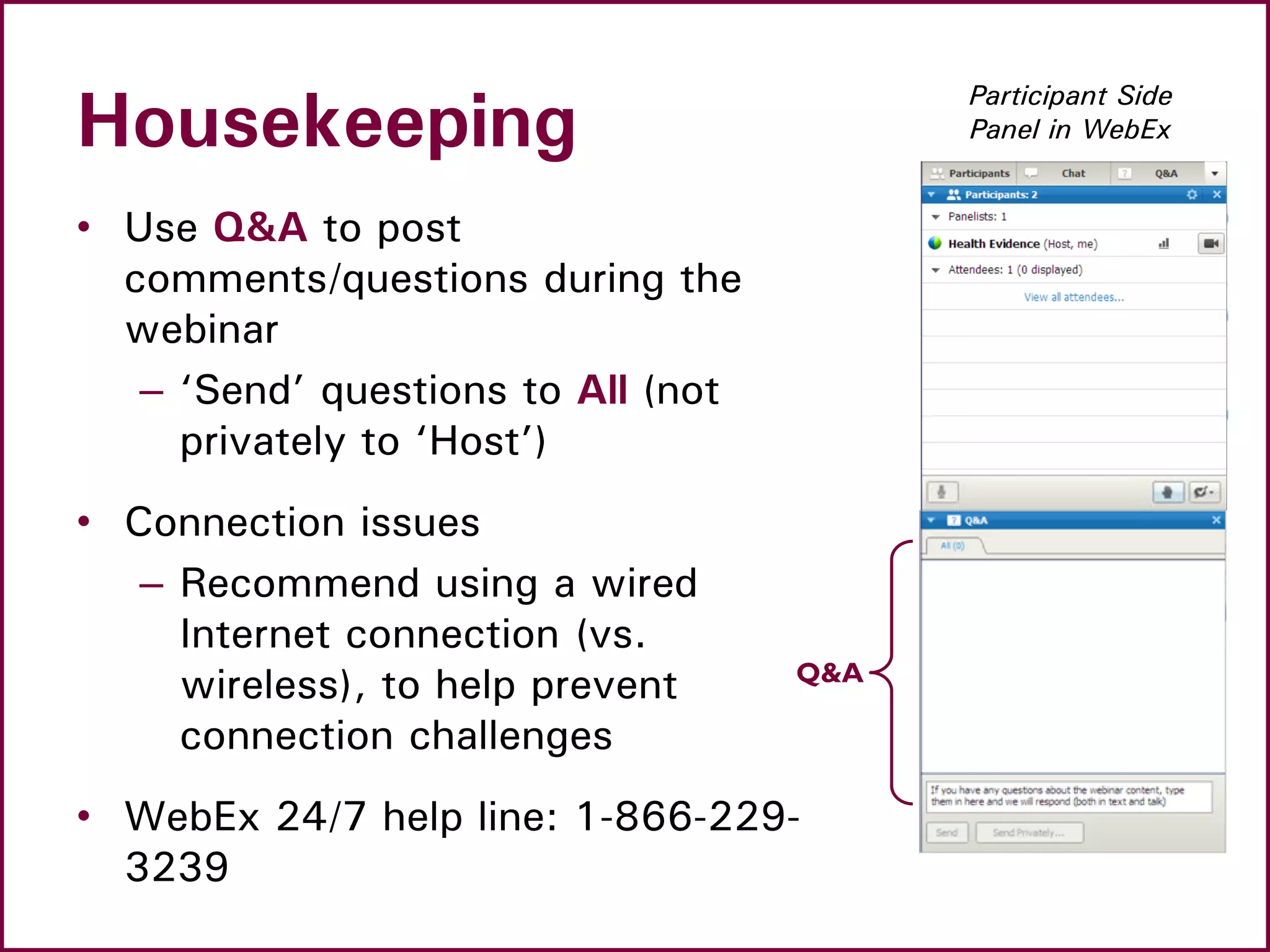
• Use Q&A to post
comments/questions during the
webinar
– ‘Send’ questions to All (not
privately to ‘Host’)
• Connection issues
– Recommend using a wired
Internet connection (vs.
wireless), to help prevent
connection challenges
• WebEx 24/7 help line: 1-866-229-
3239
Q&A
Participant Side
Panel in WebEx
Building capacity for
evidence-informed public
health decision making
Partnerships for health
system improvement
The Health Evidence Team
Maureen Dobbins
Scientific Director
Heather Husson
Manager
Lori Greco
Knowledge Broker
Robyn Traynor
Research Coordinator
Research Assistants
Stephanie Workentine
Arnav Agarwal
Linda Chan
Tiffany Oei
Students
Reza Yousefi Nooraie
(PhD candidate)
Yaso Gowrinathan
Research Assistant/
Coordinator
Jennifer Yost
Assistant Professor
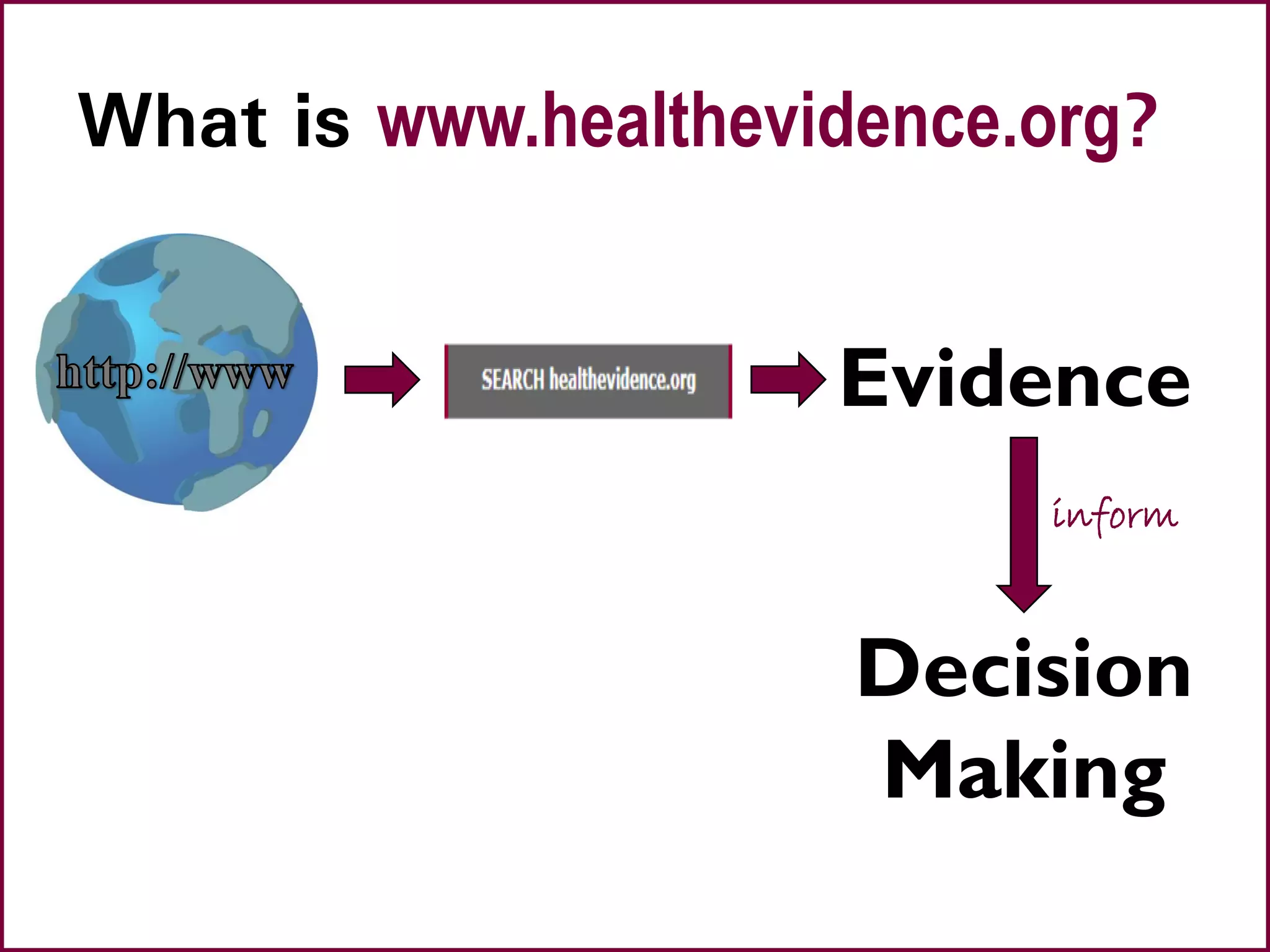
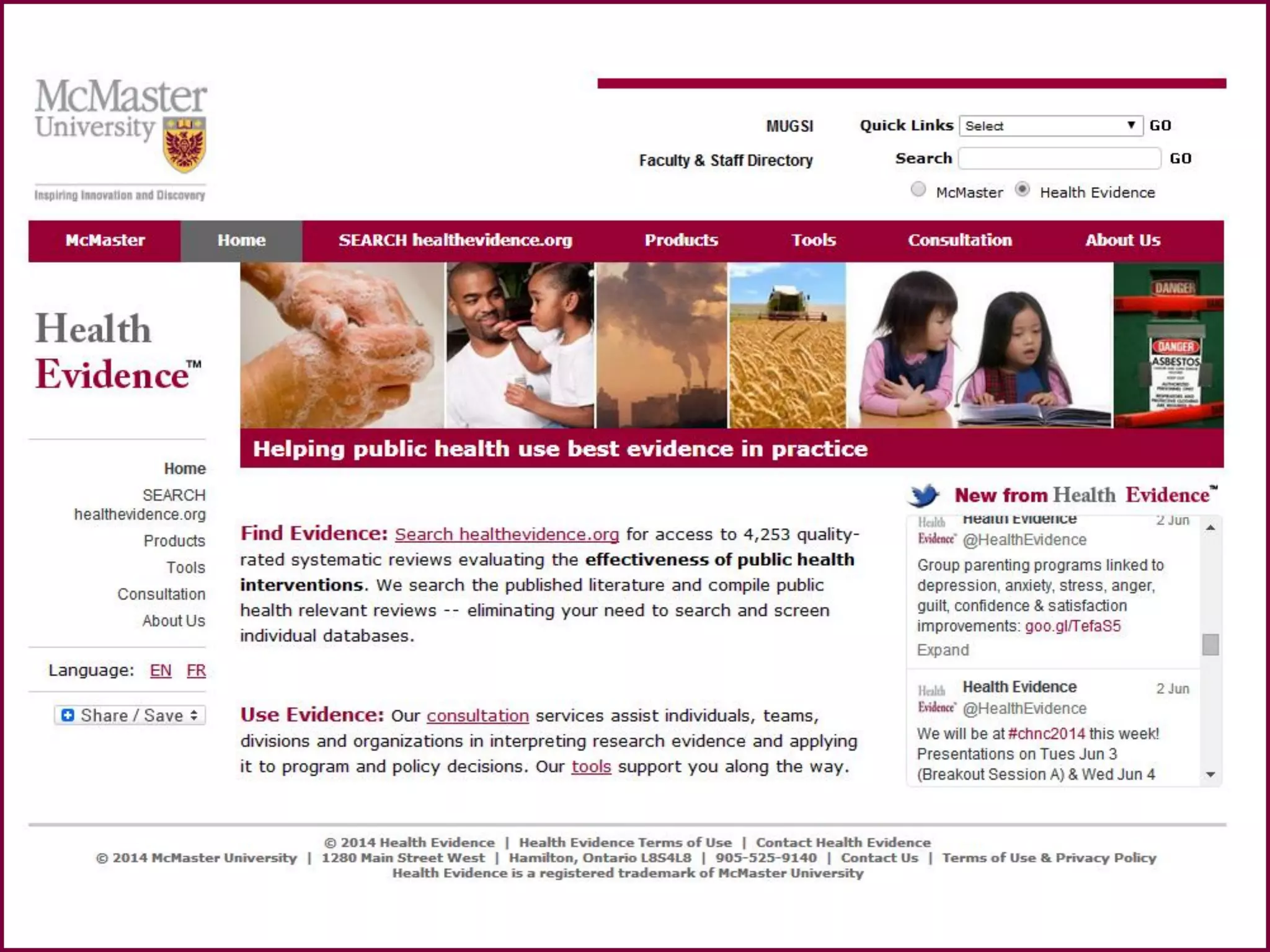
What is www.healthevidence.org?
Evidence
Decision
Making
inform
A Model for Evidence-Informed
Decision Making
National Collaborating Centre for Methods and Tools. (revised 2012).
A Model for Evidence-Informed Decision-Making in Public Health (Fact
Sheet). [http://www.nccmt.ca/pubs/FactSheet_EIDM_EN_WEB.pdf]
Stages in the process of
Evidence-Informed Public Health
National Collaborating Centre for Methods and Tools. Evidence-
Informed Public Health. [http://www.nccmt.ca/eiph/index-eng.html]
Funding for today’s webinar
Partnerships for
Health System Improvement
(FRN 101867)
Dissemination Event
(FRN 126353)
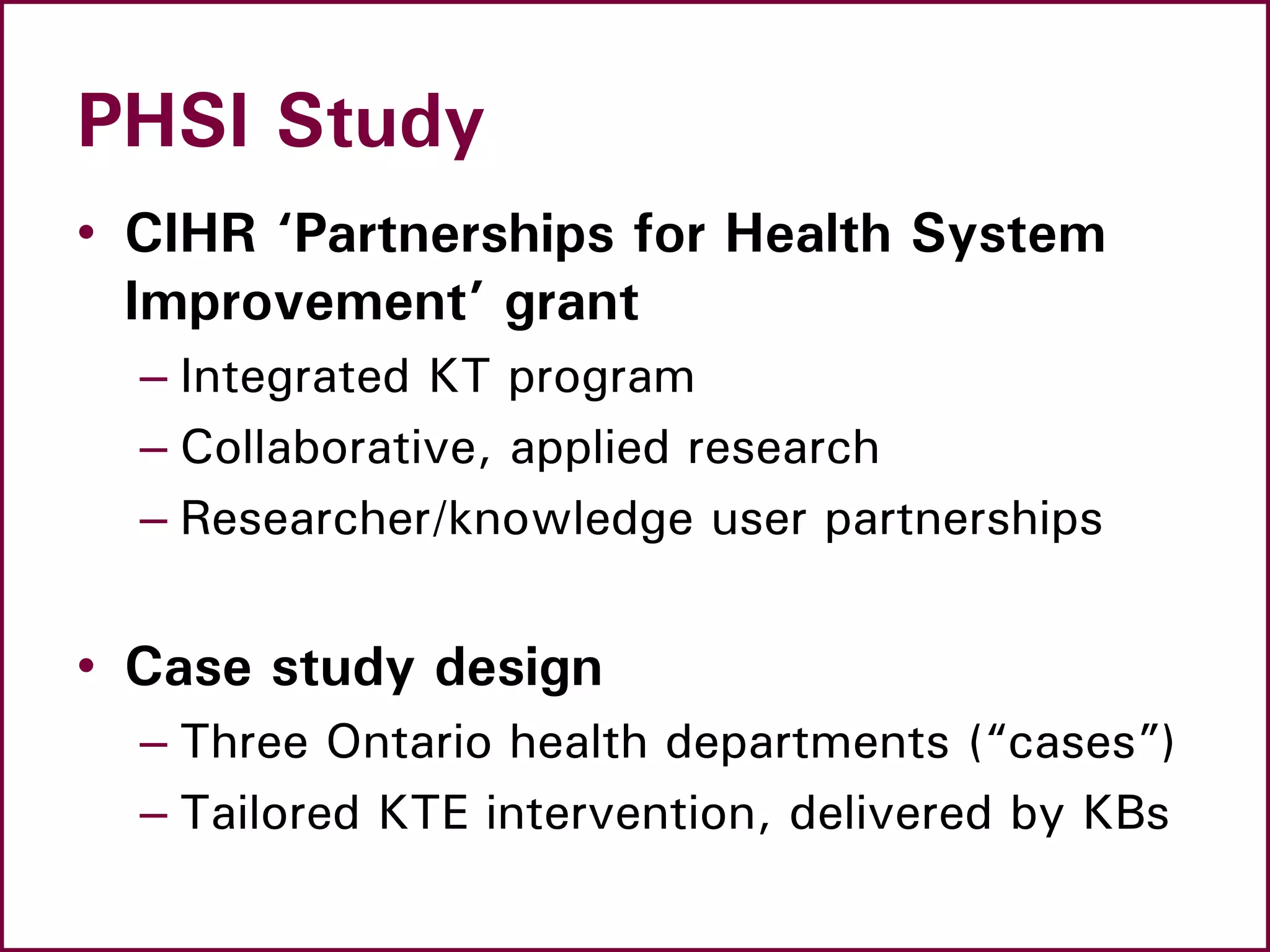
PHSI Study
• CIHR ‘Partnerships for Health System
Improvement’ grant
– Integrated KT program
– Collaborative, applied research
– Researcher/knowledge user partnerships
• Case study design
– Three Ontario health departments (“cases”)
– Tailored KTE intervention, delivered by KBs
We asked…
What is the impact of a
tailored KTE strategy on knowledge,
capacity & behaviour for EIDM?
What contextual factors facilitate
and/or impede impact?
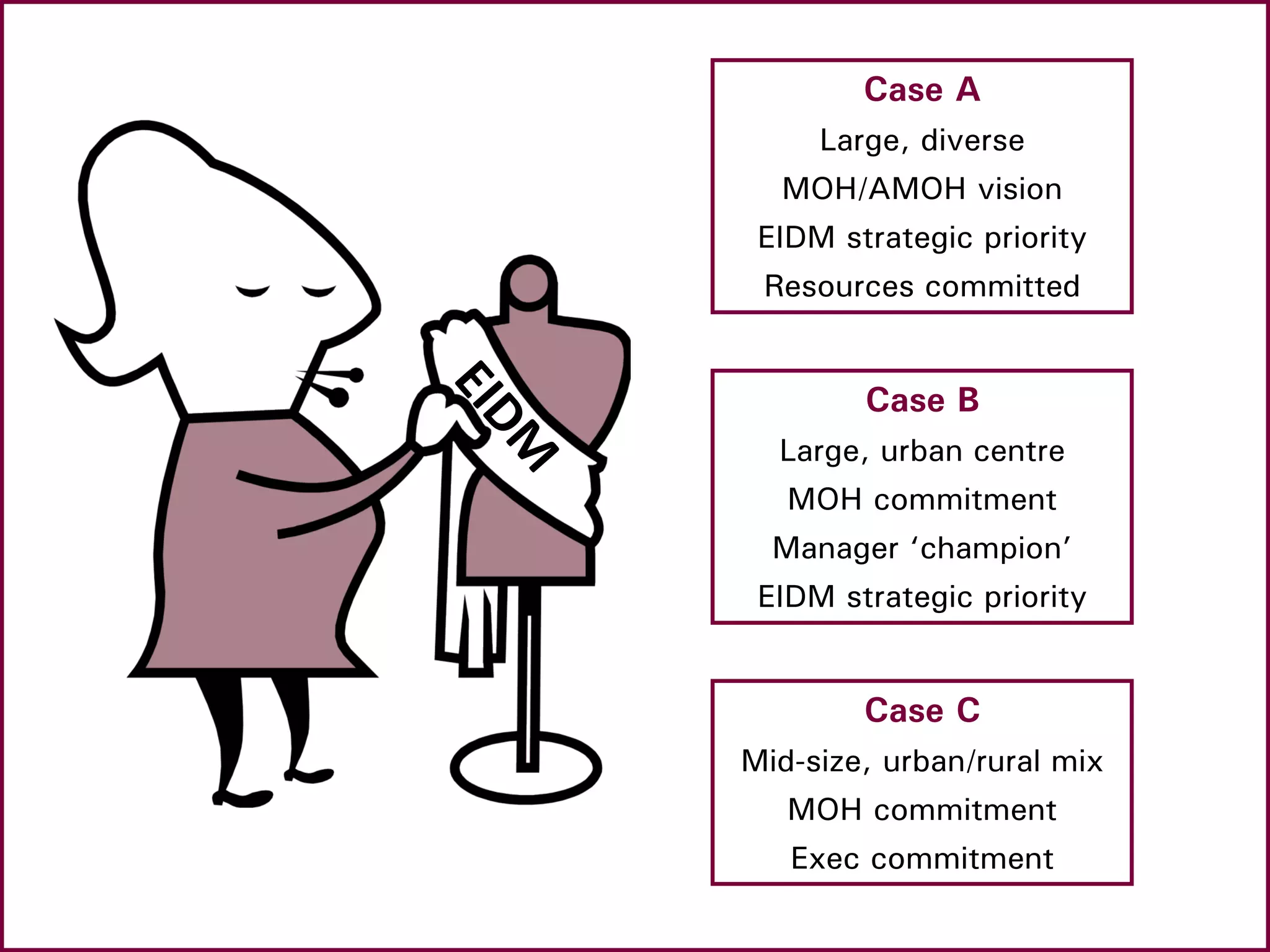
Case A
Large, diverse
MOH/AMOH vision
EIDM strategic priority
Resources committed
Case B
Large, urban centre
MOH commitment
Manager ‘champion’
EIDM strategic priority
Case C
Mid-size, urban/rural mix
MOH commitment
Exec commitment
KB
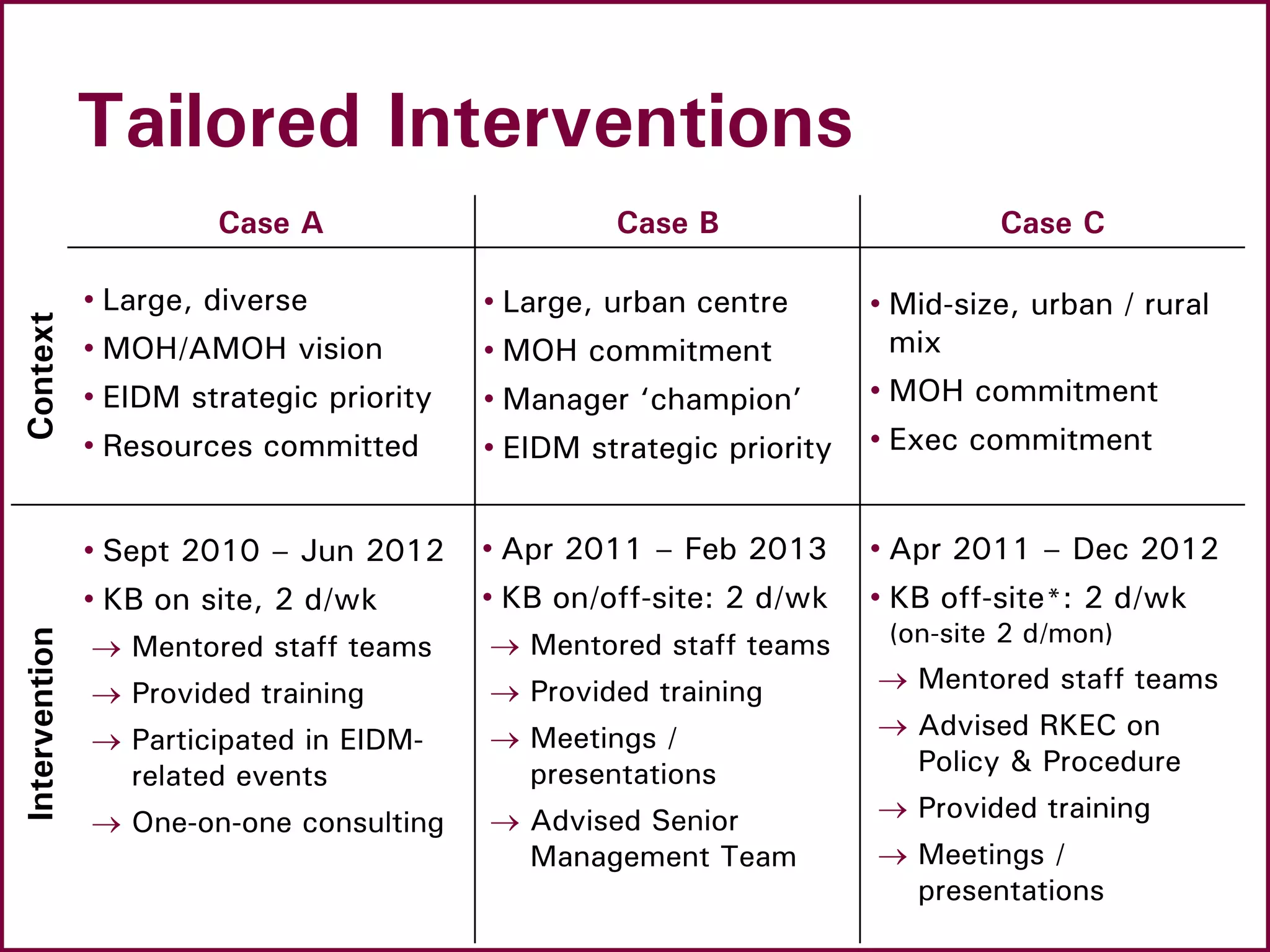
Tailored Interventions
Case A Case B Case C
ContextIntervention
• Large, diverse
• MOH/AMOH vision
• EIDM strategic priority
• Resources committed
• Sept 2010 – Jun 2012
• KB on site, 2 d/wk
 Mentored staff teams
 Provided training
 Participated in EIDM-
related events
 One-on-one consulting
• Large, urban centre
• MOH commitment
• Manager ‘champion’
• EIDM strategic priority
• Apr 2011 – Feb 2013
• KB on/off-site: 2 d/wk
 Mentored staff teams
 Provided training
 Meetings /
presentations
 Advised Senior
Management Team
• Mid-size, urban / rural
mix
• MOH commitment
• Exec commitment
• Apr 2011 – Dec 2012
• KB off-site*: 2 d/wk
(on-site 2 d/mon)
 Mentored staff teams
 Advised RKEC on
Policy & Procedure
 Provided training
 Meetings /
presentations
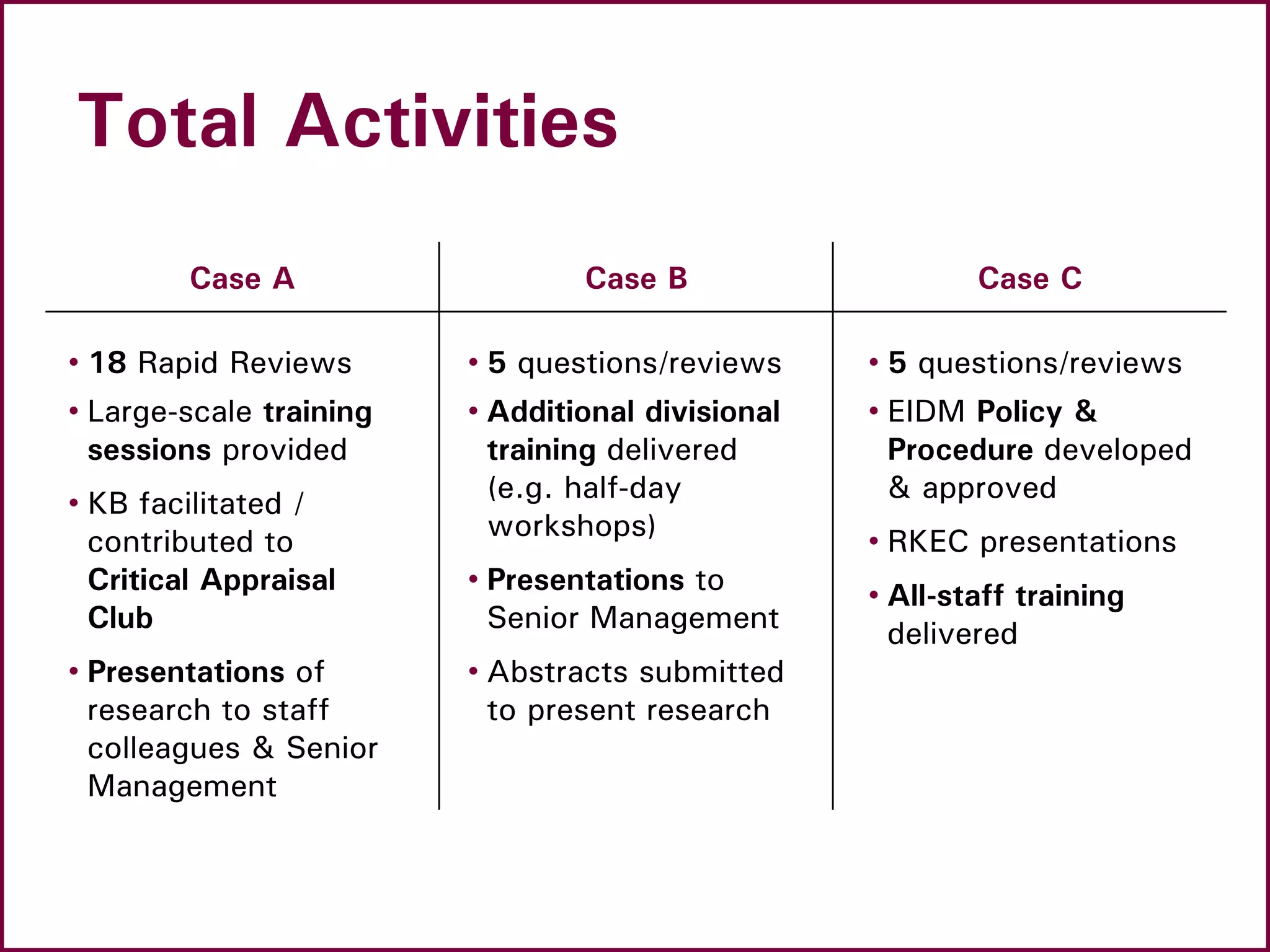
Total Activities
Case A Case B Case C
• 5 questions/reviews
• Additional divisional
training delivered
(e.g. half-day
workshops)
• Presentations to
Senior Management
• Abstracts submitted
to present research
• 18 Rapid Reviews
• Large-scale training
sessions provided
• KB facilitated /
contributed to
Critical Appraisal
Club
• Presentations of
research to staff
colleagues & Senior
Management
• 5 questions/reviews
• EIDM Policy &
Procedure developed
& approved
• RKEC presentations
• All-staff training
delivered
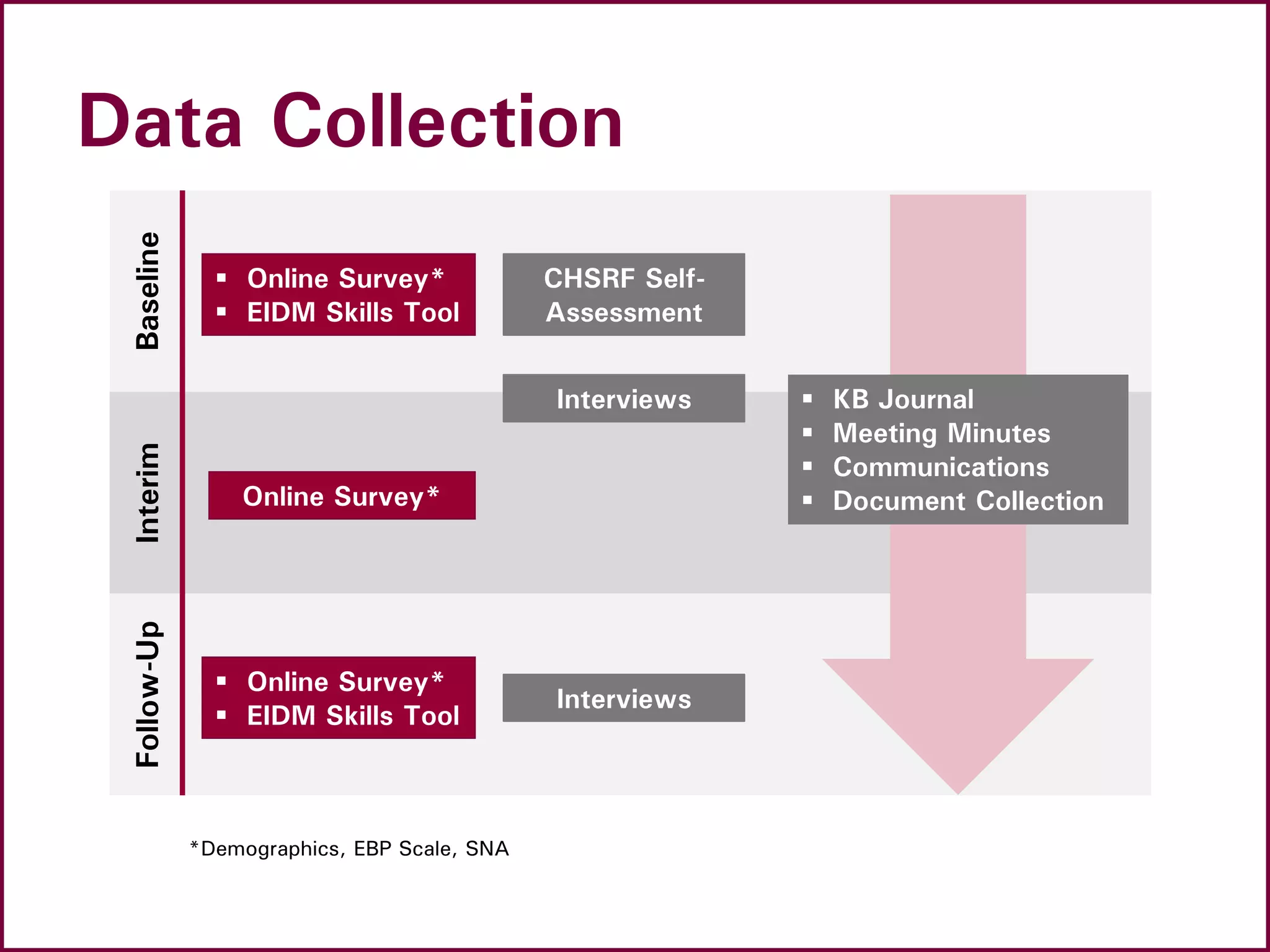
Data CollectionBaselineInterimFollow-Up
 Online Survey*
 EIDM Skills Tool
*Demographics, EBP Scale, SNA
Online Survey*
 Online Survey*
 EIDM Skills Tool
CHSRF Self-
Assessment
Interviews
Interviews
 KB Journal
 Meeting Minutes
 Communications
 Document Collection
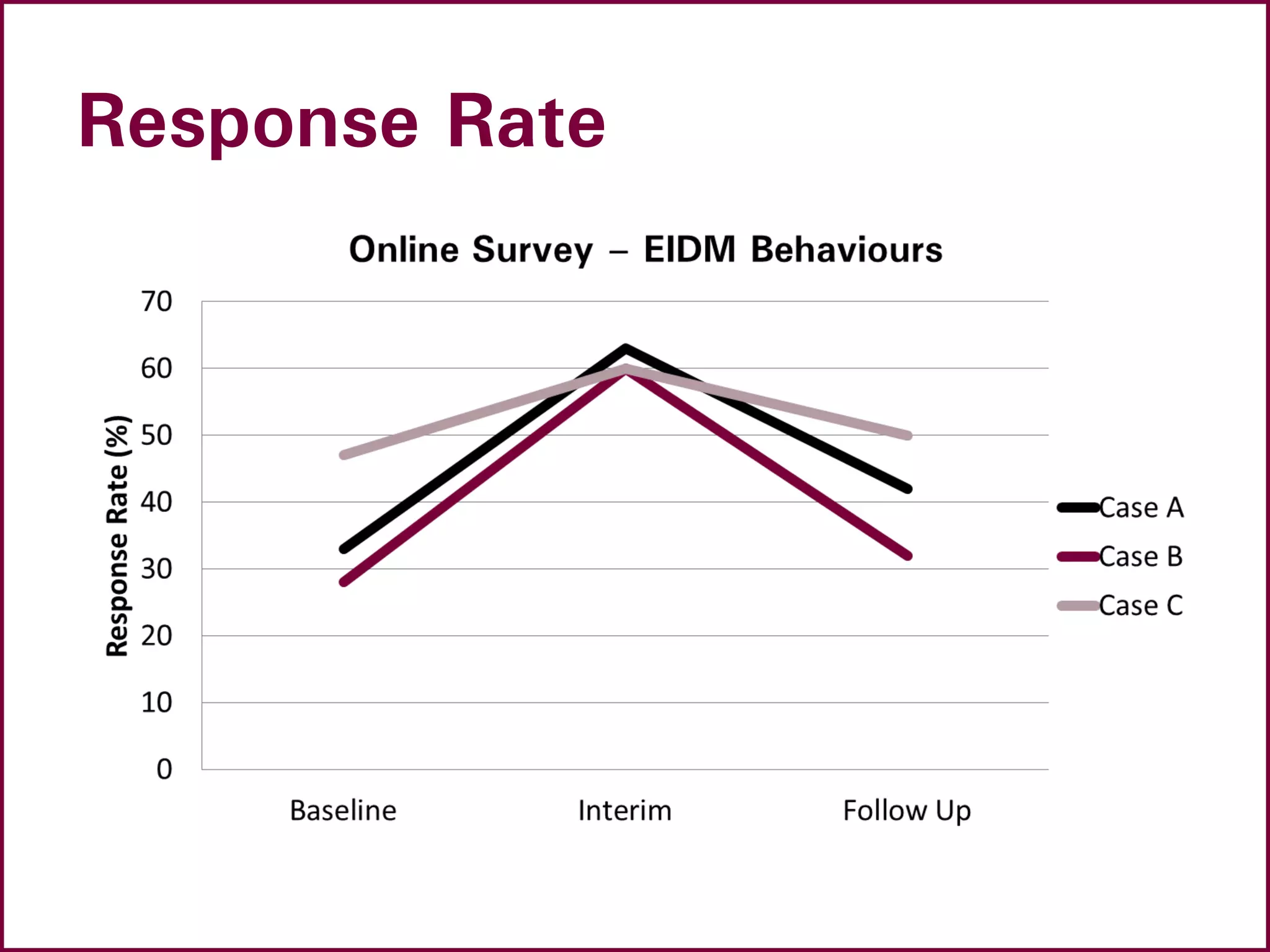
Response Rate
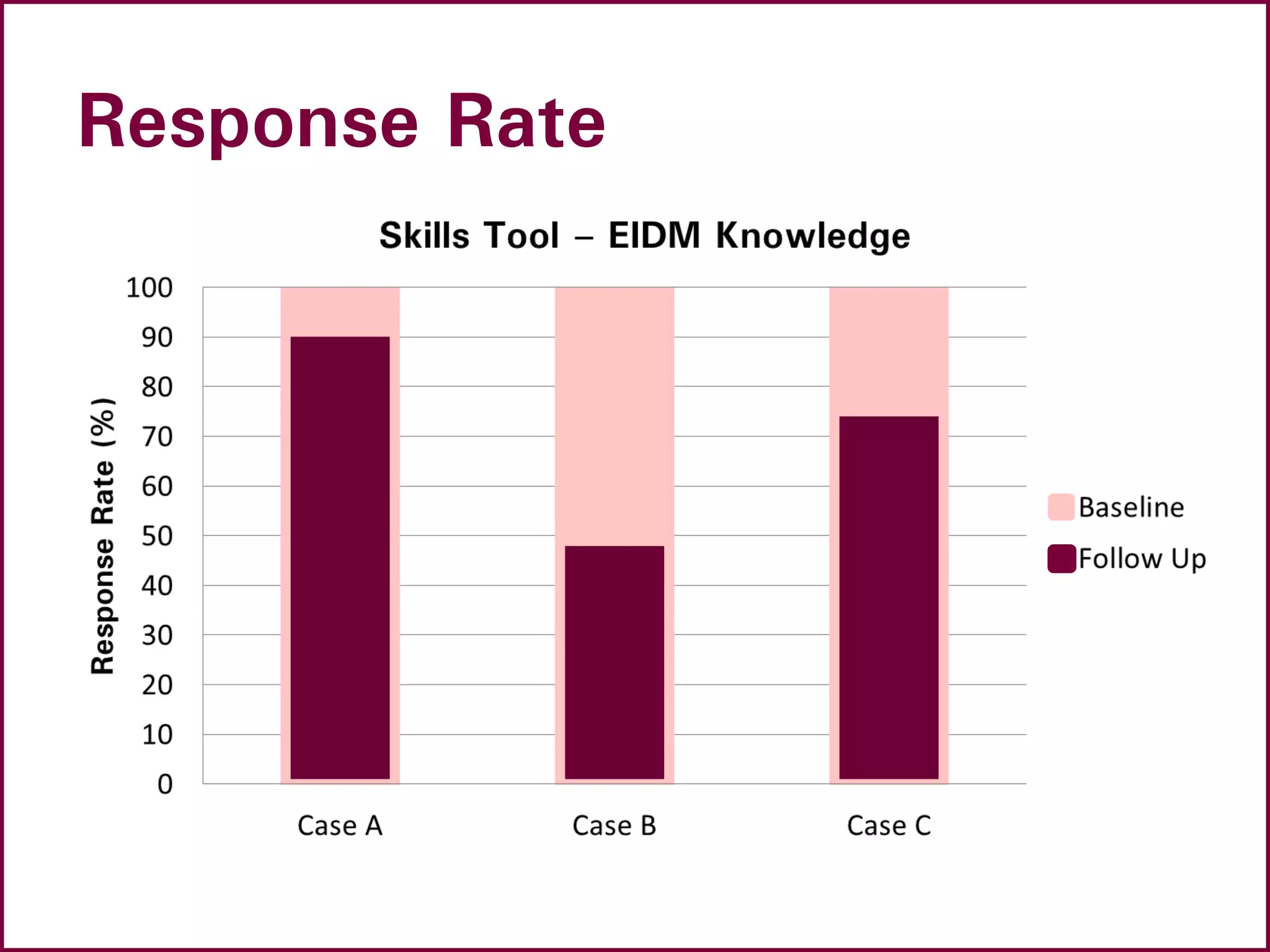
Response Rate
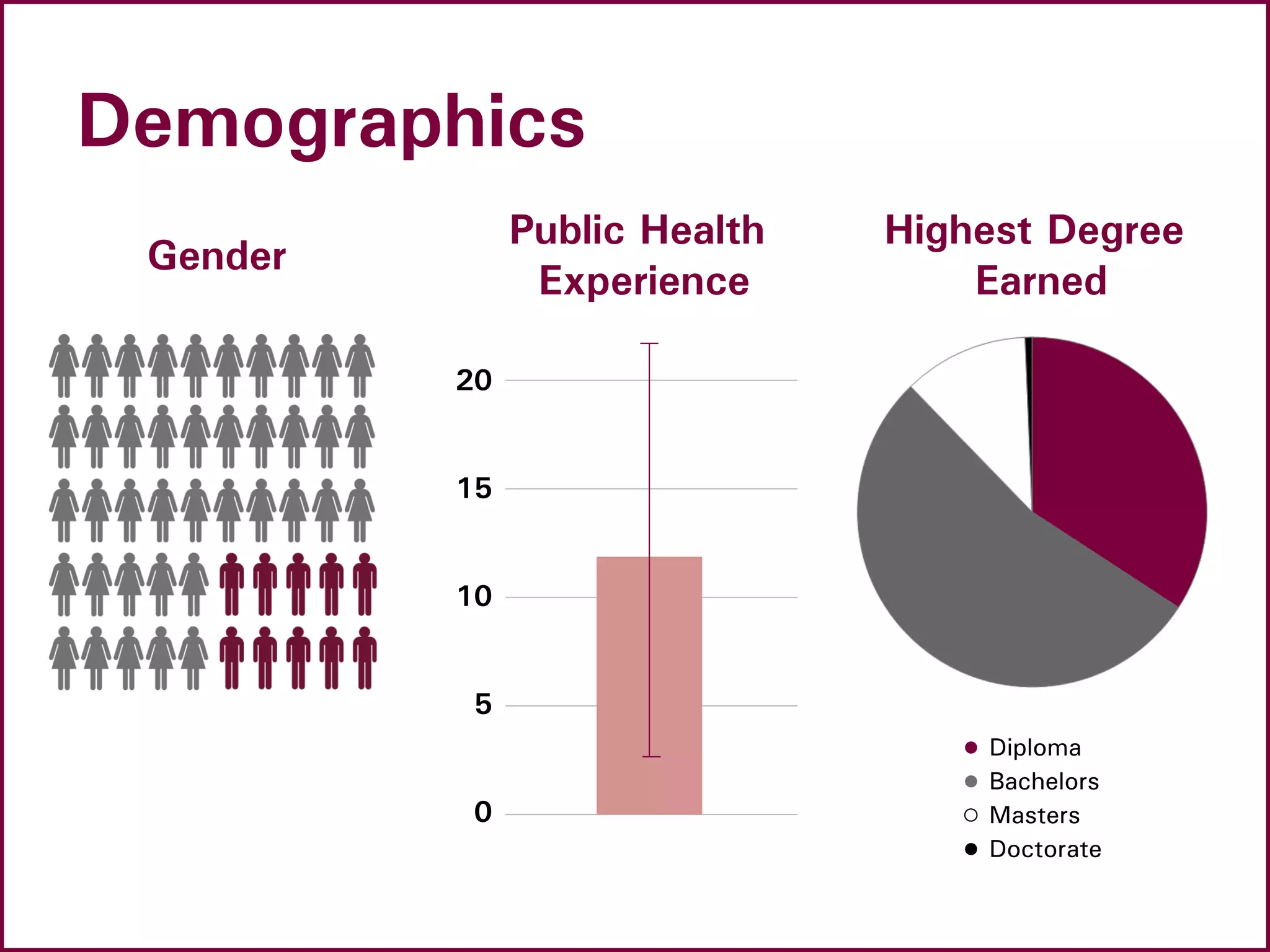
Demographics
Gender
Public Health
Experience
Highest Degree
Earned
● Diploma
● Bachelors
Masters
● Doctorate
20
15
10
5
0
We asked…
What is the impact of a
tailored KTE strategy on knowledge,
capacity & behaviour for EIDM?
What contextual factors facilitate
and/or impede impact?
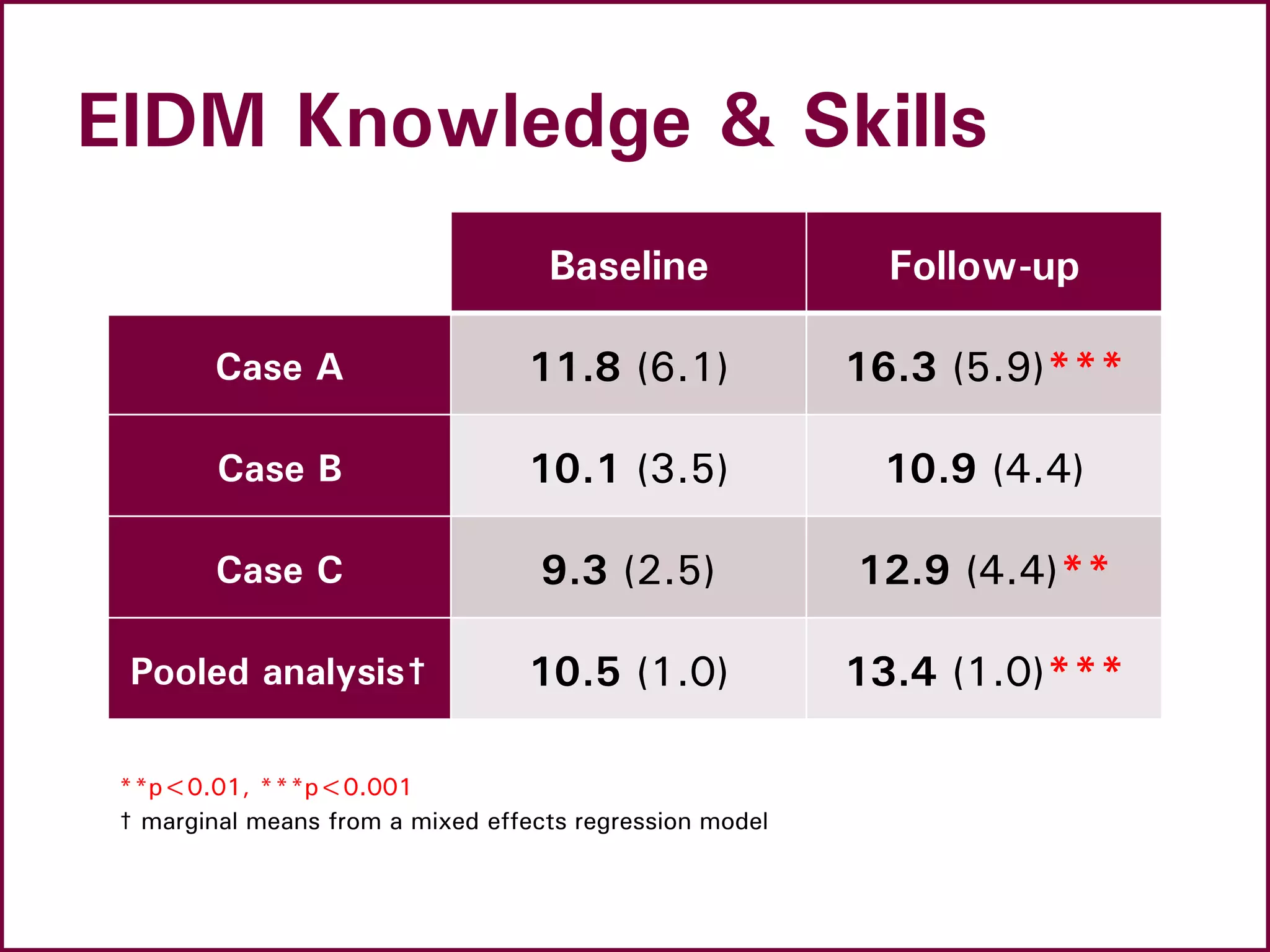
EIDM Knowledge & Skills
Baseline Follow-up
Case A 11.8 (6.1) 16.3 (5.9)***
Case B 10.1 (3.5) 10.9 (4.4)
Case C 9.3 (2.5) 12.9 (4.4)**
Pooled analysis† 10.5 (1.0) 13.4 (1.0)***
**p<0.01, ***p<0.001
† marginal means from a mixed effects regression model
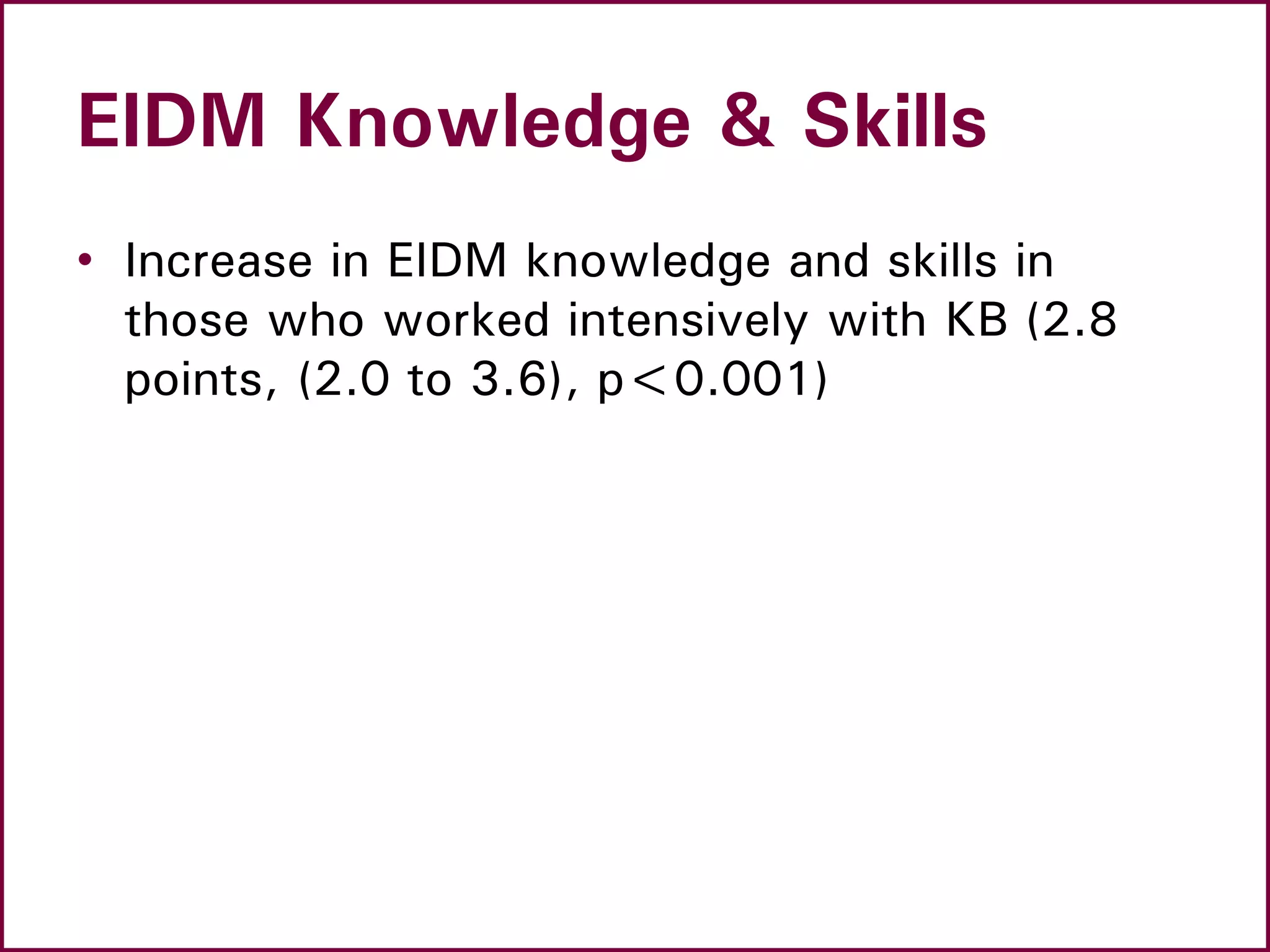
EIDM Knowledge & Skills
• Increase in EIDM knowledge and skills in
those who worked intensively with KB (2.8
points, (2.0 to 3.6), p<0.001)
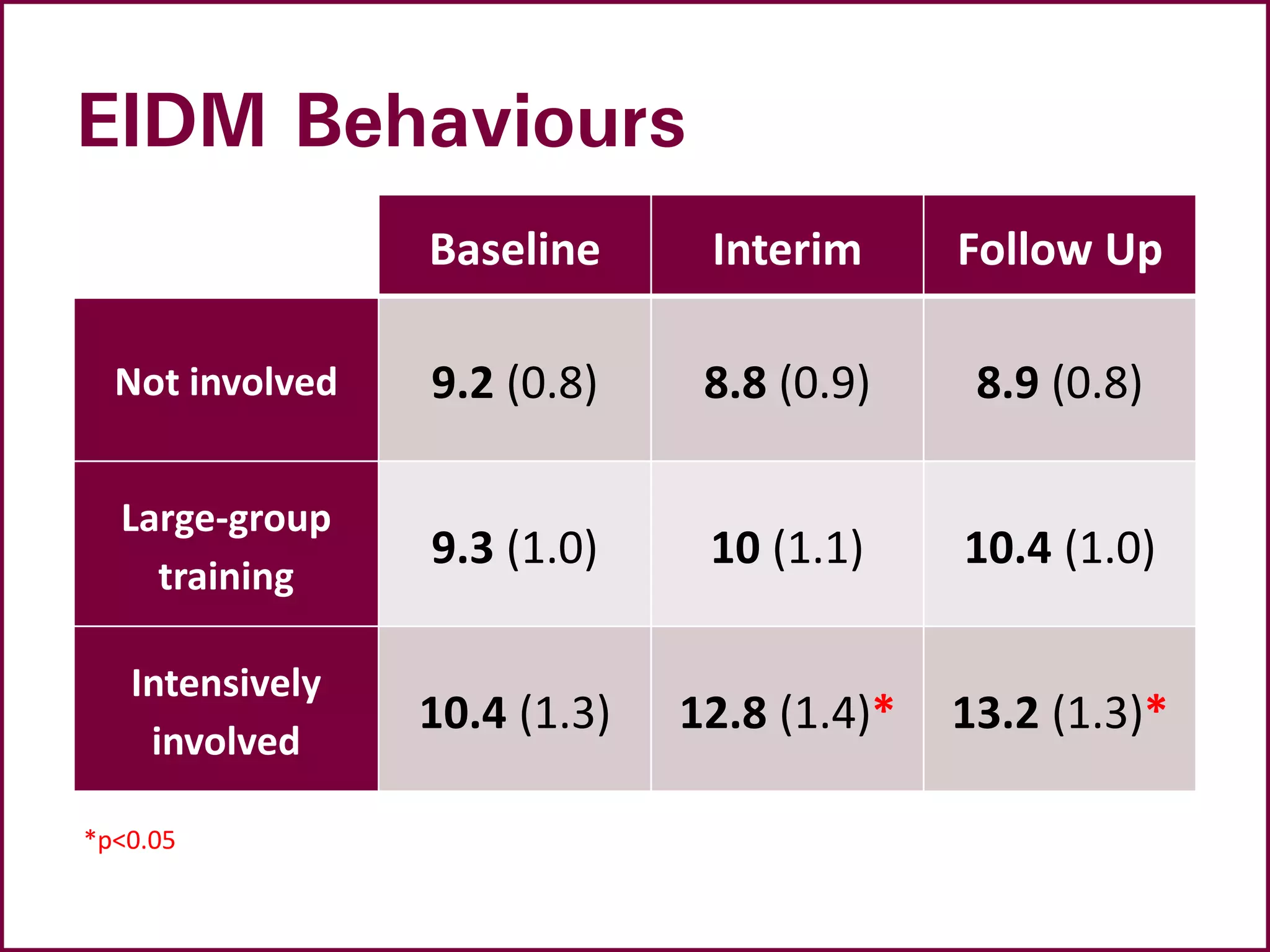
EIDM Behaviours
Baseline Interim Follow Up
Not involved 9.2 (0.8) 8.8 (0.9) 8.9 (0.8)
Large-group
training
9.3 (1.0) 10 (1.1) 10.4 (1.0)
Intensively
involved
10.4 (1.3) 12.8 (1.4)* 13.2 (1.3)*
*p<0.05
EIDM Behaviours
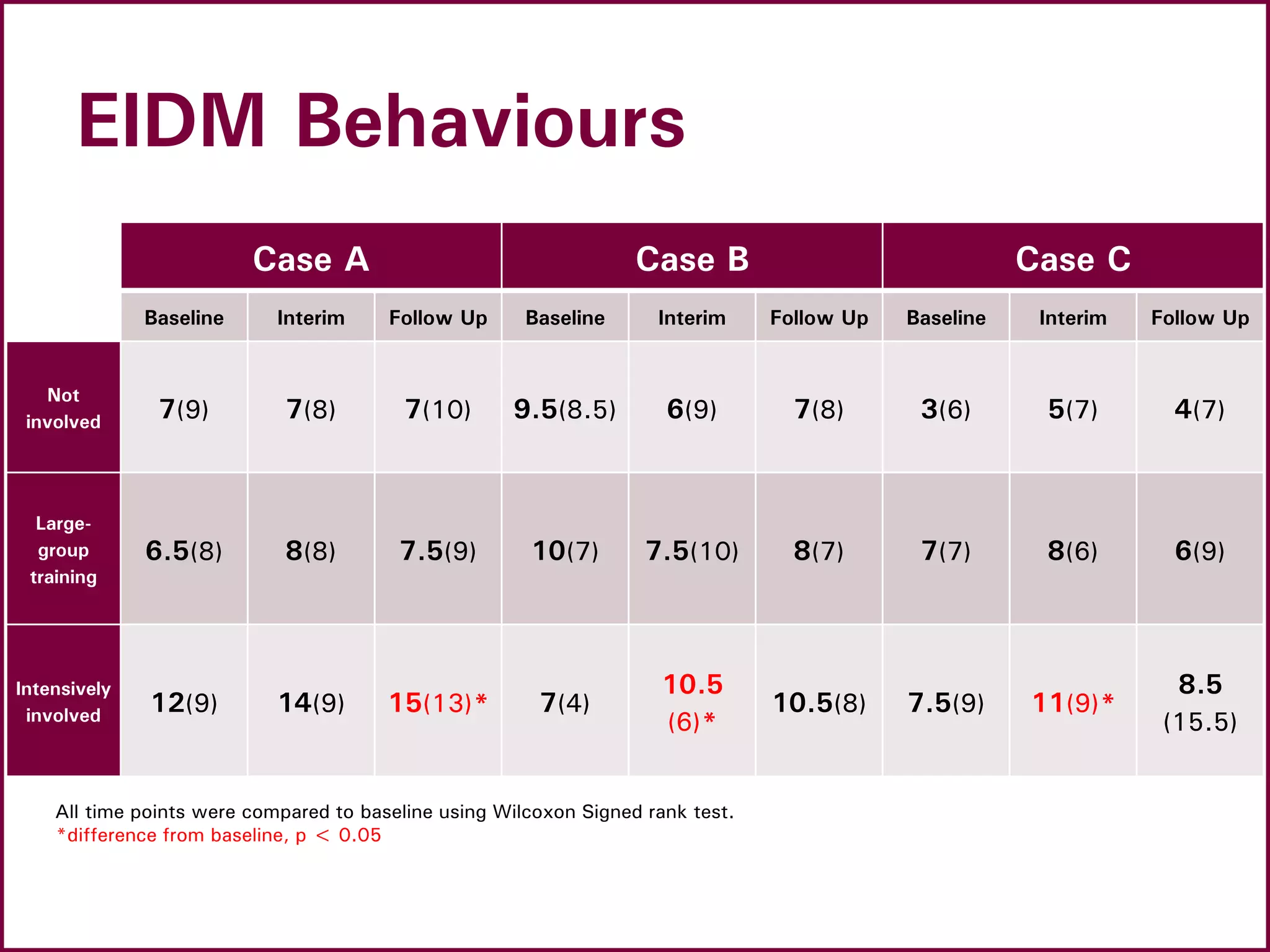
Case A Case B Case C
Baseline Interim Follow Up Baseline Interim Follow Up Baseline Interim Follow Up
Not
involved
7(9) 7(8) 7(10) 9.5(8.5) 6(9) 7(8) 3(6) 5(7) 4(7)
Large-
group
training
6.5(8) 8(8) 7.5(9) 10(7) 7.5(10) 8(7) 7(7) 8(6) 6(9)
Intensively
involved
12(9) 14(9) 15(13)* 7(4)
10.5
(6)*
10.5(8) 7.5(9) 11(9)*
8.5
(15.5)
All time points were compared to baseline using Wilcoxon Signed rank test.
*difference from baseline, p < 0.05
EIDM Behaviours
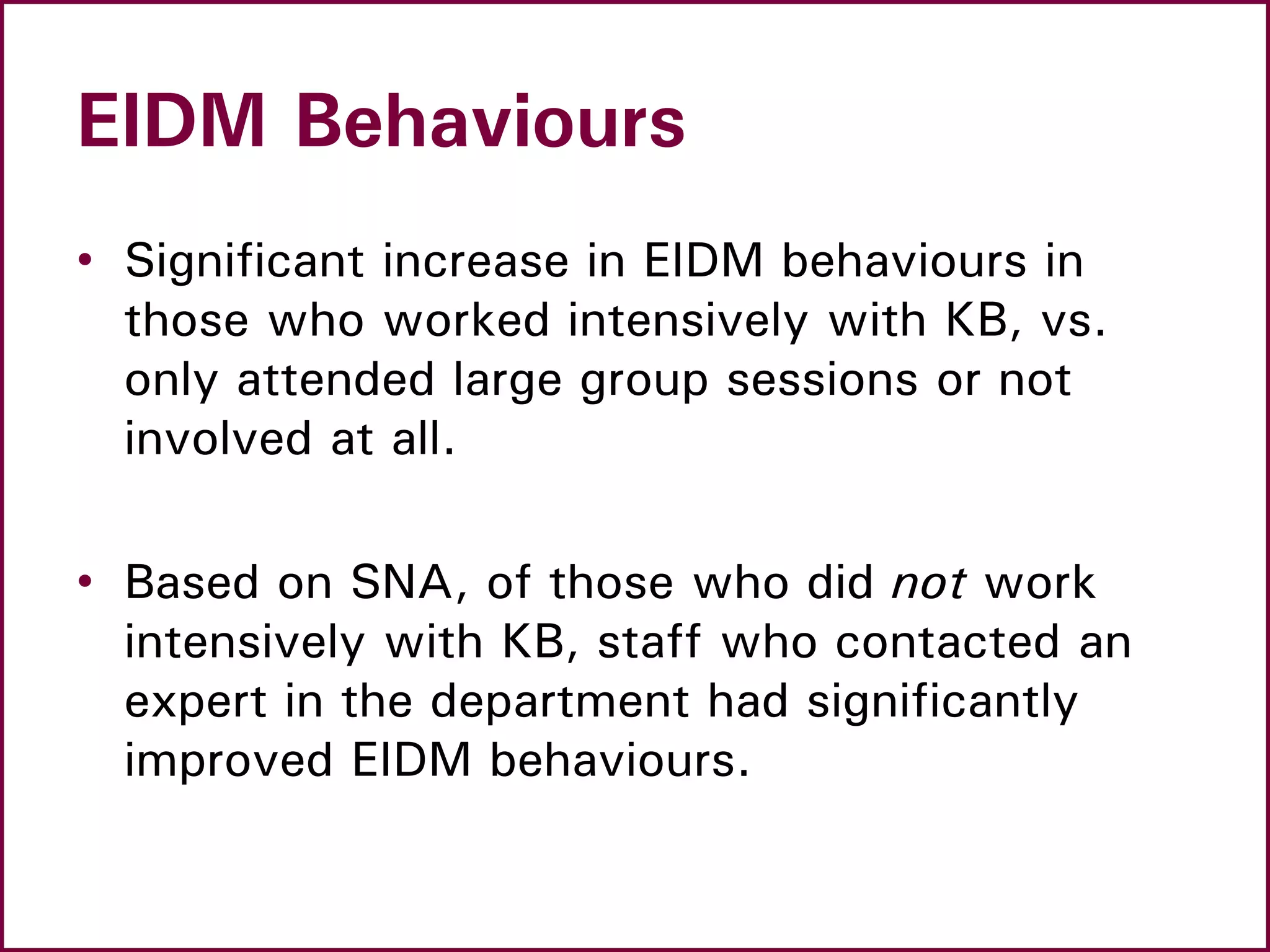
• Significant increase in EIDM behaviours in
those who worked intensively with KB, vs.
only attended large group sessions or not
involved at all.
• Based on SNA, of those who did not work
intensively with KB, staff who contacted an
expert in the department had significantly
improved EIDM behaviours.
EIDM Behaviours
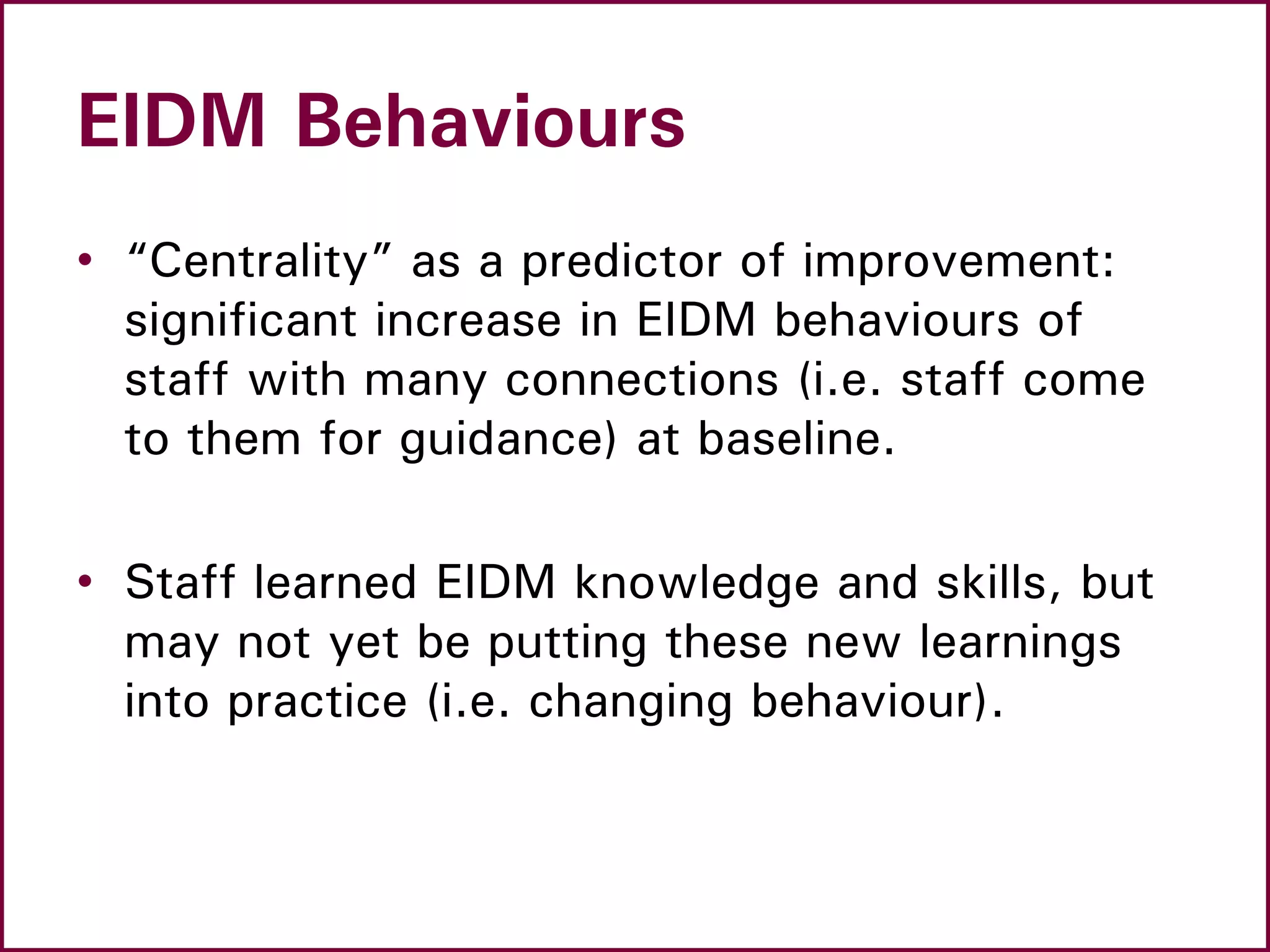
• “Centrality” as a predictor of improvement:
significant increase in EIDM behaviours of
staff with many connections (i.e. staff come
to them for guidance) at baseline.
• Staff learned EIDM knowledge and skills, but
may not yet be putting these new learnings
into practice (i.e. changing behaviour).
We asked…
What is the impact of a
tailored KT strategy on knowledge,
capacity & behaviour for EIDM?
What contextual factors facilitate
and/or impede impact?
Qualitative Analysis
• Data collected:
– 37 interviews
– 170+ KB reflective journal entries
– Case study notes
• Analyzed using NVivo9; coding
framework developed, constant
comparative process
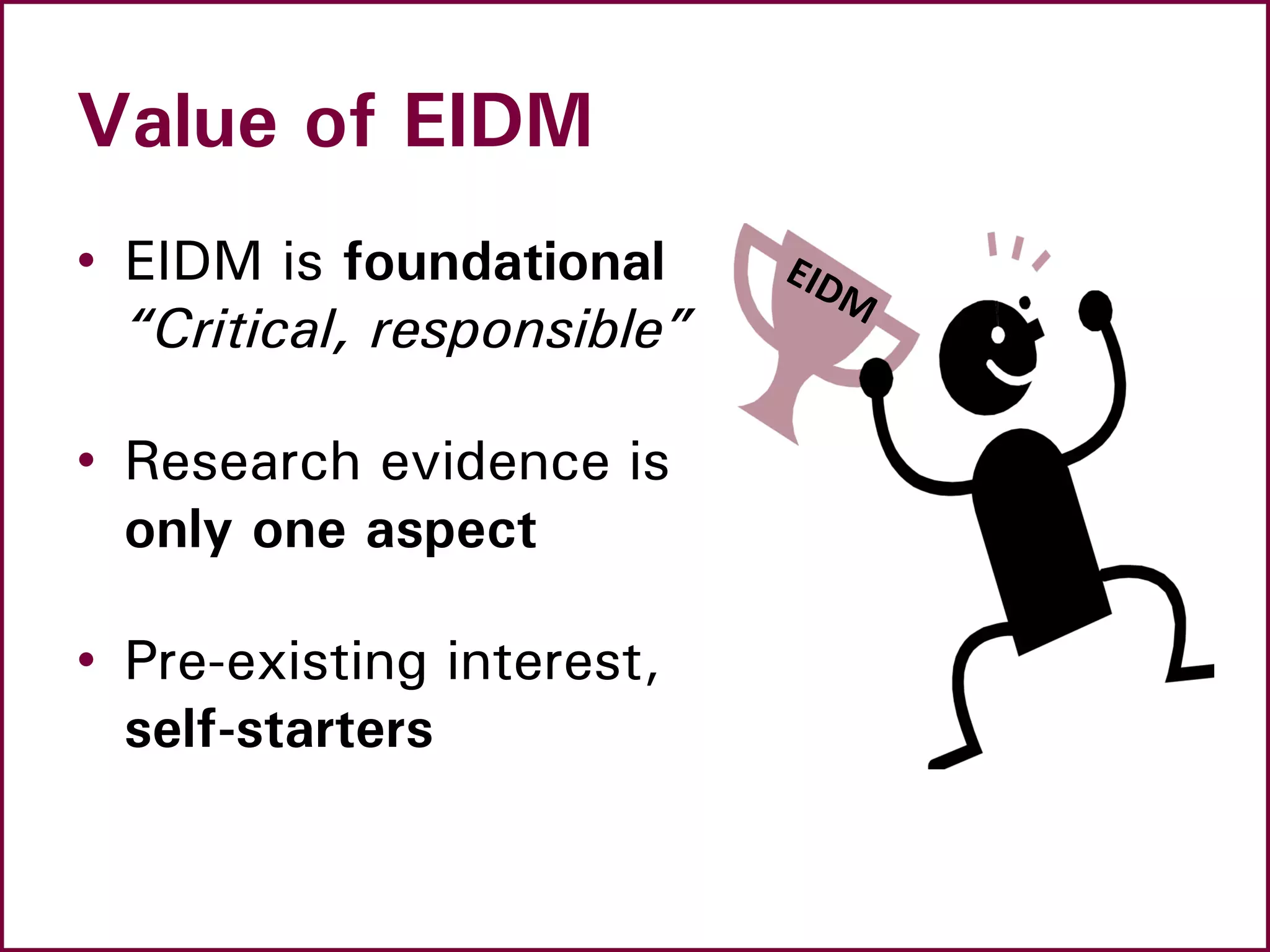
Value of EIDM
• EIDM is foundational
“Critical, responsible”
• Research evidence is
only one aspect
• Pre-existing interest,
self-starters
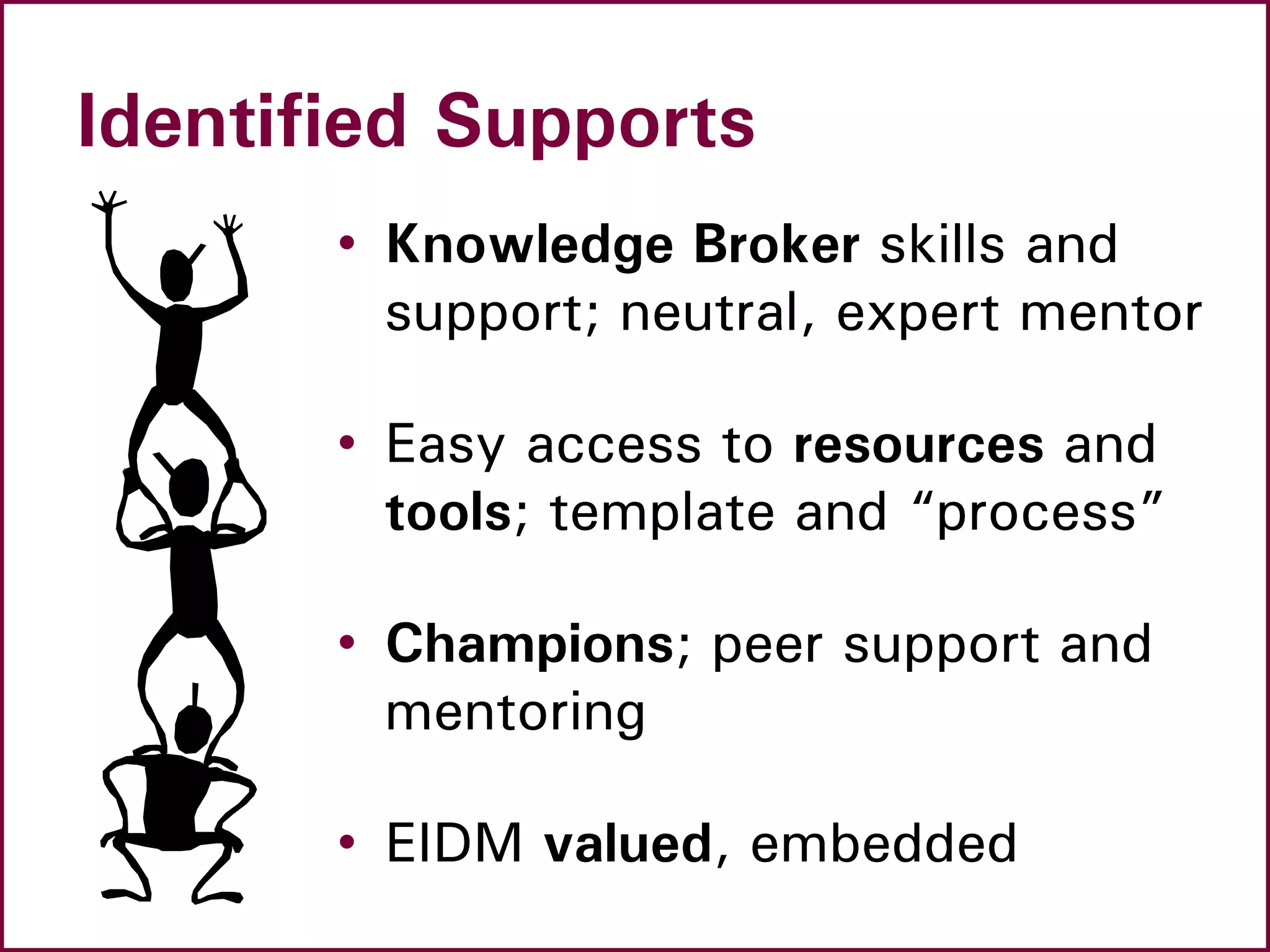
Identified Supports
• Knowledge Broker skills and
support; neutral, expert mentor
• Easy access to resources and
tools; template and “process”
• Champions; peer support and
mentoring
• EIDM valued, embedded
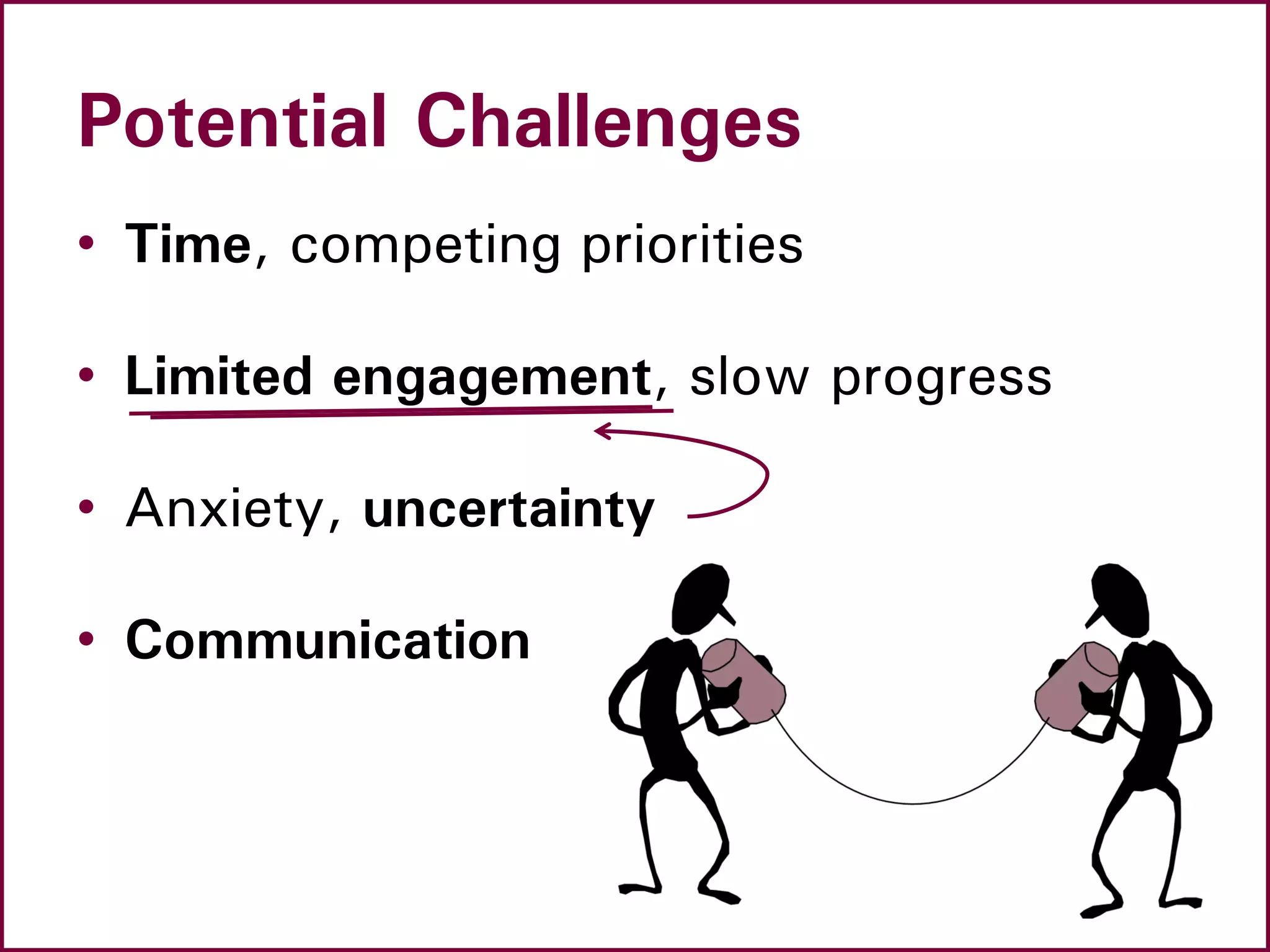
Potential Challenges
• Time, competing priorities
• Limited engagement, slow progress
• Anxiety, uncertainty
• Communication
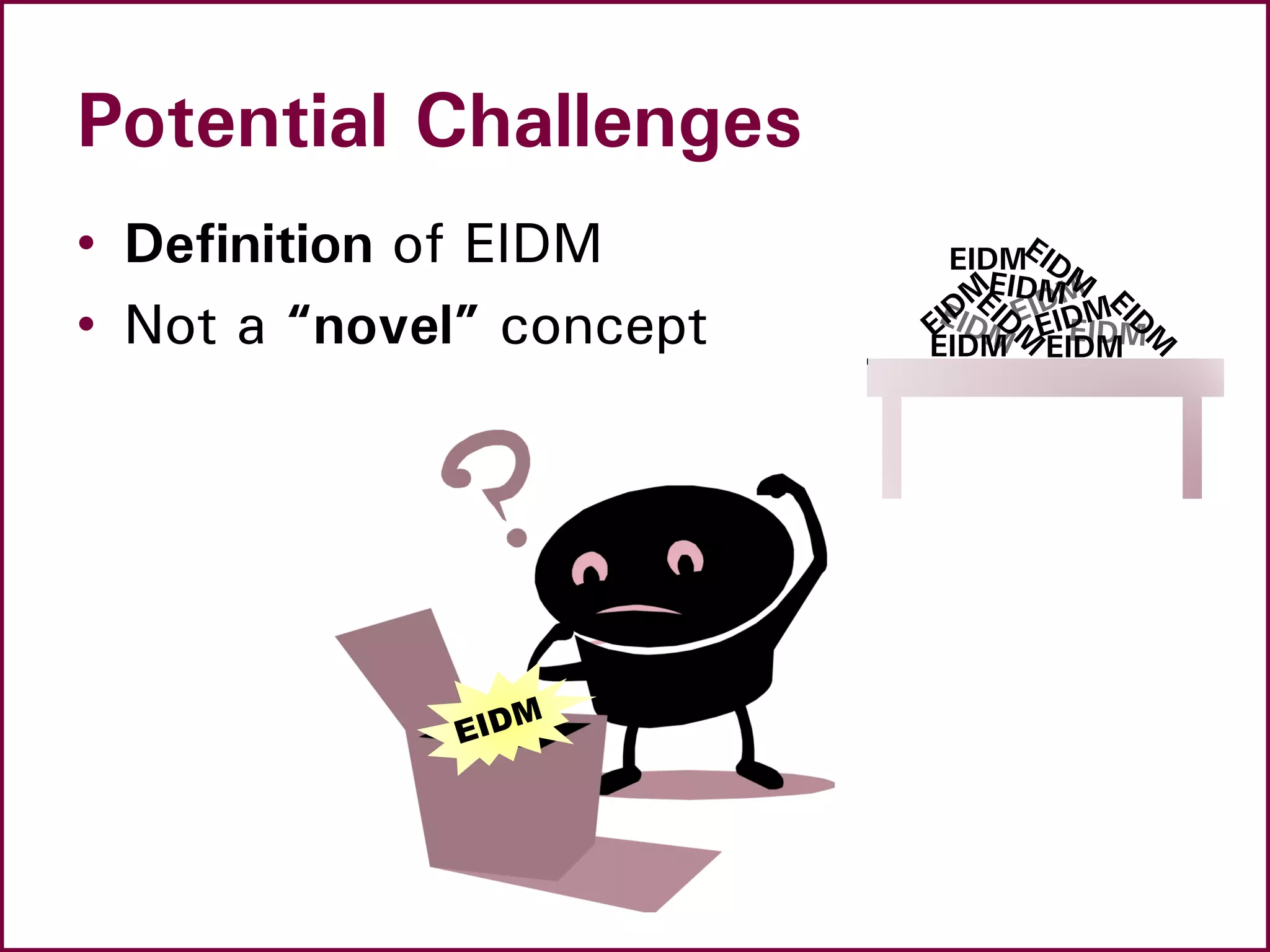
Potential Challenges
EIDM
EIDM
EIDM
• Definition of EIDM
• Not a “novel” concept
Overall Conclusions
• Public health practitioners who worked
most closely with KBs demonstrated
improvement in EIDM-related
behaviours, knowledge, skills.
• Those not intensively involved did not
change, with the exception of those
who interacted with someone identified
as an expert. Centrality in networks may
predict improvement.
• An improved understanding of EIDM
was transmitted among individuals and
diffused throughout health department.
• Improvement in EIDM behaviours cannot
be sustained unless organizational
structures are in place; process is
embedded, made routine practice.
• Understanding context is critical to
sustaining EIDM.
Publications
• Traynor R, DeCorby K, Dobbins M. Knowledge brokering in public health: A
tale of two studies. Public Health 2014, doi: 10.1016/j.puhe.2014.01.015.
• Yousefi Nooraie R, Dobbins M, Marin A. Social and organizational factors
affecting implementation of evidence-informed practice in a public health
department in Ontario: a network modelling approach. Implementation
Science 2014, 9(1):29.
• Traynor R, Dobbins M, DeCorby K. Challenges of partnership research:
Insights from a collaborative partnership in evidence-informed public health
decision making. Evidence & Policy (accepted June 2014).
• Yost J, Dobbins M, Traynor R, DeCorby K, Workentine S, Greco L. Tools to
support evidence-informed public health decision making. BMC Public Health
(resubmitted June 2014).
• Greco L, DeCorby K, Traynor R, Dobbins M, Yost J, Workentine S.
Implementing tailored, knowledge translation and exchange interventions in
public health: a Partnerships for Health System Improvement study.
Canadian Journal of Public Health (submitted January 2014).
Thank you!
Contact us:
info@healthevidence.org

Building capacity for evidence-informed public health decision making

  • 1.
    Welcome! Building capacity for evidence-informedpublic health decision making You will be placed on hold until the webinar begins. The webinar will begin shortly, please remain on the line.
  • 2.
    Housekeeping • Use Q&Ato post comments/questions during the webinar – ‘Send’ questions to All (not privately to ‘Host’) • Connection issues – Recommend using a wired Internet connection (vs. wireless), to help prevent connection challenges • WebEx 24/7 help line: 1-866-229- 3239 Q&A Participant Side Panel in WebEx
  • 3.
    Building capacity for evidence-informedpublic health decision making Partnerships for health system improvement
  • 4.
    The Health EvidenceTeam Maureen Dobbins Scientific Director Heather Husson Manager Lori Greco Knowledge Broker Robyn Traynor Research Coordinator Research Assistants Stephanie Workentine Arnav Agarwal Linda Chan Tiffany Oei Students Reza Yousefi Nooraie (PhD candidate) Yaso Gowrinathan Research Assistant/ Coordinator Jennifer Yost Assistant Professor
  • 5.
  • 7.
    A Model forEvidence-Informed Decision Making National Collaborating Centre for Methods and Tools. (revised 2012). A Model for Evidence-Informed Decision-Making in Public Health (Fact Sheet). [http://www.nccmt.ca/pubs/FactSheet_EIDM_EN_WEB.pdf]
  • 8.
    Stages in theprocess of Evidence-Informed Public Health National Collaborating Centre for Methods and Tools. Evidence- Informed Public Health. [http://www.nccmt.ca/eiph/index-eng.html]
  • 9.
    Funding for today’swebinar Partnerships for Health System Improvement (FRN 101867) Dissemination Event (FRN 126353)
  • 10.
    PHSI Study • CIHR‘Partnerships for Health System Improvement’ grant – Integrated KT program – Collaborative, applied research – Researcher/knowledge user partnerships • Case study design – Three Ontario health departments (“cases”) – Tailored KTE intervention, delivered by KBs
  • 11.
    We asked… What isthe impact of a tailored KTE strategy on knowledge, capacity & behaviour for EIDM? What contextual factors facilitate and/or impede impact?
  • 12.
    Case A Large, diverse MOH/AMOHvision EIDM strategic priority Resources committed Case B Large, urban centre MOH commitment Manager ‘champion’ EIDM strategic priority Case C Mid-size, urban/rural mix MOH commitment Exec commitment
  • 13.
  • 14.
    Tailored Interventions Case ACase B Case C ContextIntervention • Large, diverse • MOH/AMOH vision • EIDM strategic priority • Resources committed • Sept 2010 – Jun 2012 • KB on site, 2 d/wk  Mentored staff teams  Provided training  Participated in EIDM- related events  One-on-one consulting • Large, urban centre • MOH commitment • Manager ‘champion’ • EIDM strategic priority • Apr 2011 – Feb 2013 • KB on/off-site: 2 d/wk  Mentored staff teams  Provided training  Meetings / presentations  Advised Senior Management Team • Mid-size, urban / rural mix • MOH commitment • Exec commitment • Apr 2011 – Dec 2012 • KB off-site*: 2 d/wk (on-site 2 d/mon)  Mentored staff teams  Advised RKEC on Policy & Procedure  Provided training  Meetings / presentations
  • 15.
    Total Activities Case ACase B Case C • 5 questions/reviews • Additional divisional training delivered (e.g. half-day workshops) • Presentations to Senior Management • Abstracts submitted to present research • 18 Rapid Reviews • Large-scale training sessions provided • KB facilitated / contributed to Critical Appraisal Club • Presentations of research to staff colleagues & Senior Management • 5 questions/reviews • EIDM Policy & Procedure developed & approved • RKEC presentations • All-staff training delivered
  • 16.
    Data CollectionBaselineInterimFollow-Up  OnlineSurvey*  EIDM Skills Tool *Demographics, EBP Scale, SNA Online Survey*  Online Survey*  EIDM Skills Tool CHSRF Self- Assessment Interviews Interviews  KB Journal  Meeting Minutes  Communications  Document Collection
  • 17.
  • 18.
  • 19.
    Demographics Gender Public Health Experience Highest Degree Earned ●Diploma ● Bachelors Masters ● Doctorate 20 15 10 5 0
  • 20.
    We asked… What isthe impact of a tailored KTE strategy on knowledge, capacity & behaviour for EIDM? What contextual factors facilitate and/or impede impact?
  • 21.
    EIDM Knowledge &Skills Baseline Follow-up Case A 11.8 (6.1) 16.3 (5.9)*** Case B 10.1 (3.5) 10.9 (4.4) Case C 9.3 (2.5) 12.9 (4.4)** Pooled analysis† 10.5 (1.0) 13.4 (1.0)*** **p<0.01, ***p<0.001 † marginal means from a mixed effects regression model
  • 22.
    EIDM Knowledge &Skills • Increase in EIDM knowledge and skills in those who worked intensively with KB (2.8 points, (2.0 to 3.6), p<0.001)
  • 23.
    EIDM Behaviours Baseline InterimFollow Up Not involved 9.2 (0.8) 8.8 (0.9) 8.9 (0.8) Large-group training 9.3 (1.0) 10 (1.1) 10.4 (1.0) Intensively involved 10.4 (1.3) 12.8 (1.4)* 13.2 (1.3)* *p<0.05
  • 24.
    EIDM Behaviours Case ACase B Case C Baseline Interim Follow Up Baseline Interim Follow Up Baseline Interim Follow Up Not involved 7(9) 7(8) 7(10) 9.5(8.5) 6(9) 7(8) 3(6) 5(7) 4(7) Large- group training 6.5(8) 8(8) 7.5(9) 10(7) 7.5(10) 8(7) 7(7) 8(6) 6(9) Intensively involved 12(9) 14(9) 15(13)* 7(4) 10.5 (6)* 10.5(8) 7.5(9) 11(9)* 8.5 (15.5) All time points were compared to baseline using Wilcoxon Signed rank test. *difference from baseline, p < 0.05
  • 25.
    EIDM Behaviours • Significantincrease in EIDM behaviours in those who worked intensively with KB, vs. only attended large group sessions or not involved at all. • Based on SNA, of those who did not work intensively with KB, staff who contacted an expert in the department had significantly improved EIDM behaviours.
  • 26.
    EIDM Behaviours • “Centrality”as a predictor of improvement: significant increase in EIDM behaviours of staff with many connections (i.e. staff come to them for guidance) at baseline. • Staff learned EIDM knowledge and skills, but may not yet be putting these new learnings into practice (i.e. changing behaviour).
  • 27.
    We asked… What isthe impact of a tailored KT strategy on knowledge, capacity & behaviour for EIDM? What contextual factors facilitate and/or impede impact?
  • 28.
    Qualitative Analysis • Datacollected: – 37 interviews – 170+ KB reflective journal entries – Case study notes • Analyzed using NVivo9; coding framework developed, constant comparative process
  • 29.
    Value of EIDM •EIDM is foundational “Critical, responsible” • Research evidence is only one aspect • Pre-existing interest, self-starters
  • 30.
    Identified Supports • KnowledgeBroker skills and support; neutral, expert mentor • Easy access to resources and tools; template and “process” • Champions; peer support and mentoring • EIDM valued, embedded
  • 31.
    Potential Challenges • Time,competing priorities • Limited engagement, slow progress • Anxiety, uncertainty • Communication
  • 32.
    Potential Challenges EIDM EIDM EIDM • Definitionof EIDM • Not a “novel” concept
  • 33.
  • 34.
    • Public healthpractitioners who worked most closely with KBs demonstrated improvement in EIDM-related behaviours, knowledge, skills. • Those not intensively involved did not change, with the exception of those who interacted with someone identified as an expert. Centrality in networks may predict improvement.
  • 35.
    • An improvedunderstanding of EIDM was transmitted among individuals and diffused throughout health department. • Improvement in EIDM behaviours cannot be sustained unless organizational structures are in place; process is embedded, made routine practice. • Understanding context is critical to sustaining EIDM.
  • 36.
    Publications • Traynor R,DeCorby K, Dobbins M. Knowledge brokering in public health: A tale of two studies. Public Health 2014, doi: 10.1016/j.puhe.2014.01.015. • Yousefi Nooraie R, Dobbins M, Marin A. Social and organizational factors affecting implementation of evidence-informed practice in a public health department in Ontario: a network modelling approach. Implementation Science 2014, 9(1):29. • Traynor R, Dobbins M, DeCorby K. Challenges of partnership research: Insights from a collaborative partnership in evidence-informed public health decision making. Evidence & Policy (accepted June 2014). • Yost J, Dobbins M, Traynor R, DeCorby K, Workentine S, Greco L. Tools to support evidence-informed public health decision making. BMC Public Health (resubmitted June 2014). • Greco L, DeCorby K, Traynor R, Dobbins M, Yost J, Workentine S. Implementing tailored, knowledge translation and exchange interventions in public health: a Partnerships for Health System Improvement study. Canadian Journal of Public Health (submitted January 2014).
  • 38.