EMAIL YOUR QUESTIONS TO
                      www.projectinform.org/questions
 JANUARY 2010


Building a cooperative
patient/doctor relationship
A positive HIV antibody test or an AIDS diagnosis changes many aspects of a per-
son’s life, including the kind of relationship they have with their doctor. Many peo-
ple develop a more assertive attitude about their health and well-being when they
  nd out they have HIV. Because HIV disease and its treatment is complicated, mak-
ing decisions about when, how and whether to start therapy isn’t always easy.                    CHOOSE A
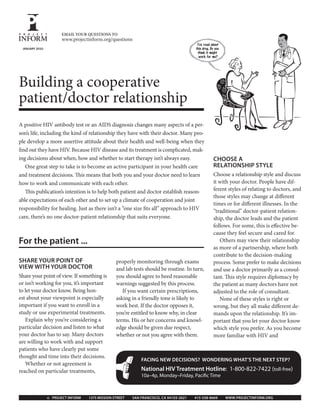
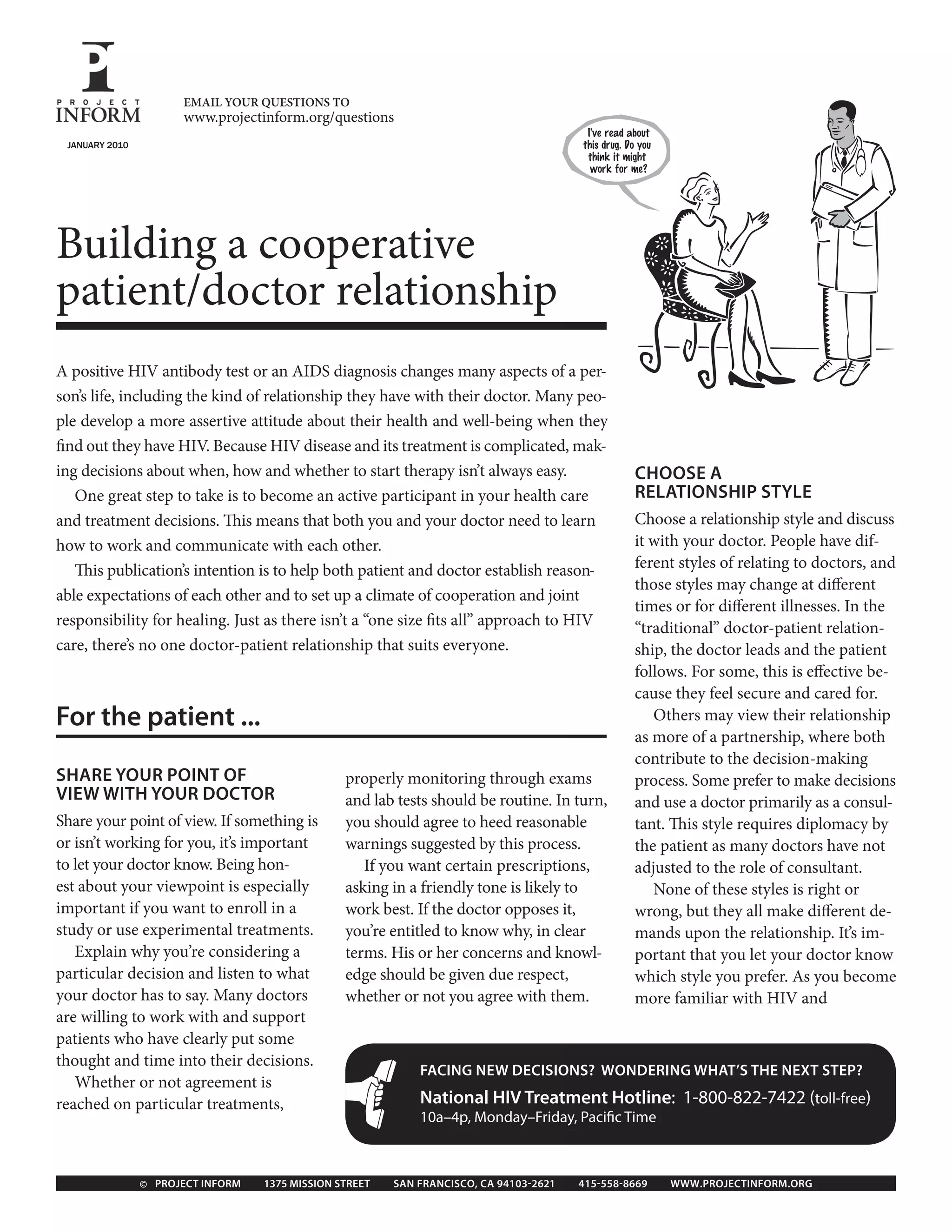
   One great step to take is to become an active participant in your health care                 RELATIONSHIP STYLE
and treatment decisions. is means that both you and your doctor need to learn                    Choose a relationship style and discuss
how to work and communicate with each other.                                                     it with your doctor. People have dif-
       is publication’s intention is to help both patient and doctor establish reason-           ferent styles of relating to doctors, and
                                                                                                 those styles may change at di erent
able expectations of each other and to set up a climate of cooperation and joint
                                                                                                 times or for di erent illnesses. In the
responsibility for healing. Just as there isn’t a “one size ts all” approach to HIV              “traditional” doctor-patient relation-
care, there’s no one doctor-patient relationship that suits everyone.                            ship, the doctor leads and the patient
                                                                                                 follows. For some, this is e ective be-
                                                                                                 cause they feel secure and cared for.
For the patient ...                                                                                 Others may view their relationship
                                                                                                 as more of a partnership, where both
                                                                                                 contribute to the decision-making
SHARE YOUR POINT OF                              properly monitoring through exams               process. Some prefer to make decisions
VIEW WITH YOUR DOCTOR                            and lab tests should be routine. In turn,       and use a doctor primarily as a consul-
Share your point of view. If something is        you should agree to heed reasonable             tant. is style requires diplomacy by
or isn’t working for you, it’s important         warnings suggested by this process.             the patient as many doctors have not
to let your doctor know. Being hon-                 If you want certain prescriptions,           adjusted to the role of consultant.
est about your viewpoint is especially           asking in a friendly tone is likely to             None of these styles is right or
important if you want to enroll in a             work best. If the doctor opposes it,            wrong, but they all make di erent de-
study or use experimental treatments.            you’re entitled to know why, in clear           mands upon the relationship. It’s im-
   Explain why you’re considering a              terms. His or her concerns and knowl-           portant that you let your doctor know
particular decision and listen to what           edge should be given due respect,               which style you prefer. As you become
your doctor has to say. Many doctors             whether or not you agree with them.             more familiar with HIV and
are willing to work with and support
patients who have clearly put some
thought and time into their decisions.
                                                             FACING NEW DECISIONS? WONDERING WHAT’S THE NEXT STEP?
   Whether or not agreement is
reached on particular treatments,                            National HIV Treatment Hotline: 1-800-822-7422 (toll-free)
                                                             10a–4p, Monday–Friday, Paci c Time


                © PROJECT INFORM   1375 MISSION STREET   SAN FRANCISCO, CA 94103 2621   415 558 8669   WWW.PROJECTINFORM.ORG
EMAIL YOUR QUESTIONS TO
2                                                                                       www.projectinform.org/questions
                                                                                                                                    JANUARY 2010


Building a cooperative patient/doctor relationship


For the patient, continued ...

experience di erent health challenges, the doctor-patient
relationship style that works best for you may change.


LEARN THE INFORMATION
Knowledge makes a world of di erence. Generally, the
more you know before a medical appointment, the more
you can bene t from each visit. Obtaining information on
your own doesn’t need to be di cult or over-whelming. In
fact, the education process can begin right at home.
   Many websites, hotlines and community organizations
are dedicated to answering questions about HIV. Realize
that you can’t learn everything at once, so concentrate on
the information that’s most important to your health right
now. While self-learning is great, it should not substitute
using your doctor as a source of information.


PREPARE FOR APPOINTMENTS
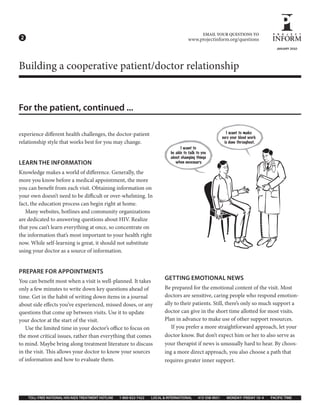
You can bene t most when a visit is well-planned. It takes                  GETTING EMOTIONAL NEWS
only a few minutes to write down key questions ahead of                    Be prepared for the emotional content of the visit. Most
time. Get in the habit of writing down items in a journal                  doctors are sensitive, caring people who respond emotion-
about side e ects you’ve experienced, missed doses, or any                 ally to their patients. Still, there’s only so much support a
questions that come up between visits. Use it to update                    doctor can give in the short time allotted for most visits.
your doctor at the start of the visit.                                     Plan in advance to make use of other support resources.
   Use the limited time in your doctor’s o ce to focus on                     If you prefer a more straightforward approach, let your
the most critical issues, rather than everything that comes                doctor know. But don’t expect him or her to also serve as
to mind. Maybe bring along treatment literature to discuss                 your therapist if news is unusually hard to hear. By choos-
in the visit. is allows your doctor to know your sources                   ing a more direct approach, you also choose a path that
of information and how to evaluate them.                                   requires greater inner support.


    TOLL FREE NATIONAL HIV/AIDS TREATMENT HOTLINE   1 800 822 7422   LOCAL & INTERNATIONAL   415 558 9051   MONDAY FRIDAY 10 4   PACIFIC TIME
EMAIL YOUR QUESTIONS TO
                      www.projectinform.org/questions                                                                              3
 JANUARY 2010


                               Building a cooperative patient/doctor relationship


For the doctor ...

SUPPORT YOUR PATIENT’S                                                   many sides of medical issues that confront patients, and
INTERESTS IN THEIR HEALTH CARE                                           do not feel insulted if your patient chooses something you
Support your patient’s interest in monitoring and treat-                 don’t recommend.
ment. While not every treatment is appropriate, every                      Today, many people take a strong role in the decision-
patient’s opinions and health are. e more uncertainties                  making process. Of course, that empowerment doesn’t
a given treatment raises, the more important it is that you              automatically make your patient right. Doctors should help
monitor its use. Patients may be willing to follow your rec-             persuade patients to do what makes sense. Use of well-
ommendations if you’re willing to monitor your patient’s                 phrased questions, reasoning, shared information, respect
other choices simultaneously.                                            and patience on both sides best achieve mutually satisfying
   When someone asks to be monitored in a course of                      choices.
treatment, it doesn’t imply you agree with it—only support
for your patient’s well-being. ere are no legal precedents
                                                                         RESPOND MEDICALLY
in AIDS in which a doctor has been accused of malpractice
for taking blood counts while a patient used a drug against              Patients may use a treatment anyway if they’re determined
his or her recommendation.                                               to and you may not be able to sway them against it. Refus-
                                                                         ing to monitor diminishes your patient’s con dence and
                                                                         may increase the risk of harm.
BE FLEXIBLE WITH YOUR RESPONSES                                             Respond in a medical fashion to the uncertainties of un-
Recognize that the uncertainties of the epidemic demand a                approved treatments or strategies. Perhaps this means more
 exible response. e expectation that patients will passively             frequent visits, other diagnostic tests, or more cautious
follow orders simply doesn’t work with everyone, certainly               reading of lab markers. Added expense may be the price
not when doctors may not have answers for every question.                and the patient must be prepared to heed the outcome of
   HIV has changed forever the way many people relate to                 the monitoring process.
their doctors. e new assertiveness and knowledge won’t
go away. To cope e ectively, doctors must learn how each
                                                                         DON’T PUSH YOUR PATIENT
person wants to be treated, particularly in regards to degree
and form of collaboration in their healing process.                      Don’t push patients to begin treatment before s/he is ready
                                                                         to commit. Starting a regimen is a big step and will change
                                                                         many things in a patient’s life.
DESCRIBE BOTH SIDES OF THE ISSUES                                           For example, taking pills every day is a constant remind-
Doctors have always known that there are two or more                     er of HIV. Disclosure is o en an issue: your patient may be
viewpoints on most issues. Be prepared to describe the                   reluctant to begin therapy that must be taken around their
                                                                         family or at work.


                © PROJECT INFORM   1375 MISSION STREET   SAN FRANCISCO, CA 94103 2621   415 558 8669   WWW.PROJECTINFORM.ORG
EMAIL YOUR QUESTIONS TO
4                                                                                        www.projectinform.org/questions
                                                                                                                                     JANUARY 2010


Building a cooperative patient/doctor relationship


If disagreements occur ...
When disagreements occur, it’s dif-                 ion should be sought from doctors                    A doctor must feel that s/he is prac-
  cult to know what to do. When an                  in leading AIDS hospitals, or doctors             ticing sound medicine, while patients
active disease appears, such as a bout              could call the WARMline at 1-800-                 may feel they cannot compromise on
of PCP, the doctor’s expertise must                 933-3413.                                         treatments they consider essential to
lead the way because its treatment is                  Disagreements about how to treat               their health. Both must strive to listen
better known. Exceptions may occur                  HIV may occur. When patients have                 and understand the other’s views.
in institutions or areas of the country             as much information as the doctor                 Sometimes, it’s possible to nd new
where expertise with HIV is not at a                about some therapies, each may ar-                options that neither party had expect-
state-of-the-art level, or when bureau-             rive at di erent conclusions based on             ed before the discussion began.
cratic procedures may hamper the                    similar data. is presents a challenge
quality of care. en, a second opin-                 for both.


    The patient might ask:                                                                       The doctor might ask:
    “What will it take for you to feel                                                           “What can I do to help you better un-
    comfortable with what I want to do?                                                          derstand the risks and why I’m con-
    More careful monitoring? Reviewing                                                           cerned with what you want to do?” or
    the decision in a month or two? More                                                         “What other options, if any, have you
    review of available data? Discussion                                                         considered?” or “Will you wait while I
    with other doctors? A statement re-                                                          review the matter more carefully?”
    leasing you from liability?”


However, patients can’t expect their                pect patients to “wait and see” inde -            Changing doctors should be reached
doctors to heartily support rem-                    nitely while the research proceeds.               only as a last resort, and only when it’s
edies for which there’s no supporting                  Sometimes doctors and patients                 clear that you both cannot accept the
evidence. Nor can patients realisti-                must question whether it’s possible               other’s part in the relationship. Each
cally expect their doctors to give the              to continue their relationship. It’s              of us must ultimately nd the combi-
same credence to highly experimental                possible to maintain the relationship             nation of patient + doctor + approach
drugs as they would to better proven                while disagreeing and continuing to               that makes a cooperative relationship
therapies. And doctors shouldn’t ex-                communicate over the di erences.                  possible.


    TOLL FREE NATIONAL HIV/AIDS TREATMENT HOTLINE    1 800 822 7422   LOCAL & INTERNATIONAL   415 558 9051   MONDAY FRIDAY 10 4   PACIFIC TIME

Building a Doctor-Patient Relationship (Additional PLUS Reading Materials)

  • 1.
    EMAIL YOUR QUESTIONSTO www.projectinform.org/questions JANUARY 2010 Building a cooperative patient/doctor relationship A positive HIV antibody test or an AIDS diagnosis changes many aspects of a per- son’s life, including the kind of relationship they have with their doctor. Many peo- ple develop a more assertive attitude about their health and well-being when they nd out they have HIV. Because HIV disease and its treatment is complicated, mak- ing decisions about when, how and whether to start therapy isn’t always easy. CHOOSE A One great step to take is to become an active participant in your health care RELATIONSHIP STYLE and treatment decisions. is means that both you and your doctor need to learn Choose a relationship style and discuss how to work and communicate with each other. it with your doctor. People have dif- is publication’s intention is to help both patient and doctor establish reason- ferent styles of relating to doctors, and those styles may change at di erent able expectations of each other and to set up a climate of cooperation and joint times or for di erent illnesses. In the responsibility for healing. Just as there isn’t a “one size ts all” approach to HIV “traditional” doctor-patient relation- care, there’s no one doctor-patient relationship that suits everyone. ship, the doctor leads and the patient follows. For some, this is e ective be- cause they feel secure and cared for. For the patient ... Others may view their relationship as more of a partnership, where both contribute to the decision-making SHARE YOUR POINT OF properly monitoring through exams process. Some prefer to make decisions VIEW WITH YOUR DOCTOR and lab tests should be routine. In turn, and use a doctor primarily as a consul- Share your point of view. If something is you should agree to heed reasonable tant. is style requires diplomacy by or isn’t working for you, it’s important warnings suggested by this process. the patient as many doctors have not to let your doctor know. Being hon- If you want certain prescriptions, adjusted to the role of consultant. est about your viewpoint is especially asking in a friendly tone is likely to None of these styles is right or important if you want to enroll in a work best. If the doctor opposes it, wrong, but they all make di erent de- study or use experimental treatments. you’re entitled to know why, in clear mands upon the relationship. It’s im- Explain why you’re considering a terms. His or her concerns and knowl- portant that you let your doctor know particular decision and listen to what edge should be given due respect, which style you prefer. As you become your doctor has to say. Many doctors whether or not you agree with them. more familiar with HIV and are willing to work with and support patients who have clearly put some thought and time into their decisions. FACING NEW DECISIONS? WONDERING WHAT’S THE NEXT STEP? Whether or not agreement is reached on particular treatments, National HIV Treatment Hotline: 1-800-822-7422 (toll-free) 10a–4p, Monday–Friday, Paci c Time © PROJECT INFORM 1375 MISSION STREET SAN FRANCISCO, CA 94103 2621 415 558 8669 WWW.PROJECTINFORM.ORG
  • 2.
    EMAIL YOUR QUESTIONSTO 2 www.projectinform.org/questions JANUARY 2010 Building a cooperative patient/doctor relationship For the patient, continued ... experience di erent health challenges, the doctor-patient relationship style that works best for you may change. LEARN THE INFORMATION Knowledge makes a world of di erence. Generally, the more you know before a medical appointment, the more you can bene t from each visit. Obtaining information on your own doesn’t need to be di cult or over-whelming. In fact, the education process can begin right at home. Many websites, hotlines and community organizations are dedicated to answering questions about HIV. Realize that you can’t learn everything at once, so concentrate on the information that’s most important to your health right now. While self-learning is great, it should not substitute using your doctor as a source of information. PREPARE FOR APPOINTMENTS You can bene t most when a visit is well-planned. It takes GETTING EMOTIONAL NEWS only a few minutes to write down key questions ahead of Be prepared for the emotional content of the visit. Most time. Get in the habit of writing down items in a journal doctors are sensitive, caring people who respond emotion- about side e ects you’ve experienced, missed doses, or any ally to their patients. Still, there’s only so much support a questions that come up between visits. Use it to update doctor can give in the short time allotted for most visits. your doctor at the start of the visit. Plan in advance to make use of other support resources. Use the limited time in your doctor’s o ce to focus on If you prefer a more straightforward approach, let your the most critical issues, rather than everything that comes doctor know. But don’t expect him or her to also serve as to mind. Maybe bring along treatment literature to discuss your therapist if news is unusually hard to hear. By choos- in the visit. is allows your doctor to know your sources ing a more direct approach, you also choose a path that of information and how to evaluate them. requires greater inner support. TOLL FREE NATIONAL HIV/AIDS TREATMENT HOTLINE 1 800 822 7422 LOCAL & INTERNATIONAL 415 558 9051 MONDAY FRIDAY 10 4 PACIFIC TIME
  • 3.
    EMAIL YOUR QUESTIONSTO www.projectinform.org/questions 3 JANUARY 2010 Building a cooperative patient/doctor relationship For the doctor ... SUPPORT YOUR PATIENT’S many sides of medical issues that confront patients, and INTERESTS IN THEIR HEALTH CARE do not feel insulted if your patient chooses something you Support your patient’s interest in monitoring and treat- don’t recommend. ment. While not every treatment is appropriate, every Today, many people take a strong role in the decision- patient’s opinions and health are. e more uncertainties making process. Of course, that empowerment doesn’t a given treatment raises, the more important it is that you automatically make your patient right. Doctors should help monitor its use. Patients may be willing to follow your rec- persuade patients to do what makes sense. Use of well- ommendations if you’re willing to monitor your patient’s phrased questions, reasoning, shared information, respect other choices simultaneously. and patience on both sides best achieve mutually satisfying When someone asks to be monitored in a course of choices. treatment, it doesn’t imply you agree with it—only support for your patient’s well-being. ere are no legal precedents RESPOND MEDICALLY in AIDS in which a doctor has been accused of malpractice for taking blood counts while a patient used a drug against Patients may use a treatment anyway if they’re determined his or her recommendation. to and you may not be able to sway them against it. Refus- ing to monitor diminishes your patient’s con dence and may increase the risk of harm. BE FLEXIBLE WITH YOUR RESPONSES Respond in a medical fashion to the uncertainties of un- Recognize that the uncertainties of the epidemic demand a approved treatments or strategies. Perhaps this means more exible response. e expectation that patients will passively frequent visits, other diagnostic tests, or more cautious follow orders simply doesn’t work with everyone, certainly reading of lab markers. Added expense may be the price not when doctors may not have answers for every question. and the patient must be prepared to heed the outcome of HIV has changed forever the way many people relate to the monitoring process. their doctors. e new assertiveness and knowledge won’t go away. To cope e ectively, doctors must learn how each DON’T PUSH YOUR PATIENT person wants to be treated, particularly in regards to degree and form of collaboration in their healing process. Don’t push patients to begin treatment before s/he is ready to commit. Starting a regimen is a big step and will change many things in a patient’s life. DESCRIBE BOTH SIDES OF THE ISSUES For example, taking pills every day is a constant remind- Doctors have always known that there are two or more er of HIV. Disclosure is o en an issue: your patient may be viewpoints on most issues. Be prepared to describe the reluctant to begin therapy that must be taken around their family or at work. © PROJECT INFORM 1375 MISSION STREET SAN FRANCISCO, CA 94103 2621 415 558 8669 WWW.PROJECTINFORM.ORG
  • 4.
    EMAIL YOUR QUESTIONSTO 4 www.projectinform.org/questions JANUARY 2010 Building a cooperative patient/doctor relationship If disagreements occur ... When disagreements occur, it’s dif- ion should be sought from doctors A doctor must feel that s/he is prac- cult to know what to do. When an in leading AIDS hospitals, or doctors ticing sound medicine, while patients active disease appears, such as a bout could call the WARMline at 1-800- may feel they cannot compromise on of PCP, the doctor’s expertise must 933-3413. treatments they consider essential to lead the way because its treatment is Disagreements about how to treat their health. Both must strive to listen better known. Exceptions may occur HIV may occur. When patients have and understand the other’s views. in institutions or areas of the country as much information as the doctor Sometimes, it’s possible to nd new where expertise with HIV is not at a about some therapies, each may ar- options that neither party had expect- state-of-the-art level, or when bureau- rive at di erent conclusions based on ed before the discussion began. cratic procedures may hamper the similar data. is presents a challenge quality of care. en, a second opin- for both. The patient might ask: The doctor might ask: “What will it take for you to feel “What can I do to help you better un- comfortable with what I want to do? derstand the risks and why I’m con- More careful monitoring? Reviewing cerned with what you want to do?” or the decision in a month or two? More “What other options, if any, have you review of available data? Discussion considered?” or “Will you wait while I with other doctors? A statement re- review the matter more carefully?” leasing you from liability?” However, patients can’t expect their pect patients to “wait and see” inde - Changing doctors should be reached doctors to heartily support rem- nitely while the research proceeds. only as a last resort, and only when it’s edies for which there’s no supporting Sometimes doctors and patients clear that you both cannot accept the evidence. Nor can patients realisti- must question whether it’s possible other’s part in the relationship. Each cally expect their doctors to give the to continue their relationship. It’s of us must ultimately nd the combi- same credence to highly experimental possible to maintain the relationship nation of patient + doctor + approach drugs as they would to better proven while disagreeing and continuing to that makes a cooperative relationship therapies. And doctors shouldn’t ex- communicate over the di erences. possible. TOLL FREE NATIONAL HIV/AIDS TREATMENT HOTLINE 1 800 822 7422 LOCAL & INTERNATIONAL 415 558 9051 MONDAY FRIDAY 10 4 PACIFIC TIME