







Building an Investment Thesis Oct 2020
Shubham Sandeep
Roopan Aulakh
piVentures2020AllRightsReserved
Why build an Investment Thesis?
• To Identify Investment Opportunities
• Two Approaches – Top Down vs Bottom Up
• Top Down: Pick a market -> Build a thesis -> Identify promising startups
• Bottom up: Meet an interesting startup -> Analyze the company, market &
competitors
piVentures2020AllRightsReserved
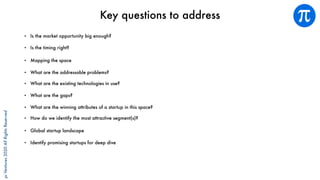
Key questions to address
• Is the market opportunity big enough?
• Is the timing right?
• Mapping the space
• What are the addressable problems?
• What are the existing technologies in use?
• What are the gaps?
• What are the winning attributes of a startup in this space?
• How do we identify the most attractive segment(s)?
• Global startup landscape
• Identify promising startups for deep dive
piVentures2020AllRightsReserved
Investment Thesis with an Example
piVentures2020AllRightsReserved
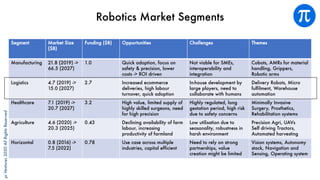
Robotics Market Segments
Segment Market Size
($B)
Funding ($B) Opportunities Challenges Themes
Manufacturing 21.8 (2019) ->
66.5 (2027)
1.0 Quick adoption, focus on
safety & precision, lower
costs -> ROI driven
Not viable for SMEs,
interoperability and
integration
Cobots, AMRs for material
handling, Grippers,
Robotic arms
Logistics 4.7 (2019) ->
15.0 (2027)
2.7 Increased ecommerce
deliveries, high labour
turnover, quick adoption
In-house development by
large players, need to
collaborate with humans
Delivery Robots, Micro
fulfilment, Warehouse
automation
Healthcare 7.1 (2019) ->
20.7 (2027)
3.2 High value, limited supply of
highly skilled surgeons, need
for high precision
Highly regulated, long
gestation period, high risk
due to safety concerns
Minimally Invasive
Surgery, Prosthetics,
Rehabilitation systems
Agriculture 4.6 (2020) ->
20.3 (2025)
0.43 Declining availability of farm
labour, increasing
productivity of farmland
Low utilisation due to
seasonality, robustness in
harsh environment
Precision Agri, UAVs
Self driving Tractors,
Automated harvesting
Horizontal 0.8 (2016) ->
7.5 (2022)
0.78 Use case across multiple
industries, capital efficient
Need to rely on strong
partnerships, value
creation might be limited
Vision systems, Autonomy
stack, Navigation and
Sensing, Operating system
piVentures2020AllRightsReserved
Warehouse Automation Investment Thesis
piVentures2020AllRightsReserved
Market Opportunity
piVentures2020AllRightsReserved
Market opportunity
• US ecommerce sales will reach $794.50 billion this year, up
32.4% year-over-year
• Number of global warehouses using high level automation
expected to go up from 4,000 in 2018 to 50,000 in 2025
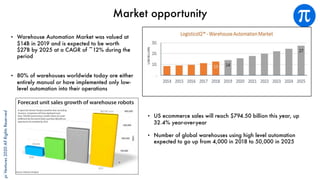
• Warehouse Automation Market was valued at
$14B in 2019 and is expected to be worth
$27B by 2025 at a CAGR of ~12% during the
period
• 80% of warehouses worldwide today are either
entirely manual or have implemented only low-
level automation into their operations
piVentures2020AllRightsReserved
Market Forces
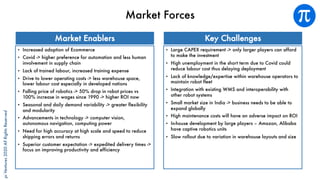
• Increased adoption of Ecommerce
• Covid -> higher preference for automation and less human
involvement in supply chain
• Lack of trained labour, increased training expense
• Drive to lower operating costs -> less warehouse space,
lower labour cost especially in developed nations
• Falling price of robotics -> 50% drop in robot prices vs
100% increase in wages since 1990 -> higher ROI now
• Seasonal and daily demand variability -> greater flexibility
and modularity
• Advancements in technology -> computer vision,
autonomous navigation, computing power
• Need for high accuracy at high scale and speed to reduce
shipping errors and returns
• Superior customer expectation -> expedited delivery times ->
focus on improving productivity and efficiency
• Large CAPEX requirement -> only larger players can afford
to make the investment
• High unemployment in the short term due to Covid could
reduce labour cost thus delaying deployment
• Lack of knowledge/expertise within warehouse operators to
maintain robot fleet
• Integration with existing WMS and interoperability with
other robot systems
• Small market size in India -> business needs to be able to
expand globally
• High maintenance costs will have an adverse impact on ROI
• In-house development by large players – Amazon, Alibaba
have captive robotics units
• Slow rollout due to variation in warehouse layouts and size
Market Enablers Key Challenges
piVentures2020AllRightsReserved
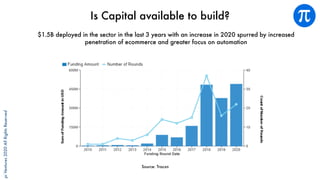
Is Capital available to build?
Source: Tracxn
$1.5B deployed in the sector in the last 3 years with an increase in 2020 spurred by increased
penetration of ecommerce and greater focus on automation
piVentures2020AllRightsReserved
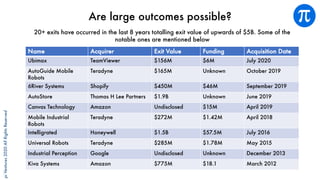
Are large outcomes possible?
20+ exits have occurred in the last 8 years totalling exit value of upwards of $5B. Some of the
notable ones are mentioned below
Name Acquirer Exit Value Funding Acquisition Date
Ubimax TeamViewer $156M $6M July 2020
AutoGuide Mobile
Robots
Teradyne $165M Unknown October 2019
6River Systems Shopify $450M $46M September 2019
AutoStore Thomas H Lee Partners $1.9B Unknown June 2019
Canvas Technology Amazon Undisclosed $15M April 2019
Mobile Industrial
Robots
Teradyne $272M $1.42M April 2018
Intelligrated Honeywell $1.5B $57.5M July 2016
Universal Robots Teradyne $285M $1.78M May 2015
Industrial Perception Google Undisclosed Unknown December 2013
Kiva Systems Amazon $775M $18.1 March 2012
piVentures2020AllRightsReserved
Mapping out the Space
piVentures2020AllRightsReserved
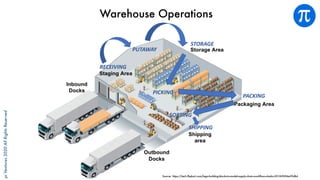
Warehouse Operations
PACKING
STORAGE
RECEIVING
SHIPPING
PUTAWAY
PICKING
SORTING
Source: https://tech.flipkart.com/lego-building-blocks-to-model-supply-chain-workflows-slashn-2018-f55f4e39d84
piVentures2020AllRightsReserved
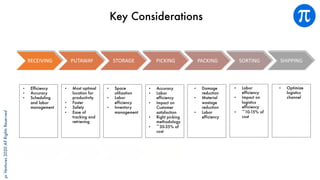
Key Considerations
• Efficiency
• Accuracy
• Scheduling
and labor
management
• Most optimal
location for
productivity
• Faster
• Safety
• Ease of
tracking and
retrieving
• Space
utilization
• Labor
efficiency
• Inventory
management
• Accuracy
• Labor
efficiency
• Impact on
Customer
satisfaction
• Right picking
methodology
• ~30-35% of
cost
• Labor
efficiency
• Impact on
logistics
efficiency
• ~10-15% of
cost
• Damage
reduction
• Material
wastage
reduction
• Labor
efficiency
• Optimize
logistics
channel
RECEIVING PUTAWAY STORAGE PICKING PACKING SORTING SHIPPING
piVentures2020AllRightsReserved
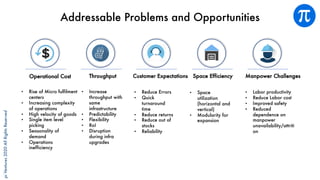
Addressable Problems and Opportunities
Operational Cost
• Rise of Micro fulfilment
centers
• Increasing complexity
of operations
• High velocity of goods
• Single item level
picking
• Seasonality of
demand
• Operations
inefficiency
Throughput
• Increase
throughput with
same
infrastructure
• Predictability
• Flexibility
• RoI
• Disruption
during infra
upgrades
Customer Expectations
• Reduce Errors
• Quick
turnaround
time
• Reduce returns
• Reduce out of
stocks
• Reliability
Space Efficiency
• Space
utilization
(horizontal and
vertical)
• Modularity for
expansion
Manpower Challenges
• Labor productivity
• Reduce Labor cost
• Improved safety
• Reduced
dependence on
manpower
unavailability/attriti
on
piVentures2020AllRightsReserved
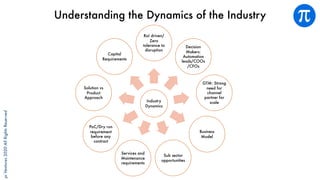
Understanding the Dynamics of the Industry
Industry
Dynamics
RoI driven/
Zero
tolerance to
disruption
Decision
Makers:
Automation
leads/COOs
/CFOs
GTM: Strong
need for
channel
partner for
scale
Business
Model
Sub sector
opportunities
Services and
Maintenance
requirements
PoC/Dry run
requirement
before any
contract
Solution vs
Product
Approach
Capital
Requirements
piVentures2020AllRightsReserved
DeepTech Opportunity
piVentures2020AllRightsReserved
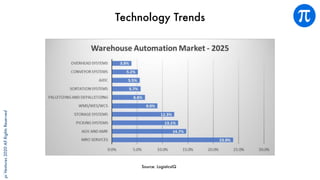
Technology Trends
Source: LogisticsIQ
piVentures2020AllRightsReserved
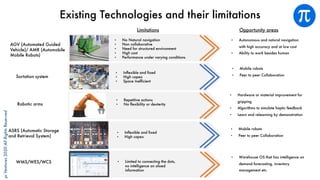
Existing Technologies and their limitations
AGV (Automated Guided
Vehicle)/ AMR (Automobile
Mobile Robots)
• No Natural navigation
• Non collaborative
• Need for structured environment
• High cost
• Performance under varying conditions
Limitations Opportunity areas
• Autonomous and natural navigation
with high accuracy and at low cost
• Ability to work besides human
Sortation system
• Inflexible and fixed
• High capex
• Space Inefficient
• Mobile robots
• Peer to peer Collaboration
Robotic arms
• Repetitive actions
• No flexibility or dexterity
• Hardware or material improvement for
gripping
• Algorithms to simulate haptic feedback
• Learn and relearning by demonstration
ASRS (Automatic Storage
and Retrieval System)
• Inflexible and fixed
• High capex
• Mobile robots
• Peer to peer Collaboration
WMS/WES/WCS • Limited to connecting the dots,
no intelligence on siloed
information
• Warehouse OS that has intelligence on
demand forecasting, inventory
management etc.
piVentures2020AllRightsReserved
Investment Opportunity
piVentures2020AllRightsReserved
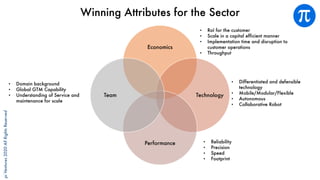
Winning Attributes for the Sector
Economics
Technology
Performance
Team
• RoI for the customer
• Scale in a capital efficient manner
• Implementation time and disruption to
customer operations
• Throughput
• Differentiated and defensible
technology
• Mobile/Modular/Flexible
• Autonomous
• Collaborative Robot
• Reliability
• Precision
• Speed
• Footprint
• Domain background
• Global GTM Capability
• Understanding of Service and
maintenance for scale
piVentures2020AllRightsReserved
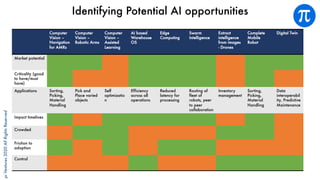
Identifying Potential AI opportunities
Computer
Vision –
Navigation
for AMRs
Computer
Vision –
Robotic Arms
Computer
Vision –
Assisted
Learning
AI based
Warehouse
OS
Edge
Computing
Swarm
Intelligence
Extract
intelligence
from images
- Drones
Complete
Mobile
Robot
Digital Twin
Market potential
Criticality (good
to have/must
have)
Applications Sorting,
Picking,
Material
Handling
Pick and
Place varied
objects
Self
optimizatio
n
Efficiency
across all
operations
Reduced
latency for
processing
Routing of
fleet of
robots, peer
to peer
collaboration
Inventory
management
Sorting,
Picking,
Material
Handling
Data
interoperabil
ity, Predictive
Maintenance
Impact timelines
Crowded
Friction to
adoption
Control
piVentures2020AllRightsReserved
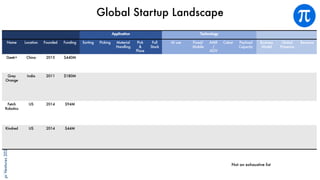
Global Startup Landscape
Application Technology
Name Location Founded Funding Sorting Picking Material
Handling
Pick
&
Place
Full
Stack
AI use Fixed/
Mobile
AMR
/
AGV
Cobot Payload
Capacity
Business
Model
Global
Presence
Revenue
Geek+ China 2015 $440M
Grey
Orange
India 2011 $180M
Fetch
Robotics
US 2014 $94M
Kindred US 2014 $44M
Not an exhaustive list
piVentures2020AllRightsReserved
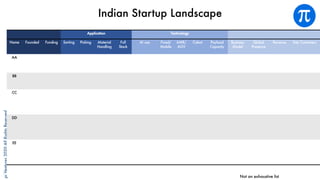
Indian Startup Landscape
Application Technology
Name Founded Funding Sorting Picking Material
Handling
Full
Stack
AI use Fixed/
Mobile
AMR/
AGV
Cobot Payload
Capacity
Business
Model
Global
Presence
Revenue Key Customers
AA
BB
CC
DD
EE
Not an exhaustive list
piVentures2020AllRightsReserved
Thank You!

Building a deeptech thesis

  • 1.
    Building an InvestmentThesis Oct 2020 Shubham Sandeep Roopan Aulakh
  • 2.
    piVentures2020AllRightsReserved Why build anInvestment Thesis? • To Identify Investment Opportunities • Two Approaches – Top Down vs Bottom Up • Top Down: Pick a market -> Build a thesis -> Identify promising startups • Bottom up: Meet an interesting startup -> Analyze the company, market & competitors
  • 3.
    piVentures2020AllRightsReserved Key questions toaddress • Is the market opportunity big enough? • Is the timing right? • Mapping the space • What are the addressable problems? • What are the existing technologies in use? • What are the gaps? • What are the winning attributes of a startup in this space? • How do we identify the most attractive segment(s)? • Global startup landscape • Identify promising startups for deep dive
  • 4.
  • 5.
    piVentures2020AllRightsReserved Robotics Market Segments SegmentMarket Size ($B) Funding ($B) Opportunities Challenges Themes Manufacturing 21.8 (2019) -> 66.5 (2027) 1.0 Quick adoption, focus on safety & precision, lower costs -> ROI driven Not viable for SMEs, interoperability and integration Cobots, AMRs for material handling, Grippers, Robotic arms Logistics 4.7 (2019) -> 15.0 (2027) 2.7 Increased ecommerce deliveries, high labour turnover, quick adoption In-house development by large players, need to collaborate with humans Delivery Robots, Micro fulfilment, Warehouse automation Healthcare 7.1 (2019) -> 20.7 (2027) 3.2 High value, limited supply of highly skilled surgeons, need for high precision Highly regulated, long gestation period, high risk due to safety concerns Minimally Invasive Surgery, Prosthetics, Rehabilitation systems Agriculture 4.6 (2020) -> 20.3 (2025) 0.43 Declining availability of farm labour, increasing productivity of farmland Low utilisation due to seasonality, robustness in harsh environment Precision Agri, UAVs Self driving Tractors, Automated harvesting Horizontal 0.8 (2016) -> 7.5 (2022) 0.78 Use case across multiple industries, capital efficient Need to rely on strong partnerships, value creation might be limited Vision systems, Autonomy stack, Navigation and Sensing, Operating system
  • 6.
  • 7.
  • 8.
    piVentures2020AllRightsReserved Market opportunity • USecommerce sales will reach $794.50 billion this year, up 32.4% year-over-year • Number of global warehouses using high level automation expected to go up from 4,000 in 2018 to 50,000 in 2025 • Warehouse Automation Market was valued at $14B in 2019 and is expected to be worth $27B by 2025 at a CAGR of ~12% during the period • 80% of warehouses worldwide today are either entirely manual or have implemented only low- level automation into their operations
  • 9.
    piVentures2020AllRightsReserved Market Forces • Increasedadoption of Ecommerce • Covid -> higher preference for automation and less human involvement in supply chain • Lack of trained labour, increased training expense • Drive to lower operating costs -> less warehouse space, lower labour cost especially in developed nations • Falling price of robotics -> 50% drop in robot prices vs 100% increase in wages since 1990 -> higher ROI now • Seasonal and daily demand variability -> greater flexibility and modularity • Advancements in technology -> computer vision, autonomous navigation, computing power • Need for high accuracy at high scale and speed to reduce shipping errors and returns • Superior customer expectation -> expedited delivery times -> focus on improving productivity and efficiency • Large CAPEX requirement -> only larger players can afford to make the investment • High unemployment in the short term due to Covid could reduce labour cost thus delaying deployment • Lack of knowledge/expertise within warehouse operators to maintain robot fleet • Integration with existing WMS and interoperability with other robot systems • Small market size in India -> business needs to be able to expand globally • High maintenance costs will have an adverse impact on ROI • In-house development by large players – Amazon, Alibaba have captive robotics units • Slow rollout due to variation in warehouse layouts and size Market Enablers Key Challenges
  • 10.
    piVentures2020AllRightsReserved Is Capital availableto build? Source: Tracxn $1.5B deployed in the sector in the last 3 years with an increase in 2020 spurred by increased penetration of ecommerce and greater focus on automation
  • 11.
    piVentures2020AllRightsReserved Are large outcomespossible? 20+ exits have occurred in the last 8 years totalling exit value of upwards of $5B. Some of the notable ones are mentioned below Name Acquirer Exit Value Funding Acquisition Date Ubimax TeamViewer $156M $6M July 2020 AutoGuide Mobile Robots Teradyne $165M Unknown October 2019 6River Systems Shopify $450M $46M September 2019 AutoStore Thomas H Lee Partners $1.9B Unknown June 2019 Canvas Technology Amazon Undisclosed $15M April 2019 Mobile Industrial Robots Teradyne $272M $1.42M April 2018 Intelligrated Honeywell $1.5B $57.5M July 2016 Universal Robots Teradyne $285M $1.78M May 2015 Industrial Perception Google Undisclosed Unknown December 2013 Kiva Systems Amazon $775M $18.1 March 2012
  • 12.
  • 13.
  • 14.
    piVentures2020AllRightsReserved Key Considerations • Efficiency •Accuracy • Scheduling and labor management • Most optimal location for productivity • Faster • Safety • Ease of tracking and retrieving • Space utilization • Labor efficiency • Inventory management • Accuracy • Labor efficiency • Impact on Customer satisfaction • Right picking methodology • ~30-35% of cost • Labor efficiency • Impact on logistics efficiency • ~10-15% of cost • Damage reduction • Material wastage reduction • Labor efficiency • Optimize logistics channel RECEIVING PUTAWAY STORAGE PICKING PACKING SORTING SHIPPING
  • 15.
    piVentures2020AllRightsReserved Addressable Problems andOpportunities Operational Cost • Rise of Micro fulfilment centers • Increasing complexity of operations • High velocity of goods • Single item level picking • Seasonality of demand • Operations inefficiency Throughput • Increase throughput with same infrastructure • Predictability • Flexibility • RoI • Disruption during infra upgrades Customer Expectations • Reduce Errors • Quick turnaround time • Reduce returns • Reduce out of stocks • Reliability Space Efficiency • Space utilization (horizontal and vertical) • Modularity for expansion Manpower Challenges • Labor productivity • Reduce Labor cost • Improved safety • Reduced dependence on manpower unavailability/attriti on
  • 16.
    piVentures2020AllRightsReserved Understanding the Dynamicsof the Industry Industry Dynamics RoI driven/ Zero tolerance to disruption Decision Makers: Automation leads/COOs /CFOs GTM: Strong need for channel partner for scale Business Model Sub sector opportunities Services and Maintenance requirements PoC/Dry run requirement before any contract Solution vs Product Approach Capital Requirements
  • 17.
  • 18.
  • 19.
    piVentures2020AllRightsReserved Existing Technologies andtheir limitations AGV (Automated Guided Vehicle)/ AMR (Automobile Mobile Robots) • No Natural navigation • Non collaborative • Need for structured environment • High cost • Performance under varying conditions Limitations Opportunity areas • Autonomous and natural navigation with high accuracy and at low cost • Ability to work besides human Sortation system • Inflexible and fixed • High capex • Space Inefficient • Mobile robots • Peer to peer Collaboration Robotic arms • Repetitive actions • No flexibility or dexterity • Hardware or material improvement for gripping • Algorithms to simulate haptic feedback • Learn and relearning by demonstration ASRS (Automatic Storage and Retrieval System) • Inflexible and fixed • High capex • Mobile robots • Peer to peer Collaboration WMS/WES/WCS • Limited to connecting the dots, no intelligence on siloed information • Warehouse OS that has intelligence on demand forecasting, inventory management etc.
  • 20.
  • 21.
    piVentures2020AllRightsReserved Winning Attributes forthe Sector Economics Technology Performance Team • RoI for the customer • Scale in a capital efficient manner • Implementation time and disruption to customer operations • Throughput • Differentiated and defensible technology • Mobile/Modular/Flexible • Autonomous • Collaborative Robot • Reliability • Precision • Speed • Footprint • Domain background • Global GTM Capability • Understanding of Service and maintenance for scale
  • 22.
    piVentures2020AllRightsReserved Identifying Potential AIopportunities Computer Vision – Navigation for AMRs Computer Vision – Robotic Arms Computer Vision – Assisted Learning AI based Warehouse OS Edge Computing Swarm Intelligence Extract intelligence from images - Drones Complete Mobile Robot Digital Twin Market potential Criticality (good to have/must have) Applications Sorting, Picking, Material Handling Pick and Place varied objects Self optimizatio n Efficiency across all operations Reduced latency for processing Routing of fleet of robots, peer to peer collaboration Inventory management Sorting, Picking, Material Handling Data interoperabil ity, Predictive Maintenance Impact timelines Crowded Friction to adoption Control
  • 23.
    piVentures2020AllRightsReserved Global Startup Landscape ApplicationTechnology Name Location Founded Funding Sorting Picking Material Handling Pick & Place Full Stack AI use Fixed/ Mobile AMR / AGV Cobot Payload Capacity Business Model Global Presence Revenue Geek+ China 2015 $440M Grey Orange India 2011 $180M Fetch Robotics US 2014 $94M Kindred US 2014 $44M Not an exhaustive list
  • 24.
    piVentures2020AllRightsReserved Indian Startup Landscape ApplicationTechnology Name Founded Funding Sorting Picking Material Handling Full Stack AI use Fixed/ Mobile AMR/ AGV Cobot Payload Capacity Business Model Global Presence Revenue Key Customers AA BB CC DD EE Not an exhaustive list
  • 25.