Based on posts of
Melissa Cyrill of 16 Jul 2016
By
Col Mukteshwar Prasad(Retd)
Opportunities in India’s
Emerging Fintech Sector
Introduction
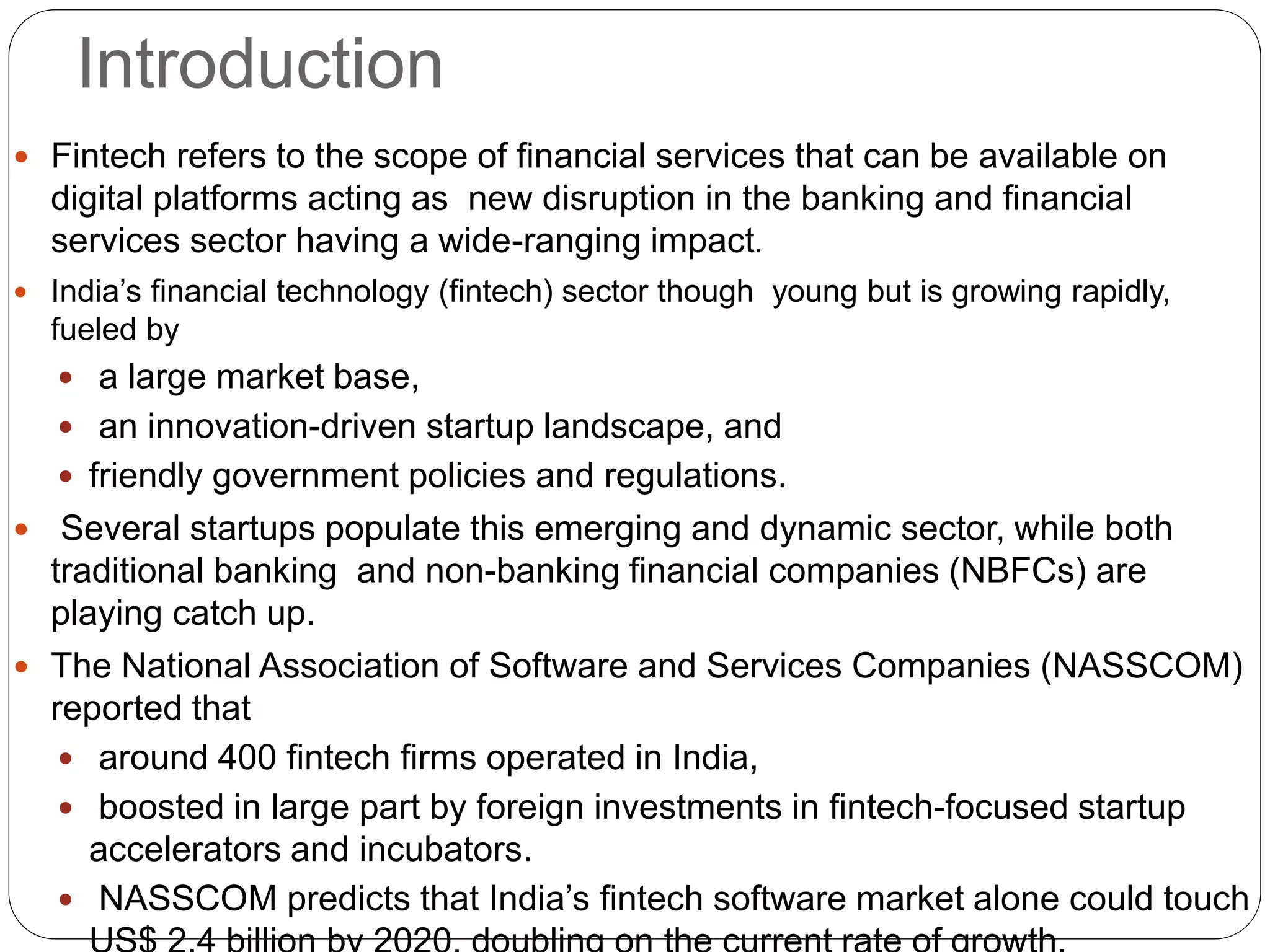
 Fintech refers to the scope of financial services that can be available on
digital platforms acting as new disruption in the banking and financial
services sector having a wide-ranging impact.
 India’s financial technology (fintech) sector though young but is growing rapidly,
fueled by
 a large market base,
 an innovation-driven startup landscape, and
 friendly government policies and regulations.
 Several startups populate this emerging and dynamic sector, while both
traditional banking and non-banking financial companies (NBFCs) are
playing catch up.
 The National Association of Software and Services Companies (NASSCOM)
reported that
 around 400 fintech firms operated in India,
 boosted in large part by foreign investments in fintech-focused startup
accelerators and incubators.
 NASSCOM predicts that India’s fintech software market alone could touch
Technology and the Financial Services in the Indian
Market
 Key service offerings to emerge on digital platforms include:
 Peer-to-Peer (P2P) Lending Services: Companies use alternative credit
models and data sources to provide consumers and businesses with faster
and easier access to capital.
 P2P lending allows online services to directly match lenders with borrowers
who may be individuals or businesses.
 Examples are Lendbox, Faircent, i2iFunding, Shiksha Financial, GyanDhan,
and MarketFinance.
 Payment Services: Companies allow both private individuals and
businesses to accept payments over the web and on mobile without needing
merchant accounts.
 Transfers are made directly to the bank account linked to the payee in order
to secure against fraud.
 Examples are Mobikwik, Paytm, and Oxigen Wallet.
 Remittance Services: A few startup ventures, albeit registered abroad, are
trying to address the gaps in remittance transactions (both inbound and
outbound) as the current process is cumbersome and expensive.
Technology and the Financial Services in the Indian
Market
 Key service offerings to emerge on digital platforms include: ……
 Personal Finance or Retail Investment Services: Fintech companies are
also growing around the need to provide customized financial information
and services to individuals based on one”s specific need , that is,
 how to save,
 manage, and
 invest one’s personal finances
 Examples are FundsIndia.com, Scripbox, PolicyBazaar, and BankBazaar.
 Miscellaneous Software Services: Companies are offering a range of cloud
computing and technology solutions, which improve access to financial
products and in turn increase efficiency in day to day business operations.
 The scope of fintech is rapidly diversifying at both macro and micro levels,
from providing online accounting software to creating specialized digital
platforms connecting buyers and sellers in specific industries.
 Examples include
 Catalyst Labs in the agriculture sector,
 AirtimeUp which provides village retailers the ability to perform mobile top
Technology and the Financial Services in the Indian
Market
 Key service offerings to emerge on digital platforms include: ……
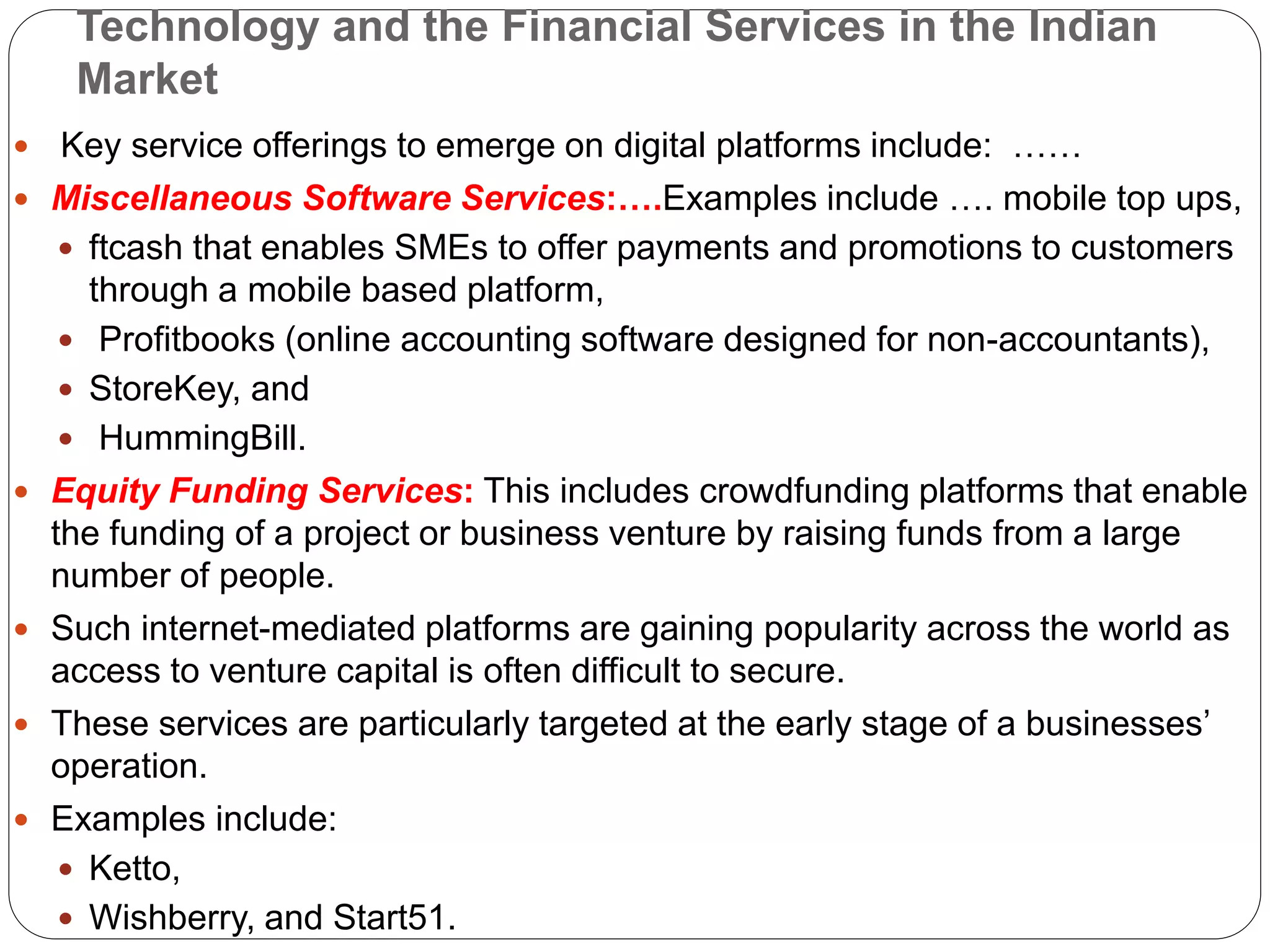
 Miscellaneous Software Services:….Examples include …. mobile top ups,
 ftcash that enables SMEs to offer payments and promotions to customers
through a mobile based platform,
 Profitbooks (online accounting software designed for non-accountants),
 StoreKey, and
 HummingBill.
 Equity Funding Services: This includes crowdfunding platforms that enable
the funding of a project or business venture by raising funds from a large
number of people.
 Such internet-mediated platforms are gaining popularity across the world as
access to venture capital is often difficult to secure.
 These services are particularly targeted at the early stage of a businesses’
operation.
 Examples include:
 Ketto,
 Wishberry, and Start51.
Technology and the Financial Services in the Indian
Market
 Key service offerings to emerge on digital platforms include: ……
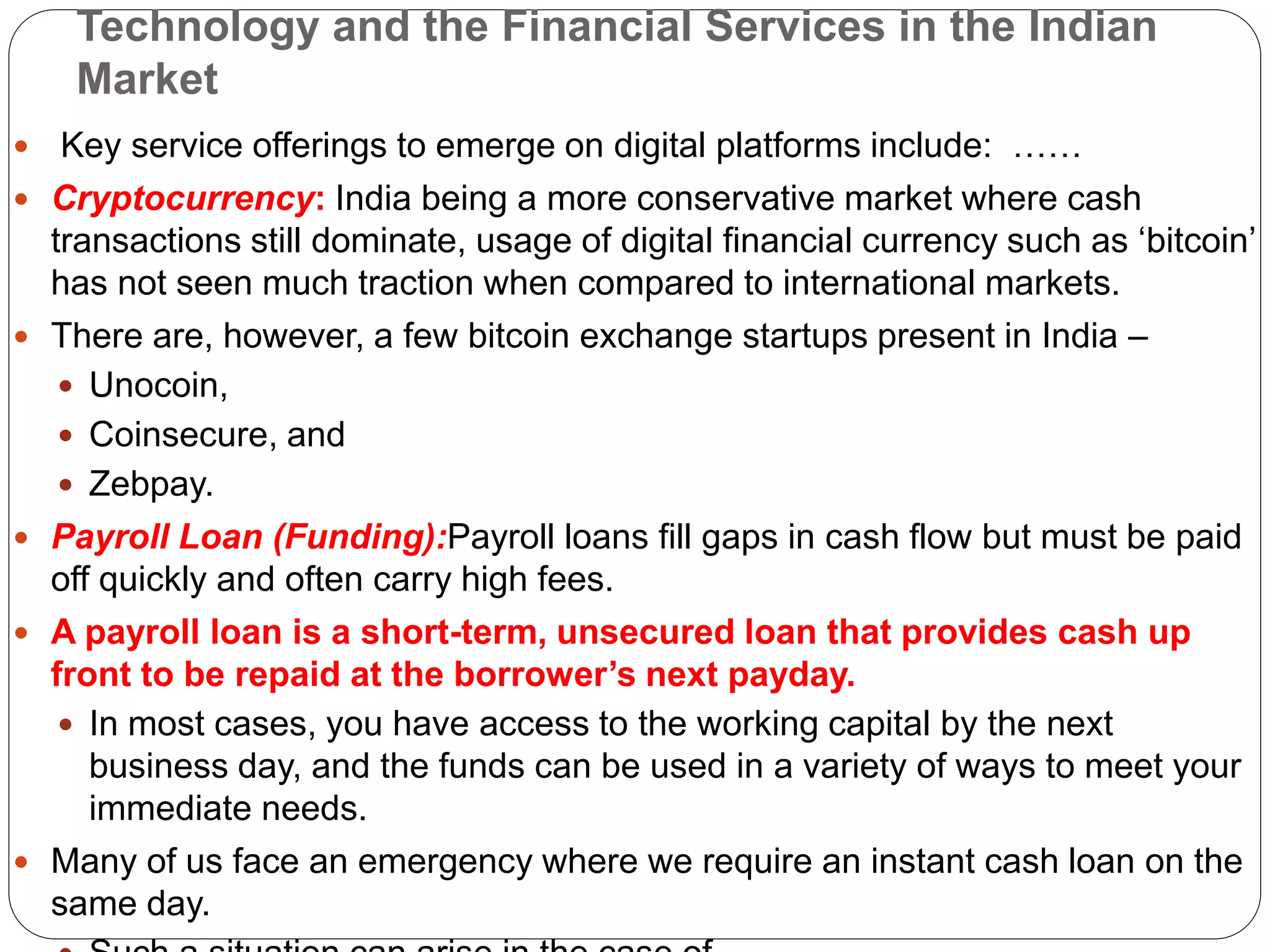
 Cryptocurrency: India being a more conservative market where cash
transactions still dominate, usage of digital financial currency such as ‘bitcoin’
has not seen much traction when compared to international markets.
 There are, however, a few bitcoin exchange startups present in India –
 Unocoin,
 Coinsecure, and
 Zebpay.
 Payroll Loan (Funding):Payroll loans fill gaps in cash flow but must be paid
off quickly and often carry high fees.
 A payroll loan is a short-term, unsecured loan that provides cash up
front to be repaid at the borrower’s next payday.
 In most cases, you have access to the working capital by the next
business day, and the funds can be used in a variety of ways to meet your
immediate needs.
 Many of us face an emergency where we require an instant cash loan on the
same day.
Technology and the Financial Services in the Indian
Market
 Key service offerings to emerge on digital platforms include: ……
 Payroll Loan (Funding):…..Such a situation can arise in the case of
 a medical emergency,
 financial opportunity o
 r urgent loan repayment.
 Getting a loan within a short time of 24-48 hours is very difficult, especially
from banks who require several weeks to process your personal loan
application.
 In such a situation, most people be forced to go to a pawnbroker or money
lender in the informal market who provides loans at very high interest rates of
3-4% per month.
 Moreover you need to provide collateral in the form of gold jewellery to get
this type of loan, which can turn out to be a humiliating and degrading
experience.
 With the Internet revolution now all products and services are available
online.
 You can purchase any product online and pay for it when it reaches your
doorstep by using the cash on delivery (COD) option.
Technology and the Financial Services in the Indian
Market
 Key service offerings to emerge on digital platforms include: ……
 Payroll Loan (Funding):….. delivery (COD) option.
 It is no different for online cash loans, you need to apply online with all the
scanned documents and the loan amount will be delivered to your
doorstep or transferred to your bank account.
 However if you are unemployed and do not have a credit history with credit
bureaus such as CIBIL, it is very difficult to get a loan online as most
websites do a credit check and approve your application on the basis of your
credit score.
 If you have credit score of more than 700 on CIBIL, it becomes very easy to
get a short term loan online.
 In India, payday loans are a new concept , this type of loan is also know as a
salary loan or cash advance loan and are short term unsecured loans usually
given in cash for meeting short term financial requirements.
 Rupee Lend – https://www.rupeelend.com/
This company is based in the Delhi NCR region and disburses loans
presently only in the national capital region, Bangalore and Mumbai.
 Rupee Lend charges a very high interest rate of 1% a day for loan from Rs
Technology and the Financial Services in the Indian
Market
 Key service offerings to emerge on digital platforms include: ……
 Payroll Loan (Funding):….. Rupee Lend – https://www.rupeelend.com/.. 1
Lakh.
 You will need to repay it within a month of borrowing.
 They are one of the few online companies that disburse loans
instantaneously and this facility is convenient for those who are facing an
emergency requirement of money.
 India Lends – https://indialends.com/
Lend Box – https://www.lendbox.in.
 Faircent – https://www.faircent.com
i-Lend – https://www.i-lend.in
Scope for Growth in India
 Fintech service firms are currently redefining the way companies and
consumers conduct transactions on a daily basis.
 This is why global investments into fintech ventures have been increasing
at record speed – tripling to US$ 12.2 billion in 2014 from US$ 4.05 billion
in 2013, and reaching US$ 19.1 billion in 2015.
 In India, the scale has been much smaller but at similar growth rates –
investment in India’s fintech industry grew 282 percent between 2013 and
2014, and reached US$ 450 million in 2015.
 Additionally, India has a large untapped market for financial service
technology startups – 40 percent of the population are currently not
connected to banks and 87 percent of payments are made in cash.
 With mobile usage expected to increase to 64 percent in 2018 from 53
percent currently, and internet penetration steadily climbing, the growth
potential for fintech in India cannot be overstated.
 Moreover, by some estimates, as much as 90 percent of small businesses
are not linked to formal financial institutions.
 These gaps in access to institutions and services offer important scope to
develop fintech solutions (such as funding, finance management) and
Disruptive Potential in the Traditional Finance and
Banking Sector
 Fintech firms are breaking new ground in the formal finance sector through
innovative and dynamic use of technology in the lending process.
 For instance, while traditional banks (around 100) and NBFCs (around
1100) in India use technology to simply
 calculate credit scores,
 fintech ventures use under mentioned increase efficiency and provide
greater access to credit
 machine learning algorithms and
 alternative data points such as
 social media footprints,
 call records,
 shopping histories, and
 The turnaround time is also much faster for the approval and disbursal
of loans by fintech firms despite several banks (State Bank of India,
ICICI, HDFC, and Axis bank) digitizing and speeding up these
processes markedly.
Challenges and Opportunities for Fintech
Expansion
 While digital finance firms have benefited from the government’s pro-startup
policies and flexible regulatory conditions imposed by the Reserve Bank of
India (RBI),
 To match formal institution’s established infrastructure and legacy
that is not easily replaceable.
 Need to instill greater confidence among Indian customers, already
known for being conservative in their financial preferences.
 Figuring out how to market to their needs
 influence financial behavior
 setting up a strong and responsive regulatory infrastructure to keep apace
with the speed of technological innovation.
 On the other hand, traditional banking and financial institutions can leverage
 their existing customer base and
 adopt digital products that
 nurture strong financial relationships
 improving service efficiency and
 broadening access to meet changing needs.
Challenges and Opportunities for Fintech
Expansion…
 On the other hand, … broadening access to meet changing needs.
 The disruptive potential of fintech firms can provoke
 the much needed modernization of the traditional sector,
 reducing costs in the process and
 increasing the size of the banking population.
 Responding to these opportunities and challenges, banks like HDFC and
Axis have launched
 mobile phone applications to ease digital transactions;
 Federal Bank announced a partnership with Startup Village to develop
innovative banking products;
 U.K. giant Barclays is set to operationalize its fifth global fintech innovation
center that will be located in India; and
 Goldman Sachs Principal Strategic Investments Group (GSPSI) is looking
to invest in Bengaluru’s fintech startup scene.
 Thus, the growth prospects in technological innovation may not necessarily
produce a mutually exclusive relationship between traditional institutions and
fintech firms in India.
The Right Combination of Incentives, Policies, and
Regulation
 Initiatives by the RBI and parallel government efforts have focused on
fostering financial inclusion.
 This has meant encouraging competition and innovation in India’s nascent
fintech sector on a more or less even playing field.
 This has allowed both online and offline solutions to emerge and has
created a safer financial system with far-reaching access.
 Reserve Bank of India: The RBI recently set up a multi-disciplinary committee
to study the fintech business in India.
 The goal is to understand the risks involved and emergence of new
models, and assess how the banking system could then adapt and
respond to them.
 The RBI has so far promoted
 the Unified Payments Interface and the Bharat Bill Payments System,
 digital payments,
 P2P lending, and
 the use of automated algorithms to offer financial advice.
 Moreover, the RBI has granted licenses to 11 fintech entities to establish
payment banks that provide savings, deposit, and remittance services.
The Right Combination of Incentives, Policies, and
Regulation…
 Government Schemes: Govt Schemes that have provided important
enabling platforms for technology innovators
 the Jan Dhan Yojana
 , Digital India program, and
 Aadhar’s Unique Identification system
 Also, e-governance systems promoted by the current government facilitate
transparency by removing the involvement of middlemen.
 Other examples of the government’s efforts to encourage the growth of a
fintech ecosystem in India
 The removal of surcharges on electronic transactions,
 tax benefits for consumers and businesses using e-payments, and
 changes in authentication requirements
 Fintech Startup Sector: This is probably the greatest empowering incentive
towards the expansion of fintech ventures in India. An encouraging regulatory
environment has enabled the launching of 174 fintech startups in 2015 alone,
as per data analytics company, Traxcn. As mentioned earlier, several national
and international banks and investment groups are also investing in India’s
fintech startups and funding fintech solutions.
Observation
 The digital and technological revolution transformed business operations
across all industries, and the financial and banking sector is no exception.
 What is heartening is that the Indian government and regulatory institutions
have in effect promoted an entrepreneurial rather than obstructive climate for
fintech in India.
 However, policies and governance will need to match the speed of innovation
in this sector, particularly to ensure secure and transparent growth.

Opportunities in india’s emerging fintech sector

  • 1.
    Based on postsof Melissa Cyrill of 16 Jul 2016 By Col Mukteshwar Prasad(Retd) Opportunities in India’s Emerging Fintech Sector
  • 2.
    Introduction  Fintech refersto the scope of financial services that can be available on digital platforms acting as new disruption in the banking and financial services sector having a wide-ranging impact.  India’s financial technology (fintech) sector though young but is growing rapidly, fueled by  a large market base,  an innovation-driven startup landscape, and  friendly government policies and regulations.  Several startups populate this emerging and dynamic sector, while both traditional banking and non-banking financial companies (NBFCs) are playing catch up.  The National Association of Software and Services Companies (NASSCOM) reported that  around 400 fintech firms operated in India,  boosted in large part by foreign investments in fintech-focused startup accelerators and incubators.  NASSCOM predicts that India’s fintech software market alone could touch
  • 3.
    Technology and theFinancial Services in the Indian Market  Key service offerings to emerge on digital platforms include:  Peer-to-Peer (P2P) Lending Services: Companies use alternative credit models and data sources to provide consumers and businesses with faster and easier access to capital.  P2P lending allows online services to directly match lenders with borrowers who may be individuals or businesses.  Examples are Lendbox, Faircent, i2iFunding, Shiksha Financial, GyanDhan, and MarketFinance.  Payment Services: Companies allow both private individuals and businesses to accept payments over the web and on mobile without needing merchant accounts.  Transfers are made directly to the bank account linked to the payee in order to secure against fraud.  Examples are Mobikwik, Paytm, and Oxigen Wallet.  Remittance Services: A few startup ventures, albeit registered abroad, are trying to address the gaps in remittance transactions (both inbound and outbound) as the current process is cumbersome and expensive.
  • 4.
    Technology and theFinancial Services in the Indian Market  Key service offerings to emerge on digital platforms include: ……  Personal Finance or Retail Investment Services: Fintech companies are also growing around the need to provide customized financial information and services to individuals based on one”s specific need , that is,  how to save,  manage, and  invest one’s personal finances  Examples are FundsIndia.com, Scripbox, PolicyBazaar, and BankBazaar.  Miscellaneous Software Services: Companies are offering a range of cloud computing and technology solutions, which improve access to financial products and in turn increase efficiency in day to day business operations.  The scope of fintech is rapidly diversifying at both macro and micro levels, from providing online accounting software to creating specialized digital platforms connecting buyers and sellers in specific industries.  Examples include  Catalyst Labs in the agriculture sector,  AirtimeUp which provides village retailers the ability to perform mobile top
  • 5.
    Technology and theFinancial Services in the Indian Market  Key service offerings to emerge on digital platforms include: ……  Miscellaneous Software Services:….Examples include …. mobile top ups,  ftcash that enables SMEs to offer payments and promotions to customers through a mobile based platform,  Profitbooks (online accounting software designed for non-accountants),  StoreKey, and  HummingBill.  Equity Funding Services: This includes crowdfunding platforms that enable the funding of a project or business venture by raising funds from a large number of people.  Such internet-mediated platforms are gaining popularity across the world as access to venture capital is often difficult to secure.  These services are particularly targeted at the early stage of a businesses’ operation.  Examples include:  Ketto,  Wishberry, and Start51.
  • 6.
    Technology and theFinancial Services in the Indian Market  Key service offerings to emerge on digital platforms include: ……  Cryptocurrency: India being a more conservative market where cash transactions still dominate, usage of digital financial currency such as ‘bitcoin’ has not seen much traction when compared to international markets.  There are, however, a few bitcoin exchange startups present in India –  Unocoin,  Coinsecure, and  Zebpay.  Payroll Loan (Funding):Payroll loans fill gaps in cash flow but must be paid off quickly and often carry high fees.  A payroll loan is a short-term, unsecured loan that provides cash up front to be repaid at the borrower’s next payday.  In most cases, you have access to the working capital by the next business day, and the funds can be used in a variety of ways to meet your immediate needs.  Many of us face an emergency where we require an instant cash loan on the same day.
  • 7.
    Technology and theFinancial Services in the Indian Market  Key service offerings to emerge on digital platforms include: ……  Payroll Loan (Funding):…..Such a situation can arise in the case of  a medical emergency,  financial opportunity o  r urgent loan repayment.  Getting a loan within a short time of 24-48 hours is very difficult, especially from banks who require several weeks to process your personal loan application.  In such a situation, most people be forced to go to a pawnbroker or money lender in the informal market who provides loans at very high interest rates of 3-4% per month.  Moreover you need to provide collateral in the form of gold jewellery to get this type of loan, which can turn out to be a humiliating and degrading experience.  With the Internet revolution now all products and services are available online.  You can purchase any product online and pay for it when it reaches your doorstep by using the cash on delivery (COD) option.
  • 8.
    Technology and theFinancial Services in the Indian Market  Key service offerings to emerge on digital platforms include: ……  Payroll Loan (Funding):….. delivery (COD) option.  It is no different for online cash loans, you need to apply online with all the scanned documents and the loan amount will be delivered to your doorstep or transferred to your bank account.  However if you are unemployed and do not have a credit history with credit bureaus such as CIBIL, it is very difficult to get a loan online as most websites do a credit check and approve your application on the basis of your credit score.  If you have credit score of more than 700 on CIBIL, it becomes very easy to get a short term loan online.  In India, payday loans are a new concept , this type of loan is also know as a salary loan or cash advance loan and are short term unsecured loans usually given in cash for meeting short term financial requirements.  Rupee Lend – https://www.rupeelend.com/ This company is based in the Delhi NCR region and disburses loans presently only in the national capital region, Bangalore and Mumbai.  Rupee Lend charges a very high interest rate of 1% a day for loan from Rs
  • 9.
    Technology and theFinancial Services in the Indian Market  Key service offerings to emerge on digital platforms include: ……  Payroll Loan (Funding):….. Rupee Lend – https://www.rupeelend.com/.. 1 Lakh.  You will need to repay it within a month of borrowing.  They are one of the few online companies that disburse loans instantaneously and this facility is convenient for those who are facing an emergency requirement of money.  India Lends – https://indialends.com/ Lend Box – https://www.lendbox.in.  Faircent – https://www.faircent.com i-Lend – https://www.i-lend.in
  • 11.
    Scope for Growthin India  Fintech service firms are currently redefining the way companies and consumers conduct transactions on a daily basis.  This is why global investments into fintech ventures have been increasing at record speed – tripling to US$ 12.2 billion in 2014 from US$ 4.05 billion in 2013, and reaching US$ 19.1 billion in 2015.  In India, the scale has been much smaller but at similar growth rates – investment in India’s fintech industry grew 282 percent between 2013 and 2014, and reached US$ 450 million in 2015.  Additionally, India has a large untapped market for financial service technology startups – 40 percent of the population are currently not connected to banks and 87 percent of payments are made in cash.  With mobile usage expected to increase to 64 percent in 2018 from 53 percent currently, and internet penetration steadily climbing, the growth potential for fintech in India cannot be overstated.  Moreover, by some estimates, as much as 90 percent of small businesses are not linked to formal financial institutions.  These gaps in access to institutions and services offer important scope to develop fintech solutions (such as funding, finance management) and
  • 13.
    Disruptive Potential inthe Traditional Finance and Banking Sector  Fintech firms are breaking new ground in the formal finance sector through innovative and dynamic use of technology in the lending process.  For instance, while traditional banks (around 100) and NBFCs (around 1100) in India use technology to simply  calculate credit scores,  fintech ventures use under mentioned increase efficiency and provide greater access to credit  machine learning algorithms and  alternative data points such as  social media footprints,  call records,  shopping histories, and  The turnaround time is also much faster for the approval and disbursal of loans by fintech firms despite several banks (State Bank of India, ICICI, HDFC, and Axis bank) digitizing and speeding up these processes markedly.
  • 15.
    Challenges and Opportunitiesfor Fintech Expansion  While digital finance firms have benefited from the government’s pro-startup policies and flexible regulatory conditions imposed by the Reserve Bank of India (RBI),  To match formal institution’s established infrastructure and legacy that is not easily replaceable.  Need to instill greater confidence among Indian customers, already known for being conservative in their financial preferences.  Figuring out how to market to their needs  influence financial behavior  setting up a strong and responsive regulatory infrastructure to keep apace with the speed of technological innovation.  On the other hand, traditional banking and financial institutions can leverage  their existing customer base and  adopt digital products that  nurture strong financial relationships  improving service efficiency and  broadening access to meet changing needs.
  • 16.
    Challenges and Opportunitiesfor Fintech Expansion…  On the other hand, … broadening access to meet changing needs.  The disruptive potential of fintech firms can provoke  the much needed modernization of the traditional sector,  reducing costs in the process and  increasing the size of the banking population.  Responding to these opportunities and challenges, banks like HDFC and Axis have launched  mobile phone applications to ease digital transactions;  Federal Bank announced a partnership with Startup Village to develop innovative banking products;  U.K. giant Barclays is set to operationalize its fifth global fintech innovation center that will be located in India; and  Goldman Sachs Principal Strategic Investments Group (GSPSI) is looking to invest in Bengaluru’s fintech startup scene.  Thus, the growth prospects in technological innovation may not necessarily produce a mutually exclusive relationship between traditional institutions and fintech firms in India.
  • 17.
    The Right Combinationof Incentives, Policies, and Regulation  Initiatives by the RBI and parallel government efforts have focused on fostering financial inclusion.  This has meant encouraging competition and innovation in India’s nascent fintech sector on a more or less even playing field.  This has allowed both online and offline solutions to emerge and has created a safer financial system with far-reaching access.  Reserve Bank of India: The RBI recently set up a multi-disciplinary committee to study the fintech business in India.  The goal is to understand the risks involved and emergence of new models, and assess how the banking system could then adapt and respond to them.  The RBI has so far promoted  the Unified Payments Interface and the Bharat Bill Payments System,  digital payments,  P2P lending, and  the use of automated algorithms to offer financial advice.  Moreover, the RBI has granted licenses to 11 fintech entities to establish payment banks that provide savings, deposit, and remittance services.
  • 18.
    The Right Combinationof Incentives, Policies, and Regulation…  Government Schemes: Govt Schemes that have provided important enabling platforms for technology innovators  the Jan Dhan Yojana  , Digital India program, and  Aadhar’s Unique Identification system  Also, e-governance systems promoted by the current government facilitate transparency by removing the involvement of middlemen.  Other examples of the government’s efforts to encourage the growth of a fintech ecosystem in India  The removal of surcharges on electronic transactions,  tax benefits for consumers and businesses using e-payments, and  changes in authentication requirements  Fintech Startup Sector: This is probably the greatest empowering incentive towards the expansion of fintech ventures in India. An encouraging regulatory environment has enabled the launching of 174 fintech startups in 2015 alone, as per data analytics company, Traxcn. As mentioned earlier, several national and international banks and investment groups are also investing in India’s fintech startups and funding fintech solutions.
  • 19.
    Observation  The digitaland technological revolution transformed business operations across all industries, and the financial and banking sector is no exception.  What is heartening is that the Indian government and regulatory institutions have in effect promoted an entrepreneurial rather than obstructive climate for fintech in India.  However, policies and governance will need to match the speed of innovation in this sector, particularly to ensure secure and transparent growth.