The Current State of Warehouse
Technology
Cathy Morrow
Roberson
Emily Murphy
With: Moderated by:
TO USE YOUR COMPUTER'S AUDIO:
When the webinar begins, you will be connected to audio
using your computer's microphone and speakers (VoIP). A
headset is recommended.
Webinar will begin:
12:30 pm, PDT
TO USE YOUR TELEPHONE:
If you prefer to use your phone, you must select "Use Telephone"
after joining the webinar and call in using the numbers below.
United States: +1 (562) 247-8321
Access Code: 357-198-079
Audio PIN: Shown after joining the webinar
--OR--
Fetch Robotics provides the market’s only cloud-driven Autonomous
Mobile Robot (AMR) solution that addresses material handling and
data collection for warehousing and intralogistics environments.
Fetch Robotics’ AMRs reduce costs and improve throughput,
efficiency, and productivity, while working alongside people.
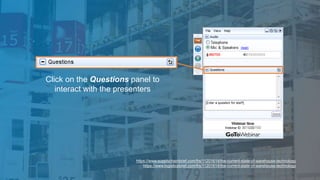
Click on the Questions panel to
interact with the presenters
https://www.supplychainbrief.com/frs/11201614/the-current-state-of-warehouse-technology
https://www.logisticsbrief.com/frs/11201614/the-current-state-of-warehouse-technology
About Cathy Morrow Roberson
Based in Atlanta, Logistics Trends & Insights aims to cut through the content noise and provide
customized logistics research and consulting services. Founder and Head Analyst Cathy Morrow
Roberson has more than 15 years of experience in the logistics market, including 10 years with
UPS Supply Chain and several years with specialized consulting firms. In addition to being quoted
in numerous publications, Roberson has published numerous articles in various business and
logistics publications.
About Emily Murphy
Emily earned a Bachelor of Arts from the University of California, Santa Cruz, for her major in Film
and Digital Media and minor in Literature. With experience in writing, publication, and teaching, she
continued her work after college as a research writer and an online blog contributor. She has now
joined the Aggregage team and is the Editor for several sites in our network, including Supply Chain
Brief, Logistics Brief, and B2B Marketing Zone.
5
The warehouse is undergoing a vast transformation thanks to technology.
With several new technologies being introduced, the idea of the Next
Generation Warehouse and what that consists of, is often debated.
Efficiency and speed are pressuring organizations to step up their
warehousing capabilities. How are they doing this and what role is
technology playing?
The Current State Of Warehouse TechnologyThe Current State of Warehousing Technology
6
• Overview
• Costs
• Technologies in the Warehouse
• Conclusion
The Current State OfAgendaTechnology
7
• Warehousing dates back to the days of graneries to store food for drought
and famine and for purchase in the conditions of emergency, famine,
drought.
• As explorers began to discover new shipping trade routes, the importance
of warehouses grew for the storage of products and commodities which
were brought from far way places.
• As civilization developed, local warehouses were introduced. totored for drought and
famine and this food was available for purchase in the conditions of emergency, famine, drought red for drought and famine and this
food was available for purchase in the conditions of emergency, famine, drought
Warehousing – An Overview
8
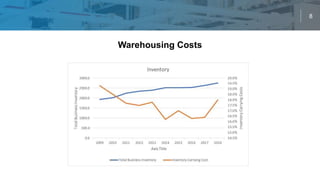
Warehousing Costs
9
Survey Question 1
Can technology replace warehouse workers?
10
Yes and No
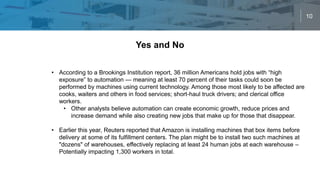
• According to a Brookings Institution report, 36 million Americans hold jobs with “high
exposure” to automation — meaning at least 70 percent of their tasks could soon be
performed by machines using current technology. Among those most likely to be affected are
cooks, waiters and others in food services; short-haul truck drivers; and clerical office
workers.
• Other analysts believe automation can create economic growth, reduce prices and
increase demand while also creating new jobs that make up for those that disappear.
• Earlier this year, Reuters reported that Amazon is installing machines that box items before
delivery at some of its fulfillment centers. The plan might be to install two such machines at
"dozens" of warehouses, effectively replacing at least 24 human jobs at each warehouse –
Potentially impacting 1,300 workers in total.
11
Survey Question 2
What warehouse technology has made the biggest impact on
efficiency gains?
12
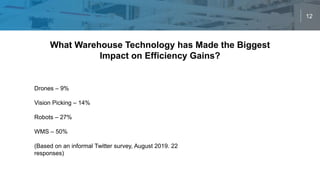
What Warehouse Technology has Made the Biggest
Impact on Efficiency Gains?
Drones – 9%
Vision Picking – 14%
Robots – 27%
WMS – 50%
(Based on an informal Twitter survey, August 2019. 22
responses)
13
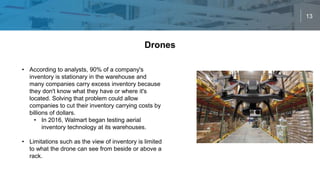
Drones
• According to analysts, 90% of a company's
inventory is stationary in the warehouse and
many companies carry excess inventory because
they don't know what they have or where it's
located. Solving that problem could allow
companies to cut their inventory carrying costs by
billions of dollars.
• In 2016, Walmart began testing aerial
inventory technology at its warehouses.
• Limitations such as the view of inventory is limited
to what the drone can see from beside or above a
rack.
14
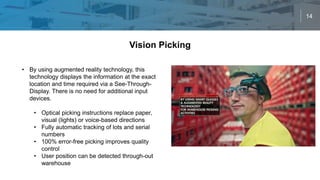
Vision Picking
• By using augmented reality technology, this
technology displays the information at the exact
location and time required via a See-Through-
Display. There is no need for additional input
devices.
• Optical picking instructions replace paper,
visual (lights) or voice-based directions
• Fully automatic tracking of lots and serial
numbers
• 100% error-free picking improves quality
control
• User position can be detected through-out
warehouse
15
Robots
• Robots already assist with loading, unloading,
sorting, picking, transportation, storage, delivery
and audits. Robots helping with these tasks come
in all shapes and sizes.
• Amazon has more than 100,000 robots in its
warehouses.
• Walmart plans to soon add more than 3,900
robots to stores across the U.S. The robots
will perform tasks such as scanning products,
sorting shipments, cleaning floors, and
readying online purchases for pickup.
• At its Shanghai fulfillment center, JD.com can
organize, pack and ship 200,000 orders a
day. It employs four people , all of whom
service the robots.
16
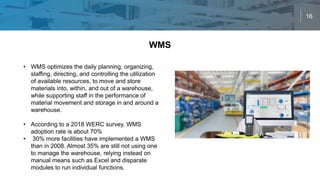
WMS
• WMS optimizes the daily planning, organizing,
staffing, directing, and controlling the utilization
of available resources, to move and store
materials into, within, and out of a warehouse,
while supporting staff in the performance of
material movement and storage in and around a
warehouse.
• According to a 2018 WERC survey, WMS
adoption rate is about 70%
• 30% more facilities have implemented a WMS
than in 2008. Almost 35% are still not using one
to manage the warehouse, relying instead on
manual means such as Excel and disparate
modules to run individual functions.
17
Survey Question 3
What’s next for warehousing technology?
18
19
Summary
• Investments in warehouse technologies continues as final customers expect goods faster
• Technologies continue to evolve. Drones, Robots, Vision Picking and WMS are just the tips of
the iceberg. Stay focused and keep up to date with the latest offerings through networking,
conferences, webinars and publications.
• While making up over 50% of inventory costs, workers will still be needed for the foreseeable
future. Competitive pay, good working environment and training opportunities are important for
retention.
Q&A
Emily Murphy
With: Moderated by:
Founder and Head Analyst at Logistics Trends &
Insights, LLC.
Linkedin page: /in/cathy-morrow-roberson-lti/
Twitter ID: @cmroberson06
@LogisticsTI
Website: logisticsTI.com
Email: croberson@logisticsTI.com
Cathy Morrow
Roberson
Editor, Aggregage
Linkedin page: /in/Emily-millard-murphy/
Twitter ID: @scbrief
Website: supplychainbrief.com
https://www.supplychainbrief.com/frs/11201614/the-current-state-of-warehouse-technology
https://www.logisticsbrief.com/frs/11201614/the-current-state-of-warehouse-technology

The Current State of Warehouse Technology

  • 1.
    The Current Stateof Warehouse Technology Cathy Morrow Roberson Emily Murphy With: Moderated by: TO USE YOUR COMPUTER'S AUDIO: When the webinar begins, you will be connected to audio using your computer's microphone and speakers (VoIP). A headset is recommended. Webinar will begin: 12:30 pm, PDT TO USE YOUR TELEPHONE: If you prefer to use your phone, you must select "Use Telephone" after joining the webinar and call in using the numbers below. United States: +1 (562) 247-8321 Access Code: 357-198-079 Audio PIN: Shown after joining the webinar --OR--
  • 2.
    Fetch Robotics providesthe market’s only cloud-driven Autonomous Mobile Robot (AMR) solution that addresses material handling and data collection for warehousing and intralogistics environments. Fetch Robotics’ AMRs reduce costs and improve throughput, efficiency, and productivity, while working alongside people.
  • 3.
    Click on theQuestions panel to interact with the presenters https://www.supplychainbrief.com/frs/11201614/the-current-state-of-warehouse-technology https://www.logisticsbrief.com/frs/11201614/the-current-state-of-warehouse-technology
  • 4.
    About Cathy MorrowRoberson Based in Atlanta, Logistics Trends & Insights aims to cut through the content noise and provide customized logistics research and consulting services. Founder and Head Analyst Cathy Morrow Roberson has more than 15 years of experience in the logistics market, including 10 years with UPS Supply Chain and several years with specialized consulting firms. In addition to being quoted in numerous publications, Roberson has published numerous articles in various business and logistics publications. About Emily Murphy Emily earned a Bachelor of Arts from the University of California, Santa Cruz, for her major in Film and Digital Media and minor in Literature. With experience in writing, publication, and teaching, she continued her work after college as a research writer and an online blog contributor. She has now joined the Aggregage team and is the Editor for several sites in our network, including Supply Chain Brief, Logistics Brief, and B2B Marketing Zone.
  • 5.
    5 The warehouse isundergoing a vast transformation thanks to technology. With several new technologies being introduced, the idea of the Next Generation Warehouse and what that consists of, is often debated. Efficiency and speed are pressuring organizations to step up their warehousing capabilities. How are they doing this and what role is technology playing? The Current State Of Warehouse TechnologyThe Current State of Warehousing Technology
  • 6.
    6 • Overview • Costs •Technologies in the Warehouse • Conclusion The Current State OfAgendaTechnology
  • 7.
    7 • Warehousing datesback to the days of graneries to store food for drought and famine and for purchase in the conditions of emergency, famine, drought. • As explorers began to discover new shipping trade routes, the importance of warehouses grew for the storage of products and commodities which were brought from far way places. • As civilization developed, local warehouses were introduced. totored for drought and famine and this food was available for purchase in the conditions of emergency, famine, drought red for drought and famine and this food was available for purchase in the conditions of emergency, famine, drought Warehousing – An Overview
  • 8.
  • 9.
    9 Survey Question 1 Cantechnology replace warehouse workers?
  • 10.
    10 Yes and No •According to a Brookings Institution report, 36 million Americans hold jobs with “high exposure” to automation — meaning at least 70 percent of their tasks could soon be performed by machines using current technology. Among those most likely to be affected are cooks, waiters and others in food services; short-haul truck drivers; and clerical office workers. • Other analysts believe automation can create economic growth, reduce prices and increase demand while also creating new jobs that make up for those that disappear. • Earlier this year, Reuters reported that Amazon is installing machines that box items before delivery at some of its fulfillment centers. The plan might be to install two such machines at "dozens" of warehouses, effectively replacing at least 24 human jobs at each warehouse – Potentially impacting 1,300 workers in total.
  • 11.
    11 Survey Question 2 Whatwarehouse technology has made the biggest impact on efficiency gains?
  • 12.
    12 What Warehouse Technologyhas Made the Biggest Impact on Efficiency Gains? Drones – 9% Vision Picking – 14% Robots – 27% WMS – 50% (Based on an informal Twitter survey, August 2019. 22 responses)
  • 13.
    13 Drones • According toanalysts, 90% of a company's inventory is stationary in the warehouse and many companies carry excess inventory because they don't know what they have or where it's located. Solving that problem could allow companies to cut their inventory carrying costs by billions of dollars. • In 2016, Walmart began testing aerial inventory technology at its warehouses. • Limitations such as the view of inventory is limited to what the drone can see from beside or above a rack.
  • 14.
    14 Vision Picking • Byusing augmented reality technology, this technology displays the information at the exact location and time required via a See-Through- Display. There is no need for additional input devices. • Optical picking instructions replace paper, visual (lights) or voice-based directions • Fully automatic tracking of lots and serial numbers • 100% error-free picking improves quality control • User position can be detected through-out warehouse
  • 15.
    15 Robots • Robots alreadyassist with loading, unloading, sorting, picking, transportation, storage, delivery and audits. Robots helping with these tasks come in all shapes and sizes. • Amazon has more than 100,000 robots in its warehouses. • Walmart plans to soon add more than 3,900 robots to stores across the U.S. The robots will perform tasks such as scanning products, sorting shipments, cleaning floors, and readying online purchases for pickup. • At its Shanghai fulfillment center, JD.com can organize, pack and ship 200,000 orders a day. It employs four people , all of whom service the robots.
  • 16.
    16 WMS • WMS optimizesthe daily planning, organizing, staffing, directing, and controlling the utilization of available resources, to move and store materials into, within, and out of a warehouse, while supporting staff in the performance of material movement and storage in and around a warehouse. • According to a 2018 WERC survey, WMS adoption rate is about 70% • 30% more facilities have implemented a WMS than in 2008. Almost 35% are still not using one to manage the warehouse, relying instead on manual means such as Excel and disparate modules to run individual functions.
  • 17.
    17 Survey Question 3 What’snext for warehousing technology?
  • 18.
  • 19.
    19 Summary • Investments inwarehouse technologies continues as final customers expect goods faster • Technologies continue to evolve. Drones, Robots, Vision Picking and WMS are just the tips of the iceberg. Stay focused and keep up to date with the latest offerings through networking, conferences, webinars and publications. • While making up over 50% of inventory costs, workers will still be needed for the foreseeable future. Competitive pay, good working environment and training opportunities are important for retention.
  • 20.
    Q&A Emily Murphy With: Moderatedby: Founder and Head Analyst at Logistics Trends & Insights, LLC. Linkedin page: /in/cathy-morrow-roberson-lti/ Twitter ID: @cmroberson06 @LogisticsTI Website: logisticsTI.com Email: croberson@logisticsTI.com Cathy Morrow Roberson Editor, Aggregage Linkedin page: /in/Emily-millard-murphy/ Twitter ID: @scbrief Website: supplychainbrief.com https://www.supplychainbrief.com/frs/11201614/the-current-state-of-warehouse-technology https://www.logisticsbrief.com/frs/11201614/the-current-state-of-warehouse-technology