SUBMITTED BY:
G.SIDDESHWARI
G.SURESH
K.BARATH
M.ANIRUDH
P.SNIGDHA
R.AKHILA
SUBMITTED TO:
MS.HIMABINDU
 Introduction
 PPP
 Objectives of PPP
 Types and approaches for PPP
 Broad roles and responsibilities
 Encouraging PPP under JNURM
 Key determinants for PPP
 Background issues
 Case study - Alandur municipality
A Public Private Partnership is an arrangement
between a public (government) entity & a private
(non-government) entity by which services that are
the responsibility of/and have traditionally been
delivered by the public entity are now to be
provided by the private entity under a set of terms
and conditions that are defined at the outset
Accountability to users - still remains with government
 PPP is not privatization or disinvestment
 PPP is not about borrowing money from the private sector
 PPP is more about creating a structure In which greater
value for money is achieved for services through private
sector innovation and management skills delivering
significant improvement in service efficiency levels
 This means that the public sector no longer builds roads, it
purchases miles of maintained highway no longer builds
prisons, it buys custodial services
no longer operates ports but provides port services through
world class operators
 No longer builds power plants but purchases power
 Sourcing of capital to augment existing schemes or implement
new schemes.
 Introducing greater technical, operational and
managerial expertise.
 Introducing new technology.
 Reducing public subsidies and redirecting them to
the poor.
 Making the sector more responsive to the customers
Objectives of PPP
 A contractual relationships between public and private
sectors in infrastructure developments.
 A cooperative venture between the public and private
sectors, built on the expertise of each partner.
 To meet clearly defined public needs through the
appropriate allocation of resources, risks and rewards.
 Reduces costs, increases construction and operation
efficiencies, and improves service quality.
 Utilizes private sector knowledge, expertise and
capital..
1. Growth of Public Debt
2. accounting fallacies to distinguish between recurrent
and capital expenditure.
3. Traditional funding sources could not keep pace with
growing Infrastructure needs.
4. Increase in demand for public services.
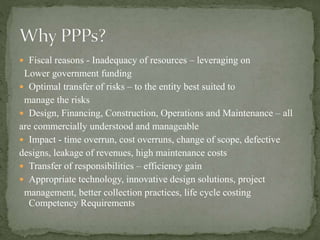
 Fiscal reasons - Inadequacy of resources – leveraging on
Lower government funding
 Optimal transfer of risks – to the entity best suited to
manage the risks
 Design, Financing, Construction, Operations and Maintenance – all
are commercially understood and manageable
 Impact - time overrun, cost overruns, change of scope, defective
designs, leakage of revenues, high maintenance costs
 Transfer of responsibilities – efficiency gain
 Appropriate technology, innovative design solutions, project
management, better collection practices, life cycle costing
Competency Requirements
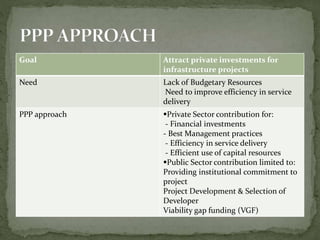
Goal Attract private investments for
infrastructure projects
Need Lack of Budgetary Resources
Need to improve efficiency in service
delivery
PPP approach Private Sector contribution for:
- Financial investments
- Best Management practices
- Efficiency in service delivery
- Efficient use of capital resources
Public Sector contribution limited to:
Providing institutional commitment to
project
Project Development & Selection of
Developer
Viability gap funding (VGF)
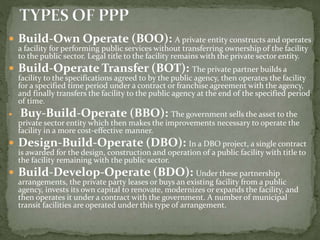
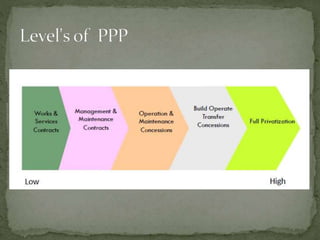
 Build-Own Operate (BOO): A private entity constructs and operates
a facility for performing public services without transferring ownership of the facility
to the public sector. Legal title to the facility remains with the private sector entity.
 Build-Operate Transfer (BOT): The private partner builds a
facility to the specifications agreed to by the public agency, then operates the facility
for a specified time period under a contract or franchise agreement with the agency,
and finally transfers the facility to the public agency at the end of the specified period
of time.
 Buy-Build-Operate (BBO): The government sells the asset to the
private sector entity which then makes the improvements necessary to operate the
facility in a more cost-effective manner.
 Design-Build-Operate (DBO): In a DBO project, a single contract
is awarded for the design, construction and operation of a public facility with title to
the facility remaining with the public sector.
 Build-Develop-Operate (BDO): Under these partnership
arrangements, the private party leases or buys an existing facility from a public
agency, invests its own capital to renovate, modernizes or expands the facility, and
then operates it under a contract with the government. A number of municipal
transit facilities are operated under this type of arrangement.
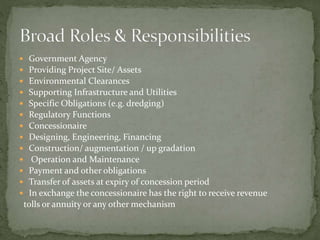
 Government Agency
 Providing Project Site/ Assets
 Environmental Clearances
 Supporting Infrastructure and Utilities
 Specific Obligations (e.g. dredging)
 Regulatory Functions
 Concessionaire
 Designing, Engineering, Financing
 Construction/ augmentation / up gradation
 Operation and Maintenance
 Payment and other obligations
 Transfer of assets at expiry of concession period
 In exchange the concessionaire has the right to receive revenue
tolls or annuity or any other mechanism
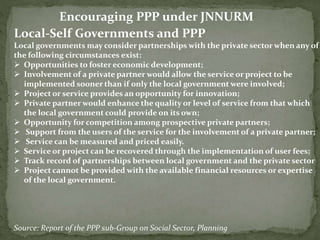
Local-Self Governments and PPP
Local governments may consider partnerships with the private sector when any of
the following circumstances exist:
 Opportunities to foster economic development;
 Involvement of a private partner would allow the service or project to be
implemented sooner than if only the local government were involved;
 Project or service provides an opportunity for innovation;
 Private partner would enhance the quality or level of service from that which
the local government could provide on its own;
 Opportunity for competition among prospective private partners;
 Support from the users of the service for the involvement of a private partner;
 Service can be measured and priced easily.
 Service or project can be recovered through the implementation of user fees;
 Track record of partnerships between local government and the private sector
 Project cannot be provided with the available financial resources or expertise
of the local government.
Source: Report of the PPP sub-Group on Social Sector, Planning
Encouraging PPP under JNNURM
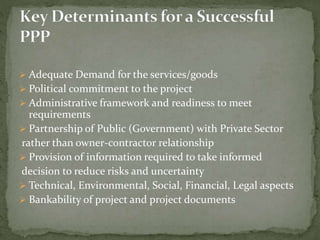
 Adequate Demand for the services/goods
 Political commitment to the project
 Administrative framework and readiness to meet
requirements
 Partnership of Public (Government) with Private Sector
rather than owner-contractor relationship
 Provision of information required to take informed
decision to reduce risks and uncertainty
 Technical, Environmental, Social, Financial, Legal aspects
 Bankability of project and project documents
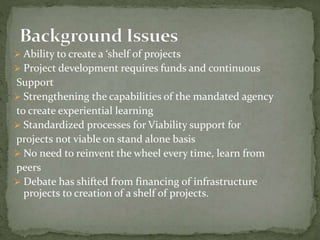
 Ability to create a ‘shelf of projects
 Project development requires funds and continuous
Support
 Strengthening the capabilities of the mandated agency
to create experiential learning
 Standardized processes for Viability support for
projects not viable on stand alone basis
 No need to reinvent the wheel every time, learn from
peers
 Debate has shifted from financing of infrastructure
projects to creation of a shelf of projects.
Background
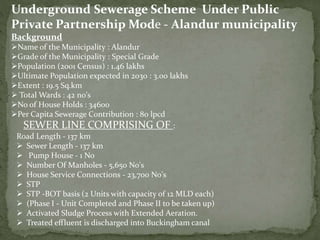
Name of the Municipality : Alandur
Grade of the Municipality : Special Grade
Population (2001 Census) : 1.46 lakhs
Ultimate Population expected in 2030 : 3.00 lakhs
Extent : 19.5 Sq.km
 Total Wards : 42 no's
No of House Holds : 34600
Per Capita Sewerage Contribution : 80 lpcd
Underground Sewerage Scheme Under Public
Private Partnership Mode - Alandur municipality
Road Length - 137 km
 Sewer Length - 137 km
 Pump House - 1 No
 Number Of Manholes - 5,650 No's
 House Service Connections - 23,700 No's
 STP
 STP -BOT basis (2 Units with capacity of 12 MLD each)
 (Phase I - Unit Completed and Phase II to be taken up)
 Activated Sludge Process with Extended Aeration.
 Treated effluent is discharged into Buckingham canal
SEWER LINE COMPRISING OF :
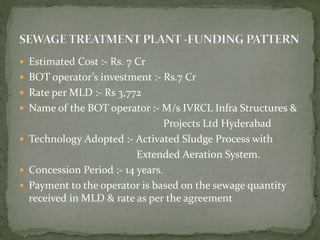
 Estimated Cost :- Rs. 7 Cr
 BOT operator’s investment :- Rs.7 Cr
 Rate per MLD :- Rs 3,772
 Name of the BOT operator :- M/s IVRCL Infra Structures &
Projects Ltd Hyderabad
 Technology Adopted :- Activated Sludge Process with
Extended Aeration System.
 Concession Period :- 14 years.
 Payment to the operator is based on the sewage quantity
received in MLD & rate as per the agreement
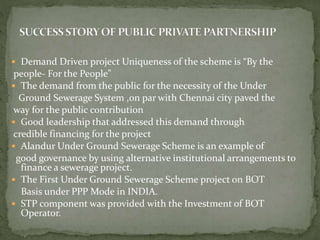
 Demand Driven project Uniqueness of the scheme is “By the
people- For the People”
 The demand from the public for the necessity of the Under
Ground Sewerage System ,on par with Chennai city paved the
way for the public contribution
 Good leadership that addressed this demand through
credible financing for the project
 Alandur Under Ground Sewerage Scheme is an example of
good governance by using alternative institutional arrangements to
finance a sewerage project.
 The First Under Ground Sewerage Scheme project on BOT
Basis under PPP Mode in INDIA.
 STP component was provided with the Investment of BOT
Operator.
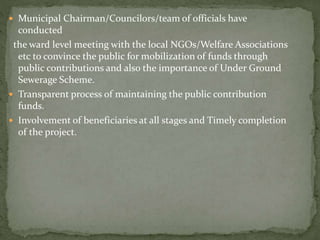
 Municipal Chairman/Councilors/team of officials have
conducted
the ward level meeting with the local NGOs/Welfare Associations
etc to convince the public for mobilization of funds through
public contributions and also the importance of Under Ground
Sewerage Scheme.
 Transparent process of maintaining the public contribution
funds.
 Involvement of beneficiaries at all stages and Timely completion
of the project.
 First sewerage scheme in India with public private
participation. Each household paying Rs.5000 for the
project.
 First BOT for STP Contractor constructed the STP -
operation and maintenance of the Sewage Treatment Plant
is for a period of 14 years.
 This STP has been given under BOT basis.
*Payment will be made by Municipality for the sewage
treated at agreed rate.
Thank you

Ppp

  • 1.
  • 2.
     Introduction  PPP Objectives of PPP  Types and approaches for PPP  Broad roles and responsibilities  Encouraging PPP under JNURM  Key determinants for PPP  Background issues  Case study - Alandur municipality
  • 3.
    A Public PrivatePartnership is an arrangement between a public (government) entity & a private (non-government) entity by which services that are the responsibility of/and have traditionally been delivered by the public entity are now to be provided by the private entity under a set of terms and conditions that are defined at the outset Accountability to users - still remains with government
  • 4.
     PPP isnot privatization or disinvestment  PPP is not about borrowing money from the private sector  PPP is more about creating a structure In which greater value for money is achieved for services through private sector innovation and management skills delivering significant improvement in service efficiency levels  This means that the public sector no longer builds roads, it purchases miles of maintained highway no longer builds prisons, it buys custodial services no longer operates ports but provides port services through world class operators  No longer builds power plants but purchases power
  • 5.
     Sourcing ofcapital to augment existing schemes or implement new schemes.  Introducing greater technical, operational and managerial expertise.  Introducing new technology.  Reducing public subsidies and redirecting them to the poor.  Making the sector more responsive to the customers Objectives of PPP
  • 6.
     A contractualrelationships between public and private sectors in infrastructure developments.  A cooperative venture between the public and private sectors, built on the expertise of each partner.  To meet clearly defined public needs through the appropriate allocation of resources, risks and rewards.  Reduces costs, increases construction and operation efficiencies, and improves service quality.  Utilizes private sector knowledge, expertise and capital..
  • 7.
    1. Growth ofPublic Debt 2. accounting fallacies to distinguish between recurrent and capital expenditure. 3. Traditional funding sources could not keep pace with growing Infrastructure needs. 4. Increase in demand for public services.
  • 8.
     Fiscal reasons- Inadequacy of resources – leveraging on Lower government funding  Optimal transfer of risks – to the entity best suited to manage the risks  Design, Financing, Construction, Operations and Maintenance – all are commercially understood and manageable  Impact - time overrun, cost overruns, change of scope, defective designs, leakage of revenues, high maintenance costs  Transfer of responsibilities – efficiency gain  Appropriate technology, innovative design solutions, project management, better collection practices, life cycle costing Competency Requirements
  • 9.
    Goal Attract privateinvestments for infrastructure projects Need Lack of Budgetary Resources Need to improve efficiency in service delivery PPP approach Private Sector contribution for: - Financial investments - Best Management practices - Efficiency in service delivery - Efficient use of capital resources Public Sector contribution limited to: Providing institutional commitment to project Project Development & Selection of Developer Viability gap funding (VGF)
  • 10.
     Build-Own Operate(BOO): A private entity constructs and operates a facility for performing public services without transferring ownership of the facility to the public sector. Legal title to the facility remains with the private sector entity.  Build-Operate Transfer (BOT): The private partner builds a facility to the specifications agreed to by the public agency, then operates the facility for a specified time period under a contract or franchise agreement with the agency, and finally transfers the facility to the public agency at the end of the specified period of time.  Buy-Build-Operate (BBO): The government sells the asset to the private sector entity which then makes the improvements necessary to operate the facility in a more cost-effective manner.  Design-Build-Operate (DBO): In a DBO project, a single contract is awarded for the design, construction and operation of a public facility with title to the facility remaining with the public sector.  Build-Develop-Operate (BDO): Under these partnership arrangements, the private party leases or buys an existing facility from a public agency, invests its own capital to renovate, modernizes or expands the facility, and then operates it under a contract with the government. A number of municipal transit facilities are operated under this type of arrangement.
  • 11.
     Government Agency Providing Project Site/ Assets  Environmental Clearances  Supporting Infrastructure and Utilities  Specific Obligations (e.g. dredging)  Regulatory Functions  Concessionaire  Designing, Engineering, Financing  Construction/ augmentation / up gradation  Operation and Maintenance  Payment and other obligations  Transfer of assets at expiry of concession period  In exchange the concessionaire has the right to receive revenue tolls or annuity or any other mechanism
  • 12.
    Local-Self Governments andPPP Local governments may consider partnerships with the private sector when any of the following circumstances exist:  Opportunities to foster economic development;  Involvement of a private partner would allow the service or project to be implemented sooner than if only the local government were involved;  Project or service provides an opportunity for innovation;  Private partner would enhance the quality or level of service from that which the local government could provide on its own;  Opportunity for competition among prospective private partners;  Support from the users of the service for the involvement of a private partner;  Service can be measured and priced easily.  Service or project can be recovered through the implementation of user fees;  Track record of partnerships between local government and the private sector  Project cannot be provided with the available financial resources or expertise of the local government. Source: Report of the PPP sub-Group on Social Sector, Planning Encouraging PPP under JNNURM
  • 14.
     Adequate Demandfor the services/goods  Political commitment to the project  Administrative framework and readiness to meet requirements  Partnership of Public (Government) with Private Sector rather than owner-contractor relationship  Provision of information required to take informed decision to reduce risks and uncertainty  Technical, Environmental, Social, Financial, Legal aspects  Bankability of project and project documents
  • 15.
     Ability tocreate a ‘shelf of projects  Project development requires funds and continuous Support  Strengthening the capabilities of the mandated agency to create experiential learning  Standardized processes for Viability support for projects not viable on stand alone basis  No need to reinvent the wheel every time, learn from peers  Debate has shifted from financing of infrastructure projects to creation of a shelf of projects.
  • 16.
    Background Name of theMunicipality : Alandur Grade of the Municipality : Special Grade Population (2001 Census) : 1.46 lakhs Ultimate Population expected in 2030 : 3.00 lakhs Extent : 19.5 Sq.km  Total Wards : 42 no's No of House Holds : 34600 Per Capita Sewerage Contribution : 80 lpcd Underground Sewerage Scheme Under Public Private Partnership Mode - Alandur municipality Road Length - 137 km  Sewer Length - 137 km  Pump House - 1 No  Number Of Manholes - 5,650 No's  House Service Connections - 23,700 No's  STP  STP -BOT basis (2 Units with capacity of 12 MLD each)  (Phase I - Unit Completed and Phase II to be taken up)  Activated Sludge Process with Extended Aeration.  Treated effluent is discharged into Buckingham canal SEWER LINE COMPRISING OF :
  • 17.
     Estimated Cost:- Rs. 7 Cr  BOT operator’s investment :- Rs.7 Cr  Rate per MLD :- Rs 3,772  Name of the BOT operator :- M/s IVRCL Infra Structures & Projects Ltd Hyderabad  Technology Adopted :- Activated Sludge Process with Extended Aeration System.  Concession Period :- 14 years.  Payment to the operator is based on the sewage quantity received in MLD & rate as per the agreement
  • 18.
     Demand Drivenproject Uniqueness of the scheme is “By the people- For the People”  The demand from the public for the necessity of the Under Ground Sewerage System ,on par with Chennai city paved the way for the public contribution  Good leadership that addressed this demand through credible financing for the project  Alandur Under Ground Sewerage Scheme is an example of good governance by using alternative institutional arrangements to finance a sewerage project.  The First Under Ground Sewerage Scheme project on BOT Basis under PPP Mode in INDIA.  STP component was provided with the Investment of BOT Operator.
  • 19.
     Municipal Chairman/Councilors/teamof officials have conducted the ward level meeting with the local NGOs/Welfare Associations etc to convince the public for mobilization of funds through public contributions and also the importance of Under Ground Sewerage Scheme.  Transparent process of maintaining the public contribution funds.  Involvement of beneficiaries at all stages and Timely completion of the project.
  • 20.
     First seweragescheme in India with public private participation. Each household paying Rs.5000 for the project.  First BOT for STP Contractor constructed the STP - operation and maintenance of the Sewage Treatment Plant is for a period of 14 years.  This STP has been given under BOT basis. *Payment will be made by Municipality for the sewage treated at agreed rate.
  • 21.