BUFFON’S NEEDLE &
                    Jason Yu – 6 th
 THE MONTE CARLO    03/10/2012

          METHOD
MONTE CARLO METHOD

There are usually several characteristics of the Monte Carlo
method:
   Define a domain of possible inputs.
   Generate inputs randomly from probability distribution over the
    domain.
   Perform a deterministic computation on the inputs.
   Aggregate the results.


  An early version of the Monte Carlo method can be seen in the Buffon’s
  Needle Experiment.
MONTE CARLO METHOD – WHY PI?

 The Monte Carlo method is heavily intertwined with the
  process of estimating pi.
 Let’s consider a circle inscribed in a unit square. If the circle
  and square have rations of areas that is pi/ 4, the value of pi
  can be approximated by using steps in the Monte Carlo
  method:
   Draw a square on the ground, then inscribe a circle within it.
   Uniformly scatter some objects of uniform size over the square.
   Count the number of objects inside the circle and the total # of
    objects.
   Lastly, the ration of the two counts will be an estimate of the ratio of
    the two areas, which is pi/4. Multiply the result by 4 and you should
    receive an estimate for pi.
GEORGE-
LOUIS
LECLERC
The pioneer of
t h e B u f fo n
Needle
ex p e r i me n t .
BUFFON’S NEEDLE – THE QUESTION

 In the 18 th Century, a French naturalist and renowned
  mathematician, George -Louis Leclerc, the Comte de
  Buf fon, proposed a question that states:


     “Suppose we have a floor made of parallel strips of wood, each the
     same width, and we drop a needle onto the floor. What is the
     probability that the needle will lie across a line between two strips?”
BUFFON’S NEEDLE – THE EXPERIMENT

 Buf fon’s needle, the earliest problem in geometric probability
  to be solved, can be solved using integral geometry.

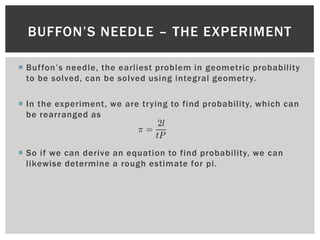
 In the experiment, we are trying to find probability, which can
  be rearranged as


 So if we can derive an equation to find probability, we can
  likewise determine a rough estimate for pi.
BUFFON’S NEEDLE – THE MATH

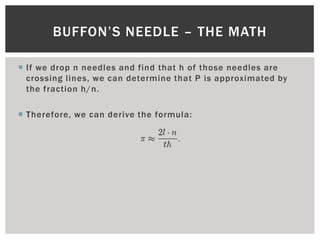
 If we drop n needles and find that h of those needles are
  crossing lines, we can determine that P is approximated by
  the fraction h/n.

 Therefore, we can derive the formula:
BUFFON’S NEEDLE – WHY PI?

 In 1901 Italian mathematician Mario Lazzarini performed the
  Buffon’s needle experiment and concluded, after tossing a
  needle 3408 times, that the estimate for pi was 355/113.

 This value is extremely accurate and differs from the actual
  value of pi by no more than 3E-7.

 However, there is some controversy surrounding this experiment
  as it would be rather easy to manipulate the results by simply
  repeating the process.

 For example, if one drops 213 needles and happens to get 113
  successes, then one can report an estimate of pi accurate to six
  decimal places. However, if this doesn’t work, one can still
  perform 213 more trials and hope for 226 successes.

Buffon Needle and the Monte Carlo Method

  • 1.
    BUFFON’S NEEDLE & Jason Yu – 6 th THE MONTE CARLO 03/10/2012 METHOD
  • 2.
    MONTE CARLO METHOD Thereare usually several characteristics of the Monte Carlo method:  Define a domain of possible inputs.  Generate inputs randomly from probability distribution over the domain.  Perform a deterministic computation on the inputs.  Aggregate the results. An early version of the Monte Carlo method can be seen in the Buffon’s Needle Experiment.
  • 3.
    MONTE CARLO METHOD– WHY PI?  The Monte Carlo method is heavily intertwined with the process of estimating pi.  Let’s consider a circle inscribed in a unit square. If the circle and square have rations of areas that is pi/ 4, the value of pi can be approximated by using steps in the Monte Carlo method:  Draw a square on the ground, then inscribe a circle within it.  Uniformly scatter some objects of uniform size over the square.  Count the number of objects inside the circle and the total # of objects.  Lastly, the ration of the two counts will be an estimate of the ratio of the two areas, which is pi/4. Multiply the result by 4 and you should receive an estimate for pi.
  • 4.
    GEORGE- LOUIS LECLERC The pioneer of th e B u f fo n Needle ex p e r i me n t .
  • 5.
    BUFFON’S NEEDLE –THE QUESTION  In the 18 th Century, a French naturalist and renowned mathematician, George -Louis Leclerc, the Comte de Buf fon, proposed a question that states: “Suppose we have a floor made of parallel strips of wood, each the same width, and we drop a needle onto the floor. What is the probability that the needle will lie across a line between two strips?”
  • 6.
    BUFFON’S NEEDLE –THE EXPERIMENT  Buf fon’s needle, the earliest problem in geometric probability to be solved, can be solved using integral geometry.  In the experiment, we are trying to find probability, which can be rearranged as  So if we can derive an equation to find probability, we can likewise determine a rough estimate for pi.
  • 7.
    BUFFON’S NEEDLE –THE MATH  If we drop n needles and find that h of those needles are crossing lines, we can determine that P is approximated by the fraction h/n.  Therefore, we can derive the formula:
  • 8.
    BUFFON’S NEEDLE –WHY PI?  In 1901 Italian mathematician Mario Lazzarini performed the Buffon’s needle experiment and concluded, after tossing a needle 3408 times, that the estimate for pi was 355/113.  This value is extremely accurate and differs from the actual value of pi by no more than 3E-7.  However, there is some controversy surrounding this experiment as it would be rather easy to manipulate the results by simply repeating the process.  For example, if one drops 213 needles and happens to get 113 successes, then one can report an estimate of pi accurate to six decimal places. However, if this doesn’t work, one can still perform 213 more trials and hope for 226 successes.