For Diploma, BE, ME, M Tech, BCA, MCA, PHD Project Guidance, Please Visit: www.ocularsystems.in Or
                                     Call Us On 7385665306


            Buffer Sizing for 802.11 Based Networks

Abstract:-


We consider the sizing of network buffers in 802.11 based networks.
Wireless networks face a number of fundamental issues that do not arise
in wired networks. We demonstrate that the use of fixed size buffers in
802.11 networks inevitably leads to either undesirable channel under-
utilization or unnecessary high delays. We present two novel dynamic
buffer sizing algorithms that achieve high throughput while maintaining
low delay across a wide range of network conditions. Experimental
measurements demonstrate the utility of the proposed algorithms in a
production WLAN and a lab test bed.


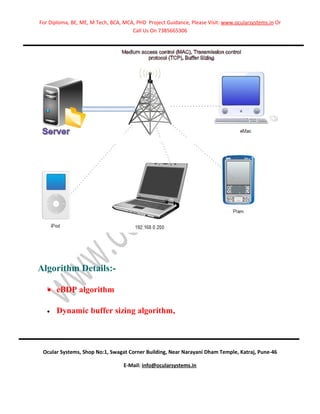
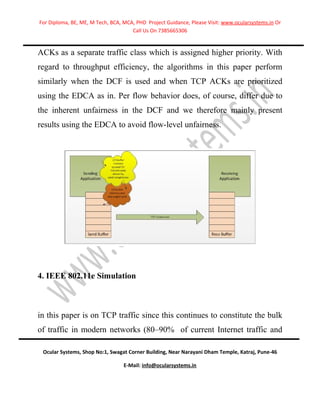
Architecture:-


 Ocular Systems, Shop No:1, Swagat Corner Building, Near Narayani Dham Temple, Katraj, Pune-46

                                  E-Mail: info@ocularsystems.in
For Diploma, BE, ME, M Tech, BCA, MCA, PHD Project Guidance, Please Visit: www.ocularsystems.in Or
                                     Call Us On 7385665306


Algorithm Details:-

   • eBDP algorithm

   •   Dynamic buffer sizing algorithm,


 Ocular Systems, Shop No:1, Swagat Corner Building, Near Narayani Dham Temple, Katraj, Pune-46

                                  E-Mail: info@ocularsystems.in
For Diploma, BE, ME, M Tech, BCA, MCA, PHD Project Guidance, Please Visit: www.ocularsystems.in Or
                                     Call Us On 7385665306


   • Adaptive Limit Tuning (ALT) Feedback Algorithm

Explanation:-

The algorithms in this paper perform similarly when the DCF is used
and when TCP ACKs are prioritized using the EDCA as in. Per flow
behavior does, of course, differ due to the inherent unfairness in the
DCF and we therefore mainly present results using the EDCA to avoid
flow-level unfairness
Abbreviation
DCF-Distributed Coordinated Function (DCF)
EDCA -Enhanced distributed channel access (EDCA)


Existing System:-

The distribution of packet service times is also strongly dependent on the
WLAN offered load. This directly affects the burstiness of transmissions
and so buffering requirements.
IEEE 802.11b support up to 11 MBps, sometimes this is not enough –
far lower than 100 Mbps fast Ethernet


 Ocular Systems, Shop No:1, Swagat Corner Building, Near Narayani Dham Temple, Katraj, Pune-46

                                  E-Mail: info@ocularsystems.in
For Diploma, BE, ME, M Tech, BCA, MCA, PHD Project Guidance, Please Visit: www.ocularsystems.in Or
                                     Call Us On 7385665306


In co-existing environment, the probability of frequency collision for
one 802.11 frame vary from 48% ~62%

Disadvantages

    Unaware of interference from/to other networks

    Weak security policy

           Poor performance (coverage, throughput, capacity, security)

           Unstable service

           Customer dissatisfaction


Proposed System:-

In this paper we demonstrate the major performance costs associated
with the use of fixed buffer sizes in 802.11WLANs and present two
novel dynamic buffer sizing algorithms that achieve significant
performance gains. The stability of the feedback loop induced by the
adaptation is analyzed, including when cascaded with the feedback loop
created by TCP congestion control action. using the A* algorithm


 Ocular Systems, Shop No:1, Swagat Corner Building, Near Narayani Dham Temple, Katraj, Pune-46

                                  E-Mail: info@ocularsystems.in
For Diploma, BE, ME, M Tech, BCA, MCA, PHD Project Guidance, Please Visit: www.ocularsystems.in Or
                                     Call Us On 7385665306


proposed in this paper, the RTTs observed when repeating the same
experiment fall to only 90-130 ms. This reduction in delay does not
come at the cost of reduced throughput, i.e., the measured throughput
with the A* algorithm and the default buffers is similar


in this paper is on TCP traffic since this continues to constitute the bulk
of traffic in modern networks (80–90% of current Internet traffic and
also of WLAN traffic ), although we extend consideration to UDP traffic
at various points during the discussion and also during our experimental
tests.


Advantages


             The reduction in network delay not only benefits UDP traffic,
              but also short-lived TCP connections

           Comes from easy maintenance, cabling cost, working
              efficiency and accuracy


 Ocular Systems, Shop No:1, Swagat Corner Building, Near Narayani Dham Temple, Katraj, Pune-46

                                  E-Mail: info@ocularsystems.in
For Diploma, BE, ME, M Tech, BCA, MCA, PHD Project Guidance, Please Visit: www.ocularsystems.in Or
                                     Call Us On 7385665306


           Network can be established in a new location just by moving
              the PCs!


Main Modules:-

1. Buffer Sizing


Buffers play a key role in 802.11/802.11e wireless networks. To
illustrate this, we present measurements from the production WLAN of
the Hamilton Institute, which show that the current state of the art which
makes use of fixed size buffers, can easily lead to poor performance. .
We recorded RTTs before and after one wireless station started to
download a 37MByte file from a web-site. Before starting the download,
we pinged the access point (AP) from a laptop 5 times, each time
sending 100 ping packets. The RTTs reported by the ping program was
between 2.6-3.2 ms. However, after starting This work is supported by
Irish Research Council for Science, Engineering and Technology and
Science Foundation Ireland Grant 07/IN.1/I901. the download and
allowing it to continue for a while (to let the congestion control
algorithm of TCP probe for the available bandwidth), the RTTs to the

 Ocular Systems, Shop No:1, Swagat Corner Building, Near Narayani Dham Temple, Katraj, Pune-46

                                  E-Mail: info@ocularsystems.in
For Diploma, BE, ME, M Tech, BCA, MCA, PHD Project Guidance, Please Visit: www.ocularsystems.in Or
                                     Call Us On 7385665306


AP hugely increased to 2900-3400 ms. During the test, normal services
such as web browsing experienced obvious pauses/lags on wireless
stations using the network. Closer inspection revealed that the buffer
occupancy at the AP exceeded 200 packets most of the time and reached
250 packets from time to time during the test. Note that the increase in
measured RTT could be almost entirely attributed to the resulting
queuing delay at the AP, and indicates that a more sophisticated
approach to buffer sizing is required.
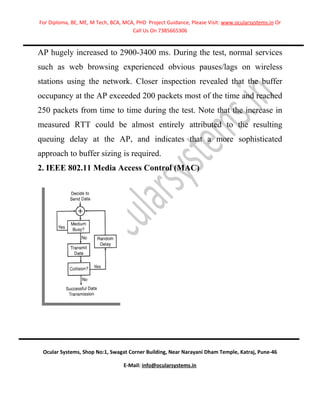
2. IEEE 802.11 Media Access Control (MAC)


 Ocular Systems, Shop No:1, Swagat Corner Building, Near Narayani Dham Temple, Katraj, Pune-46

                                  E-Mail: info@ocularsystems.in
For Diploma, BE, ME, M Tech, BCA, MCA, PHD Project Guidance, Please Visit: www.ocularsystems.in Or
                                     Call Us On 7385665306


Measured distribution of the MAC layer service time when there are 2
and 12 stations active. It can be seen that the mean service time changes
by over an order of magnitude as the number of stations varies. Observe
also from these measured distributions that there are significant
fluctuations in the service time for a given fixed load. This is a direct
consequence of the stochastic nature of the CSMA/CA contention
mechanism used by the 802.11/802.11e MAC.


3. TCP/IP packet in 802.11

Consider a WLAN consisting of n client stations each carrying one TCP
upload flow. The TCP ACKs are transmitted by the wireless AP. In this
case TCP ACK packets can be easily queued/dropped due to the fact that
the basic 802.11 DCF ensures that stations win a roughly equal number
of transmission opportunities. Namely, while the data packets for the n
flows have an aggregate n/(n + 1) share of the transmission opportunities
the TCP ACKs for the n flows have only a 1/(n+1) share. Issues of this
sort are known to lead to significant unfairness amongst TCP flows but
can be readily resolved using 802.11e functionality by treating TCP

 Ocular Systems, Shop No:1, Swagat Corner Building, Near Narayani Dham Temple, Katraj, Pune-46

                                  E-Mail: info@ocularsystems.in
For Diploma, BE, ME, M Tech, BCA, MCA, PHD Project Guidance, Please Visit: www.ocularsystems.in Or
                                     Call Us On 7385665306


ACKs as a separate traffic class which is assigned higher priority. With
regard to throughput efficiency, the algorithms in this paper perform
similarly when the DCF is used and when TCP ACKs are prioritized
using the EDCA as in. Per flow behavior does, of course, differ due to
the inherent unfairness in the DCF and we therefore mainly present
results using the EDCA to avoid flow-level unfairness.


4. IEEE 802.11e Simulation


in this paper is on TCP traffic since this continues to constitute the bulk
of traffic in modern networks (80–90% of current Internet traffic and

 Ocular Systems, Shop No:1, Swagat Corner Building, Near Narayani Dham Temple, Katraj, Pune-46

                                  E-Mail: info@ocularsystems.in
For Diploma, BE, ME, M Tech, BCA, MCA, PHD Project Guidance, Please Visit: www.ocularsystems.in Or
                                     Call Us On 7385665306


also of WLAN traffic), although we extend consideration to UDP traffic
at various points during the discussion and also during our experimental
tests.


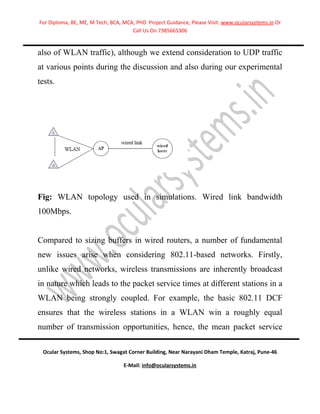
Fig: WLAN topology used in simulations. Wired link bandwidth
100Mbps.


Compared to sizing buffers in wired routers, a number of fundamental
new issues arise when considering 802.11-based networks. Firstly,
unlike wired networks, wireless transmissions are inherently broadcast
in nature which leads to the packet service times at different stations in a
WLAN being strongly coupled. For example, the basic 802.11 DCF
ensures that the wireless stations in a WLAN win a roughly equal
number of transmission opportunities, hence, the mean packet service

 Ocular Systems, Shop No:1, Swagat Corner Building, Near Narayani Dham Temple, Katraj, Pune-46

                                  E-Mail: info@ocularsystems.in
For Diploma, BE, ME, M Tech, BCA, MCA, PHD Project Guidance, Please Visit: www.ocularsystems.in Or
                                     Call Us On 7385665306


time at a station is an order of magnitude longer when 10 other stations
are active than when only a single station is active. Consequently, the
buffering requirements at each station would also differ, depending on
the number of other active stations in the WLAN


In this paper, in addition to extensive simulation results we also present
experimental measurements demonstrating the utility of the proposed
algorithms in a test bed located in office environment and with realistic
traffic. This latter includes a mix of TCP and UDP traffic


5. Traffic Mix, Adaptive Limit Tuning (ALT)

We configure the traffic mix on the network to capture the complexity of
real networks in order to help gain greater confidence in the practical
utility of the proposed buffer sizing approach.


 Ocular Systems, Shop No:1, Swagat Corner Building, Near Narayani Dham Temple, Katraj, Pune-46

                                  E-Mail: info@ocularsystems.in
For Diploma, BE, ME, M Tech, BCA, MCA, PHD Project Guidance, Please Visit: www.ocularsystems.in Or
                                     Call Us On 7385665306


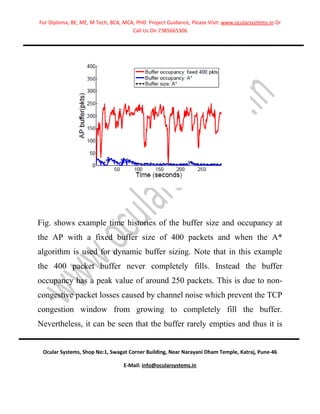
Fig. shows example time histories of the buffer size and occupancy at
the AP with a fixed buffer size of 400 packets and when the A*
algorithm is used for dynamic buffer sizing. Note that in this example
the 400 packet buffer never completely fills. Instead the buffer
occupancy has a peak value of around 250 packets. This is due to non-
congestive packet losses caused by channel noise which prevent the TCP
congestion window from growing to completely fill the buffer.
Nevertheless, it can be seen that the buffer rarely empties and thus it is


 Ocular Systems, Shop No:1, Swagat Corner Building, Near Narayani Dham Temple, Katraj, Pune-46

                                  E-Mail: info@ocularsystems.in
For Diploma, BE, ME, M Tech, BCA, MCA, PHD Project Guidance, Please Visit: www.ocularsystems.in Or
                                     Call Us On 7385665306


sufficient to provide an indication of the throughput when the wireless
link is fully utilized.


System Requirements:


Hardware Requirement:


    Minimum 1.1 GHz PROCESSOR should be on the computer.
    128 MB RAM.
    20 GB HDD.
    1.44 MB FDD.
    52x CD-ROM Drive.
    MONITORS at 800x600 minimum resolution at 256 colors
      minimum.
    I/O, One or two button mouse and standard 101-key keyboard.


Software Requirement:


             Operating System                  : Windows 95/98/2000/NT4.0.

 Ocular Systems, Shop No:1, Swagat Corner Building, Near Narayani Dham Temple, Katraj, Pune-46

                                  E-Mail: info@ocularsystems.in
For Diploma, BE, ME, M Tech, BCA, MCA, PHD Project Guidance, Please Visit: www.ocularsystems.in Or
                                     Call Us On 7385665306


              Technology                            : JAVA, JFC(Swing), JMF
              Development IDE                   : Eclipse 3.x


 Ocular Systems, Shop No:1, Swagat Corner Building, Near Narayani Dham Temple, Katraj, Pune-46

                                  E-Mail: info@ocularsystems.in

Buffer sizing for 802.11 based networks

  • 1.
    For Diploma, BE,ME, M Tech, BCA, MCA, PHD Project Guidance, Please Visit: www.ocularsystems.in Or Call Us On 7385665306 Buffer Sizing for 802.11 Based Networks Abstract:- We consider the sizing of network buffers in 802.11 based networks. Wireless networks face a number of fundamental issues that do not arise in wired networks. We demonstrate that the use of fixed size buffers in 802.11 networks inevitably leads to either undesirable channel under- utilization or unnecessary high delays. We present two novel dynamic buffer sizing algorithms that achieve high throughput while maintaining low delay across a wide range of network conditions. Experimental measurements demonstrate the utility of the proposed algorithms in a production WLAN and a lab test bed. Architecture:- Ocular Systems, Shop No:1, Swagat Corner Building, Near Narayani Dham Temple, Katraj, Pune-46 E-Mail: info@ocularsystems.in
  • 2.
    For Diploma, BE,ME, M Tech, BCA, MCA, PHD Project Guidance, Please Visit: www.ocularsystems.in Or Call Us On 7385665306 Algorithm Details:- • eBDP algorithm • Dynamic buffer sizing algorithm, Ocular Systems, Shop No:1, Swagat Corner Building, Near Narayani Dham Temple, Katraj, Pune-46 E-Mail: info@ocularsystems.in
  • 3.
    For Diploma, BE,ME, M Tech, BCA, MCA, PHD Project Guidance, Please Visit: www.ocularsystems.in Or Call Us On 7385665306 • Adaptive Limit Tuning (ALT) Feedback Algorithm Explanation:- The algorithms in this paper perform similarly when the DCF is used and when TCP ACKs are prioritized using the EDCA as in. Per flow behavior does, of course, differ due to the inherent unfairness in the DCF and we therefore mainly present results using the EDCA to avoid flow-level unfairness Abbreviation DCF-Distributed Coordinated Function (DCF) EDCA -Enhanced distributed channel access (EDCA) Existing System:- The distribution of packet service times is also strongly dependent on the WLAN offered load. This directly affects the burstiness of transmissions and so buffering requirements. IEEE 802.11b support up to 11 MBps, sometimes this is not enough – far lower than 100 Mbps fast Ethernet Ocular Systems, Shop No:1, Swagat Corner Building, Near Narayani Dham Temple, Katraj, Pune-46 E-Mail: info@ocularsystems.in
  • 4.
    For Diploma, BE,ME, M Tech, BCA, MCA, PHD Project Guidance, Please Visit: www.ocularsystems.in Or Call Us On 7385665306 In co-existing environment, the probability of frequency collision for one 802.11 frame vary from 48% ~62% Disadvantages  Unaware of interference from/to other networks  Weak security policy  Poor performance (coverage, throughput, capacity, security)  Unstable service  Customer dissatisfaction Proposed System:- In this paper we demonstrate the major performance costs associated with the use of fixed buffer sizes in 802.11WLANs and present two novel dynamic buffer sizing algorithms that achieve significant performance gains. The stability of the feedback loop induced by the adaptation is analyzed, including when cascaded with the feedback loop created by TCP congestion control action. using the A* algorithm Ocular Systems, Shop No:1, Swagat Corner Building, Near Narayani Dham Temple, Katraj, Pune-46 E-Mail: info@ocularsystems.in
  • 5.
    For Diploma, BE,ME, M Tech, BCA, MCA, PHD Project Guidance, Please Visit: www.ocularsystems.in Or Call Us On 7385665306 proposed in this paper, the RTTs observed when repeating the same experiment fall to only 90-130 ms. This reduction in delay does not come at the cost of reduced throughput, i.e., the measured throughput with the A* algorithm and the default buffers is similar in this paper is on TCP traffic since this continues to constitute the bulk of traffic in modern networks (80–90% of current Internet traffic and also of WLAN traffic ), although we extend consideration to UDP traffic at various points during the discussion and also during our experimental tests. Advantages  The reduction in network delay not only benefits UDP traffic, but also short-lived TCP connections  Comes from easy maintenance, cabling cost, working efficiency and accuracy Ocular Systems, Shop No:1, Swagat Corner Building, Near Narayani Dham Temple, Katraj, Pune-46 E-Mail: info@ocularsystems.in
  • 6.
    For Diploma, BE,ME, M Tech, BCA, MCA, PHD Project Guidance, Please Visit: www.ocularsystems.in Or Call Us On 7385665306  Network can be established in a new location just by moving the PCs! Main Modules:- 1. Buffer Sizing Buffers play a key role in 802.11/802.11e wireless networks. To illustrate this, we present measurements from the production WLAN of the Hamilton Institute, which show that the current state of the art which makes use of fixed size buffers, can easily lead to poor performance. . We recorded RTTs before and after one wireless station started to download a 37MByte file from a web-site. Before starting the download, we pinged the access point (AP) from a laptop 5 times, each time sending 100 ping packets. The RTTs reported by the ping program was between 2.6-3.2 ms. However, after starting This work is supported by Irish Research Council for Science, Engineering and Technology and Science Foundation Ireland Grant 07/IN.1/I901. the download and allowing it to continue for a while (to let the congestion control algorithm of TCP probe for the available bandwidth), the RTTs to the Ocular Systems, Shop No:1, Swagat Corner Building, Near Narayani Dham Temple, Katraj, Pune-46 E-Mail: info@ocularsystems.in
  • 7.
    For Diploma, BE,ME, M Tech, BCA, MCA, PHD Project Guidance, Please Visit: www.ocularsystems.in Or Call Us On 7385665306 AP hugely increased to 2900-3400 ms. During the test, normal services such as web browsing experienced obvious pauses/lags on wireless stations using the network. Closer inspection revealed that the buffer occupancy at the AP exceeded 200 packets most of the time and reached 250 packets from time to time during the test. Note that the increase in measured RTT could be almost entirely attributed to the resulting queuing delay at the AP, and indicates that a more sophisticated approach to buffer sizing is required. 2. IEEE 802.11 Media Access Control (MAC) Ocular Systems, Shop No:1, Swagat Corner Building, Near Narayani Dham Temple, Katraj, Pune-46 E-Mail: info@ocularsystems.in
  • 8.
    For Diploma, BE,ME, M Tech, BCA, MCA, PHD Project Guidance, Please Visit: www.ocularsystems.in Or Call Us On 7385665306 Measured distribution of the MAC layer service time when there are 2 and 12 stations active. It can be seen that the mean service time changes by over an order of magnitude as the number of stations varies. Observe also from these measured distributions that there are significant fluctuations in the service time for a given fixed load. This is a direct consequence of the stochastic nature of the CSMA/CA contention mechanism used by the 802.11/802.11e MAC. 3. TCP/IP packet in 802.11 Consider a WLAN consisting of n client stations each carrying one TCP upload flow. The TCP ACKs are transmitted by the wireless AP. In this case TCP ACK packets can be easily queued/dropped due to the fact that the basic 802.11 DCF ensures that stations win a roughly equal number of transmission opportunities. Namely, while the data packets for the n flows have an aggregate n/(n + 1) share of the transmission opportunities the TCP ACKs for the n flows have only a 1/(n+1) share. Issues of this sort are known to lead to significant unfairness amongst TCP flows but can be readily resolved using 802.11e functionality by treating TCP Ocular Systems, Shop No:1, Swagat Corner Building, Near Narayani Dham Temple, Katraj, Pune-46 E-Mail: info@ocularsystems.in
  • 9.
    For Diploma, BE,ME, M Tech, BCA, MCA, PHD Project Guidance, Please Visit: www.ocularsystems.in Or Call Us On 7385665306 ACKs as a separate traffic class which is assigned higher priority. With regard to throughput efficiency, the algorithms in this paper perform similarly when the DCF is used and when TCP ACKs are prioritized using the EDCA as in. Per flow behavior does, of course, differ due to the inherent unfairness in the DCF and we therefore mainly present results using the EDCA to avoid flow-level unfairness. 4. IEEE 802.11e Simulation in this paper is on TCP traffic since this continues to constitute the bulk of traffic in modern networks (80–90% of current Internet traffic and Ocular Systems, Shop No:1, Swagat Corner Building, Near Narayani Dham Temple, Katraj, Pune-46 E-Mail: info@ocularsystems.in
  • 10.
    For Diploma, BE,ME, M Tech, BCA, MCA, PHD Project Guidance, Please Visit: www.ocularsystems.in Or Call Us On 7385665306 also of WLAN traffic), although we extend consideration to UDP traffic at various points during the discussion and also during our experimental tests. Fig: WLAN topology used in simulations. Wired link bandwidth 100Mbps. Compared to sizing buffers in wired routers, a number of fundamental new issues arise when considering 802.11-based networks. Firstly, unlike wired networks, wireless transmissions are inherently broadcast in nature which leads to the packet service times at different stations in a WLAN being strongly coupled. For example, the basic 802.11 DCF ensures that the wireless stations in a WLAN win a roughly equal number of transmission opportunities, hence, the mean packet service Ocular Systems, Shop No:1, Swagat Corner Building, Near Narayani Dham Temple, Katraj, Pune-46 E-Mail: info@ocularsystems.in
  • 11.
    For Diploma, BE,ME, M Tech, BCA, MCA, PHD Project Guidance, Please Visit: www.ocularsystems.in Or Call Us On 7385665306 time at a station is an order of magnitude longer when 10 other stations are active than when only a single station is active. Consequently, the buffering requirements at each station would also differ, depending on the number of other active stations in the WLAN In this paper, in addition to extensive simulation results we also present experimental measurements demonstrating the utility of the proposed algorithms in a test bed located in office environment and with realistic traffic. This latter includes a mix of TCP and UDP traffic 5. Traffic Mix, Adaptive Limit Tuning (ALT) We configure the traffic mix on the network to capture the complexity of real networks in order to help gain greater confidence in the practical utility of the proposed buffer sizing approach. Ocular Systems, Shop No:1, Swagat Corner Building, Near Narayani Dham Temple, Katraj, Pune-46 E-Mail: info@ocularsystems.in
  • 12.
    For Diploma, BE,ME, M Tech, BCA, MCA, PHD Project Guidance, Please Visit: www.ocularsystems.in Or Call Us On 7385665306 Fig. shows example time histories of the buffer size and occupancy at the AP with a fixed buffer size of 400 packets and when the A* algorithm is used for dynamic buffer sizing. Note that in this example the 400 packet buffer never completely fills. Instead the buffer occupancy has a peak value of around 250 packets. This is due to non- congestive packet losses caused by channel noise which prevent the TCP congestion window from growing to completely fill the buffer. Nevertheless, it can be seen that the buffer rarely empties and thus it is Ocular Systems, Shop No:1, Swagat Corner Building, Near Narayani Dham Temple, Katraj, Pune-46 E-Mail: info@ocularsystems.in
  • 13.
    For Diploma, BE,ME, M Tech, BCA, MCA, PHD Project Guidance, Please Visit: www.ocularsystems.in Or Call Us On 7385665306 sufficient to provide an indication of the throughput when the wireless link is fully utilized. System Requirements: Hardware Requirement:  Minimum 1.1 GHz PROCESSOR should be on the computer.  128 MB RAM.  20 GB HDD.  1.44 MB FDD.  52x CD-ROM Drive.  MONITORS at 800x600 minimum resolution at 256 colors minimum.  I/O, One or two button mouse and standard 101-key keyboard. Software Requirement:  Operating System : Windows 95/98/2000/NT4.0. Ocular Systems, Shop No:1, Swagat Corner Building, Near Narayani Dham Temple, Katraj, Pune-46 E-Mail: info@ocularsystems.in
  • 14.
    For Diploma, BE,ME, M Tech, BCA, MCA, PHD Project Guidance, Please Visit: www.ocularsystems.in Or Call Us On 7385665306  Technology : JAVA, JFC(Swing), JMF  Development IDE : Eclipse 3.x Ocular Systems, Shop No:1, Swagat Corner Building, Near Narayani Dham Temple, Katraj, Pune-46 E-Mail: info@ocularsystems.in