B.Tech admission in India 
By: 
admission.edhole.com
2 
3. INFLUENCE LINES FOR 
STATICALLY DETERMINATE 
STRUCTURES 
admission.edhole.com
3 
3. INFLUENCE LINES FOR STATICALLY 
DETERMINATE STRUCTURES - AN OVERVIEW 
• Introduction - What is an influence line? 
• Influence lines for beams 
• Qualitative influence lines - Muller-Breslau Principle 
• Influence lines for floor girders 
• Influence lines for trusses 
• Live loads for bridges 
• Maximum influence at a point due to a series of 
concentrated loads 
• Absolute maximum shear and moment 
admission.edhole.com
4 
3.1 INTRODUCTION TO INFLUENCE LINES 
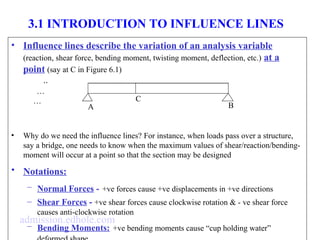
• Influence lines describe the variation of an analysis variable 
(reaction, shear force, bending moment, twisting moment, deflection, etc.) at a 
point (say at C in Figure 6.1) 
.. 
… 
… 
C 
A B 
• Why do we need the influence lines? For instance, when loads pass over a structure, 
say a bridge, one needs to know when the maximum values of shear/reaction/bending-moment 
will occur at a point so that the section may be designed 
• Notations: 
– Normal Forces - +ve forces cause +ve displacements in +ve directions 
– Shear Forces - +ve shear forces cause clockwise rotation & - ve shear force 
causes anti-clockwise rotation 
– Bending Moments: +ve bending moments cause “cup holding water” 
deformed shape 
admission.edhole.com
5 
3.2 INFLUENCE LINES FOR BEAMS 
• Procedure: 
(1) Allow a unit load (either 1b, 1N, 1kip, or 1 tonne) to move over beam 
from left to right 
(2) Find the values of shear force or bending moment, at the point under 
consideration, as the unit load moves over the beam from left to right 
(3) Plot the values of the shear force or bending moment, over the length of 
the beam, computed for the point under consideration 
admission.edhole.com
6 
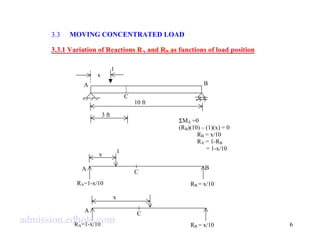
3.3 MOVING CONCENTRATED LOAD 
3.3.1 Variation of Reactions RA and RB as functions of load position 
SMA =0 
(RB)(10) – (1)(x) = 0 
RB = x/10 
RA = 1-RB 
= 1-x/10 
x 
1 
A B 
C 
10 ft 
3 ft 
x 1 
A B 
C 
RA=1-x/10 RB = x/10 
x 
A C 
RA=1-x/10 RB = x/10 admission.edhole.com
7 
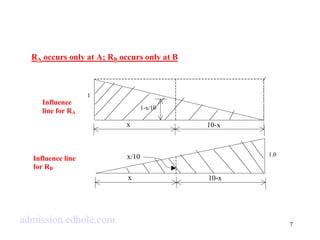
RA occurs only at A; RB occurs only at B 
Influence line 
for RB 
1-x/10 
1 
Influence 
line for RA 
x 10-x 
x/10 1.0 
x 10-x 
admission.edhole.com
8 
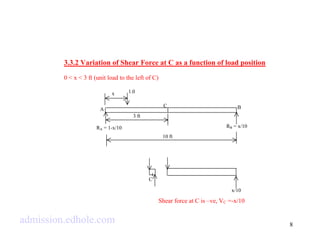
3.3.2 Variation of Shear Force at C as a function of load position 
0 < x < 3 ft (unit load to the left of C) 
C 
A B 
Shear force at C is –ve, VC =-x/10 
x 1.0 
3 ft 
RA = 1-x/10 RB = x/10 
10 ft 
x/10 
C 
admission.edhole.com
9 
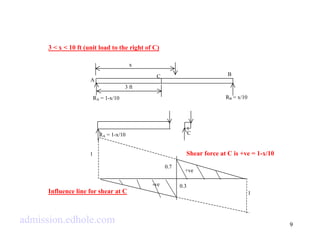
3 < x < 10 ft (unit load to the right of C) 
B 
Shear force at C is +ve = 1-x/10 
Influence line for shear at C 
C 
x 
3 ft 
A 
RA = 1-x/10 RB = x/10 
C 
1 
1 
-ve 
+ve 
0.3 
0.7 
RA = 1-x/10 
admission.edhole.com
10 
3.3.3 Variation of Bending Moment at C as a function of load position 
0 < x < 3.0 ft (Unit load to the left of C) 
C 
A B 
x/10 
Bending moment is +ve at C 
x 
3 ft 
RA = 1-x/10 RA = x/10 
10 ft 
C 
x/10 
x/10 
(x/10)(7) (x/10)(7) 
x/10 
admission.edhole.com
11 
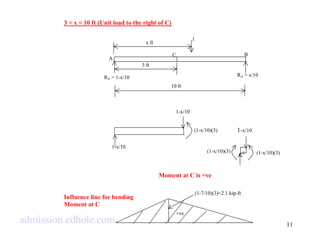
3 < x < 10 ft (Unit load to the right of C) 
Moment at C is +ve 
Influence line for bending 
Moment at C 
C 
x ft 
3 ft 
A 
RA = 1-x/10 
10 ft 
B 
1-x/10 
C 
1-x/10 
(1-x/10)(3) 
(1-x/10)(3) 
1 
RA = x/10 
1-x/10 
(1-x/10)(3) 
+ve 
(1-7/10)(3)=2.1 kip-ft 
admission.edhole.com
12 
3.4 QUALITATIVE INFLUENCED LINES - MULLER-BRESLAU’S 
PRINCIPLE 
• The principle gives only a procedure to determine of the influence line of a 
parameter for a determinate or an indeterminate structure 
• But using the basic understanding of the influence lines, the 
magnitudes of the influence lines also can be computed 
• In order to draw the shape of the influence lines properly, the capacity of the 
beam to resist the parameter investigated (reaction, bending moment, shear 
force, etc.), at that point, must be removed 
• The principle states that:The influence line for a parameter (say, reaction, 
shear or bending moment), at a point, is to the same scale as the deflected 
shape of the beam, when the beam is acted upon by that parameter. 
– The capacity of the beam to resist that parameter, at that point, must be 
removed. 
– Then allow the beam to deflect under that parameter 
– Positive directions of the forces are the same as before
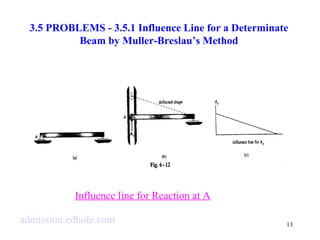
3.5 PROBLEMS - 3.5.1 Influence Line for a Determinate 
13 
Beam by Muller-Breslau’s Method 
Influence line for Reaction at A 
admission.edhole.com
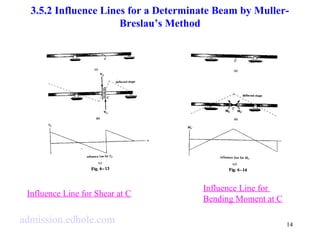
3.5.2 Influence Lines for a Determinate Beam by Muller- 
14 
Breslau’s Method 
Influence Line for Shear at C Influence Line for 
Bending Moment at C 
admission.edhole.com
15 
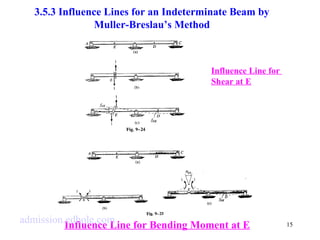
3.5.3 Influence Lines for an Indeterminate Beam by 
Muller-Breslau’s Method 
Influence Line for 
Shear at E 
admission.edhole.com 
Influence Line for Bending Moment at E
16 
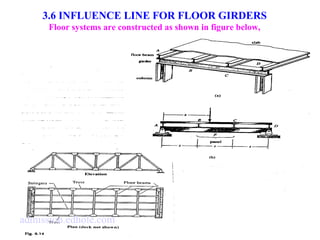
3.6 INFLUENCE LINE FOR FLOOR GIRDERS 
Floor systems are constructed as shown in figure below, 
admission.edhole.com
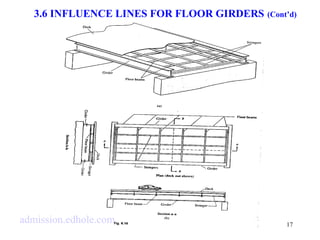
3.6 INFLUENCE LINES FOR FLOOR GIRDERS (Cont’d) 
17 
admission.edhole.com
3.6 INFLUENCE LINES FOR FLOOR GIRDERS (Cont’d) 
3.6.1 Force Equilibrium Method: 
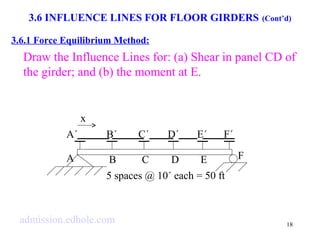
Draw the Influence Lines for: (a) Shear in panel CD of 
the girder; and (b) the moment at E. 
18 
x 
A´ B´ C´ D´ E´ F´ 
A B C D E F 
5 spaces @ 10´ each = 50 ft 
admission.edhole.com
19 
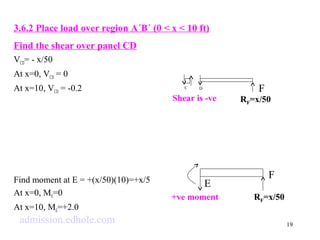
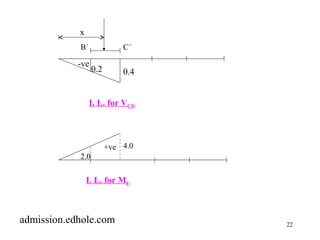
3.6.2 Place load over region A´B´ (0 < x < 10 ft) 
Find the shear over panel CD 
VCD= - x/50 
At x=0, VCD = 0 
At x=10, VCD = -0.2 
Find moment at E = +(x/50)(10)=+x/5 
At x=0, ME=0 
At x=10, ME=+2.0 
C D 
F 
Shear is -ve RF=x/50 
F 
RF=x/50 
E 
+ve moment 
admission.edhole.com
20 
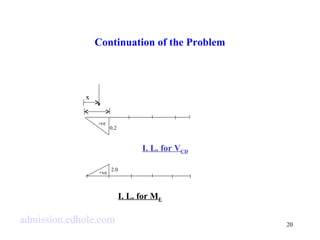
Continuation of the Problem 
-ve 
0.2 
+ve 2.0 
x 
I. L. for VCD 
I. L. for ME 
admission.edhole.com
21 
Problem Continued - 
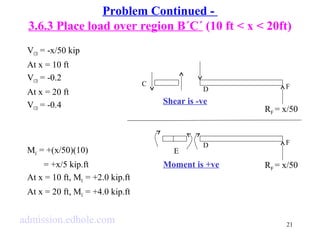
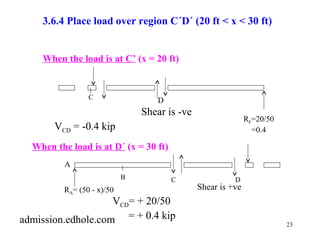
3.6.3 Place load over region B´C´ (10 ft < x < 20ft) 
VCD = -x/50 kip 
At x = 10 ft 
VCD = -0.2 
At x = 20 ft 
VCD = -0.4 
ME = +(x/50)(10) 
= +x/5 kip.ft 
At x = 10 ft, ME = +2.0 kip.ft 
At x = 20 ft, ME = +4.0 kip.ft 
D C F 
Shear is -ve 
RF = x/50 
D F 
RF = x/50 
E 
Moment is +ve 
admission.edhole.com
22 
x 
B´ C´ 
0.2 0.4 -ve 
I. L. for VCD 
+ve 4.0 
2.0 
I. L. for ME 
admission.edhole.com
23 
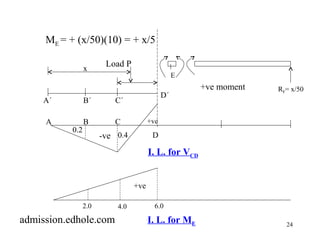
3.6.4 Place load over region C´D´ (20 ft < x < 30 ft) 
When the load is at C’ (x = 20 ft) 
C D 
RF=20/50 
=0.4 
Shear is -ve 
VCD = -0.4 kip 
When the load is at D´ (x = 30 ft) 
A 
RA= (50 - x)/50 
B C D 
Shear is +ve 
VCD= + 20/50 
admission.edhole.com = + 0.4 kip
24 
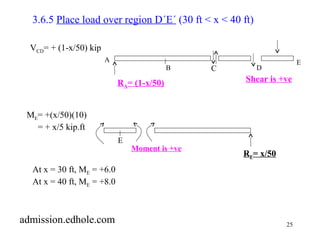
ME = + (x/50)(10) = + x/5 
E 
+ve moment RF= x/50 
A B C 
-ve 
D 
A´ B´ C´ 
D´ 
x 
+ve 
0.4 
0.2 
I. L. for VCD 
+ve 
2.0 4.0 6.0 
I. L. for ME 
Load P 
admission.edhole.com
25 
3.6.5 Place load over region D´E´ (30 ft < x < 40 ft) 
A 
B C D 
E 
RA= (1-x/50) Shear is +ve 
VCD= + (1-x/50) kip 
RF Moment is +ve = x/50 
E 
ME= +(x/50)(10) 
= + x/5 kip.ft 
At x = 30 ft, ME = +6.0 
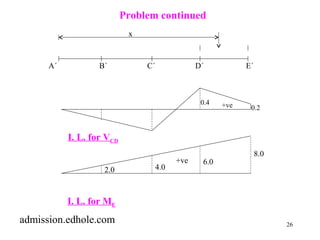
At x = 40 ft, ME = +8.0 
admission.edhole.com
26 
x 
A´ B´ C´ D´ E´ 
0.4 
+ve 0.2 
+ve 
8.0 
6.0 
I. L. for VCD 
2.0 4.0 
I. L. for ME 
Problem continued 
admission.edhole.com
27 
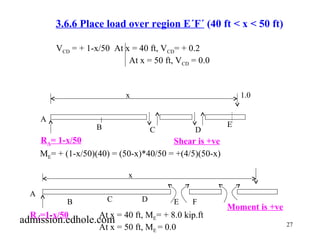
3.6.6 Place load over region E´F´ (40 ft < x < 50 ft) 
VCD = + 1-x/50 At x = 40 ft, VCD= + 0.2 
At x = 50 ft, VCD = 0.0 
x 1.0 
A 
B C D 
E 
RA= 1-x/50 Shear is +ve 
ME= + (1-x/50)(40) = (50-x)*40/50 = +(4/5)(50-x) 
B C D E F 
A 
x 
RA=1-x/50 At x = 40 ft, ME= + 8.0 kip.ft 
At x = 50 ft, ME = 0.0 
Moment is +ve 
admission.edhole.com
28 
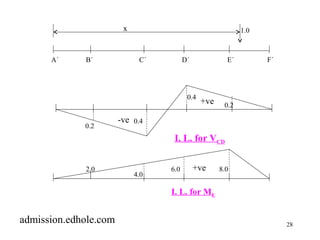
x 1.0 
A´ B´ C´ D´ E´ F´ 
0.2 
0.4 
0.4 
0.2 
2.0 
4.0 
I. L. for VCD 
6.0 8.0 
I. L. for ME 
-ve 
+ve 
+ve 
admission.edhole.com
29 
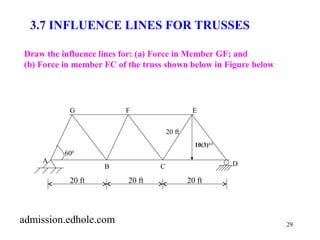
3.7 INFLUENCE LINES FOR TRUSSES 
Draw the influence lines for: (a) Force in Member GF; and 
(b) Force in member FC of the truss shown below in Figure below 
F 
B C D 
G 
20 ft 20 ft 20 ft 
A 
E 
600 
20 ft 
10(3)1/3 
admission.edhole.com
30 
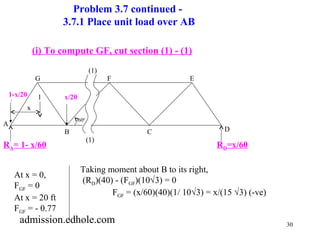
Problem 3.7 continued - 
3.7.1 Place unit load over AB 
(i) To compute GF, cut section (1) - (1) 
(1) 
G F E 
Taking moment about B to its right, 
(RD)(40) - (FGF)(10Ö3) = 0 
FGF = (x/60)(40)(1/ 10Ö3) = x/(15 Ö3) (-ve) 
1-x/20 1 x/20 
At x = 0, 
FGF = 0 
At x = 20 ft 
FGF = - 0.77 
(1) 
A 
B C D 
x 
600 
RA= 1- x/60 RD=x/60 
admission.edhole.com
31 
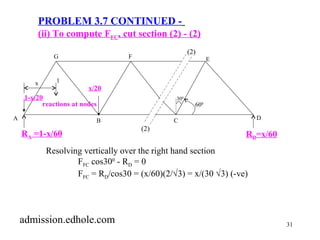
PROBLEM 3.7 CONTINUED - 
(ii) To compute FFC, cut section (2) - (2) 
G F E 
reactions at nodes 
Resolving vertically over the right hand section 
FFC cos300 - RD = 0 
FFC = RD/cos30 = (x/60)(2/Ö3) = x/(30 Ö3) (-ve) 
x 1 
1-x/20 
x/20 
(2) 
(2) 
300 
600 
A B C D 
RA =1-x/60 RD=x/60 
admission.edhole.com
32 
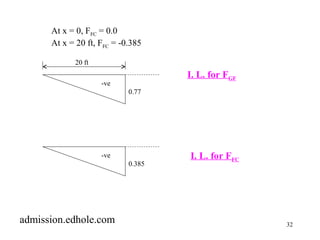
At x = 0, FFC = 0.0 
At x = 20 ft, FFC = -0.385 
I. L. for FGF 
I. L. for FFC 
0.77 
20 ft 
-ve 
0.385 
-ve 
admission.edhole.com
33 
PROBLEM 3.7 Continued - 
3.7.2 Place unit load over BC (20 ft < x <40 ft) 
[Section (1) - (1) is valid for 20 < x < 40 ft] 
(i) To compute FGF use section (1) -(1) 
G F E 
(1) 
(1) 
Taking moment about B, to its left, 
(RA)(20) - (FGF)(10Ö3) = 0 
FGF = (20RA)/(10Ö3) = (1-x/60)(2 /Ö3) 
At x = 20 ft, FFG = 0.77 (-ve) 
At x = 40 ft, FFG = 0.385 (-ve) 
A 
B C D 
x 
(40-x)/20 
1 (x-20)/20 
reactions at nodes 
20 ft 
RA=1-x/60 RD(x-20) (40-x) =x/60 
admission.edhole.com
34 
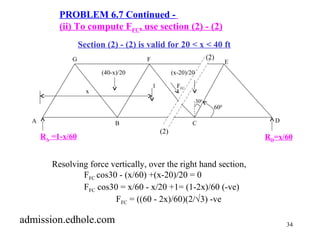
PROBLEM 6.7 Continued - 
(ii) To compute FFC, use section (2) - (2) 
Section (2) - (2) is valid for 20 < x < 40 ft 
(2) 
G F E 
(40-x)/20 (x-20)/20 
FFC 
Resolving force vertically, over the right hand section, 
FFC cos30 - (x/60) +(x-20)/20 = 0 
FFC cos30 = x/60 - x/20 +1= (1-2x)/60 (-ve) 
FFC = ((60 - 2x)/60)(2/Ö3) -ve 
x 
1 
(2) 
300 
600 
A B C D 
RA =1-x/60 RD=x/60 
admission.edhole.com
35 
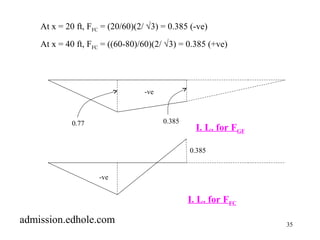
At x = 20 ft, FFC = (20/60)(2/ Ö3) = 0.385 (-ve) 
At x = 40 ft, FFC = ((60-80)/60)(2/ Ö3) = 0.385 (+ve) 
-ve 
0.77 0.385 
-ve 
I. L. for FGF 
0.385 
I. L. for FFC 
admission.edhole.com
36 
PROBLEM 3.7 Continued - 
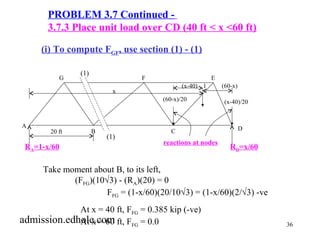
3.7.3 Place unit load over CD (40 ft < x <60 ft) 
(i) To compute FGF, use section (1) - (1) 
G F E 
x 
(1) 
(1) 
Take moment about B, to its left, 
(x-40) 1 
(60-x) 
(60-x)/20 (x-40)/20 
(FFG)(10Ö3) - (RA)(20) = 0 
FFG = (1-x/60)(20/10Ö3) = (1-x/60)(2/Ö3) -ve 
At x = 40 ft, FFG = 0.385 kip (-ve) 
At x = 60 ft, FFG = 0.0 
A 
B C D 
reactions at nodes 
20 ft 
RA=1-x/60 RD=x/60 
admission.edhole.com
37 
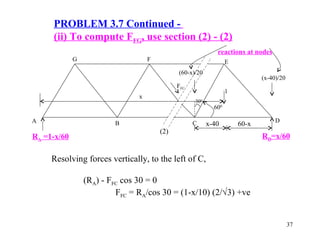
PROBLEM 3.7 Continued - 
(ii) To compute FFG, use section (2) - (2) 
reactions at nodes 
G F E 
x 
A B C D 
(2) 
300 
Resolving forces vertically, to the left of C, 
(RA) - FFC cos 30 = 0 
1 
600 
FFC = RA/cos 30 = (1-x/10) (2/Ö3) +ve 
RA =1-x/60 
(60-x)/20 
(x-40)/20 
FFC 
RD=x/60 
x-40 60-x
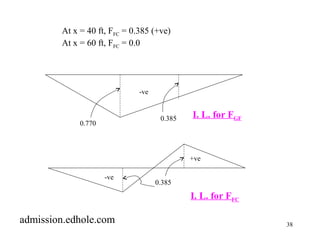
38 
At x = 40 ft, FFC = 0.385 (+ve) 
At x = 60 ft, FFC = 0.0 
-ve 
0.770 
0.385 
-ve 
I. L. for FGF 
+ve 
I. L. for FFC 
0.385 
admission.edhole.com
3.8 MAXIMUM SHEAR FORCE AND BENDING MOMENT 
39 
UNDER A SERIES OF CONCENTRATED LOADS 
a1 a2 a3 
x 
PR= resultant load 
a1 a2 a3 
C.L. 
x 
Taking moment about A, 
RE ´ L = PR ´[L/2 - (x -x)] 
R PR 
E = - + 
(L / 2 x x) 
L 
x 
PR= resultant load 
L/2 
L RE 
A 
B C D 
E 
P1 
P2 P3 P4 
P1 P2 
P3 P4 
RA 
admission.edhole.com
40 
Taking moment about E, 
R ´ L = P ´ L + x - 
x 
A R 
R P 
= R 
+ - 
M = R ´ L + x - P a + a - P ´ 
a 
D A 
P 
= + - + - + - ´ 
0 
[ / 2 ( )] 
( / 2 ) 
1 1 2 2 2 
( / 2 )( / 2 ) ( ) ( ) 
L x x P 
P 
dM 
= 
= + - + + - 
0 R ( / 2 ) R 
( / 2 )( 1) 
L x x L x 
= + - - - 
[( / 2) ( / 2) ] 
P 
L 
i e x x 
- = 
. ., 2 0 
x 2 
x 
2 
( / 2 ) ( ) 
1 1 2 2 2 
= 
x x 
L x 
L 
L 
dx 
L x x L x P a a P a 
L 
L x x 
L 
R 
D 
R 
A 
= 
The centerline must divide the distance between the resultant of 
all the loads in the moving series of loads and the load considered 
admuisnsdieorn w.ehdichho mlea.cxoimmum bending moment occurs.

B.tech admission in india

  • 1.
    B.Tech admission inIndia By: admission.edhole.com
  • 2.
    2 3. INFLUENCELINES FOR STATICALLY DETERMINATE STRUCTURES admission.edhole.com
  • 3.
    3 3. INFLUENCELINES FOR STATICALLY DETERMINATE STRUCTURES - AN OVERVIEW • Introduction - What is an influence line? • Influence lines for beams • Qualitative influence lines - Muller-Breslau Principle • Influence lines for floor girders • Influence lines for trusses • Live loads for bridges • Maximum influence at a point due to a series of concentrated loads • Absolute maximum shear and moment admission.edhole.com
  • 4.
    4 3.1 INTRODUCTIONTO INFLUENCE LINES • Influence lines describe the variation of an analysis variable (reaction, shear force, bending moment, twisting moment, deflection, etc.) at a point (say at C in Figure 6.1) .. … … C A B • Why do we need the influence lines? For instance, when loads pass over a structure, say a bridge, one needs to know when the maximum values of shear/reaction/bending-moment will occur at a point so that the section may be designed • Notations: – Normal Forces - +ve forces cause +ve displacements in +ve directions – Shear Forces - +ve shear forces cause clockwise rotation & - ve shear force causes anti-clockwise rotation – Bending Moments: +ve bending moments cause “cup holding water” deformed shape admission.edhole.com
  • 5.
    5 3.2 INFLUENCELINES FOR BEAMS • Procedure: (1) Allow a unit load (either 1b, 1N, 1kip, or 1 tonne) to move over beam from left to right (2) Find the values of shear force or bending moment, at the point under consideration, as the unit load moves over the beam from left to right (3) Plot the values of the shear force or bending moment, over the length of the beam, computed for the point under consideration admission.edhole.com
  • 6.
    6 3.3 MOVINGCONCENTRATED LOAD 3.3.1 Variation of Reactions RA and RB as functions of load position SMA =0 (RB)(10) – (1)(x) = 0 RB = x/10 RA = 1-RB = 1-x/10 x 1 A B C 10 ft 3 ft x 1 A B C RA=1-x/10 RB = x/10 x A C RA=1-x/10 RB = x/10 admission.edhole.com
  • 7.
    7 RA occursonly at A; RB occurs only at B Influence line for RB 1-x/10 1 Influence line for RA x 10-x x/10 1.0 x 10-x admission.edhole.com
  • 8.
    8 3.3.2 Variationof Shear Force at C as a function of load position 0 < x < 3 ft (unit load to the left of C) C A B Shear force at C is –ve, VC =-x/10 x 1.0 3 ft RA = 1-x/10 RB = x/10 10 ft x/10 C admission.edhole.com
  • 9.
    9 3 <x < 10 ft (unit load to the right of C) B Shear force at C is +ve = 1-x/10 Influence line for shear at C C x 3 ft A RA = 1-x/10 RB = x/10 C 1 1 -ve +ve 0.3 0.7 RA = 1-x/10 admission.edhole.com
  • 10.
    10 3.3.3 Variationof Bending Moment at C as a function of load position 0 < x < 3.0 ft (Unit load to the left of C) C A B x/10 Bending moment is +ve at C x 3 ft RA = 1-x/10 RA = x/10 10 ft C x/10 x/10 (x/10)(7) (x/10)(7) x/10 admission.edhole.com
  • 11.
    11 3 <x < 10 ft (Unit load to the right of C) Moment at C is +ve Influence line for bending Moment at C C x ft 3 ft A RA = 1-x/10 10 ft B 1-x/10 C 1-x/10 (1-x/10)(3) (1-x/10)(3) 1 RA = x/10 1-x/10 (1-x/10)(3) +ve (1-7/10)(3)=2.1 kip-ft admission.edhole.com
  • 12.
    12 3.4 QUALITATIVEINFLUENCED LINES - MULLER-BRESLAU’S PRINCIPLE • The principle gives only a procedure to determine of the influence line of a parameter for a determinate or an indeterminate structure • But using the basic understanding of the influence lines, the magnitudes of the influence lines also can be computed • In order to draw the shape of the influence lines properly, the capacity of the beam to resist the parameter investigated (reaction, bending moment, shear force, etc.), at that point, must be removed • The principle states that:The influence line for a parameter (say, reaction, shear or bending moment), at a point, is to the same scale as the deflected shape of the beam, when the beam is acted upon by that parameter. – The capacity of the beam to resist that parameter, at that point, must be removed. – Then allow the beam to deflect under that parameter – Positive directions of the forces are the same as before
  • 13.
    3.5 PROBLEMS -3.5.1 Influence Line for a Determinate 13 Beam by Muller-Breslau’s Method Influence line for Reaction at A admission.edhole.com
  • 14.
    3.5.2 Influence Linesfor a Determinate Beam by Muller- 14 Breslau’s Method Influence Line for Shear at C Influence Line for Bending Moment at C admission.edhole.com
  • 15.
    15 3.5.3 InfluenceLines for an Indeterminate Beam by Muller-Breslau’s Method Influence Line for Shear at E admission.edhole.com Influence Line for Bending Moment at E
  • 16.
    16 3.6 INFLUENCELINE FOR FLOOR GIRDERS Floor systems are constructed as shown in figure below, admission.edhole.com
  • 17.
    3.6 INFLUENCE LINESFOR FLOOR GIRDERS (Cont’d) 17 admission.edhole.com
  • 18.
    3.6 INFLUENCE LINESFOR FLOOR GIRDERS (Cont’d) 3.6.1 Force Equilibrium Method: Draw the Influence Lines for: (a) Shear in panel CD of the girder; and (b) the moment at E. 18 x A´ B´ C´ D´ E´ F´ A B C D E F 5 spaces @ 10´ each = 50 ft admission.edhole.com
  • 19.
    19 3.6.2 Placeload over region A´B´ (0 < x < 10 ft) Find the shear over panel CD VCD= - x/50 At x=0, VCD = 0 At x=10, VCD = -0.2 Find moment at E = +(x/50)(10)=+x/5 At x=0, ME=0 At x=10, ME=+2.0 C D F Shear is -ve RF=x/50 F RF=x/50 E +ve moment admission.edhole.com
  • 20.
    20 Continuation ofthe Problem -ve 0.2 +ve 2.0 x I. L. for VCD I. L. for ME admission.edhole.com
  • 21.
    21 Problem Continued- 3.6.3 Place load over region B´C´ (10 ft < x < 20ft) VCD = -x/50 kip At x = 10 ft VCD = -0.2 At x = 20 ft VCD = -0.4 ME = +(x/50)(10) = +x/5 kip.ft At x = 10 ft, ME = +2.0 kip.ft At x = 20 ft, ME = +4.0 kip.ft D C F Shear is -ve RF = x/50 D F RF = x/50 E Moment is +ve admission.edhole.com
  • 22.
    22 x B´C´ 0.2 0.4 -ve I. L. for VCD +ve 4.0 2.0 I. L. for ME admission.edhole.com
  • 23.
    23 3.6.4 Placeload over region C´D´ (20 ft < x < 30 ft) When the load is at C’ (x = 20 ft) C D RF=20/50 =0.4 Shear is -ve VCD = -0.4 kip When the load is at D´ (x = 30 ft) A RA= (50 - x)/50 B C D Shear is +ve VCD= + 20/50 admission.edhole.com = + 0.4 kip
  • 24.
    24 ME =+ (x/50)(10) = + x/5 E +ve moment RF= x/50 A B C -ve D A´ B´ C´ D´ x +ve 0.4 0.2 I. L. for VCD +ve 2.0 4.0 6.0 I. L. for ME Load P admission.edhole.com
  • 25.
    25 3.6.5 Placeload over region D´E´ (30 ft < x < 40 ft) A B C D E RA= (1-x/50) Shear is +ve VCD= + (1-x/50) kip RF Moment is +ve = x/50 E ME= +(x/50)(10) = + x/5 kip.ft At x = 30 ft, ME = +6.0 At x = 40 ft, ME = +8.0 admission.edhole.com
  • 26.
    26 x A´B´ C´ D´ E´ 0.4 +ve 0.2 +ve 8.0 6.0 I. L. for VCD 2.0 4.0 I. L. for ME Problem continued admission.edhole.com
  • 27.
    27 3.6.6 Placeload over region E´F´ (40 ft < x < 50 ft) VCD = + 1-x/50 At x = 40 ft, VCD= + 0.2 At x = 50 ft, VCD = 0.0 x 1.0 A B C D E RA= 1-x/50 Shear is +ve ME= + (1-x/50)(40) = (50-x)*40/50 = +(4/5)(50-x) B C D E F A x RA=1-x/50 At x = 40 ft, ME= + 8.0 kip.ft At x = 50 ft, ME = 0.0 Moment is +ve admission.edhole.com
  • 28.
    28 x 1.0 A´ B´ C´ D´ E´ F´ 0.2 0.4 0.4 0.2 2.0 4.0 I. L. for VCD 6.0 8.0 I. L. for ME -ve +ve +ve admission.edhole.com
  • 29.
    29 3.7 INFLUENCELINES FOR TRUSSES Draw the influence lines for: (a) Force in Member GF; and (b) Force in member FC of the truss shown below in Figure below F B C D G 20 ft 20 ft 20 ft A E 600 20 ft 10(3)1/3 admission.edhole.com
  • 30.
    30 Problem 3.7continued - 3.7.1 Place unit load over AB (i) To compute GF, cut section (1) - (1) (1) G F E Taking moment about B to its right, (RD)(40) - (FGF)(10Ö3) = 0 FGF = (x/60)(40)(1/ 10Ö3) = x/(15 Ö3) (-ve) 1-x/20 1 x/20 At x = 0, FGF = 0 At x = 20 ft FGF = - 0.77 (1) A B C D x 600 RA= 1- x/60 RD=x/60 admission.edhole.com
  • 31.
    31 PROBLEM 3.7CONTINUED - (ii) To compute FFC, cut section (2) - (2) G F E reactions at nodes Resolving vertically over the right hand section FFC cos300 - RD = 0 FFC = RD/cos30 = (x/60)(2/Ö3) = x/(30 Ö3) (-ve) x 1 1-x/20 x/20 (2) (2) 300 600 A B C D RA =1-x/60 RD=x/60 admission.edhole.com
  • 32.
    32 At x= 0, FFC = 0.0 At x = 20 ft, FFC = -0.385 I. L. for FGF I. L. for FFC 0.77 20 ft -ve 0.385 -ve admission.edhole.com
  • 33.
    33 PROBLEM 3.7Continued - 3.7.2 Place unit load over BC (20 ft < x <40 ft) [Section (1) - (1) is valid for 20 < x < 40 ft] (i) To compute FGF use section (1) -(1) G F E (1) (1) Taking moment about B, to its left, (RA)(20) - (FGF)(10Ö3) = 0 FGF = (20RA)/(10Ö3) = (1-x/60)(2 /Ö3) At x = 20 ft, FFG = 0.77 (-ve) At x = 40 ft, FFG = 0.385 (-ve) A B C D x (40-x)/20 1 (x-20)/20 reactions at nodes 20 ft RA=1-x/60 RD(x-20) (40-x) =x/60 admission.edhole.com
  • 34.
    34 PROBLEM 6.7Continued - (ii) To compute FFC, use section (2) - (2) Section (2) - (2) is valid for 20 < x < 40 ft (2) G F E (40-x)/20 (x-20)/20 FFC Resolving force vertically, over the right hand section, FFC cos30 - (x/60) +(x-20)/20 = 0 FFC cos30 = x/60 - x/20 +1= (1-2x)/60 (-ve) FFC = ((60 - 2x)/60)(2/Ö3) -ve x 1 (2) 300 600 A B C D RA =1-x/60 RD=x/60 admission.edhole.com
  • 35.
    35 At x= 20 ft, FFC = (20/60)(2/ Ö3) = 0.385 (-ve) At x = 40 ft, FFC = ((60-80)/60)(2/ Ö3) = 0.385 (+ve) -ve 0.77 0.385 -ve I. L. for FGF 0.385 I. L. for FFC admission.edhole.com
  • 36.
    36 PROBLEM 3.7Continued - 3.7.3 Place unit load over CD (40 ft < x <60 ft) (i) To compute FGF, use section (1) - (1) G F E x (1) (1) Take moment about B, to its left, (x-40) 1 (60-x) (60-x)/20 (x-40)/20 (FFG)(10Ö3) - (RA)(20) = 0 FFG = (1-x/60)(20/10Ö3) = (1-x/60)(2/Ö3) -ve At x = 40 ft, FFG = 0.385 kip (-ve) At x = 60 ft, FFG = 0.0 A B C D reactions at nodes 20 ft RA=1-x/60 RD=x/60 admission.edhole.com
  • 37.
    37 PROBLEM 3.7Continued - (ii) To compute FFG, use section (2) - (2) reactions at nodes G F E x A B C D (2) 300 Resolving forces vertically, to the left of C, (RA) - FFC cos 30 = 0 1 600 FFC = RA/cos 30 = (1-x/10) (2/Ö3) +ve RA =1-x/60 (60-x)/20 (x-40)/20 FFC RD=x/60 x-40 60-x
  • 38.
    38 At x= 40 ft, FFC = 0.385 (+ve) At x = 60 ft, FFC = 0.0 -ve 0.770 0.385 -ve I. L. for FGF +ve I. L. for FFC 0.385 admission.edhole.com
  • 39.
    3.8 MAXIMUM SHEARFORCE AND BENDING MOMENT 39 UNDER A SERIES OF CONCENTRATED LOADS a1 a2 a3 x PR= resultant load a1 a2 a3 C.L. x Taking moment about A, RE ´ L = PR ´[L/2 - (x -x)] R PR E = - + (L / 2 x x) L x PR= resultant load L/2 L RE A B C D E P1 P2 P3 P4 P1 P2 P3 P4 RA admission.edhole.com
  • 40.
    40 Taking momentabout E, R ´ L = P ´ L + x - x A R R P = R + - M = R ´ L + x - P a + a - P ´ a D A P = + - + - + - ´ 0 [ / 2 ( )] ( / 2 ) 1 1 2 2 2 ( / 2 )( / 2 ) ( ) ( ) L x x P P dM = = + - + + - 0 R ( / 2 ) R ( / 2 )( 1) L x x L x = + - - - [( / 2) ( / 2) ] P L i e x x - = . ., 2 0 x 2 x 2 ( / 2 ) ( ) 1 1 2 2 2 = x x L x L L dx L x x L x P a a P a L L x x L R D R A = The centerline must divide the distance between the resultant of all the loads in the moving series of loads and the load considered admuisnsdieorn w.ehdichho mlea.cxoimmum bending moment occurs.