B.SC(N) IV
Syllabus
Community Health Nursing-II
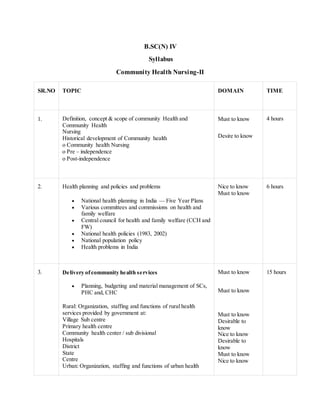
SR.NO TOPIC DOMAIN TIME
1. Definition, concept & scope of community Health and
Community Health
Nursing
Historical development of Community health
o Community health Nursing
o Pre – independence
o Post-independence
Must to know
Desire to know
4 hours
2. Health planning and policies and problems
 National health planning in India — Five Year Plans
 Various committees and commissions on health and
family welfare
 Central council for health and family welfare (CCH and
FW)
 National health policies (1983, 2002)
 National population policy
 Health problems in India
Nice to know
Must to know
6 hours
3. Delivery ofcommunity health services
 Planning, budgeting and material management of SCs,
PHC and, CHC
Rural: Organization, staffing and functions of rural health
services provided by government at:
Village Sub centre
Primary health centre
Community health center / sub divisional
Hospitals
District
State
Centre
Urban: Organization, staffing and functions of urban health
Must to know
Must to know
Must to know
Desirable to
know
Nice to know
Desirable to
know
Must to know
Nice to know
15 hours
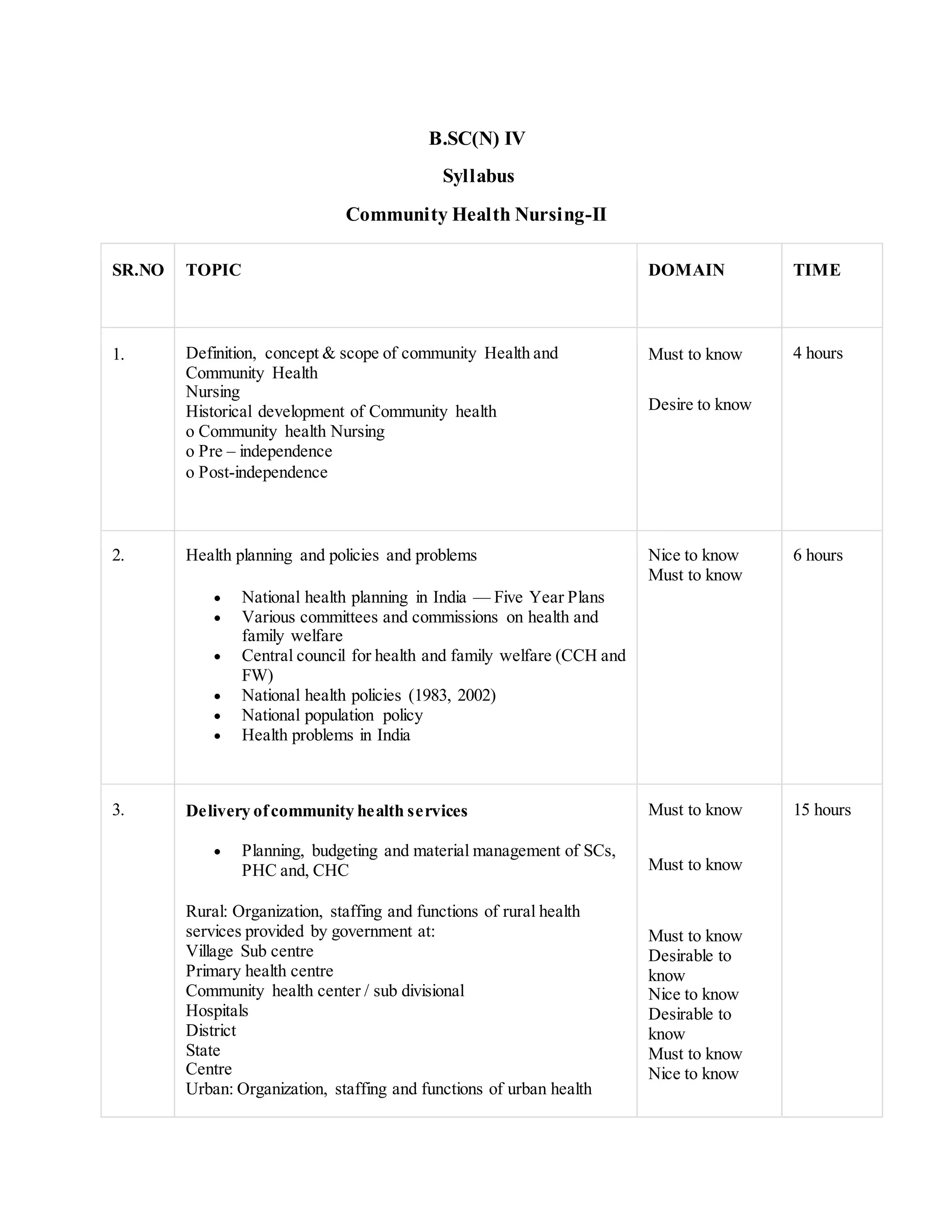
services provided by government at:
Slums Dispensaries
Maternal and child health centers
Special Clinics
Hospitals
Corporation / Municipality / Board
 Components of health services
 Environmental sanitation
 Health education
 Vital statistics
 M.C.H – antenatal, natal, postnatal MTP Act, female
foeticide act,child adoption act
 Family Welfare
 National health programmes
 School health services
 Occupational health
 Defence services
 Systems of Medicine and health care
 Allopathy
 Indian System of Medicine and Homeopathy
 Alternative health care systems like yoga, meditation,
social and spiritual healing etc.
 Referralsystem
Must to know
Nice to know
Must to know
Desirable to
know
Desirable to
know
Desirable to
know
Desirable to
know
Desirable to
know
Must to know
4. Community health nursing approaches, concepts and roles
and responsibilities ofnursing personnel.
 Approaches
– Nursing theories and Nursing process
– Epidemiological approach
– Problem solving approach
– Evidence based approach
– Empowering people to care for themselves
 Concepts of Primary Health Care:
– Equitable distribution
– Community participation
– Focus on prevention
– Use of appropriate technology
– Multi-sectoral approach
 Roles and responsibilities of Community health nursing
Must to know
Must to know
Desirable to
know
25 hours
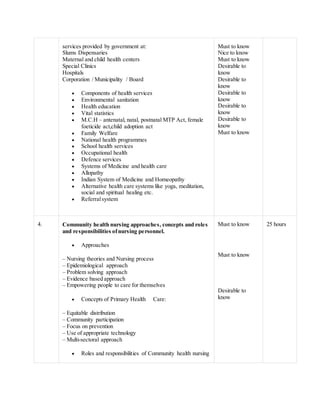
personnel in
– Family health services
– Information Education
– Communication (IEC)
– Management information (MIS):
Maintenance of Records & Reports
– Training and supervision of various categories of health
workers
– National Health Programmes
– Environmental sanitation
– Maternal and Child health and Family welfare
– Treatment of minor ailments
– School Health Services
– Occupational Health
– description of Community health nursing personnel
5. Assisting individuals and groups to promote and maintain
their health.
 Empowerment for self-care of individual, families and
groups in-Assessment of self and family.
 Monitoring growth and development
Mile stones
Weight measurement
Social development
Temperature and Blood pressure monitoring
Menstrual cycle
Breast self-examination and testicles
Warning signs of various diseases
Tests Urine for sugar and albumin, blood sugar
Seek health services for
Routine checkup
Immunization
Counseling
Diagnosis
Treatment
Follow up
 Maintenance of Health records for self and family
 Continue medical care and follow up in community for
various diseases and disabilities
 Carryout therapeutic procedures as prescribed / required
for self and family
Desirable to
know
Must to know
Desirable to
know
Nice to know
Desirable to
know
Must to know
Nice to know
15 hours
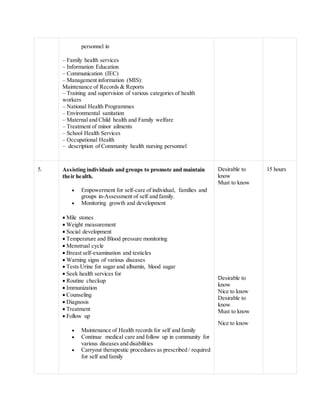
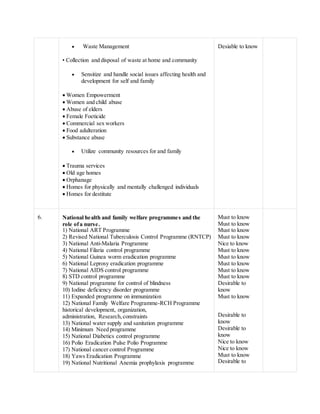
 Waste Management
• Collection and disposal of waste at home and community
 Sensitize and handle social issues affecting health and
development for self and family
Women Empowerment
Women and child abuse
Abuse of elders
Female Foeticide
Commercial sex workers
Food adulteration
Substance abuse
 Utilize community resources for and family
Trauma services
Old age homes
Orphanage
Homes for physically and mentally challenged individuals
Homes for destitute
Desiable to know
6. National health and family welfare programmes and the
role ofa nurse.
1) National ART Programme
2) Revised National Tuberculosis Control Programme (RNTCP)
3) National Anti-Malaria Programme
4) National Filaria control programme
5) National Guinea worm eradication programme
6) National Leprosy eradication programme
7) National AIDS control programme
8) STD control programme
9) National programme for control of blindness
10) Iodine deficiency disorder programme
11) Expanded programme on immunization
12) National Family Welfare Programme-RCH Programme
historical development, organization,
administration, Research,constraints
13) National water supply and sanitation programme
14) Minimum Need programme
15) National Diabetics control programme
16) Polio Eradication Pulse Polio Programme
17) National cancer control Programme
18) Yaws Eradication Programme
19) National Nutritional Anemia prophylaxis programme
Must to know
Must to know
Must to know
Must to know
Nice to know
Must to know
Must to know
Must to know
Must to know
Must to know
Desirable to
know
Must to know
Desirable to
know
Desirable to
know
Nice to know
Nice to know
Must to know
Desirable to
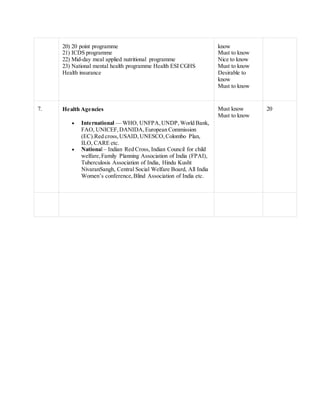
20) 20 point programme
21) ICDS programme
22) Mid-day meal applied nutritional programme
23) National mental health programme Health ESI CGHS
Health insurance
know
Must to know
Nice to know
Must to know
Desirable to
know
Must to know
7. Health Agencies
 International — WHO, UNFPA,UNDP, World Bank,
FAO, UNICEF,DANIDA,European Commission
(EC).Red cross,USAID,UNESCO,Colombo Plan,
ILO, CARE etc.
 National – Indian Red Cross, Indian Council for child
welfare,Family Planning Association of India (FPAI),
Tuberculosis Association of India, Hindu Kusht
NivaranSangh, Central Social Welfare Board, All India
Women’s conference,Blind Association of India etc.
Must know
Must to know
20
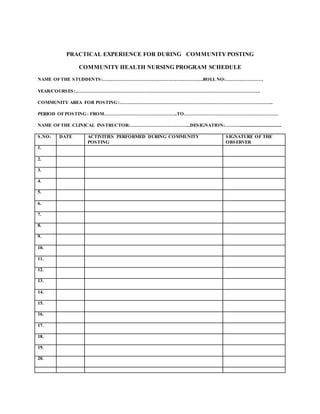
PRACTICAL EXPERIENCE FOR DURING COMMUNITY POSTING
COMMUNITY HEALTH NURSING PROGRAM SCHEDULE
NAME OFTHE STUDDENTS:……………………………………………………….ROLL NO:……………………
YEAR/COURSES:……………………………………………………………………………………………………….
COMMUNITY AREA FOR POSTING:……………………………………………………………………………………..
PERIOD OFPOSTING: FROM………………………………………..TO……………………………………………………
NAME OFTHE CLINICAL INSTRUCTOR:………………………………...DESIGNATION:………....................................
S.NO: DATE ACTIVITIES PERFORMED DURING COMMUNITY
POSTING
SIGNATURE OF THE
OBSERVER
1.
2.
3.
4.
5.
6.
7.
8.
9.
10.
11.
12.
13.
14.
15.
16.
17.
18.
19.
20.
S.NO: DATE ACTIVITIES PERFORMED DURING COMMUNITY
POSTING
SIGNATURE OF THE
OBSERVER
21.
22.
23.
24.
25.
26.
27.
28.
29.
30.
31.
32.
33.
34.
35.
36.
37.
38.
39.
40.
SIGNATURE OF COORDINATOR SIGNATURE OF THE HOD’S
DATE: DATE:
SIGNATURE OF THE PRINCIPAL
DATE:
B.sc nursing iv year community  ii

B.sc nursing iv year community ii

  • 1.
    B.SC(N) IV Syllabus Community HealthNursing-II SR.NO TOPIC DOMAIN TIME 1. Definition, concept & scope of community Health and Community Health Nursing Historical development of Community health o Community health Nursing o Pre – independence o Post-independence Must to know Desire to know 4 hours 2. Health planning and policies and problems  National health planning in India — Five Year Plans  Various committees and commissions on health and family welfare  Central council for health and family welfare (CCH and FW)  National health policies (1983, 2002)  National population policy  Health problems in India Nice to know Must to know 6 hours 3. Delivery ofcommunity health services  Planning, budgeting and material management of SCs, PHC and, CHC Rural: Organization, staffing and functions of rural health services provided by government at: Village Sub centre Primary health centre Community health center / sub divisional Hospitals District State Centre Urban: Organization, staffing and functions of urban health Must to know Must to know Must to know Desirable to know Nice to know Desirable to know Must to know Nice to know 15 hours
  • 2.
    services provided bygovernment at: Slums Dispensaries Maternal and child health centers Special Clinics Hospitals Corporation / Municipality / Board  Components of health services  Environmental sanitation  Health education  Vital statistics  M.C.H – antenatal, natal, postnatal MTP Act, female foeticide act,child adoption act  Family Welfare  National health programmes  School health services  Occupational health  Defence services  Systems of Medicine and health care  Allopathy  Indian System of Medicine and Homeopathy  Alternative health care systems like yoga, meditation, social and spiritual healing etc.  Referralsystem Must to know Nice to know Must to know Desirable to know Desirable to know Desirable to know Desirable to know Desirable to know Must to know 4. Community health nursing approaches, concepts and roles and responsibilities ofnursing personnel.  Approaches – Nursing theories and Nursing process – Epidemiological approach – Problem solving approach – Evidence based approach – Empowering people to care for themselves  Concepts of Primary Health Care: – Equitable distribution – Community participation – Focus on prevention – Use of appropriate technology – Multi-sectoral approach  Roles and responsibilities of Community health nursing Must to know Must to know Desirable to know 25 hours
  • 3.
    personnel in – Familyhealth services – Information Education – Communication (IEC) – Management information (MIS): Maintenance of Records & Reports – Training and supervision of various categories of health workers – National Health Programmes – Environmental sanitation – Maternal and Child health and Family welfare – Treatment of minor ailments – School Health Services – Occupational Health – description of Community health nursing personnel 5. Assisting individuals and groups to promote and maintain their health.  Empowerment for self-care of individual, families and groups in-Assessment of self and family.  Monitoring growth and development Mile stones Weight measurement Social development Temperature and Blood pressure monitoring Menstrual cycle Breast self-examination and testicles Warning signs of various diseases Tests Urine for sugar and albumin, blood sugar Seek health services for Routine checkup Immunization Counseling Diagnosis Treatment Follow up  Maintenance of Health records for self and family  Continue medical care and follow up in community for various diseases and disabilities  Carryout therapeutic procedures as prescribed / required for self and family Desirable to know Must to know Desirable to know Nice to know Desirable to know Must to know Nice to know 15 hours
  • 4.
     Waste Management •Collection and disposal of waste at home and community  Sensitize and handle social issues affecting health and development for self and family Women Empowerment Women and child abuse Abuse of elders Female Foeticide Commercial sex workers Food adulteration Substance abuse  Utilize community resources for and family Trauma services Old age homes Orphanage Homes for physically and mentally challenged individuals Homes for destitute Desiable to know 6. National health and family welfare programmes and the role ofa nurse. 1) National ART Programme 2) Revised National Tuberculosis Control Programme (RNTCP) 3) National Anti-Malaria Programme 4) National Filaria control programme 5) National Guinea worm eradication programme 6) National Leprosy eradication programme 7) National AIDS control programme 8) STD control programme 9) National programme for control of blindness 10) Iodine deficiency disorder programme 11) Expanded programme on immunization 12) National Family Welfare Programme-RCH Programme historical development, organization, administration, Research,constraints 13) National water supply and sanitation programme 14) Minimum Need programme 15) National Diabetics control programme 16) Polio Eradication Pulse Polio Programme 17) National cancer control Programme 18) Yaws Eradication Programme 19) National Nutritional Anemia prophylaxis programme Must to know Must to know Must to know Must to know Nice to know Must to know Must to know Must to know Must to know Must to know Desirable to know Must to know Desirable to know Desirable to know Nice to know Nice to know Must to know Desirable to
  • 5.
    20) 20 pointprogramme 21) ICDS programme 22) Mid-day meal applied nutritional programme 23) National mental health programme Health ESI CGHS Health insurance know Must to know Nice to know Must to know Desirable to know Must to know 7. Health Agencies  International — WHO, UNFPA,UNDP, World Bank, FAO, UNICEF,DANIDA,European Commission (EC).Red cross,USAID,UNESCO,Colombo Plan, ILO, CARE etc.  National – Indian Red Cross, Indian Council for child welfare,Family Planning Association of India (FPAI), Tuberculosis Association of India, Hindu Kusht NivaranSangh, Central Social Welfare Board, All India Women’s conference,Blind Association of India etc. Must know Must to know 20
  • 6.
    PRACTICAL EXPERIENCE FORDURING COMMUNITY POSTING COMMUNITY HEALTH NURSING PROGRAM SCHEDULE NAME OFTHE STUDDENTS:……………………………………………………….ROLL NO:…………………… YEAR/COURSES:………………………………………………………………………………………………………. COMMUNITY AREA FOR POSTING:…………………………………………………………………………………….. PERIOD OFPOSTING: FROM………………………………………..TO…………………………………………………… NAME OFTHE CLINICAL INSTRUCTOR:………………………………...DESIGNATION:……….................................... S.NO: DATE ACTIVITIES PERFORMED DURING COMMUNITY POSTING SIGNATURE OF THE OBSERVER 1. 2. 3. 4. 5. 6. 7. 8. 9. 10. 11. 12. 13. 14. 15. 16. 17. 18. 19. 20.
  • 7.
    S.NO: DATE ACTIVITIESPERFORMED DURING COMMUNITY POSTING SIGNATURE OF THE OBSERVER 21. 22. 23. 24. 25. 26. 27. 28. 29. 30. 31. 32. 33. 34. 35. 36. 37. 38. 39. 40. SIGNATURE OF COORDINATOR SIGNATURE OF THE HOD’S DATE: DATE: SIGNATURE OF THE PRINCIPAL DATE: