Applied Statistics and Mathematics in
       Economics & Business
             BS1501
           Tutorial 2
       Pairach Piboonrungroj
               (Champ)

           me@Pairach.com
1. Mutually Exclusive?
(a) Being an economist and being a professor:
    Not mutually exclusive

(b) Throwing a 5 or 6 with one die:
     Mutually exclusive

(c) Being an M.P. and being 20 years of age.
    (Minimum age of an M.P. is 21):
    Mutually exclusive

(d) Drawing a red card or an ace out of a pack of
    cards:
    Not mutually exclusive
2.Accountancy employees

(a) Prob. of employees from Wales: P(W)
   = from Wales / All employees
   = 6/15

(b) Prob. of employees Scotland: P(S)
   = from Scotland / All employees
   = 4/15
2.Accountancy employees
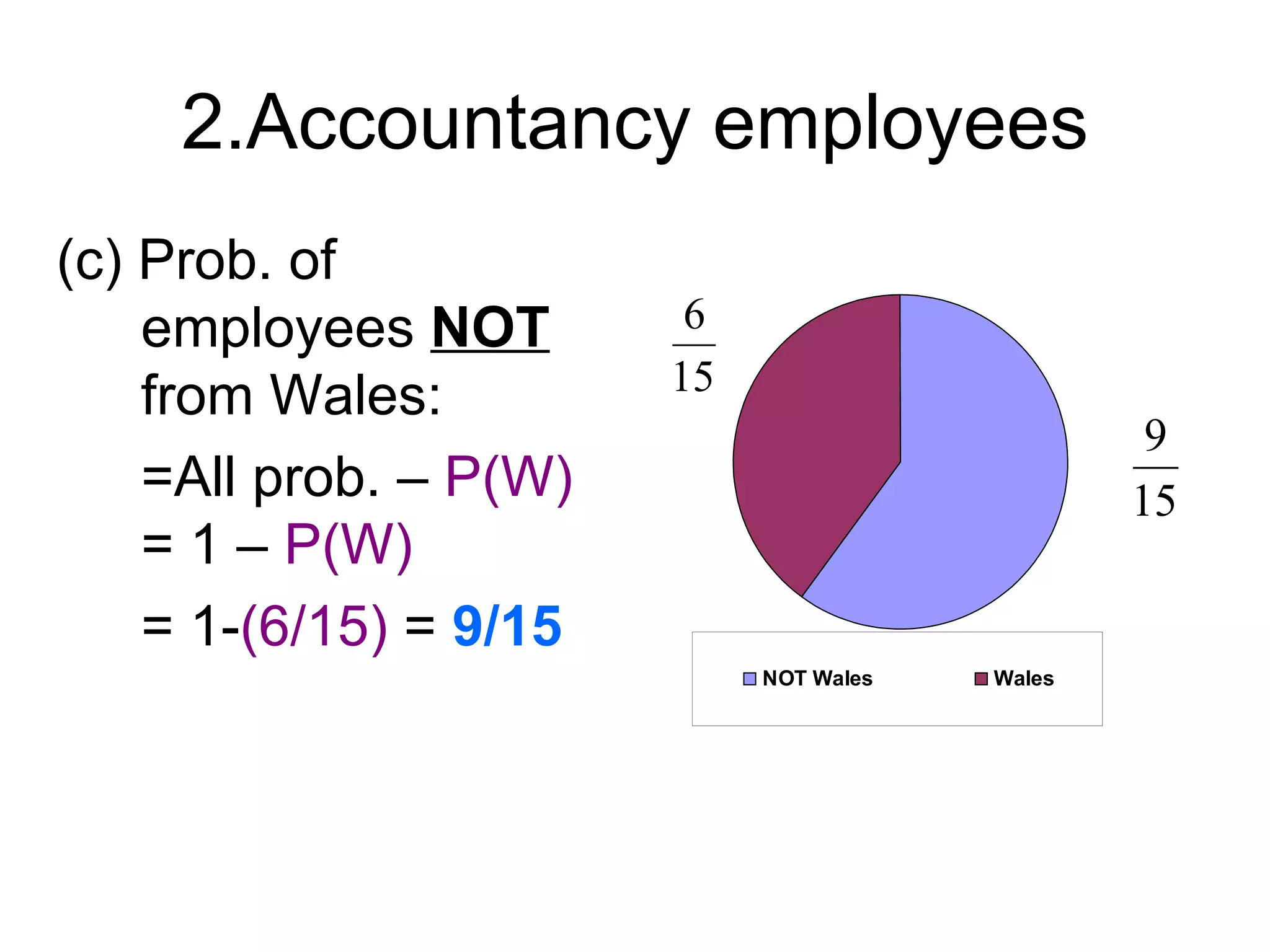
(c) Prob. of
    employees NOT        6
                        15
    from Wales:
                                                  9
    =All prob. – P(W)                            15
    = 1 – P(W)
    = 1-(6/15) = 9/15
                             NOT Wales   Wales
2.Accountancy employees
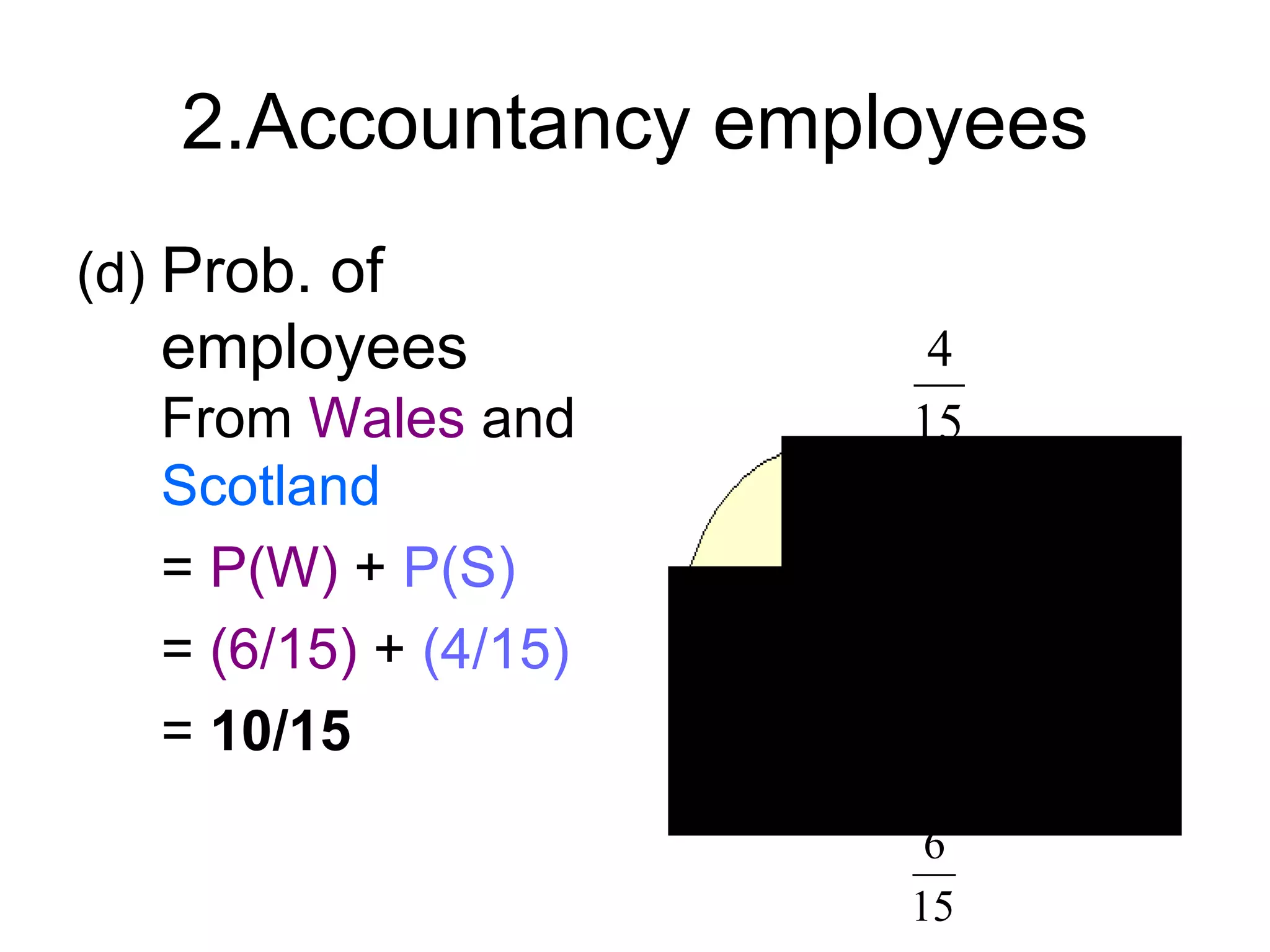
(d) Prob. of
   employees            4
   From Wales and      15
   Scotland
   = P(W) + P(S)
   = (6/15) + (4/15)
   = 10/15
                        6
                       15
3. Primary school in Cardiff
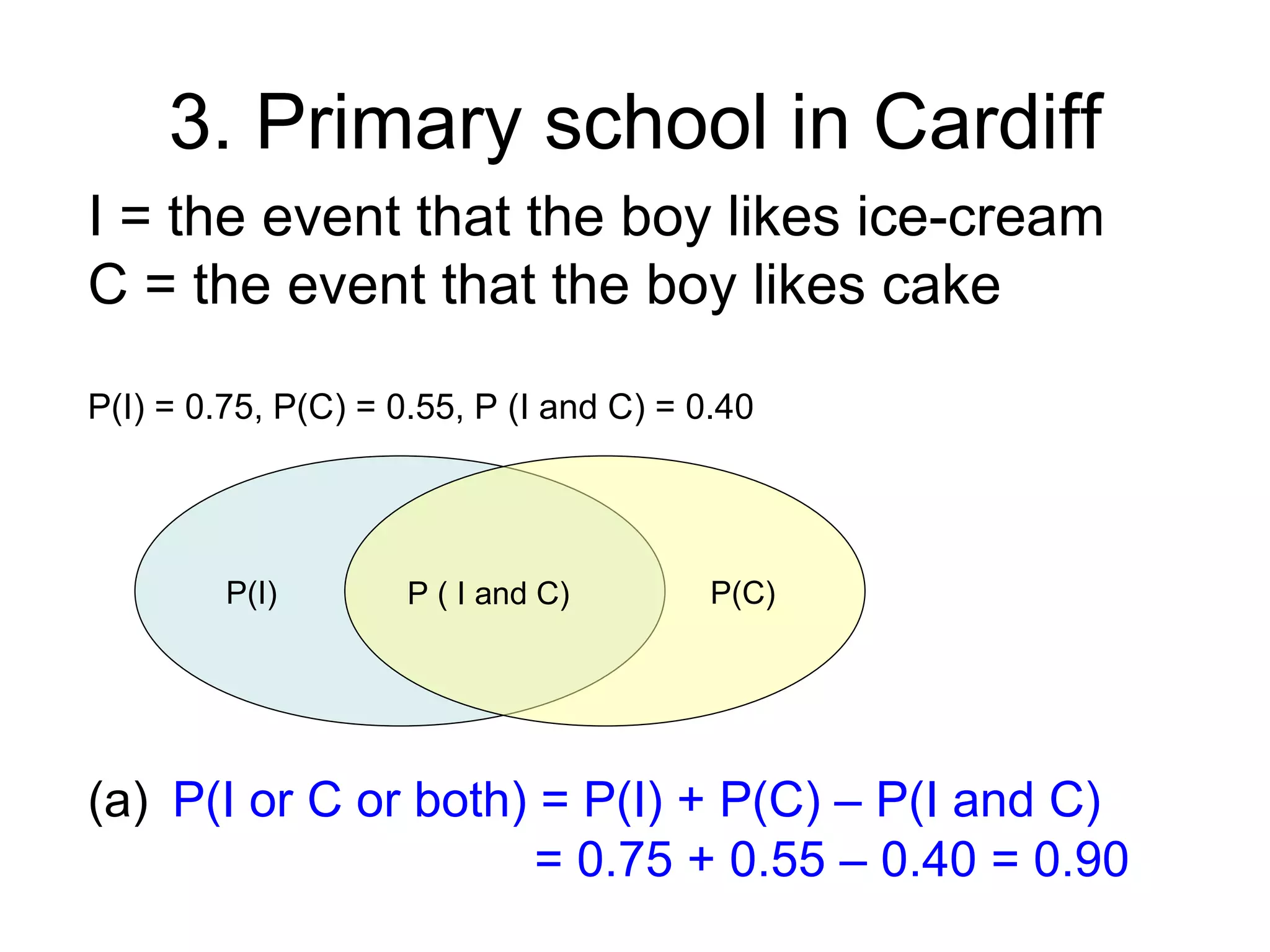
I = the event that the boy likes ice-cream
C = the event that the boy likes cake

P(I) = 0.75, P(C) = 0.55, P (I and C) = 0.40


         P(I)        P ( I and C)        P(C)


(a) P(I or C or both) = P(I) + P(C) – P(I and C)
                      = 0.75 + 0.55 – 0.40 = 0.90
3. Primary school in Cardiff
I = the event that the boy likes ice-cream
C = the event that the boy likes cake

P(I) = 0.75, P(C) = 0.55, P (I and C) = 0.40


(b) Neither ice-cream nor cake
     = 1 – P(I or C or Both)
     = 1- 0.90
     = 0.1
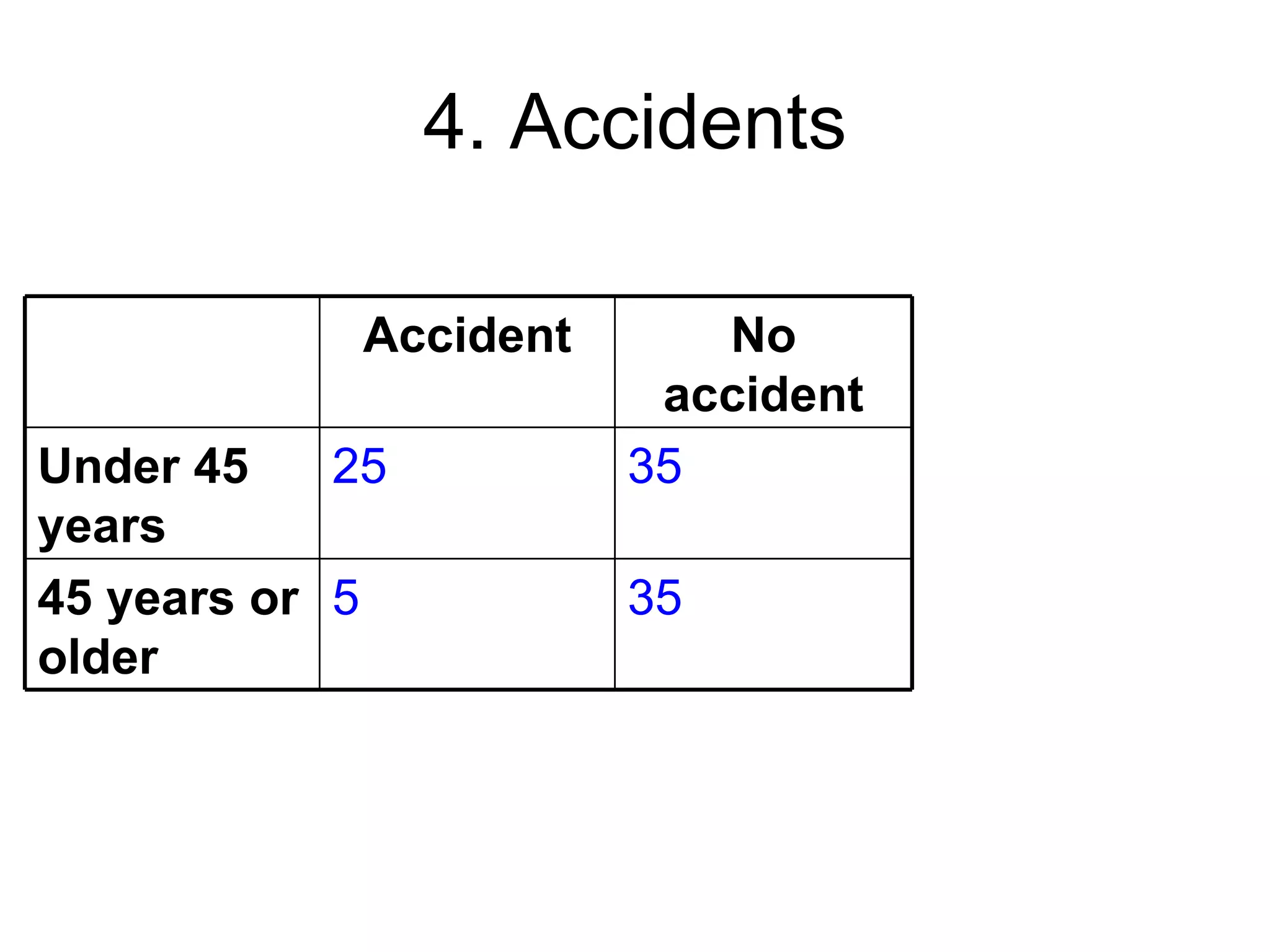
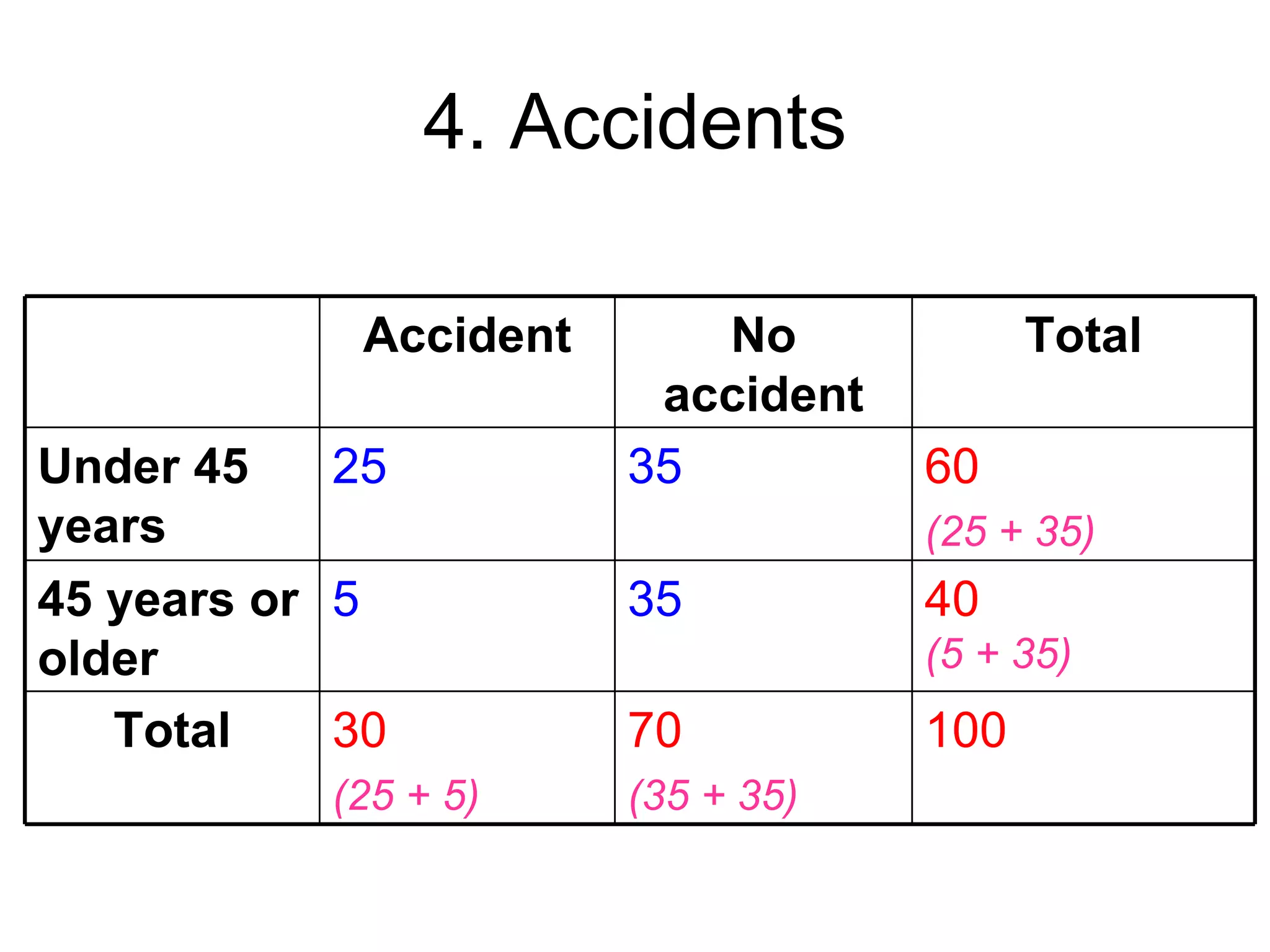
4. Accidents

             Accident      No
                         accident
Under 45    25          35
years
45 years or 5           35
older
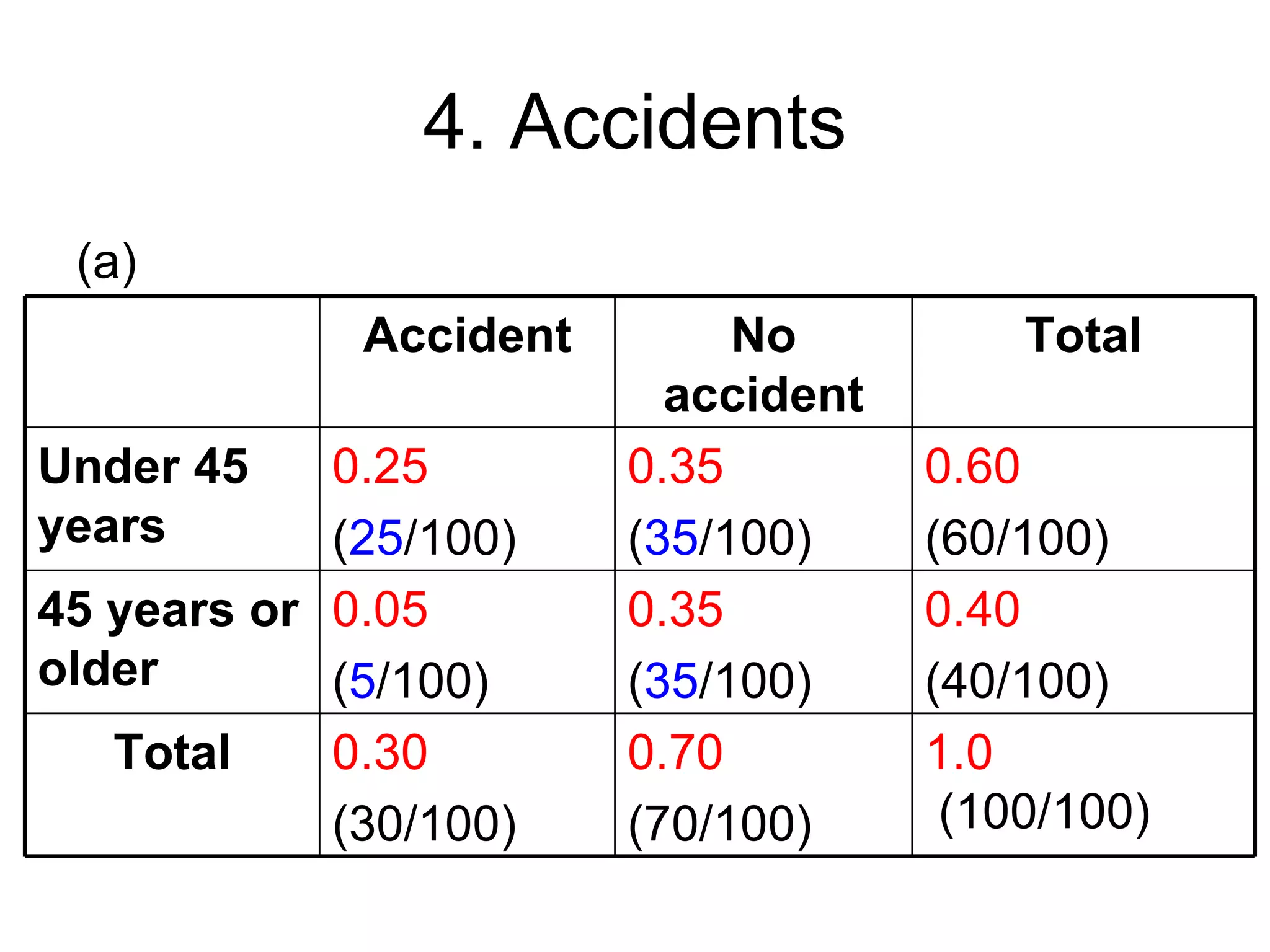
4. Accidents

             Accident      No             Total
                         accident
Under 45    25          35          60
years                               (25 + 35)
45 years or 5           35          40
older                               (5 + 35)
   Total    30          70          100
           (25 + 5)     (35 + 35)
4. Accidents
 (a)
             Accident        No          Total
                          accident
Under 45    0.25        0.35         0.60
years       (25/100)    (35/100)     (60/100)
45 years or 0.05        0.35         0.40
older       (5/100)     (35/100)     (40/100)
   Total    0.30        0.70         1.0
            (30/100)    (70/100)      (100/100)
4. Accidents
(b) P(Accident | under 45)

= P(Accident and under 45) / P(Under 45)
= 0.25 / 0.60 = 0.416

                Accident     No accident        Total
Under 45      0.25           0.35          0.60
years         (25/100)       (35/100)      ([25+35]/100)
45 years or   0.05           0.35          0.40
older         (5/100)        (35/100)      (40/100)
    Total     0.30           0.70          1.0
              (30/100)       (70/100)      (100/100)
4. Accidents
(c) P( Accident | over 45)

= P(Accident and over 45) / P(over 45)
= 0.05 / 0.40 = 0.125

                Accident     No accident        Total
Under 45      0.25           0.35          0.60
years         (25/100)       (35/100)      ([25+35]/100)
45 years or   0.05           0.35          0.40
older         (5/100)        (35/100)      (40/100)
    Total     0.30           0.70          1.0
              (30/100)       (70/100)      (100/100)
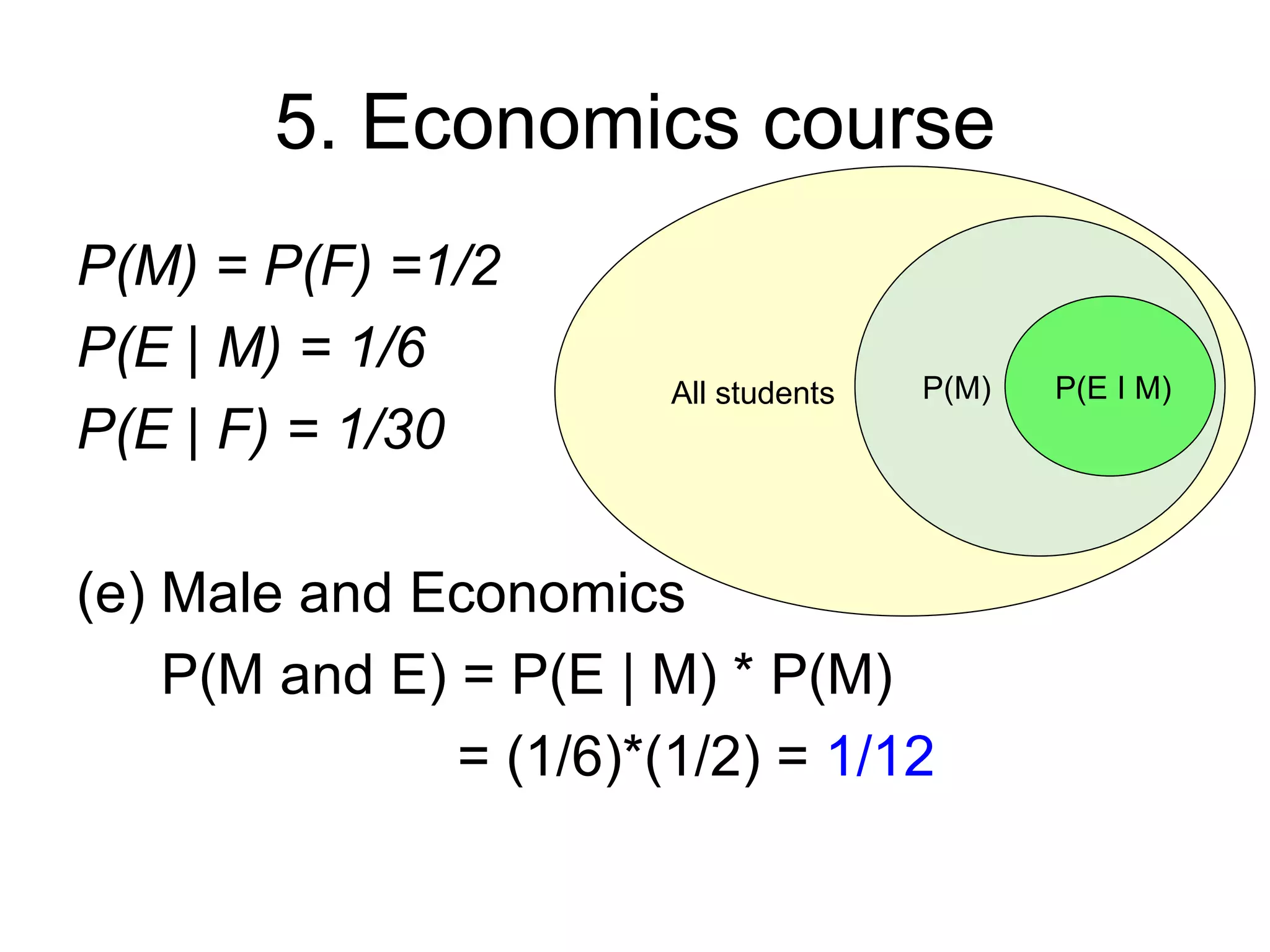
5. Economics course
P(M) = P(F) =1/2
P(E | M) = 1/6
                        All students   P(M)   P(E I M)
P(E | F) = 1/30

(e) Male and Economics
    P(M and E) = P(E | M) * P(M)
               = (1/6)*(1/2) = 1/12
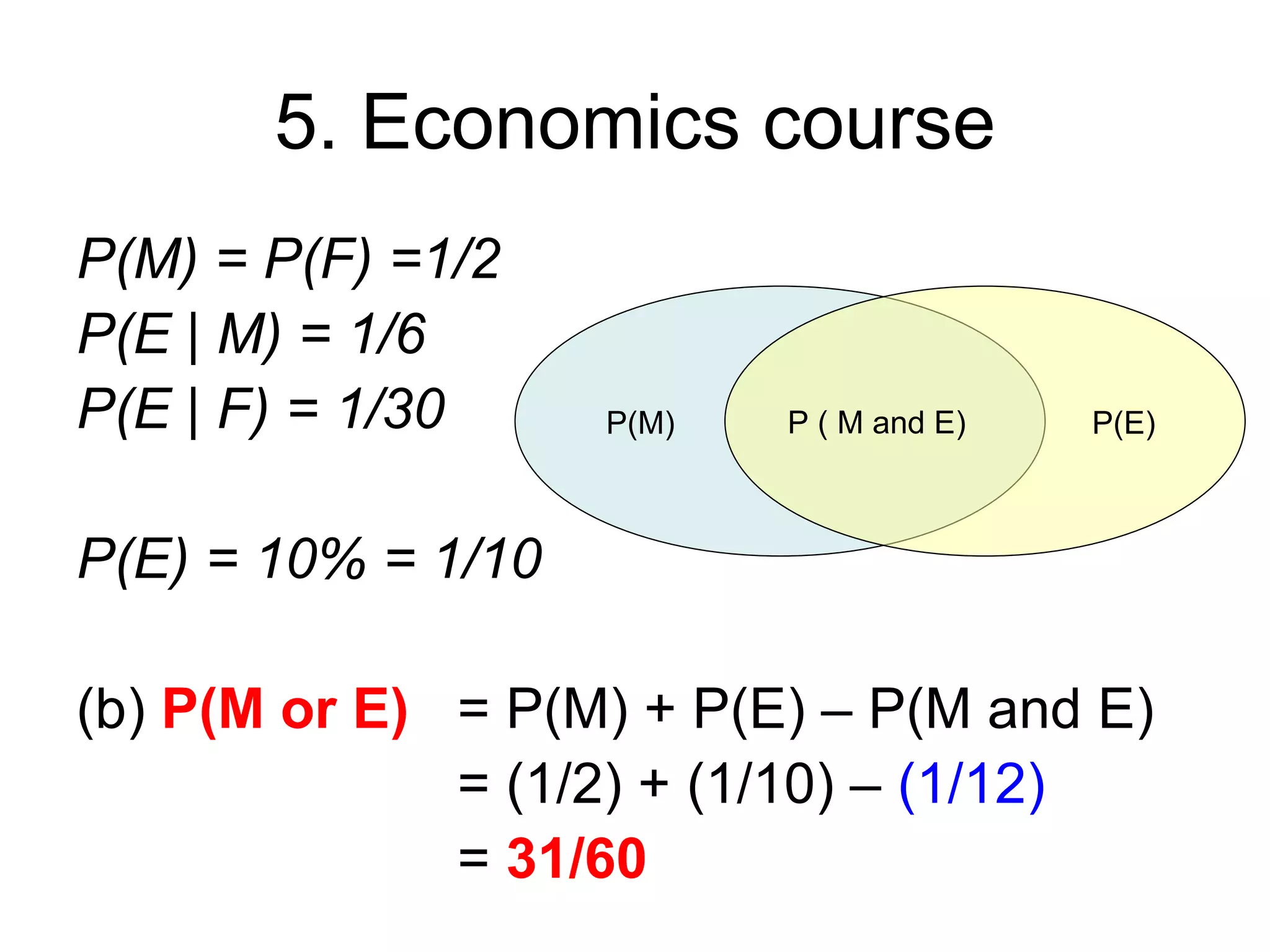
5. Economics course
P(M) = P(F) =1/2
P(E | M) = 1/6
P(E | F) = 1/30     P(M)   P ( M and E)   P(E)


P(E) = 10% = 1/10

(b) P(M or E) = P(M) + P(E) – P(M and E)
              = (1/2) + (1/10) – (1/12)
              = 31/60
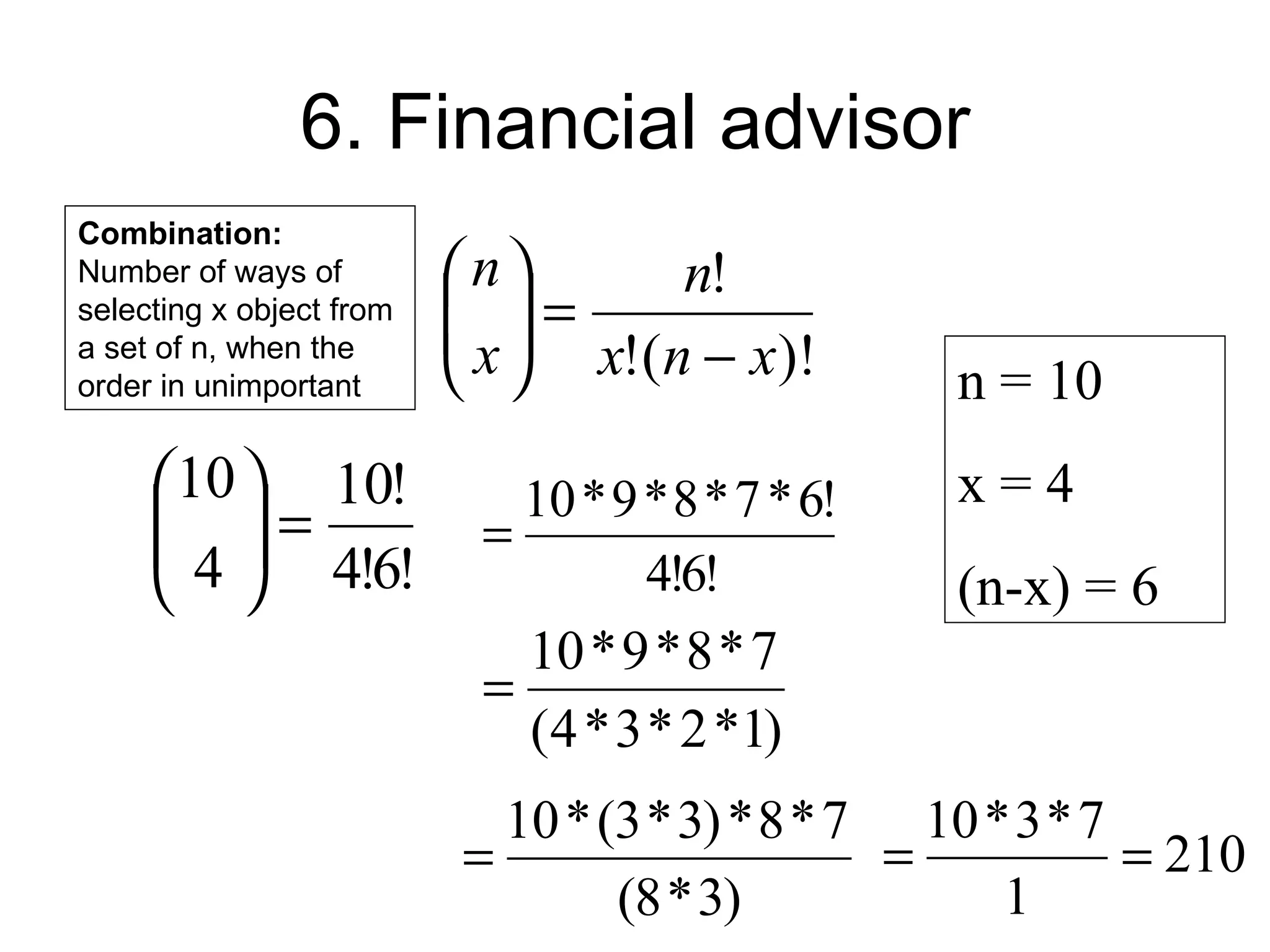
6. Financial advisor
Combination:
Number of ways of         n       n!
selecting x object from    =
                           x  x!(n − x)!
a set of n, when the
order in unimportant                             n = 10
     10  10!               10 * 9 * 8 * 7 * 6!   x=4
      =
      4  4!6!            =
                                  4!6!           (n-x) = 6
                             10 * 9 * 8 * 7
                           =
                             (4 * 3 * 2 *1)
                            10 * (3 * 3) * 8 * 7 10 * 3 * 7
                          =                     =           = 210
                                  (8 * 3)            1
7. Company’s Demand
Weekly unit Demand                     E (x) =
        (x)        Probability: f(x)   x*f(x)     x – E (x)   [x-E(x)]^2*f(x)

        800               0.10            80.00     -185.00          3422.50

        900               0.25           225.00      -85.00          1806.25

       1000               0.40           400.00       15.00             90.00

       1100               0.20           220.00      115.00          2645.00

       1200               0.05            60.00      215.00          2311.25

       Sum           Expected value      985.00 Variance            10275.00
                                                  Std
                                                  Deviation            101.37
7. Company’s Demand
(a) E(x)   = Sum [x*f(x)]
            = 800(0.10) + 900(0.25) +
             1000(0.40) + 1100(0.20) + 1200(0.05)
            = 985

(b) Var(x) = Sum [(x-E(x)^2)*f(x)]
           = (800-985)^2(0.10) + (900 -985)^2(0.25)
             + (1000-985)^2(0.40)+(1100-985)^2(0.20)
             +(1200-985)^2(0.05)
           = 10,275
Standard deviation = sqrt(10,275) = 101.36
8. Insurance Salesperson
               n                      n− x
      P ( x) =  [ p ( x)] [1 − p ( x)]
                x
                           x

                
                                                    n       n!
 (a) P( x = 6) =  6 (2 / 3) 6 (1 / 3) 0 = 0.088    =
                  
                                                   x  x!(n − x)!
                    6


                6
(b) P( x = 4) =  (2 / 3) 4 (1 / 3) 2 = 0.329
                 4
                 
8. Insurance Salesperson
                   n                                     n       n!
          P ( x) =  [ p( x)]x [1 − p( x)]n − x
                    x                                     =
                                                          x  x!(n − x)!


(c) P ( x > ) = − P ( x =0) +P ( x = )]
           1   1 [                  1
                                  6                                   6
                     P ( x = 0) =  (2 / 3) 0 (1 / 3) 6   P ( x = 1) =  (2 / 3)1 (1 / 3) 5
                                  0                                   1

                    = 1 − 0.02
                    = 0.98

(d)   µ = np = 6(2 / 3) = 4
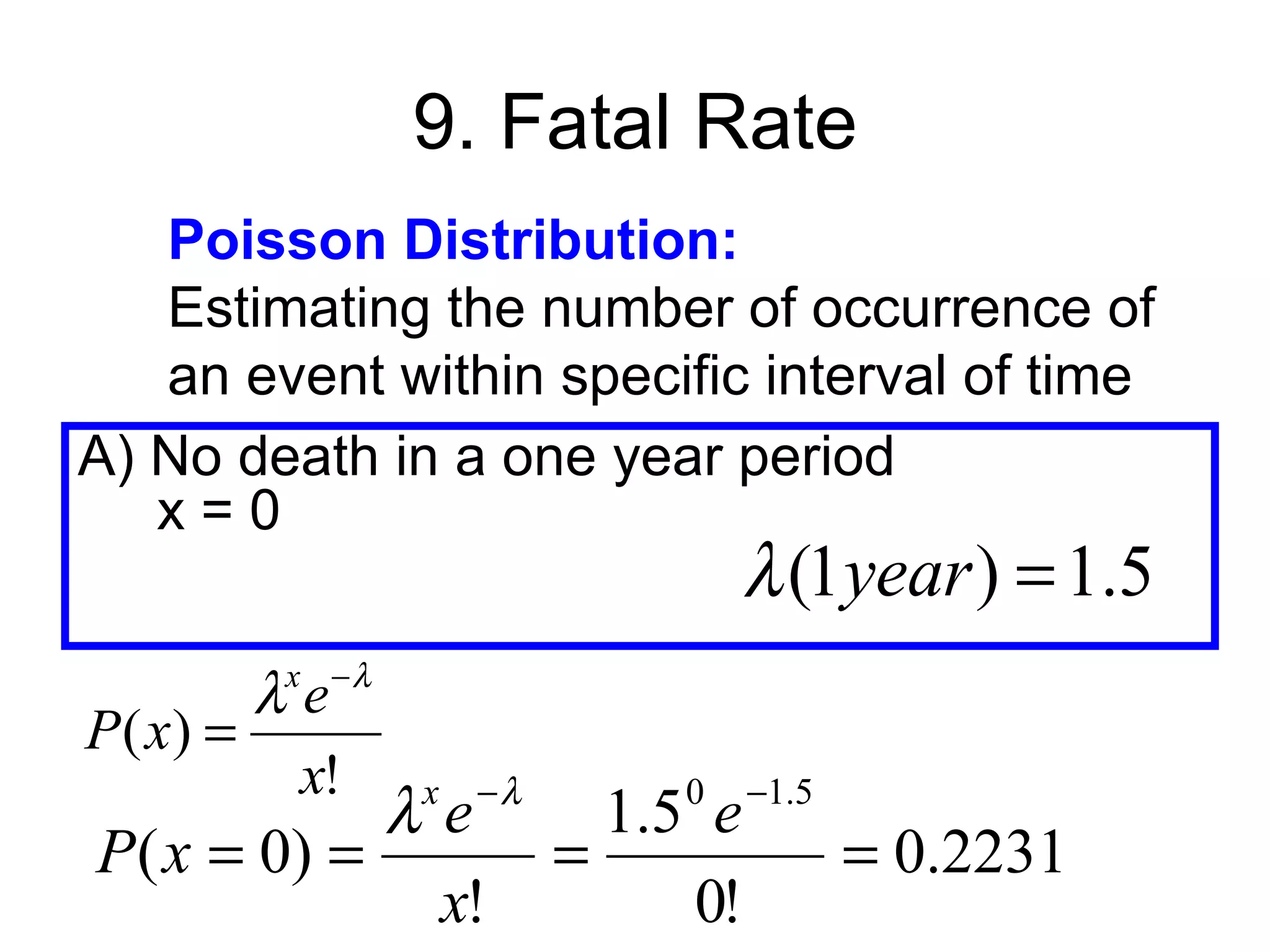
9. Fatal Rate
   Poisson Distribution:
   Estimating the number of occurrence of
   an event within specific interval of time
A) No death in a one year period
   x=0
                                 λ (1year ) = 1.5
         x −λ
         λe
P ( x) =
          x!        −λ
            λe  x            0
                           1.5 e   −1.5
P( x = 0) =              =                = 0.2231
             x!               0!
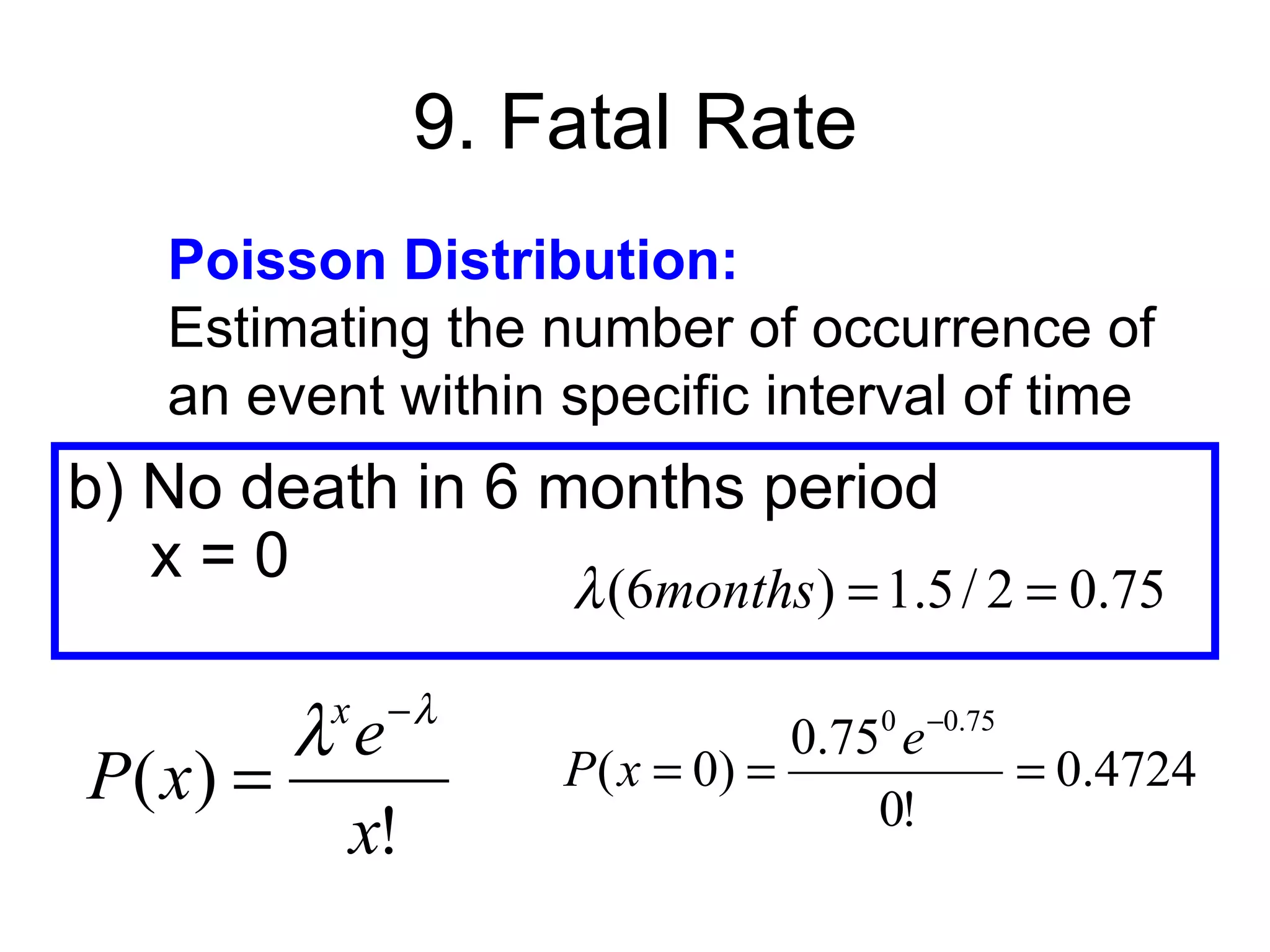
9. Fatal Rate
    Poisson Distribution:
    Estimating the number of occurrence of
    an event within specific interval of time
b) No death in 6 months period
   x=0            λ (6months ) = 1.5 / 2 = 0.75
           x −λ
        λe                        0.750 e −0.75
P( x) =              P ( x = 0) =
                                      0!
                                                = 0.4724
         x!
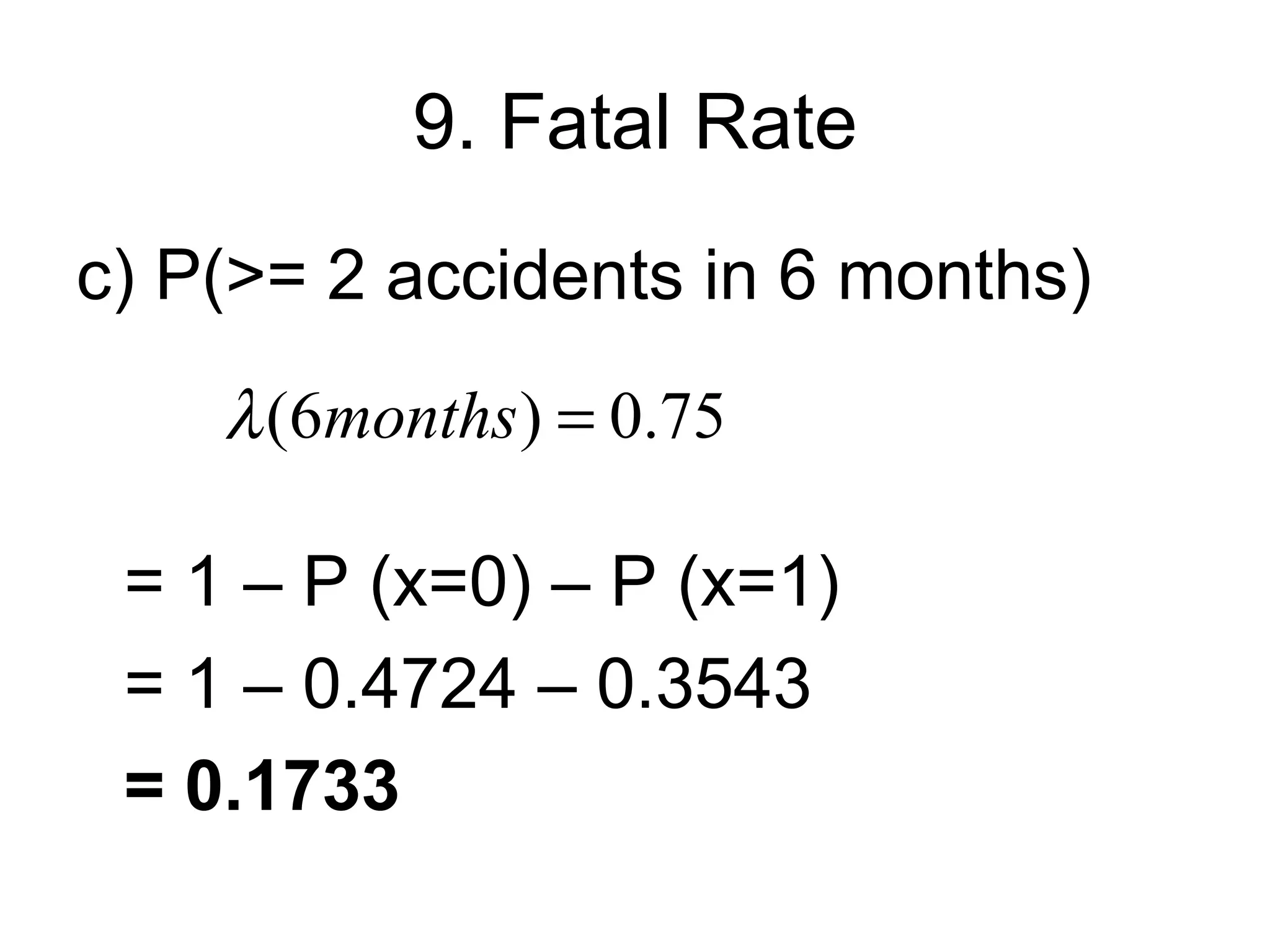
9. Fatal Rate
c) P(>= 2 accidents in 6 months)
    λ (6months ) = 0.75

 = 1 – P (x=0) – P (x=1)
 = 1 – 0.4724 – 0.3543
 = 0.1733
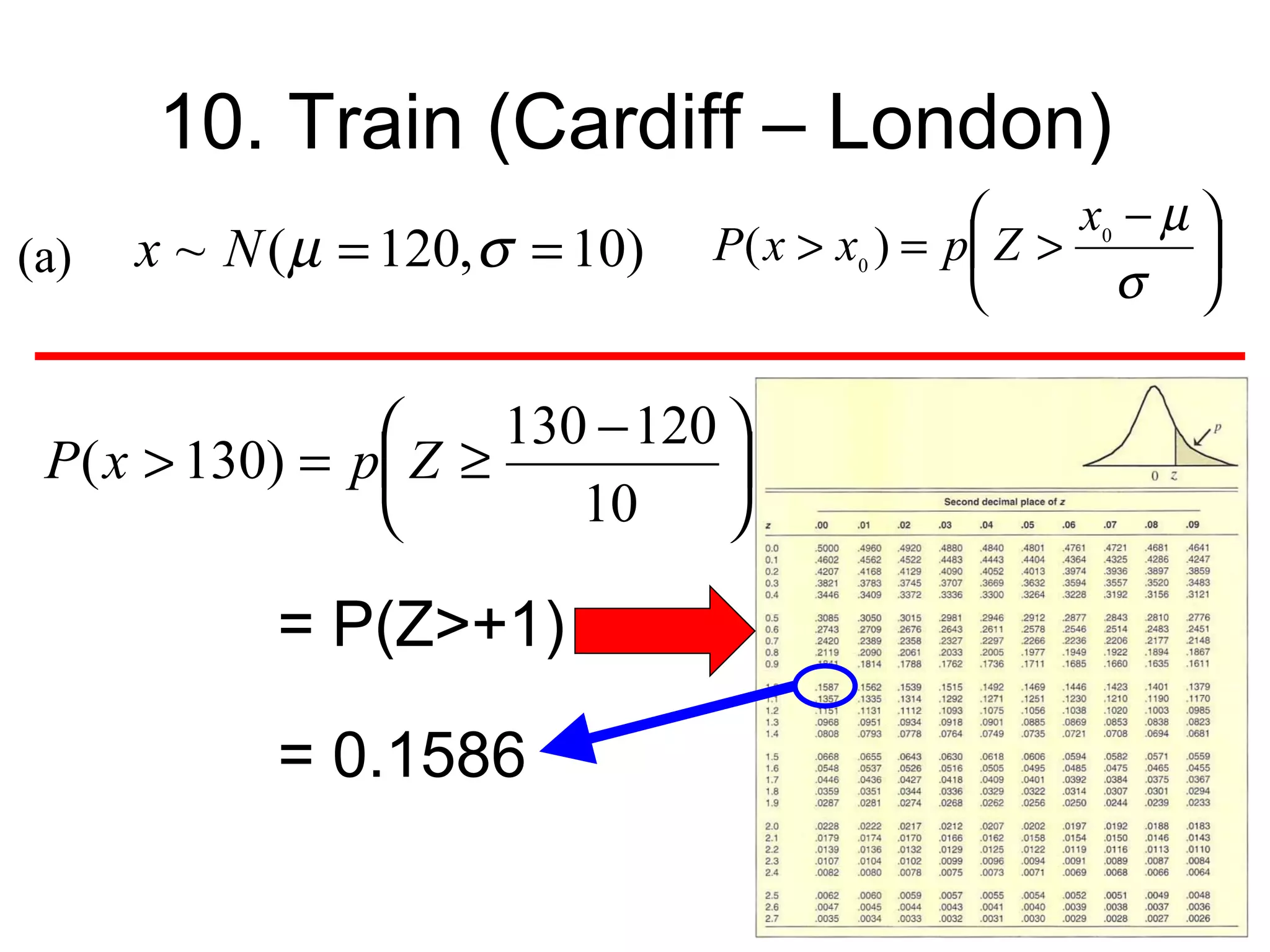
10. Train (Cardiff – London)
                                                       x0 − µ 
(a)   x ~ N ( µ = 120, σ = 10)   P ( x > x0 ) = p  Z >        
                                                         σ 


                     130 − 120 
 P( x > 130) = p Z ≥           
                        10     

            = P(Z>+1)

            = 0.1586
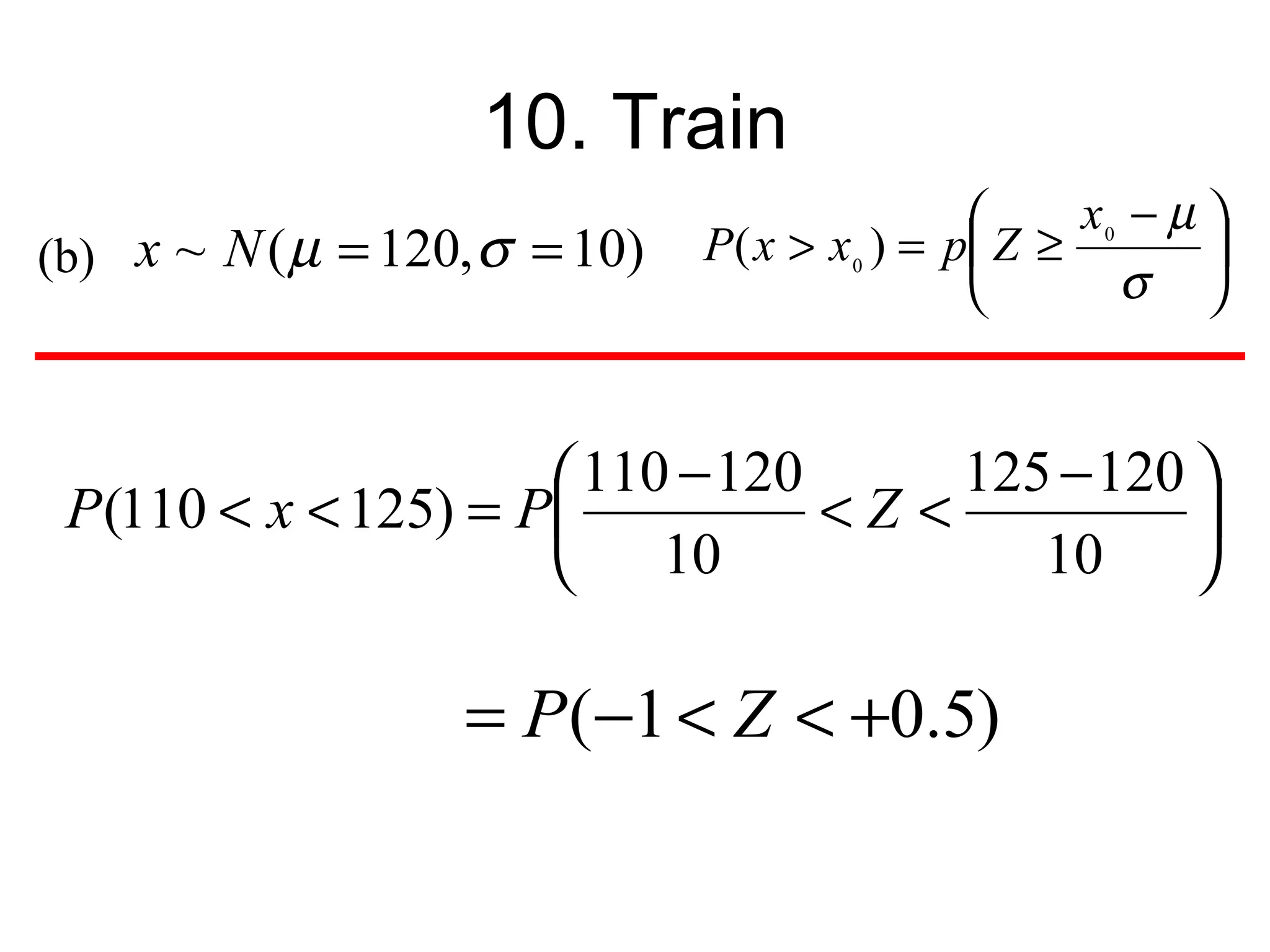
10. Train
                                                     x0 − µ 
(b) x ~ N ( µ = 120, σ = 10)   P ( x > x 0 ) = p Z ≥        
                                                       σ 


                      110 − 120      125 − 120 
 P(110 < x < 125) = P           <Z <           
                      10                10     

                   = P (−1 < Z < +0.5)
Z = -1   Z = 0.5

  10. Train
(b)   P (−1 < Z < +0.5)

= 1- [P(Z<-1) + P(Z>0.5)]
  P ( Z < −1) = P ( Z > 1)

= 1- [P(Z>1) + P(Z>0.5)]

= 1 – 0.15866 –
0.30854
= 0.5328
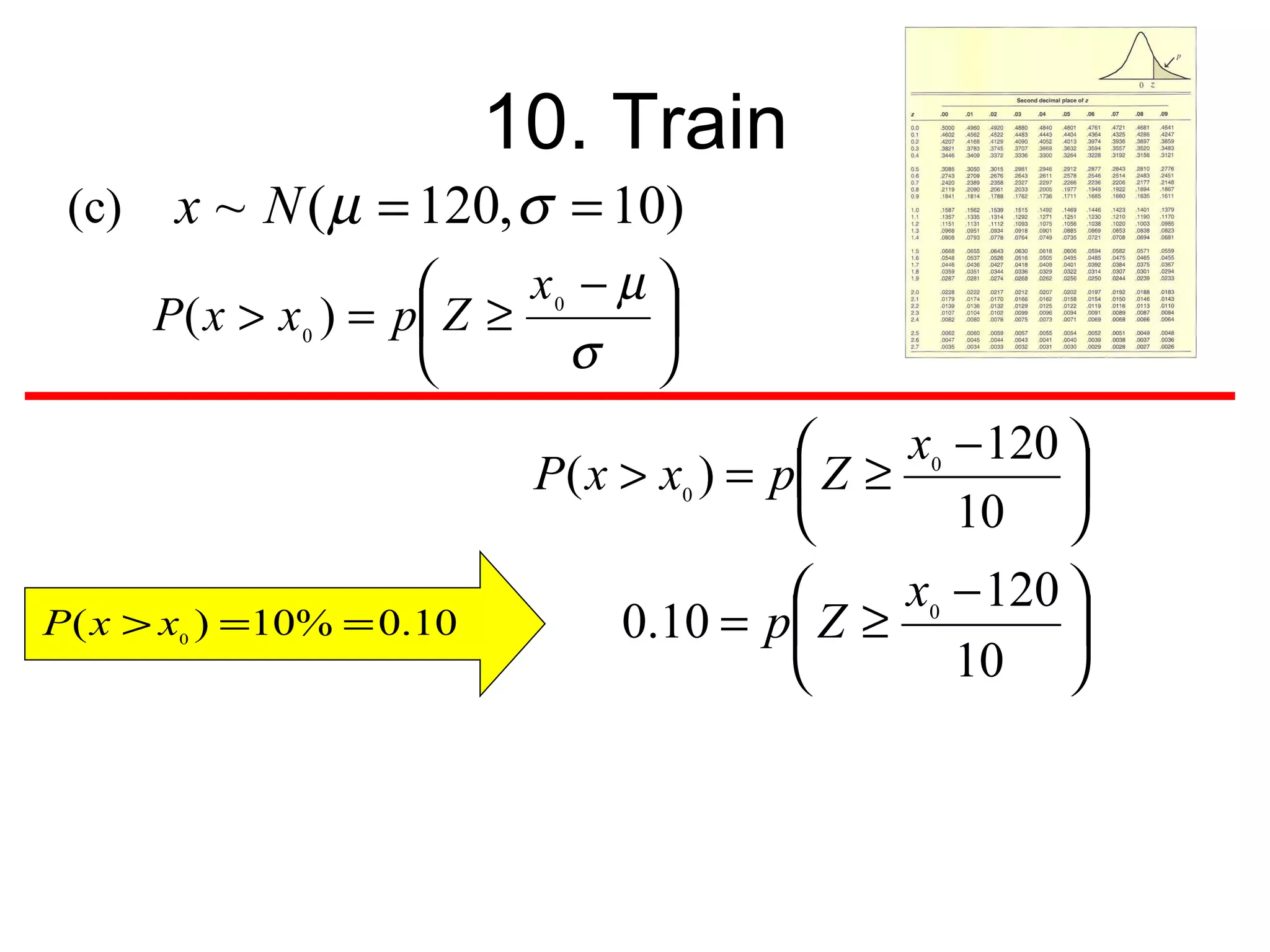
10. Train
 (c)    x ~ N ( µ = 120, σ = 10)
                             x0 − µ 
       P ( x > x 0 ) = p Z ≥        
                               σ 
                                                   x0 − 120 
                             P ( x > x0 ) = p  Z ≥          
                                                      10 
                                                   x0 − 120 
P ( x > x0 ) =10% = 0.10           0.10 = p Z ≥             
                                                      10 
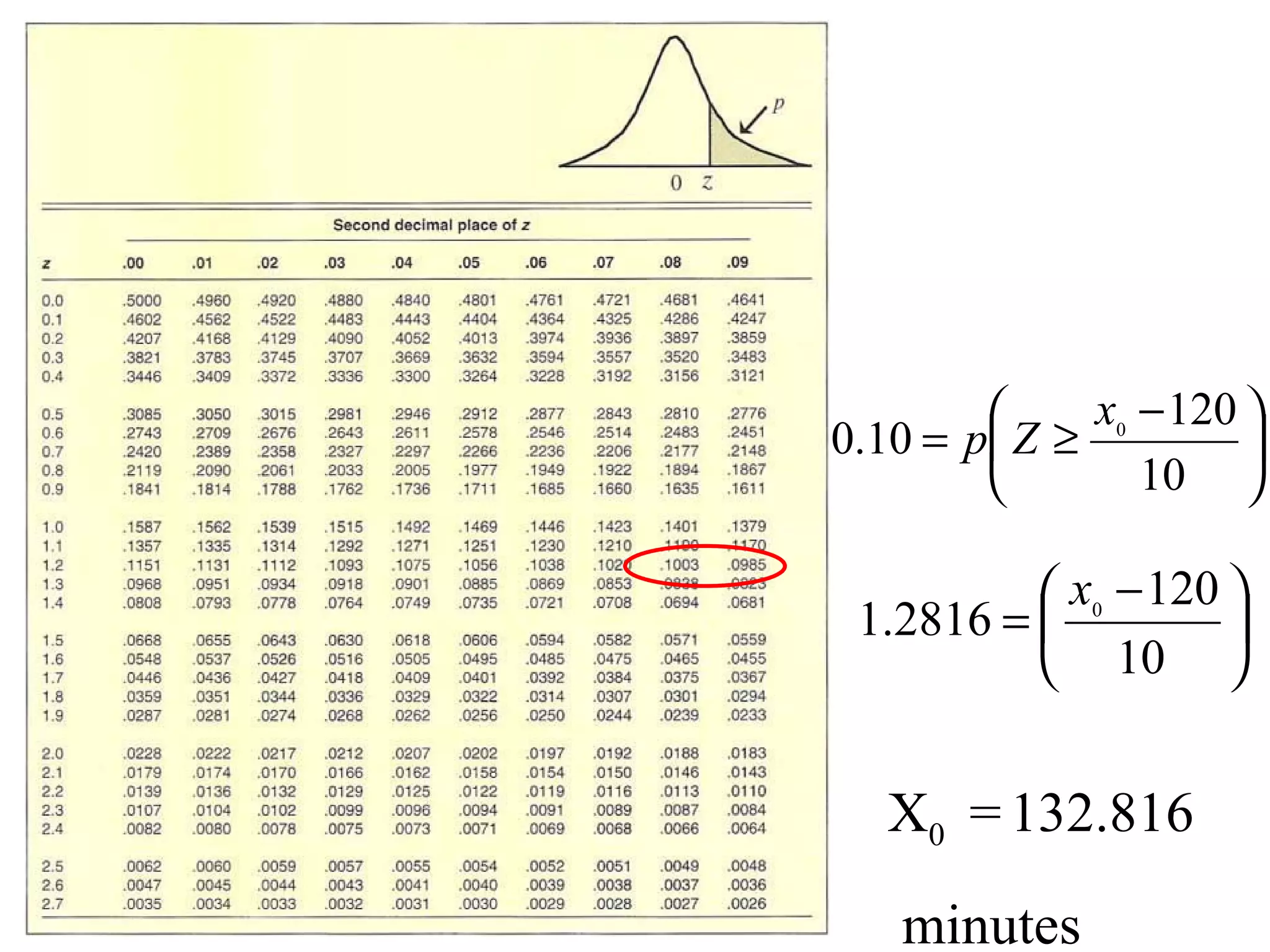
10. Train


                         x0 − 120 
            0.10 = p Z ≥          
                            10 

                       x0 − 120 
             1.2816 =           
                       10 


               X0 = 132.816
               minutes
Thank You for Your Attention
• To download this slide (PPT & PDF)
  visit
  www.pairach.com/teaching


 • Any further question?
   Please email to
   me@pairach.com

BS1501 tutorial 2

  • 1.
    Applied Statistics andMathematics in Economics & Business BS1501 Tutorial 2 Pairach Piboonrungroj (Champ) me@Pairach.com
  • 2.
    1. Mutually Exclusive? (a)Being an economist and being a professor: Not mutually exclusive (b) Throwing a 5 or 6 with one die: Mutually exclusive (c) Being an M.P. and being 20 years of age. (Minimum age of an M.P. is 21): Mutually exclusive (d) Drawing a red card or an ace out of a pack of cards: Not mutually exclusive
  • 3.
    2.Accountancy employees (a) Prob.of employees from Wales: P(W) = from Wales / All employees = 6/15 (b) Prob. of employees Scotland: P(S) = from Scotland / All employees = 4/15
  • 4.
    2.Accountancy employees (c) Prob.of employees NOT 6 15 from Wales: 9 =All prob. – P(W) 15 = 1 – P(W) = 1-(6/15) = 9/15 NOT Wales Wales
  • 5.
    2.Accountancy employees (d) Prob.of employees 4 From Wales and 15 Scotland = P(W) + P(S) = (6/15) + (4/15) = 10/15 6 15
  • 6.
    3. Primary schoolin Cardiff I = the event that the boy likes ice-cream C = the event that the boy likes cake P(I) = 0.75, P(C) = 0.55, P (I and C) = 0.40 P(I) P ( I and C) P(C) (a) P(I or C or both) = P(I) + P(C) – P(I and C) = 0.75 + 0.55 – 0.40 = 0.90
  • 7.
    3. Primary schoolin Cardiff I = the event that the boy likes ice-cream C = the event that the boy likes cake P(I) = 0.75, P(C) = 0.55, P (I and C) = 0.40 (b) Neither ice-cream nor cake = 1 – P(I or C or Both) = 1- 0.90 = 0.1
  • 8.
    4. Accidents Accident No accident Under 45 25 35 years 45 years or 5 35 older
  • 9.
    4. Accidents Accident No Total accident Under 45 25 35 60 years (25 + 35) 45 years or 5 35 40 older (5 + 35) Total 30 70 100 (25 + 5) (35 + 35)
  • 10.
    4. Accidents (a) Accident No Total accident Under 45 0.25 0.35 0.60 years (25/100) (35/100) (60/100) 45 years or 0.05 0.35 0.40 older (5/100) (35/100) (40/100) Total 0.30 0.70 1.0 (30/100) (70/100) (100/100)
  • 11.
    4. Accidents (b) P(Accident| under 45) = P(Accident and under 45) / P(Under 45) = 0.25 / 0.60 = 0.416 Accident No accident Total Under 45 0.25 0.35 0.60 years (25/100) (35/100) ([25+35]/100) 45 years or 0.05 0.35 0.40 older (5/100) (35/100) (40/100) Total 0.30 0.70 1.0 (30/100) (70/100) (100/100)
  • 12.
    4. Accidents (c) P(Accident | over 45) = P(Accident and over 45) / P(over 45) = 0.05 / 0.40 = 0.125 Accident No accident Total Under 45 0.25 0.35 0.60 years (25/100) (35/100) ([25+35]/100) 45 years or 0.05 0.35 0.40 older (5/100) (35/100) (40/100) Total 0.30 0.70 1.0 (30/100) (70/100) (100/100)
  • 13.
    5. Economics course P(M)= P(F) =1/2 P(E | M) = 1/6 All students P(M) P(E I M) P(E | F) = 1/30 (e) Male and Economics P(M and E) = P(E | M) * P(M) = (1/6)*(1/2) = 1/12
  • 14.
    5. Economics course P(M)= P(F) =1/2 P(E | M) = 1/6 P(E | F) = 1/30 P(M) P ( M and E) P(E) P(E) = 10% = 1/10 (b) P(M or E) = P(M) + P(E) – P(M and E) = (1/2) + (1/10) – (1/12) = 31/60
  • 15.
    6. Financial advisor Combination: Numberof ways of n n! selecting x object from  =  x  x!(n − x)! a set of n, when the order in unimportant   n = 10 10  10! 10 * 9 * 8 * 7 * 6! x=4  =  4  4!6! =   4!6! (n-x) = 6 10 * 9 * 8 * 7 = (4 * 3 * 2 *1) 10 * (3 * 3) * 8 * 7 10 * 3 * 7 = = = 210 (8 * 3) 1
  • 16.
    7. Company’s Demand Weeklyunit Demand E (x) = (x) Probability: f(x) x*f(x) x – E (x) [x-E(x)]^2*f(x) 800 0.10 80.00 -185.00 3422.50 900 0.25 225.00 -85.00 1806.25 1000 0.40 400.00 15.00 90.00 1100 0.20 220.00 115.00 2645.00 1200 0.05 60.00 215.00 2311.25 Sum Expected value 985.00 Variance 10275.00 Std Deviation 101.37
  • 17.
    7. Company’s Demand (a)E(x) = Sum [x*f(x)] = 800(0.10) + 900(0.25) + 1000(0.40) + 1100(0.20) + 1200(0.05) = 985 (b) Var(x) = Sum [(x-E(x)^2)*f(x)] = (800-985)^2(0.10) + (900 -985)^2(0.25) + (1000-985)^2(0.40)+(1100-985)^2(0.20) +(1200-985)^2(0.05) = 10,275 Standard deviation = sqrt(10,275) = 101.36
  • 18.
    8. Insurance Salesperson n n− x P ( x) =  [ p ( x)] [1 − p ( x)]  x x   n n! (a) P( x = 6) =  6 (2 / 3) 6 (1 / 3) 0 = 0.088  =      x  x!(n − x)!  6 6 (b) P( x = 4) =  (2 / 3) 4 (1 / 3) 2 = 0.329  4  
  • 19.
    8. Insurance Salesperson n n n! P ( x) =  [ p( x)]x [1 − p( x)]n − x  x  =    x  x!(n − x)! (c) P ( x > ) = − P ( x =0) +P ( x = )] 1 1 [ 1 6 6 P ( x = 0) =  (2 / 3) 0 (1 / 3) 6 P ( x = 1) =  (2 / 3)1 (1 / 3) 5 0 1 = 1 − 0.02 = 0.98 (d) µ = np = 6(2 / 3) = 4
  • 20.
    9. Fatal Rate Poisson Distribution: Estimating the number of occurrence of an event within specific interval of time A) No death in a one year period x=0 λ (1year ) = 1.5 x −λ λe P ( x) = x! −λ λe x 0 1.5 e −1.5 P( x = 0) = = = 0.2231 x! 0!
  • 21.
    9. Fatal Rate Poisson Distribution: Estimating the number of occurrence of an event within specific interval of time b) No death in 6 months period x=0 λ (6months ) = 1.5 / 2 = 0.75 x −λ λe 0.750 e −0.75 P( x) = P ( x = 0) = 0! = 0.4724 x!
  • 22.
    9. Fatal Rate c)P(>= 2 accidents in 6 months) λ (6months ) = 0.75 = 1 – P (x=0) – P (x=1) = 1 – 0.4724 – 0.3543 = 0.1733
  • 23.
    10. Train (Cardiff– London)  x0 − µ  (a) x ~ N ( µ = 120, σ = 10) P ( x > x0 ) = p  Z >   σ   130 − 120  P( x > 130) = p Z ≥   10  = P(Z>+1) = 0.1586
  • 24.
    10. Train  x0 − µ  (b) x ~ N ( µ = 120, σ = 10) P ( x > x 0 ) = p Z ≥   σ   110 − 120 125 − 120  P(110 < x < 125) = P <Z <   10 10  = P (−1 < Z < +0.5)
  • 25.
    Z = -1 Z = 0.5 10. Train (b) P (−1 < Z < +0.5) = 1- [P(Z<-1) + P(Z>0.5)] P ( Z < −1) = P ( Z > 1) = 1- [P(Z>1) + P(Z>0.5)] = 1 – 0.15866 – 0.30854 = 0.5328
  • 26.
    10. Train (c) x ~ N ( µ = 120, σ = 10)  x0 − µ  P ( x > x 0 ) = p Z ≥   σ   x0 − 120  P ( x > x0 ) = p  Z ≥   10   x0 − 120  P ( x > x0 ) =10% = 0.10 0.10 = p Z ≥   10 
  • 27.
    10. Train  x0 − 120  0.10 = p Z ≥   10   x0 − 120  1.2816 =    10  X0 = 132.816 minutes
  • 28.
    Thank You forYour Attention • To download this slide (PPT & PDF) visit www.pairach.com/teaching • Any further question? Please email to me@pairach.com