Bromination of alkenesBromination of alkenes
Author: Dr. Robert D. Craig, Ph.DAuthor: Dr. Robert D. Craig, Ph.D
For Organic Chemistry firstFor Organic Chemistry first
semestersemester
Preparation of Organic compoundsPreparation of Organic compounds
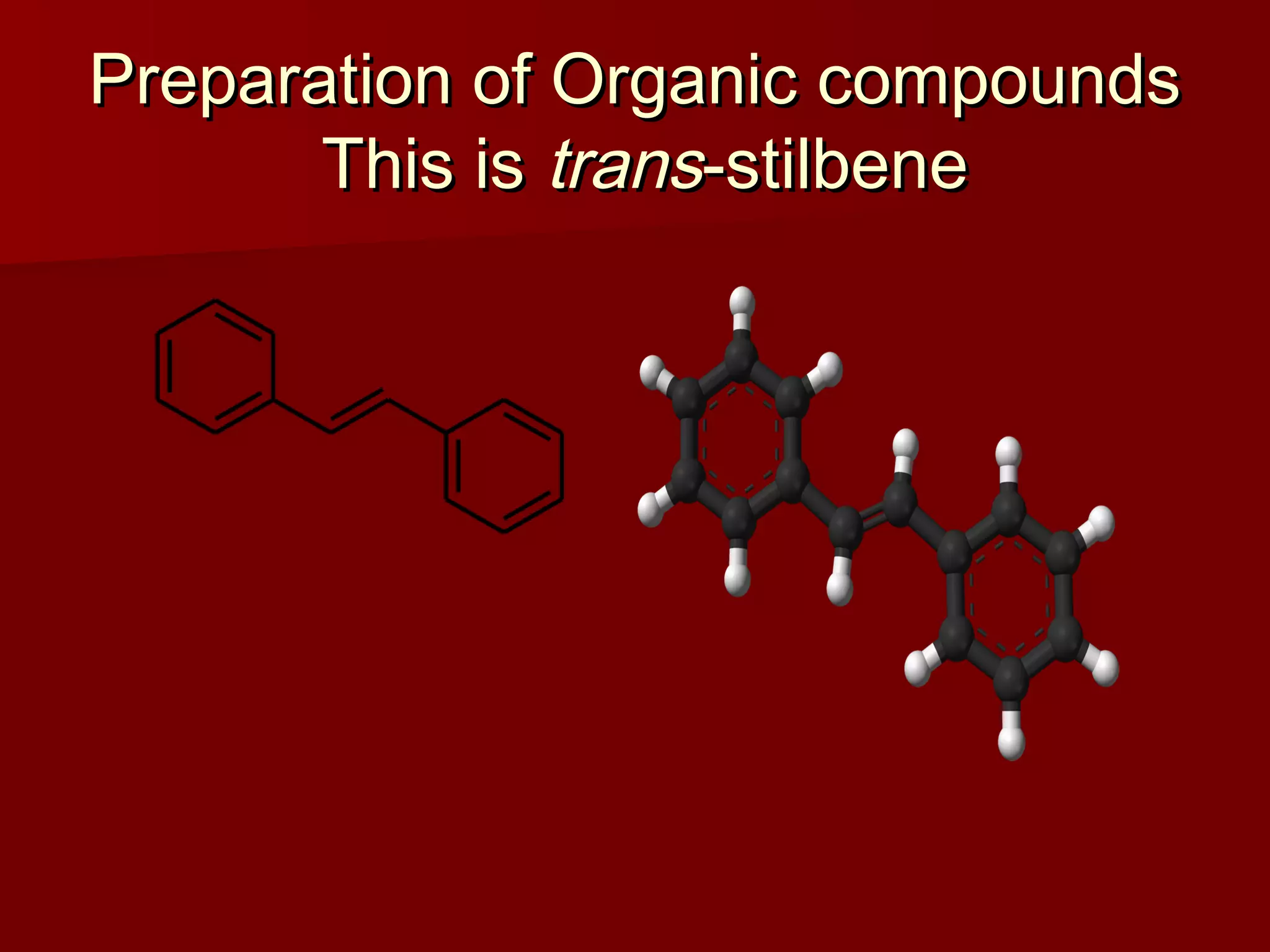
This isThis is transtrans-stilbene-stilbene
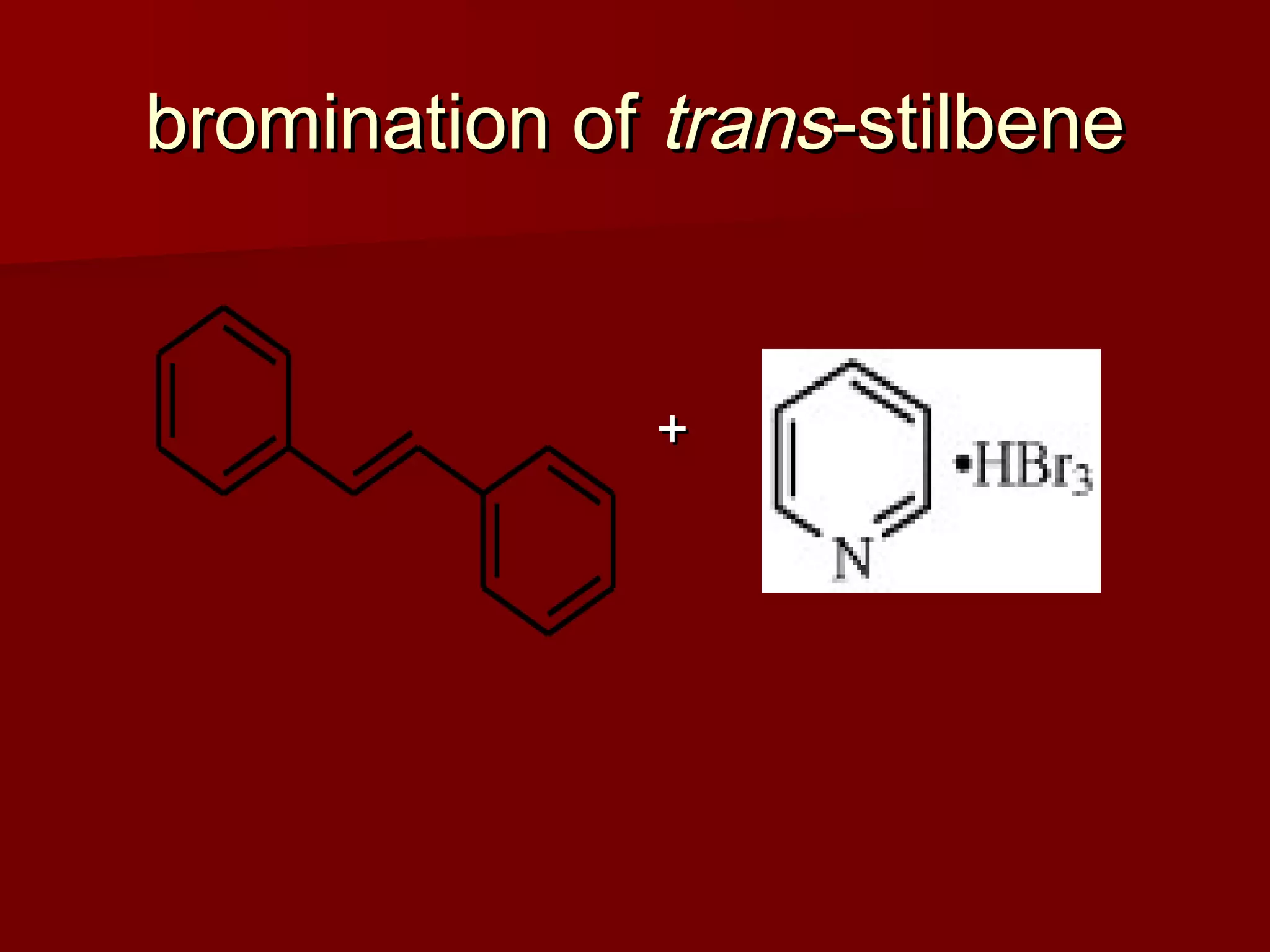
bromination ofbromination of transtrans-stilbene-stilbene
++
Meso-Stilbene Di BromideMeso-Stilbene Di Bromide
The bromination of an alkene is illustrated inThe bromination of an alkene is illustrated in
this experiment. In this particular reaction,this experiment. In this particular reaction,
bromination ofbromination of transtrans-stilbene-stilbene
generates a compound with two chiralgenerates a compound with two chiral
centers, leading to the possibility that thecenters, leading to the possibility that the
product could be either theproduct could be either the
meso or the d,l diastereomer.meso or the d,l diastereomer.
aa plane of symmetryplane of symmetry
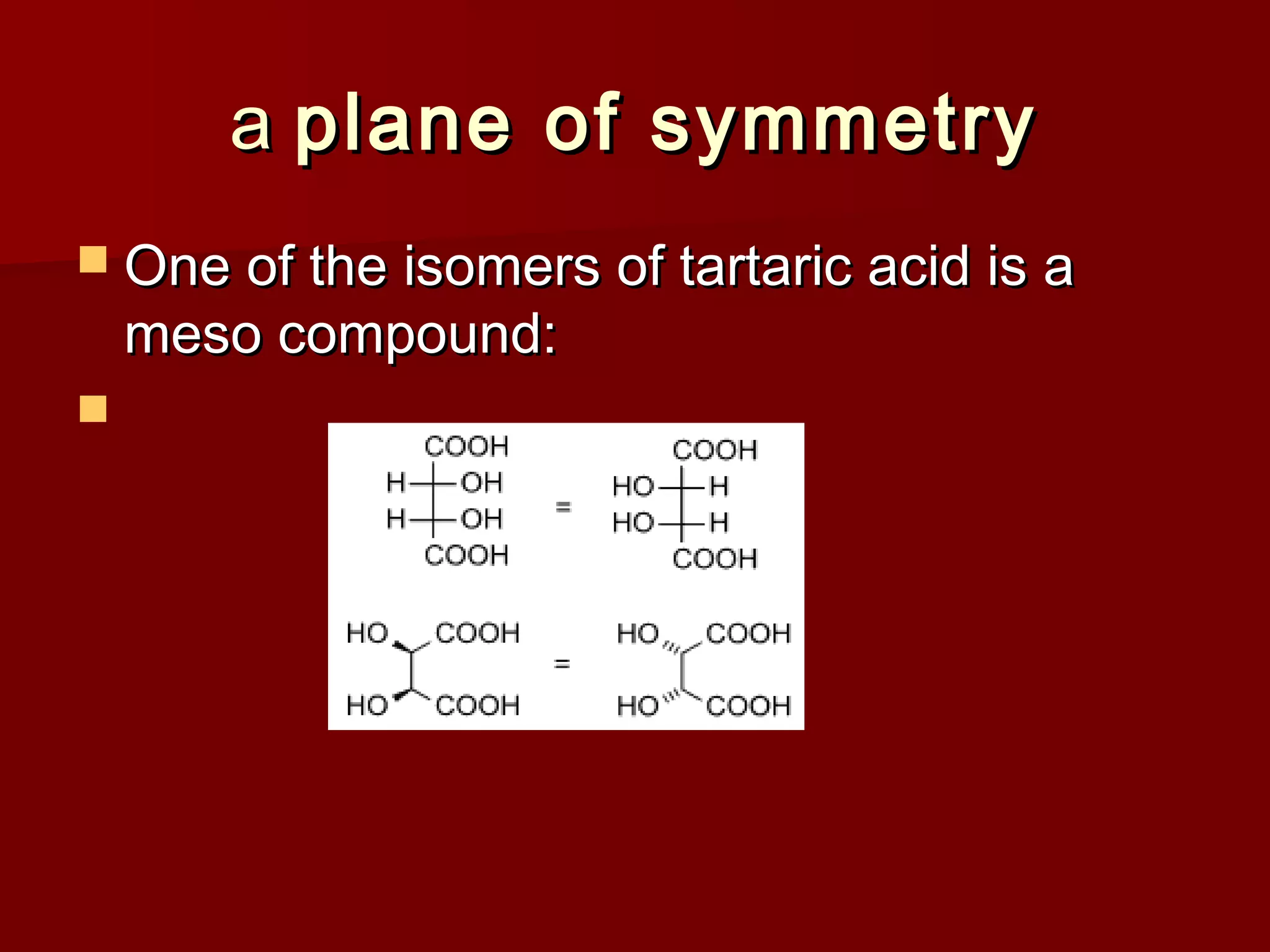
 One of the isomers of tartaric acid is aOne of the isomers of tartaric acid is a
meso compound:meso compound:

aa plane of symmetryplane of symmetry
 MesoMeso is a prefix which, by strict definitions,is a prefix which, by strict definitions,
indicates the presence of a 17th chiral center. Itindicates the presence of a 17th chiral center. It
comes from the Greek for "middle" or "mid", andcomes from the Greek for "middle" or "mid", and
refers to the fact that the molecule can rotaterefers to the fact that the molecule can rotate
about its middle. A meso molecule is not aabout its middle. A meso molecule is not a
diastereomer because rotating either of its chiraldiastereomer because rotating either of its chiral
centers doesn't change the molecule overall; acenters doesn't change the molecule overall; a
meso molecule has an internal plane ofmeso molecule has an internal plane of
reflection, also called areflection, also called a plane of symmetryplane of symmetry
pyridinium bromide perbromidepyridinium bromide perbromide
CAS [39416-48-3]  CAS [39416-48-3]     C   C55HH66BrBr33N     (MW 319.86)N     (MW 319.86)
The Reaction is stereospecificThe Reaction is stereospecific
The exclusive formation of the meso diastereomerThe exclusive formation of the meso diastereomer
shows that the reaction is stereospecific andshows that the reaction is stereospecific and
occurs with anti stereochemistry (mechanismoccurs with anti stereochemistry (mechanism
below).below).
 The bromination reagent in this experiment isThe bromination reagent in this experiment is
the pyridinium salt of the tribromide ion,the pyridinium salt of the tribromide ion,
 BrBr33 which can be used as a source of Brwhich can be used as a source of Br22 in somein some
reactions.reactions.
pyridinium bromide perbromidepyridinium bromide perbromide
 This solid salt is easier and safer to handleThis solid salt is easier and safer to handle
than molecular bromine. It is commonlythan molecular bromine. It is commonly
known as pyridinium bromide perbromide.known as pyridinium bromide perbromide.
Preparation of Organic compoundsPreparation of Organic compounds
 Bromination of an alkene (cyclic or acyclic)Bromination of an alkene (cyclic or acyclic)
is an example of an electrophilic additionis an example of an electrophilic addition
reaction. The reaction proceeds in tworeaction. The reaction proceeds in two
stages.stages.
 The first stage involves the formation of aThe first stage involves the formation of a
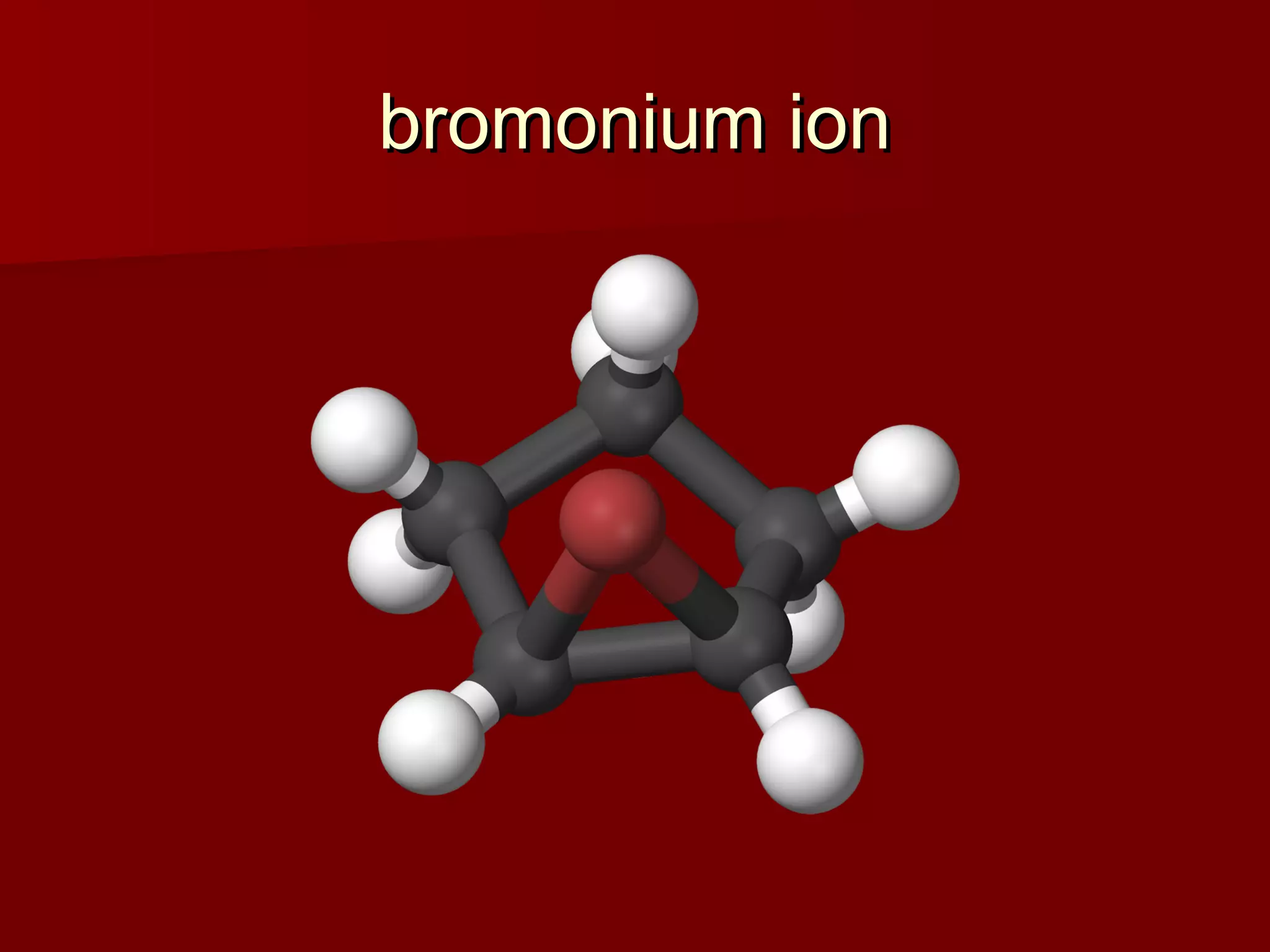
cyclic bromonium ion intermediate. Incyclic bromonium ion intermediate. In
special circumstances,this intermediatespecial circumstances,this intermediate
can isolated or observed using NMR.can isolated or observed using NMR.
nucleophilic attacknucleophilic attack
 . The second stage is a nucleophilic attack. The second stage is a nucleophilic attack
by a bromide ion on the intermediate, withby a bromide ion on the intermediate, with
inversion occurring at the carbon atominversion occurring at the carbon atom
attacked, to yield a vicinal dibromide.attacked, to yield a vicinal dibromide.
MECHANISM FOR REACTIONMECHANISM FOR REACTION
OF ALKENES WITHOF ALKENES WITH
HALOGENSHALOGENS
 Step 1:Step 1:
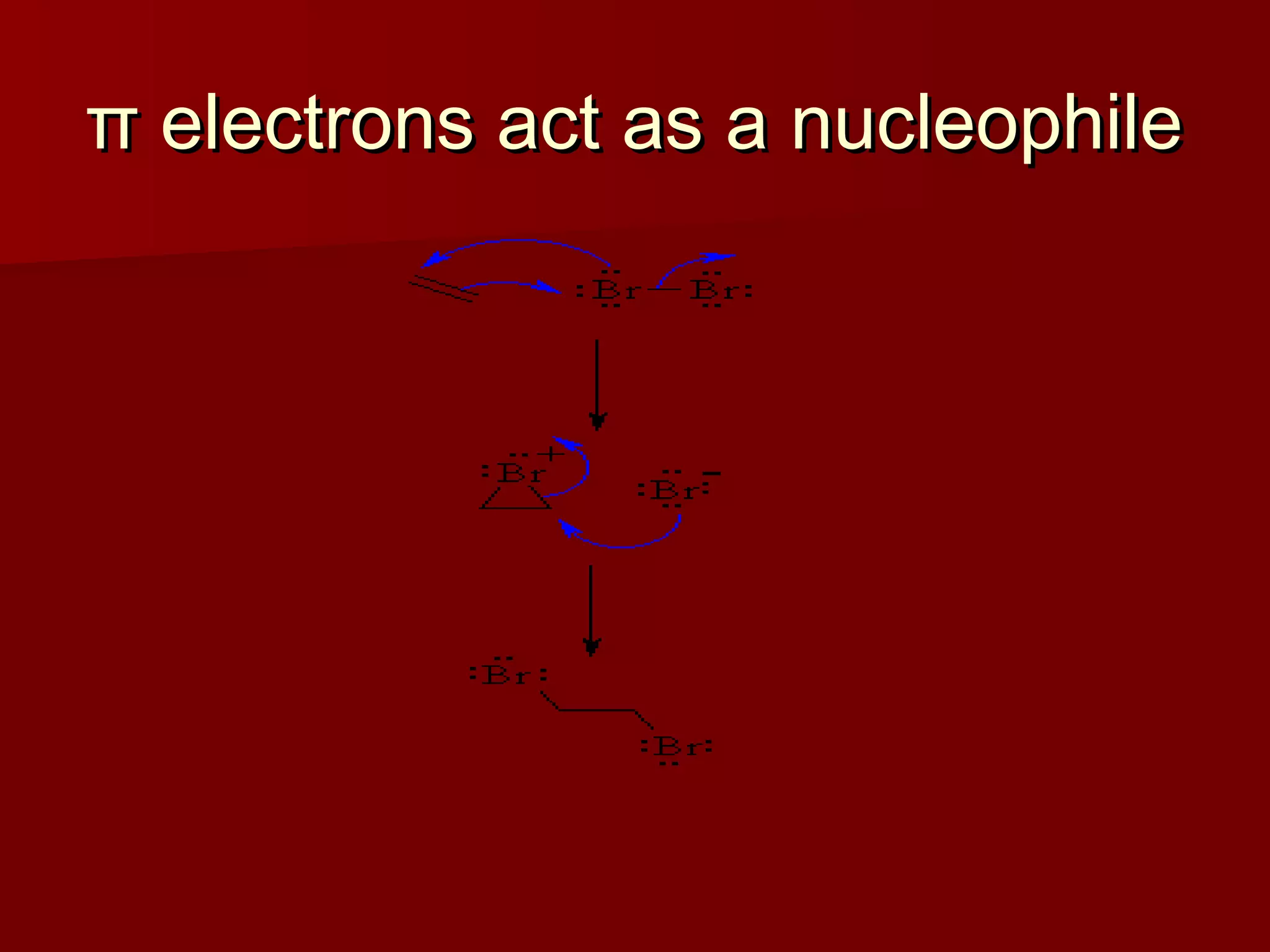
The π electrons act as a nucleophile,The π electrons act as a nucleophile,
attacking the bromine, displacing aattacking the bromine, displacing a
bromide ion but forming a cationic cyclicbromide ion but forming a cationic cyclic
bromonium ion as an intermediate.bromonium ion as an intermediate.
π electrons act as a nucleophileπ electrons act as a nucleophile
bromonium ionbromonium ion
The second stageThe second stage
 This second stage is like an Sn2 process.This second stage is like an Sn2 process.
Cyclic alkenes such as cyclohexeneCyclic alkenes such as cyclohexene
provide evidence that the reaction is anprovide evidence that the reaction is an
anti addition,anti addition,
 The bromine atoms being introduced transThe bromine atoms being introduced trans
to one another.to one another.
transtrans addition.addition.
 Step 2:Step 2:
Attack of the nucleophilic bromide from theAttack of the nucleophilic bromide from the
side away from the bromonium center inside away from the bromonium center in
an SN2 like fashion opens the cyclican SN2 like fashion opens the cyclic
bromonium ion to give overallbromonium ion to give overall transtrans
addition.addition.
The second stageThe second stage
 It is important to realize that if two differentIt is important to realize that if two different
groups are present on one or both of thegroups are present on one or both of the
sp2 carbon atoms of the alkenesp2 carbon atoms of the alkene
 linkage, chiral carbon centers arelinkage, chiral carbon centers are
generated on bromination of these carbongenerated on bromination of these carbon
atoms. In the case withatoms. In the case with transtrans-stilbene, two-stilbene, two
chiral centers are generated, yielding thechiral centers are generated, yielding the
meso dibromide.meso dibromide.
mechanism of the brominationmechanism of the bromination
 Because of The absence of the d,lBecause of The absence of the d,l
diastereomer confirms that thediastereomer confirms that the
reaction is stereospecifically anti. (Synreaction is stereospecifically anti. (Syn
addition would have given d,l.)addition would have given d,l.)
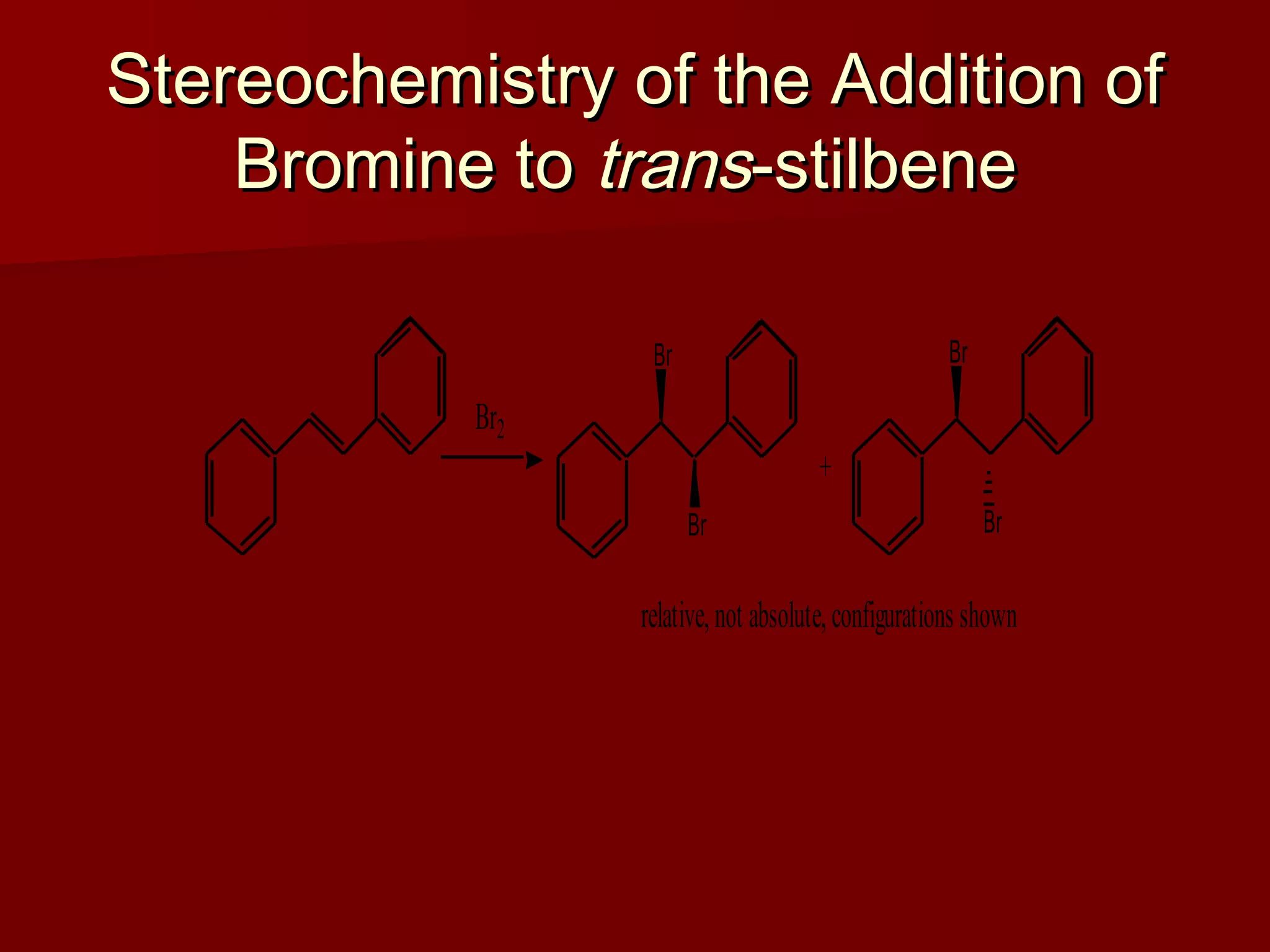
Stereochemistry of the Addition ofStereochemistry of the Addition of
Bromine toBromine to transtrans-stilbene-stilbene
Br2
+
Br
Br
Br
Br
relative,not absolute,configurations shown
mechanism of the brominationmechanism of the bromination
 Bromination of alkenes using a BrBromination of alkenes using a Br22/CCl/CCl44
solution (a red-brown color) is frequentlysolution (a red-brown color) is frequently
used as a qualitative test for the presenceused as a qualitative test for the presence
of unsaturation in a compound.of unsaturation in a compound.
 Rapid loss of color from the reagent is aRapid loss of color from the reagent is a
positive test.positive test.
Microscale procedureMicroscale procedure
 From pdf! (and book p 735)From pdf! (and book p 735)
 Microscale procedureMicroscale procedure
 In a reaction tube, dissolve 50 mg of E-In a reaction tube, dissolve 50 mg of E-
stilbene in 1 mL of acetic acid by heatingstilbene in 1 mL of acetic acid by heating
on a steam bathon a steam bath
Microscale procedureMicroscale procedure
 Then add 100 mg of pyridiniumThen add 100 mg of pyridinium
hydrobromide perbromide.hydrobromide perbromide.
 Mix by swirling!Mix by swirling!
 If necessary rinse crystals of the reagentIf necessary rinse crystals of the reagent
down the walls of the flask with a littledown the walls of the flask with a little
acetic acid and continue heating for anacetic acid and continue heating for an
additional 1 to 2 min.additional 1 to 2 min.
Microscale procedureMicroscale procedure
 The dibromide separates in small platesThe dibromide separates in small plates
 Cool this mixture under the tap, collect theCool this mixture under the tap, collect the
product on a Wilfilter (Fig 4.14 of page 74)product on a Wilfilter (Fig 4.14 of page 74)
 Or on a Hirsh funnelOr on a Hirsh funnel
Cleaning UpCleaning Up
 And wash it with methanol to remove anyAnd wash it with methanol to remove any
color, the yield of colorless crystals (mpcolor, the yield of colorless crystals (mp
236236 oo
C – 237C – 237 oo
C) is 80 mg.C) is 80 mg.
 Use this material to prepare theUse this material to prepare the
diphenylacetylene after determining thediphenylacetylene after determining the
percent yield and the melting pointpercent yield and the melting point
From pdf is the same!From pdf is the same!
 In a 4" test tube, 100 mg ofIn a 4" test tube, 100 mg of transtrans-stilbene is-stilbene is
dissolved in 2 mL of glacial acetic acid bydissolved in 2 mL of glacial acetic acid by
heating in a bath of boilingheating in a bath of boiling
 water, and then 200 mg of pyridinium bromidewater, and then 200 mg of pyridinium bromide
perbromide is added. The mixture is stirredperbromide is added. The mixture is stirred
constantly with continuedconstantly with continued
 heating at 100 ßC for 7 minutes. The reactionheating at 100 ßC for 7 minutes. The reaction
mixture is cooled to room temperature, and themixture is cooled to room temperature, and the
product collected byproduct collected by
 suction filtration and washed with methanol.suction filtration and washed with methanol.
 http://www.aug.edu/~tcrute/lab_experimenhttp://www.aug.edu/~tcrute/lab_experimen
ts/3411%20lab%20Br2%20stilbene-briefts/3411%20lab%20Br2%20stilbene-brief
%20report.doc%20report.doc
 CHEM3411CHEM3411
 Stereochemistry of the Addition of Bromine toStereochemistry of the Addition of Bromine to transtrans-stilbene-stilbene
 You will prepare dl- and meso-1,2-dibromo-1,2-diphenylethane (two diastereomers of stilbene dibromide) by an addition reaction to trans-stilbene. These products will notYou will prepare dl- and meso-1,2-dibromo-1,2-diphenylethane (two diastereomers of stilbene dibromide) by an addition reaction to trans-stilbene. These products will not
be formed in equal amounts. Isolation by recrystallization and melting point determination of one diastereomer will allow characterization of the diastereomer ratio.be formed in equal amounts. Isolation by recrystallization and melting point determination of one diastereomer will allow characterization of the diastereomer ratio.
 Before you come to labBefore you come to lab
 Review textbook concerning the bromination of alkenes. It is essential that you perform aReview textbook concerning the bromination of alkenes. It is essential that you perform a high yieldinghigh yielding recrystallization to yieldrecrystallization to yield purepure product, thus you should reviewproduct, thus you should review
recrystallization in Zubrick. Complete usual pre-lab. Read the sections of your textbook about meso and dl (or chiral) diastereomers.recrystallization in Zubrick. Complete usual pre-lab. Read the sections of your textbook about meso and dl (or chiral) diastereomers.
 ProcedureProcedure
 Bromination of trans-stilbeneBromination of trans-stilbene
 Carry out the reaction in the fume hood. To a 50 mL Erlenmeyer flask is added 0.3 g (record exact mass) ofCarry out the reaction in the fume hood. To a 50 mL Erlenmeyer flask is added 0.3 g (record exact mass) of transtrans-stilbene and 3.0 mL of dichloromethane. To this stirred-stilbene and 3.0 mL of dichloromethane. To this stirred
mixture is added sufficient 10% bromine/dichloromethane solution to ensure,mixture is added sufficient 10% bromine/dichloromethane solution to ensure, based on colorbased on color, a slight excess of bromine (usually 3 mL or less). Stopper and clamp the, a slight excess of bromine (usually 3 mL or less). Stopper and clamp the
flask and place in an ice-water bath for crystallization. The bromine color may disappear to leave an overall yellow color. Take the cooled sample to the bench andflask and place in an ice-water bath for crystallization. The bromine color may disappear to leave an overall yellow color. Take the cooled sample to the bench and
suction-filter the crude product. Rinse the crystals with about 1 mL of cold dichloromethane. Blot dry to yield the crude product.suction-filter the crude product. Rinse the crystals with about 1 mL of cold dichloromethane. Blot dry to yield the crude product.
 Preparation of a pure samplePreparation of a pure sample
 Precisely weigh a small portion (certainly less than 0.1 g- actually about 0.05 g works quite well) of the crude product and recrystallize from methanol. Use your 125 mLPrecisely weigh a small portion (certainly less than 0.1 g- actually about 0.05 g works quite well) of the crude product and recrystallize from methanol. Use your 125 mL
Erlenmeyer to ensure enough capacity for the proper amount of solvent. Hot, gravity filtration is probably unnecessary for lack of insoluble impurities. Isolate the productErlenmeyer to ensure enough capacity for the proper amount of solvent. Hot, gravity filtration is probably unnecessary for lack of insoluble impurities. Isolate the product
by suction filtration through the cone shaped porcelain funnel (Hirsh funnel). Dry the crystals as much as possible by allowing air to suck through them for severalby suction filtration through the cone shaped porcelain funnel (Hirsh funnel). Dry the crystals as much as possible by allowing air to suck through them for several
minutes.minutes.
 AnalysisAnalysis
 Measure the mass of your crude product (mixture of diastereomers). Account for the mass removed for recrystallization, and calculate the percent yield of the reactionMeasure the mass of your crude product (mixture of diastereomers). Account for the mass removed for recrystallization, and calculate the percent yield of the reaction
based on the limiting reactant. For your recrystallized product, measure the melting point to identify the diastereomer (literature values: dl-stilbene dibromide- 113-114°Cbased on the limiting reactant. For your recrystallized product, measure the melting point to identify the diastereomer (literature values: dl-stilbene dibromide- 113-114°C
and meso-stilbene dibromide 237°C). Measure the mass of the pure diastereomer and, based on the amount of crude product you purified, calculate the ratio of productsand meso-stilbene dibromide 237°C). Measure the mass of the pure diastereomer and, based on the amount of crude product you purified, calculate the ratio of products
assuming the remaining mass is the other diastereomer.assuming the remaining mass is the other diastereomer.
 Turn in the carbon copies of your prelab and raw data from your observation at this time. You will complete your report in your notebook and turn in the original portionsTurn in the carbon copies of your prelab and raw data from your observation at this time. You will complete your report in your notebook and turn in the original portions
for the prelab and results in addition to your additional analysis (see next page) for grading.for the prelab and results in addition to your additional analysis (see next page) for grading.

 Brief Report GuidelineBrief Report Guideline
 In your notebook, following the section on in-lab data and observations complete the following:In your notebook, following the section on in-lab data and observations complete the following:
 Summarize the results (calculated in the analysis above) ofSummarize the results (calculated in the analysis above) of
 yield of reaction (based on limiting reactant and the mass of the crude product mixture of diastereomers- show calculations!)yield of reaction (based on limiting reactant and the mass of the crude product mixture of diastereomers- show calculations!)
 ratio of meso to dl diastereomers (based on the pure sample- mass of pure compared to the recrystalized crude- show calculations)ratio of meso to dl diastereomers (based on the pure sample- mass of pure compared to the recrystalized crude- show calculations)
 observed melting point with a comparison to the expected melting point possibilitiesobserved melting point with a comparison to the expected melting point possibilities
 your conclusion about the identity of pure product that was isolated from the mixtureyour conclusion about the identity of pure product that was isolated from the mixture
 Discuss the following concisely:Discuss the following concisely:
 Show mechanism(s) that account for the formation of each diastereomer. Explain why each might occur. (Hint: a particular mechanism might give both diastereomers.Show mechanism(s) that account for the formation of each diastereomer. Explain why each might occur. (Hint: a particular mechanism might give both diastereomers.
There also might be more than one mechanism that will make a particular diastereomer) Suggest (with good reasons to back up your suggestions) particular parts of theThere also might be more than one mechanism that will make a particular diastereomer) Suggest (with good reasons to back up your suggestions) particular parts of the
procedure that were the weak points (inherent problems with the general method involved and, if appropriate, any mistakes you made that affected your measurements) inprocedure that were the weak points (inherent problems with the general method involved and, if appropriate, any mistakes you made that affected your measurements) in
your ability to measure the ratio of diastereomer.your ability to measure the ratio of diastereomer.
REU: Research ExperiencesREU: Research Experiences
for Undergraduatesfor Undergraduates
 University of Nevada NSF-REU summerUniversity of Nevada NSF-REU summer
program in chemistry.program in chemistry.
 Program in the summer of 2011 or 2012.Program in the summer of 2011 or 2012.
 Students interested in the REU program inStudents interested in the REU program in
general should consult the NSF web site for ageneral should consult the NSF web site for a
listing of programs available nation-wide:listing of programs available nation-wide:
REU: Research ExperiencesREU: Research Experiences
for UndergraduatesResearchfor UndergraduatesResearch
Experience for Undergraduates (REU)Experience for Undergraduates (REU)
ProgramProgram
A program funded by the National ScienceA program funded by the National Science
Foundation (NSF)Foundation (NSF)
Charlie from Charlie’s AngelsCharlie from Charlie’s Angels
Charlie was pretty cool too!Charlie was pretty cool too!
For the girls, not to be sexist!For the girls, not to be sexist!
 ..
Charlie always had info for theCharlie always had info for the
angelsangels
Never saw him??? Kinda strange?Never saw him??? Kinda strange?
But, you got use to it.But, you got use to it.
How to synthesize a compound?How to synthesize a compound?
 My job is to give you some info as well!My job is to give you some info as well!
 Synthesis of organic compoundsSynthesis of organic compounds
What can I do with this info???What can I do with this info???
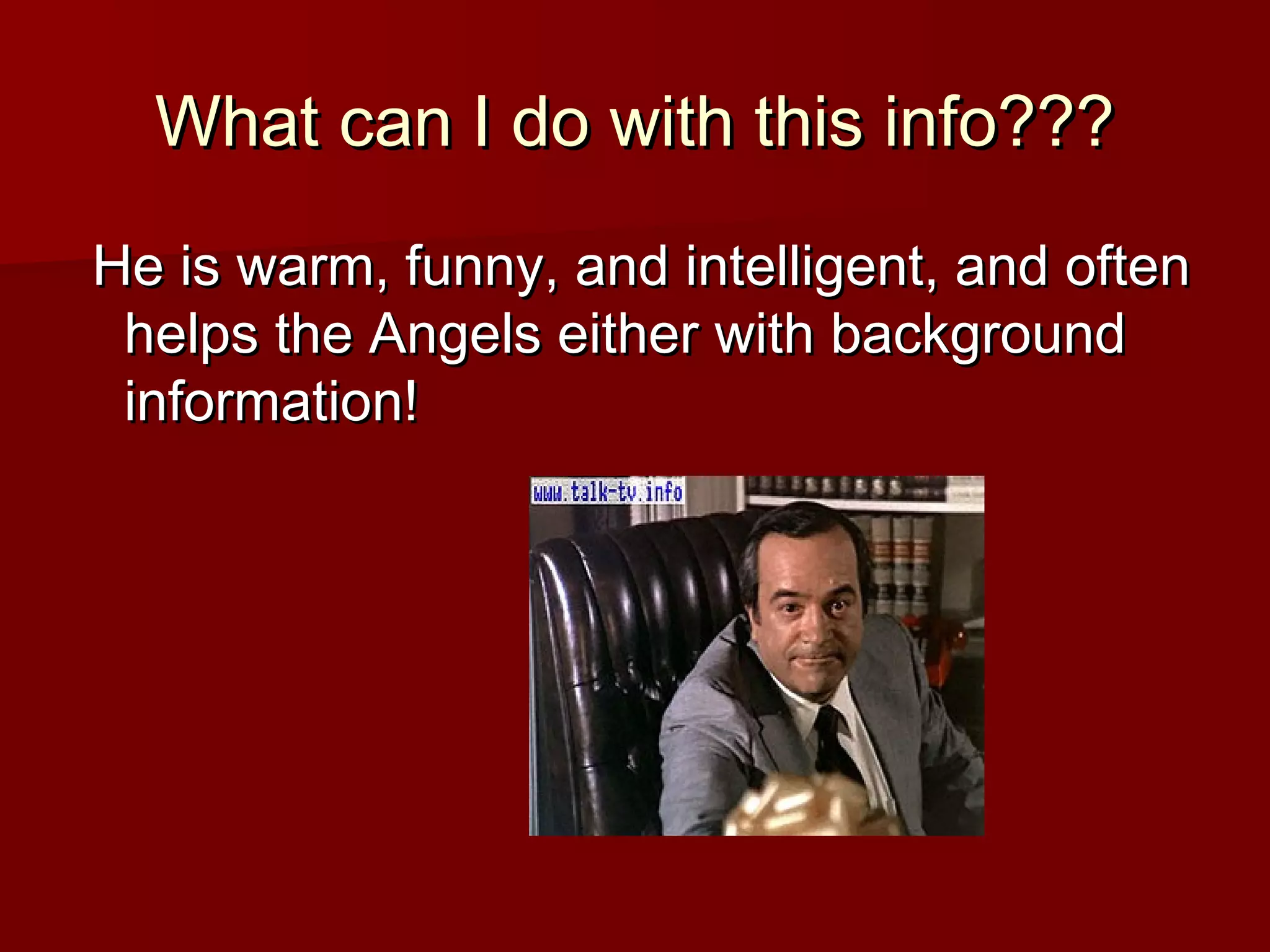
He is warm, funny, and intelligent, and oftenHe is warm, funny, and intelligent, and often
helps the Angels either with backgroundhelps the Angels either with background
information!information!
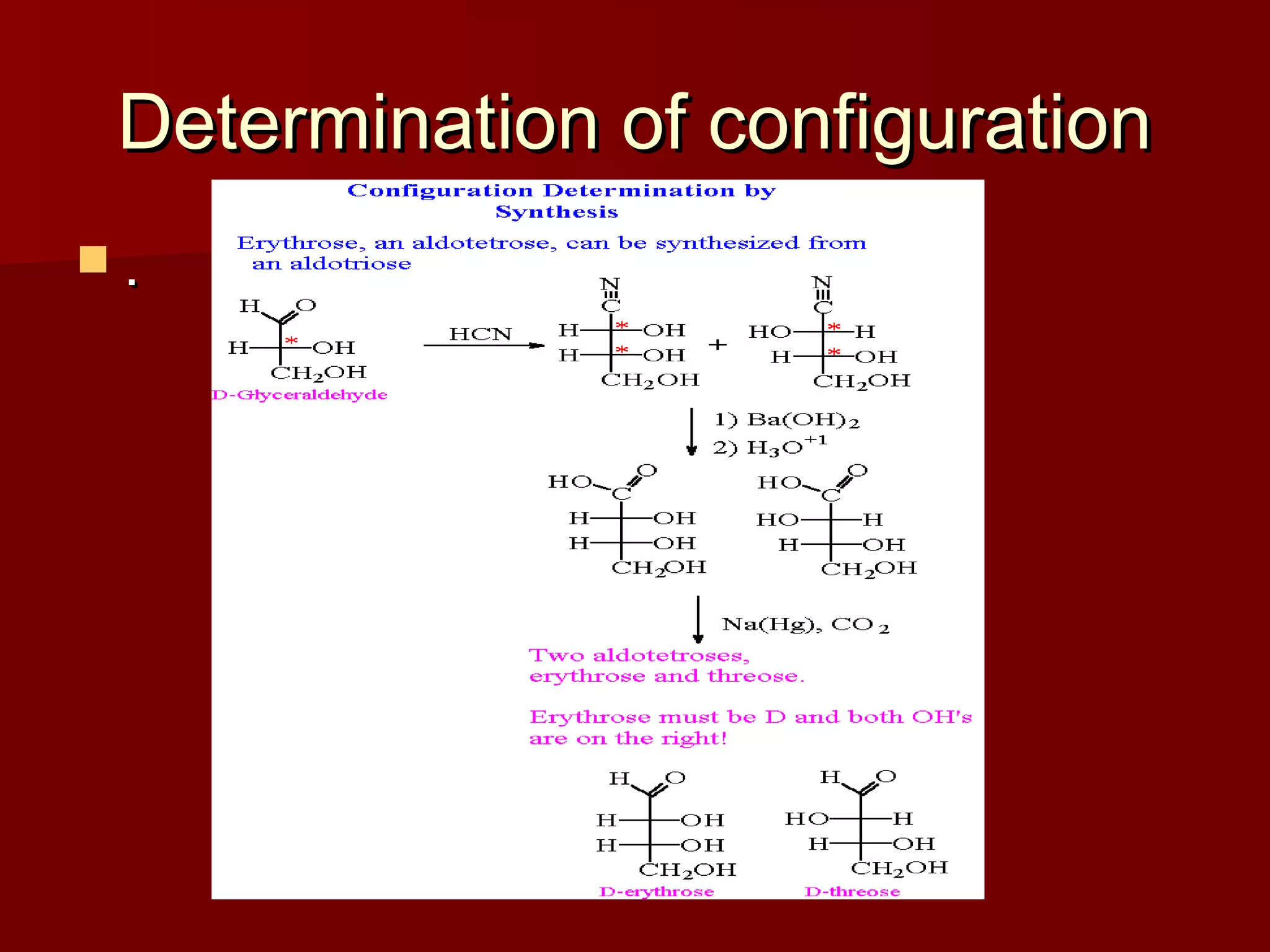
Determination of configurationDetermination of configuration
 ..
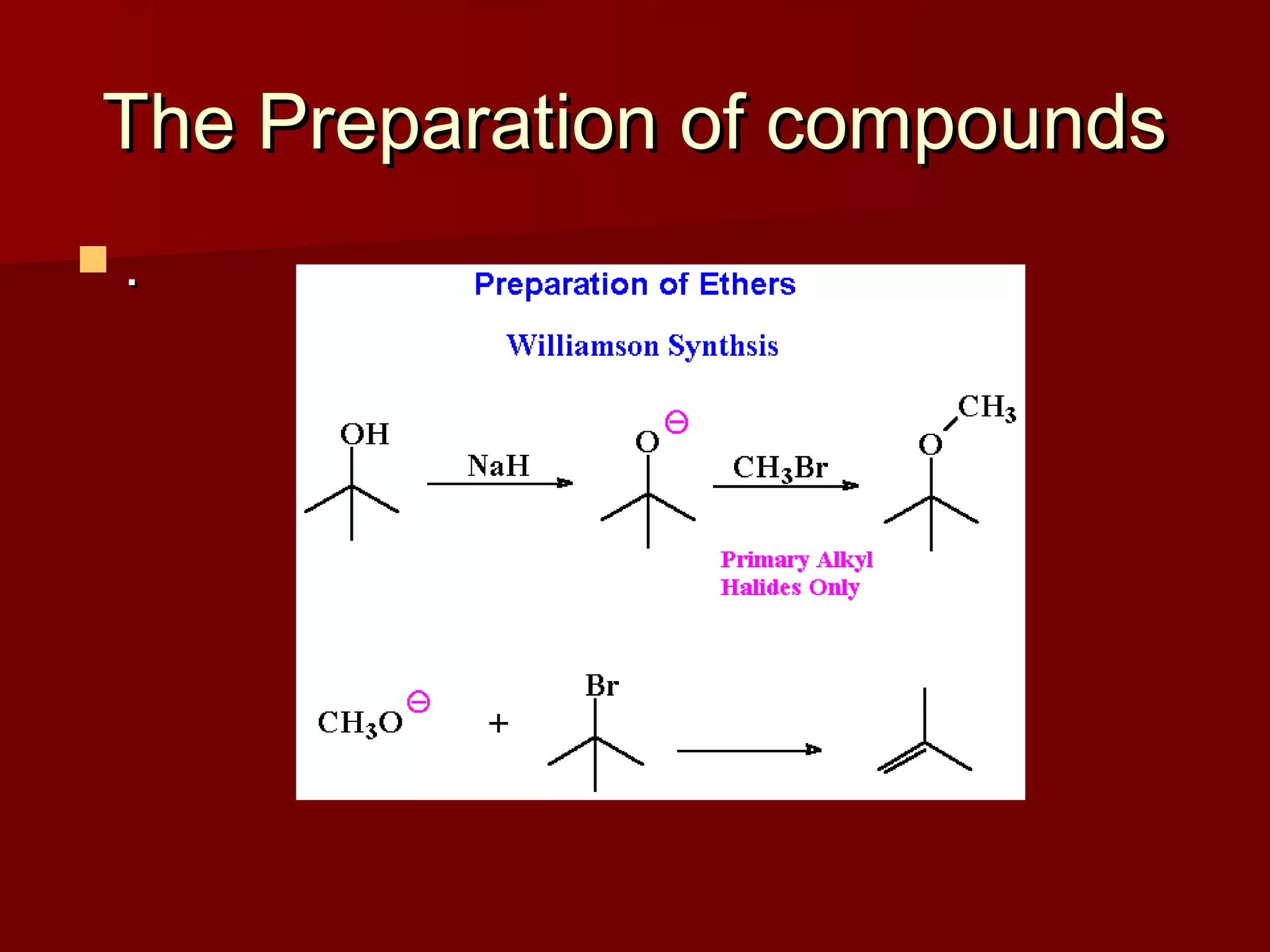
The Preparation of compoundsThe Preparation of compounds
 ..
StilbeneStilbene
 Stilbene used as a LASER dyeStilbene used as a LASER dye
Brominationof alkenes

Brominationof alkenes

  • 1.
    Bromination of alkenesBrominationof alkenes Author: Dr. Robert D. Craig, Ph.DAuthor: Dr. Robert D. Craig, Ph.D For Organic Chemistry firstFor Organic Chemistry first semestersemester
  • 2.
    Preparation of OrganiccompoundsPreparation of Organic compounds This isThis is transtrans-stilbene-stilbene
  • 3.
    bromination ofbromination oftranstrans-stilbene-stilbene ++
  • 4.
    Meso-Stilbene Di BromideMeso-StilbeneDi Bromide The bromination of an alkene is illustrated inThe bromination of an alkene is illustrated in this experiment. In this particular reaction,this experiment. In this particular reaction, bromination ofbromination of transtrans-stilbene-stilbene generates a compound with two chiralgenerates a compound with two chiral centers, leading to the possibility that thecenters, leading to the possibility that the product could be either theproduct could be either the meso or the d,l diastereomer.meso or the d,l diastereomer.
  • 5.
    aa plane ofsymmetryplane of symmetry  One of the isomers of tartaric acid is aOne of the isomers of tartaric acid is a meso compound:meso compound: 
  • 6.
    aa plane ofsymmetryplane of symmetry  MesoMeso is a prefix which, by strict definitions,is a prefix which, by strict definitions, indicates the presence of a 17th chiral center. Itindicates the presence of a 17th chiral center. It comes from the Greek for "middle" or "mid", andcomes from the Greek for "middle" or "mid", and refers to the fact that the molecule can rotaterefers to the fact that the molecule can rotate about its middle. A meso molecule is not aabout its middle. A meso molecule is not a diastereomer because rotating either of its chiraldiastereomer because rotating either of its chiral centers doesn't change the molecule overall; acenters doesn't change the molecule overall; a meso molecule has an internal plane ofmeso molecule has an internal plane of reflection, also called areflection, also called a plane of symmetryplane of symmetry
  • 7.
    pyridinium bromide perbromidepyridiniumbromide perbromide CAS [39416-48-3]  CAS [39416-48-3]     C   C55HH66BrBr33N     (MW 319.86)N     (MW 319.86)
  • 8.
    The Reaction isstereospecificThe Reaction is stereospecific The exclusive formation of the meso diastereomerThe exclusive formation of the meso diastereomer shows that the reaction is stereospecific andshows that the reaction is stereospecific and occurs with anti stereochemistry (mechanismoccurs with anti stereochemistry (mechanism below).below).  The bromination reagent in this experiment isThe bromination reagent in this experiment is the pyridinium salt of the tribromide ion,the pyridinium salt of the tribromide ion,  BrBr33 which can be used as a source of Brwhich can be used as a source of Br22 in somein some reactions.reactions.
  • 9.
    pyridinium bromide perbromidepyridiniumbromide perbromide  This solid salt is easier and safer to handleThis solid salt is easier and safer to handle than molecular bromine. It is commonlythan molecular bromine. It is commonly known as pyridinium bromide perbromide.known as pyridinium bromide perbromide.
  • 10.
    Preparation of OrganiccompoundsPreparation of Organic compounds  Bromination of an alkene (cyclic or acyclic)Bromination of an alkene (cyclic or acyclic) is an example of an electrophilic additionis an example of an electrophilic addition reaction. The reaction proceeds in tworeaction. The reaction proceeds in two stages.stages.  The first stage involves the formation of aThe first stage involves the formation of a cyclic bromonium ion intermediate. Incyclic bromonium ion intermediate. In special circumstances,this intermediatespecial circumstances,this intermediate can isolated or observed using NMR.can isolated or observed using NMR.
  • 11.
    nucleophilic attacknucleophilic attack . The second stage is a nucleophilic attack. The second stage is a nucleophilic attack by a bromide ion on the intermediate, withby a bromide ion on the intermediate, with inversion occurring at the carbon atominversion occurring at the carbon atom attacked, to yield a vicinal dibromide.attacked, to yield a vicinal dibromide.
  • 12.
    MECHANISM FOR REACTIONMECHANISMFOR REACTION OF ALKENES WITHOF ALKENES WITH HALOGENSHALOGENS  Step 1:Step 1: The π electrons act as a nucleophile,The π electrons act as a nucleophile, attacking the bromine, displacing aattacking the bromine, displacing a bromide ion but forming a cationic cyclicbromide ion but forming a cationic cyclic bromonium ion as an intermediate.bromonium ion as an intermediate.
  • 13.
    π electrons actas a nucleophileπ electrons act as a nucleophile
  • 14.
  • 15.
    The second stageThesecond stage  This second stage is like an Sn2 process.This second stage is like an Sn2 process. Cyclic alkenes such as cyclohexeneCyclic alkenes such as cyclohexene provide evidence that the reaction is anprovide evidence that the reaction is an anti addition,anti addition,  The bromine atoms being introduced transThe bromine atoms being introduced trans to one another.to one another.
  • 16.
    transtrans addition.addition.  Step2:Step 2: Attack of the nucleophilic bromide from theAttack of the nucleophilic bromide from the side away from the bromonium center inside away from the bromonium center in an SN2 like fashion opens the cyclican SN2 like fashion opens the cyclic bromonium ion to give overallbromonium ion to give overall transtrans addition.addition.
  • 17.
    The second stageThesecond stage  It is important to realize that if two differentIt is important to realize that if two different groups are present on one or both of thegroups are present on one or both of the sp2 carbon atoms of the alkenesp2 carbon atoms of the alkene  linkage, chiral carbon centers arelinkage, chiral carbon centers are generated on bromination of these carbongenerated on bromination of these carbon atoms. In the case withatoms. In the case with transtrans-stilbene, two-stilbene, two chiral centers are generated, yielding thechiral centers are generated, yielding the meso dibromide.meso dibromide.
  • 18.
    mechanism of thebrominationmechanism of the bromination  Because of The absence of the d,lBecause of The absence of the d,l diastereomer confirms that thediastereomer confirms that the reaction is stereospecifically anti. (Synreaction is stereospecifically anti. (Syn addition would have given d,l.)addition would have given d,l.)
  • 19.
    Stereochemistry of theAddition ofStereochemistry of the Addition of Bromine toBromine to transtrans-stilbene-stilbene Br2 + Br Br Br Br relative,not absolute,configurations shown
  • 20.
    mechanism of thebrominationmechanism of the bromination  Bromination of alkenes using a BrBromination of alkenes using a Br22/CCl/CCl44 solution (a red-brown color) is frequentlysolution (a red-brown color) is frequently used as a qualitative test for the presenceused as a qualitative test for the presence of unsaturation in a compound.of unsaturation in a compound.  Rapid loss of color from the reagent is aRapid loss of color from the reagent is a positive test.positive test.
  • 21.
    Microscale procedureMicroscale procedure From pdf! (and book p 735)From pdf! (and book p 735)  Microscale procedureMicroscale procedure  In a reaction tube, dissolve 50 mg of E-In a reaction tube, dissolve 50 mg of E- stilbene in 1 mL of acetic acid by heatingstilbene in 1 mL of acetic acid by heating on a steam bathon a steam bath
  • 22.
    Microscale procedureMicroscale procedure Then add 100 mg of pyridiniumThen add 100 mg of pyridinium hydrobromide perbromide.hydrobromide perbromide.  Mix by swirling!Mix by swirling!  If necessary rinse crystals of the reagentIf necessary rinse crystals of the reagent down the walls of the flask with a littledown the walls of the flask with a little acetic acid and continue heating for anacetic acid and continue heating for an additional 1 to 2 min.additional 1 to 2 min.
  • 23.
    Microscale procedureMicroscale procedure The dibromide separates in small platesThe dibromide separates in small plates  Cool this mixture under the tap, collect theCool this mixture under the tap, collect the product on a Wilfilter (Fig 4.14 of page 74)product on a Wilfilter (Fig 4.14 of page 74)  Or on a Hirsh funnelOr on a Hirsh funnel
  • 24.
    Cleaning UpCleaning Up And wash it with methanol to remove anyAnd wash it with methanol to remove any color, the yield of colorless crystals (mpcolor, the yield of colorless crystals (mp 236236 oo C – 237C – 237 oo C) is 80 mg.C) is 80 mg.  Use this material to prepare theUse this material to prepare the diphenylacetylene after determining thediphenylacetylene after determining the percent yield and the melting pointpercent yield and the melting point
  • 27.
    From pdf isthe same!From pdf is the same!  In a 4" test tube, 100 mg ofIn a 4" test tube, 100 mg of transtrans-stilbene is-stilbene is dissolved in 2 mL of glacial acetic acid bydissolved in 2 mL of glacial acetic acid by heating in a bath of boilingheating in a bath of boiling  water, and then 200 mg of pyridinium bromidewater, and then 200 mg of pyridinium bromide perbromide is added. The mixture is stirredperbromide is added. The mixture is stirred constantly with continuedconstantly with continued  heating at 100 ßC for 7 minutes. The reactionheating at 100 ßC for 7 minutes. The reaction mixture is cooled to room temperature, and themixture is cooled to room temperature, and the product collected byproduct collected by  suction filtration and washed with methanol.suction filtration and washed with methanol.
  • 29.
  • 30.
     CHEM3411CHEM3411  Stereochemistryof the Addition of Bromine toStereochemistry of the Addition of Bromine to transtrans-stilbene-stilbene  You will prepare dl- and meso-1,2-dibromo-1,2-diphenylethane (two diastereomers of stilbene dibromide) by an addition reaction to trans-stilbene. These products will notYou will prepare dl- and meso-1,2-dibromo-1,2-diphenylethane (two diastereomers of stilbene dibromide) by an addition reaction to trans-stilbene. These products will not be formed in equal amounts. Isolation by recrystallization and melting point determination of one diastereomer will allow characterization of the diastereomer ratio.be formed in equal amounts. Isolation by recrystallization and melting point determination of one diastereomer will allow characterization of the diastereomer ratio.  Before you come to labBefore you come to lab  Review textbook concerning the bromination of alkenes. It is essential that you perform aReview textbook concerning the bromination of alkenes. It is essential that you perform a high yieldinghigh yielding recrystallization to yieldrecrystallization to yield purepure product, thus you should reviewproduct, thus you should review recrystallization in Zubrick. Complete usual pre-lab. Read the sections of your textbook about meso and dl (or chiral) diastereomers.recrystallization in Zubrick. Complete usual pre-lab. Read the sections of your textbook about meso and dl (or chiral) diastereomers.  ProcedureProcedure  Bromination of trans-stilbeneBromination of trans-stilbene  Carry out the reaction in the fume hood. To a 50 mL Erlenmeyer flask is added 0.3 g (record exact mass) ofCarry out the reaction in the fume hood. To a 50 mL Erlenmeyer flask is added 0.3 g (record exact mass) of transtrans-stilbene and 3.0 mL of dichloromethane. To this stirred-stilbene and 3.0 mL of dichloromethane. To this stirred mixture is added sufficient 10% bromine/dichloromethane solution to ensure,mixture is added sufficient 10% bromine/dichloromethane solution to ensure, based on colorbased on color, a slight excess of bromine (usually 3 mL or less). Stopper and clamp the, a slight excess of bromine (usually 3 mL or less). Stopper and clamp the flask and place in an ice-water bath for crystallization. The bromine color may disappear to leave an overall yellow color. Take the cooled sample to the bench andflask and place in an ice-water bath for crystallization. The bromine color may disappear to leave an overall yellow color. Take the cooled sample to the bench and suction-filter the crude product. Rinse the crystals with about 1 mL of cold dichloromethane. Blot dry to yield the crude product.suction-filter the crude product. Rinse the crystals with about 1 mL of cold dichloromethane. Blot dry to yield the crude product.  Preparation of a pure samplePreparation of a pure sample  Precisely weigh a small portion (certainly less than 0.1 g- actually about 0.05 g works quite well) of the crude product and recrystallize from methanol. Use your 125 mLPrecisely weigh a small portion (certainly less than 0.1 g- actually about 0.05 g works quite well) of the crude product and recrystallize from methanol. Use your 125 mL Erlenmeyer to ensure enough capacity for the proper amount of solvent. Hot, gravity filtration is probably unnecessary for lack of insoluble impurities. Isolate the productErlenmeyer to ensure enough capacity for the proper amount of solvent. Hot, gravity filtration is probably unnecessary for lack of insoluble impurities. Isolate the product by suction filtration through the cone shaped porcelain funnel (Hirsh funnel). Dry the crystals as much as possible by allowing air to suck through them for severalby suction filtration through the cone shaped porcelain funnel (Hirsh funnel). Dry the crystals as much as possible by allowing air to suck through them for several minutes.minutes.  AnalysisAnalysis  Measure the mass of your crude product (mixture of diastereomers). Account for the mass removed for recrystallization, and calculate the percent yield of the reactionMeasure the mass of your crude product (mixture of diastereomers). Account for the mass removed for recrystallization, and calculate the percent yield of the reaction based on the limiting reactant. For your recrystallized product, measure the melting point to identify the diastereomer (literature values: dl-stilbene dibromide- 113-114°Cbased on the limiting reactant. For your recrystallized product, measure the melting point to identify the diastereomer (literature values: dl-stilbene dibromide- 113-114°C and meso-stilbene dibromide 237°C). Measure the mass of the pure diastereomer and, based on the amount of crude product you purified, calculate the ratio of productsand meso-stilbene dibromide 237°C). Measure the mass of the pure diastereomer and, based on the amount of crude product you purified, calculate the ratio of products assuming the remaining mass is the other diastereomer.assuming the remaining mass is the other diastereomer.  Turn in the carbon copies of your prelab and raw data from your observation at this time. You will complete your report in your notebook and turn in the original portionsTurn in the carbon copies of your prelab and raw data from your observation at this time. You will complete your report in your notebook and turn in the original portions for the prelab and results in addition to your additional analysis (see next page) for grading.for the prelab and results in addition to your additional analysis (see next page) for grading.   Brief Report GuidelineBrief Report Guideline  In your notebook, following the section on in-lab data and observations complete the following:In your notebook, following the section on in-lab data and observations complete the following:  Summarize the results (calculated in the analysis above) ofSummarize the results (calculated in the analysis above) of  yield of reaction (based on limiting reactant and the mass of the crude product mixture of diastereomers- show calculations!)yield of reaction (based on limiting reactant and the mass of the crude product mixture of diastereomers- show calculations!)  ratio of meso to dl diastereomers (based on the pure sample- mass of pure compared to the recrystalized crude- show calculations)ratio of meso to dl diastereomers (based on the pure sample- mass of pure compared to the recrystalized crude- show calculations)  observed melting point with a comparison to the expected melting point possibilitiesobserved melting point with a comparison to the expected melting point possibilities  your conclusion about the identity of pure product that was isolated from the mixtureyour conclusion about the identity of pure product that was isolated from the mixture  Discuss the following concisely:Discuss the following concisely:  Show mechanism(s) that account for the formation of each diastereomer. Explain why each might occur. (Hint: a particular mechanism might give both diastereomers.Show mechanism(s) that account for the formation of each diastereomer. Explain why each might occur. (Hint: a particular mechanism might give both diastereomers. There also might be more than one mechanism that will make a particular diastereomer) Suggest (with good reasons to back up your suggestions) particular parts of theThere also might be more than one mechanism that will make a particular diastereomer) Suggest (with good reasons to back up your suggestions) particular parts of the procedure that were the weak points (inherent problems with the general method involved and, if appropriate, any mistakes you made that affected your measurements) inprocedure that were the weak points (inherent problems with the general method involved and, if appropriate, any mistakes you made that affected your measurements) in your ability to measure the ratio of diastereomer.your ability to measure the ratio of diastereomer.
  • 31.
    REU: Research ExperiencesREU:Research Experiences for Undergraduatesfor Undergraduates  University of Nevada NSF-REU summerUniversity of Nevada NSF-REU summer program in chemistry.program in chemistry.  Program in the summer of 2011 or 2012.Program in the summer of 2011 or 2012.  Students interested in the REU program inStudents interested in the REU program in general should consult the NSF web site for ageneral should consult the NSF web site for a listing of programs available nation-wide:listing of programs available nation-wide:
  • 33.
    REU: Research ExperiencesREU:Research Experiences for UndergraduatesResearchfor UndergraduatesResearch Experience for Undergraduates (REU)Experience for Undergraduates (REU) ProgramProgram A program funded by the National ScienceA program funded by the National Science Foundation (NSF)Foundation (NSF)
  • 34.
    Charlie from Charlie’sAngelsCharlie from Charlie’s Angels
  • 35.
    Charlie was prettycool too!Charlie was pretty cool too! For the girls, not to be sexist!For the girls, not to be sexist!  ..
  • 36.
    Charlie always hadinfo for theCharlie always had info for the angelsangels
  • 37.
    Never saw him???Kinda strange?Never saw him??? Kinda strange? But, you got use to it.But, you got use to it.
  • 38.
    How to synthesizea compound?How to synthesize a compound?  My job is to give you some info as well!My job is to give you some info as well!  Synthesis of organic compoundsSynthesis of organic compounds
  • 39.
    What can Ido with this info???What can I do with this info??? He is warm, funny, and intelligent, and oftenHe is warm, funny, and intelligent, and often helps the Angels either with backgroundhelps the Angels either with background information!information!
  • 40.
  • 41.
    The Preparation ofcompoundsThe Preparation of compounds  ..
  • 42.
    StilbeneStilbene  Stilbene usedas a LASER dyeStilbene used as a LASER dye