Consumer Behavior &
Technology
Ch # 01
Teacher: Ms. Yasra Aslam
Subject: Consumer Behavior
Book: Consumer Behavior
By: Leon Schiffman, Joseph Wisenblit & S. Ramesh Kumar
Teacher: Yasra Aslam 1-1
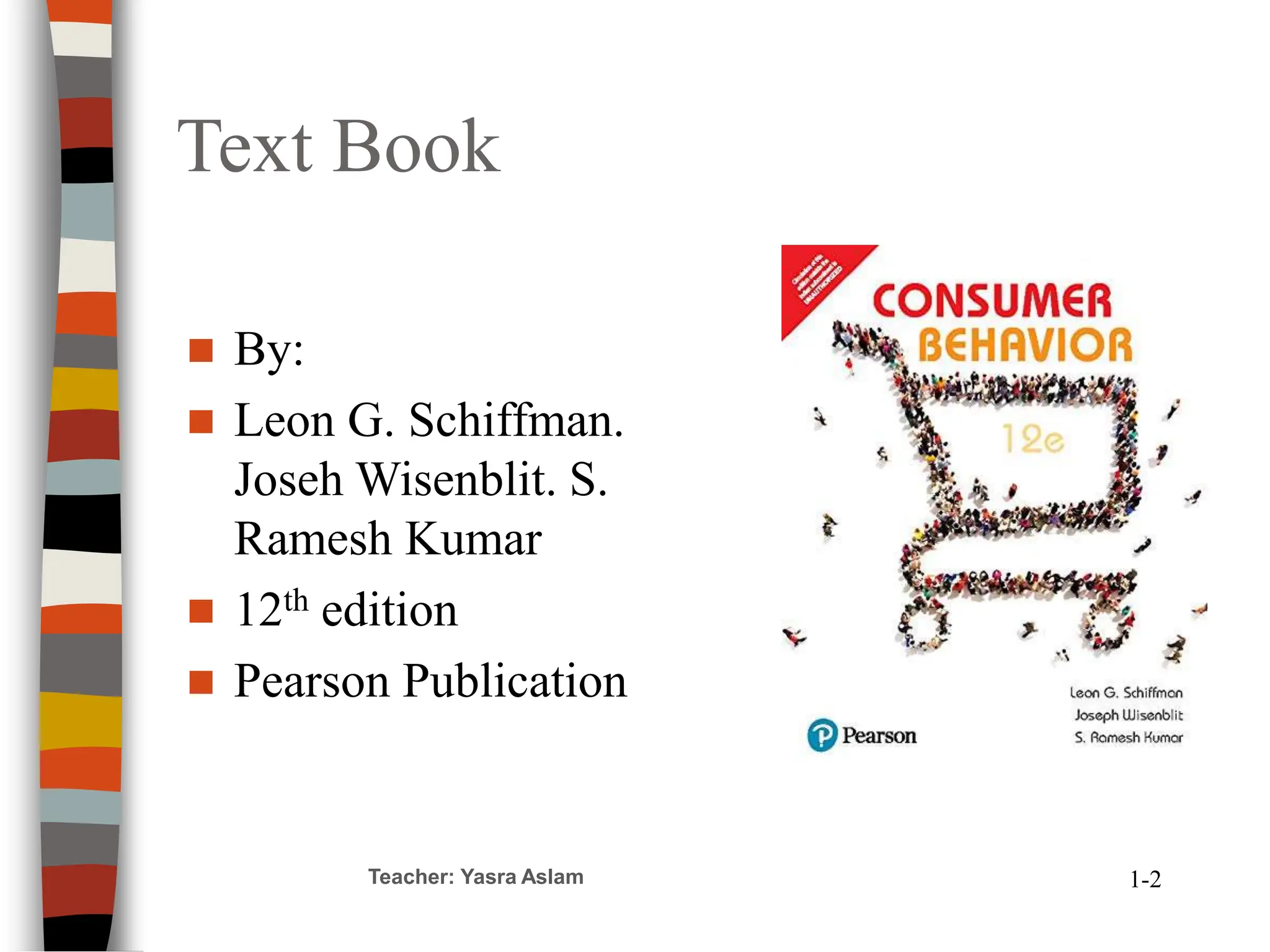
Text Book
 By:
 Leon G. Schiffman.
Joseh Wisenblit. S.
Ramesh Kumar
 12th edition
 Pearson Publication
Teacher: Yasra Aslam 1-2
Teacher: Yasra Aslam
Consumer Behaviour
The behaviour that consumers
display in searching for,
purchasing, using, evaluating,
and disposing of products and
services that they expect will
satisfy their needs.
1-3
Teacher: Yasra Aslam
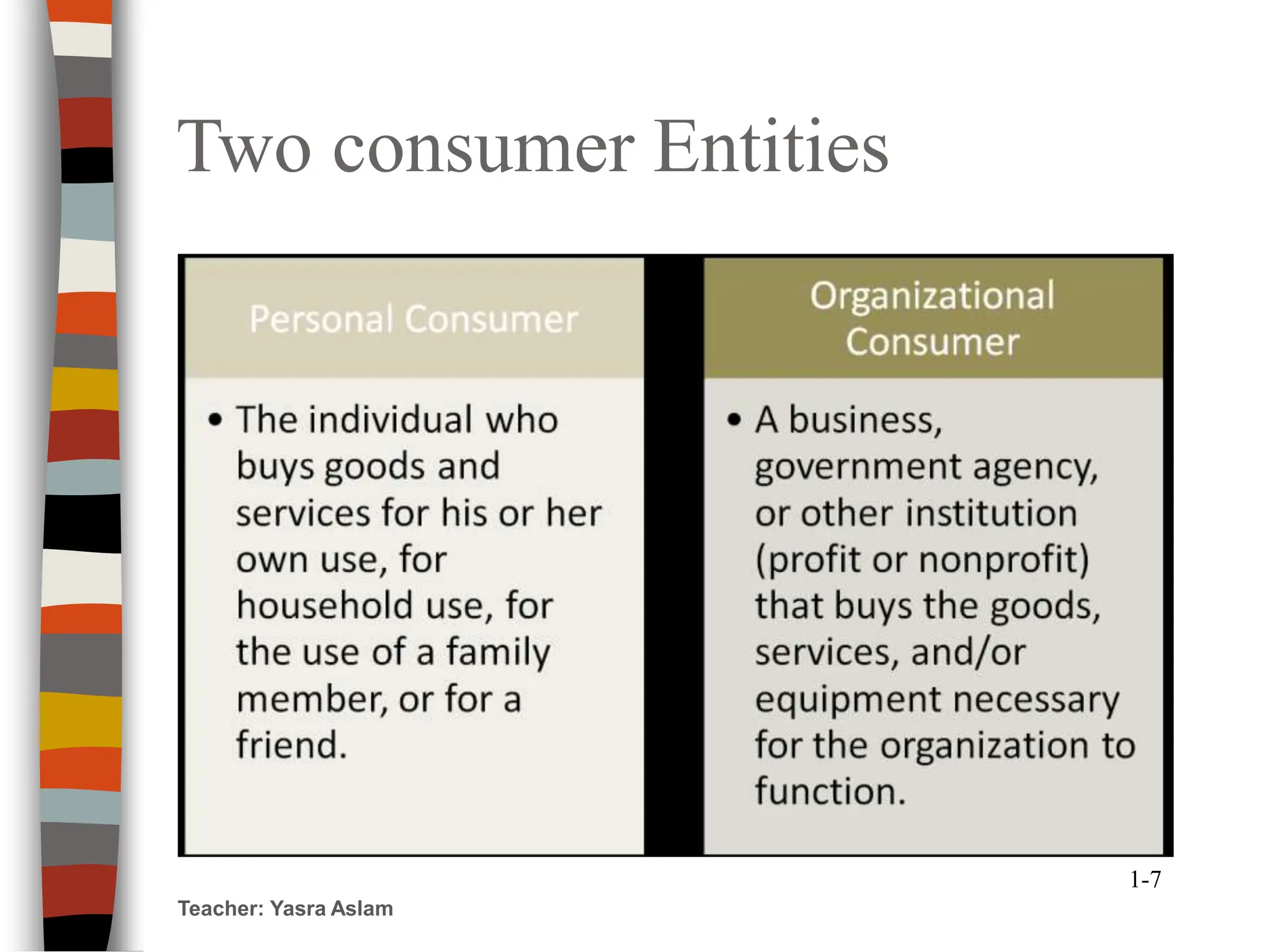
Personal Consumer
The individual who buys goods
and services for his or her own
use, for household use, for the
use of a family member, or for a
friend.
1-4
Teacher: Yasra Aslam 1-5
Example (video)
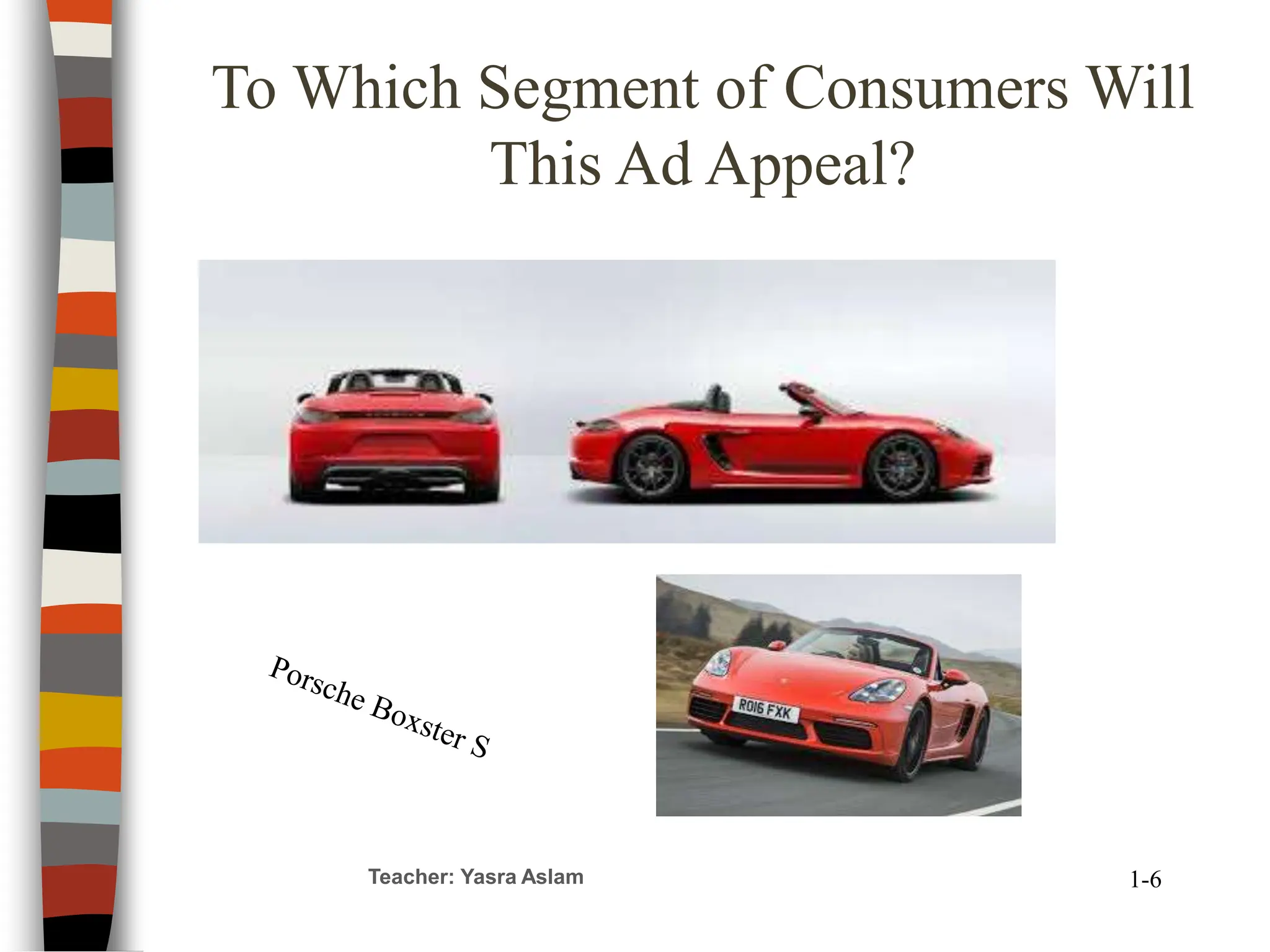
To Which Segment of Consumers Will
This Ad Appeal?
Teacher: Yasra Aslam 1-6
Two consumer Entities
Teacher: Yasra Aslam
1-7
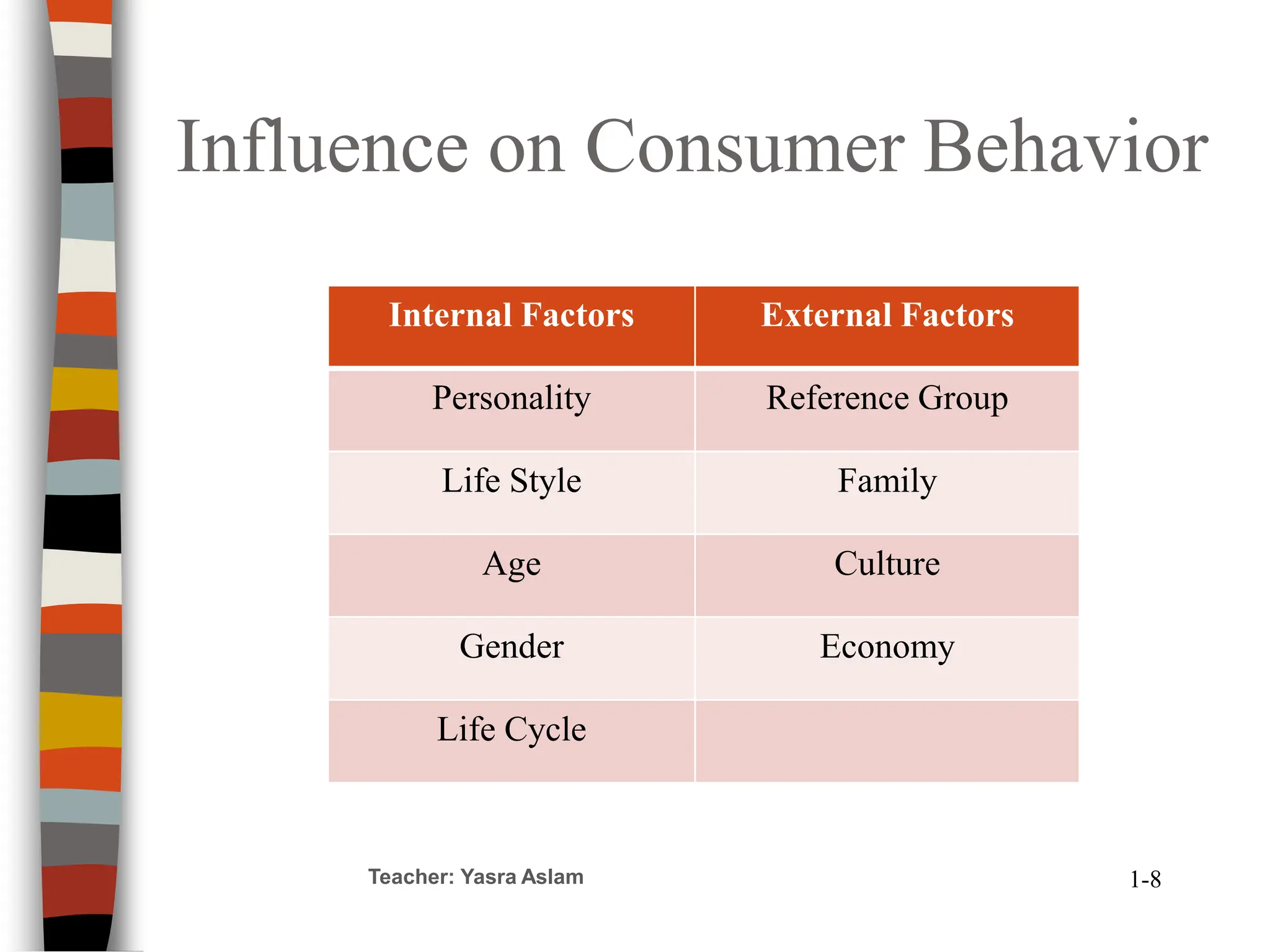
Influence on Consumer Behavior
Internal Factors External Factors
Personality Reference Group
Life Style Family
Age Culture
Gender Economy
Life Cycle
Teacher: Yasra Aslam 1-8
Teacher: Yasra Aslam
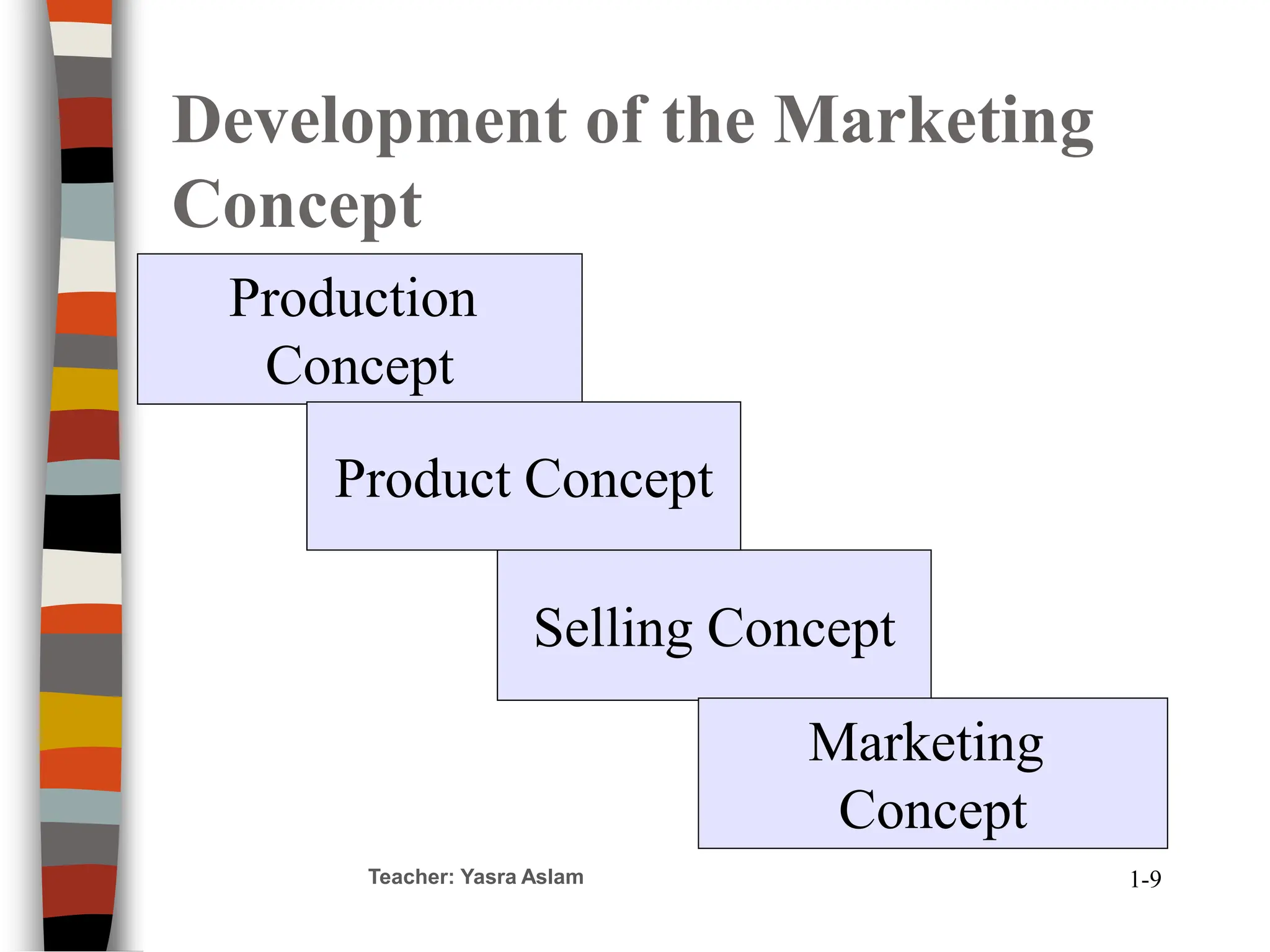
Development of the Marketing
Concept
Production
Concept
Selling Concept
Product Concept
Marketing
Concept
1-9
Teacher: Yasra Aslam
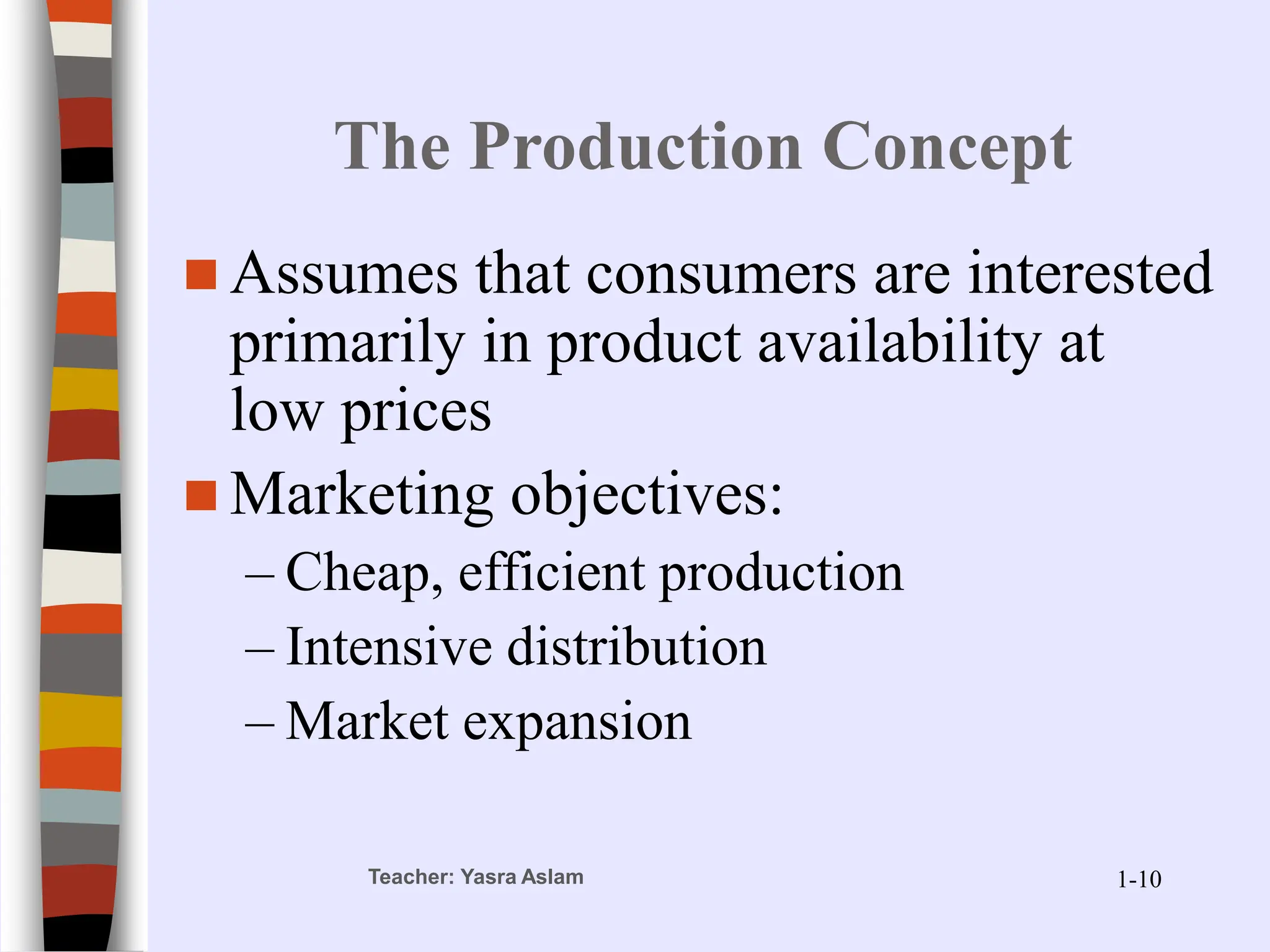
The Production Concept
 Assumes that consumers are interested
primarily in product availability at
low prices
 Marketing objectives:
– Cheap, efficient production
– Intensive distribution
– Market expansion
1-10
Teacher: Yasra Aslam
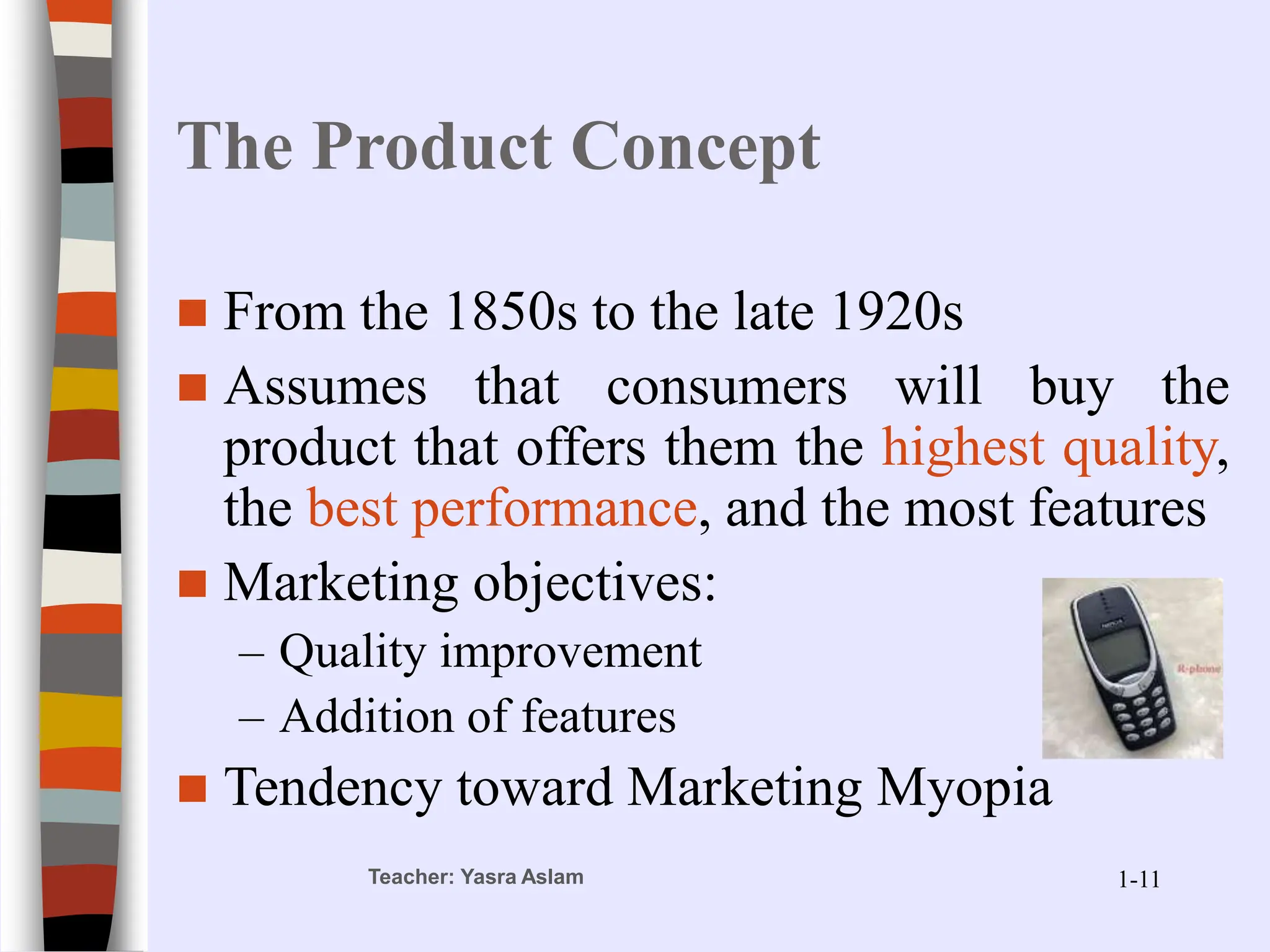
The Product Concept
 From the 1850s to the late 1920s
 Assumes that consumers will buy the
product that offers them the highest quality,
the best performance, and the most features
 Marketing objectives:
– Quality improvement
– Addition of features
 Tendency toward Marketing Myopia
1-11
Teacher: Yasra Aslam
The Selling Concept
 From the 1930s to the mid 1950s
 Assumes that consumers are unlikely to buy
a product unless they are aggressively
persuaded to do so
 Marketing objectives:
– Sell, sell, sell
 Lack of concern for customer needs and
satisfaction
1-12
Teacher: Yasra Aslam
The Marketing Concept
 1950s to current - Focus on the customer
 Assumes that to be successful, a company must
determine the needs and wants of specific
target markets and deliver the desired
satisfactions better than the competition
 Marketing objectives:
– Profits through customer satisfaction
1-13
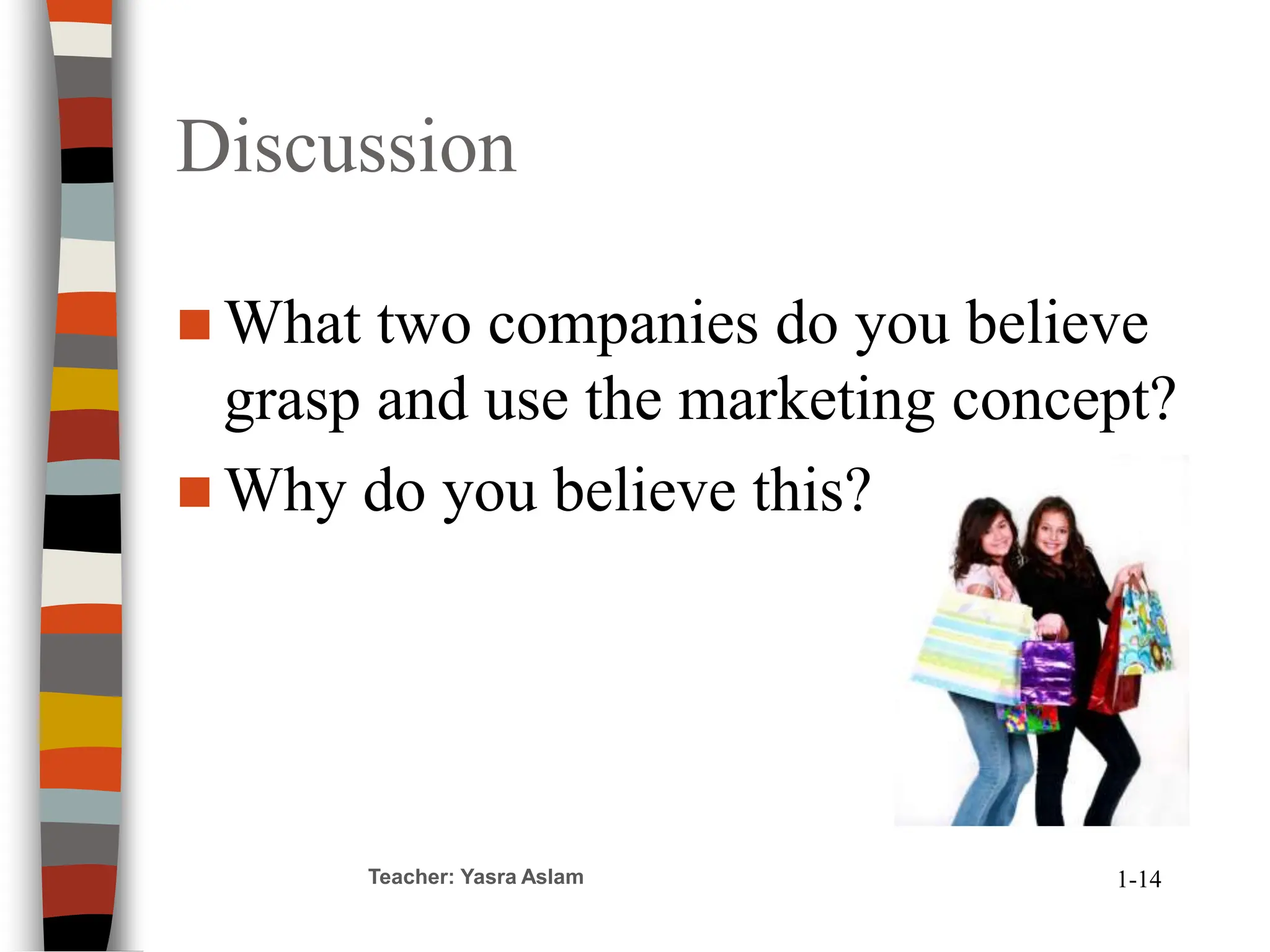
Discussion
 What two companies do you believe
grasp and use the marketing concept?
 Why do you believe this?
Teacher: Yasra Aslam 1-14
Teacher: Yasra Aslam
Implementing the Marketing
Concept
Consumer Research
Segmentation
Targeting
Positioning
1-15
Teacher: Yasra Aslam
Segmentation, Targeting, and
Positioning
 Segmentation: process of dividing the
market into subsets of consumers with
common needs or characteristics
 Targeting: Selecting one ore more of
the segments to pursue
 Positioning: Developing a distinct
image for the product in the mind of
the consumer
1-16
Discussion Questions
What products that you regularly
purchase are highly segmented?
What are the different segments?
Why is segmentation useful to the
marketer for these products?
Teacher: Yasra Aslam 1-17
Challenge for Positioning
Statement
 Products
Services
Teacher: Yasra Aslam 1-18
Tips for Creating a Positioning
Statement
 When writing and evaluating your positioning statement, keep
the following tips in mind:
 Keep it brief.
 Make it unique and memorable.
 It's true to your business' core values.
 It includes a credible promise of what the brand delivers to
consumers.
 It communicates how your business is different from the
competition.
 It's clear enough for use as a guideline to evaluate whether or
not business decisions align with the brand.
Teacher: Yasra Aslam 1-19
Evaluate your Brand Positioning
Statement
 Before you sign off on what you’ve
written, ask yourself the following
questions:
 Will it help inform your marketing
decisions?
 Does it effectively differentiate your
brand?
 Is it believable?
 Is it flexible enough to allow for growth
over time? (In other words, does it
position your brand for long-term
success?)
 Does it paint a clear mental image?
 Does it speak directly to your core
audience?
 Is it consistent, across all aspects
of your brand?
 Does it motivate your audience?
 Is it easily understood?
 Will it stand up to your
competitors?
 Is it unique? (Is it different from
your competitors’brand
positioning?)
 Is it memorable?
 Can you OWN it?
Teacher: Yasra Aslam 1-20
There are four required essentials to
establishing rock-solid brand positioning:
 Your audience: Who is your demographic? What are their pain
points.
 Your market: What is your market category? And, how does your
brand better relate to your audience, in comparison to your
competition?
 Your brand promise: Think back to your audience’s pain points
and then ask yourself, how does your brand solve those
problems? In the eyes of your audience, what are the greatest
benefits your brand offers?
 Your evidence: What irrefutable evidence can you offer to
demonstrate that your brand delivers on its promise?
Teacher: Yasra Aslam 1-21
Teacher: Yasra Aslam
Successful Positioning
Communicating the benefits of
the product, rather than its
features
Communicating a Unique Selling
Proposition for the product
1-22
How can you power a planet,
hungry for electricity without
damaging it?
Teacher: Yasra Aslam
1-23
Teacher: Yasra Aslam
1-24
Teacher: Yasra Aslam
The Societal Marketing Concept
 All companies prosper when society
prospers.
 Companies, as well as individuals,
would be better off if social
responsibility was an integral
component of every marketing decision.
 Requires all marketers adhere to
principles of social responsibility.
1-25
Teacher: Yasra Aslam 1-26
Teacher: Yasra Aslam
The Marketing Mix
Product
Price
Place
Promotion
1-27
Teacher: Yasra Aslam
Technology Benefits Consumers &
Marketers
 Allows customization of products, services, and
promotional messages like never before
 Enhances relationships with customers more effectively and
efficiently
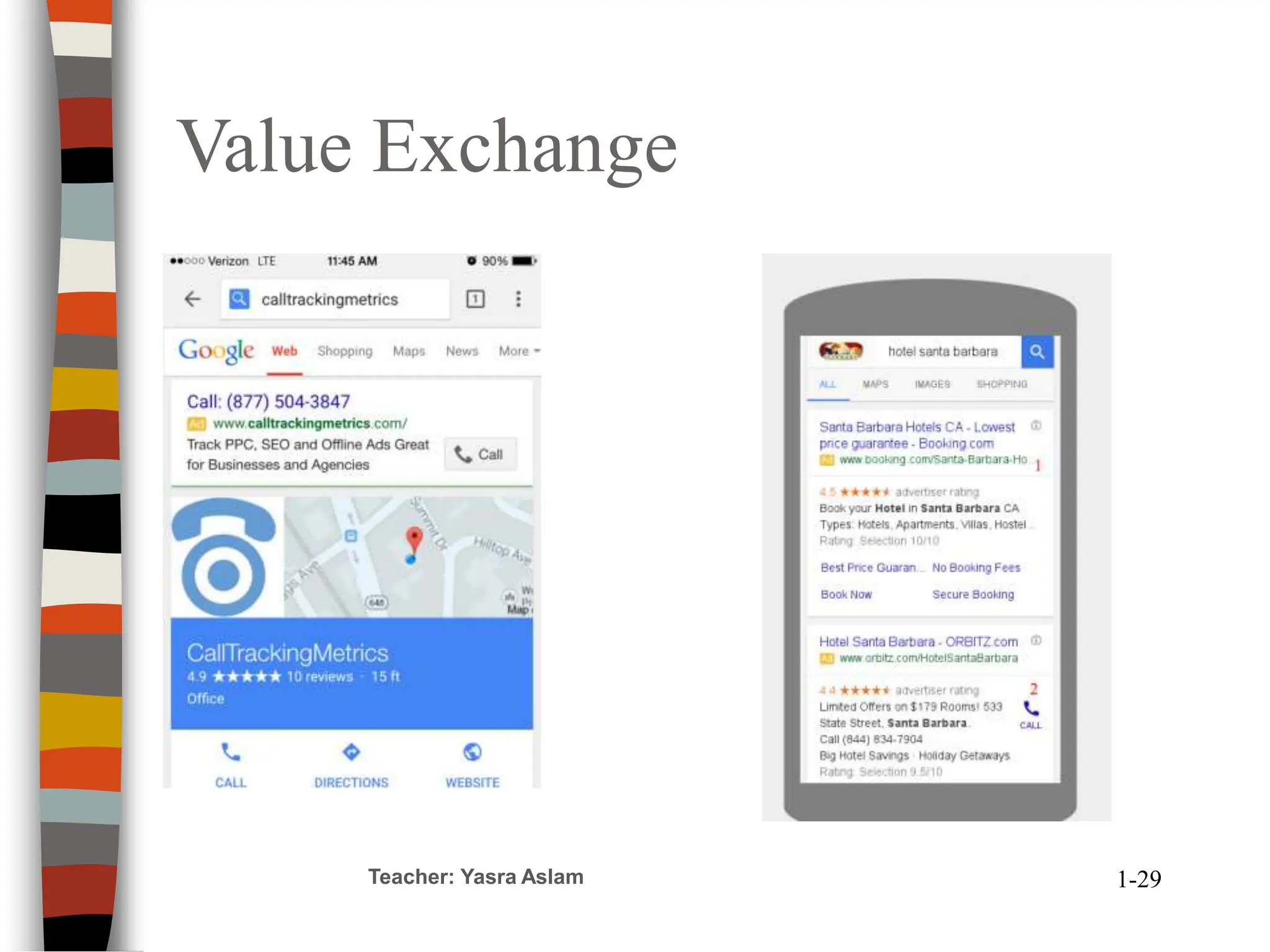
 Click-to-call-ad
 E.g. hotel paid to Google when u call.
1-28
Value Exchange
Teacher: Yasra Aslam 1-29
More Precise Targeting
 Revamping distribution systems
– Direct distribution becomes more of an option (online
shopping)
 Pricing methods may need to be re-
evaluated
– Comparison shopping made easier
 Consumer research methods may change
– How do you measure web-based promotions?
Teacher: Yasra Aslam 1-30
Interactive Communication Channel
TV cable Boxes (two way
communication between consumer
& broadcaster.
Audi (most memorable road rip
story)
Netflix. PTCL Smart TV
Teacher: Yasra Aslam 1-31
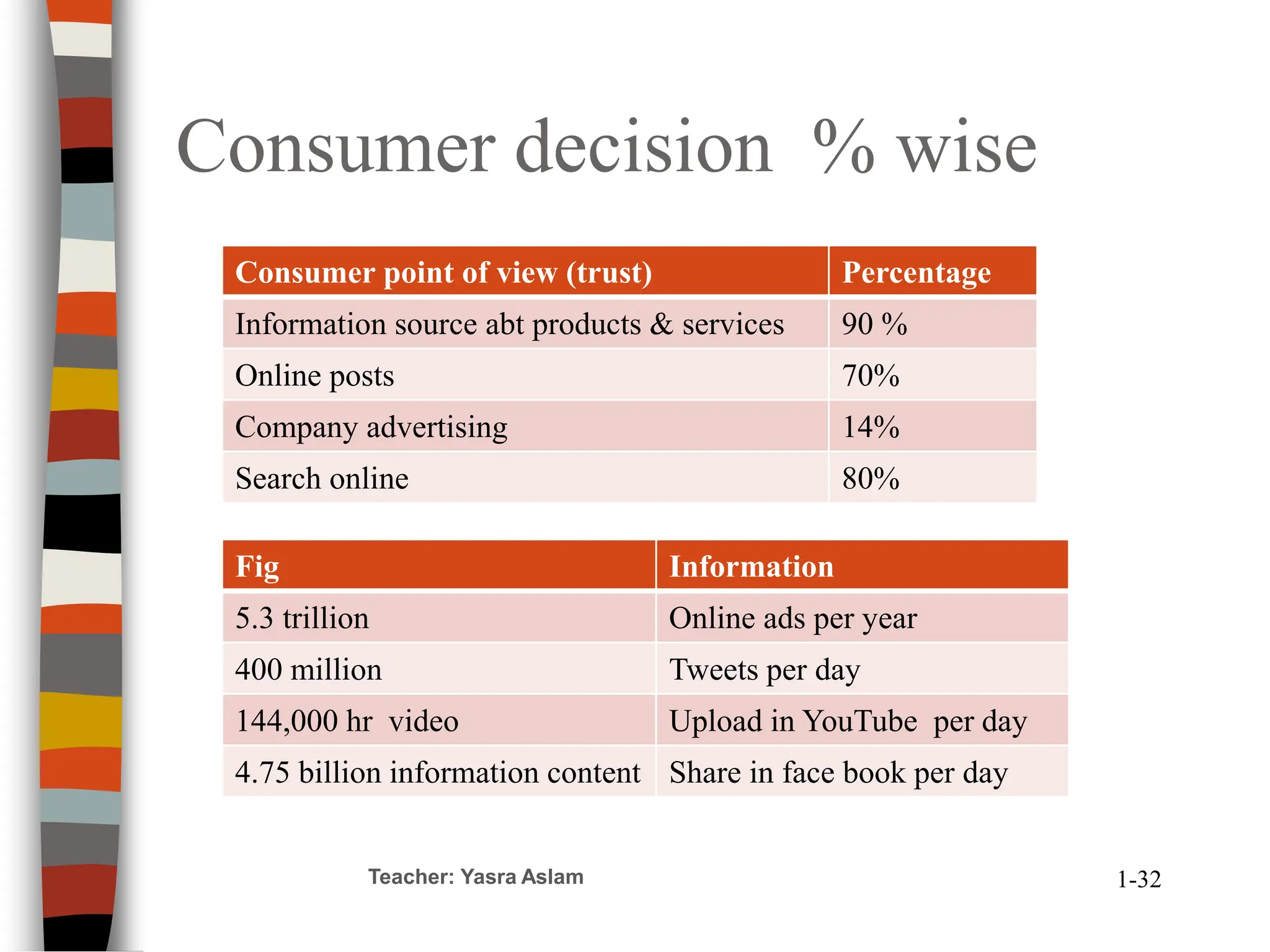
Consumer decision % wise
Consumer point of view (trust) Percentage
Information source abt products & services 90 %
Online posts 70%
Company advertising 14%
Search online 80%
Teacher: Yasra Aslam 1-32
Fig Information
5.3 trillion Online ads per year
400 million Tweets per day
144,000 hr video Upload in YouTube per day
4.75 billion information content Share in face book per day
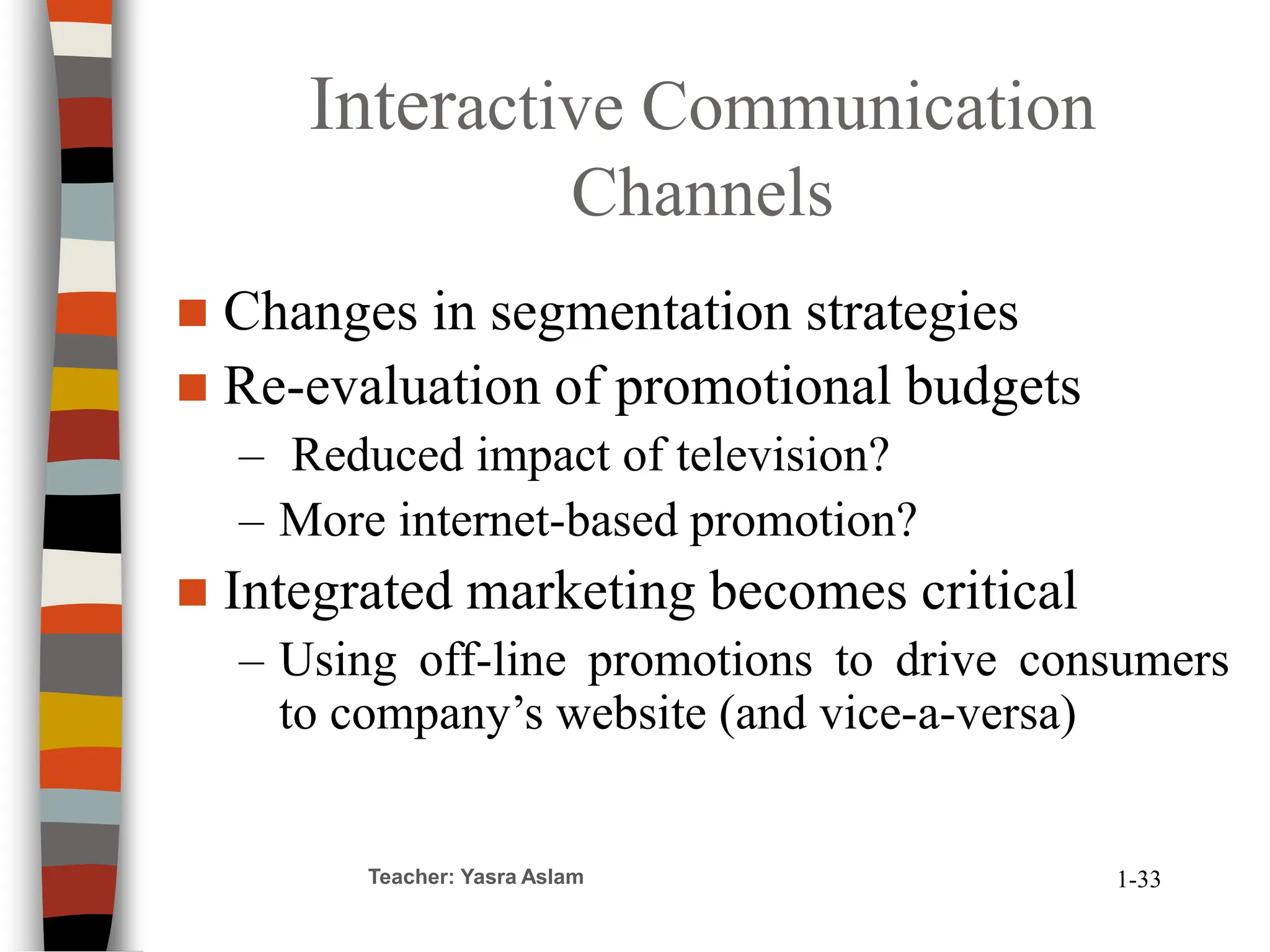
Interactive Communication
Channels
 Changes in segmentation strategies
 Re-evaluation of promotional budgets
– Reduced impact of television?
– More internet-based promotion?
 Integrated marketing becomes critical
– Using off-line promotions to drive consumers
to company’s website (and vice-a-versa)
Teacher: Yasra Aslam 1-33
Cont..,
Teacher: Yasra Aslam 1-34
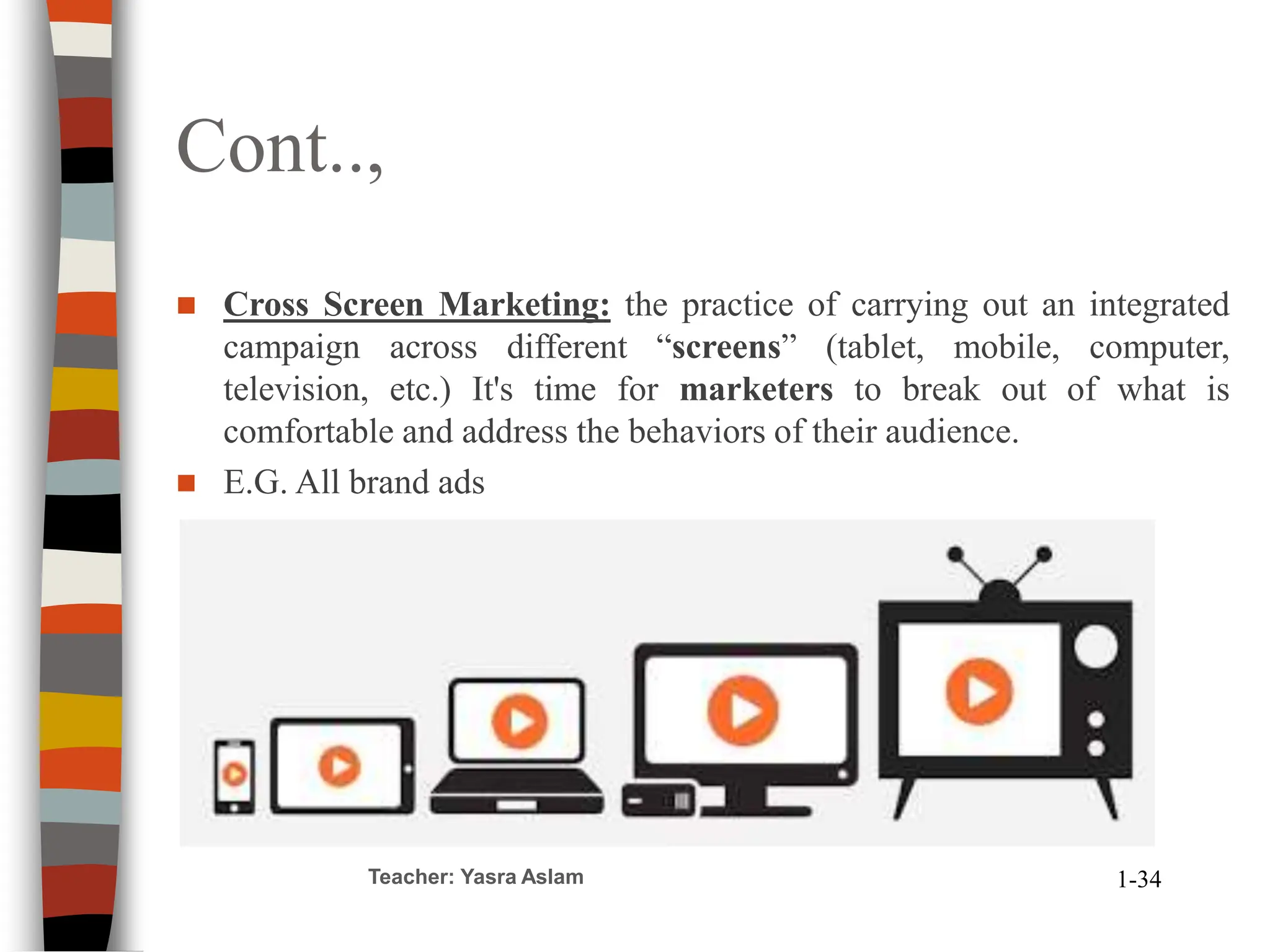
 Cross Screen Marketing: the practice of carrying out an integrated
campaign across different “screens” (tablet, mobile, computer,
television, etc.) It's time for marketers to break out of what is
comfortable and address the behaviors of their audience.
 E.G. All brand ads
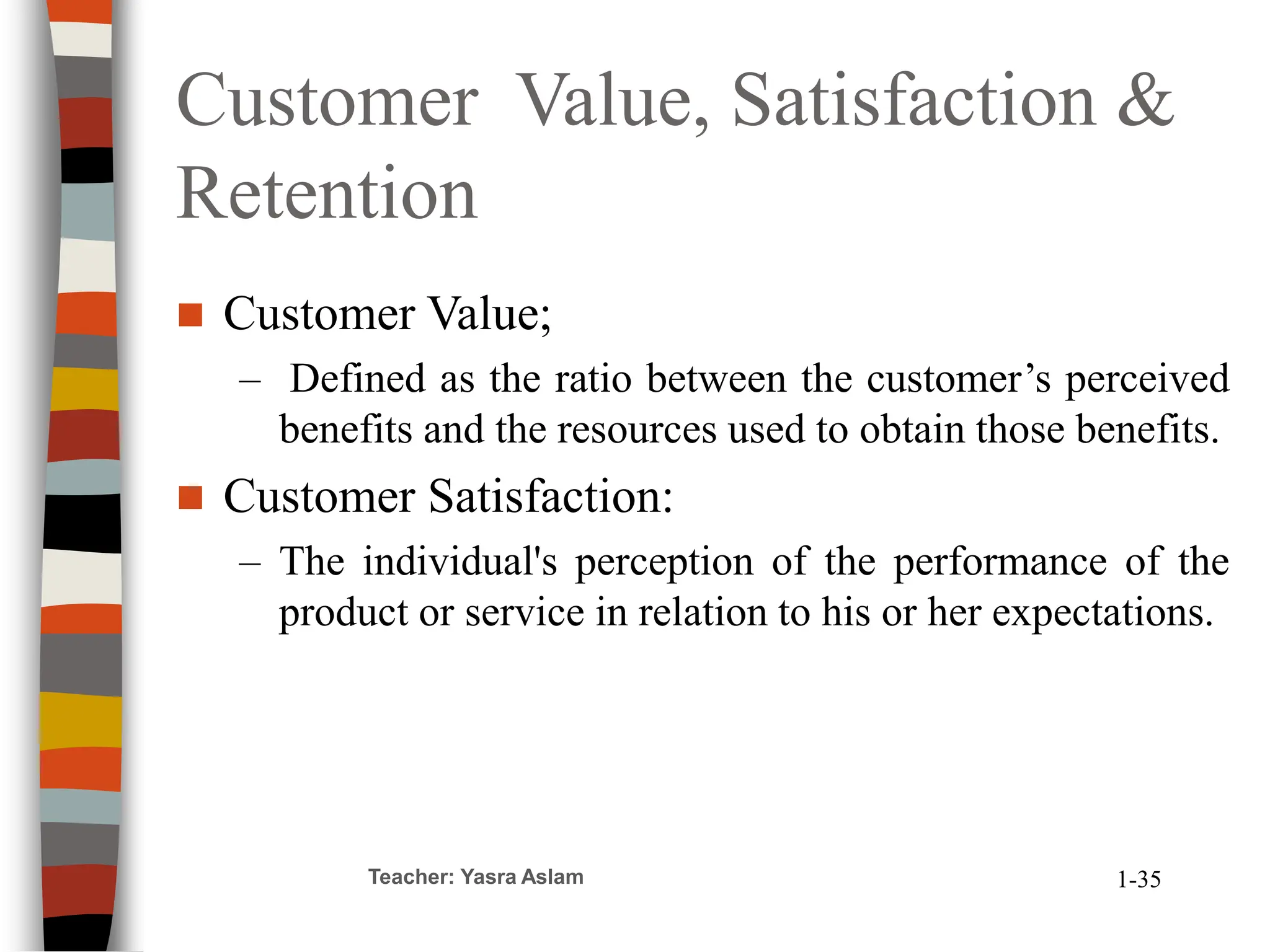
Customer Value, Satisfaction &
Retention
 Customer Value;
– Defined as the ratio between the customer’s perceived
benefits and the resources used to obtain those benefits.
 Customer Satisfaction:
– The individual's perception of the performance of the
product or service in relation to his or her expectations.
Teacher: Yasra Aslam 1-35
Cont..,
 Retention:
– The objective of providing value is to retain highly
satisfied customers.
– They buy more products
– They are less price sensitive
– Loyal customer
– They spread positive word of mouth
– Low customer turn over
– Make employee job easier
Teacher: Yasra Aslam 1-36
Discussion Questions
Teacher: Yasra Aslam
1-37
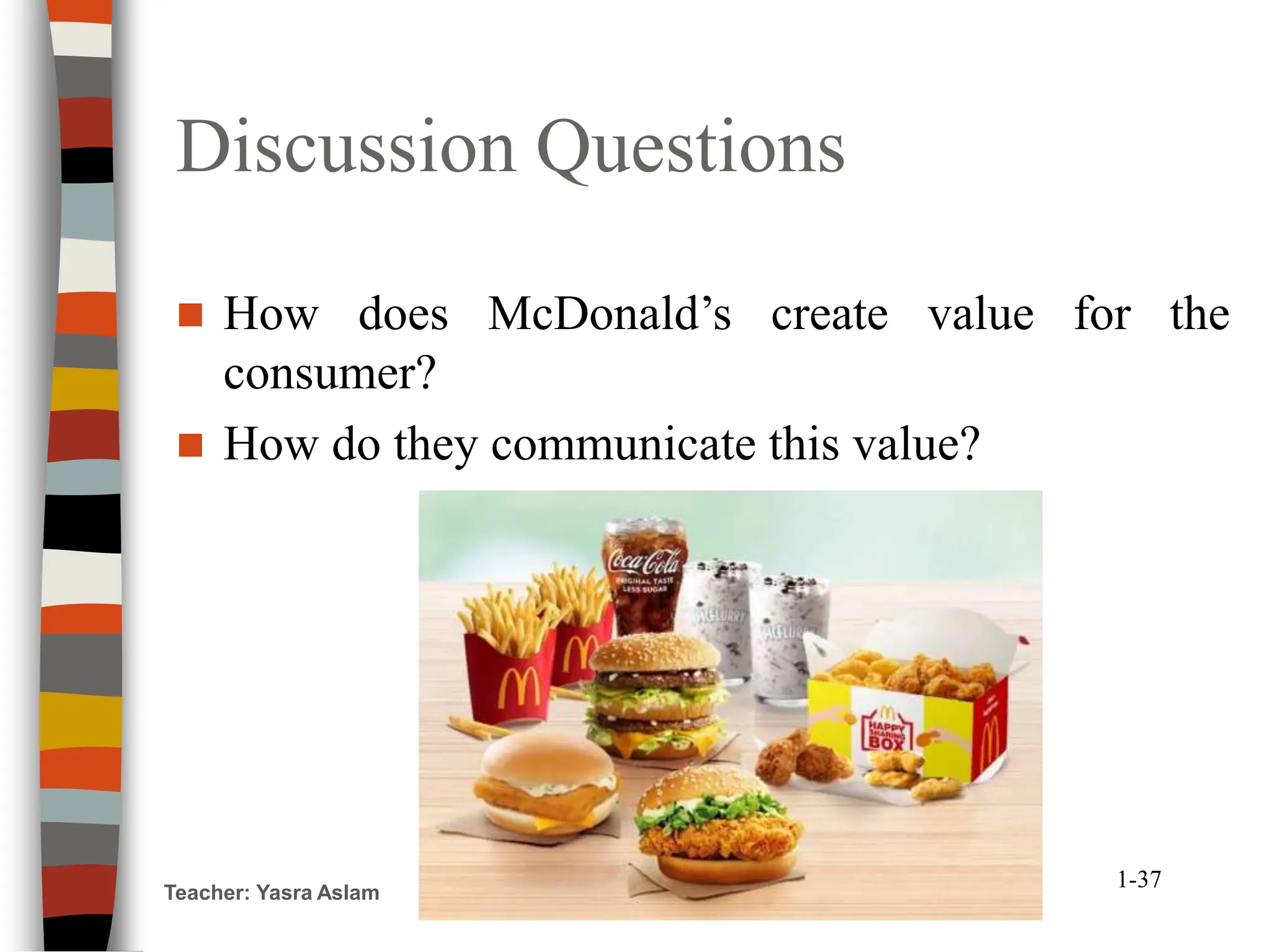
 How does McDonald’s create value for the
consumer?
 How do they communicate this value?
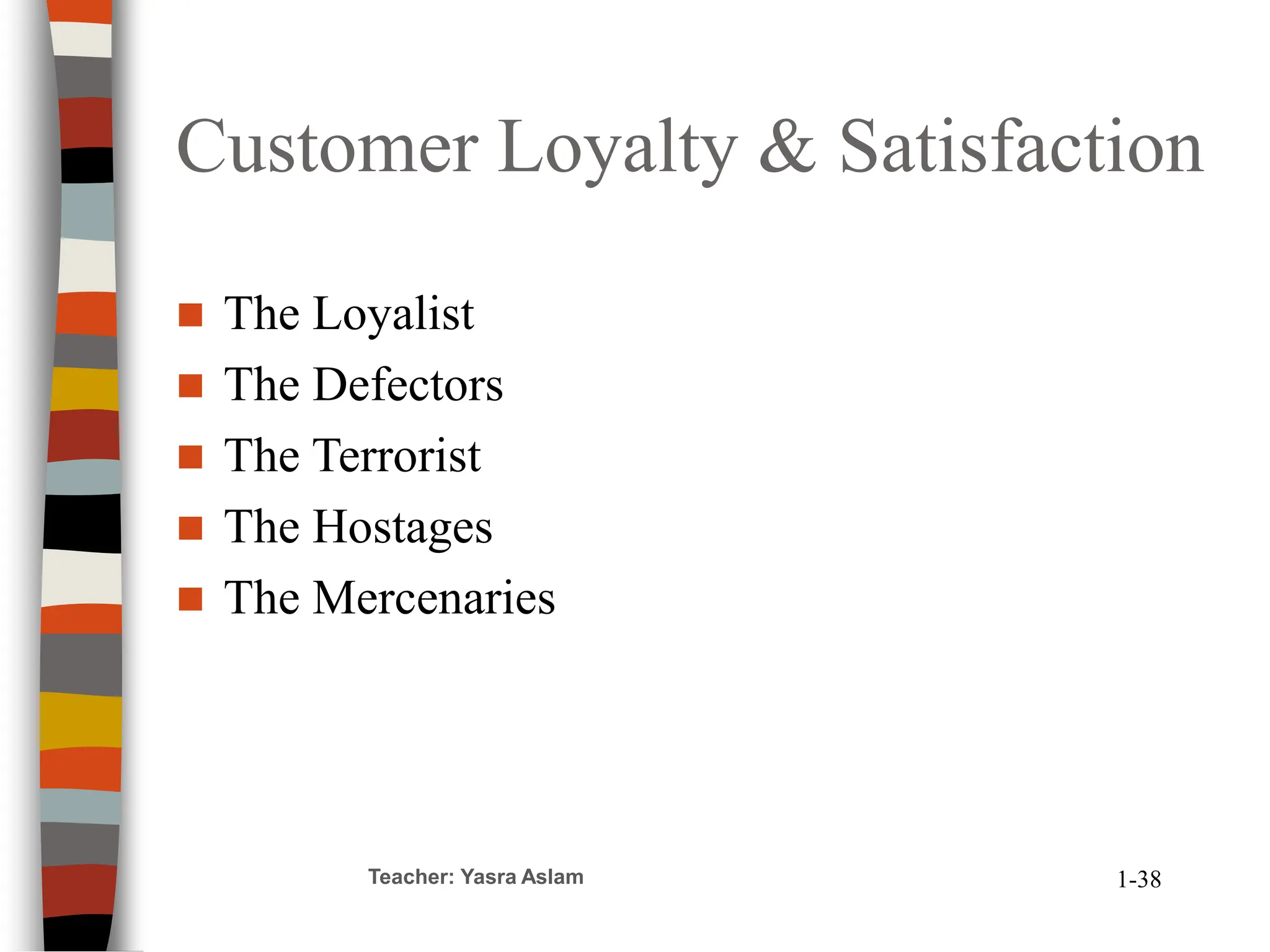
Customer Loyalty & Satisfaction
 The Loyalist
 The Defectors
 The Terrorist
 The Hostages
 The Mercenaries
Teacher: Yasra Aslam 1-38
Teacher: Yasra Aslam
1-39
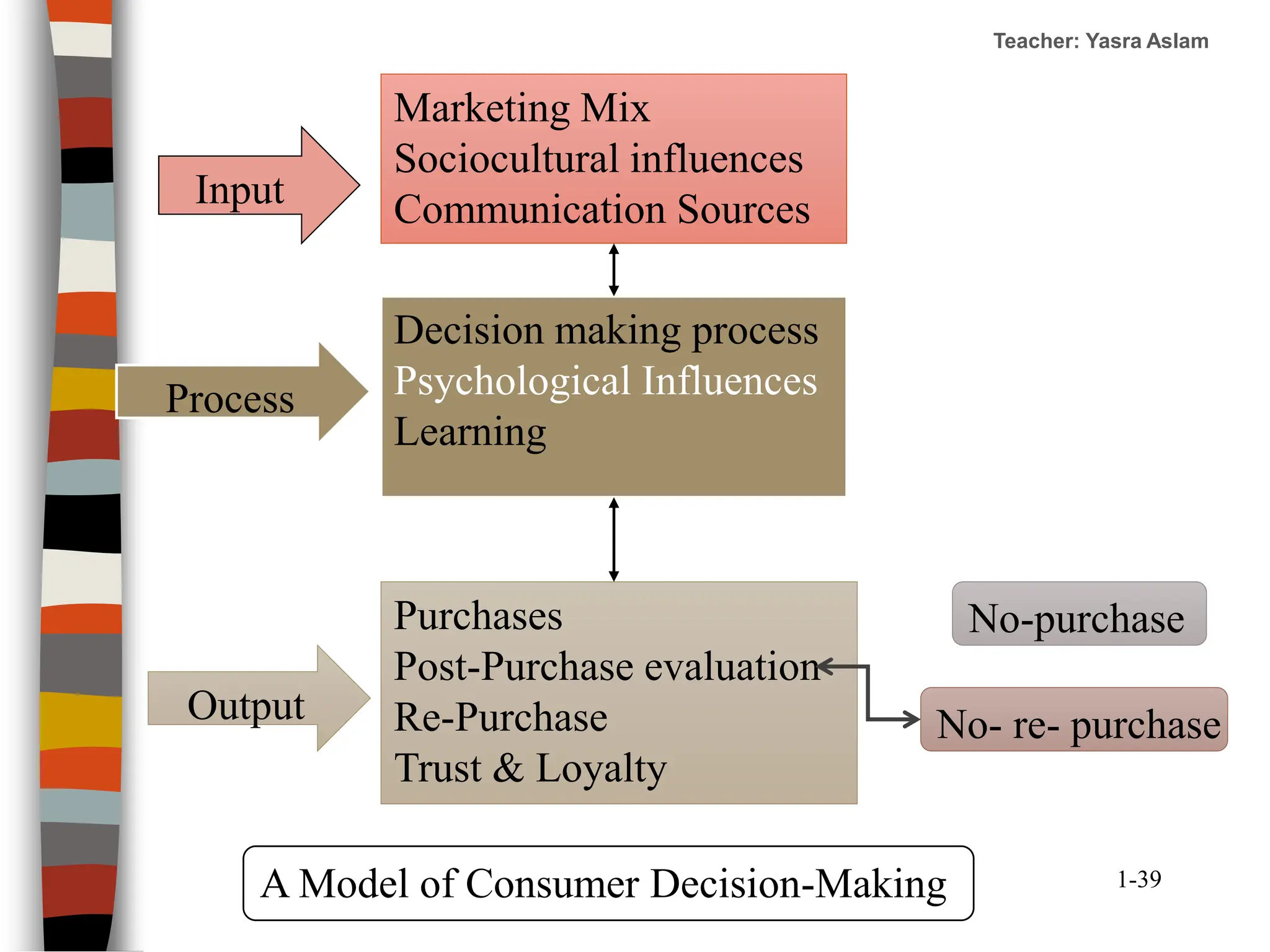
Marketing Mix
Sociocultural influences
Communication Sources
Decision making process
Psychological Influences
Learning
Purchases
Post-Purchase evaluation
Re-Purchase
Trust & Loyalty
No- re- purchase
No-purchase
Input
Process
Output
A Model of Consumer Decision-Making

Ch - 1(Intrroduction) consumer business.ppt

  • 1.
    Consumer Behavior & Technology Ch# 01 Teacher: Ms. Yasra Aslam Subject: Consumer Behavior Book: Consumer Behavior By: Leon Schiffman, Joseph Wisenblit & S. Ramesh Kumar Teacher: Yasra Aslam 1-1
  • 2.
    Text Book  By: Leon G. Schiffman. Joseh Wisenblit. S. Ramesh Kumar  12th edition  Pearson Publication Teacher: Yasra Aslam 1-2
  • 3.
    Teacher: Yasra Aslam ConsumerBehaviour The behaviour that consumers display in searching for, purchasing, using, evaluating, and disposing of products and services that they expect will satisfy their needs. 1-3
  • 4.
    Teacher: Yasra Aslam PersonalConsumer The individual who buys goods and services for his or her own use, for household use, for the use of a family member, or for a friend. 1-4
  • 5.
    Teacher: Yasra Aslam1-5 Example (video)
  • 6.
    To Which Segmentof Consumers Will This Ad Appeal? Teacher: Yasra Aslam 1-6
  • 7.
  • 8.
    Influence on ConsumerBehavior Internal Factors External Factors Personality Reference Group Life Style Family Age Culture Gender Economy Life Cycle Teacher: Yasra Aslam 1-8
  • 9.
    Teacher: Yasra Aslam Developmentof the Marketing Concept Production Concept Selling Concept Product Concept Marketing Concept 1-9
  • 10.
    Teacher: Yasra Aslam TheProduction Concept  Assumes that consumers are interested primarily in product availability at low prices  Marketing objectives: – Cheap, efficient production – Intensive distribution – Market expansion 1-10
  • 11.
    Teacher: Yasra Aslam TheProduct Concept  From the 1850s to the late 1920s  Assumes that consumers will buy the product that offers them the highest quality, the best performance, and the most features  Marketing objectives: – Quality improvement – Addition of features  Tendency toward Marketing Myopia 1-11
  • 12.
    Teacher: Yasra Aslam TheSelling Concept  From the 1930s to the mid 1950s  Assumes that consumers are unlikely to buy a product unless they are aggressively persuaded to do so  Marketing objectives: – Sell, sell, sell  Lack of concern for customer needs and satisfaction 1-12
  • 13.
    Teacher: Yasra Aslam TheMarketing Concept  1950s to current - Focus on the customer  Assumes that to be successful, a company must determine the needs and wants of specific target markets and deliver the desired satisfactions better than the competition  Marketing objectives: – Profits through customer satisfaction 1-13
  • 14.
    Discussion  What twocompanies do you believe grasp and use the marketing concept?  Why do you believe this? Teacher: Yasra Aslam 1-14
  • 15.
    Teacher: Yasra Aslam Implementingthe Marketing Concept Consumer Research Segmentation Targeting Positioning 1-15
  • 16.
    Teacher: Yasra Aslam Segmentation,Targeting, and Positioning  Segmentation: process of dividing the market into subsets of consumers with common needs or characteristics  Targeting: Selecting one ore more of the segments to pursue  Positioning: Developing a distinct image for the product in the mind of the consumer 1-16
  • 17.
    Discussion Questions What productsthat you regularly purchase are highly segmented? What are the different segments? Why is segmentation useful to the marketer for these products? Teacher: Yasra Aslam 1-17
  • 18.
    Challenge for Positioning Statement Products Services Teacher: Yasra Aslam 1-18
  • 19.
    Tips for Creatinga Positioning Statement  When writing and evaluating your positioning statement, keep the following tips in mind:  Keep it brief.  Make it unique and memorable.  It's true to your business' core values.  It includes a credible promise of what the brand delivers to consumers.  It communicates how your business is different from the competition.  It's clear enough for use as a guideline to evaluate whether or not business decisions align with the brand. Teacher: Yasra Aslam 1-19
  • 20.
    Evaluate your BrandPositioning Statement  Before you sign off on what you’ve written, ask yourself the following questions:  Will it help inform your marketing decisions?  Does it effectively differentiate your brand?  Is it believable?  Is it flexible enough to allow for growth over time? (In other words, does it position your brand for long-term success?)  Does it paint a clear mental image?  Does it speak directly to your core audience?  Is it consistent, across all aspects of your brand?  Does it motivate your audience?  Is it easily understood?  Will it stand up to your competitors?  Is it unique? (Is it different from your competitors’brand positioning?)  Is it memorable?  Can you OWN it? Teacher: Yasra Aslam 1-20
  • 21.
    There are fourrequired essentials to establishing rock-solid brand positioning:  Your audience: Who is your demographic? What are their pain points.  Your market: What is your market category? And, how does your brand better relate to your audience, in comparison to your competition?  Your brand promise: Think back to your audience’s pain points and then ask yourself, how does your brand solve those problems? In the eyes of your audience, what are the greatest benefits your brand offers?  Your evidence: What irrefutable evidence can you offer to demonstrate that your brand delivers on its promise? Teacher: Yasra Aslam 1-21
  • 22.
    Teacher: Yasra Aslam SuccessfulPositioning Communicating the benefits of the product, rather than its features Communicating a Unique Selling Proposition for the product 1-22
  • 23.
    How can youpower a planet, hungry for electricity without damaging it? Teacher: Yasra Aslam 1-23
  • 24.
  • 25.
    Teacher: Yasra Aslam TheSocietal Marketing Concept  All companies prosper when society prospers.  Companies, as well as individuals, would be better off if social responsibility was an integral component of every marketing decision.  Requires all marketers adhere to principles of social responsibility. 1-25
  • 26.
  • 27.
    Teacher: Yasra Aslam TheMarketing Mix Product Price Place Promotion 1-27
  • 28.
    Teacher: Yasra Aslam TechnologyBenefits Consumers & Marketers  Allows customization of products, services, and promotional messages like never before  Enhances relationships with customers more effectively and efficiently  Click-to-call-ad  E.g. hotel paid to Google when u call. 1-28
  • 29.
  • 30.
    More Precise Targeting Revamping distribution systems – Direct distribution becomes more of an option (online shopping)  Pricing methods may need to be re- evaluated – Comparison shopping made easier  Consumer research methods may change – How do you measure web-based promotions? Teacher: Yasra Aslam 1-30
  • 31.
    Interactive Communication Channel TVcable Boxes (two way communication between consumer & broadcaster. Audi (most memorable road rip story) Netflix. PTCL Smart TV Teacher: Yasra Aslam 1-31
  • 32.
    Consumer decision %wise Consumer point of view (trust) Percentage Information source abt products & services 90 % Online posts 70% Company advertising 14% Search online 80% Teacher: Yasra Aslam 1-32 Fig Information 5.3 trillion Online ads per year 400 million Tweets per day 144,000 hr video Upload in YouTube per day 4.75 billion information content Share in face book per day
  • 33.
    Interactive Communication Channels  Changesin segmentation strategies  Re-evaluation of promotional budgets – Reduced impact of television? – More internet-based promotion?  Integrated marketing becomes critical – Using off-line promotions to drive consumers to company’s website (and vice-a-versa) Teacher: Yasra Aslam 1-33
  • 34.
    Cont.., Teacher: Yasra Aslam1-34  Cross Screen Marketing: the practice of carrying out an integrated campaign across different “screens” (tablet, mobile, computer, television, etc.) It's time for marketers to break out of what is comfortable and address the behaviors of their audience.  E.G. All brand ads
  • 35.
    Customer Value, Satisfaction& Retention  Customer Value; – Defined as the ratio between the customer’s perceived benefits and the resources used to obtain those benefits.  Customer Satisfaction: – The individual's perception of the performance of the product or service in relation to his or her expectations. Teacher: Yasra Aslam 1-35
  • 36.
    Cont..,  Retention: – Theobjective of providing value is to retain highly satisfied customers. – They buy more products – They are less price sensitive – Loyal customer – They spread positive word of mouth – Low customer turn over – Make employee job easier Teacher: Yasra Aslam 1-36
  • 37.
    Discussion Questions Teacher: YasraAslam 1-37  How does McDonald’s create value for the consumer?  How do they communicate this value?
  • 38.
    Customer Loyalty &Satisfaction  The Loyalist  The Defectors  The Terrorist  The Hostages  The Mercenaries Teacher: Yasra Aslam 1-38
  • 39.
    Teacher: Yasra Aslam 1-39 MarketingMix Sociocultural influences Communication Sources Decision making process Psychological Influences Learning Purchases Post-Purchase evaluation Re-Purchase Trust & Loyalty No- re- purchase No-purchase Input Process Output A Model of Consumer Decision-Making