Breakwater
BY : Abd-elrhman Hesham Moez
Department : marine engineering
ClimateChange1
Costal erosion
Is the wearing away of land and the removal of beach
or due to due sediments by wave action , tidal currents
or drainage .
ClimateChange2
Erosion
corrosion
abrasion
Types of
erosion
ClimateChange3
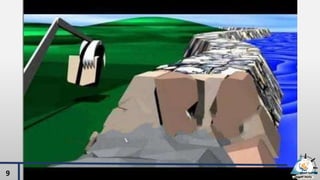
What is breakwater ?
A breakwater is a structure constructed for forming an artificial
harbor with a basin so protected from the effect of waves as to
provide safe berthing for fishing vessels
ClimateChange4
ClimateChange5
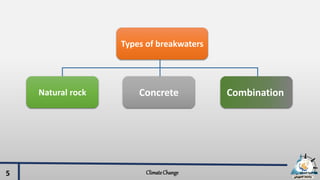
Types of breakwaters
Natural rock Concrete Combination
ClimateChange6
Considerations
ClimateChange7
In the presence of thick sand deposits, a rubble foundation
with adequate scour protection is recommended lest strong
tidal streams, water currents or wave turbulence scour away
the sand underneath the foundation.
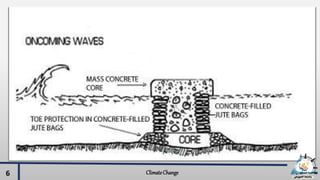
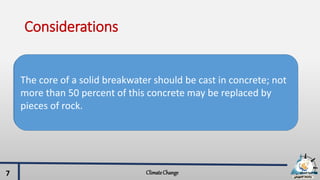
The core of a solid breakwater should be cast in concrete; not
more than 50 percent of this concrete may be replaced by
pieces of rock.
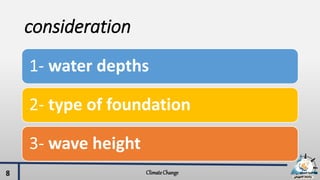
consideration
1- water depths
2- type of foundation
3- wave height
ClimateChange8
ClimateChange9
FLOATING BREAKWATERS
• are pontoon structures, although various
modifications to their shape have been investigated in
an effort to optimize the mass
• (and ultimately the cost).
ClimateChange10
ClimateChange11
To be effective as a breakwater …
• the motions of a floating structure must be of small amplitude.
• the structure must respond to a spectrum of incident wave
conditions.
ClimateChange12
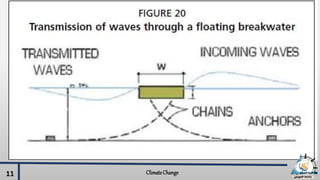
The efficiency of a floating breakwater
depends primarily on the ratio of :
the width of the pontoon
to
the wavelength of the oncoming waves
ClimateChange13
FLOATING BREAKWATERS
• not suitable for creating protected areas should never be installed.
• on lake shores, where the waves tend to be very short (choppy) can
installed.
ClimateChange14
Thank you

Breakwater