BRC Global Standard for Food Safety Issue 6

                      Draft Document for Consultation

The BRC have produced this first draft of the Standard with the assistance of two
international Working Groups, directed by a Steering Committee.

The Working Groups and Committees have representatives from the main users of the
standard and include
     Retailers
     Food Service Companies
     Manufacturer Trade Association Representatives
     Certification Body Representatives
     Accreditation Body representative.

The document has been produced following the consultation under taken on issue 5 and has
so far as possible reflected the comments made by contributors to the original consultation.

Consultation Period

The BRC welcomes comments and suggestions for further improvement of the standard its
requirements and protocol. Comments should be provided using the form provided and
received by the BRC by the 18th May 2011

Comments received will be reviewed by the BRC and Steering Committee to inform the
production of the final standard.


BRC Global Standard for Food Safety issue 6    Draft for Consultation   17.4.2011
© British Retail Consortium 2011            Page 1
Overview of the Draft Standard
Before starting the task the BRC sought the views of the users of issue 5 from
around the world through an extensive consultation process.

The feedback on issue 5 was generally very positive and the continual growth in
use of the standard around the world, with nearly 14,000 certificated sites and
over 20% growth in 2010, is a testament to its increasing international
popularity. The consultation identified a number of opportunities for further
improvement particularly with regard to the way the audits are conducted
including:-
      A better balance of auditing time between the factory environment and
        paperwork review with more emphasis on good manufacturing practice.
      ensuring consistency of audit results and particularly that grades awarded
        were truly representative of the standards sites could maintain on an on-
        going basis.
      providing a path to allow recognition of sites which are developing their
        food safety systems.
      Reduce the need for multiple customer audits

The rewrite process has been directed by a steering committee made up of senior
representatives from major retailers and food service companies using the
standard to ensure the standard continues to develop in line with their own
requirements.

Moving the standards forward -Evolution not revolution.

The main focus of the rewrite has been on the development of ideas to extend the
reach of the standard, provide options to differentiate the performance of sites
and encourage a consistency of audit. The review of the requirements has
focused on clarification and simplification rather than wholesale changes reflecting
the feedback from consultation.

1. Increasing Focus on Good Manufacturing Practice (GMP)

Maintaining good and constantly improving standards of Food Safety and due
diligence requires documented procedures and processes to ensure the
consistency of working methods and provide information to analyse to identify
areas for improvement. The implementation of the procedures within the factory,
staff training supervision and working practices, factory hygiene and working
conditions however ultimately affect the product safety and quality. Issue 6
attempts to rebalance the audit process by increasing the amount of time spent
by the auditor within the processing areas.
The proposals for issue 6 of the standard and the auditor training package in
preparation to accompany the standard incorporate subtle but significant changes
to increase the emphasis on the GMP aspects of the audit. These include
      A two part audit checklist (in line with the unannounced audit option 2)
        which clearly defines requirements which are expected to be audited
        within the production areas
      A change in the balance of the number and depth of requirements in
        favour of good manufacturing practices rather than documentation of the
        systems.
      A new more customer focused audit report format reducing report writing
        time and encourage a more challenging audit approach.
      Greater emphasis on standardising best practices for auditing the BRC
        standard within the auditor training materials.


BRC Global Standard for Food Safety issue 6    Draft for Consultation   17.4.2011
© British Retail Consortium 2011            Page 2
Against a backdrop of an overall reduction in the number of requirements
sections of the standard covering foreign body control, hygiene and housekeeping
and allergens have been expanded.

3. Refreshing the requirements

The rewrite has been used as an opportunity to look at the wording and lay out of
the standard to simplify and remove ambiguity.

A review has been undertaken of the statements of intent which precede each set
of requirements in the standard to ensure that these all express the required out
come with the following more detailed requirements supporting the achievement
of the desired outcome.

Changes to the draft of the standard have resulted in an overall reduction in the
number of clauses of about 25% by removing or rolling together clause so that
each expresses a significant idea. This should also add to the consistency of
grading as requirements now have a more similar significance.

The certification process has been strengthened by ensuring that not only are
issues identified at the audit corrected but also the root cause is identified and an
action plan put in place to prevent recurrence.

3. Unannounced audits- Increasing accessibility and reward

The use of unannounced audits by customers is becoming increasingly common in
some markets and is seen as providing a greater challenge and more realistic
assessment of a sites day to day standards. The unannounced scheme within
issue 5 was not well used partly because the benefits were not seen to outweigh
the practical difficulties of having the entire audit conducted unannounced.
For issue 6 the working groups have developed two options for unannounced
audits both of which will be voluntary.
Option 1 – Full unannounced audit similar to issue 5
Option 2 – An audit in two parts
      Part 1 unannounced audit - largely based on factory operations and good
        manufacturing practice
      Part 2 - planned audit - based largely on a review of documented
        systems, procedures and records carried out at the usual audit due date.
 The new option 2 audit allows sites to ensure availability of managers for the
 documentation review whilst still being able to benefit from the higher audit
 grade.
 The increased emphasis on Good Manufacturing Practices with this approach and
 realism from the unannounced element will increase customer confidence in the
 audit and grades.
 The BRC will promote the unannounced scheme and help market the sites
 achieving the schemes top A+ Grade.


4. Encouraging Food Safety- The new Enrolment process

The BRC Standards have been adopted and used around the world with
certificated sites in over 100 countries. Shortly to be published as issue 6 the
standard has rightly gradually increased the requirements for certification with
each issue as factory standards and our knowledge of food safety improves. It is
important that as the standards for certification move forward there is still a path


BRC Global Standard for Food Safety issue 6    Draft for Consultation   17.4.2011
© British Retail Consortium 2011            Page 3
for sites which are currently developing their food safety systems to be
recognised and encouraged to develop to ultimately achieve certification.

A new enrolment process will be introduced which will enable sites to be register
their audits on the BRC Directory and share their progress with customers as they
develop their food safety systems. A progressive weighted scoring system will be
introduced prioritising the basics of food hygiene to encourage improvement
where sites are not certificated. This recognises the status of the sites and
provides a measure by which to chart their progress towards full certification. The
audit report and score card will be available on the private area of the BRC
Directory only and enable sites to share results with their customers.

Whilst encouraging improvement it is recognised that there must be a clear point
of difference between certificated sites, meeting all of the requirements of the
standard. Only sites achieving full certification will be issued with a grade and
certificate, have their achievement recognised on the BRC public website
Directory and be able to use the BRC certificated site logos.


BRC Global Standard for Food Safety issue 6    Draft for Consultation   17.4.2011
© British Retail Consortium 2011            Page 4
BRC Global Standard for Food Safety Issue 6


                                REQUIREMENTS SECTION I


Key to using this section

The requirements within the standard have been colour coded to indicate those requirements
which are predominantly expected to be audited during the Part 1 audit focused on Good
Manufacturing Practices and requirements which would usually be audited during the Office
based review of Documentation.

Document colour coding

                            Part 1 - GMP audit
                            Part 2 – Systems/Documentation audit
                            Included in both Part 1 and Part 2


BRC Global Standard for Food Safety issue 6    Draft for Consultation   17.4.2011
© British Retail Consortium 2011            Page 5
1.1    SENIOR MANAGEMENT COMMITMENT AND CONTINUAL
    IMPROVEMENT

   FUNDAMENTAL
    The company’s senior management shall demonstrate they are fully committed to the
    implementation of the requirements of the Global Standard for Food Safety and to
    processes which facilitate continual improvement of food safety and quality
    management.

    1.1.1          The company shall have a documented policy which states the company‟s
                   intention to meet its obligation to produce safe and legal products to the specified
                   quality, and its responsibility to its customers. This shall be:
                         signed by the person with overall responsibility for the site
                         communicated to all staff.
    1.1.2          The company‟s senior management shall ensure that clear objectives are defined
                   to maintain and improve the safety, quality and legality of products manufactured
                   in accordance with the quality policy and this standard. These objectives shall
                   be:
                        Documented and include targets or clear measures of success
                        Clearly communicated to relevant staff
                        Monitored and results reported at least quarterly to site senior
                            management

    1.1.3          Management review meetings attended by the sites senior management shall be
                   undertaken at appropriate planned intervals, as a minimum annually, to review
                   the site performance against the standard and objectives set in 1.1.2. The review
                   process shall include the evaluation of:
                     previous management review action plans and time frames
                     results of internal, second party and third party audits
                     customer complaints and results of any customer performance reviews
                     incidents, corrective actions, out of specification results and non-conforming
                        materials
                     review of the management of the HACCP system
                     resource requirements.
                   Records of the meeting shall be documented and used to revise the objectives.
                   The decisions and actions agreed within the review process shall be effectively
                   communicated to appropriate staff, and actions implemented within agreed time
                   scales.
    1.1.4          The company shall have a demonstrable meeting program which enables food
                   safety, legality and quality issues to be brought to the attention of senior
                   management at least monthly and allows for the resolution of immediate issues.
    1.1.5          The company‟s senior management shall provide the human and financial
                   resources required to produce food safely in compliance with the requirements of
                   this standard and for the implementation of the HACCP based food safety plan.
    1.1.6          The company‟s senior management shall have a system in place to ensure that the
                   company is kept informed of all relevant legislative, scientific and technical
                   developments, and industry Codes of Practice applicable in the country of raw
                   material supply, production and, where known, the country where the product
                   will be sold.
    1.1.7          The company shall have the current, original copy of the Standard available.
    1.1.8          Where the company is certificated to the standard they shall ensure that

    BRC Global Standard for Food Safety issue 6    Draft for Consultation    17.4.2011
    © British Retail Consortium 2011            Page 6
announced recertification audits occur on or before the audit due date indicated
               on the certificate.
1.1.9          The most senior production or operations manager on site shall attend the
               opening and closing meetings of the audit for Global Standard for Food Safety
               certification. Relevant departmental managers or their deputies shall be available
               as required during the audit process.
1.1.10         The company‟s senior management shall ensure that the root cause of non-
               conformities identified at the previous audit against the Standard have been
               effectively addressed to prevent recurrence.

1.2         Organisational Structure, Responsibilities and Management Authority

The company shall have a clear organisational structure and lines of communication to
enable effective management of product safety, legality and quality.

1.2.1         The company shall have an organisation chart demonstrating the management
              structure of the company. The responsibilities for the management of activities
              which ensure food safety, quality and legality shall be clearly allocated and
              understood by the managers responsible. It shall be clearly documented who
              deputises in the absence of the responsible person.
1.2.2         The company‟s senior management shall ensure that all employees are aware of
              their responsibilities. Where documented work instructions exist for activities
              undertaken the relevant employees shall have access to and be able to demonstrate
              that work is carried out in accordance with the instruction.


BRC Global Standard for Food Safety issue 6    Draft for Consultation   17.4.2011
© British Retail Consortium 2011            Page 7
2 THE FOOD SAFETY PLAN – HACCP


   FUNDAMENTAL

    The company shall have fully implemented and effective Food Safety Plan based on
    Codex Alimentarius HACCP principles.

    2.1         The HACCP Food Safety Team – Codex Alimentarius Step 1

    2.1.1         The HACCP plan shall be developed and managed by a multi-disciplinary food
                  safety team that includes those responsible for Quality/Technical, Production
                  Operations, Engineering and other relevant functions.
                  The team leader shall have an in depth knowledge of HACCP and be able to
                  demonstrate competence and experience.
                  The team members shall have specific knowledge of HACCP and relevant
                  knowledge of product, process and associated hazards.
                  In the event of the company not having appropriate in-house knowledge, external
                  expertise may be sought, but day-to-day management of the food safety system
                  shall remain the responsibility of the company.

    2.2          Pre- requisite programs
    2.2.1         The company shall establish and maintain environmental and operational
                  programs necessary to create an environment suitable to produce safe and legal
                  food products (pre-requisite programs). As a guide these may include the
                  following
                       Cleaning and sanitising
                       Pest control
                       Maintenance programs for equipment and buildings
                       Personal hygiene requirements
                       Staff training
                       Purchasing
                       Transportation arrangements
                       Processes to prevent cross contamination
                       Allergen controls
                  The control measures and monitoring procedures for the pre-requisite programs
                  must be clearly documented


    BRC Global Standard for Food Safety issue 6    Draft for Consultation   17.4.2011
    © British Retail Consortium 2011            Page 8
2.3         Describe the Product – Codex Alimentarius Step 2

2.3.1          The scope of the HACCP plan including the products and processes covered shall
              be defined. For each product or group of products a full description shall be
              developed, which includes all relevant information on food safety. As a guide, this
              may include the following, although this is not an exhaustive list:
                 composition (e.g. raw materials, ingredients, recipe)
                 origin of ingredients
                 physical or chemical properties that impact food safety (e.g. pH, aw)
                 treatment and processing (e.g. heating, freezing, salting)
                 packaging system (e.g. modified atmosphere, vacuum)
                 storage and distribution conditions (e.g. chilled, ambient)
                 target safe shelf life under prescribed storage and usage conditions
                instructions for use, and potential for misuse (e.g. storage, preparation)
2.3.2         All relevant information needed to conduct the hazard analysis shall be collected,
              maintained, documented and updated. The company will ensure that the HACCP
              plan is based on comprehensive information sources, which are referenced and
              available on request. This may include the following, although this is not an
              exhaustive list:
                  the latest scientific literature
                  historical and known hazards associated with specific food products
                  relevant Codes of Practice
                  recognised guidelines
                  food safety legislation of products in destination countries
                  customer requirements.


2.4         Identify Intended Use – Codex Alimentarius Step 3

2.4.1         The intended use of the product by the customer shall be described defining the
              consumer target groups, including the suitability of the product for vulnerable
              groups of the population, e.g. infants, elderly, allergy sufferers.

2.5     Construct a Process Flow Diagram – Codex Alimentarius Step 4

2.5.1         A flow diagram shall be prepared to cover each product, product category or
              process. This shall set out all aspects of the food process operation within the
              HACCP scope, from raw materials selection through processing, storage and
              distribution. As a guide, this may include the following, although this is not an
              exhaustive list:
                 plan of premises and equipment layout
                 raw materials including introduction of utilities and other contact materials (
                     e.g. water, packaging)
                 sequence and interaction of all process steps
                 outsourced processes and subcontracted work
                 process parameters
                 potential for process delay
                 rework and recycling
                 low/high risk and clean/dirty area segregation
                 finished products, intermediate/semi-processed products, by-products and


BRC Global Standard for Food Safety issue 6    Draft for Consultation   17.4.2011
© British Retail Consortium 2011            Page 9
waste.


2.6       Verify Flow Diagram – Codex Alimentarius Step 5

2.6.1         The HACCP food safety team shall verify the accuracy of the flow diagrams by
              on-site audit and challenge. Daily and seasonal variations shall be considered and
              evaluated. Records of verified flow diagrams shall be maintained.

2.7         List all potential hazards associated with each Process Step, Conduct a
            Hazard Analysis and consider any measures to control identified hazards –
            Codex Alimentarius Step 6, Principle 1

2.7.1         The HACCP food safety team shall identify and record all the potential hazards
              that are reasonably expected to occur at each step in relation to product, process
              and facilities. This shall include hazards present in raw materials, those introduced
              during the process or surviving the process steps, and allergen risks (refer to clause
              5.2). It shall also take account of the preceding and following steps in the process
              chain.
2.7.2         The HACCP food safety team shall conduct a hazard analysis to identify hazards
              which need to be prevented, eliminated or reduced to acceptable levels.
              Consideration shall be given to the following:
                    likely occurrence of hazard
                    severity of the effects on consumer safety
                    vulnerability of those exposed
                    survival and multiplication of micro-organisms of specific concern to the
                        product
                    presence or production of toxins, chemicals or foreign bodies
                    contamination of raw materials, intermediate/semi-processed product, or
                        finished product
                   Where elimination of the hazard is not practical justification for acceptable
                   levels in the finished product for the hazard shall be determined and
                   documented.
2.7.3         The HACCP food safety team shall consider the control measures necessary to
              prevent, eliminate or reduce the hazard to acceptable levels. Where the control is
              achieved through existing pre requisite programs this shall be stated and the
              adequacy of the program to control the hazard validated. Consideration may be
              given to using more than one control measure.


2.8         Determine the Critical Control Points (CCP) – Codex Alimentarius Step 7,
Principle 2

2.8.1         For each hazard that requires control, control points shall be reviewed to identify
              those that are critical. This requires a logical approach and may be facilitated by
              use of a decision tree. CCPs shall be those control points which are required in
              order to prevent, eliminate or reduce a food safety hazard to acceptable levels. If a


BRC Global Standard for Food Safety issue 6    Draft for Consultation    17.4.2011
© British Retail Consortium 2011            Page 10
hazard is identified at a step where control is necessary for safety but the control
                does not exist, the product or process shall be modified at that step, or at an earlier
                or later step, to provide a control measure.

 2.9           Establish Critical Limits for each CCP – Codex Alimentarius Step 8, Principle
 3

 2.9.1          For each CCP, the appropriate critical limits shall be defined in order to identify
                clearly if the process is in or out of control and if the identified acceptable level of
                the food safety hazard in the finished product is exceeded. Critical limits shall be:
                      measurable wherever possible (e.g. time, temperature, pH)
                      Supported by clear guidance or examples where measures are subjective.
                 The rationale for the establishment of critical limits shall be clearly documented
                 and shall take into account relevant legislation or codes of practice where
                 applicable.
 2.9.2          The HACCP food safety team shall validate each CCP. Documented evidence
                shall show that the control measures selected and critical limits identified are
                capable of consistently controlling the hazard to the specified acceptable level in
                the worst case scenario.


2.10      Establish a Monitoring System for each CCP – Codex Alimentarius Step 9,
          Principle 4

 2.10.1           A monitoring system shall be established for each CCP to ensure compliance
                  with critical limits The monitoring system shall be able to detect loss of control
                  of CCPs and wherever possible provide information in time for corrective action
                  to be taken. As a guide, consideration may be given to the following, although
                  this is not an exhaustive list:
                        online measurement
                        offline measurement
                        continuous measurement (e.g. thermographs)
                        where discontinuous measurement is used, the system shall ensure that
                           the sample taken is representative of the batch of product.
 2.10.2           Records associated with the monitoring of each CCP shall include the date, time
                  and result of measurement and shall be signed by the person responsible for the
                  monitoring and verified, as appropriate, by an authorised person. Where records
                  are in electronic form there shall be evidence that records have been checked and
                  verified.


 2.11          Establish a Corrective Action Plan – Codex Alimentarius Step 10, Principle
 5

 2.11.1         The HACCP food safety team shall specify and document the corrective action to
                be taken when monitored results indicate a failure to meet a control limit, or when
                monitored results indicate a trend towards loss of control. This shall include the


 BRC Global Standard for Food Safety issue 6    Draft for Consultation       17.4.2011
 © British Retail Consortium 2011            Page 11
action to be taken by nominated personnel with regard to any products that have
              been manufactured during the period when the process was out of control.


2.12        Establish Verification Procedures – Codex Alimentarius Step 11, Principle 6

2.12.1        Procedures of verification shall be established to confirm that the HACCP plan
              including controls managed by pre-requisite programs are effective. Examples of
              verification activities are:
                    internal audits
                    review of records where acceptable limits have been exceeded
                    review of complaints by enforcement authorities or customers
                    review of incidents of product withdrawal or recall.
               Results of verification shall be recorded and communicated to the HACCP food
               safety team


2.13            HACCP Documentation and Record Keeping – Codex Alimentarius Step
12, Principle 7

2.13.1        Documentation and record keeping shall be sufficient to assist the company to
              verify that the HACCP controls are in place and maintained.

2.14        Review the HACCP Plan

2.14.1        The HACCP food safety team shall review the HACCP plan at least annually and
              prior to any changes which may affect product safety. As a guide, these may
              include the following, although this is not an exhaustive list:
                   change in raw materials or supplier of raw materials
                   change in ingredients/recipe
                   change in processing conditions or equipment
                   change in packaging, storage or distribution conditions
                   change in senior staff or management responsibilities
                   change in consumer use
                   emergence of a new risk for example adulteration of an ingredient
                   developments in scientific information associated with ingredients,
                       process or product.
              Appropriate changes resulting from the review shall be incorporated into the
              HACCP plan, fully documented and validation recorded.


BRC Global Standard for Food Safety issue 6    Draft for Consultation   17.4.2011
© British Retail Consortium 2011            Page 12
3       FOOD SAFETY AND QUALITY MANAGEMENT SYSTEM

3.1         Food Safety and Quality Manual

The company’s processes and procedures to meet the requirements of this standard
shall be documented to allow consistent application, facilitate training and support due
diligence.

3.1.1         The companies documented procedures, working methods and practices shall be
              collated in the form of a printed or electronic quality manual.
3.1.2         The food safety and quality manual shall be fully implemented and the manual or
              relevant components shall be readily available to key staff.
3.1.3         All procedures and work instructions shall be clearly legible, unambiguous, in
              appropriate languages and sufficiently detailed to enable their correct application
              by appropriate staff. This shall include the use of photographs, diagrams or other
              pictorial instructions where written communication alone is not sufficient e.g.
              issues of literacy or foreign language.

3.2.        Documentation Control


The company shall operate an effective document control system to ensure that only the
correct versions of documents including recording forms are available and in use.

3.2.1         The company shall have a procedure to manage documents which form part of the
              food safety and quality system. This shall include
                   a register of all controlled documents indicating the latest version number.
                   The method for the identification and authorisation of controlled
                      documents
                   A record of the reason for any changes or amendments to documents
                   The system for the replacement of existing documents when these are
                      updated.

3.3.3       Record Completion and Maintenance

The company shall maintain genuine records to demonstrate the effective control of
product safety, legality and quality.


3.3.1         Records shall be legible, retained in good condition and retrievable. Any
              alterations to records shall be authorised and justification for alteration shall be
              recorded. Where records are in electronic form these shall be suitably backed up
              to prevent loss.
3.3.2         Records shall be retained for a defined period, as a minimum 12 months.
              Consideration shall be given to any legal or customer requirements and to the shelf
              life of the product. This shall take into account, where it is specified on the label,
              the possibility that shelf life may be extended by the consumer, e.g. freezing.


BRC Global Standard for Food Safety issue 6    Draft for Consultation    17.4.2011
© British Retail Consortium 2011            Page 13
3.4       Internal Audit

   FUNDAMENTAL
    The company shall be able to demonstrate that they verify the effective application of
    the food safety plan and the implementation of the requirements of the Global Standard
    for Food Safety.

    3.4.1          There shall be a planned program of internal audits with a scope which covers the
                   implementation of the HACCP program, pre-requisite programs and procedures
                   implemented to achieve this standard. The scope and frequency of the audits shall
                   be established in relation to the risks associated with the activity and previous
                   audit performance; all activities shall be covered at least annually.
    3.4.2          In addition to the internal audit program there shall be a program of documented
                   audits to ensure that the factory environment and processing equipment is
                   maintained in a suitable condition for food production. These audits shall include:
                        Hygiene audits to assess cleaning and housekeeping performance
                        Fabrication audits to identify risks to the product from the building or
                            equipment.
                   The frequency of these audits shall be based on risk but will be no less than once
                   per month.
    3.4.3          Internal audits shall be carried out by appropriately trained competent auditors,
                   who are independent from the audited department.
    3.4.4          The internal audit program shall be fully implemented. Internal audit reports shall
                   identify conformity as well as non-conformity and the results shall be reported to
                   the personnel responsible for the activity audited. Corrective actions and
                   timescales for their implementation shall be agreed and completion of the actions
                   verified.

    3.5          Supplier and raw material approval and performance monitoring

    3.5.1        Management of Suppliers of raw materials and packaging

    The company shall have an effective supplier approval and monitoring system to ensure
    that any potential risks from raw materials (including packaging) to the safety, legality
    and quality of the final product are understood and managed.

    3.5.1.1       The company shall undertake a documented risk analysis of each raw material or
                  group of raw materials to identify potential risks to product safety, legality and
                  quality. This shall take into account the potential for
                       allergen contamination
                       Foreign body risks
                       Microbiological or chemical contamination
                       Influence on the final product quality

                  This shall form the basis for the raw material acceptance and testing procedure and
                  for the processes adopted for supplier approval and monitoring.

    3.5.1.2       The company shall have a documented supplier approval and on-going monitoring
                  procedure to ensure that suppliers are manufacturing products under hygienic
                  conditions, effectively manage risks to raw material quality and safety and are
                  operating affective traceability processes. The approval and monitoring procedure
                  shall be based upon one or a combination of

    BRC Global Standard for Food Safety issue 6    Draft for Consultation    17.4.2011
    © British Retail Consortium 2011            Page 14
 Supplier audits
                    Third party audits or certification (e.g. to BRC Global Standards)
                    Supplier Questionnaires
              Where approval is based on questionnaires these shall be reissued at least every 3
              years.
3.5.1.3       The procedures shall define how exceptions are handled, e.g. where raw material
              suppliers are prescribed by a customer or where products are purchased from
              agents and direct audit or monitoring has not been undertaken.
3.5.1.4       The company shall review the performance of new suppliers against defined
              criteria within a specified „trial‟ period and thereafter at a specified frequency to
              decide the level of on-going supplier performance monitoring.


3.5.2 Raw material and packaging acceptance and monitoring procedures

Controls on the acceptance of raw materials shall ensure that raw materials do not
compromise the safety, legality or quality of products.

3.5.2.1         The company shall have a documented procedure for the acceptance of raw
                materials and packaging on receipt based upon the risk analysis (3.5.1) Raw
                material acceptance and its release for use shall be based on one or more of the
                following:
                      Inspection on receipt
                      Certificates of conformance
                      Certificates of analysis
                      Product sampling and testing
                A register of raw materials and the requirements to be met for acceptance shall
                be available. The parameters for acceptance and for the frequency of testing shall
                be clearly defined.
3.5.2.2         The procedures shall be fully implemented and records maintained to
                demonstrate the basis for acceptance of each batch of raw materials.

3.5.3 Management of suppliers of services and outsourced services

The company shall be able to demonstrate that where services are out sourced any risks to
food safety have been evaluated and effective controls are in place.

3.5.3.1       There shall be a documented procedure for the approval and monitoring of
              suppliers of services. Such services shall include as appropriate
              Pest Control
              Laundry services
              Contracted cleaning
              Contracted Servicing and Maintenance of equipment
              Transport and Distribution
              Laboratory testing
              Catering services
              Waste Management.
3.5.3.2       Contracts shall exist with the suppliers of services which clearly define service
              expectations and ensure potential food safety risks have been addressed.

3.5.4 Management of out sourced processing


BRC Global Standard for Food Safety issue 6    Draft for Consultation     17.4.2011
© British Retail Consortium 2011            Page 15
Where any intermediate process step in the manufacture of a product which is included within
    the scope of certification is sub contracted to a third party or undertaken at another company
    site this shall be managed to ensure this does not compromise the safety, legality or quality of
    the product.

          3.5.4.1      The Company shall be able to demonstrate that where part of the production
                       process is out sourced and undertaken off site that this has been declared to
                       the brand owner and where required approval granted.

          3.5.4.2      The Company shall ensure that suppliers are approved and monitored by
                       successful completion of either a documented site audit or 3rd party
                       certification to the BRC Global Standard for Food Safety or other industry
                       recognised standard.
          3.5.4.3      Any out sourced processing operations shall
                              Be included within the company‟s HACCP plan
                             Be undertaken in accordance with established contracts which clearly
                                define any processing requirements and product specification.
                             Maintain product traceability.
          3.5.4.4      The Company shall establish inspection and test procedures for out sourced
                       product on return for further processing including visual, chemical and/or
                       microbiological testing dependent on the nature of the product.

    3.6             Specifications

    Specifications shall exist for raw materials including packaging, finished products and
    any product or service which could affect the integrity of the finished product.

    3.6.1            Specifications for raw materials and packaging shall be adequate and accurate and
                     ensure compliance with relevant safety and legislative requirements. The
                     specifications shall include defined limits for relevant attributes of the material
                     which may affect the quality or safety of the final products e.g. chemical,
                     microbiological or physical standards.
    3.6.2            Manufacturing instructions and process specifications shall comply with recipes
                     and quality criteria as detailed in agreed customer specifications.
    3.6.3            Specifications shall be available for all finished products. These shall either be in
                     the agreed format of the customer or in the case of branded products include key
                     data to meet legal requirements and assist the customer in the safe usage of the
                     product.
    3.6.4            The company shall seek formal agreement of specifications with relevant parties.
                     Where specifications are not formally agreed then the company shall be able to
                     demonstrate that they have taken steps to ensure formal agreement is in place.
    3.6.5            Specifications shall be reviewed whenever products change or at least every 3
                     years. The date of review and the approval of any changes shall be recorded.

    3.7             Corrective Action

   FUNDAMENTAL
    The company shall be able to demonstrate that they use the information from identified
    failures in the food safety and quality management system to make necessary
    corrections and prevent recurrence.

    3.7.1            The company shall have a documented procedure for handling non-conformances


    BRC Global Standard for Food Safety issue 6    Draft for Consultation       17.4.2011
    © British Retail Consortium 2011            Page 16
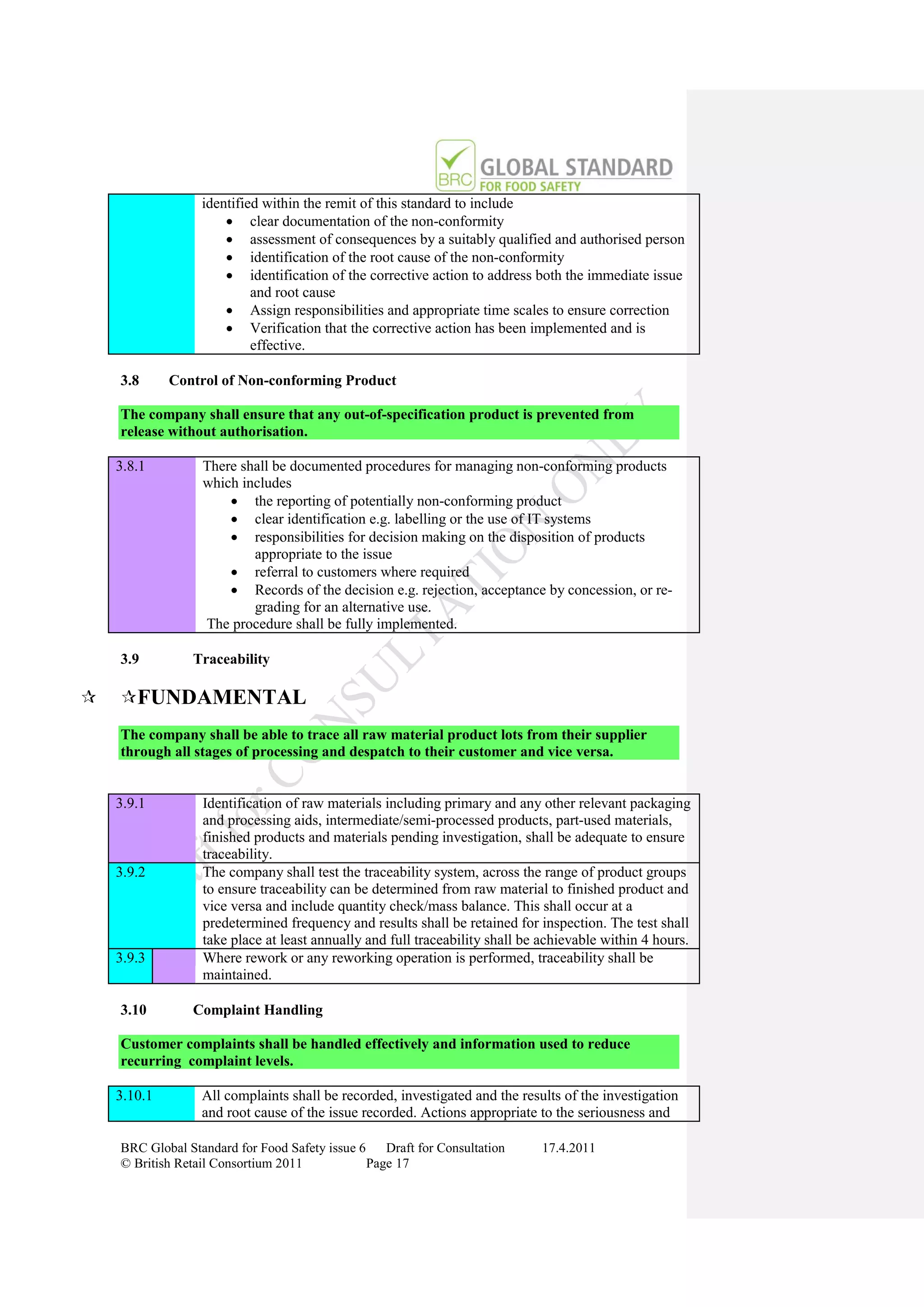
identified within the remit of this standard to include
                       clear documentation of the non-conformity
                       assessment of consequences by a suitably qualified and authorised person
                       identification of the root cause of the non-conformity
                       identification of the corrective action to address both the immediate issue
                           and root cause
                       Assign responsibilities and appropriate time scales to ensure correction
                       Verification that the corrective action has been implemented and is
                           effective.

    3.8      Control of Non-conforming Product

    The company shall ensure that any out-of-specification product is prevented from
    release without authorisation.

    3.8.1         There shall be documented procedures for managing non-conforming products
                  which includes
                       the reporting of potentially non-conforming product
                       clear identification e.g. labelling or the use of IT systems
                       responsibilities for decision making on the disposition of products
                          appropriate to the issue
                       referral to customers where required
                       Records of the decision e.g. rejection, acceptance by concession, or re-
                          grading for an alternative use.
                  The procedure shall be fully implemented.

    3.9         Traceability

   FUNDAMENTAL
    The company shall be able to trace all raw material product lots from their supplier
    through all stages of processing and despatch to their customer and vice versa.


    3.9.1         Identification of raw materials including primary and any other relevant packaging
                  and processing aids, intermediate/semi-processed products, part-used materials,
                  finished products and materials pending investigation, shall be adequate to ensure
                  traceability.
    3.9.2         The company shall test the traceability system, across the range of product groups
                  to ensure traceability can be determined from raw material to finished product and
                  vice versa and include quantity check/mass balance. This shall occur at a
                  predetermined frequency and results shall be retained for inspection. The test shall
                  take place at least annually and full traceability shall be achievable within 4 hours.
    3.9.3         Where rework or any reworking operation is performed, traceability shall be
                  maintained.

    3.10        Complaint Handling

    Customer complaints shall be handled effectively and information used to reduce
    recurring complaint levels.

    3.10.1        All complaints shall be recorded, investigated and the results of the investigation
                  and root cause of the issue recorded. Actions appropriate to the seriousness and

    BRC Global Standard for Food Safety issue 6    Draft for Consultation    17.4.2011
    © British Retail Consortium 2011            Page 17
frequency of the problems identified shall be carried out promptly and effectively
              by appropriately trained staff.
3.10.2        Complaint data shall be analysed for significant trends and used to implement on-
              going improvements to product safety, legality and quality, and to avoid
              recurrence. This analysis shall be made available to relevant staff


BRC Global Standard for Food Safety issue 6    Draft for Consultation   17.4.2011
© British Retail Consortium 2011            Page 18
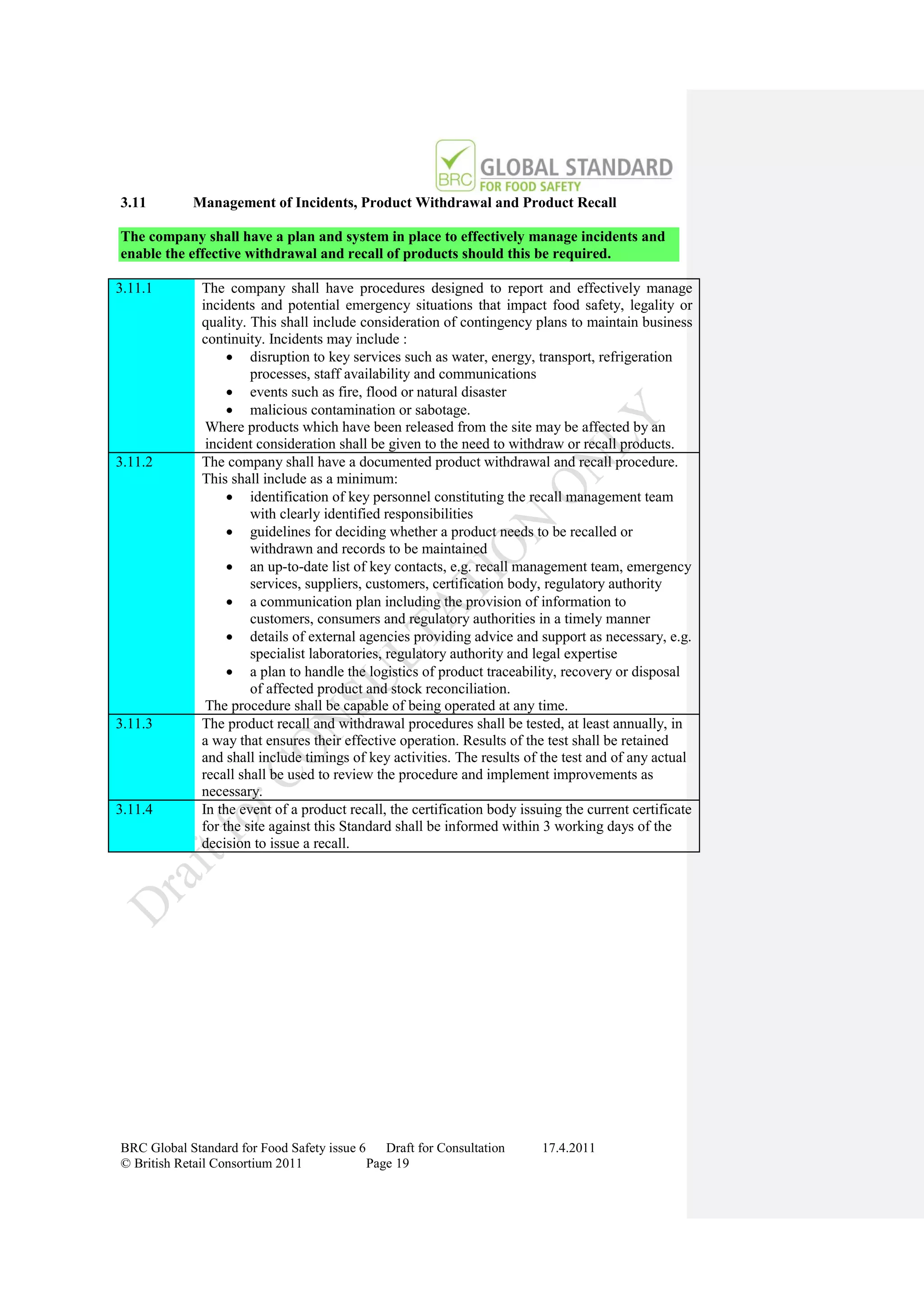
3.11        Management of Incidents, Product Withdrawal and Product Recall

The company shall have a plan and system in place to effectively manage incidents and
enable the effective withdrawal and recall of products should this be required.

3.11.1        The company shall have procedures designed to report and effectively manage
              incidents and potential emergency situations that impact food safety, legality or
              quality. This shall include consideration of contingency plans to maintain business
              continuity. Incidents may include :
                    disruption to key services such as water, energy, transport, refrigeration
                       processes, staff availability and communications
                    events such as fire, flood or natural disaster
                    malicious contamination or sabotage.
               Where products which have been released from the site may be affected by an
               incident consideration shall be given to the need to withdraw or recall products.
3.11.2        The company shall have a documented product withdrawal and recall procedure.
              This shall include as a minimum:
                    identification of key personnel constituting the recall management team
                       with clearly identified responsibilities
                    guidelines for deciding whether a product needs to be recalled or
                       withdrawn and records to be maintained
                    an up-to-date list of key contacts, e.g. recall management team, emergency
                       services, suppliers, customers, certification body, regulatory authority
                    a communication plan including the provision of information to
                       customers, consumers and regulatory authorities in a timely manner
                    details of external agencies providing advice and support as necessary, e.g.
                       specialist laboratories, regulatory authority and legal expertise
                    a plan to handle the logistics of product traceability, recovery or disposal
                       of affected product and stock reconciliation.
               The procedure shall be capable of being operated at any time.
3.11.3        The product recall and withdrawal procedures shall be tested, at least annually, in
              a way that ensures their effective operation. Results of the test shall be retained
              and shall include timings of key activities. The results of the test and of any actual
              recall shall be used to review the procedure and implement improvements as
              necessary.
3.11.4        In the event of a product recall, the certification body issuing the current certificate
              for the site against this Standard shall be informed within 3 working days of the
              decision to issue a recall.


BRC Global Standard for Food Safety issue 6    Draft for Consultation      17.4.2011
© British Retail Consortium 2011            Page 19
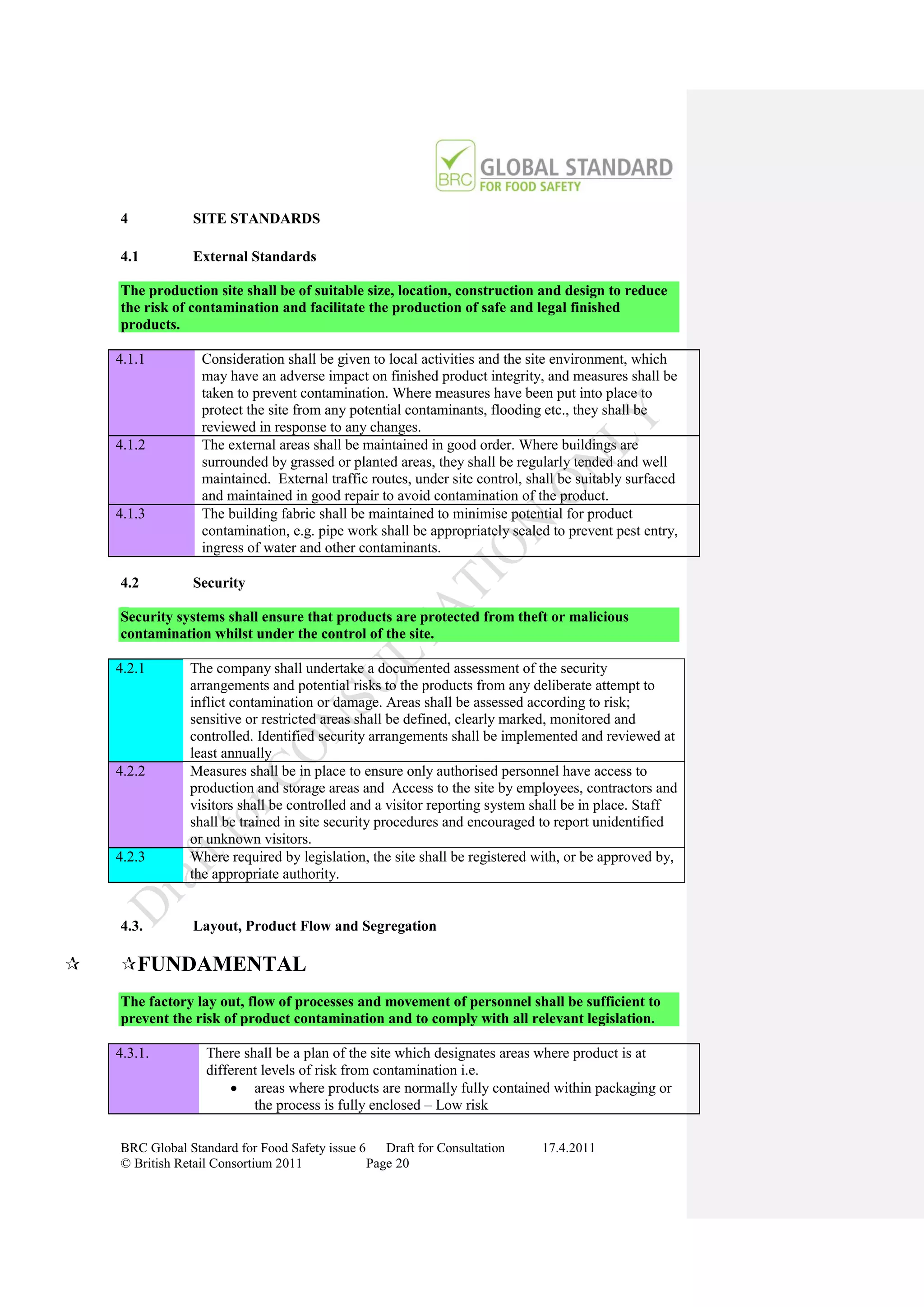
4           SITE STANDARDS

    4.1         External Standards

    The production site shall be of suitable size, location, construction and design to reduce
    the risk of contamination and facilitate the production of safe and legal finished
    products.

    4.1.1         Consideration shall be given to local activities and the site environment, which
                  may have an adverse impact on finished product integrity, and measures shall be
                  taken to prevent contamination. Where measures have been put into place to
                  protect the site from any potential contaminants, flooding etc., they shall be
                  reviewed in response to any changes.
    4.1.2         The external areas shall be maintained in good order. Where buildings are
                  surrounded by grassed or planted areas, they shall be regularly tended and well
                  maintained. External traffic routes, under site control, shall be suitably surfaced
                  and maintained in good repair to avoid contamination of the product.
    4.1.3         The building fabric shall be maintained to minimise potential for product
                  contamination, e.g. pipe work shall be appropriately sealed to prevent pest entry,
                  ingress of water and other contaminants.

    4.2         Security

    Security systems shall ensure that products are protected from theft or malicious
    contamination whilst under the control of the site.

    4.2.1       The company shall undertake a documented assessment of the security
                arrangements and potential risks to the products from any deliberate attempt to
                inflict contamination or damage. Areas shall be assessed according to risk;
                sensitive or restricted areas shall be defined, clearly marked, monitored and
                controlled. Identified security arrangements shall be implemented and reviewed at
                least annually
    4.2.2       Measures shall be in place to ensure only authorised personnel have access to
                production and storage areas and Access to the site by employees, contractors and
                visitors shall be controlled and a visitor reporting system shall be in place. Staff
                shall be trained in site security procedures and encouraged to report unidentified
                or unknown visitors.
    4.2.3       Where required by legislation, the site shall be registered with, or be approved by,
                the appropriate authority.


    4.3.        Layout, Product Flow and Segregation

   FUNDAMENTAL
    The factory lay out, flow of processes and movement of personnel shall be sufficient to
    prevent the risk of product contamination and to comply with all relevant legislation.

    4.3.1.         There shall be a plan of the site which designates areas where product is at
                   different levels of risk from contamination i.e.
                        areas where products are normally fully contained within packaging or
                           the process is fully enclosed – Low risk

    BRC Global Standard for Food Safety issue 6    Draft for Consultation    17.4.2011
    © British Retail Consortium 2011            Page 20
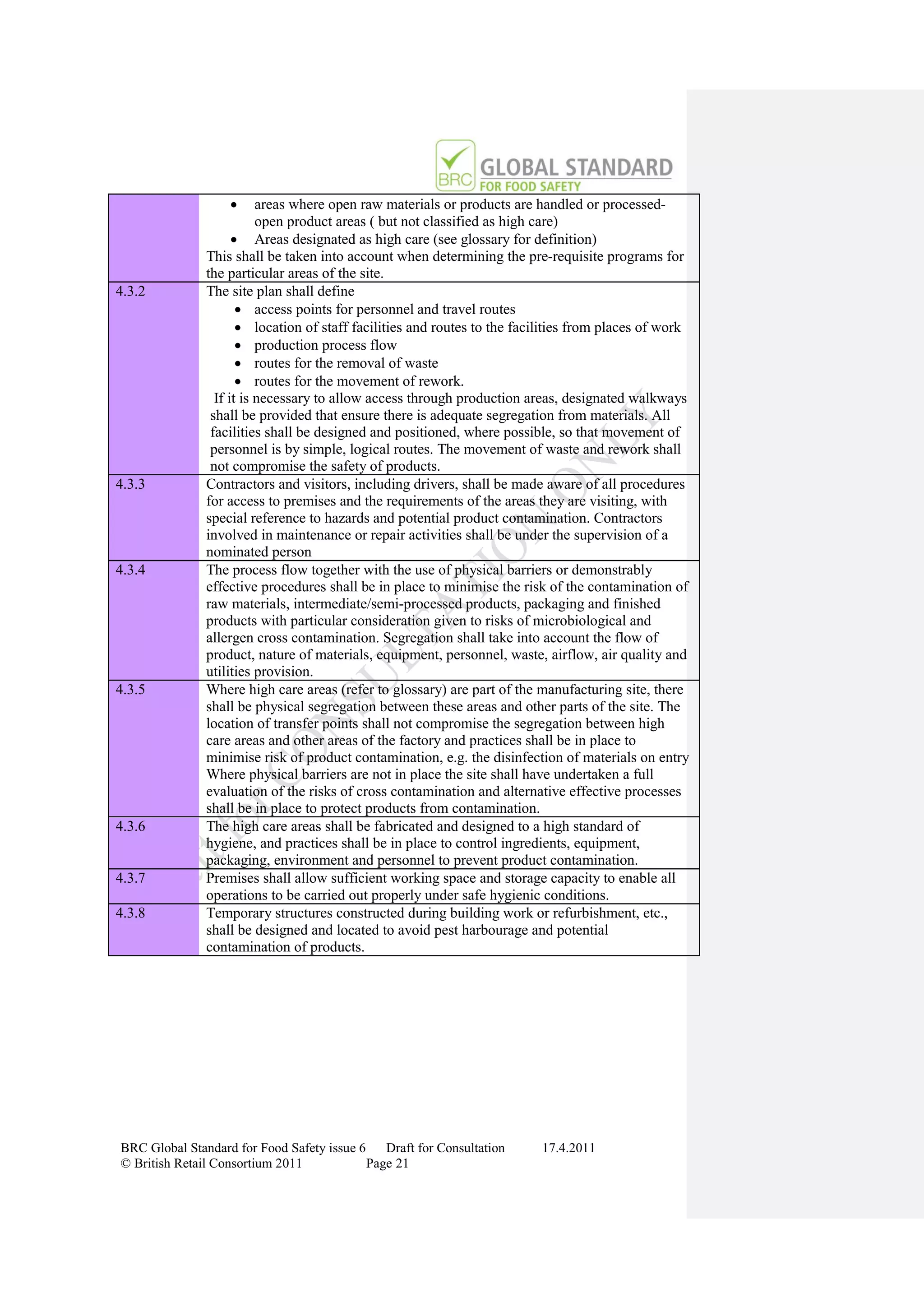
      areas where open raw materials or products are handled or processed-
                          open product areas ( but not classified as high care)
                      Areas designated as high care (see glossary for definition)
               This shall be taken into account when determining the pre-requisite programs for
               the particular areas of the site.
4.3.2          The site plan shall define
                       access points for personnel and travel routes
                       location of staff facilities and routes to the facilities from places of work
                       production process flow
                       routes for the removal of waste
                       routes for the movement of rework.
                 If it is necessary to allow access through production areas, designated walkways
                shall be provided that ensure there is adequate segregation from materials. All
                facilities shall be designed and positioned, where possible, so that movement of
                personnel is by simple, logical routes. The movement of waste and rework shall
                not compromise the safety of products.
4.3.3          Contractors and visitors, including drivers, shall be made aware of all procedures
               for access to premises and the requirements of the areas they are visiting, with
               special reference to hazards and potential product contamination. Contractors
               involved in maintenance or repair activities shall be under the supervision of a
               nominated person
4.3.4          The process flow together with the use of physical barriers or demonstrably
               effective procedures shall be in place to minimise the risk of the contamination of
               raw materials, intermediate/semi-processed products, packaging and finished
               products with particular consideration given to risks of microbiological and
               allergen cross contamination. Segregation shall take into account the flow of
               product, nature of materials, equipment, personnel, waste, airflow, air quality and
               utilities provision.
4.3.5          Where high care areas (refer to glossary) are part of the manufacturing site, there
               shall be physical segregation between these areas and other parts of the site. The
               location of transfer points shall not compromise the segregation between high
               care areas and other areas of the factory and practices shall be in place to
               minimise risk of product contamination, e.g. the disinfection of materials on entry
               Where physical barriers are not in place the site shall have undertaken a full
               evaluation of the risks of cross contamination and alternative effective processes
               shall be in place to protect products from contamination.
4.3.6          The high care areas shall be fabricated and designed to a high standard of
               hygiene, and practices shall be in place to control ingredients, equipment,
               packaging, environment and personnel to prevent product contamination.
4.3.7          Premises shall allow sufficient working space and storage capacity to enable all
               operations to be carried out properly under safe hygienic conditions.
4.3.8          Temporary structures constructed during building work or refurbishment, etc.,
               shall be designed and located to avoid pest harbourage and potential
               contamination of products.


BRC Global Standard for Food Safety issue 6    Draft for Consultation     17.4.2011
© British Retail Consortium 2011            Page 21
4.4         Building Fabric
            Raw Material Handling, Preparation, Processing, Packing and Storage
Areas

The fabrication of the site, buildings and facilities shall be suitable for the intended
purpose.


4.4.1         Walls shall be constructed, finished and maintained to prevent the accumulation of
              dirt, minimise condensation and mould growth, and facilitate cleaning.

4.4.2         Floors shall be suitably hard wearing to meet the demands of the process, and
              withstand cleaning materials and methods. They shall be impervious and
              maintained in good repair.
4.4.3         Drainage, including drains from laboratories, where provided, shall be sited,
              designed and maintained to minimise risk of product contamination and not
              compromise product safety. Machinery and piping shall be arranged so that,
              wherever feasible, process waste water goes directly to drain. Where significant
              amounts of water are used, or direct piping to drain is not feasible, floors shall
              have adequate falls to cope with the flow of any water or effluent towards suitable
              drainage.

4.4.4         Ceilings and overheads shall be constructed, finished and maintained to prevent
              the risk of product contamination.
4.4.5         Where suspended ceilings, or roof voids are present, adequate access to the void
              shall be provided to facilitate inspection for pest activity unless the void is fully
              sealed.

4.4.6         Where there is a risk to product, windows and roof glazing which is designed to be
              opened for ventilation purposes shall be adequately screened to prevent the ingress
              of pests.
4.4.7         Where they pose a risk to product, glass windows shall be protected against
              breakage.

4.4.8         Doors shall be maintained in good condition. Where external doors to raw
              material handling, processing, packing and storage areas are opened, suitable
              precautions shall be taken to prevent pest ingress. Doors and dock levellers in
              these areas shall be close fitting or adequately proofed.

4.4.9         Suitable and sufficient lighting shall be provided for correct operation of
              processes, inspection of product, and effective cleaning.
4.4.10        Where they constitute a risk to product, bulbs and strip lights, including those on
              electric fly-killer devices, shall be adequately protected. Where full protection
              cannot be provided, alternative management such as wire mesh screens or
              monitoring procedures shall be in place.

4.4.11        Adequate ventilation and extraction shall be provided in product storage and
              processing environments to prevent condensation or excessive dust.
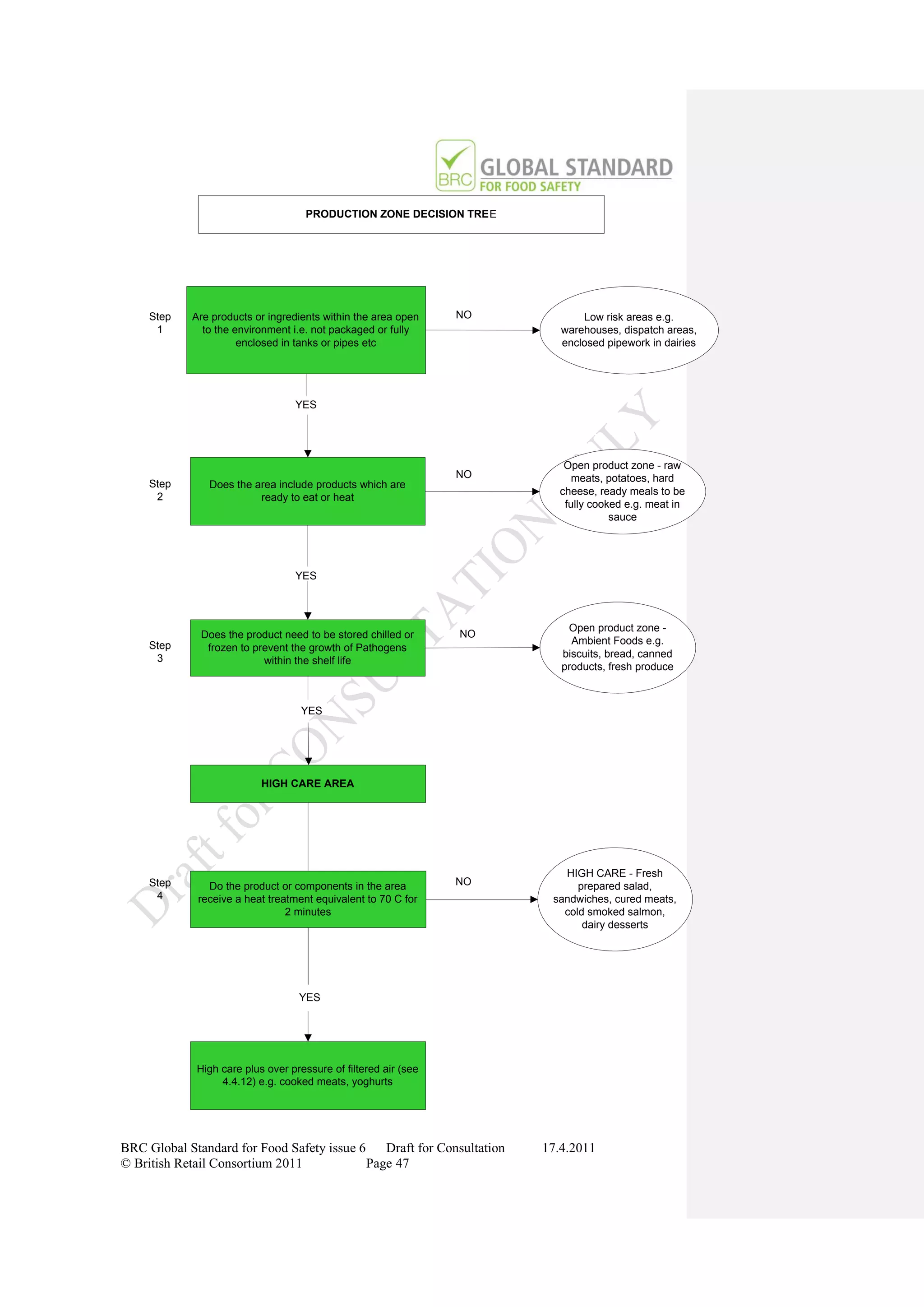
4.4.12        Where appropriate, differential air-pressure systems shall be in place. High care
              areas handling products at greater microbiological risk (see decision tree in
              appendix) shall be supplied with filtered air and maintained at a positive air
              pressure, relative to the surrounding areas.


BRC Global Standard for Food Safety issue 6    Draft for Consultation     17.4.2011
© British Retail Consortium 2011            Page 22
4.5         Utilities- Water and Air

Utilities used within the production and storage areas shall be monitored to effectively
control the risk of product contamination.

4.5.1         All water used as a raw material in the manufacture of processed food, the
              preparation of product, or for equipment or plant cleaning shall be supplied in
              sufficient quantity, be potable at point of use and pose no risk of contamination
              according to applicable legislation. The microbiological and chemical quality of
              water shall be analysed at point of use on a frequency based on risk.
4.5.2         An up to date plan shall be available of the water distribution system on site
              including holding tanks, water treatment and water recycling as appropriate. The
              plan shall be used as a basis for water sampling and the management of water
              quality
4.5.3         Where legislation specifically permits the use of water which may not be potable
              for initial product cleaning e.g. storage /washing of fish, the water shall meet the
              designated legal requirement for this operation.
4.5.4         Air, other gases and steam used directly in contact with or as an ingredient in
              products shall be monitored to ensure this does not represent a contamination risk.
              Compressed air used directly in contact with the product shall be filtered.


4.6         Equipment

All food processing equipment shall be suitable for the intended purpose and shall be
used to minimise the risk of contamination of product.

4.6.1         All equipment shall be constructed of appropriate materials. The design and
              placement of equipment shall ensure it can be effectively cleaned and maintained.
4.6.2         Equipment which is in direct contact with food shall be suitable for food contact
              and meet any legal requirements where applicable.


BRC Global Standard for Food Safety issue 6    Draft for Consultation   17.4.2011
© British Retail Consortium 2011            Page 23
4.7         Maintenance

An effective maintenance programme shall be in operation for plant and equipment to
prevent contamination and reduce the potential for breakdowns.

4.7.1         There shall be a documented planned maintenance schedule or condition
              monitoring system which includes all plant and processing equipment. When
              commissioning new equipment and plant, this shall be included within the
              program.
4.7.2         In addition to any planned maintenance programme, where there is a risk of
              product contamination by foreign bodies arising from equipment damage, the
              equipment shall be inspected at predetermined intervals, inspection results
              documented and appropriate action taken.
4.7.3         Where temporary repairs are made, these shall be controlled to ensure the safety or
              legality of product is not jeopardised. These temporary measures shall be
              permanently repaired as soon as practicable and within a defined timescale.
4.7.4         The company shall ensure that the safety or legality of product is not jeopardised
              during maintenance and subsequent cleaning operations. Maintenance work shall
              be followed by a documented hygiene clearance procedure, which records that
              product contamination hazards have been removed from machinery and
              equipment. On completion of any maintenance work, machinery and equipment
              shall be clean and free from contamination hazards.
4.7.5         Materials used for equipment and plant maintenance and that pose a risk by direct
              or indirect contact with raw materials, intermediate and finished products, such as
              lubricating oil and paints, shall be suitable for the intended use.
4.7.6         Engineering workshops shall be kept clean and tidy and controls shall be in place
              to prevent contamination risks to the product, e.g. provision of swarf mats at the
              entrance/exit of workshops.

4.8         Staff Facilities

Staff facilities shall be sufficient to accommodate the required number of personnel, and
shall be designed and operated to minimise the risk of product contamination. Such
facilities shall be maintained in good and clean condition.

4.8.1           Designated changing facilities shall be provided for all personnel, whether staff,
                visitor or contractor. These shall be sited to allow direct access to the production,
                packing or storage areas without recourse to any external area. Where this is not
                possible, a risk assessment shall be carried out and procedures implemented
                accordingly, e.g. the provision of cleaning facilities for footwear.
4.8.2           Storage facilities of sufficient size to accommodate all reasonable personal items
                shall be provided for all personnel who work in raw material handling,
                processing, preparation, packing and storage areas.
4.8.3           Outdoor clothing and other personal items shall be stored separately from work
                wear within the changing facilities. Facilities shall be available to separate clean
                and dirty work wear.
4.8.4           Where an operation includes a high care area, personnel shall enter via a
                specially designated changing facility. The changing facilities shall include the
                following requirements
                       clear instructions for the order of changing into dedicated protective
                           clothes to prevent the contamination of clean clothing.
                       Dedicated foot wear, or for visitors only shoe coverings, shall be
                           provided to be worn in the high care area. An effective system shall be


BRC Global Standard for Food Safety issue 6    Draft for Consultation     17.4.2011
© British Retail Consortium 2011            Page 24
provided to segregate areas for wearing high care and other foot wear
                          e.g. barrier or bench system.
                       Protective clothing shall be visually distinctive and shall not be worn
                          outside of the high care area.
                       Hand washing during the changing procedure shall be incorporated to
                          prevent contamination of the clean protective clothing.
                       On entry to high care areas hand disinfection shall be provided,
4.8.5           Suitable and sufficient hand-washing facilities shall be provided at access to, and
                at other appropriate points within, production areas. Such hand-wash facilities
                shall provide as a minimum:
                      sufficient quantity of warm water
                      liquid soap
                      single use towels or suitably designed and located air driers
                      water taps with hand free operation
                      advisory signs to prompt hand washing (including consideration of
                         appropriate language).

4.8.6           Toilets shall be adequately segregated and shall not open directly into
                production, packing and storage areas. Toilets shall be provided with hand-
                washing facilities comprising:
                     basins with soap and water at a suitable temperature
                     adequate hand-drying facilities
                     advisory signs to prompt hand washing (including consideration of
                         appropriate language).
                Where hand-washing facilities within toilet facilities are the only facilities
                provided before re-entering production, then the requirements of 4.8.5 shall
                apply and signs shall be in place to direct people to hand wash facilities before
                entering production..
4.8.7           Where smoking is allowed under national law designated controlled smoking
                areas shall be provided which are isolated from production areas to an extent that
                ensures smoke cannot reach the product and fitted with sufficient extraction to
                the exterior of the building. Adequate arrangements for dealing with smokers‟
                waste shall be provided at smoking facilities, both inside and at exterior
                locations.
4.8.8           Catering Facilities


4.8.8.1         All food brought into manufacturing premises by staff shall be appropriately
                stored in a clean and hygienic state. Suitable clean refrigerated storage facilities
                shall be provided. Refrigeration shall be maintained at the correct temperature
                and the temperature checked and recorded. No food shall be taken into storage,
                processing or production areas. Where eating of food is allowed outside during
                breaks, this shall be in suitable designated areas with appropriate control of
                waste
4.8.8.2         Vending machines where used shall be maintained in a clean hygienic condition.
                Vending machines containing food requiring refrigeration shall be maintained at
                the correct temperature and the temperature checked and recorded.
4.8.8.3         Where catering facilities are provided on the premises, they shall be suitably
                controlled to prevent contamination of product. Catering facilities shall be
                subject to internal audits at least every 3 months to ensure that satisfactory
                standards of hygiene are maintained. The audits shall be based on adherence to
                the food safety plan and as a minimum cover

BRC Global Standard for Food Safety issue 6    Draft for Consultation     17.4.2011
© British Retail Consortium 2011            Page 25
    standards of cleaning and maintenance of equipment
                        temperature controls of chill and freezer units
                        Staff training and awareness of good hygiene practices for catering
                        Stock rotation and management of product shelf life
                        Segregation of raw and cooked foods
                        Waste control


BRC Global Standard for Food Safety issue 6    Draft for Consultation   17.4.2011
© British Retail Consortium 2011            Page 26
4.9         Chemical and Physical Product Contamination Control
            Raw Material Handling, Preparation, Processing, Packing and Storage
Areas

Appropriate facilities and procedures shall be in place to control the risk of chemical or
physical contamination of product and implement the controls identified in the HACCP
study.


4.9.1       Chemical Control

4.9.1.1       Processes shall be in place to manage the use, storage and handling of non-food
              chemicals. This shall include as a minimum:
                   approved list of chemicals for purchase
                   availability of material safety data sheets and specifications
                   confirmation of suitability for use in a food processing environment
                   avoidance of strong scented products
                   the labelling and/or identification of containers of chemicals at all times
                   segregated and secure storage with restricted access to authorised
                     personnel
                   use by trained personnel only.

4.9.2       Metal Control

4.9.2.1         There shall be a documented policy for the control of the use of sharp metal
                implements including knives, cutting blades on equipment, needles and wires.
                This shall include a record of inspection for damage and the investigation of any
                lost items. Snap-off blade knives shall not be used.
4.9.2.2         The purchase of ingredients and packaging which use staples or other foreign
                body hazards as part of the packaging materials shall be avoided. Where staples
                or other items are used appropriate precautions shall be taken to minimise the
                risk of product contamination.


4.9.3       Glass, Brittle Plastic, Ceramics and Similar Materials

4.9.3.1       Glass or other brittle materials shall be excluded or protected against breakage
              where ever possible from areas where open products are handled or there is a risk
              of product contamination.
4.9.3.2       Documented procedures for handling glass and other brittle materials shall be in
              place and implemented to ensure that necessary precautions are taken. Procedures
              shall include as a minimum:
                   list of items detailing location, number, type and condition
                   recorded checks of condition of items carried out at a specified frequency
                       based on the level of risk to the product
                   details on cleaning or replacing items to minimise potential for product
                       contamination.


BRC Global Standard for Food Safety issue 6    Draft for Consultation   17.4.2011
© British Retail Consortium 2011            Page 27
4.9.3.3       Documented procedures detailing the action to be taken in case of breakage of
              glass or other brittle items shall be implemented and include the following:
                   quarantining the products and production area that were potentially
                       affected
                   cleaning the production area
                   inspecting the production area and authorising to continue production
                   changing of work wear and inspection of footwear
                   specifying those staff authorised to carry out the above points
                   recording the breakage incident.
4.9.3.4       Products packed into glass or other brittle containers.
4.9.3.4.1     The storage of the containers shall be segregated from the storage of raw materials,
              product or other packaging.
4.9.3.4.2     There shall be an effective system for the inspection/cleaning of the containers
              before filling which is capable of eliminating damaged containers and removing
              foreign bodies.
4.9.3.4.3     Systems shall be in place to manage container breakages between the container
              cleaning/inspection point and container closure. This shall include as a minimum
              documented instructions
                   for the removal and disposal of at risk products in the vicinity of the
                       breakage, this may be specific for different equipment or areas of the
                       production line.
                   of methods to be used for the effective cleaning of the line or equipment
                       which may be contaminated by fragments of the container. Cleaning shall
                       not result in the further dispersal of fragments for instance by the use of
                       high pressure water or air.
                   The use of dedicated, clearly identifiable cleaning equipment e.g. colour
                       coded, for removal of container breakages.
                   The use of dedicated, accessible lidded waste containers for the collection
                       of damaged containers and fragments
                   A documented inspection of production equipment following the cleaning
                       of a breakage to ensure cleaning has effectively removed any risk of
                       further contamination. Instructions shall be provided of areas for
                       inspection.
                   Authorisation for production to re- start
4.9.3.4.4     Records shall be maintained of all container breakages on the line. Where no
              breakages have occurred during a production period this shall also be recorded.
              This record shall be reviewed to identify trends and potential line or supplier
              improvements.


4.9.4       Wood

4.9.4.1       Wood shall not be used in open product or high care areas. Where the use of wood
              cannot be avoided, in open product areas and the risk is managed, the condition of
              wood shall be continually monitored to ensure it is in good condition free from
              damage or splinters.


4.10        Foreign Body Detection and Removal Equipment

The risk of product contamination shall be reduced or eliminated by the effective use of
equipment to remove or detect foreign bodies


BRC Global Standard for Food Safety issue 6    Draft for Consultation   17.4.2011
© British Retail Consortium 2011            Page 28
4.10.1.1       A documented assessment in association with the HACCP study shall be carried
               out of each production process to identify the potential use of equipment to detect
               or remove foreign body contamination. Typical equipment to be considered may
               include
                     Filters
                     Sieves
                     Metal detection
                     Magnets
                     Optical sorting equipment
                     X-ray detection equipment
                     Other physical separation equipment e.g. gravity separation , fluid bed
                        technology
4.10.1.2       The type, location and sensitivity of the detection method shall be specified as part
               of the Company‟s documented system. Industry best practice shall be applied with
               regard to the nature of the ingredient, material, product and / or the packed
               product. The location of the detection method or any other factors influencing the
               sensitivity of the detector shall be accounted for.
4.10.1.3       The Company shall ensure that the frequency of the testing of the foreign body
               detection equipment is:-
                     In accordance with documented procedures:-
                     Takes into consideration specific customer requirements:-
                     Is based on the Company‟s ability to identify, hold or recall any affected
                        materials should the foreign body detection method fail.
4.10.1.4       Where foreign material is detected or removed by the equipment the source of the
               material should be investigated. Information on rejected materials should be used
               to identify trends and where possible instigate preventive action to reduce the
               occurrence of the foreign material.

4.10.2     Filters and Sieves

4.10.2.1       Filters and sieves used for foreign body control shall be of a specified mesh size or
               gauge, designed to provide the maximum practical protection for the product.
               Material retained or removed by the system shall be examined routinely to identify
               contamination risks.
4.10.2.2       Filters and sieves shall be regularly inspected for damage on a documented
               frequency based on risk. The presence of damaged filters or sieves shall be
               recorded and the potential for contamination of products investigated.


4.10.3 Metal Detectors and X-ray equipment

4.10.3.1       Metal detection equipment shall be in place unless on the basis of risk it can be
               shown that this does not improve the safety of the products. Where metal detectors
               are not used justification shall be documented. Justification would normally be
               expected to be based on the use of an alternative more effective method of
               protection e.g. use of X-ray or fine sieves or filtration of products.
4.10.3.2       Where Metal detectors or X-ray equipment is used this shall be situated to
               maximise foreign body detection within the finished product.
4.10.3.3       The metal detector or X-ray equipment shall incorporate one of the following:
                    an automatic rejection device, for continuous in line systems, which shall
                        either divert contaminated product out of the product flow or to a secure
                        unit accessible only to authorised personnel

BRC Global Standard for Food Safety issue 6    Draft for Consultation     17.4.2011
© British Retail Consortium 2011            Page 29
     a belt stop system with an alarm where the product cannot be
                       automatically rejected e.g. very large packs
                      in-line detectors which identify the location of the contaminant shall be
                       operated to allow effective segregation of the affected product.

4.10.3.4      The company shall establish and implement documented procedures for the
              operation and testing of the metal or X-ray equipment. This shall include as a
              minimum:
                     Responsibilities for the testing of equipment
                     the operating effectiveness and sensitivity of the equipment and any
                       variation to this for particular products
                     the methods and frequency of checking the detector.
                     recording of the results of checks.
                     Actions to be taken in case of failure when tested.
4.10.3.5      Metal detector checking procedures shall be based on best practice and shall as a
              minimum include:
                     use of test pieces incorporating a sphere of metal of a known diameter.
                       The test pieces shall be marked with the size and type of test material
                       contained
                     tests shall be carried out using separate test pieces containing ferrous
                       metal, nonferrous metal and stainless steel, unless the product is within a
                       foil container.
                     The test shall where ever possible be carried out by inserting the test piece
                       within a clearly identified sample pack of the food being produced at the
                       time of the test.
                     The test shall check that both the detection and rejection mechanisms are
                       working effectively under normal working conditions.
                     Checks shall test the memory/reset function of the metal detector by
                       passing successive test packs through the unit.
4.10.3.6      The company shall establish and implement corrective action and reporting
              procedures in the event of the testing procedure identifying any failure of the metal
              or foreign body detector. Action shall include a combination of isolation,
              quarantining and re-inspection of all product produced since the last successful
              test.

4.10 4 Magnets

4.10.4          The type, location and the strength of Magnets shall be fully
                documented. Documented procedures shall be in place for the
                inspection, cleaning and integrity checks. Records of all checks shall be
                maintained.


4.10.5 Optical sorting equipment

4.10.5.1      Each unit shall be checked in accordance with the manufacturer‟s instructions or
              recommendations. Checks shall be documented.

4.10.6 Container cleaning

4.10.6.1      Based on risk assessment, procedures shall be implemented to minimise foreign
              body contamination originating with the packaging /container, during filling
              operations, e.g. covered conveyors, container inversion and foreign body removal

BRC Global Standard for Food Safety issue 6    Draft for Consultation    17.4.2011
© British Retail Consortium 2011            Page 30
through rinsing with water or air jets.
    4.10.6.2       The effectiveness of the container cleaning equipment shall be checked and
                   recorded during each production. Where the system incorporates a rejection
                   system for dirty or damaged containers the check shall incorporate a test of both
                   the detection and effective rejection of the test container.

    4.11       Housekeeping and Hygiene

   FUNDAMENTAL
    Housekeeping and cleaning systems shall be in place which ensure appropriate
    standards of hygiene are maintained at all times and the risk of product contamination
    is minimised.

    4.11.1             Documented cleaning procedures shall be in place and maintained for the
                       building, utilities, plant and all equipment. Cleaning procedures shall as a
                       minimum include the:
                             responsibility for cleaning
                             item/area to be cleaned
                             frequency of cleaning
                             method of cleaning including breaking down equipment for cleaning
                                purposes where required.
                             cleaning materials to be used
                             cleaning records and responsibility for verification.
                       The frequency and methods of cleaning shall be based on risk.
                       The procedures shall be implemented to ensure appropriate standards of
                       cleaning are achieved.
    4.11.2             The cleaning and disinfection procedures shall be validated with due regard to
                       the potential product risks e.g. microbiological, allergen control or product
                       contamination control. Revalidation shall be carried out following building or
                       maintenance work, new product introduction or changes to equipment.
                       Records shall be maintained. Limits of acceptable and unacceptable cleaning
                       performance shall be defined based on visual appearance, Bio luminescence
                       techniques, microbiological testing or chemical testing as appropriate.
    4.11.3             The resources for undertaking cleaning shall be available. Where it is
                       necessary to dismantle equipment for cleaning purposes or to enter major
                       pieces of plant for cleaning this shall be appropriately scheduled and where
                       necessary planned for non-production periods. Cleaning staff shall be
                       adequately trained or engineering support provided where access within
                       equipment is required for cleaning.
    4.11.4             The cleanliness of equipment shall be checked before equipment is released
                       back into production. The results of checks on cleaning including analytical
                       and microbiological checks where appropriate shall be used to identify trends
                       in cleaning performance and instigate improvements where required.
    4.11.5             Cleaning chemicals and equipment shall be:
                             fit for purpose
                             suitably identified for intended use, e.g. colour coded or labelled
                             stored in a hygienic manner to prevent contamination.
                       Equipment used for cleaning in high care areas shall be dedicated for use in
                        that area and should not present a risk of contamination.
    4.11.6             Cleaning in Place (CIP)
                       Cleaning-in-place (CIP) facilities, where used, shall be monitored and
                       maintained to ensure their effective operation

    BRC Global Standard for Food Safety issue 6    Draft for Consultation    17.4.2011
    © British Retail Consortium 2011            Page 31
4.11.6.1          . A schematic plan of the lay out of the CIP system shall be available. There
                  shall be an inspection report or other verification that

                          systems are hygienically designed with no dead areas, limited
                           interruptions to flow streams and good system drain ability.

                           Scavenge pumps are operated to ensure that there is no build-up of
                           cleaning fluids in the vessels

                          Spray balls effectively clean vessels by providing full surface
                           coverage and are periodically inspected for blockages. Rotating spray
                           devices should have a defined and validated operational time .

                          CIP equipment has adequate separation from active product lines - for
                           example through the use of double seat valves, manually controlled
                           links or blanks in pipe work.

                  The system shall be revalidated following alterations or additions to the CIP
                  equipment.
4.11.6.2          The CIP equipment shall be operated to ensure effective cleaning is carried out

                          The process parameters, time, detergent concentrations, flow rate and
                           temperatures shall be defined to ensure removal of the appropriate
                           target hazard e.g. soil, allergens, vegetative microorganisms, spores.
                           This shall be validated and records of the validation maintained.

                          Process verification shall be undertaken by analysis of rinse waters
                           and/or first product through the line, for the presence of cleaning
                           fluids or tests of ATP, allergens or microorganisms as appropriate.

                          Detergent tanks shall be kept stocked up and a log maintained of when
                           these are filled and emptied. Recovered pre rinse solutions shall be
                           monitored for a buildup of carry-over from the detergent tanks,

                  Filters where fitted shall be cleaned and inspected regularly.

4.12        Waste/Waste Disposal

Waste disposal shall be managed in accordance with legal requirements and to prevent
accumulation, risk of contamination and the attraction of pests.

4.12.1        Where licensing is in operation for disposal of categorised waste, it shall be
              removed by licensed contractors and records of disposal shall be maintained and
              available for audit.
4.12.2        Food products intended to be supplied for animal feed shall be segregated and
              managed in accordance with relevant legislative requirements.
4.12.3        External waste collection containers and rooms housing waste facilities shall be
              managed to minimise risk. These shall be:
                   clearly identified
                   designed for ease of use and effective cleaning
                   well maintained to allow cleaning and. where required, disinfection
                   emptied at appropriate frequencies
                   covered or doors kept closed as appropriate.


BRC Global Standard for Food Safety issue 6    Draft for Consultation    17.4.2011
© British Retail Consortium 2011            Page 32
4.12.4        If unsafe products or substandard trademarked materials are transferred to a third
              party for destruction or disposal, that third party shall be a specialist in secure
              product or waste disposal and shall provide records which includes the quantity of
              waste collected for destruction or disposal.

4.13        Pest Control

The whole site shall have effective preventative pest control program in place to
minimise the risk of infestation and there shall be the resources to rapidly respond to
any issues which occur to prevent risk to products.

4.13.1         The company shall either contract the services of a competent pest control
               organisation, or shall have appropriately trained staff, for the regular inspection
               and treatment of the site to deter and eradicate infestation. The frequency of
               inspections shall be determined by risk assessment and shall be documented.
               Where the services of a pest control contractor are employed, the service contract
               shall be clearly defined and reflect the activities of the site.
4.13.2         Where a company undertakes its own pest control it shall be able to effectively
               demonstrate that:
                     pest control operations are undertaken by trained and competent staff
                        with the knowledge covering the selection of pest control chemicals
                        including limitations of use, the biology of the pests relevant to the site,
                        pest proofing,
                     Sufficient resources are available to respond to any infestation issues
                     There is ready access to specialist technical knowledge when required.
                     Legislation governing the use of pest control products is understood.
                     Dedicated locked facilities are used for the storage of pesticides
4.13.3         Documentation and inspection records shall be maintained. This shall include as
               a minimum:
                     an up-to-date, plan of the full site identifying numbered pest control
                        device locations
                     identification of the baits and/or monitoring devices on site
                     clearly defined responsibilities for site management and for the
                        contractor
                     details of pest control products used including instructions for their
                        effective use and action to be taken in case of emergencies..
4.13.4         Bait stations shall be robust, of tamper resistant construction, secured in place
               and appropriately located to prevent contamination risk to product. Missing bait
               boxes shall be recorded, reviewed and investigated. Toxic rodent baits shall not
               be used within production or storage areas except when treating an active
               infestation
4.13.5         Fly-killing devices and/or pheromone traps shall be correctly sited and
               operational. If there is a danger of insects being expelled from a fly killing
               extermination device and contaminating the product, alternative systems and
               equipment shall be used.
4.13.6         In the event of infestation, immediate action shall be taken to eliminate the
               hazard. Action shall be taken to identify, evaluate and authorise the release of any
               product potentially affected.
4.13.7         Detailed records of pest control inspections, recommendations and actions taken
               shall be maintained. It shall be the responsibility of the company to ensure all of
               the relevant recommendations made by their contractor or in-house expert are
               carried out and monitored. The completion of corrective action shall be
               demonstrated by documented evidence.


BRC Global Standard for Food Safety issue 6    Draft for Consultation    17.4.2011
© British Retail Consortium 2011            Page 33
4.13.8         An in depth documented pest control survey shall be undertaken usually quarterly
               by a pest control expert to review the pest control measures in place. The timing
               of the survey shall be such to allow access to equipment for inspection where a
               risk of stored product insects exist .
4.13.9         Results of pest control inspections shall be assessed and analysed for trends on a
               regular basis, but as a minimum:
                     in the event of an infestation
                     annually.
               This shall include a catch analysis from trapping devices to identify problem
               areas. Any such problems shall be suitably rectified.

4.14        Storage Facilities

All facilities used for the storage of ingredients, in-process product and finished
products shall be suitable for the purpose

4.14.1        Documented procedures to maintain product safety and quality during storage
              shall be developed on the basis of risk assessment, understood by relevant staff
              and implemented accordingly. These may include as appropriate:
                     managing chilled and frozen product transfer between temperature
                       controlled areas.
                     segregation of products where necessary to avoid cross contamination
                       (physical, microbiological or allergens) or taint uptake
                     storing materials off the floor and away from walls as appropriate
                     specific handling or stacking requirements to prevent product damage.
4.14.2        Where temperature control is required, the storage area shall be capable of
              maintaining product temperature within specification and operated to ensure
              specified temperatures are maintained. Temperature recording equipment with
              suitable temperature alarms shall be fitted to all storage facilities or there shall be
              a system of recorded manual temperature checks on at least a 4 hourly basis.
4.14.3        Where controlled atmosphere storage is required, the storage conditions shall be
              specified and effectively controlled. Records shall be maintained of the storage
              conditions.
4.14.4        Where storage outside is necessary, items shall be protected from contamination
              and deterioration.
4.14.5        Receipt documents and/or product identification shall facilitate correct stock
              rotation of raw materials intermediate products and finished products in storage
              and ensure materials are used in the correct order and within the prescribed shelf
              life.


4.15 Dispatch and Transport

Procedures shall be in place to ensure that the management of dispatch and of the
vehicles and containers used for transporting products from the site do not present a
risk to the safety or quality of the products.

4.15.1        Documented procedures to maintain product safety and quality during loading and
              transportation shall be developed and implemented. These may include as
              appropriate:
                   controlling temperature of loading dock areas
                   the use of covered bays for vehicle loading or unloading


BRC Global Standard for Food Safety issue 6    Draft for Consultation      17.4.2011
© British Retail Consortium 2011            Page 34
 securing loads on pallets to prevent movement during transit.
                    Inspection of loads prior to dispatch
4.15.2        Traceability shall be ensured during transportation. There shall be a clear record of
              dispatch and receipt of goods and materials demonstrating that sufficient checks
              have been completed during the transfer of goods.
4.15.3        All vehicles or containers used for the dispatch of products shall be inspected prior
              to loading to ensure that they are fit for purpose. This shall ensure that they are
                    In a suitably clean condition
                    Free from strong odours which may cause taint to products
                    Suitably maintained to prevent damage to products during transit
                    Equipped to ensure any temperature requirements can be maintained.
              Records of inspections shall be maintained.
4.15.4        Where temperature control is required, the transport shall be capable of
              maintaining product temperature within specification, under minimum and
              maximum load. Temperature data-logging devices which can be interrogated to
              confirm time/temperature conditions or a system to verify and record at
              predetermined frequencies the correct operation of refrigeration equipment shall
              be used and records maintained.
4.15.5        Maintenance systems and documented cleaning procedures shall be maintained for
              all vehicles and equipment used for loading/unloading (e.g. hoses of silo
              installations). There shall be records of the measures taken.
4.15.6        The company shall have documented procedures for the transport of products
              which shall include
                    Any restrictions on the use of mixed loads

                      Requirements for the security of products during transit particularly when
                       vehicles are parked and unattended

                      The need for clear instructions in the case of vehicle breakdown, accident
                       or failure of refrigeration systems which ensure the safety of the products
                       is assessed and records maintained

4.15.7        Where the company employs third-party contractors, all the requirements specified
              in this section shall be clearly defined in the contract and verified or the contracted
              company shall be certificated to the Global Standard for Storage and
              Distribution.


5           PRODUCT CONTROL

5.1         Product Design/Development

Product design and development procedures shall be in place for the new product
development process and any changes to product, packaging or manufacturing
processes to ensure that safe and legal product results.

5.1.1         The company shall provide clear guidelines on any restrictions to the scope of new
              product developments to control the introduction of hazards which would be
              unacceptable to the company or customers, for example the introduction of
              allergens, glass packaging or microbiological risks.


BRC Global Standard for Food Safety issue 6    Draft for Consultation     17.4.2011
© British Retail Consortium 2011            Page 35
5.1.2         All new products and changes to product formulation, packaging or methods of
              processing shall be formally approved by the HACCP team leader or authorised
              HACCP committee member. This shall ensure that hazards have been assessed
              and suitable controls through the HACCP system are implemented. This approval
              shall be granted before products are introduced into the factory environment.
5.1.3         Trials using production equipment shall be carried out where it is necessary to
              validate that product formulation and manufacturing processes are capable of
              producing a safe product of the required quality.
5.1.4         Shelf-life trials shall be undertaken using documented protocols reflecting
              conditions experienced during storage and handling. Results shall be recorded and
              retained and shall confirm compliance with relevant microbiological, chemical and
              organoleptic criteria. Where shelf life trials prior to production are impractical, for
              instance for some long life products, a documented science based justification for
              the assigned shelf life shall be produced.
5.1.5         The company‟s senior management shall ensure that a system is in place to
              confirm that labelling of the product or other forms of customer information meets
              legislation for the designated country of use and in accordance with the
              appropriate product specification.
5.1.6         All products shall be labelled to meet legal requirements and shall include
              information to allow the safe handling, display, storage , preparation and use of the
              product within the food supply chain or by the customer. There shall be a process
              to verify that ingredient and allergen labelling is correct based on the product
              recipe.
5.1.7         Where a product is designed to enable a claim to be made to satisfy a consumer
              group, e.g. nutritional claim, reduced sugar; the company shall ensure that the
              product formulation and production process is fully validated to meet the stated
              claim.


BRC Global Standard for Food Safety issue 6    Draft for Consultation     17.4.2011
© British Retail Consortium 2011            Page 36
5.2         Management of Allergens


   FUNDAMENTAL
    The company shall have a developed system for the management of allergenic materials
    which minimises the risk of allergen contamination of products and meets legal
    requirements for labelling.


    5.2.1         The company shall carry out an assessment of raw materials to establish the
                  presence and likelihood of contamination by allergens (refer to glossary). This
                  shall include review of raw material specifications and where required obtain
                  additional information from suppliers for example through questionnaires to
                  understand the allergen status of the material, its ingredients and the factory in
                  which they are produced.
    5.2.2         The company shall identify and list allergen-containing materials handled on site.
                  This shall include raw materials, processing aids, intermediate and finished
                  products and any new product development ingredients or products.
    5.2.3         A documented risk assessment shall be carried out to identify routes of
                  contamination and establish documented policies and procedures for handling raw
                  materials, intermediate and finished products to ensure cross contamination is
                  avoided. This shall include :
                       Consideration to the physical state of the allergenic material i.e. powder,
                           liquid, particulate
                       Identification of potential points of cross contamination through the
                           process flow.
                       Assess the risk of allergen cross contamination at each step
                       Identify suitable controls to reduce or eliminate the risk of cross
                           contamination.
    5.2.4         Documented procedures shall be established to ensure the effective management
                  of allergenic materials to prevent cross contamination into products not containing
                  the allergen. This shall include as appropriate:
                          physical or time segregation whilst allergen-containing materials are
                              being stored, processed or packed
                          The use of additional protective over clothing when handling allergenic
                              materials
                          use of identified, dedicated equipment and utensils for processing
                          Scheduling of production to reduce changes between products
                              containing an allergen and products not containing the allergen.
                          systems to restrict the movement of air bourne dust containing
                              allergenic material
                          waste handling and spillage controls
                          restrictions on food brought onto site by staff, visitors, contractors and
                              for catering purposes.
    5.2.5         Where rework is used, or reworking operations carried out, procedures shall be
                  implemented to ensure rework containing allergens is not used in products that do
                  not already contain the allergen.

    5.2.6         Where a claim is made regarding the suitability of a food for allergy or food
                  sensitivity sufferers, the company shall ensure that the production process is fully
                  validated to meet the stated claim. This shall be documented.
    5.2.7         Equipment or area cleaning procedures shall be designed to remove or reduce to

    BRC Global Standard for Food Safety issue 6    Draft for Consultation    17.4.2011
    © British Retail Consortium 2011            Page 37
acceptable levels any potential cross contamination by allergens. The cleaning
              methods shall be validated to ensure they are effective and the effectiveness of the
              procedure routinely verified.. Cleaning equipment used to clean allergenic
              materials shall either be identifiable and specific for allergen use, single use, or
              effectively cleaned after use.
5.2.8         All relevant personnel, including engineers, temporary staff and contractors, shall
              have received general allergen awareness training and be appropriately trained in
              the company‟s allergen handling procedures.
5.2.9         An effective system of documented checks shall be in place at line start up,
              following product change over and changes in batches of packaging to ensure that
              the labels applied are correct for the products packed.


5.3         Provenance, Assured status and claims of Identity Preserved Materials

Systems of traceability, identification and segregation of raw materials, intermediate
and finished products shall be in place to ensure that all claims relating to provenance
or assurance status can be substantiated.

5.3.1         Where claims are to be made on finished packs about the provenance or assured
              status of raw materials used; the status of each batch of the raw material shall be
              verified and records maintained.
5.3.2         Where a claim is made relating to the provenance or assured status of an
              ingredient the facility shall maintain purchasing records, traceability of raw
              material usage and final product packing records to substantiate claims. The
              company shall undertake documented mass balance tests at least quarterly.
5.3.3         The process flow for the production of products where claims are made shall be
              documented and potential areas for contamination or loss of identity identified.
              Appropriate controls shall be established to ensure the integrity of the product
              claims.

5.4         Product Packaging

Product packaging shall be appropriate for the intended use and shall be stored under
conditions to minimise contamination and deterioration.

5.4.1         When purchasing or specifying food contact packaging the supplier of packaging
              materials shall be made aware of any particular characteristics of the food e.g. high
              fat content, pH or usage conditions such as microwaving which may affect
              packaging suitability. Certificates of conformity or other evidence shall be
              available for product packaging to confirm it conforms to relevant food safety
              legislation and is suitable for its intended use.
5.4.2         Where appropriate, packaging shall be stored away from raw materials and
              finished product. Any part-used packaging materials suitable for use shall be
              effectively protected from contamination and clearly identified before being
              returned to an appropriate storage area. Obsolete packaging shall be stored in a
              separate area and systems be in place to prevent accidental use.
5.4.3         Product contact liners (or raw material/work-in progress contact liners) purchased
              by the company shall be appropriately coloured and resistant to tearing to prevent
              accidental contamination.

5.5         Product Inspection and Laboratory Testing


BRC Global Standard for Food Safety issue 6    Draft for Consultation    17.4.2011
© British Retail Consortium 2011            Page 38
The company shall undertake or subcontract inspection and analyses which are critical
to confirm product safety, legality and quality, using appropriate procedures, facilities
and standards.

5.5.1      Product Inspection and testing

5.5.1.1       There shall be a scheduled program of testing covering products and the
              processing environment which may include microbiological chemical, physical
              and organoleptic testing according to risk. The methods, frequency and specified
              limits shall be documented.
5.5.1.2       Test and inspection results shall be recorded and reviewed regularly to identify
              trends. Appropriate actions shall be implemented promptly to address any
              unsatisfactory results or trends
5.5.1.3       The company shall ensure that a system of on-going shelf life assessment is in
              place. This shall be based on risk and shall include microbiological and sensory
              analysis as well as relevant chemical factors such as pH and Aw. Records and
              results from shelf life tests shall validate the minimum shelf life period indicated
              on the product.

5.5.2            Laboratory Testing

5.5.2.1       Pathogen testing shall be subcontracted to an external laboratory or, where
              conducted internally, the laboratory facility shall be fully segregated from the
              manufacturing site and have operating procedures to prevent any risk of product
              contamination.
5.5.2.2       Where routine testing laboratories are present on a manufacturing site, they shall
              be located, designed and operated to eliminate potential risks to product safety.
              Controls shall be documented, implemented and shall include consideration of the
              following:
                   design and operation of drainage and ventilation systems
                   access and security of the facility
                   movement of laboratory personnel
                   protective clothing arrangements
                   processes for obtaining product samples
                   disposal of laboratory waste.
5.5.2.3       Where the company undertakes or subcontracts analyses which are critical to
              product safety or legality, the laboratory, or subcontractors shall have gained
              recognised laboratory accreditation or operate in accordance with the requirements
              and principles of ISO 17025. Documented justification shall be available where
              accredited methods are not undertaken.
5.5.2.4       Procedures shall be in place to ensure reliability of laboratory results, other than
              those critical to safety and legality specified in 5.5.2.3 . These shall include:
                    use of recognised test methods, where available
                    documented testing procedures
                    ensuring staff are suitably qualified and/or trained and competent to carry
                       out the analysis required
                    use of a system to verify the accuracy of test results, e.g. ring or
                       proficiency testing
                    use of appropriately calibrated and maintained equipment.


5.6         Product Release


BRC Global Standard for Food Safety issue 6    Draft for Consultation    17.4.2011
© British Retail Consortium 2011            Page 39
The company shall ensure that finished product is not released unless all agreed
procedures have been followed.

5.6.1         Where products requiring positive release are stored off site, procedures shall be in
              place to ensure that release does not occur until all release criteria have been
              completed and release authorised.


BRC Global Standard for Food Safety issue 6    Draft for Consultation    17.4.2011
© British Retail Consortium 2011            Page 40
6           PROCESS CONTROL

    6.1         Control of Operations

   FUNDAMENTAL
    The company shall operate to documented procedures and/or work instructions that
    ensure the production of consistently safe and legal product with the desired quality
    characteristics, in full compliance with the HACCP food safety plan.

    6.1.1         Documented process specifications and work instructions shall be available for the
                  key processes in the production of products to ensure product safety in compliance
                  to HACCP and ensure product quality. The specifications may include as
                  appropriate
                        recipes- including a high light of any allergens
                        mixing instructions, speed, time
                        equipment process settings
                        cooking times and temperatures
                        cooling times and temperatures
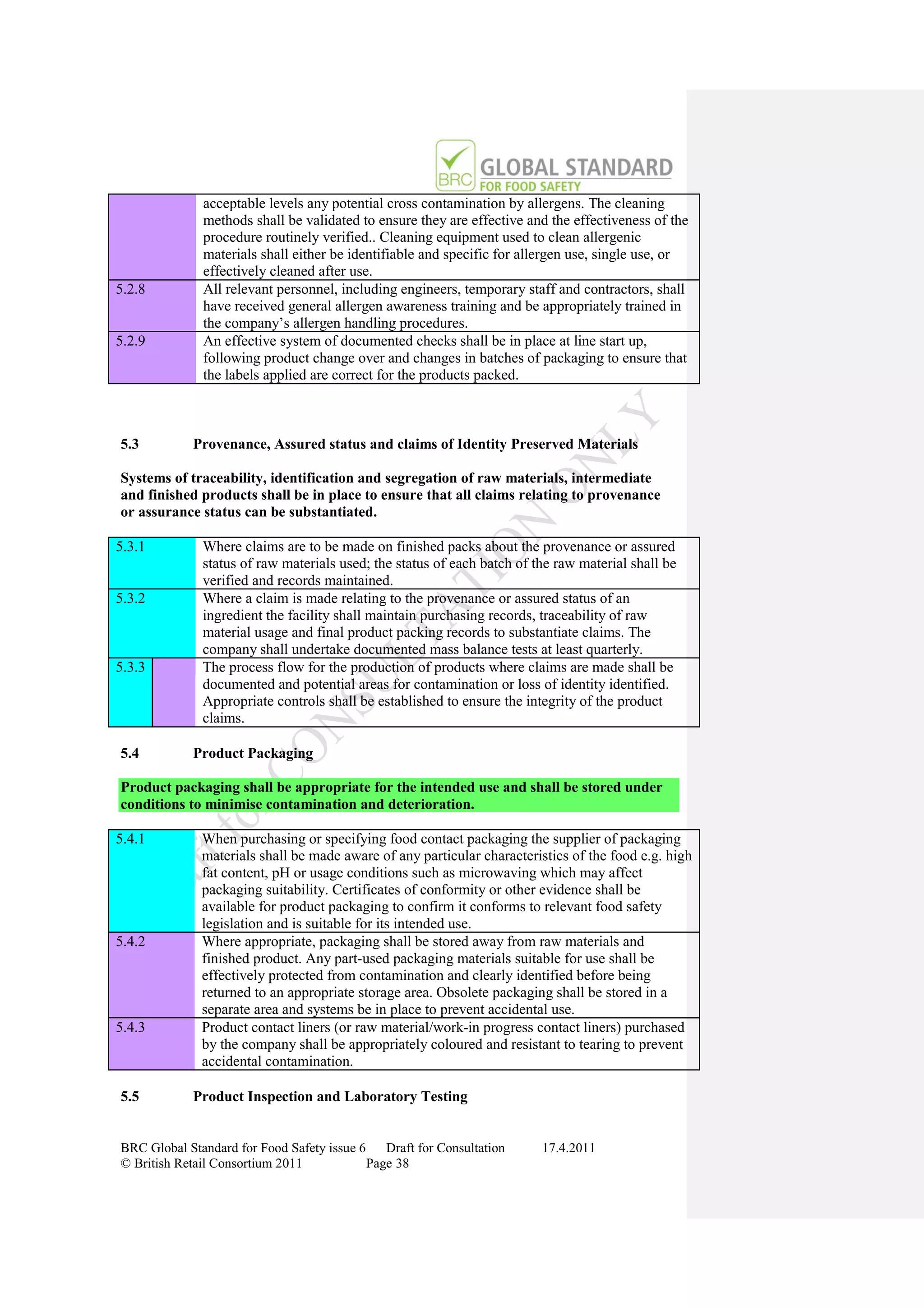
                        labelling instructions
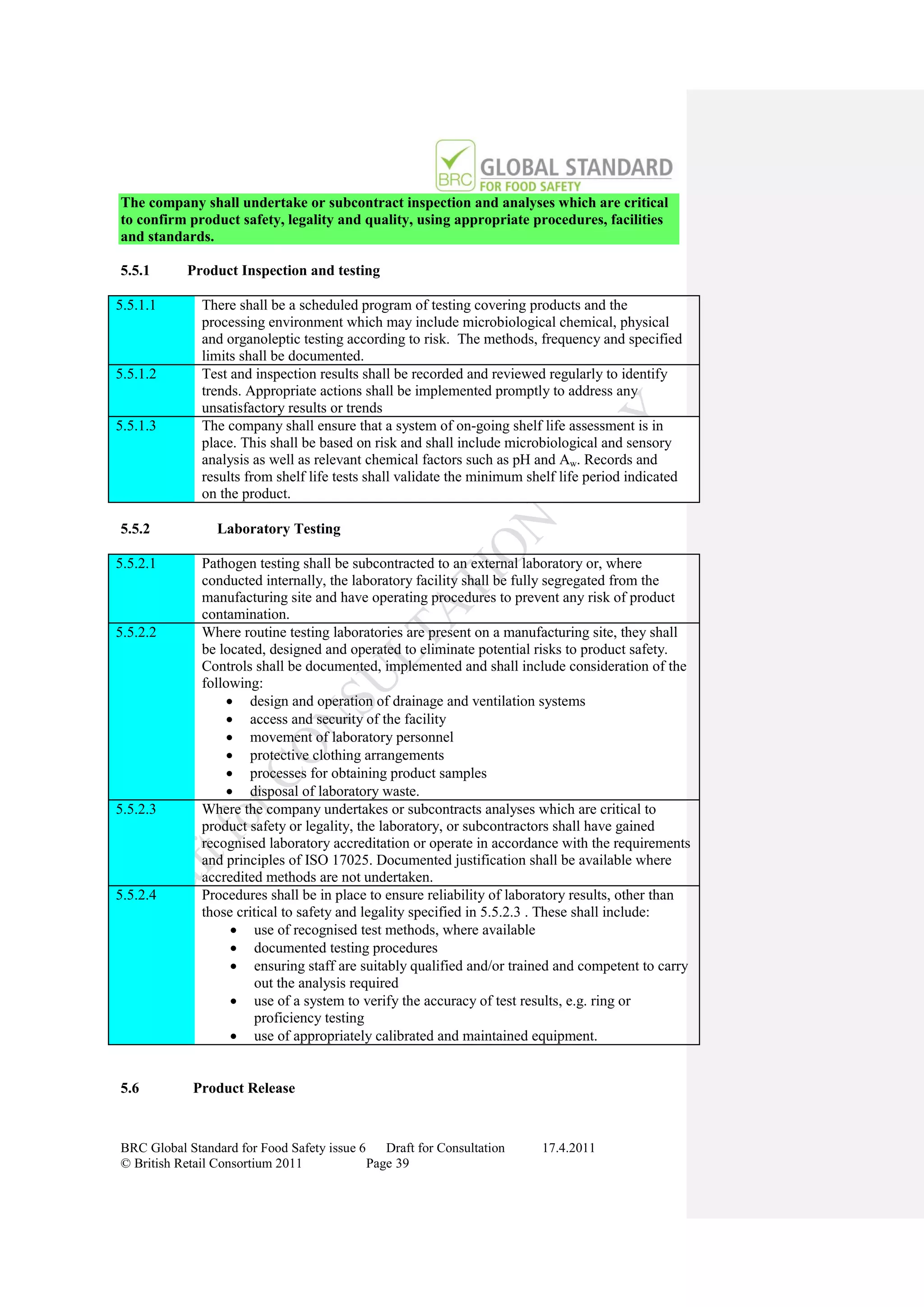
                        coding and shelf life marking
    6.1.2         Process monitoring such as temperature, time, pressure and chemical properties
                  shall be established, adequately controlled and recorded to ensure that product is
                  produced within the required process specification.
    6.1.3         In circumstances where process parameters are controlled by in-line monitoring
                  devices, these shall be linked to a suitable failure alert system that is routinely
                  tested.
    6.1.4         Where variation in processing conditions may occur within equipment critical to
                  the safety of products the processing characteristics shall be validated at a
                  frequency based on risk and equipment performance e.g. heat distribution in ovens
                  and processing vessels, temperature distribution in freezers and cold stores.
    6.1.5         In the case of equipment failure or deviation of the process from specification,
                  procedures shall be in place to establish the safety status and quality of the
                  product, prior to release.
    6.1.6         Documented checks shall be carried out of the production lines before
                  commencing production and following changes to product. These shall ensure that
                  lines have been suitably cleaned and are ready for production. Documented checks
                  shall be carried out at product changes to ensure all products and packaging from
                  the previous production have been removed from the line before changing to the
                  next production.
    6.1.7         Documented procedures shall be in place to ensure that products are packed into
                  the correct packaging and correctly labelled. This shall include checks at the start
                  of packing, during the packaging run, following packaging changes and when
                  changing batches of packaging materials to ensure correct packaging materials are
                  used. This shall include verification of any code information or other printing
                  carried out at packing.


    BRC Global Standard for Food Safety issue 6    Draft for Consultation   17.4.2011
    © British Retail Consortium 2011            Page 41
6.2         Quantity – Weight, Volume and Number Control

The company shall operate a quantity control system which conforms to legal
requirements in the country where the product is sold and any additional industry
sector codes or specified customer requirement.

6.2.1         The frequency and methodology of quantity checking shall meet the requirements
              of appropriate legislation governing quantity verification and records of checks
              shall be maintained.
6.2.2         Where the quantity of the product is not governed by legislative requirements (e.g.
              bulk quantity), the product must conform to customer requirements and records
              maintained.


6.3         Calibration and Control of Measuring and Monitoring Devices

The company shall be able to demonstrate that measuring and monitoring equipment is
sufficiently accurate and reliable to provide confidence in measurement results.

6.3.1         The company shall identify and control measuring equipment used to monitor
              CCPs, product safety and legality.
              This shall include as a minimum:
                   a documented list of equipment and its location
                   equipment identified and marked in accordance with requirements (e.g.
                       numbered, calibration due date).
                   Prevention from adjustment by unauthorised staff
                   Protection from damage , deterioration or misuse
6.3.2         All identified measuring devices including new equipment shall be checked and
              where necessary adjusted:
                   at a predetermined frequency, based on risk assessment
                   to a defined method traceable to a recognised national or international
                       standard where possible.
              Results shall be documented. Equipment shall be readable and be of a suitable
              accuracy for the measurements it is required to perform.
6.3.3         Reference measuring equipment shall be calibrated and traceable to a recognised
              national or international standard and records maintained.
6.3.4         Procedures shall be in place to record actions to be taken when the prescribed
              measuring and monitoring devices are found not to be operating within specified
              limits. Where the safety or legality of products is based on equipment found to be
              inaccurate action shall to be taken to ensure at risk product is not offered for sale


BRC Global Standard for Food Safety issue 6    Draft for Consultation     17.4.2011
© British Retail Consortium 2011            Page 42
7           PERSONNEL

    7.1       Training – Raw Material Handling, Preparation, Processing, Packing and
    Storage Areas

   FUNDAMENTAL
    The company shall ensure that all personnel performing work that affects product
    safety, legality and quality are demonstrably competent to carry out their activity,
    through training, work experience or qualification.

    7.1.1         All relevant personnel, including temporary staff and contractors, shall be
                  appropriately trained prior to commencing work and adequately supervised
                  throughout the working period.
    7.1.2         Where personnel are engaged in activities relating to Critical Control Points,
                  relevant training and competency assessment shall be in place.
    7.1.3         The company shall put in place documented programmes covering the training
                  needs of relevant personnel. These shall include as a minimum:
                        identifying the necessary competencies for specific roles
                        providing training or other action to ensure staff have the necessary
                            competencies
                        reviewing and auditing the implementation and effectiveness of training
                            and competency of the trainer
                        the delivery of training in the appropriate language of trainees.
    7.1.4         Records of all training shall be available. This shall include as a minimum:
                        name of trainee and confirmation of attendance
                        date and duration of training
                        title or course contents as appropriate
                        training provider.
                  Where training is undertaken by agencies on behalf of the company records of the
                       training shall be available
    7.1.5         The company shall routinely review the competencies of staff and provide relevant
                  training as appropriate. This may be in the form of training, refresher training,
                  coaching, mentoring or on-the-job experience.

    7.2       Personal Hygiene – Raw Materials Handling, Preparation, Processing,
    Packing and Storage Areas

    The company’s personal hygiene standards shall be appropriate to the products
    produced, documented and adopted by all personnel, including agency staff, contractors
    and visitors to the production facility.

    7.2.1         The requirements for personal hygiene shall be documented and communicated to
                  all personnel. This shall include as a minimum the following requirements :
                        Watches shall not be worn.
                        Jewellery shall not be worn, with the exception of a plain wedding ring or
                           a wedding wristband
                        Rings and studs in exposed parts of the body, such as ears, noses, tongues
                           and eyebrows, shall not be worn
                        Fingernails shall be kept short, clean and unvarnished. False fingernails
                           shall not be permitted
                        Excessive perfume or aftershave shall not be worn


    BRC Global Standard for Food Safety issue 6    Draft for Consultation   17.4.2011
    © British Retail Consortium 2011            Page 43
Compliance with the requirements shall be checked routinely.
7.2.2         Hand cleaning shall be performed on entry to the production areas and at a
              frequency that is appropriate to minimise the risk of product contamination.
7.2.3         Smoking (where permitted under law), eating and drinking shall only be permitted
              in designated areas segregated from food-handling and storage areas.
7.2.4         All cuts and grazes on exposed skin shall be covered by an appropriately coloured
              plaster different from the product colour (preferably blue) and containing a metal
              detectable strip. These shall be company issued and monitored. Where
              appropriate, in addition to the plaster, a finger stall shall be worn.
7.2.5         Where metal detection equipment is used a sample from each batch of plasters
              shall be successfully tested through this and records shall be kept.
7.2.6         Processes and written instructions for staff shall be in place to control the use and
              storage of personal medicines to minimise the risk of contamination.

7.3          Medical Screening

 The company shall ensure that procedures are in place to ensure that employees, agency
 staff, contractors or visitors are not a source of transmission of food borne diseases to
 products.
7.3.1          The company shall have a procedure which enables notification by employees,
               including temporary employees, of any relevant infections, disease or condition
               with which they may have been in contact or be suffering from.
7.3.2          Where there may be risk to product safety, visitors and contractors shall be
               required to complete a health questionnaire or otherwise confirm that they are not
               suffering from a condition which may put product safety at risk prior to entering
               the raw material, preparation, processing, packing and storage areas.
7.3.3          There shall be written and communicated procedures for employees, including
               temporary employees, contractors and visitors, on action to be taken in the case of
               infectious disease from which they may be suffering or have been in contact.
               Particular consideration should be given where product safety may be
               compromised. Expert medical advice shall be sought where required.

7.4          Protective Clothing – Employees or Visitors to Production Areas

Suitable company issued protective clothing shall be worn by employees, contractors or
           visitors working in or entering production areas.

7.4.1         The company shall document and communicate to all employees, contractors or
              visitors the rules regarding the wearing of protective clothing in specified work
              areas, e.g. high care and low-risk areas. This shall also include policies for
              wearing of protective clothing away from the production environment, e.g.
              removal before entering toilets, use of canteen and smoking areas.
7.4.2         Protective clothing shall be available that:
                    Is provided in sufficient numbers for each employee
                    Is of suitable design to prevent contamination of the product (as a
                       minimum contain no external pockets above the waist or sewn on
                       buttons).
                    Fully contains all scalp hair to prevent product contamination
                    Includes snoods for beards and moustaches where required to prevent
                       product contamination
7.4.3         Laundering of protective clothing shall take place in-house using defined and
              verified criteria to validate the effectiveness of the laundering process or by an
              approved contracted laundry. Where protective clothing for high care areas is


BRC Global Standard for Food Safety issue 6    Draft for Consultation    17.4.2011
© British Retail Consortium 2011            Page 44
provided by a contracted laundry this shall be audited. . The effectiveness of
              cleaning shall be monitored. Washing of work wear by the employee is
              exceptional but shall be deemed acceptable where the protective clothing is to
              protect the employee from the products handled and the products are low risk.
              Detailed procedures shall be in place to ensure the effectiveness of the laundering
              process.
7.4.4         If gloves are used, they shall be replaced regularly. Where appropriate, gloves
              shall be suitable for food use; of a disposable type; of a distinctive colour (blue
              where possible) be intact, and not shed loose fibres.


BRC Global Standard for Food Safety issue 6    Draft for Consultation   17.4.2011
© British Retail Consortium 2011            Page 45
BRC Global Standard for Food Safety issue 6    Draft for Consultation   17.4.2011
© British Retail Consortium 2011            Page 46
PRODUCTION ZONE DECISION TREE


     Step   Are products or ingredients within the area open     NO            Low risk areas e.g.
      1       to the environment i.e. not packaged or fully                warehouses, dispatch areas,
                      enclosed in tanks or pipes etc                       enclosed pipework in dairies


                                  YES


                                                                           Open product zone - raw
                                                                 NO          meats, potatoes, hard
     Step      Does the area include products which are
                                                                          cheese, ready meals to be
      2                  ready to eat or heat
                                                                           fully cooked e.g. meat in
                                                                                     sauce


                                  YES


                                                                            Open product zone -
              Does the product need to be stored chilled or      NO
     Step                                                                    Ambient Foods e.g.
               frozen to prevent the growth of Pathogens
      3                                                                    biscuits, bread, canned
                           within the shelf life
                                                                           products, fresh produce


                                    YES


                           HIGH CARE AREA


                                                                           HIGH CARE - Fresh
     Step      Do the product or components in the area          NO           prepared salad,
      4      receive a heat treatment equivalent to 70 C for             sandwiches, cured meats,
                                2 minutes                                  cold smoked salmon,
                                                                               dairy desserts


                                   YES


             High care plus over pressure of filtered air (see
                  4.4.12) e.g. cooked meats, yoghurts


BRC Global Standard for Food Safety issue 6    Draft for Consultation   17.4.2011
© British Retail Consortium 2011            Page 47
The Audit Protocol
How to Gain Certification

1                               Introduction

        The process by which a company gains and maintains certification is summarised in
        Figure 2.

        Every effort has been made to ensure that the content of this audit protocol is accurate
        at the time of printing. However, it may be subject to minor change, and reference
        should be made to the BRC Global Standards website www.brcglobalstandards.com,
        where changes will be published.

        Conformance by the company to the requirements of the Global Standard for Food
        Safety and its suitability for the awarding of a certificate will be assessed by an
        independent audit company – the certification body. Certification will be graded
        according to the number and type of non-conformities which shall also influence the
        frequency of on-going audits. This section describes the process to be followed by a
        company seeking certification.

2       Self Assessment of Compliance with the Standard

        It is essential that the company is assessed against the current issue of the Global
        Standard for Food Safety and that this is available throughout the certification
        process. The current issue of the Standard in the required language is available from
        www.brcglobalstandards.com.

        The Standard should be read and understood and a preliminary self-assessment
        should be conducted by the company against the Standard. Any areas of non-
        conformity should be addressed by the company. Further information and guidance to
        ensure compliance with the Standard, including training courses and guideline
        booklets, are available.

        An optional on-site pre-assessment may be carried out by the selected certification
        body in preparation for the audit to provide guidance to the company on the process
        of certification.

2       Selection of a Certification Body

        Once a self-assessment has been completed and non-conformities addressed, the
        company must select a certification body. The BRC cannot advise on the selection of
        a specific certification body, but the BRC Global Standards Directory lists BRC-
        approved certification bodies. Visit www.brcdirectory.com.

        In selecting a certification body, the company should consider:


BRC Global Standard for Food Safety issue 6    Draft for Consultation     17.4.2011
© British Retail Consortium 2011            Page 48
   acceptability of the certification body to customers; certain customers carry lists of
        their preferred certification bodies


BRC Global Standard for Food Safety issue 6    Draft for Consultation   17.4.2011
© British Retail Consortium 2011            Page 49
Figure 2                                                                                                                                   Comment [MS1]: Note to typesetter: do
                                                                                                                                                   not insert Figure 2 in the middle of bulleted
                                                                                                                                                   list.
        How to Gain Certification

                                                                                      Obtain Copy Of Standard
                                                                                     www.brcglobalstandards.com


                                                                                     Self Assessment Compliance
                                                                                            With Standard


                                                                                        Select Certification Body
                                                                                         www.brcdirectory.com


                                                                                       Pre-assessment (Optional)


                                                                                             On Site Audit


                                                                        Closing Meeting                                   Critical or Major Non-
                                                                     Confirmation of any Non-                              conformity against
                                                                           conformities                                 Fundamental Requirement


                                                      Corrective Action
                                                     Submitted or Revisit            No Non-conformities
                                                     Within 28 Calendar                  Identified
                                                            Days


                                                                                                                         No Corrective Action
                                                 Evidence Assessed                                                     Submitted Within 28 Days
                   Evidence Assessed                 Clarification
                       Inadequate                     Required


                                                    Additional                      Evidence Assessed
                                                                                                                         No Certificate Issued
                                                   Clarification                        Compliant
                                                                                                                            Report Issued
                                                    Provided
                                                                                                                           Specifying Status
                                                                                                                         Process / Certification
                                                                                                                             Suspended

                                                                                     Corrective Action
                                                                                    Status Documented


                                                                                        Certification
                                                                                       Documentation
                                                                                         Collated

                     No Certificate
                        Issued                                                       Certification and
                     Report Issued                   Evidence                       Grading Decision
                    Specifying Status                Assessed                      made by Certification
                       Process/                     Inadequate                      Decision Manager
                      Certification
                      Suspended
                                                                             Certificate Details and Audit Report
                                                                            Issued to Company and sent to BRC


                                                                                                                          Critical or Major
                                                                                                                          (Fundamental)
                                                                                        On Going                          Non-conformity
                      Certificate and Audit Details listed                                                                   Identified
                     on BRC Global Standards Directory                                 Compliance
                                                                                                                           Certification
                             www.brcdirectory.com                                                                           Suspended

                                                                                          Audit
                                                                                   In Accordance With
                                                                                   Required Frequency


BRC Global Standard for Food Safety issue 6    Draft for Consultation                                               17.4.2011
© British Retail Consortium 2011            Page 50
   the scope of accreditation of the certification body. It is essential that the certification
          body is accredited to assess companies for the categories of products produced.
          Clarification of the categories of products against which the certification body can audit
          should be obtained either by confirmation from the certification body concerned or from
          accreditation schedules published by the appropriate national accreditation body. A list of
          product categories is provided in Appendix 3

         confirmation that the auditor proposed by the certification body meets the qualifications,
          training and experience requirements specified by the BRC and documented in Appendix
          2.


4         Company/Certification Body Contractual Arrangements

          A contract shall exist between the company and the certification body, detailing the scope
          of the audit and the reporting requirements. This contract will be formulated by the
          certification body.

          The BRC will require an registration fee to be collected by the certification body from the
          company for every audit undertaken. The certification body shall not issue a certificate or
          report until the registration fee has been received, irrespective of the outcome of the
          certification process.

4.1       Scope of Audit

          The scope of the audit must be agreed between the company and the certification body in
          advance of the audit to ensure the allocation of an auditor with the correct category and
          product knowledge. The wording of the scope will be verified by the auditor during the
          site audit.

          The audit shall include all applicable requirements within the standard and all production
          processes undertaken at the site seeking certification, for the products within the scope of
          certification.

          The audit scope and any permitted exclusions shall be clearly defined both on the audit
          report and any certificate issued. The description of product groups and type of pack
          within the scope shall enable a recipient of the report or certificate to clearly identify if
          products supplied have been included within the scope. This may include a description of
          processing activities undertaken at the site, which fall within the scope of the standard,
          where this adds clarity for the user of the report or certificate e.g. the slicing and packing
          of cooked meats.

          The audit, report and certificate shall be site specific. Storage facilities under the control
          of the site management and within a 50Km radius of the site shall however be included
          within the audit and certificate or specifically excluded.

          The audit report and certificate shall cover only products manufactured at the site which
          has been audited. Products purchased for resale by a site “factored goods” cannot be
          included within the scope of the certificate. A description of the process for managing
          factored goods may be included within the audit report.


BRC Global Standard for Food Safety issue 6            Draft for Consultation              15.4.11
© British Retail Consortium 2011                     Page 51
Exclusions from scope.

        The achievement of the certification criteria relies on clear commitment from the site
        management to adopting the best practice principles out lined within the standard and to
        the development of a food safety culture within the business. It follows therefore that the
        exclusion of products from the scope of certification shall only be accepted by exception.

        The exclusion of products produced at a site to be certificated from the scope of
        certification will only be acceptable where:

               the products are produced in a separate area of the factory

                                          or

               the products are produced on different production equipment and can be clearly
        differentiated from product within the scope e.g. glass jars in a cannery.

                                          and

               The excluded products make up a minority of the products produced at the site

        Where exclusions are requested these shall be agreed with the certification body in
        advance of the audit. Exclusions shall be clearly stated on the audit report and certificate
        and the justification for any exclusions from scope must be recorded on the audit report.

        The certification of products must include audit of the entire process from raw material to
        end product dispatch. It is not possible to exclude either parts of the process undertaken at
        the site or parts of the standard. Where exclusions are accepted the auditor shall assess
        any risks presented by excluded areas or products e.g. the introduction of allergens


4.2     Extension to Scope

        Once certification has been granted, any additional significant products manufactured or
        processes undertaken by the site, which are required to be included in the scope of
        certification, must be communicated to the certification body. The certification body shall
        assess the significance of the new products or processes and decide whether to conduct a
        site visit to examine the aspects of the required extension to scope. The current certificate
        will be superseded by any new certificate issued using the same expiry date as detailed on
        the original certificate.

4.3     Auditor Selection

        It is the responsibility of the company to ensure that adequate and accurate information is
        given to the certification body detailing the products it manufactures and the process
        technologies it uses to enable the certification body to select an auditor with the required
        skills to undertake the audit. Auditors must be skilled to audit in the relevant product
        category as listed in Appendix 3.

BRC Global Standard for Food Safety issue 6         Draft for Consultation               15.4.11
© British Retail Consortium 2011                  Page 52
The certification body, auditors and the company must be aware of the need to avoid
        conflict of interest when arranging an auditor for the site visit. The company may decline
        the services of a particular auditor offered by the certification body. The same auditor is
        not permitted to undertake audits on more than three consecutive occasions to the same
        site.

5       Audit Preparation by the Company

        For the initial audit, the company shall agree a mutually convenient date, with due
        consideration given to the amount of work required to meet the requirements of the
        Standard. For subsequent audits, the mutually agreed date must allow sufficient time to
        ensure the company does not go outside of the certification time frame as detailed in
        paragraph 12 „On-going Audit Frequency and Certification‟ and referenced in Appendix
        6.

        There is a requirement on the company to plan carefully for the audit, to have appropriate
        documentation for the auditor to assess and to have appropriate staff available at all times
        during the on-site audit.

        The company shall ensure that the production programme at the time of the audit covers
        products for the intended scope of the certification. Where possible, the widest range of
        these products shall be in production for the auditor to assess. Where the product range is
        large or diverse, the auditor has the discretion to continue the audit until sufficiently
        satisfied that the intended scope of the certification has been assessed. Where a
        significant production process is undertaken only during a different period of the year
        from the audit a separate audit will be required to assess that production method.

        The company shall provide the certification body with any information such as HACCP
        documentation, recent quality issues, withdrawals or customer complaints and other
        relevant performance data that would assist the auditor in conducting an effective audit.

        The company will make the previous year‟s audit report available to the auditor and the
        certification body.

6       Duration of the Audit

        The company shall provide the certification body with appropriate information to allow
        them to assess the duration and the cost of audit. This should include details of
        manufacturing schedules to allow audits to cover relevant processes, for example night
        time manufacture if necessary. Requested information may also include, for example, a
        site plan, number of employees and number of product lines. The time to assess all
        documentation is supplementary to the duration of the audit.

        Before the audit takes place, the certification body shall indicate the approximate duration
        of the audit. The typical duration of an audit shall be 2 man days. Additional time will be
        required for the review of any documentary evidence provided and completion of the
        final audit report.

        The BRC provide a guideline document on the website www.brcglobalstandards.com
        which shall be used to calculate the duration of the audit based on the number of
        employees, size of the site and number of distinct product groups produced at the site.

BRC Global Standard for Food Safety issue 6         Draft for Consultation              15.4.11
© British Retail Consortium 2011                  Page 53
However, certain factors can necessitate an increase or decrease in the duration of the
        audit within the limits allowed by the calculator, such factors may include.

               numbers of locations, with separate offices, manufacturing or storage sites
               complexity of the manufacturing process
               number of product lines
               labour-intensity of processes
               communication difficulties, e.g. language
               the number of non-conformities recorded in the previous audit
               difficulties experienced during the audit requiring further investigation
               the quality of company preparation, e.g. documentation, HACCP, QMS.


        These factors will require careful consideration both upon confirmation of the expected
        duration of the audit and during the audit itself. Deviation from the calculated audit time
        frame must be justified and specified on the audit report.

        In the event that the audit against this standard is intended to be combined with other
        audit standards, the total time taken for these audits must be specified on the audit report
        and fully justified.


7       The On-site Audit

        The on-site audit consists of the following six stages:

               the opening meeting – to confirm the scope and process of the audit

               document review – a review of the documented HACCP and quality management
                systems

               Traceability challenge including a vertical audit of associated records of
                production

               production facility inspection – to review practical implementation of the systems
                and interview personnel

               review of production facility inspection – to verify and conduct further
                documentation checks

               final review of findings by the auditor – preparation for the closing meeting

               closing meeting – to review audit findings with the company. Note that non-


BRC Global Standard for Food Safety issue 6         Draft for Consultation              15.4.11
© British Retail Consortium 2011                  Page 54
conformities are subject to subsequent independent verification by the
                certification body management.

        The company will fully assist the auditor at all times. It is expected that at the opening
        and closing meetings those attending on behalf of the company will be senior managers
        who have the appropriate authority to ensure that corrective action can be progressed if
        non-conformities are found. The most senior operations manager on site or their
        nominated deputy shall be available at the audit and attend the opening and closing
        meetings.

        During the audit, detailed notes shall be made regarding the company‟s conformities and
        non-conformities against the Standard and these will be used as the basis for the audit
        report. The auditor will assess the nature and severity of any non-conformity.

        At the closing meeting, the auditor shall present his/her findings, and discuss all non-
        conformities that have been identified during the audit, but shall not make comment on
        the likely outcome of the certification process. Information on the process and timescales
        for the company to provide evidence to the auditor of the corrective action to close non-
        conformities must be given. A written summary of the non-conformities discussed at the
        closing meeting will be documented by the auditor either at the closing meeting or within
        one working day after completion of the audit.

        The decision to award certification and the grade of the certificate will be determined
        independently by the certification body management, following a technical review of the
        audit report and the closing of non-conformities. The company will be informed of the
        certification decision following this review.


8       Non-conformities and Corrective Action

        The level of non-conformity assigned by an auditor against a requirement of the Standard
        is an objective judgement with respect to severity and risk and is based on evidence
        collected and observations made during the audit. This is verified by the certification
        body management.

8.1     Non-conformities

        There are three levels of non-conformity:

           Critical – where there is a critical failure to comply with a food safety or legal issue
           Major – where there is a substantial failure to meet the requirements of a „statement
            of intent‟ or any clause of the Standard or a situation is identified which would, on
            the basis of available objective evidence, raise significant doubt as to the conformity
            of the product being supplied
           Minor – where a clause has not been fully met but, on the basis of objective
            evidence, the conformity of the product is not in doubt.
        The objective of the audit is to provide a true reflection of the standard of the operation
        and level of conformity against the Global Standard for Food Safety. Consideration
        should therefore be given to awarding a single major non-conformity where minor non-

BRC Global Standard for Food Safety issue 6           Draft for Consultation             15.4.11
© British Retail Consortium 2011                    Page 55
conformities are repeatedly raised against a particular clause of the standard. Clustering
        of a significant number of minor non-conformities against a clause and recording this as a
        single minor non-conformity is not permitted.

8.2     Procedures for Handling Non-conformities and Corrective Action

        The criteria for grading and means of confirming corrective action are summarised in
        Appendix 4. The decision to award a certificate, and the grade of the certificate, A, B or
        C, will depend on the number and severity of non-conformities raised, and the completion
        of effective corrective actions within the stated time limit by the company. Where the
        number and type of non-conformities exceeds a certain level, no grade will be awarded
        and the site will be un-certificated, such sites will be part of the enrolment program (see
        ).

        Following identification of any non-conformities during the audit, the company must
        undertake an analysis of the underlying cause of the non-conformance (root cause) and
        develop a corrective action plan to address the root cause. This plan together with
        evidence that the immediate non conformity identified at the audit has been corrected
        must be provided by the company to the certification body prior to a certification decision
        being made.

        Non-conformities from the previous audit should be checked during the current audit to
        confirm corrective action has been taken and is operating effectively.

        Critical or Major Non-conformities Raised against ‘Fundamental’ Clauses

        Where a critical or major non-conformity against the statement of intent of a
        „fundamental‟ clause has been established at an initial audit, the company shall not gain
        certification. Where a critical non-conformity is found at a subsequent audit, certification
        must be immediately suspended.

        In either of the above cases, this results in the site not being awarded a certificate and
        there shall be a further full on-site audit carried out to verify appropriate corrective action
        has taken place and there is demonstrable evidence of compliance.

        In the event that a critical or major non-conformity against the statement of intent of a
        „fundamental‟ clause has been established by the certification body, the company shall
        immediately inform its customers and make them fully aware of the circumstances.
        Information on the corrective actions to be taken in order to achieve certification status
        will also be provided to customers.

        Major Non-conformities

        No certificate shall be issued until major non-conformities have been demonstrated as
        having been corrected.

        It is normally expected that major non-conformities will be corrected within 28 calendar
        days of the audit taking place, either permanently or temporarily (providing the solution
        is acceptable to the certification body) and the certification body can verify that
        corrective action has taken place.


BRC Global Standard for Food Safety issue 6          Draft for Consultation               15.4.11
© British Retail Consortium 2011                   Page 56
This can be achieved either by objective evidence being submitted to the certification
        body such as updated procedures, records, photographs or invoices for work undertaken
        etc., or by the certification body undertaking a further on-site visit.

        If satisfactory evidence is not provided within the 28 day period allowed for submission
        following the audit certification will not be granted. The company will then require a
        further full audit in order to be considered for certification.

        Minor Non-conformities

        Certification will only be awarded where minor non-conformities have been addressed,
        the corrective action taken and evidence (e.g. photos, invoices) for work completed has
        been provided to the certification body, within 28 calendar days following the audit. The
        certification body may undertake further site visits to verify that action has been taken.
        Where documentary evidence is provided, absolute verification may be left until the next
        audit.

        Analysis of Root cause.

        For each non-conformance raised the site shall in addition to undertaking the necessary
        corrective action, undertake a review of the underlying cause (root cause) of the non-
        conformance. The root cause shall be identified and an action plan to correct this and
        timescale provided to the certification body. This shall be included in the audit report.

9       Further Action

        For certificated companies, where deemed appropriate, the certification body may carry
        out further audits or question activities to validate continued certification at any time.
        These visits may take the form of announced or unannounced visits to undertake either a
        full or part audit.

        Where justifiable, suspension or withdrawal of certification may be implemented pending
        the outcomes of such further reviews by the certification body. The ultimate decision to
        suspend or withdraw certification remains with the certification body.

        If there is no intention on behalf of the company to take appropriate corrective actions or
        the corrective actions are deemed inappropriate, certification shall be withdrawn.

        In the event that certification is withdrawn or suspended by the certification body, the
        company shall immediately inform its customers and make them fully aware of the
        circumstances relating to the withdrawal or suspension. Information on the corrective
        actions to be taken in order to reinstate certification status will also be provided to
        customers.

10      Grading of the Audit

        The purpose of the certification grading system is to indicate to the user of the report the
        commitment of the company to continual compliance and will dictate the future audit
        frequency The grade is dependent on the number and severity of the non-conformities
        identified at the audit and verification by a technical review by the certification body
        management where the number and severity of non-conformities may change.

BRC Global Standard for Food Safety issue 6         Draft for Consultation              15.4.11
© British Retail Consortium 2011                  Page 57
Table x

             Summary of Grading Criteria, Action Required and Audit Frequency

Grade     Critical or       Critical    Major    Minor      Corrective action                      Audit
          major non-                                                                               frequency
          conformity
          against the
          statement of
          intent of a
          fundamental
          requirement

A                                       0        10 or      Objective evidence in 28               12 months
                                                 fewer      calendar days

B                                       0        11 to      Objective evidence in 28               12 months
                                                 20         calendar days

B                                       1        10 or      Objective evidence in 28               12 months
                                                 fewer      calendar days

C                                       0        20 to      Re-visit required within 28            6 months
                                                 30         calendar days

C                                       1        10 to      Re-visit required within 28            6 months
                                                 20         calendar days

C                                       2        10 or      Re-visit required within 28            6 months
                                                 fewer      calendar days

          1 or more                                         Certification not granted.

                                                            Re-audit required

                            1 or                            Certification not granted.
                            more
                                                            Re-audit required

                                        Fewer    31 or      Certification not granted.
                                        than 2   more
                                                            Re-audit required

                                        2        21 or      Certification not granted.
                                                 more
                                                            Re-audit required

                                        3 or                Certification not granted.
                                        more
                                                            Re-audit required


BRC Global Standard for Food Safety issue 6        Draft for Consultation                15.4.11
© British Retail Consortium 2011                 Page 58
Certification will not be granted and therefore no grade shall be awarded if corrective action is
not completed or evidence of completion is not received by the certification body within the 28
calendar-day timescale.

The certification body shall justify a high number (more than 20) of minor non-conformities
where one or less major non-conformity is given. This shall be detailed on the audit report.


        The certification body will review objective evidence of corrective action completed prior
        to awarding a certificate, but this will not improve the grade awarded.

10.1    Certification

        After a successful review of the audit report and documentary evidence provided in
        relation to the non-conformities identified, a certification decision shall be made by the
        designated independent certification manager and a certificate issued by the certification
        body typically within 42 calendar days of the audit. The certificate shall conform to the
        format shown in Appendix 5, using BRC and accreditation body logo usage rules.

           All dates specified on the certificate shall be the format of: day, month, year, e.g. 11
            November 2012.

           The certificate will detail the scope of the audit and any accepted exclusions from
            scope.

           Where the on-site audit has been undertaken by an auditor trained by the BRC who
            has been issued with a BRC Third Party Auditor Certificate for this Standard, the
            BRC Trained Auditor Logo may be added to the certificate.

           The date of audit specified on the initial certificate shall be the date of the audit
            relating to the granting of that certificate (the date of the initial audit) irrespective of
            whether further audits were made to verify corrective action arising from the initial
            audit.

        The users of certificates are advised that they should verify that the scope of the
        certificate is clearly stated and that this information is consistent with their own
        requirements. Whilst the certificate is issued to the company, it remains the property of
        the certification body who control its ownership, use and display.

10.2    Appeals

        The company has the right to appeal the certification decision made by the certification
        body and any appeal should be made in writing within seven calendar days of receipt of
        the certification decision.

        The certification body shall have a documented procedure for the consideration and
        resolution of appeals against the certification decision. These investigative procedures


BRC Global Standard for Food Safety issue 6           Draft for Consultation               15.4.11
© British Retail Consortium 2011                    Page 59
shall be independent of the individual auditor and certification manager. Individual
        certification bodies‟ documented appeals procedures will be made available to the
        company on request. Appeals will be finalised within 30 calendar days of receipt. A full
        written response will be given after the completion of a full and thorough investigation
        into the appeal.

        In the event of an unsuccessful appeal, the certification body has the right to charge costs
        for conducting the appeal.


11      Audit Reporting

        Following each audit, a full written report shall be prepared in the agreed format. The
        report shall be produced in open text format in English or in another language dependent
        upon user needs.

        The detailed audit report section shall include both comment where criteria have been
        met, particularly where improvement or enhancement is evident, and objective evidence
        to support any non-conformities that have been identified.

        The detailed audit report section must assist the reader to:

           gain greater understanding of individual clauses either for conformity or for non-
            conformity
           be informed of corrective action taken
           be informed of improvements made since the last audit
           be informed of „best practice‟ systems, procedures, equipment or fabrication in place
           be informed of any additional pertinent comments the auditor made.
        The report shall accurately reflect the findings of the auditor during the audit. Reports
        shall be prepared and dispatched to the company within a period typically no longer than
        42 calendar days after the audit date.

        Audit reports shall remain the property of the company commissioning the audit and shall
        not be released, in whole or part, to a third party unless the company has given prior
        consent (unless otherwise required by law).

        The audit report shall be uploaded onto the BRC Directory. The audit report will be
        stored securely in confidence. The owner of the audit report may allocated access to the
        audit report on the Directory. . The audit report and associated documentation shall be
        stored safely and securely for a period of five years by the certification body.

12      On-going Audit Frequency and Certification

        The on-going audit schedule will be agreed between the company and the certification
        body. The minimum frequency will be 12 months, but this could vary according to the
        performance of the company at an audit as reflected by the grade, as stated in Appendix
        4.


BRC Global Standard for Food Safety issue 6          Draft for Consultation             15.4.11
© British Retail Consortium 2011                   Page 60
The due date of the subsequent audit shall be calculated from the date of the initial audit,
        irrespective of whether further site visits were made to verify corrective action arising
        from the initial audit, and not from the certificate issue date.

        The subsequent audit shall be scheduled to occur within a 28-day time period up to the
        next audit due date. This allows sufficient time for corrective action to take place in the
        event of any non-conformities being raised, without jeopardising continued certification.

        Appendix 4 provides worked examples in accordance with the 6-month and 12-month
        audit frequencies.

        It is the responsibility of the company to maintain certification. Where an audit is delayed
        beyond the due date, except in justifiable circumstances, this shall result in a major non-
        conformity being awarded at the next audit. Justifiable circumstances shall be
        documented in the audit report.

12.1    Certificate Expiry – Justifiable Circumstances

        There will be some circumstances where the certificate cannot be renewed on the 6-
        month or 12-month basis due to the inability of the certification body to conduct an audit.
        These justifiable circumstances which would not result in the assigning of a major non-
        conformity (refer to Section II clause     ) can include when the site is:

           situated in a specific country or an area within a specific country where there is
            government advice to not visit and there is no suitable local auditor

           within a statutory exclusion zone that could compromise food safety or animal welfare

           in an area that has suffered a natural or unnatural disaster, rendering the site unable to
            produce.

       If the renewal of the certificate is prevented due to these exceptional circumstances, the
       customer may still decide to take products from that site for an agreed time, as they may
       still demonstrate legal compliance by other means such as risk assessment and complaints
       records, to show that the site is still competent to continue production until another audit
       can be arranged.

12.2    Seasonal Products

        Refer to glossary for definition of seasonal products.

        A site that is open for 12 months of the year may process products in different seasons,
        but would not be classed as a seasonal products site as it would operate all the year round.
        If specific seasonal products are in scope there may be a case to visit the site more than
        once a year.

        For true seasonal products there may be circumstances where the frequency could be
        more than 12 months. The on-site audit date will be dictated by product harvest which
        may be affected by the weather. The certificate expiry dates in these circumstances will
        be controlled by the actual audit date rather than the anniversary of the initial audit date.
        Justification needs to be included on the audit report.

BRC Global Standard for Food Safety issue 6          Draft for Consultation               15.4.11
© British Retail Consortium 2011                   Page 61
Certain seasonal products are manufactured for only six or fewer months in any annual
        cycle. The audit must take place during the production of the product, irrespective of
        grade assigned from the previous audit. Verification of corrective action in relation to
        critical and major non-conformities must take place within the seasonal period that the
        product is manufactured.


Operation of the Unannounced schemes

All Schemes

1. Application to join the unannounced schemes
     The decision to participate in the scheme rests with the site.
     The scheme will only be open to those suppliers who are currently awarded a
       Certification Grade A+, A, B+ or B following their audit against either issue 5 or issue 6
       of the standard.
     The decision to join the scheme shall be made within the first 3 months following the
       issue of a qualifying certificate. After this period only the announced scheme will be
       available (this provides the opportunity for sites to change CB if they wish)
     The scheme is available to sites producing seasonally however separate rules will apply.

2. Pre-audit planning.
     The site opting for an unannounced audit shall supply the certification body with
        background information at the time of choosing this scheme to allow the auditor to plan
        for the unannounced audit. This will include but is not limited to
             o summary of CCPs
             o process flow diagram
             o a simple site plan
             o organisational chart
             o list of products or product groups included within the audit scope
             o copy of the previous audit report (new CBs only)
             o typical shift patterns
             o Production schedules where production processes are not carried out each day


Option 1 – Full unannounced Audits

Audit timing
   The audit will be un-announced and replace the normal scheduled audit. Although this
        may occur at any stage between months 3 and 12 of the audit due date this shall typically
        be within the last 4 months.
   The site may nominate up to 15 days when the audit cannot occur. This is to cover known
        plant shut downs, planned customer visits. Notification must be provided to certification
        bodies at the time of selecting the unannounced scheme. Certification Bodies are expected
        to operate discretion in the case of emergencies.

Audit process
   The audit will be a full audit, examining both GMP (part 1) and the systems and
       documentation (part 2) sections of the standard.


BRC Global Standard for Food Safety issue 6        Draft for Consultation              15.4.11
© British Retail Consortium 2011                 Page 62
    The audit will start with an opening meeting with the site management and proceed to the
        site audit normally within 30 minutes of arrival.
       The GMP audit will be carried out on the first day of the audit.
       The grading will be based on the number and severity of non-conformities using the same
        criteria as for the announced audit scheme.
       The process for handling corrective actions will be as per the announced scheme

Certification
    The audit report and certificate will state unannounced Option 1
    Successful completion of the audit will result in the awarding of a Certification Grade
        distinguished by an +. Companies completing the audit will be awarded Grade A+, B+ or
        C+ where + indicates an un-announced audit, and this grade will appear on the
        Certificate. This certificate will supersede the existing certificate.
    The certificate shall be issued within 42 days of the audit. The certificate will have an
        expiry date based on the expiry date of the previous certificate, 6 or 12 months dependent
        on grade.

                                                         Next audit due       Cert Exp date
        Audit 1             Announced scheme              28 days up to       1 Jan 2013 +42 days
        completed                                        and including        i.e. 14 Feb 2013
        1st Jan 2012                                     1 Jan 2013
                            Opt into unannounced         Between 1 Jul        1 Jan 2013 +42 days
                            scheme Option 1 ( march      2012 and 1 Jan       i.e. 14 Feb 2013
                            2012)                        2013
        Unannounced         Remain in unannounced        Between 1 Jul        1 Jan 2014 +42 days
        audit 2             scheme Option 1              2013 and 1 Jan       i.e. 14 Feb 2014
        completed                                        2014
        1st Oct 2012
                            Reverts to the Announced     28 days up to and    1 Oct 2014 +42 days
                            scheme by choice grades      including            i.e. 14 Nov 2014
                            A+ or B+                     1 Oct 2013
                            Reverts to the Announced     28 days up to and    1 Apr 2014 +42 days
                            scheme score Grade C+        including            i.e. 14 May 2014
                                                         1 Apr 2013


       The next audit due date will be based on the initial audit date and not the date of the
        unannounced audit so long as the site remains within the unannounced scheme.
       The certificate will indicate that the certificate is based on Unannounced audit protocol
        option 1

Planning the next audit
    If the supplier wishes to remain in the Option 1 scheme the next audit will occur as per
       the rules indicate above.
    If the supplier wishes to withdraw from the scheme the next audit will be announced and
       occur within 28 days up to and including the audit due date based on the unannounced
       audit date.


BRC Global Standard for Food Safety issue 6         Draft for Consultation              15.4.11
© British Retail Consortium 2011                  Page 63
   If the supplier opts to move to Unannounced option 2 the rules for this scheme will apply
        and the announced systems audit will occur within the 28 day window based on the initial
        audit date.

Option 2 – Unannounced GMP audit (part 1) followed by
Announced Documentation/systems audit (part 2)


Unannounced audit (part 1 audit)

Audit timing
   The un-announced GMP audit shall occur at any stage between months 6 and 10 of the
        audit cycle i.e. 2 to 6 months before the audit due date.
   The site may nominate up to 10 days at the time of selecting this unannounced scheme
        when the audit cannot occur. This is to cover known plant shut downs, planned customer
        visits.
Audit process
    The audit will start with an opening meeting with the site management and proceed to the
        production area normally within 30 minutes of arrival.
   The audit will primarily cover the factory operations GMP section indicated as part 1
        requirements of the standard but may call on supporting documentation normally covered
        in a part 2 audit where required.

Non conformities/corrective actions
    Non conformities will be classified as per a standard audit
    If a critical non-conformance and/or the number and type of non-conformances identified
       would result in the failure to achieve a certificate the existing certificate for the site shall
       be immediately withdrawn.
    Major and minor non conformities shall be corrected and documentary evidence provided
       to the certification body within 28 days of the audit. The action taken will be verified
       during the planned systems audit
Reporting process
     A report detailing any non-conformities identified shall be provided to the site within 2
        working days of the audit (this would usually be provided at the end of the audit)
     The auditor shall record information identifying how a site complies with requirements
        of the standard which will be recorded in the final audit report after completion of the
        part 2 audit.
     The Original Certificate will remain and new one not issued until part 2 is completed

Part 2 audit – Announced audit of systems and documentation

Audit timing
   The audit shall be arranged with the site to be carried out in the 28 day window up to and
        including the audit due date indicated on the certificate.

Audit process
   The audit will cover primarily systems and documentation, as indicated as part 2 in the
       requirements of the standard but will include a review of the facilities.


BRC Global Standard for Food Safety issue 6           Draft for Consultation               15.4.11
© British Retail Consortium 2011                    Page 64
  Correction of non-conformities identified at the stage 1 audit shall be verified during the
      audit.
Non conformities/corrective actions
    Non conformities will be classified as per a standard audit
    If a critical non-conformance is identified the certificate for the site shall be immediately
      withdrawn.
    Major and minor non conformities shall be corrected and documentary evidence provided
      to the certification body within 28 days of the audit.


Final audit report

       A full audit report shall be produced in the standard format following completion of the
        part 2 audit.
       The report will include all non-conformities identified at both the part 1 and the part 2
        audits.
       The report will include information identifying how the site complied with the
        requirements of both the part 1 and the part 2 audit.
       The grade will be based upon the total number and severity of nonconformities raised
        during both the part 1 and the part 2 audits.

Certification

       Successful completion of the audit will result in the awarding of a Certification Grade
        distinguished by an + e.g. Grade A+, B+ or C+ where + indicates an un-announced audit,
        and this grade will appear on the Certificate. This certificate will supersede the existing
        certificate.
       The certificate shall be issued within 42 days of the part 2 audit. The certificate will have
        an expiry date based on the expiry date of the previous certificate, 6 or 12 months
        dependent on grade.
       The next audit due date will be based on the initial audit date and will apply to the part 2
        audit.
       The certificate will indicate that the certificate is based on Unannounced audit option 2

Next audit
    If the supplier wishes to remain in the scheme the program will repeat the cycle as
       indicated above based on the audit due date on the certificate.
    If the supplier wishes to withdraw from the scheme the next audit will be announced and
       occur within 28 days up to and including the audit due date indicated on the certificate.
    If the supplier opts to move to Unannounced option 1 the rules for this scheme will apply.

Seasonal products.

The unannounced schemes may be applied to seasonal products. The following rules will
however apply.
The expected seasonal production dates shall be notified to the certification body at the time of
choosing the unannounced scheme.
No dates may be excluded within the production season.


BRC Global Standard for Food Safety issue 6          Draft for Consultation               15.4.11
© British Retail Consortium 2011                   Page 65
Where the option 2 scheme is chosen the Documentation and systems audit will take place at a
pre-arranged date at least 28 days before the expected start to the season to allow for completion
of any corrective actions. The GMP audit will be carried out as an unannounced audit during the
season.


BRC Global Standard for Food Safety issue 6         Draft for Consultation              15.4.11
© British Retail Consortium 2011                  Page 66

BRC 6 Taslak

  • 1.
    BRC Global Standardfor Food Safety Issue 6 Draft Document for Consultation The BRC have produced this first draft of the Standard with the assistance of two international Working Groups, directed by a Steering Committee. The Working Groups and Committees have representatives from the main users of the standard and include  Retailers  Food Service Companies  Manufacturer Trade Association Representatives  Certification Body Representatives  Accreditation Body representative. The document has been produced following the consultation under taken on issue 5 and has so far as possible reflected the comments made by contributors to the original consultation. Consultation Period The BRC welcomes comments and suggestions for further improvement of the standard its requirements and protocol. Comments should be provided using the form provided and received by the BRC by the 18th May 2011 Comments received will be reviewed by the BRC and Steering Committee to inform the production of the final standard. BRC Global Standard for Food Safety issue 6 Draft for Consultation 17.4.2011 © British Retail Consortium 2011 Page 1
  • 2.
    Overview of theDraft Standard Before starting the task the BRC sought the views of the users of issue 5 from around the world through an extensive consultation process. The feedback on issue 5 was generally very positive and the continual growth in use of the standard around the world, with nearly 14,000 certificated sites and over 20% growth in 2010, is a testament to its increasing international popularity. The consultation identified a number of opportunities for further improvement particularly with regard to the way the audits are conducted including:-  A better balance of auditing time between the factory environment and paperwork review with more emphasis on good manufacturing practice.  ensuring consistency of audit results and particularly that grades awarded were truly representative of the standards sites could maintain on an on- going basis.  providing a path to allow recognition of sites which are developing their food safety systems.  Reduce the need for multiple customer audits The rewrite process has been directed by a steering committee made up of senior representatives from major retailers and food service companies using the standard to ensure the standard continues to develop in line with their own requirements. Moving the standards forward -Evolution not revolution. The main focus of the rewrite has been on the development of ideas to extend the reach of the standard, provide options to differentiate the performance of sites and encourage a consistency of audit. The review of the requirements has focused on clarification and simplification rather than wholesale changes reflecting the feedback from consultation. 1. Increasing Focus on Good Manufacturing Practice (GMP) Maintaining good and constantly improving standards of Food Safety and due diligence requires documented procedures and processes to ensure the consistency of working methods and provide information to analyse to identify areas for improvement. The implementation of the procedures within the factory, staff training supervision and working practices, factory hygiene and working conditions however ultimately affect the product safety and quality. Issue 6 attempts to rebalance the audit process by increasing the amount of time spent by the auditor within the processing areas. The proposals for issue 6 of the standard and the auditor training package in preparation to accompany the standard incorporate subtle but significant changes to increase the emphasis on the GMP aspects of the audit. These include  A two part audit checklist (in line with the unannounced audit option 2) which clearly defines requirements which are expected to be audited within the production areas  A change in the balance of the number and depth of requirements in favour of good manufacturing practices rather than documentation of the systems.  A new more customer focused audit report format reducing report writing time and encourage a more challenging audit approach.  Greater emphasis on standardising best practices for auditing the BRC standard within the auditor training materials. BRC Global Standard for Food Safety issue 6 Draft for Consultation 17.4.2011 © British Retail Consortium 2011 Page 2
  • 3.
    Against a backdropof an overall reduction in the number of requirements sections of the standard covering foreign body control, hygiene and housekeeping and allergens have been expanded. 3. Refreshing the requirements The rewrite has been used as an opportunity to look at the wording and lay out of the standard to simplify and remove ambiguity. A review has been undertaken of the statements of intent which precede each set of requirements in the standard to ensure that these all express the required out come with the following more detailed requirements supporting the achievement of the desired outcome. Changes to the draft of the standard have resulted in an overall reduction in the number of clauses of about 25% by removing or rolling together clause so that each expresses a significant idea. This should also add to the consistency of grading as requirements now have a more similar significance. The certification process has been strengthened by ensuring that not only are issues identified at the audit corrected but also the root cause is identified and an action plan put in place to prevent recurrence. 3. Unannounced audits- Increasing accessibility and reward The use of unannounced audits by customers is becoming increasingly common in some markets and is seen as providing a greater challenge and more realistic assessment of a sites day to day standards. The unannounced scheme within issue 5 was not well used partly because the benefits were not seen to outweigh the practical difficulties of having the entire audit conducted unannounced. For issue 6 the working groups have developed two options for unannounced audits both of which will be voluntary. Option 1 – Full unannounced audit similar to issue 5 Option 2 – An audit in two parts  Part 1 unannounced audit - largely based on factory operations and good manufacturing practice  Part 2 - planned audit - based largely on a review of documented systems, procedures and records carried out at the usual audit due date. The new option 2 audit allows sites to ensure availability of managers for the documentation review whilst still being able to benefit from the higher audit grade. The increased emphasis on Good Manufacturing Practices with this approach and realism from the unannounced element will increase customer confidence in the audit and grades. The BRC will promote the unannounced scheme and help market the sites achieving the schemes top A+ Grade. 4. Encouraging Food Safety- The new Enrolment process The BRC Standards have been adopted and used around the world with certificated sites in over 100 countries. Shortly to be published as issue 6 the standard has rightly gradually increased the requirements for certification with each issue as factory standards and our knowledge of food safety improves. It is important that as the standards for certification move forward there is still a path BRC Global Standard for Food Safety issue 6 Draft for Consultation 17.4.2011 © British Retail Consortium 2011 Page 3
  • 4.
    for sites whichare currently developing their food safety systems to be recognised and encouraged to develop to ultimately achieve certification. A new enrolment process will be introduced which will enable sites to be register their audits on the BRC Directory and share their progress with customers as they develop their food safety systems. A progressive weighted scoring system will be introduced prioritising the basics of food hygiene to encourage improvement where sites are not certificated. This recognises the status of the sites and provides a measure by which to chart their progress towards full certification. The audit report and score card will be available on the private area of the BRC Directory only and enable sites to share results with their customers. Whilst encouraging improvement it is recognised that there must be a clear point of difference between certificated sites, meeting all of the requirements of the standard. Only sites achieving full certification will be issued with a grade and certificate, have their achievement recognised on the BRC public website Directory and be able to use the BRC certificated site logos. BRC Global Standard for Food Safety issue 6 Draft for Consultation 17.4.2011 © British Retail Consortium 2011 Page 4
  • 5.
    BRC Global Standardfor Food Safety Issue 6 REQUIREMENTS SECTION I Key to using this section The requirements within the standard have been colour coded to indicate those requirements which are predominantly expected to be audited during the Part 1 audit focused on Good Manufacturing Practices and requirements which would usually be audited during the Office based review of Documentation. Document colour coding Part 1 - GMP audit Part 2 – Systems/Documentation audit Included in both Part 1 and Part 2 BRC Global Standard for Food Safety issue 6 Draft for Consultation 17.4.2011 © British Retail Consortium 2011 Page 5
  • 6.
    1.1 SENIOR MANAGEMENT COMMITMENT AND CONTINUAL IMPROVEMENT  FUNDAMENTAL The company’s senior management shall demonstrate they are fully committed to the implementation of the requirements of the Global Standard for Food Safety and to processes which facilitate continual improvement of food safety and quality management. 1.1.1 The company shall have a documented policy which states the company‟s intention to meet its obligation to produce safe and legal products to the specified quality, and its responsibility to its customers. This shall be:  signed by the person with overall responsibility for the site  communicated to all staff. 1.1.2 The company‟s senior management shall ensure that clear objectives are defined to maintain and improve the safety, quality and legality of products manufactured in accordance with the quality policy and this standard. These objectives shall be:  Documented and include targets or clear measures of success  Clearly communicated to relevant staff  Monitored and results reported at least quarterly to site senior management 1.1.3 Management review meetings attended by the sites senior management shall be undertaken at appropriate planned intervals, as a minimum annually, to review the site performance against the standard and objectives set in 1.1.2. The review process shall include the evaluation of:  previous management review action plans and time frames  results of internal, second party and third party audits  customer complaints and results of any customer performance reviews  incidents, corrective actions, out of specification results and non-conforming materials  review of the management of the HACCP system  resource requirements. Records of the meeting shall be documented and used to revise the objectives. The decisions and actions agreed within the review process shall be effectively communicated to appropriate staff, and actions implemented within agreed time scales. 1.1.4 The company shall have a demonstrable meeting program which enables food safety, legality and quality issues to be brought to the attention of senior management at least monthly and allows for the resolution of immediate issues. 1.1.5 The company‟s senior management shall provide the human and financial resources required to produce food safely in compliance with the requirements of this standard and for the implementation of the HACCP based food safety plan. 1.1.6 The company‟s senior management shall have a system in place to ensure that the company is kept informed of all relevant legislative, scientific and technical developments, and industry Codes of Practice applicable in the country of raw material supply, production and, where known, the country where the product will be sold. 1.1.7 The company shall have the current, original copy of the Standard available. 1.1.8 Where the company is certificated to the standard they shall ensure that BRC Global Standard for Food Safety issue 6 Draft for Consultation 17.4.2011 © British Retail Consortium 2011 Page 6
  • 7.
    announced recertification auditsoccur on or before the audit due date indicated on the certificate. 1.1.9 The most senior production or operations manager on site shall attend the opening and closing meetings of the audit for Global Standard for Food Safety certification. Relevant departmental managers or their deputies shall be available as required during the audit process. 1.1.10 The company‟s senior management shall ensure that the root cause of non- conformities identified at the previous audit against the Standard have been effectively addressed to prevent recurrence. 1.2 Organisational Structure, Responsibilities and Management Authority The company shall have a clear organisational structure and lines of communication to enable effective management of product safety, legality and quality. 1.2.1 The company shall have an organisation chart demonstrating the management structure of the company. The responsibilities for the management of activities which ensure food safety, quality and legality shall be clearly allocated and understood by the managers responsible. It shall be clearly documented who deputises in the absence of the responsible person. 1.2.2 The company‟s senior management shall ensure that all employees are aware of their responsibilities. Where documented work instructions exist for activities undertaken the relevant employees shall have access to and be able to demonstrate that work is carried out in accordance with the instruction. BRC Global Standard for Food Safety issue 6 Draft for Consultation 17.4.2011 © British Retail Consortium 2011 Page 7
  • 8.
    2 THE FOODSAFETY PLAN – HACCP  FUNDAMENTAL The company shall have fully implemented and effective Food Safety Plan based on Codex Alimentarius HACCP principles. 2.1 The HACCP Food Safety Team – Codex Alimentarius Step 1 2.1.1 The HACCP plan shall be developed and managed by a multi-disciplinary food safety team that includes those responsible for Quality/Technical, Production Operations, Engineering and other relevant functions. The team leader shall have an in depth knowledge of HACCP and be able to demonstrate competence and experience. The team members shall have specific knowledge of HACCP and relevant knowledge of product, process and associated hazards. In the event of the company not having appropriate in-house knowledge, external expertise may be sought, but day-to-day management of the food safety system shall remain the responsibility of the company. 2.2 Pre- requisite programs 2.2.1 The company shall establish and maintain environmental and operational programs necessary to create an environment suitable to produce safe and legal food products (pre-requisite programs). As a guide these may include the following  Cleaning and sanitising  Pest control  Maintenance programs for equipment and buildings  Personal hygiene requirements  Staff training  Purchasing  Transportation arrangements  Processes to prevent cross contamination  Allergen controls The control measures and monitoring procedures for the pre-requisite programs must be clearly documented BRC Global Standard for Food Safety issue 6 Draft for Consultation 17.4.2011 © British Retail Consortium 2011 Page 8
  • 9.
    2.3 Describe the Product – Codex Alimentarius Step 2 2.3.1 The scope of the HACCP plan including the products and processes covered shall be defined. For each product or group of products a full description shall be developed, which includes all relevant information on food safety. As a guide, this may include the following, although this is not an exhaustive list:  composition (e.g. raw materials, ingredients, recipe)  origin of ingredients  physical or chemical properties that impact food safety (e.g. pH, aw)  treatment and processing (e.g. heating, freezing, salting)  packaging system (e.g. modified atmosphere, vacuum)  storage and distribution conditions (e.g. chilled, ambient)  target safe shelf life under prescribed storage and usage conditions instructions for use, and potential for misuse (e.g. storage, preparation) 2.3.2 All relevant information needed to conduct the hazard analysis shall be collected, maintained, documented and updated. The company will ensure that the HACCP plan is based on comprehensive information sources, which are referenced and available on request. This may include the following, although this is not an exhaustive list:  the latest scientific literature  historical and known hazards associated with specific food products  relevant Codes of Practice  recognised guidelines  food safety legislation of products in destination countries  customer requirements. 2.4 Identify Intended Use – Codex Alimentarius Step 3 2.4.1 The intended use of the product by the customer shall be described defining the consumer target groups, including the suitability of the product for vulnerable groups of the population, e.g. infants, elderly, allergy sufferers. 2.5 Construct a Process Flow Diagram – Codex Alimentarius Step 4 2.5.1 A flow diagram shall be prepared to cover each product, product category or process. This shall set out all aspects of the food process operation within the HACCP scope, from raw materials selection through processing, storage and distribution. As a guide, this may include the following, although this is not an exhaustive list:  plan of premises and equipment layout  raw materials including introduction of utilities and other contact materials ( e.g. water, packaging)  sequence and interaction of all process steps  outsourced processes and subcontracted work  process parameters  potential for process delay  rework and recycling  low/high risk and clean/dirty area segregation  finished products, intermediate/semi-processed products, by-products and BRC Global Standard for Food Safety issue 6 Draft for Consultation 17.4.2011 © British Retail Consortium 2011 Page 9
  • 10.
    waste. 2.6 Verify Flow Diagram – Codex Alimentarius Step 5 2.6.1 The HACCP food safety team shall verify the accuracy of the flow diagrams by on-site audit and challenge. Daily and seasonal variations shall be considered and evaluated. Records of verified flow diagrams shall be maintained. 2.7 List all potential hazards associated with each Process Step, Conduct a Hazard Analysis and consider any measures to control identified hazards – Codex Alimentarius Step 6, Principle 1 2.7.1 The HACCP food safety team shall identify and record all the potential hazards that are reasonably expected to occur at each step in relation to product, process and facilities. This shall include hazards present in raw materials, those introduced during the process or surviving the process steps, and allergen risks (refer to clause 5.2). It shall also take account of the preceding and following steps in the process chain. 2.7.2 The HACCP food safety team shall conduct a hazard analysis to identify hazards which need to be prevented, eliminated or reduced to acceptable levels. Consideration shall be given to the following:  likely occurrence of hazard  severity of the effects on consumer safety  vulnerability of those exposed  survival and multiplication of micro-organisms of specific concern to the product  presence or production of toxins, chemicals or foreign bodies  contamination of raw materials, intermediate/semi-processed product, or finished product Where elimination of the hazard is not practical justification for acceptable levels in the finished product for the hazard shall be determined and documented. 2.7.3 The HACCP food safety team shall consider the control measures necessary to prevent, eliminate or reduce the hazard to acceptable levels. Where the control is achieved through existing pre requisite programs this shall be stated and the adequacy of the program to control the hazard validated. Consideration may be given to using more than one control measure. 2.8 Determine the Critical Control Points (CCP) – Codex Alimentarius Step 7, Principle 2 2.8.1 For each hazard that requires control, control points shall be reviewed to identify those that are critical. This requires a logical approach and may be facilitated by use of a decision tree. CCPs shall be those control points which are required in order to prevent, eliminate or reduce a food safety hazard to acceptable levels. If a BRC Global Standard for Food Safety issue 6 Draft for Consultation 17.4.2011 © British Retail Consortium 2011 Page 10
  • 11.
    hazard is identifiedat a step where control is necessary for safety but the control does not exist, the product or process shall be modified at that step, or at an earlier or later step, to provide a control measure. 2.9 Establish Critical Limits for each CCP – Codex Alimentarius Step 8, Principle 3 2.9.1 For each CCP, the appropriate critical limits shall be defined in order to identify clearly if the process is in or out of control and if the identified acceptable level of the food safety hazard in the finished product is exceeded. Critical limits shall be:  measurable wherever possible (e.g. time, temperature, pH)  Supported by clear guidance or examples where measures are subjective. The rationale for the establishment of critical limits shall be clearly documented and shall take into account relevant legislation or codes of practice where applicable. 2.9.2 The HACCP food safety team shall validate each CCP. Documented evidence shall show that the control measures selected and critical limits identified are capable of consistently controlling the hazard to the specified acceptable level in the worst case scenario. 2.10 Establish a Monitoring System for each CCP – Codex Alimentarius Step 9, Principle 4 2.10.1 A monitoring system shall be established for each CCP to ensure compliance with critical limits The monitoring system shall be able to detect loss of control of CCPs and wherever possible provide information in time for corrective action to be taken. As a guide, consideration may be given to the following, although this is not an exhaustive list:  online measurement  offline measurement  continuous measurement (e.g. thermographs)  where discontinuous measurement is used, the system shall ensure that the sample taken is representative of the batch of product. 2.10.2 Records associated with the monitoring of each CCP shall include the date, time and result of measurement and shall be signed by the person responsible for the monitoring and verified, as appropriate, by an authorised person. Where records are in electronic form there shall be evidence that records have been checked and verified. 2.11 Establish a Corrective Action Plan – Codex Alimentarius Step 10, Principle 5 2.11.1 The HACCP food safety team shall specify and document the corrective action to be taken when monitored results indicate a failure to meet a control limit, or when monitored results indicate a trend towards loss of control. This shall include the BRC Global Standard for Food Safety issue 6 Draft for Consultation 17.4.2011 © British Retail Consortium 2011 Page 11
  • 12.
    action to betaken by nominated personnel with regard to any products that have been manufactured during the period when the process was out of control. 2.12 Establish Verification Procedures – Codex Alimentarius Step 11, Principle 6 2.12.1 Procedures of verification shall be established to confirm that the HACCP plan including controls managed by pre-requisite programs are effective. Examples of verification activities are:  internal audits  review of records where acceptable limits have been exceeded  review of complaints by enforcement authorities or customers  review of incidents of product withdrawal or recall. Results of verification shall be recorded and communicated to the HACCP food safety team 2.13 HACCP Documentation and Record Keeping – Codex Alimentarius Step 12, Principle 7 2.13.1 Documentation and record keeping shall be sufficient to assist the company to verify that the HACCP controls are in place and maintained. 2.14 Review the HACCP Plan 2.14.1 The HACCP food safety team shall review the HACCP plan at least annually and prior to any changes which may affect product safety. As a guide, these may include the following, although this is not an exhaustive list:  change in raw materials or supplier of raw materials  change in ingredients/recipe  change in processing conditions or equipment  change in packaging, storage or distribution conditions  change in senior staff or management responsibilities  change in consumer use  emergence of a new risk for example adulteration of an ingredient  developments in scientific information associated with ingredients, process or product. Appropriate changes resulting from the review shall be incorporated into the HACCP plan, fully documented and validation recorded. BRC Global Standard for Food Safety issue 6 Draft for Consultation 17.4.2011 © British Retail Consortium 2011 Page 12
  • 13.
    3 FOOD SAFETY AND QUALITY MANAGEMENT SYSTEM 3.1 Food Safety and Quality Manual The company’s processes and procedures to meet the requirements of this standard shall be documented to allow consistent application, facilitate training and support due diligence. 3.1.1 The companies documented procedures, working methods and practices shall be collated in the form of a printed or electronic quality manual. 3.1.2 The food safety and quality manual shall be fully implemented and the manual or relevant components shall be readily available to key staff. 3.1.3 All procedures and work instructions shall be clearly legible, unambiguous, in appropriate languages and sufficiently detailed to enable their correct application by appropriate staff. This shall include the use of photographs, diagrams or other pictorial instructions where written communication alone is not sufficient e.g. issues of literacy or foreign language. 3.2. Documentation Control The company shall operate an effective document control system to ensure that only the correct versions of documents including recording forms are available and in use. 3.2.1 The company shall have a procedure to manage documents which form part of the food safety and quality system. This shall include  a register of all controlled documents indicating the latest version number.  The method for the identification and authorisation of controlled documents  A record of the reason for any changes or amendments to documents  The system for the replacement of existing documents when these are updated. 3.3.3 Record Completion and Maintenance The company shall maintain genuine records to demonstrate the effective control of product safety, legality and quality. 3.3.1 Records shall be legible, retained in good condition and retrievable. Any alterations to records shall be authorised and justification for alteration shall be recorded. Where records are in electronic form these shall be suitably backed up to prevent loss. 3.3.2 Records shall be retained for a defined period, as a minimum 12 months. Consideration shall be given to any legal or customer requirements and to the shelf life of the product. This shall take into account, where it is specified on the label, the possibility that shelf life may be extended by the consumer, e.g. freezing. BRC Global Standard for Food Safety issue 6 Draft for Consultation 17.4.2011 © British Retail Consortium 2011 Page 13
  • 14.
    3.4 Internal Audit  FUNDAMENTAL The company shall be able to demonstrate that they verify the effective application of the food safety plan and the implementation of the requirements of the Global Standard for Food Safety. 3.4.1 There shall be a planned program of internal audits with a scope which covers the implementation of the HACCP program, pre-requisite programs and procedures implemented to achieve this standard. The scope and frequency of the audits shall be established in relation to the risks associated with the activity and previous audit performance; all activities shall be covered at least annually. 3.4.2 In addition to the internal audit program there shall be a program of documented audits to ensure that the factory environment and processing equipment is maintained in a suitable condition for food production. These audits shall include:  Hygiene audits to assess cleaning and housekeeping performance  Fabrication audits to identify risks to the product from the building or equipment. The frequency of these audits shall be based on risk but will be no less than once per month. 3.4.3 Internal audits shall be carried out by appropriately trained competent auditors, who are independent from the audited department. 3.4.4 The internal audit program shall be fully implemented. Internal audit reports shall identify conformity as well as non-conformity and the results shall be reported to the personnel responsible for the activity audited. Corrective actions and timescales for their implementation shall be agreed and completion of the actions verified. 3.5 Supplier and raw material approval and performance monitoring 3.5.1 Management of Suppliers of raw materials and packaging The company shall have an effective supplier approval and monitoring system to ensure that any potential risks from raw materials (including packaging) to the safety, legality and quality of the final product are understood and managed. 3.5.1.1 The company shall undertake a documented risk analysis of each raw material or group of raw materials to identify potential risks to product safety, legality and quality. This shall take into account the potential for  allergen contamination  Foreign body risks  Microbiological or chemical contamination  Influence on the final product quality This shall form the basis for the raw material acceptance and testing procedure and for the processes adopted for supplier approval and monitoring. 3.5.1.2 The company shall have a documented supplier approval and on-going monitoring procedure to ensure that suppliers are manufacturing products under hygienic conditions, effectively manage risks to raw material quality and safety and are operating affective traceability processes. The approval and monitoring procedure shall be based upon one or a combination of BRC Global Standard for Food Safety issue 6 Draft for Consultation 17.4.2011 © British Retail Consortium 2011 Page 14
  • 15.
     Supplier audits  Third party audits or certification (e.g. to BRC Global Standards)  Supplier Questionnaires Where approval is based on questionnaires these shall be reissued at least every 3 years. 3.5.1.3 The procedures shall define how exceptions are handled, e.g. where raw material suppliers are prescribed by a customer or where products are purchased from agents and direct audit or monitoring has not been undertaken. 3.5.1.4 The company shall review the performance of new suppliers against defined criteria within a specified „trial‟ period and thereafter at a specified frequency to decide the level of on-going supplier performance monitoring. 3.5.2 Raw material and packaging acceptance and monitoring procedures Controls on the acceptance of raw materials shall ensure that raw materials do not compromise the safety, legality or quality of products. 3.5.2.1 The company shall have a documented procedure for the acceptance of raw materials and packaging on receipt based upon the risk analysis (3.5.1) Raw material acceptance and its release for use shall be based on one or more of the following:  Inspection on receipt  Certificates of conformance  Certificates of analysis  Product sampling and testing A register of raw materials and the requirements to be met for acceptance shall be available. The parameters for acceptance and for the frequency of testing shall be clearly defined. 3.5.2.2 The procedures shall be fully implemented and records maintained to demonstrate the basis for acceptance of each batch of raw materials. 3.5.3 Management of suppliers of services and outsourced services The company shall be able to demonstrate that where services are out sourced any risks to food safety have been evaluated and effective controls are in place. 3.5.3.1 There shall be a documented procedure for the approval and monitoring of suppliers of services. Such services shall include as appropriate Pest Control Laundry services Contracted cleaning Contracted Servicing and Maintenance of equipment Transport and Distribution Laboratory testing Catering services Waste Management. 3.5.3.2 Contracts shall exist with the suppliers of services which clearly define service expectations and ensure potential food safety risks have been addressed. 3.5.4 Management of out sourced processing BRC Global Standard for Food Safety issue 6 Draft for Consultation 17.4.2011 © British Retail Consortium 2011 Page 15
  • 16.
    Where any intermediateprocess step in the manufacture of a product which is included within the scope of certification is sub contracted to a third party or undertaken at another company site this shall be managed to ensure this does not compromise the safety, legality or quality of the product. 3.5.4.1 The Company shall be able to demonstrate that where part of the production process is out sourced and undertaken off site that this has been declared to the brand owner and where required approval granted. 3.5.4.2 The Company shall ensure that suppliers are approved and monitored by successful completion of either a documented site audit or 3rd party certification to the BRC Global Standard for Food Safety or other industry recognised standard. 3.5.4.3 Any out sourced processing operations shall  Be included within the company‟s HACCP plan  Be undertaken in accordance with established contracts which clearly define any processing requirements and product specification.  Maintain product traceability. 3.5.4.4 The Company shall establish inspection and test procedures for out sourced product on return for further processing including visual, chemical and/or microbiological testing dependent on the nature of the product. 3.6 Specifications Specifications shall exist for raw materials including packaging, finished products and any product or service which could affect the integrity of the finished product. 3.6.1 Specifications for raw materials and packaging shall be adequate and accurate and ensure compliance with relevant safety and legislative requirements. The specifications shall include defined limits for relevant attributes of the material which may affect the quality or safety of the final products e.g. chemical, microbiological or physical standards. 3.6.2 Manufacturing instructions and process specifications shall comply with recipes and quality criteria as detailed in agreed customer specifications. 3.6.3 Specifications shall be available for all finished products. These shall either be in the agreed format of the customer or in the case of branded products include key data to meet legal requirements and assist the customer in the safe usage of the product. 3.6.4 The company shall seek formal agreement of specifications with relevant parties. Where specifications are not formally agreed then the company shall be able to demonstrate that they have taken steps to ensure formal agreement is in place. 3.6.5 Specifications shall be reviewed whenever products change or at least every 3 years. The date of review and the approval of any changes shall be recorded. 3.7 Corrective Action  FUNDAMENTAL The company shall be able to demonstrate that they use the information from identified failures in the food safety and quality management system to make necessary corrections and prevent recurrence. 3.7.1 The company shall have a documented procedure for handling non-conformances BRC Global Standard for Food Safety issue 6 Draft for Consultation 17.4.2011 © British Retail Consortium 2011 Page 16
  • 17.
    identified within theremit of this standard to include  clear documentation of the non-conformity  assessment of consequences by a suitably qualified and authorised person  identification of the root cause of the non-conformity  identification of the corrective action to address both the immediate issue and root cause  Assign responsibilities and appropriate time scales to ensure correction  Verification that the corrective action has been implemented and is effective. 3.8 Control of Non-conforming Product The company shall ensure that any out-of-specification product is prevented from release without authorisation. 3.8.1 There shall be documented procedures for managing non-conforming products which includes  the reporting of potentially non-conforming product  clear identification e.g. labelling or the use of IT systems  responsibilities for decision making on the disposition of products appropriate to the issue  referral to customers where required  Records of the decision e.g. rejection, acceptance by concession, or re- grading for an alternative use. The procedure shall be fully implemented. 3.9 Traceability  FUNDAMENTAL The company shall be able to trace all raw material product lots from their supplier through all stages of processing and despatch to their customer and vice versa. 3.9.1 Identification of raw materials including primary and any other relevant packaging and processing aids, intermediate/semi-processed products, part-used materials, finished products and materials pending investigation, shall be adequate to ensure traceability. 3.9.2 The company shall test the traceability system, across the range of product groups to ensure traceability can be determined from raw material to finished product and vice versa and include quantity check/mass balance. This shall occur at a predetermined frequency and results shall be retained for inspection. The test shall take place at least annually and full traceability shall be achievable within 4 hours. 3.9.3 Where rework or any reworking operation is performed, traceability shall be maintained. 3.10 Complaint Handling Customer complaints shall be handled effectively and information used to reduce recurring complaint levels. 3.10.1 All complaints shall be recorded, investigated and the results of the investigation and root cause of the issue recorded. Actions appropriate to the seriousness and BRC Global Standard for Food Safety issue 6 Draft for Consultation 17.4.2011 © British Retail Consortium 2011 Page 17
  • 18.
    frequency of theproblems identified shall be carried out promptly and effectively by appropriately trained staff. 3.10.2 Complaint data shall be analysed for significant trends and used to implement on- going improvements to product safety, legality and quality, and to avoid recurrence. This analysis shall be made available to relevant staff BRC Global Standard for Food Safety issue 6 Draft for Consultation 17.4.2011 © British Retail Consortium 2011 Page 18
  • 19.
    3.11 Management of Incidents, Product Withdrawal and Product Recall The company shall have a plan and system in place to effectively manage incidents and enable the effective withdrawal and recall of products should this be required. 3.11.1 The company shall have procedures designed to report and effectively manage incidents and potential emergency situations that impact food safety, legality or quality. This shall include consideration of contingency plans to maintain business continuity. Incidents may include :  disruption to key services such as water, energy, transport, refrigeration processes, staff availability and communications  events such as fire, flood or natural disaster  malicious contamination or sabotage. Where products which have been released from the site may be affected by an incident consideration shall be given to the need to withdraw or recall products. 3.11.2 The company shall have a documented product withdrawal and recall procedure. This shall include as a minimum:  identification of key personnel constituting the recall management team with clearly identified responsibilities  guidelines for deciding whether a product needs to be recalled or withdrawn and records to be maintained  an up-to-date list of key contacts, e.g. recall management team, emergency services, suppliers, customers, certification body, regulatory authority  a communication plan including the provision of information to customers, consumers and regulatory authorities in a timely manner  details of external agencies providing advice and support as necessary, e.g. specialist laboratories, regulatory authority and legal expertise  a plan to handle the logistics of product traceability, recovery or disposal of affected product and stock reconciliation. The procedure shall be capable of being operated at any time. 3.11.3 The product recall and withdrawal procedures shall be tested, at least annually, in a way that ensures their effective operation. Results of the test shall be retained and shall include timings of key activities. The results of the test and of any actual recall shall be used to review the procedure and implement improvements as necessary. 3.11.4 In the event of a product recall, the certification body issuing the current certificate for the site against this Standard shall be informed within 3 working days of the decision to issue a recall. BRC Global Standard for Food Safety issue 6 Draft for Consultation 17.4.2011 © British Retail Consortium 2011 Page 19
  • 20.
    4 SITE STANDARDS 4.1 External Standards The production site shall be of suitable size, location, construction and design to reduce the risk of contamination and facilitate the production of safe and legal finished products. 4.1.1 Consideration shall be given to local activities and the site environment, which may have an adverse impact on finished product integrity, and measures shall be taken to prevent contamination. Where measures have been put into place to protect the site from any potential contaminants, flooding etc., they shall be reviewed in response to any changes. 4.1.2 The external areas shall be maintained in good order. Where buildings are surrounded by grassed or planted areas, they shall be regularly tended and well maintained. External traffic routes, under site control, shall be suitably surfaced and maintained in good repair to avoid contamination of the product. 4.1.3 The building fabric shall be maintained to minimise potential for product contamination, e.g. pipe work shall be appropriately sealed to prevent pest entry, ingress of water and other contaminants. 4.2 Security Security systems shall ensure that products are protected from theft or malicious contamination whilst under the control of the site. 4.2.1 The company shall undertake a documented assessment of the security arrangements and potential risks to the products from any deliberate attempt to inflict contamination or damage. Areas shall be assessed according to risk; sensitive or restricted areas shall be defined, clearly marked, monitored and controlled. Identified security arrangements shall be implemented and reviewed at least annually 4.2.2 Measures shall be in place to ensure only authorised personnel have access to production and storage areas and Access to the site by employees, contractors and visitors shall be controlled and a visitor reporting system shall be in place. Staff shall be trained in site security procedures and encouraged to report unidentified or unknown visitors. 4.2.3 Where required by legislation, the site shall be registered with, or be approved by, the appropriate authority. 4.3. Layout, Product Flow and Segregation  FUNDAMENTAL The factory lay out, flow of processes and movement of personnel shall be sufficient to prevent the risk of product contamination and to comply with all relevant legislation. 4.3.1. There shall be a plan of the site which designates areas where product is at different levels of risk from contamination i.e.  areas where products are normally fully contained within packaging or the process is fully enclosed – Low risk BRC Global Standard for Food Safety issue 6 Draft for Consultation 17.4.2011 © British Retail Consortium 2011 Page 20
  • 21.
    areas where open raw materials or products are handled or processed- open product areas ( but not classified as high care)  Areas designated as high care (see glossary for definition) This shall be taken into account when determining the pre-requisite programs for the particular areas of the site. 4.3.2 The site plan shall define  access points for personnel and travel routes  location of staff facilities and routes to the facilities from places of work  production process flow  routes for the removal of waste  routes for the movement of rework. If it is necessary to allow access through production areas, designated walkways shall be provided that ensure there is adequate segregation from materials. All facilities shall be designed and positioned, where possible, so that movement of personnel is by simple, logical routes. The movement of waste and rework shall not compromise the safety of products. 4.3.3 Contractors and visitors, including drivers, shall be made aware of all procedures for access to premises and the requirements of the areas they are visiting, with special reference to hazards and potential product contamination. Contractors involved in maintenance or repair activities shall be under the supervision of a nominated person 4.3.4 The process flow together with the use of physical barriers or demonstrably effective procedures shall be in place to minimise the risk of the contamination of raw materials, intermediate/semi-processed products, packaging and finished products with particular consideration given to risks of microbiological and allergen cross contamination. Segregation shall take into account the flow of product, nature of materials, equipment, personnel, waste, airflow, air quality and utilities provision. 4.3.5 Where high care areas (refer to glossary) are part of the manufacturing site, there shall be physical segregation between these areas and other parts of the site. The location of transfer points shall not compromise the segregation between high care areas and other areas of the factory and practices shall be in place to minimise risk of product contamination, e.g. the disinfection of materials on entry Where physical barriers are not in place the site shall have undertaken a full evaluation of the risks of cross contamination and alternative effective processes shall be in place to protect products from contamination. 4.3.6 The high care areas shall be fabricated and designed to a high standard of hygiene, and practices shall be in place to control ingredients, equipment, packaging, environment and personnel to prevent product contamination. 4.3.7 Premises shall allow sufficient working space and storage capacity to enable all operations to be carried out properly under safe hygienic conditions. 4.3.8 Temporary structures constructed during building work or refurbishment, etc., shall be designed and located to avoid pest harbourage and potential contamination of products. BRC Global Standard for Food Safety issue 6 Draft for Consultation 17.4.2011 © British Retail Consortium 2011 Page 21
  • 22.
    4.4 Building Fabric Raw Material Handling, Preparation, Processing, Packing and Storage Areas The fabrication of the site, buildings and facilities shall be suitable for the intended purpose. 4.4.1 Walls shall be constructed, finished and maintained to prevent the accumulation of dirt, minimise condensation and mould growth, and facilitate cleaning. 4.4.2 Floors shall be suitably hard wearing to meet the demands of the process, and withstand cleaning materials and methods. They shall be impervious and maintained in good repair. 4.4.3 Drainage, including drains from laboratories, where provided, shall be sited, designed and maintained to minimise risk of product contamination and not compromise product safety. Machinery and piping shall be arranged so that, wherever feasible, process waste water goes directly to drain. Where significant amounts of water are used, or direct piping to drain is not feasible, floors shall have adequate falls to cope with the flow of any water or effluent towards suitable drainage. 4.4.4 Ceilings and overheads shall be constructed, finished and maintained to prevent the risk of product contamination. 4.4.5 Where suspended ceilings, or roof voids are present, adequate access to the void shall be provided to facilitate inspection for pest activity unless the void is fully sealed. 4.4.6 Where there is a risk to product, windows and roof glazing which is designed to be opened for ventilation purposes shall be adequately screened to prevent the ingress of pests. 4.4.7 Where they pose a risk to product, glass windows shall be protected against breakage. 4.4.8 Doors shall be maintained in good condition. Where external doors to raw material handling, processing, packing and storage areas are opened, suitable precautions shall be taken to prevent pest ingress. Doors and dock levellers in these areas shall be close fitting or adequately proofed. 4.4.9 Suitable and sufficient lighting shall be provided for correct operation of processes, inspection of product, and effective cleaning. 4.4.10 Where they constitute a risk to product, bulbs and strip lights, including those on electric fly-killer devices, shall be adequately protected. Where full protection cannot be provided, alternative management such as wire mesh screens or monitoring procedures shall be in place. 4.4.11 Adequate ventilation and extraction shall be provided in product storage and processing environments to prevent condensation or excessive dust. 4.4.12 Where appropriate, differential air-pressure systems shall be in place. High care areas handling products at greater microbiological risk (see decision tree in appendix) shall be supplied with filtered air and maintained at a positive air pressure, relative to the surrounding areas. BRC Global Standard for Food Safety issue 6 Draft for Consultation 17.4.2011 © British Retail Consortium 2011 Page 22
  • 23.
    4.5 Utilities- Water and Air Utilities used within the production and storage areas shall be monitored to effectively control the risk of product contamination. 4.5.1 All water used as a raw material in the manufacture of processed food, the preparation of product, or for equipment or plant cleaning shall be supplied in sufficient quantity, be potable at point of use and pose no risk of contamination according to applicable legislation. The microbiological and chemical quality of water shall be analysed at point of use on a frequency based on risk. 4.5.2 An up to date plan shall be available of the water distribution system on site including holding tanks, water treatment and water recycling as appropriate. The plan shall be used as a basis for water sampling and the management of water quality 4.5.3 Where legislation specifically permits the use of water which may not be potable for initial product cleaning e.g. storage /washing of fish, the water shall meet the designated legal requirement for this operation. 4.5.4 Air, other gases and steam used directly in contact with or as an ingredient in products shall be monitored to ensure this does not represent a contamination risk. Compressed air used directly in contact with the product shall be filtered. 4.6 Equipment All food processing equipment shall be suitable for the intended purpose and shall be used to minimise the risk of contamination of product. 4.6.1 All equipment shall be constructed of appropriate materials. The design and placement of equipment shall ensure it can be effectively cleaned and maintained. 4.6.2 Equipment which is in direct contact with food shall be suitable for food contact and meet any legal requirements where applicable. BRC Global Standard for Food Safety issue 6 Draft for Consultation 17.4.2011 © British Retail Consortium 2011 Page 23
  • 24.
    4.7 Maintenance An effective maintenance programme shall be in operation for plant and equipment to prevent contamination and reduce the potential for breakdowns. 4.7.1 There shall be a documented planned maintenance schedule or condition monitoring system which includes all plant and processing equipment. When commissioning new equipment and plant, this shall be included within the program. 4.7.2 In addition to any planned maintenance programme, where there is a risk of product contamination by foreign bodies arising from equipment damage, the equipment shall be inspected at predetermined intervals, inspection results documented and appropriate action taken. 4.7.3 Where temporary repairs are made, these shall be controlled to ensure the safety or legality of product is not jeopardised. These temporary measures shall be permanently repaired as soon as practicable and within a defined timescale. 4.7.4 The company shall ensure that the safety or legality of product is not jeopardised during maintenance and subsequent cleaning operations. Maintenance work shall be followed by a documented hygiene clearance procedure, which records that product contamination hazards have been removed from machinery and equipment. On completion of any maintenance work, machinery and equipment shall be clean and free from contamination hazards. 4.7.5 Materials used for equipment and plant maintenance and that pose a risk by direct or indirect contact with raw materials, intermediate and finished products, such as lubricating oil and paints, shall be suitable for the intended use. 4.7.6 Engineering workshops shall be kept clean and tidy and controls shall be in place to prevent contamination risks to the product, e.g. provision of swarf mats at the entrance/exit of workshops. 4.8 Staff Facilities Staff facilities shall be sufficient to accommodate the required number of personnel, and shall be designed and operated to minimise the risk of product contamination. Such facilities shall be maintained in good and clean condition. 4.8.1 Designated changing facilities shall be provided for all personnel, whether staff, visitor or contractor. These shall be sited to allow direct access to the production, packing or storage areas without recourse to any external area. Where this is not possible, a risk assessment shall be carried out and procedures implemented accordingly, e.g. the provision of cleaning facilities for footwear. 4.8.2 Storage facilities of sufficient size to accommodate all reasonable personal items shall be provided for all personnel who work in raw material handling, processing, preparation, packing and storage areas. 4.8.3 Outdoor clothing and other personal items shall be stored separately from work wear within the changing facilities. Facilities shall be available to separate clean and dirty work wear. 4.8.4 Where an operation includes a high care area, personnel shall enter via a specially designated changing facility. The changing facilities shall include the following requirements  clear instructions for the order of changing into dedicated protective clothes to prevent the contamination of clean clothing.  Dedicated foot wear, or for visitors only shoe coverings, shall be provided to be worn in the high care area. An effective system shall be BRC Global Standard for Food Safety issue 6 Draft for Consultation 17.4.2011 © British Retail Consortium 2011 Page 24
  • 25.
    provided to segregateareas for wearing high care and other foot wear e.g. barrier or bench system.  Protective clothing shall be visually distinctive and shall not be worn outside of the high care area.  Hand washing during the changing procedure shall be incorporated to prevent contamination of the clean protective clothing.  On entry to high care areas hand disinfection shall be provided, 4.8.5 Suitable and sufficient hand-washing facilities shall be provided at access to, and at other appropriate points within, production areas. Such hand-wash facilities shall provide as a minimum:  sufficient quantity of warm water  liquid soap  single use towels or suitably designed and located air driers  water taps with hand free operation  advisory signs to prompt hand washing (including consideration of appropriate language). 4.8.6 Toilets shall be adequately segregated and shall not open directly into production, packing and storage areas. Toilets shall be provided with hand- washing facilities comprising:  basins with soap and water at a suitable temperature  adequate hand-drying facilities  advisory signs to prompt hand washing (including consideration of appropriate language). Where hand-washing facilities within toilet facilities are the only facilities provided before re-entering production, then the requirements of 4.8.5 shall apply and signs shall be in place to direct people to hand wash facilities before entering production.. 4.8.7 Where smoking is allowed under national law designated controlled smoking areas shall be provided which are isolated from production areas to an extent that ensures smoke cannot reach the product and fitted with sufficient extraction to the exterior of the building. Adequate arrangements for dealing with smokers‟ waste shall be provided at smoking facilities, both inside and at exterior locations. 4.8.8 Catering Facilities 4.8.8.1 All food brought into manufacturing premises by staff shall be appropriately stored in a clean and hygienic state. Suitable clean refrigerated storage facilities shall be provided. Refrigeration shall be maintained at the correct temperature and the temperature checked and recorded. No food shall be taken into storage, processing or production areas. Where eating of food is allowed outside during breaks, this shall be in suitable designated areas with appropriate control of waste 4.8.8.2 Vending machines where used shall be maintained in a clean hygienic condition. Vending machines containing food requiring refrigeration shall be maintained at the correct temperature and the temperature checked and recorded. 4.8.8.3 Where catering facilities are provided on the premises, they shall be suitably controlled to prevent contamination of product. Catering facilities shall be subject to internal audits at least every 3 months to ensure that satisfactory standards of hygiene are maintained. The audits shall be based on adherence to the food safety plan and as a minimum cover BRC Global Standard for Food Safety issue 6 Draft for Consultation 17.4.2011 © British Retail Consortium 2011 Page 25
  • 26.
    standards of cleaning and maintenance of equipment  temperature controls of chill and freezer units  Staff training and awareness of good hygiene practices for catering  Stock rotation and management of product shelf life  Segregation of raw and cooked foods  Waste control BRC Global Standard for Food Safety issue 6 Draft for Consultation 17.4.2011 © British Retail Consortium 2011 Page 26
  • 27.
    4.9 Chemical and Physical Product Contamination Control Raw Material Handling, Preparation, Processing, Packing and Storage Areas Appropriate facilities and procedures shall be in place to control the risk of chemical or physical contamination of product and implement the controls identified in the HACCP study. 4.9.1 Chemical Control 4.9.1.1 Processes shall be in place to manage the use, storage and handling of non-food chemicals. This shall include as a minimum:  approved list of chemicals for purchase  availability of material safety data sheets and specifications  confirmation of suitability for use in a food processing environment  avoidance of strong scented products  the labelling and/or identification of containers of chemicals at all times  segregated and secure storage with restricted access to authorised personnel  use by trained personnel only. 4.9.2 Metal Control 4.9.2.1 There shall be a documented policy for the control of the use of sharp metal implements including knives, cutting blades on equipment, needles and wires. This shall include a record of inspection for damage and the investigation of any lost items. Snap-off blade knives shall not be used. 4.9.2.2 The purchase of ingredients and packaging which use staples or other foreign body hazards as part of the packaging materials shall be avoided. Where staples or other items are used appropriate precautions shall be taken to minimise the risk of product contamination. 4.9.3 Glass, Brittle Plastic, Ceramics and Similar Materials 4.9.3.1 Glass or other brittle materials shall be excluded or protected against breakage where ever possible from areas where open products are handled or there is a risk of product contamination. 4.9.3.2 Documented procedures for handling glass and other brittle materials shall be in place and implemented to ensure that necessary precautions are taken. Procedures shall include as a minimum:  list of items detailing location, number, type and condition  recorded checks of condition of items carried out at a specified frequency based on the level of risk to the product  details on cleaning or replacing items to minimise potential for product contamination. BRC Global Standard for Food Safety issue 6 Draft for Consultation 17.4.2011 © British Retail Consortium 2011 Page 27
  • 28.
    4.9.3.3 Documented procedures detailing the action to be taken in case of breakage of glass or other brittle items shall be implemented and include the following:  quarantining the products and production area that were potentially affected  cleaning the production area  inspecting the production area and authorising to continue production  changing of work wear and inspection of footwear  specifying those staff authorised to carry out the above points  recording the breakage incident. 4.9.3.4 Products packed into glass or other brittle containers. 4.9.3.4.1 The storage of the containers shall be segregated from the storage of raw materials, product or other packaging. 4.9.3.4.2 There shall be an effective system for the inspection/cleaning of the containers before filling which is capable of eliminating damaged containers and removing foreign bodies. 4.9.3.4.3 Systems shall be in place to manage container breakages between the container cleaning/inspection point and container closure. This shall include as a minimum documented instructions  for the removal and disposal of at risk products in the vicinity of the breakage, this may be specific for different equipment or areas of the production line.  of methods to be used for the effective cleaning of the line or equipment which may be contaminated by fragments of the container. Cleaning shall not result in the further dispersal of fragments for instance by the use of high pressure water or air.  The use of dedicated, clearly identifiable cleaning equipment e.g. colour coded, for removal of container breakages.  The use of dedicated, accessible lidded waste containers for the collection of damaged containers and fragments  A documented inspection of production equipment following the cleaning of a breakage to ensure cleaning has effectively removed any risk of further contamination. Instructions shall be provided of areas for inspection.  Authorisation for production to re- start 4.9.3.4.4 Records shall be maintained of all container breakages on the line. Where no breakages have occurred during a production period this shall also be recorded. This record shall be reviewed to identify trends and potential line or supplier improvements. 4.9.4 Wood 4.9.4.1 Wood shall not be used in open product or high care areas. Where the use of wood cannot be avoided, in open product areas and the risk is managed, the condition of wood shall be continually monitored to ensure it is in good condition free from damage or splinters. 4.10 Foreign Body Detection and Removal Equipment The risk of product contamination shall be reduced or eliminated by the effective use of equipment to remove or detect foreign bodies BRC Global Standard for Food Safety issue 6 Draft for Consultation 17.4.2011 © British Retail Consortium 2011 Page 28
  • 29.
    4.10.1.1 A documented assessment in association with the HACCP study shall be carried out of each production process to identify the potential use of equipment to detect or remove foreign body contamination. Typical equipment to be considered may include  Filters  Sieves  Metal detection  Magnets  Optical sorting equipment  X-ray detection equipment  Other physical separation equipment e.g. gravity separation , fluid bed technology 4.10.1.2 The type, location and sensitivity of the detection method shall be specified as part of the Company‟s documented system. Industry best practice shall be applied with regard to the nature of the ingredient, material, product and / or the packed product. The location of the detection method or any other factors influencing the sensitivity of the detector shall be accounted for. 4.10.1.3 The Company shall ensure that the frequency of the testing of the foreign body detection equipment is:-  In accordance with documented procedures:-  Takes into consideration specific customer requirements:-  Is based on the Company‟s ability to identify, hold or recall any affected materials should the foreign body detection method fail. 4.10.1.4 Where foreign material is detected or removed by the equipment the source of the material should be investigated. Information on rejected materials should be used to identify trends and where possible instigate preventive action to reduce the occurrence of the foreign material. 4.10.2 Filters and Sieves 4.10.2.1 Filters and sieves used for foreign body control shall be of a specified mesh size or gauge, designed to provide the maximum practical protection for the product. Material retained or removed by the system shall be examined routinely to identify contamination risks. 4.10.2.2 Filters and sieves shall be regularly inspected for damage on a documented frequency based on risk. The presence of damaged filters or sieves shall be recorded and the potential for contamination of products investigated. 4.10.3 Metal Detectors and X-ray equipment 4.10.3.1 Metal detection equipment shall be in place unless on the basis of risk it can be shown that this does not improve the safety of the products. Where metal detectors are not used justification shall be documented. Justification would normally be expected to be based on the use of an alternative more effective method of protection e.g. use of X-ray or fine sieves or filtration of products. 4.10.3.2 Where Metal detectors or X-ray equipment is used this shall be situated to maximise foreign body detection within the finished product. 4.10.3.3 The metal detector or X-ray equipment shall incorporate one of the following:  an automatic rejection device, for continuous in line systems, which shall either divert contaminated product out of the product flow or to a secure unit accessible only to authorised personnel BRC Global Standard for Food Safety issue 6 Draft for Consultation 17.4.2011 © British Retail Consortium 2011 Page 29
  • 30.
    a belt stop system with an alarm where the product cannot be automatically rejected e.g. very large packs  in-line detectors which identify the location of the contaminant shall be operated to allow effective segregation of the affected product. 4.10.3.4 The company shall establish and implement documented procedures for the operation and testing of the metal or X-ray equipment. This shall include as a minimum:  Responsibilities for the testing of equipment  the operating effectiveness and sensitivity of the equipment and any variation to this for particular products  the methods and frequency of checking the detector.  recording of the results of checks.  Actions to be taken in case of failure when tested. 4.10.3.5 Metal detector checking procedures shall be based on best practice and shall as a minimum include:  use of test pieces incorporating a sphere of metal of a known diameter. The test pieces shall be marked with the size and type of test material contained  tests shall be carried out using separate test pieces containing ferrous metal, nonferrous metal and stainless steel, unless the product is within a foil container.  The test shall where ever possible be carried out by inserting the test piece within a clearly identified sample pack of the food being produced at the time of the test.  The test shall check that both the detection and rejection mechanisms are working effectively under normal working conditions.  Checks shall test the memory/reset function of the metal detector by passing successive test packs through the unit. 4.10.3.6 The company shall establish and implement corrective action and reporting procedures in the event of the testing procedure identifying any failure of the metal or foreign body detector. Action shall include a combination of isolation, quarantining and re-inspection of all product produced since the last successful test. 4.10 4 Magnets 4.10.4 The type, location and the strength of Magnets shall be fully documented. Documented procedures shall be in place for the inspection, cleaning and integrity checks. Records of all checks shall be maintained. 4.10.5 Optical sorting equipment 4.10.5.1 Each unit shall be checked in accordance with the manufacturer‟s instructions or recommendations. Checks shall be documented. 4.10.6 Container cleaning 4.10.6.1 Based on risk assessment, procedures shall be implemented to minimise foreign body contamination originating with the packaging /container, during filling operations, e.g. covered conveyors, container inversion and foreign body removal BRC Global Standard for Food Safety issue 6 Draft for Consultation 17.4.2011 © British Retail Consortium 2011 Page 30
  • 31.
    through rinsing withwater or air jets. 4.10.6.2 The effectiveness of the container cleaning equipment shall be checked and recorded during each production. Where the system incorporates a rejection system for dirty or damaged containers the check shall incorporate a test of both the detection and effective rejection of the test container. 4.11 Housekeeping and Hygiene  FUNDAMENTAL Housekeeping and cleaning systems shall be in place which ensure appropriate standards of hygiene are maintained at all times and the risk of product contamination is minimised. 4.11.1 Documented cleaning procedures shall be in place and maintained for the building, utilities, plant and all equipment. Cleaning procedures shall as a minimum include the:  responsibility for cleaning  item/area to be cleaned  frequency of cleaning  method of cleaning including breaking down equipment for cleaning purposes where required.  cleaning materials to be used  cleaning records and responsibility for verification. The frequency and methods of cleaning shall be based on risk. The procedures shall be implemented to ensure appropriate standards of cleaning are achieved. 4.11.2 The cleaning and disinfection procedures shall be validated with due regard to the potential product risks e.g. microbiological, allergen control or product contamination control. Revalidation shall be carried out following building or maintenance work, new product introduction or changes to equipment. Records shall be maintained. Limits of acceptable and unacceptable cleaning performance shall be defined based on visual appearance, Bio luminescence techniques, microbiological testing or chemical testing as appropriate. 4.11.3 The resources for undertaking cleaning shall be available. Where it is necessary to dismantle equipment for cleaning purposes or to enter major pieces of plant for cleaning this shall be appropriately scheduled and where necessary planned for non-production periods. Cleaning staff shall be adequately trained or engineering support provided where access within equipment is required for cleaning. 4.11.4 The cleanliness of equipment shall be checked before equipment is released back into production. The results of checks on cleaning including analytical and microbiological checks where appropriate shall be used to identify trends in cleaning performance and instigate improvements where required. 4.11.5 Cleaning chemicals and equipment shall be:  fit for purpose  suitably identified for intended use, e.g. colour coded or labelled  stored in a hygienic manner to prevent contamination. Equipment used for cleaning in high care areas shall be dedicated for use in that area and should not present a risk of contamination. 4.11.6 Cleaning in Place (CIP) Cleaning-in-place (CIP) facilities, where used, shall be monitored and maintained to ensure their effective operation BRC Global Standard for Food Safety issue 6 Draft for Consultation 17.4.2011 © British Retail Consortium 2011 Page 31
  • 32.
    4.11.6.1 . A schematic plan of the lay out of the CIP system shall be available. There shall be an inspection report or other verification that  systems are hygienically designed with no dead areas, limited interruptions to flow streams and good system drain ability.  Scavenge pumps are operated to ensure that there is no build-up of cleaning fluids in the vessels  Spray balls effectively clean vessels by providing full surface coverage and are periodically inspected for blockages. Rotating spray devices should have a defined and validated operational time .  CIP equipment has adequate separation from active product lines - for example through the use of double seat valves, manually controlled links or blanks in pipe work. The system shall be revalidated following alterations or additions to the CIP equipment. 4.11.6.2 The CIP equipment shall be operated to ensure effective cleaning is carried out  The process parameters, time, detergent concentrations, flow rate and temperatures shall be defined to ensure removal of the appropriate target hazard e.g. soil, allergens, vegetative microorganisms, spores. This shall be validated and records of the validation maintained.  Process verification shall be undertaken by analysis of rinse waters and/or first product through the line, for the presence of cleaning fluids or tests of ATP, allergens or microorganisms as appropriate.  Detergent tanks shall be kept stocked up and a log maintained of when these are filled and emptied. Recovered pre rinse solutions shall be monitored for a buildup of carry-over from the detergent tanks, Filters where fitted shall be cleaned and inspected regularly. 4.12 Waste/Waste Disposal Waste disposal shall be managed in accordance with legal requirements and to prevent accumulation, risk of contamination and the attraction of pests. 4.12.1 Where licensing is in operation for disposal of categorised waste, it shall be removed by licensed contractors and records of disposal shall be maintained and available for audit. 4.12.2 Food products intended to be supplied for animal feed shall be segregated and managed in accordance with relevant legislative requirements. 4.12.3 External waste collection containers and rooms housing waste facilities shall be managed to minimise risk. These shall be:  clearly identified  designed for ease of use and effective cleaning  well maintained to allow cleaning and. where required, disinfection  emptied at appropriate frequencies  covered or doors kept closed as appropriate. BRC Global Standard for Food Safety issue 6 Draft for Consultation 17.4.2011 © British Retail Consortium 2011 Page 32
  • 33.
    4.12.4 If unsafe products or substandard trademarked materials are transferred to a third party for destruction or disposal, that third party shall be a specialist in secure product or waste disposal and shall provide records which includes the quantity of waste collected for destruction or disposal. 4.13 Pest Control The whole site shall have effective preventative pest control program in place to minimise the risk of infestation and there shall be the resources to rapidly respond to any issues which occur to prevent risk to products. 4.13.1 The company shall either contract the services of a competent pest control organisation, or shall have appropriately trained staff, for the regular inspection and treatment of the site to deter and eradicate infestation. The frequency of inspections shall be determined by risk assessment and shall be documented. Where the services of a pest control contractor are employed, the service contract shall be clearly defined and reflect the activities of the site. 4.13.2 Where a company undertakes its own pest control it shall be able to effectively demonstrate that:  pest control operations are undertaken by trained and competent staff with the knowledge covering the selection of pest control chemicals including limitations of use, the biology of the pests relevant to the site, pest proofing,  Sufficient resources are available to respond to any infestation issues  There is ready access to specialist technical knowledge when required.  Legislation governing the use of pest control products is understood.  Dedicated locked facilities are used for the storage of pesticides 4.13.3 Documentation and inspection records shall be maintained. This shall include as a minimum:  an up-to-date, plan of the full site identifying numbered pest control device locations  identification of the baits and/or monitoring devices on site  clearly defined responsibilities for site management and for the contractor  details of pest control products used including instructions for their effective use and action to be taken in case of emergencies.. 4.13.4 Bait stations shall be robust, of tamper resistant construction, secured in place and appropriately located to prevent contamination risk to product. Missing bait boxes shall be recorded, reviewed and investigated. Toxic rodent baits shall not be used within production or storage areas except when treating an active infestation 4.13.5 Fly-killing devices and/or pheromone traps shall be correctly sited and operational. If there is a danger of insects being expelled from a fly killing extermination device and contaminating the product, alternative systems and equipment shall be used. 4.13.6 In the event of infestation, immediate action shall be taken to eliminate the hazard. Action shall be taken to identify, evaluate and authorise the release of any product potentially affected. 4.13.7 Detailed records of pest control inspections, recommendations and actions taken shall be maintained. It shall be the responsibility of the company to ensure all of the relevant recommendations made by their contractor or in-house expert are carried out and monitored. The completion of corrective action shall be demonstrated by documented evidence. BRC Global Standard for Food Safety issue 6 Draft for Consultation 17.4.2011 © British Retail Consortium 2011 Page 33
  • 34.
    4.13.8 An in depth documented pest control survey shall be undertaken usually quarterly by a pest control expert to review the pest control measures in place. The timing of the survey shall be such to allow access to equipment for inspection where a risk of stored product insects exist . 4.13.9 Results of pest control inspections shall be assessed and analysed for trends on a regular basis, but as a minimum:  in the event of an infestation  annually. This shall include a catch analysis from trapping devices to identify problem areas. Any such problems shall be suitably rectified. 4.14 Storage Facilities All facilities used for the storage of ingredients, in-process product and finished products shall be suitable for the purpose 4.14.1 Documented procedures to maintain product safety and quality during storage shall be developed on the basis of risk assessment, understood by relevant staff and implemented accordingly. These may include as appropriate:  managing chilled and frozen product transfer between temperature controlled areas.  segregation of products where necessary to avoid cross contamination (physical, microbiological or allergens) or taint uptake  storing materials off the floor and away from walls as appropriate  specific handling or stacking requirements to prevent product damage. 4.14.2 Where temperature control is required, the storage area shall be capable of maintaining product temperature within specification and operated to ensure specified temperatures are maintained. Temperature recording equipment with suitable temperature alarms shall be fitted to all storage facilities or there shall be a system of recorded manual temperature checks on at least a 4 hourly basis. 4.14.3 Where controlled atmosphere storage is required, the storage conditions shall be specified and effectively controlled. Records shall be maintained of the storage conditions. 4.14.4 Where storage outside is necessary, items shall be protected from contamination and deterioration. 4.14.5 Receipt documents and/or product identification shall facilitate correct stock rotation of raw materials intermediate products and finished products in storage and ensure materials are used in the correct order and within the prescribed shelf life. 4.15 Dispatch and Transport Procedures shall be in place to ensure that the management of dispatch and of the vehicles and containers used for transporting products from the site do not present a risk to the safety or quality of the products. 4.15.1 Documented procedures to maintain product safety and quality during loading and transportation shall be developed and implemented. These may include as appropriate:  controlling temperature of loading dock areas  the use of covered bays for vehicle loading or unloading BRC Global Standard for Food Safety issue 6 Draft for Consultation 17.4.2011 © British Retail Consortium 2011 Page 34
  • 35.
     securing loadson pallets to prevent movement during transit.  Inspection of loads prior to dispatch 4.15.2 Traceability shall be ensured during transportation. There shall be a clear record of dispatch and receipt of goods and materials demonstrating that sufficient checks have been completed during the transfer of goods. 4.15.3 All vehicles or containers used for the dispatch of products shall be inspected prior to loading to ensure that they are fit for purpose. This shall ensure that they are  In a suitably clean condition  Free from strong odours which may cause taint to products  Suitably maintained to prevent damage to products during transit  Equipped to ensure any temperature requirements can be maintained. Records of inspections shall be maintained. 4.15.4 Where temperature control is required, the transport shall be capable of maintaining product temperature within specification, under minimum and maximum load. Temperature data-logging devices which can be interrogated to confirm time/temperature conditions or a system to verify and record at predetermined frequencies the correct operation of refrigeration equipment shall be used and records maintained. 4.15.5 Maintenance systems and documented cleaning procedures shall be maintained for all vehicles and equipment used for loading/unloading (e.g. hoses of silo installations). There shall be records of the measures taken. 4.15.6 The company shall have documented procedures for the transport of products which shall include  Any restrictions on the use of mixed loads  Requirements for the security of products during transit particularly when vehicles are parked and unattended  The need for clear instructions in the case of vehicle breakdown, accident or failure of refrigeration systems which ensure the safety of the products is assessed and records maintained 4.15.7 Where the company employs third-party contractors, all the requirements specified in this section shall be clearly defined in the contract and verified or the contracted company shall be certificated to the Global Standard for Storage and Distribution. 5 PRODUCT CONTROL 5.1 Product Design/Development Product design and development procedures shall be in place for the new product development process and any changes to product, packaging or manufacturing processes to ensure that safe and legal product results. 5.1.1 The company shall provide clear guidelines on any restrictions to the scope of new product developments to control the introduction of hazards which would be unacceptable to the company or customers, for example the introduction of allergens, glass packaging or microbiological risks. BRC Global Standard for Food Safety issue 6 Draft for Consultation 17.4.2011 © British Retail Consortium 2011 Page 35
  • 36.
    5.1.2 All new products and changes to product formulation, packaging or methods of processing shall be formally approved by the HACCP team leader or authorised HACCP committee member. This shall ensure that hazards have been assessed and suitable controls through the HACCP system are implemented. This approval shall be granted before products are introduced into the factory environment. 5.1.3 Trials using production equipment shall be carried out where it is necessary to validate that product formulation and manufacturing processes are capable of producing a safe product of the required quality. 5.1.4 Shelf-life trials shall be undertaken using documented protocols reflecting conditions experienced during storage and handling. Results shall be recorded and retained and shall confirm compliance with relevant microbiological, chemical and organoleptic criteria. Where shelf life trials prior to production are impractical, for instance for some long life products, a documented science based justification for the assigned shelf life shall be produced. 5.1.5 The company‟s senior management shall ensure that a system is in place to confirm that labelling of the product or other forms of customer information meets legislation for the designated country of use and in accordance with the appropriate product specification. 5.1.6 All products shall be labelled to meet legal requirements and shall include information to allow the safe handling, display, storage , preparation and use of the product within the food supply chain or by the customer. There shall be a process to verify that ingredient and allergen labelling is correct based on the product recipe. 5.1.7 Where a product is designed to enable a claim to be made to satisfy a consumer group, e.g. nutritional claim, reduced sugar; the company shall ensure that the product formulation and production process is fully validated to meet the stated claim. BRC Global Standard for Food Safety issue 6 Draft for Consultation 17.4.2011 © British Retail Consortium 2011 Page 36
  • 37.
    5.2 Management of Allergens  FUNDAMENTAL The company shall have a developed system for the management of allergenic materials which minimises the risk of allergen contamination of products and meets legal requirements for labelling. 5.2.1 The company shall carry out an assessment of raw materials to establish the presence and likelihood of contamination by allergens (refer to glossary). This shall include review of raw material specifications and where required obtain additional information from suppliers for example through questionnaires to understand the allergen status of the material, its ingredients and the factory in which they are produced. 5.2.2 The company shall identify and list allergen-containing materials handled on site. This shall include raw materials, processing aids, intermediate and finished products and any new product development ingredients or products. 5.2.3 A documented risk assessment shall be carried out to identify routes of contamination and establish documented policies and procedures for handling raw materials, intermediate and finished products to ensure cross contamination is avoided. This shall include :  Consideration to the physical state of the allergenic material i.e. powder, liquid, particulate  Identification of potential points of cross contamination through the process flow.  Assess the risk of allergen cross contamination at each step  Identify suitable controls to reduce or eliminate the risk of cross contamination. 5.2.4 Documented procedures shall be established to ensure the effective management of allergenic materials to prevent cross contamination into products not containing the allergen. This shall include as appropriate:  physical or time segregation whilst allergen-containing materials are being stored, processed or packed  The use of additional protective over clothing when handling allergenic materials  use of identified, dedicated equipment and utensils for processing  Scheduling of production to reduce changes between products containing an allergen and products not containing the allergen.  systems to restrict the movement of air bourne dust containing allergenic material  waste handling and spillage controls  restrictions on food brought onto site by staff, visitors, contractors and for catering purposes. 5.2.5 Where rework is used, or reworking operations carried out, procedures shall be implemented to ensure rework containing allergens is not used in products that do not already contain the allergen. 5.2.6 Where a claim is made regarding the suitability of a food for allergy or food sensitivity sufferers, the company shall ensure that the production process is fully validated to meet the stated claim. This shall be documented. 5.2.7 Equipment or area cleaning procedures shall be designed to remove or reduce to BRC Global Standard for Food Safety issue 6 Draft for Consultation 17.4.2011 © British Retail Consortium 2011 Page 37
  • 38.
    acceptable levels anypotential cross contamination by allergens. The cleaning methods shall be validated to ensure they are effective and the effectiveness of the procedure routinely verified.. Cleaning equipment used to clean allergenic materials shall either be identifiable and specific for allergen use, single use, or effectively cleaned after use. 5.2.8 All relevant personnel, including engineers, temporary staff and contractors, shall have received general allergen awareness training and be appropriately trained in the company‟s allergen handling procedures. 5.2.9 An effective system of documented checks shall be in place at line start up, following product change over and changes in batches of packaging to ensure that the labels applied are correct for the products packed. 5.3 Provenance, Assured status and claims of Identity Preserved Materials Systems of traceability, identification and segregation of raw materials, intermediate and finished products shall be in place to ensure that all claims relating to provenance or assurance status can be substantiated. 5.3.1 Where claims are to be made on finished packs about the provenance or assured status of raw materials used; the status of each batch of the raw material shall be verified and records maintained. 5.3.2 Where a claim is made relating to the provenance or assured status of an ingredient the facility shall maintain purchasing records, traceability of raw material usage and final product packing records to substantiate claims. The company shall undertake documented mass balance tests at least quarterly. 5.3.3 The process flow for the production of products where claims are made shall be documented and potential areas for contamination or loss of identity identified. Appropriate controls shall be established to ensure the integrity of the product claims. 5.4 Product Packaging Product packaging shall be appropriate for the intended use and shall be stored under conditions to minimise contamination and deterioration. 5.4.1 When purchasing or specifying food contact packaging the supplier of packaging materials shall be made aware of any particular characteristics of the food e.g. high fat content, pH or usage conditions such as microwaving which may affect packaging suitability. Certificates of conformity or other evidence shall be available for product packaging to confirm it conforms to relevant food safety legislation and is suitable for its intended use. 5.4.2 Where appropriate, packaging shall be stored away from raw materials and finished product. Any part-used packaging materials suitable for use shall be effectively protected from contamination and clearly identified before being returned to an appropriate storage area. Obsolete packaging shall be stored in a separate area and systems be in place to prevent accidental use. 5.4.3 Product contact liners (or raw material/work-in progress contact liners) purchased by the company shall be appropriately coloured and resistant to tearing to prevent accidental contamination. 5.5 Product Inspection and Laboratory Testing BRC Global Standard for Food Safety issue 6 Draft for Consultation 17.4.2011 © British Retail Consortium 2011 Page 38
  • 39.
    The company shallundertake or subcontract inspection and analyses which are critical to confirm product safety, legality and quality, using appropriate procedures, facilities and standards. 5.5.1 Product Inspection and testing 5.5.1.1 There shall be a scheduled program of testing covering products and the processing environment which may include microbiological chemical, physical and organoleptic testing according to risk. The methods, frequency and specified limits shall be documented. 5.5.1.2 Test and inspection results shall be recorded and reviewed regularly to identify trends. Appropriate actions shall be implemented promptly to address any unsatisfactory results or trends 5.5.1.3 The company shall ensure that a system of on-going shelf life assessment is in place. This shall be based on risk and shall include microbiological and sensory analysis as well as relevant chemical factors such as pH and Aw. Records and results from shelf life tests shall validate the minimum shelf life period indicated on the product. 5.5.2 Laboratory Testing 5.5.2.1 Pathogen testing shall be subcontracted to an external laboratory or, where conducted internally, the laboratory facility shall be fully segregated from the manufacturing site and have operating procedures to prevent any risk of product contamination. 5.5.2.2 Where routine testing laboratories are present on a manufacturing site, they shall be located, designed and operated to eliminate potential risks to product safety. Controls shall be documented, implemented and shall include consideration of the following:  design and operation of drainage and ventilation systems  access and security of the facility  movement of laboratory personnel  protective clothing arrangements  processes for obtaining product samples  disposal of laboratory waste. 5.5.2.3 Where the company undertakes or subcontracts analyses which are critical to product safety or legality, the laboratory, or subcontractors shall have gained recognised laboratory accreditation or operate in accordance with the requirements and principles of ISO 17025. Documented justification shall be available where accredited methods are not undertaken. 5.5.2.4 Procedures shall be in place to ensure reliability of laboratory results, other than those critical to safety and legality specified in 5.5.2.3 . These shall include:  use of recognised test methods, where available  documented testing procedures  ensuring staff are suitably qualified and/or trained and competent to carry out the analysis required  use of a system to verify the accuracy of test results, e.g. ring or proficiency testing  use of appropriately calibrated and maintained equipment. 5.6 Product Release BRC Global Standard for Food Safety issue 6 Draft for Consultation 17.4.2011 © British Retail Consortium 2011 Page 39
  • 40.
    The company shallensure that finished product is not released unless all agreed procedures have been followed. 5.6.1 Where products requiring positive release are stored off site, procedures shall be in place to ensure that release does not occur until all release criteria have been completed and release authorised. BRC Global Standard for Food Safety issue 6 Draft for Consultation 17.4.2011 © British Retail Consortium 2011 Page 40
  • 41.
    6 PROCESS CONTROL 6.1 Control of Operations  FUNDAMENTAL The company shall operate to documented procedures and/or work instructions that ensure the production of consistently safe and legal product with the desired quality characteristics, in full compliance with the HACCP food safety plan. 6.1.1 Documented process specifications and work instructions shall be available for the key processes in the production of products to ensure product safety in compliance to HACCP and ensure product quality. The specifications may include as appropriate  recipes- including a high light of any allergens  mixing instructions, speed, time  equipment process settings  cooking times and temperatures  cooling times and temperatures  labelling instructions  coding and shelf life marking 6.1.2 Process monitoring such as temperature, time, pressure and chemical properties shall be established, adequately controlled and recorded to ensure that product is produced within the required process specification. 6.1.3 In circumstances where process parameters are controlled by in-line monitoring devices, these shall be linked to a suitable failure alert system that is routinely tested. 6.1.4 Where variation in processing conditions may occur within equipment critical to the safety of products the processing characteristics shall be validated at a frequency based on risk and equipment performance e.g. heat distribution in ovens and processing vessels, temperature distribution in freezers and cold stores. 6.1.5 In the case of equipment failure or deviation of the process from specification, procedures shall be in place to establish the safety status and quality of the product, prior to release. 6.1.6 Documented checks shall be carried out of the production lines before commencing production and following changes to product. These shall ensure that lines have been suitably cleaned and are ready for production. Documented checks shall be carried out at product changes to ensure all products and packaging from the previous production have been removed from the line before changing to the next production. 6.1.7 Documented procedures shall be in place to ensure that products are packed into the correct packaging and correctly labelled. This shall include checks at the start of packing, during the packaging run, following packaging changes and when changing batches of packaging materials to ensure correct packaging materials are used. This shall include verification of any code information or other printing carried out at packing. BRC Global Standard for Food Safety issue 6 Draft for Consultation 17.4.2011 © British Retail Consortium 2011 Page 41
  • 42.
    6.2 Quantity – Weight, Volume and Number Control The company shall operate a quantity control system which conforms to legal requirements in the country where the product is sold and any additional industry sector codes or specified customer requirement. 6.2.1 The frequency and methodology of quantity checking shall meet the requirements of appropriate legislation governing quantity verification and records of checks shall be maintained. 6.2.2 Where the quantity of the product is not governed by legislative requirements (e.g. bulk quantity), the product must conform to customer requirements and records maintained. 6.3 Calibration and Control of Measuring and Monitoring Devices The company shall be able to demonstrate that measuring and monitoring equipment is sufficiently accurate and reliable to provide confidence in measurement results. 6.3.1 The company shall identify and control measuring equipment used to monitor CCPs, product safety and legality. This shall include as a minimum:  a documented list of equipment and its location  equipment identified and marked in accordance with requirements (e.g. numbered, calibration due date).  Prevention from adjustment by unauthorised staff  Protection from damage , deterioration or misuse 6.3.2 All identified measuring devices including new equipment shall be checked and where necessary adjusted:  at a predetermined frequency, based on risk assessment  to a defined method traceable to a recognised national or international standard where possible. Results shall be documented. Equipment shall be readable and be of a suitable accuracy for the measurements it is required to perform. 6.3.3 Reference measuring equipment shall be calibrated and traceable to a recognised national or international standard and records maintained. 6.3.4 Procedures shall be in place to record actions to be taken when the prescribed measuring and monitoring devices are found not to be operating within specified limits. Where the safety or legality of products is based on equipment found to be inaccurate action shall to be taken to ensure at risk product is not offered for sale BRC Global Standard for Food Safety issue 6 Draft for Consultation 17.4.2011 © British Retail Consortium 2011 Page 42
  • 43.
    7 PERSONNEL 7.1 Training – Raw Material Handling, Preparation, Processing, Packing and Storage Areas  FUNDAMENTAL The company shall ensure that all personnel performing work that affects product safety, legality and quality are demonstrably competent to carry out their activity, through training, work experience or qualification. 7.1.1 All relevant personnel, including temporary staff and contractors, shall be appropriately trained prior to commencing work and adequately supervised throughout the working period. 7.1.2 Where personnel are engaged in activities relating to Critical Control Points, relevant training and competency assessment shall be in place. 7.1.3 The company shall put in place documented programmes covering the training needs of relevant personnel. These shall include as a minimum:  identifying the necessary competencies for specific roles  providing training or other action to ensure staff have the necessary competencies  reviewing and auditing the implementation and effectiveness of training and competency of the trainer  the delivery of training in the appropriate language of trainees. 7.1.4 Records of all training shall be available. This shall include as a minimum:  name of trainee and confirmation of attendance  date and duration of training  title or course contents as appropriate  training provider. Where training is undertaken by agencies on behalf of the company records of the training shall be available 7.1.5 The company shall routinely review the competencies of staff and provide relevant training as appropriate. This may be in the form of training, refresher training, coaching, mentoring or on-the-job experience. 7.2 Personal Hygiene – Raw Materials Handling, Preparation, Processing, Packing and Storage Areas The company’s personal hygiene standards shall be appropriate to the products produced, documented and adopted by all personnel, including agency staff, contractors and visitors to the production facility. 7.2.1 The requirements for personal hygiene shall be documented and communicated to all personnel. This shall include as a minimum the following requirements :  Watches shall not be worn.  Jewellery shall not be worn, with the exception of a plain wedding ring or a wedding wristband  Rings and studs in exposed parts of the body, such as ears, noses, tongues and eyebrows, shall not be worn  Fingernails shall be kept short, clean and unvarnished. False fingernails shall not be permitted  Excessive perfume or aftershave shall not be worn BRC Global Standard for Food Safety issue 6 Draft for Consultation 17.4.2011 © British Retail Consortium 2011 Page 43
  • 44.
    Compliance with therequirements shall be checked routinely. 7.2.2 Hand cleaning shall be performed on entry to the production areas and at a frequency that is appropriate to minimise the risk of product contamination. 7.2.3 Smoking (where permitted under law), eating and drinking shall only be permitted in designated areas segregated from food-handling and storage areas. 7.2.4 All cuts and grazes on exposed skin shall be covered by an appropriately coloured plaster different from the product colour (preferably blue) and containing a metal detectable strip. These shall be company issued and monitored. Where appropriate, in addition to the plaster, a finger stall shall be worn. 7.2.5 Where metal detection equipment is used a sample from each batch of plasters shall be successfully tested through this and records shall be kept. 7.2.6 Processes and written instructions for staff shall be in place to control the use and storage of personal medicines to minimise the risk of contamination. 7.3 Medical Screening The company shall ensure that procedures are in place to ensure that employees, agency staff, contractors or visitors are not a source of transmission of food borne diseases to products. 7.3.1 The company shall have a procedure which enables notification by employees, including temporary employees, of any relevant infections, disease or condition with which they may have been in contact or be suffering from. 7.3.2 Where there may be risk to product safety, visitors and contractors shall be required to complete a health questionnaire or otherwise confirm that they are not suffering from a condition which may put product safety at risk prior to entering the raw material, preparation, processing, packing and storage areas. 7.3.3 There shall be written and communicated procedures for employees, including temporary employees, contractors and visitors, on action to be taken in the case of infectious disease from which they may be suffering or have been in contact. Particular consideration should be given where product safety may be compromised. Expert medical advice shall be sought where required. 7.4 Protective Clothing – Employees or Visitors to Production Areas Suitable company issued protective clothing shall be worn by employees, contractors or visitors working in or entering production areas. 7.4.1 The company shall document and communicate to all employees, contractors or visitors the rules regarding the wearing of protective clothing in specified work areas, e.g. high care and low-risk areas. This shall also include policies for wearing of protective clothing away from the production environment, e.g. removal before entering toilets, use of canteen and smoking areas. 7.4.2 Protective clothing shall be available that:  Is provided in sufficient numbers for each employee  Is of suitable design to prevent contamination of the product (as a minimum contain no external pockets above the waist or sewn on buttons).  Fully contains all scalp hair to prevent product contamination  Includes snoods for beards and moustaches where required to prevent product contamination 7.4.3 Laundering of protective clothing shall take place in-house using defined and verified criteria to validate the effectiveness of the laundering process or by an approved contracted laundry. Where protective clothing for high care areas is BRC Global Standard for Food Safety issue 6 Draft for Consultation 17.4.2011 © British Retail Consortium 2011 Page 44
  • 45.
    provided by acontracted laundry this shall be audited. . The effectiveness of cleaning shall be monitored. Washing of work wear by the employee is exceptional but shall be deemed acceptable where the protective clothing is to protect the employee from the products handled and the products are low risk. Detailed procedures shall be in place to ensure the effectiveness of the laundering process. 7.4.4 If gloves are used, they shall be replaced regularly. Where appropriate, gloves shall be suitable for food use; of a disposable type; of a distinctive colour (blue where possible) be intact, and not shed loose fibres. BRC Global Standard for Food Safety issue 6 Draft for Consultation 17.4.2011 © British Retail Consortium 2011 Page 45
  • 46.
    BRC Global Standardfor Food Safety issue 6 Draft for Consultation 17.4.2011 © British Retail Consortium 2011 Page 46
  • 47.
    PRODUCTION ZONE DECISIONTREE Step Are products or ingredients within the area open NO Low risk areas e.g. 1 to the environment i.e. not packaged or fully warehouses, dispatch areas, enclosed in tanks or pipes etc enclosed pipework in dairies YES Open product zone - raw NO meats, potatoes, hard Step Does the area include products which are cheese, ready meals to be 2 ready to eat or heat fully cooked e.g. meat in sauce YES Open product zone - Does the product need to be stored chilled or NO Step Ambient Foods e.g. frozen to prevent the growth of Pathogens 3 biscuits, bread, canned within the shelf life products, fresh produce YES HIGH CARE AREA HIGH CARE - Fresh Step Do the product or components in the area NO prepared salad, 4 receive a heat treatment equivalent to 70 C for sandwiches, cured meats, 2 minutes cold smoked salmon, dairy desserts YES High care plus over pressure of filtered air (see 4.4.12) e.g. cooked meats, yoghurts BRC Global Standard for Food Safety issue 6 Draft for Consultation 17.4.2011 © British Retail Consortium 2011 Page 47
  • 48.
    The Audit Protocol Howto Gain Certification 1 Introduction The process by which a company gains and maintains certification is summarised in Figure 2. Every effort has been made to ensure that the content of this audit protocol is accurate at the time of printing. However, it may be subject to minor change, and reference should be made to the BRC Global Standards website www.brcglobalstandards.com, where changes will be published. Conformance by the company to the requirements of the Global Standard for Food Safety and its suitability for the awarding of a certificate will be assessed by an independent audit company – the certification body. Certification will be graded according to the number and type of non-conformities which shall also influence the frequency of on-going audits. This section describes the process to be followed by a company seeking certification. 2 Self Assessment of Compliance with the Standard It is essential that the company is assessed against the current issue of the Global Standard for Food Safety and that this is available throughout the certification process. The current issue of the Standard in the required language is available from www.brcglobalstandards.com. The Standard should be read and understood and a preliminary self-assessment should be conducted by the company against the Standard. Any areas of non- conformity should be addressed by the company. Further information and guidance to ensure compliance with the Standard, including training courses and guideline booklets, are available. An optional on-site pre-assessment may be carried out by the selected certification body in preparation for the audit to provide guidance to the company on the process of certification. 2 Selection of a Certification Body Once a self-assessment has been completed and non-conformities addressed, the company must select a certification body. The BRC cannot advise on the selection of a specific certification body, but the BRC Global Standards Directory lists BRC- approved certification bodies. Visit www.brcdirectory.com. In selecting a certification body, the company should consider: BRC Global Standard for Food Safety issue 6 Draft for Consultation 17.4.2011 © British Retail Consortium 2011 Page 48
  • 49.
    acceptability of the certification body to customers; certain customers carry lists of their preferred certification bodies BRC Global Standard for Food Safety issue 6 Draft for Consultation 17.4.2011 © British Retail Consortium 2011 Page 49
  • 50.
    Figure 2 Comment [MS1]: Note to typesetter: do not insert Figure 2 in the middle of bulleted list. How to Gain Certification Obtain Copy Of Standard www.brcglobalstandards.com Self Assessment Compliance With Standard Select Certification Body www.brcdirectory.com Pre-assessment (Optional) On Site Audit Closing Meeting Critical or Major Non- Confirmation of any Non- conformity against conformities Fundamental Requirement Corrective Action Submitted or Revisit No Non-conformities Within 28 Calendar Identified Days No Corrective Action Evidence Assessed Submitted Within 28 Days Evidence Assessed Clarification Inadequate Required Additional Evidence Assessed No Certificate Issued Clarification Compliant Report Issued Provided Specifying Status Process / Certification Suspended Corrective Action Status Documented Certification Documentation Collated No Certificate Issued Certification and Report Issued Evidence Grading Decision Specifying Status Assessed made by Certification Process/ Inadequate Decision Manager Certification Suspended Certificate Details and Audit Report Issued to Company and sent to BRC Critical or Major (Fundamental) On Going Non-conformity Certificate and Audit Details listed Identified on BRC Global Standards Directory Compliance Certification www.brcdirectory.com Suspended Audit In Accordance With Required Frequency BRC Global Standard for Food Safety issue 6 Draft for Consultation 17.4.2011 © British Retail Consortium 2011 Page 50
  • 51.
    the scope of accreditation of the certification body. It is essential that the certification body is accredited to assess companies for the categories of products produced. Clarification of the categories of products against which the certification body can audit should be obtained either by confirmation from the certification body concerned or from accreditation schedules published by the appropriate national accreditation body. A list of product categories is provided in Appendix 3  confirmation that the auditor proposed by the certification body meets the qualifications, training and experience requirements specified by the BRC and documented in Appendix 2. 4 Company/Certification Body Contractual Arrangements A contract shall exist between the company and the certification body, detailing the scope of the audit and the reporting requirements. This contract will be formulated by the certification body. The BRC will require an registration fee to be collected by the certification body from the company for every audit undertaken. The certification body shall not issue a certificate or report until the registration fee has been received, irrespective of the outcome of the certification process. 4.1 Scope of Audit The scope of the audit must be agreed between the company and the certification body in advance of the audit to ensure the allocation of an auditor with the correct category and product knowledge. The wording of the scope will be verified by the auditor during the site audit. The audit shall include all applicable requirements within the standard and all production processes undertaken at the site seeking certification, for the products within the scope of certification. The audit scope and any permitted exclusions shall be clearly defined both on the audit report and any certificate issued. The description of product groups and type of pack within the scope shall enable a recipient of the report or certificate to clearly identify if products supplied have been included within the scope. This may include a description of processing activities undertaken at the site, which fall within the scope of the standard, where this adds clarity for the user of the report or certificate e.g. the slicing and packing of cooked meats. The audit, report and certificate shall be site specific. Storage facilities under the control of the site management and within a 50Km radius of the site shall however be included within the audit and certificate or specifically excluded. The audit report and certificate shall cover only products manufactured at the site which has been audited. Products purchased for resale by a site “factored goods” cannot be included within the scope of the certificate. A description of the process for managing factored goods may be included within the audit report. BRC Global Standard for Food Safety issue 6 Draft for Consultation 15.4.11 © British Retail Consortium 2011 Page 51
  • 52.
    Exclusions from scope. The achievement of the certification criteria relies on clear commitment from the site management to adopting the best practice principles out lined within the standard and to the development of a food safety culture within the business. It follows therefore that the exclusion of products from the scope of certification shall only be accepted by exception. The exclusion of products produced at a site to be certificated from the scope of certification will only be acceptable where:  the products are produced in a separate area of the factory or  the products are produced on different production equipment and can be clearly differentiated from product within the scope e.g. glass jars in a cannery. and  The excluded products make up a minority of the products produced at the site Where exclusions are requested these shall be agreed with the certification body in advance of the audit. Exclusions shall be clearly stated on the audit report and certificate and the justification for any exclusions from scope must be recorded on the audit report. The certification of products must include audit of the entire process from raw material to end product dispatch. It is not possible to exclude either parts of the process undertaken at the site or parts of the standard. Where exclusions are accepted the auditor shall assess any risks presented by excluded areas or products e.g. the introduction of allergens 4.2 Extension to Scope Once certification has been granted, any additional significant products manufactured or processes undertaken by the site, which are required to be included in the scope of certification, must be communicated to the certification body. The certification body shall assess the significance of the new products or processes and decide whether to conduct a site visit to examine the aspects of the required extension to scope. The current certificate will be superseded by any new certificate issued using the same expiry date as detailed on the original certificate. 4.3 Auditor Selection It is the responsibility of the company to ensure that adequate and accurate information is given to the certification body detailing the products it manufactures and the process technologies it uses to enable the certification body to select an auditor with the required skills to undertake the audit. Auditors must be skilled to audit in the relevant product category as listed in Appendix 3. BRC Global Standard for Food Safety issue 6 Draft for Consultation 15.4.11 © British Retail Consortium 2011 Page 52
  • 53.
    The certification body,auditors and the company must be aware of the need to avoid conflict of interest when arranging an auditor for the site visit. The company may decline the services of a particular auditor offered by the certification body. The same auditor is not permitted to undertake audits on more than three consecutive occasions to the same site. 5 Audit Preparation by the Company For the initial audit, the company shall agree a mutually convenient date, with due consideration given to the amount of work required to meet the requirements of the Standard. For subsequent audits, the mutually agreed date must allow sufficient time to ensure the company does not go outside of the certification time frame as detailed in paragraph 12 „On-going Audit Frequency and Certification‟ and referenced in Appendix 6. There is a requirement on the company to plan carefully for the audit, to have appropriate documentation for the auditor to assess and to have appropriate staff available at all times during the on-site audit. The company shall ensure that the production programme at the time of the audit covers products for the intended scope of the certification. Where possible, the widest range of these products shall be in production for the auditor to assess. Where the product range is large or diverse, the auditor has the discretion to continue the audit until sufficiently satisfied that the intended scope of the certification has been assessed. Where a significant production process is undertaken only during a different period of the year from the audit a separate audit will be required to assess that production method. The company shall provide the certification body with any information such as HACCP documentation, recent quality issues, withdrawals or customer complaints and other relevant performance data that would assist the auditor in conducting an effective audit. The company will make the previous year‟s audit report available to the auditor and the certification body. 6 Duration of the Audit The company shall provide the certification body with appropriate information to allow them to assess the duration and the cost of audit. This should include details of manufacturing schedules to allow audits to cover relevant processes, for example night time manufacture if necessary. Requested information may also include, for example, a site plan, number of employees and number of product lines. The time to assess all documentation is supplementary to the duration of the audit. Before the audit takes place, the certification body shall indicate the approximate duration of the audit. The typical duration of an audit shall be 2 man days. Additional time will be required for the review of any documentary evidence provided and completion of the final audit report. The BRC provide a guideline document on the website www.brcglobalstandards.com which shall be used to calculate the duration of the audit based on the number of employees, size of the site and number of distinct product groups produced at the site. BRC Global Standard for Food Safety issue 6 Draft for Consultation 15.4.11 © British Retail Consortium 2011 Page 53
  • 54.
    However, certain factorscan necessitate an increase or decrease in the duration of the audit within the limits allowed by the calculator, such factors may include.  numbers of locations, with separate offices, manufacturing or storage sites  complexity of the manufacturing process  number of product lines  labour-intensity of processes  communication difficulties, e.g. language  the number of non-conformities recorded in the previous audit  difficulties experienced during the audit requiring further investigation  the quality of company preparation, e.g. documentation, HACCP, QMS. These factors will require careful consideration both upon confirmation of the expected duration of the audit and during the audit itself. Deviation from the calculated audit time frame must be justified and specified on the audit report. In the event that the audit against this standard is intended to be combined with other audit standards, the total time taken for these audits must be specified on the audit report and fully justified. 7 The On-site Audit The on-site audit consists of the following six stages:  the opening meeting – to confirm the scope and process of the audit  document review – a review of the documented HACCP and quality management systems  Traceability challenge including a vertical audit of associated records of production  production facility inspection – to review practical implementation of the systems and interview personnel  review of production facility inspection – to verify and conduct further documentation checks  final review of findings by the auditor – preparation for the closing meeting  closing meeting – to review audit findings with the company. Note that non- BRC Global Standard for Food Safety issue 6 Draft for Consultation 15.4.11 © British Retail Consortium 2011 Page 54
  • 55.
    conformities are subjectto subsequent independent verification by the certification body management. The company will fully assist the auditor at all times. It is expected that at the opening and closing meetings those attending on behalf of the company will be senior managers who have the appropriate authority to ensure that corrective action can be progressed if non-conformities are found. The most senior operations manager on site or their nominated deputy shall be available at the audit and attend the opening and closing meetings. During the audit, detailed notes shall be made regarding the company‟s conformities and non-conformities against the Standard and these will be used as the basis for the audit report. The auditor will assess the nature and severity of any non-conformity. At the closing meeting, the auditor shall present his/her findings, and discuss all non- conformities that have been identified during the audit, but shall not make comment on the likely outcome of the certification process. Information on the process and timescales for the company to provide evidence to the auditor of the corrective action to close non- conformities must be given. A written summary of the non-conformities discussed at the closing meeting will be documented by the auditor either at the closing meeting or within one working day after completion of the audit. The decision to award certification and the grade of the certificate will be determined independently by the certification body management, following a technical review of the audit report and the closing of non-conformities. The company will be informed of the certification decision following this review. 8 Non-conformities and Corrective Action The level of non-conformity assigned by an auditor against a requirement of the Standard is an objective judgement with respect to severity and risk and is based on evidence collected and observations made during the audit. This is verified by the certification body management. 8.1 Non-conformities There are three levels of non-conformity:  Critical – where there is a critical failure to comply with a food safety or legal issue  Major – where there is a substantial failure to meet the requirements of a „statement of intent‟ or any clause of the Standard or a situation is identified which would, on the basis of available objective evidence, raise significant doubt as to the conformity of the product being supplied  Minor – where a clause has not been fully met but, on the basis of objective evidence, the conformity of the product is not in doubt. The objective of the audit is to provide a true reflection of the standard of the operation and level of conformity against the Global Standard for Food Safety. Consideration should therefore be given to awarding a single major non-conformity where minor non- BRC Global Standard for Food Safety issue 6 Draft for Consultation 15.4.11 © British Retail Consortium 2011 Page 55
  • 56.
    conformities are repeatedlyraised against a particular clause of the standard. Clustering of a significant number of minor non-conformities against a clause and recording this as a single minor non-conformity is not permitted. 8.2 Procedures for Handling Non-conformities and Corrective Action The criteria for grading and means of confirming corrective action are summarised in Appendix 4. The decision to award a certificate, and the grade of the certificate, A, B or C, will depend on the number and severity of non-conformities raised, and the completion of effective corrective actions within the stated time limit by the company. Where the number and type of non-conformities exceeds a certain level, no grade will be awarded and the site will be un-certificated, such sites will be part of the enrolment program (see ). Following identification of any non-conformities during the audit, the company must undertake an analysis of the underlying cause of the non-conformance (root cause) and develop a corrective action plan to address the root cause. This plan together with evidence that the immediate non conformity identified at the audit has been corrected must be provided by the company to the certification body prior to a certification decision being made. Non-conformities from the previous audit should be checked during the current audit to confirm corrective action has been taken and is operating effectively. Critical or Major Non-conformities Raised against ‘Fundamental’ Clauses Where a critical or major non-conformity against the statement of intent of a „fundamental‟ clause has been established at an initial audit, the company shall not gain certification. Where a critical non-conformity is found at a subsequent audit, certification must be immediately suspended. In either of the above cases, this results in the site not being awarded a certificate and there shall be a further full on-site audit carried out to verify appropriate corrective action has taken place and there is demonstrable evidence of compliance. In the event that a critical or major non-conformity against the statement of intent of a „fundamental‟ clause has been established by the certification body, the company shall immediately inform its customers and make them fully aware of the circumstances. Information on the corrective actions to be taken in order to achieve certification status will also be provided to customers. Major Non-conformities No certificate shall be issued until major non-conformities have been demonstrated as having been corrected. It is normally expected that major non-conformities will be corrected within 28 calendar days of the audit taking place, either permanently or temporarily (providing the solution is acceptable to the certification body) and the certification body can verify that corrective action has taken place. BRC Global Standard for Food Safety issue 6 Draft for Consultation 15.4.11 © British Retail Consortium 2011 Page 56
  • 57.
    This can beachieved either by objective evidence being submitted to the certification body such as updated procedures, records, photographs or invoices for work undertaken etc., or by the certification body undertaking a further on-site visit. If satisfactory evidence is not provided within the 28 day period allowed for submission following the audit certification will not be granted. The company will then require a further full audit in order to be considered for certification. Minor Non-conformities Certification will only be awarded where minor non-conformities have been addressed, the corrective action taken and evidence (e.g. photos, invoices) for work completed has been provided to the certification body, within 28 calendar days following the audit. The certification body may undertake further site visits to verify that action has been taken. Where documentary evidence is provided, absolute verification may be left until the next audit. Analysis of Root cause. For each non-conformance raised the site shall in addition to undertaking the necessary corrective action, undertake a review of the underlying cause (root cause) of the non- conformance. The root cause shall be identified and an action plan to correct this and timescale provided to the certification body. This shall be included in the audit report. 9 Further Action For certificated companies, where deemed appropriate, the certification body may carry out further audits or question activities to validate continued certification at any time. These visits may take the form of announced or unannounced visits to undertake either a full or part audit. Where justifiable, suspension or withdrawal of certification may be implemented pending the outcomes of such further reviews by the certification body. The ultimate decision to suspend or withdraw certification remains with the certification body. If there is no intention on behalf of the company to take appropriate corrective actions or the corrective actions are deemed inappropriate, certification shall be withdrawn. In the event that certification is withdrawn or suspended by the certification body, the company shall immediately inform its customers and make them fully aware of the circumstances relating to the withdrawal or suspension. Information on the corrective actions to be taken in order to reinstate certification status will also be provided to customers. 10 Grading of the Audit The purpose of the certification grading system is to indicate to the user of the report the commitment of the company to continual compliance and will dictate the future audit frequency The grade is dependent on the number and severity of the non-conformities identified at the audit and verification by a technical review by the certification body management where the number and severity of non-conformities may change. BRC Global Standard for Food Safety issue 6 Draft for Consultation 15.4.11 © British Retail Consortium 2011 Page 57
  • 58.
    Table x Summary of Grading Criteria, Action Required and Audit Frequency Grade Critical or Critical Major Minor Corrective action Audit major non- frequency conformity against the statement of intent of a fundamental requirement A 0 10 or Objective evidence in 28 12 months fewer calendar days B 0 11 to Objective evidence in 28 12 months 20 calendar days B 1 10 or Objective evidence in 28 12 months fewer calendar days C 0 20 to Re-visit required within 28 6 months 30 calendar days C 1 10 to Re-visit required within 28 6 months 20 calendar days C 2 10 or Re-visit required within 28 6 months fewer calendar days 1 or more Certification not granted. Re-audit required 1 or Certification not granted. more Re-audit required Fewer 31 or Certification not granted. than 2 more Re-audit required 2 21 or Certification not granted. more Re-audit required 3 or Certification not granted. more Re-audit required BRC Global Standard for Food Safety issue 6 Draft for Consultation 15.4.11 © British Retail Consortium 2011 Page 58
  • 59.
    Certification will notbe granted and therefore no grade shall be awarded if corrective action is not completed or evidence of completion is not received by the certification body within the 28 calendar-day timescale. The certification body shall justify a high number (more than 20) of minor non-conformities where one or less major non-conformity is given. This shall be detailed on the audit report. The certification body will review objective evidence of corrective action completed prior to awarding a certificate, but this will not improve the grade awarded. 10.1 Certification After a successful review of the audit report and documentary evidence provided in relation to the non-conformities identified, a certification decision shall be made by the designated independent certification manager and a certificate issued by the certification body typically within 42 calendar days of the audit. The certificate shall conform to the format shown in Appendix 5, using BRC and accreditation body logo usage rules.  All dates specified on the certificate shall be the format of: day, month, year, e.g. 11 November 2012.  The certificate will detail the scope of the audit and any accepted exclusions from scope.  Where the on-site audit has been undertaken by an auditor trained by the BRC who has been issued with a BRC Third Party Auditor Certificate for this Standard, the BRC Trained Auditor Logo may be added to the certificate.  The date of audit specified on the initial certificate shall be the date of the audit relating to the granting of that certificate (the date of the initial audit) irrespective of whether further audits were made to verify corrective action arising from the initial audit. The users of certificates are advised that they should verify that the scope of the certificate is clearly stated and that this information is consistent with their own requirements. Whilst the certificate is issued to the company, it remains the property of the certification body who control its ownership, use and display. 10.2 Appeals The company has the right to appeal the certification decision made by the certification body and any appeal should be made in writing within seven calendar days of receipt of the certification decision. The certification body shall have a documented procedure for the consideration and resolution of appeals against the certification decision. These investigative procedures BRC Global Standard for Food Safety issue 6 Draft for Consultation 15.4.11 © British Retail Consortium 2011 Page 59
  • 60.
    shall be independentof the individual auditor and certification manager. Individual certification bodies‟ documented appeals procedures will be made available to the company on request. Appeals will be finalised within 30 calendar days of receipt. A full written response will be given after the completion of a full and thorough investigation into the appeal. In the event of an unsuccessful appeal, the certification body has the right to charge costs for conducting the appeal. 11 Audit Reporting Following each audit, a full written report shall be prepared in the agreed format. The report shall be produced in open text format in English or in another language dependent upon user needs. The detailed audit report section shall include both comment where criteria have been met, particularly where improvement or enhancement is evident, and objective evidence to support any non-conformities that have been identified. The detailed audit report section must assist the reader to:  gain greater understanding of individual clauses either for conformity or for non- conformity  be informed of corrective action taken  be informed of improvements made since the last audit  be informed of „best practice‟ systems, procedures, equipment or fabrication in place  be informed of any additional pertinent comments the auditor made. The report shall accurately reflect the findings of the auditor during the audit. Reports shall be prepared and dispatched to the company within a period typically no longer than 42 calendar days after the audit date. Audit reports shall remain the property of the company commissioning the audit and shall not be released, in whole or part, to a third party unless the company has given prior consent (unless otherwise required by law). The audit report shall be uploaded onto the BRC Directory. The audit report will be stored securely in confidence. The owner of the audit report may allocated access to the audit report on the Directory. . The audit report and associated documentation shall be stored safely and securely for a period of five years by the certification body. 12 On-going Audit Frequency and Certification The on-going audit schedule will be agreed between the company and the certification body. The minimum frequency will be 12 months, but this could vary according to the performance of the company at an audit as reflected by the grade, as stated in Appendix 4. BRC Global Standard for Food Safety issue 6 Draft for Consultation 15.4.11 © British Retail Consortium 2011 Page 60
  • 61.
    The due dateof the subsequent audit shall be calculated from the date of the initial audit, irrespective of whether further site visits were made to verify corrective action arising from the initial audit, and not from the certificate issue date. The subsequent audit shall be scheduled to occur within a 28-day time period up to the next audit due date. This allows sufficient time for corrective action to take place in the event of any non-conformities being raised, without jeopardising continued certification. Appendix 4 provides worked examples in accordance with the 6-month and 12-month audit frequencies. It is the responsibility of the company to maintain certification. Where an audit is delayed beyond the due date, except in justifiable circumstances, this shall result in a major non- conformity being awarded at the next audit. Justifiable circumstances shall be documented in the audit report. 12.1 Certificate Expiry – Justifiable Circumstances There will be some circumstances where the certificate cannot be renewed on the 6- month or 12-month basis due to the inability of the certification body to conduct an audit. These justifiable circumstances which would not result in the assigning of a major non- conformity (refer to Section II clause ) can include when the site is:  situated in a specific country or an area within a specific country where there is government advice to not visit and there is no suitable local auditor  within a statutory exclusion zone that could compromise food safety or animal welfare  in an area that has suffered a natural or unnatural disaster, rendering the site unable to produce. If the renewal of the certificate is prevented due to these exceptional circumstances, the customer may still decide to take products from that site for an agreed time, as they may still demonstrate legal compliance by other means such as risk assessment and complaints records, to show that the site is still competent to continue production until another audit can be arranged. 12.2 Seasonal Products Refer to glossary for definition of seasonal products. A site that is open for 12 months of the year may process products in different seasons, but would not be classed as a seasonal products site as it would operate all the year round. If specific seasonal products are in scope there may be a case to visit the site more than once a year. For true seasonal products there may be circumstances where the frequency could be more than 12 months. The on-site audit date will be dictated by product harvest which may be affected by the weather. The certificate expiry dates in these circumstances will be controlled by the actual audit date rather than the anniversary of the initial audit date. Justification needs to be included on the audit report. BRC Global Standard for Food Safety issue 6 Draft for Consultation 15.4.11 © British Retail Consortium 2011 Page 61
  • 62.
    Certain seasonal productsare manufactured for only six or fewer months in any annual cycle. The audit must take place during the production of the product, irrespective of grade assigned from the previous audit. Verification of corrective action in relation to critical and major non-conformities must take place within the seasonal period that the product is manufactured. Operation of the Unannounced schemes All Schemes 1. Application to join the unannounced schemes  The decision to participate in the scheme rests with the site.  The scheme will only be open to those suppliers who are currently awarded a Certification Grade A+, A, B+ or B following their audit against either issue 5 or issue 6 of the standard.  The decision to join the scheme shall be made within the first 3 months following the issue of a qualifying certificate. After this period only the announced scheme will be available (this provides the opportunity for sites to change CB if they wish)  The scheme is available to sites producing seasonally however separate rules will apply. 2. Pre-audit planning.  The site opting for an unannounced audit shall supply the certification body with background information at the time of choosing this scheme to allow the auditor to plan for the unannounced audit. This will include but is not limited to o summary of CCPs o process flow diagram o a simple site plan o organisational chart o list of products or product groups included within the audit scope o copy of the previous audit report (new CBs only) o typical shift patterns o Production schedules where production processes are not carried out each day Option 1 – Full unannounced Audits Audit timing  The audit will be un-announced and replace the normal scheduled audit. Although this may occur at any stage between months 3 and 12 of the audit due date this shall typically be within the last 4 months.  The site may nominate up to 15 days when the audit cannot occur. This is to cover known plant shut downs, planned customer visits. Notification must be provided to certification bodies at the time of selecting the unannounced scheme. Certification Bodies are expected to operate discretion in the case of emergencies. Audit process  The audit will be a full audit, examining both GMP (part 1) and the systems and documentation (part 2) sections of the standard. BRC Global Standard for Food Safety issue 6 Draft for Consultation 15.4.11 © British Retail Consortium 2011 Page 62
  • 63.
    The audit will start with an opening meeting with the site management and proceed to the site audit normally within 30 minutes of arrival.  The GMP audit will be carried out on the first day of the audit.  The grading will be based on the number and severity of non-conformities using the same criteria as for the announced audit scheme.  The process for handling corrective actions will be as per the announced scheme Certification  The audit report and certificate will state unannounced Option 1  Successful completion of the audit will result in the awarding of a Certification Grade distinguished by an +. Companies completing the audit will be awarded Grade A+, B+ or C+ where + indicates an un-announced audit, and this grade will appear on the Certificate. This certificate will supersede the existing certificate.  The certificate shall be issued within 42 days of the audit. The certificate will have an expiry date based on the expiry date of the previous certificate, 6 or 12 months dependent on grade. Next audit due Cert Exp date Audit 1 Announced scheme 28 days up to 1 Jan 2013 +42 days completed and including i.e. 14 Feb 2013 1st Jan 2012 1 Jan 2013 Opt into unannounced Between 1 Jul 1 Jan 2013 +42 days scheme Option 1 ( march 2012 and 1 Jan i.e. 14 Feb 2013 2012) 2013 Unannounced Remain in unannounced Between 1 Jul 1 Jan 2014 +42 days audit 2 scheme Option 1 2013 and 1 Jan i.e. 14 Feb 2014 completed 2014 1st Oct 2012 Reverts to the Announced 28 days up to and 1 Oct 2014 +42 days scheme by choice grades including i.e. 14 Nov 2014 A+ or B+ 1 Oct 2013 Reverts to the Announced 28 days up to and 1 Apr 2014 +42 days scheme score Grade C+ including i.e. 14 May 2014 1 Apr 2013  The next audit due date will be based on the initial audit date and not the date of the unannounced audit so long as the site remains within the unannounced scheme.  The certificate will indicate that the certificate is based on Unannounced audit protocol option 1 Planning the next audit  If the supplier wishes to remain in the Option 1 scheme the next audit will occur as per the rules indicate above.  If the supplier wishes to withdraw from the scheme the next audit will be announced and occur within 28 days up to and including the audit due date based on the unannounced audit date. BRC Global Standard for Food Safety issue 6 Draft for Consultation 15.4.11 © British Retail Consortium 2011 Page 63
  • 64.
    If the supplier opts to move to Unannounced option 2 the rules for this scheme will apply and the announced systems audit will occur within the 28 day window based on the initial audit date. Option 2 – Unannounced GMP audit (part 1) followed by Announced Documentation/systems audit (part 2) Unannounced audit (part 1 audit) Audit timing  The un-announced GMP audit shall occur at any stage between months 6 and 10 of the audit cycle i.e. 2 to 6 months before the audit due date.  The site may nominate up to 10 days at the time of selecting this unannounced scheme when the audit cannot occur. This is to cover known plant shut downs, planned customer visits. Audit process  The audit will start with an opening meeting with the site management and proceed to the production area normally within 30 minutes of arrival.  The audit will primarily cover the factory operations GMP section indicated as part 1 requirements of the standard but may call on supporting documentation normally covered in a part 2 audit where required. Non conformities/corrective actions  Non conformities will be classified as per a standard audit  If a critical non-conformance and/or the number and type of non-conformances identified would result in the failure to achieve a certificate the existing certificate for the site shall be immediately withdrawn.  Major and minor non conformities shall be corrected and documentary evidence provided to the certification body within 28 days of the audit. The action taken will be verified during the planned systems audit Reporting process  A report detailing any non-conformities identified shall be provided to the site within 2 working days of the audit (this would usually be provided at the end of the audit)  The auditor shall record information identifying how a site complies with requirements of the standard which will be recorded in the final audit report after completion of the part 2 audit.  The Original Certificate will remain and new one not issued until part 2 is completed Part 2 audit – Announced audit of systems and documentation Audit timing  The audit shall be arranged with the site to be carried out in the 28 day window up to and including the audit due date indicated on the certificate. Audit process  The audit will cover primarily systems and documentation, as indicated as part 2 in the requirements of the standard but will include a review of the facilities. BRC Global Standard for Food Safety issue 6 Draft for Consultation 15.4.11 © British Retail Consortium 2011 Page 64
  • 65.
     Correctionof non-conformities identified at the stage 1 audit shall be verified during the audit. Non conformities/corrective actions  Non conformities will be classified as per a standard audit  If a critical non-conformance is identified the certificate for the site shall be immediately withdrawn.  Major and minor non conformities shall be corrected and documentary evidence provided to the certification body within 28 days of the audit. Final audit report  A full audit report shall be produced in the standard format following completion of the part 2 audit.  The report will include all non-conformities identified at both the part 1 and the part 2 audits.  The report will include information identifying how the site complied with the requirements of both the part 1 and the part 2 audit.  The grade will be based upon the total number and severity of nonconformities raised during both the part 1 and the part 2 audits. Certification  Successful completion of the audit will result in the awarding of a Certification Grade distinguished by an + e.g. Grade A+, B+ or C+ where + indicates an un-announced audit, and this grade will appear on the Certificate. This certificate will supersede the existing certificate.  The certificate shall be issued within 42 days of the part 2 audit. The certificate will have an expiry date based on the expiry date of the previous certificate, 6 or 12 months dependent on grade.  The next audit due date will be based on the initial audit date and will apply to the part 2 audit.  The certificate will indicate that the certificate is based on Unannounced audit option 2 Next audit  If the supplier wishes to remain in the scheme the program will repeat the cycle as indicated above based on the audit due date on the certificate.  If the supplier wishes to withdraw from the scheme the next audit will be announced and occur within 28 days up to and including the audit due date indicated on the certificate.  If the supplier opts to move to Unannounced option 1 the rules for this scheme will apply. Seasonal products. The unannounced schemes may be applied to seasonal products. The following rules will however apply. The expected seasonal production dates shall be notified to the certification body at the time of choosing the unannounced scheme. No dates may be excluded within the production season. BRC Global Standard for Food Safety issue 6 Draft for Consultation 15.4.11 © British Retail Consortium 2011 Page 65
  • 66.
    Where the option2 scheme is chosen the Documentation and systems audit will take place at a pre-arranged date at least 28 days before the expected start to the season to allow for completion of any corrective actions. The GMP audit will be carried out as an unannounced audit during the season. BRC Global Standard for Food Safety issue 6 Draft for Consultation 15.4.11 © British Retail Consortium 2011 Page 66